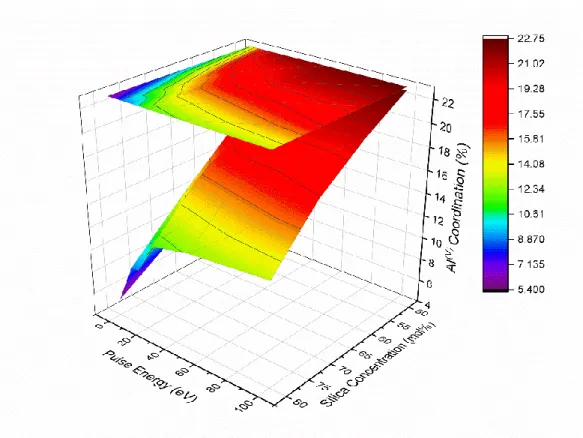
Loop coordination for Al-Al, Si-Si and Al-Si after exposure to various pulse energies. Loop coordination for Al-Al, Si-Si and Al-Si (CAS15.70) after exposure to various pulse energies.
Introduction
- M OTIVATION
- G LASS S TRUCTURE
- Soda-Lime Silicate
- Calcium Aluminosilicate
- Compositional Space
- F EMTOSECOND L ASERS
- M ECHANISMS OF F EMTOSECOND L ASER I NTERACTION WITH G LASS
- P ARAMETERS AFFECTING L ASER -G LASS I NTERACTION
- Wavelength
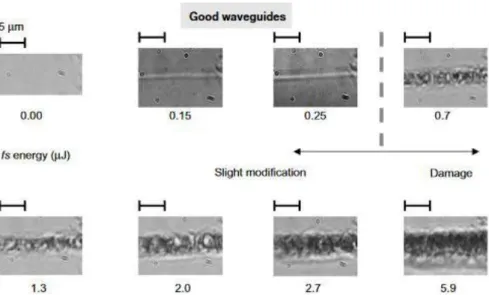
- Pulse Energy and Intensity
- Pulse Duration
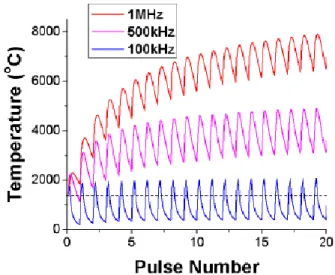
- Repetition Rate
- F EMTOSECOND L ASER -I NDUCED P HENOMENA
- Voids
- Refractive Index & Densification Change
- T HESIS O UTLINE
- R EFERENCES
For a monochromatic propagating wave, local intensity is related to the amplitude (E) of the electric field through the following: Transfer of energy from the electron plasma to the glass leads to a change in the glass structure and its optical properties.

Ultrafast Modification of Oxide Glass Surface Hardness
A BSTRACT
We have successfully modified the surface hardness of various commercial silicate glasses using a high-intensity femtosecond pulsed laser. Using a peak power of 2.2 W and a repetition rate of 5.1 MHz, we observed an 18-20% increase in surface hardness in low-modifier glass and a 16.6% decrease in high-modifier glass.
I NTRODUCTION
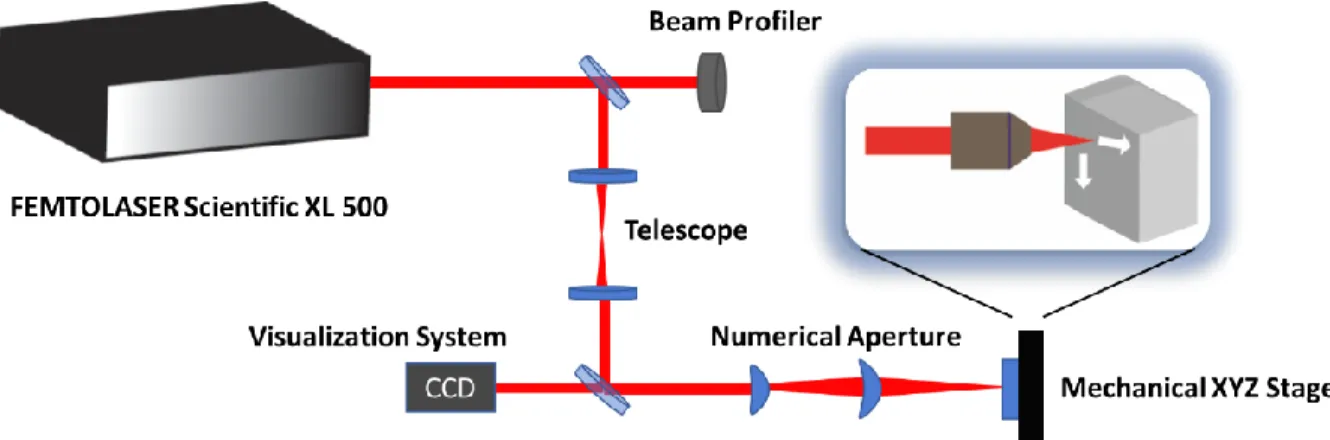
The present article provides methods to increase surface hardness by applying ultrafast laser pulses with a high repetition rate. High repetition rate femtosecond laser irradiation offers the opportunity to not only manipulate ionic positions but also be spatially selective.
M ATERIALS AND M ETHODS
- Femtosecond Laser Treatment & Terahertz Time Domain Spectroscopy Analysis
- X-ray Photoelectron Spectroscopy
- Surface hardness & Densification
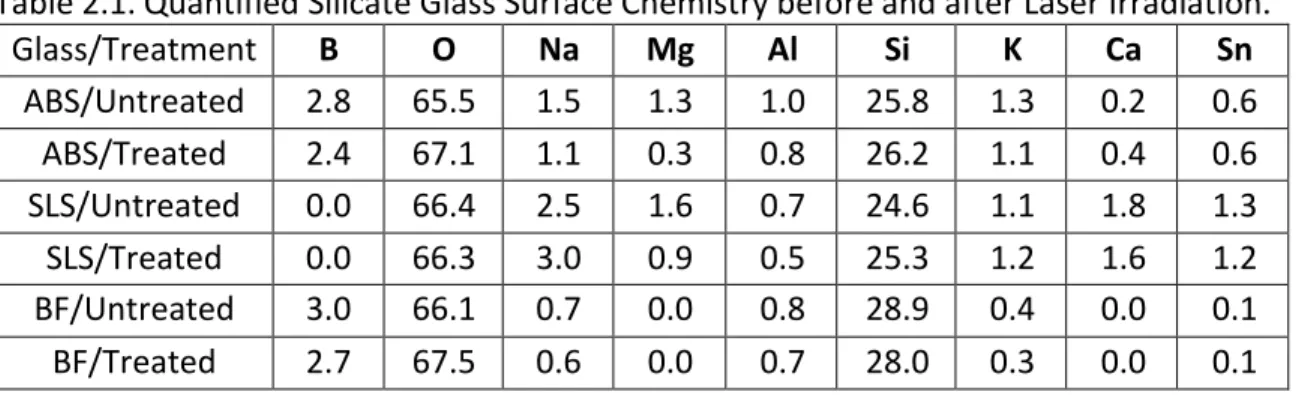
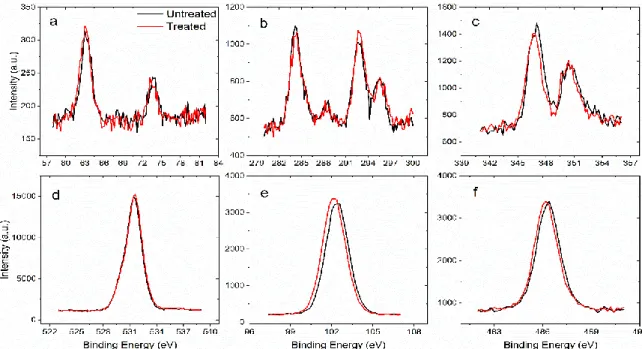
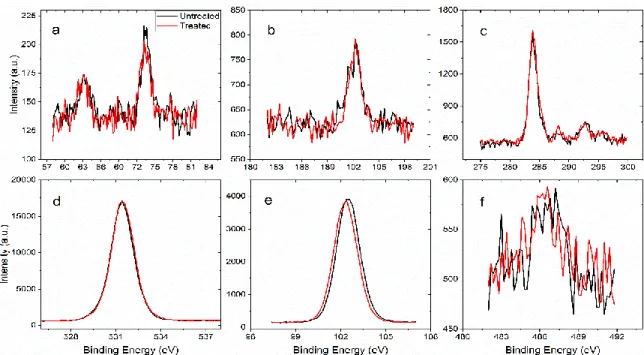
Similar to SLS and BF, laser exposure has no observable effect on the ion concentration on the glass surface. Microindentation analysis of silicate glass surface hardness (left), refractive index as a function of frequency for soda lime silicate and aluminum borosilicate.
C ONCLUSION
R EFERENCES
Gorelik, T.; Will, M.; Nolte, S.; Tuennermann, A.; Glatzel, U., Transmission electron microscopy studies of femtosecond laser-induced modifications in quartz. Petrovic, J., Durability of the refractive index change induced by a single femtosecond laser pulse in glass. Fuerbach, A.; Gross, S.; Klein, D.; Arriola, A.; Ams, M.; Dekker, P.; Withford, M., Refractive index change mechanisms in different glasses induced by femtosecond laser irradiation.
Structural Modifications of Soda-Lime Silicate Glasses using Femtosecond Pulse-Laser
A BSTRACT
Modification valence contributes to structural rigidity and the degree of disorder that a glass can acquire during the deposition of high-energy laser pulses. Varying soda content caused greater shift in the laser-modified Q3 band position and width compared to the calcium-modified system. These results underline the role of modifier ions in the laser-induced densification of the SLS glasses.
I NTRODUCTION
Zimmermann et al.18 studied the effects of heat accumulation from high repetition rate pulsed lasers (9.4 kHz) on the resulting glass density in quartz and borosilicate glasses. Previous works 29 , 30 have shown the effects of variable laser fluences on the degree of densification. The purpose of this study is to investigate the effect of glass modifier concentration (alkaline and alkaline earth) and laser fluence on densification trends observed by Raman spectroscopy, in particular the effect of laser fluence on the stretching mode of Q3 Si-O in the Raman high-frequency region.
E XPERIMENTAL M ETHODS
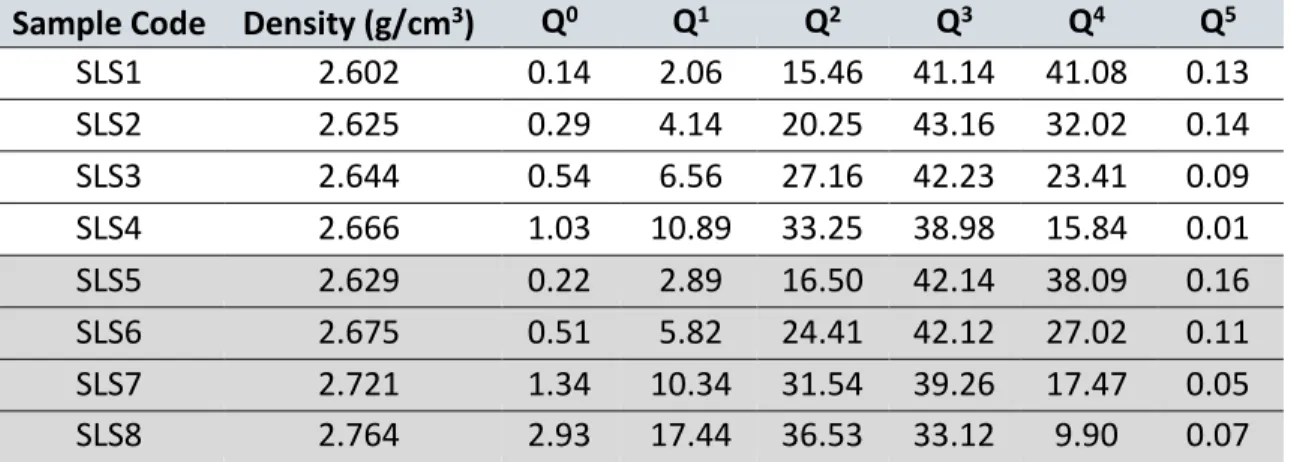
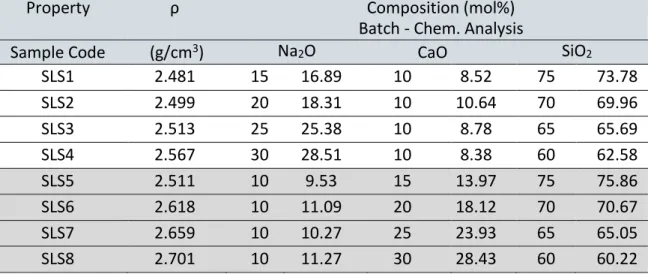
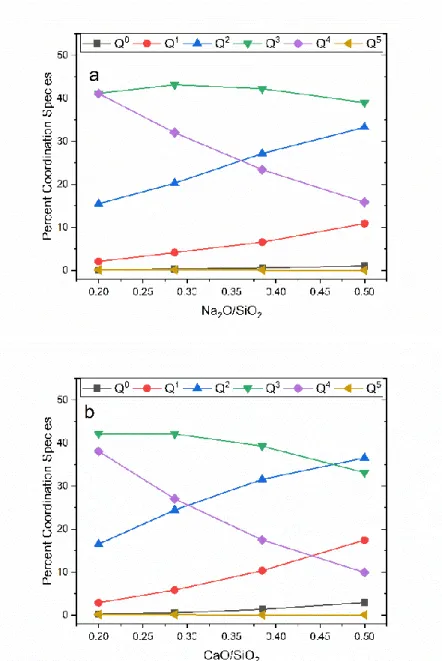
In accordance with similar studies32-34, the system was melted at the canonical temperature up to a temperature of 4000 K. To determine the ratio of Q species in the glass, we first distinguished between bridging and non-bridging oxygen atoms (respectively BO and NBO). In both cases, a cutoff of 2.43 Å was used as the first minimum in the Si-O radial distribution function (RDF).
R ESULTS & D ISCUSSION
- Structure of Pristine Glasses
- Structure of Laser-Modified Glasses
This claim is consistent with the Q2 Si-O stretching state found in the high-frequency region. Assignment of vibrational modes and their origins used in the deconvolution of the Raman high-frequency region. Kitamura et al.48 suggest that the rate of change of the Si-O bond length during the densification process is greater in alkali silicate glasses than pure SiO2. The discrepancy in densification rate is due to ionic bonding producing a more compact network due to the disjoint tetrahedra.
C ONCLUSION
A CKNOWLEDGMENTS
R EFERENCES
Cormack, A.; Du, J.; Zeitler, T., Alkali ion migration mechanisms in silicate glasses probed by molecular dynamics simulations. Eberstein, M., Structural modifications of binary lithium silicate glasses after femtosecond laser pulse irradiation investigated by micro-Raman spectroscopy. Laurent, O.; Mantisi, B.; Micoulaut, M., Structure and Topology of Soda-Lime Silicate Glasses: Implications for Window Glass.
Laser-induced structural modification in calcium aluminosilicate glasses using molecular dynamic
A BSTRACT
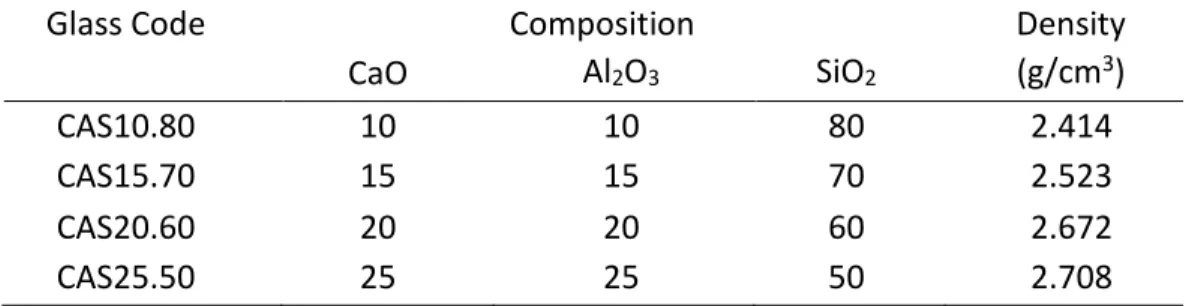
Glass structures of multicomponent oxide systems (CaO-Al2O3-SiO2) are studied using a simulated pulsed laser with molecular dynamics.
I NTRODUCTION
Five-coordinated Al, along the tectosilicate junction, have been extensively reported by Neuville19,37, Stebbins38 and others13,23,39, showing a significant deviation between Al(V) concentrations. For CAS systems along the tectosilicate junction, the number of NBO decreases as the silica content increases16. In this work, we report the results of molecular dynamic (MD) simulations aimed at investigating the effects of composition and laser energy on the short- and medium-range order, microstructure, and residual density profiles in silica-rich calcium aluminosilicate (CAS) glasses along the tectosilicate junction.
M ETHODS
- Simulated Glass Formation
- Simulated Laser Exposure
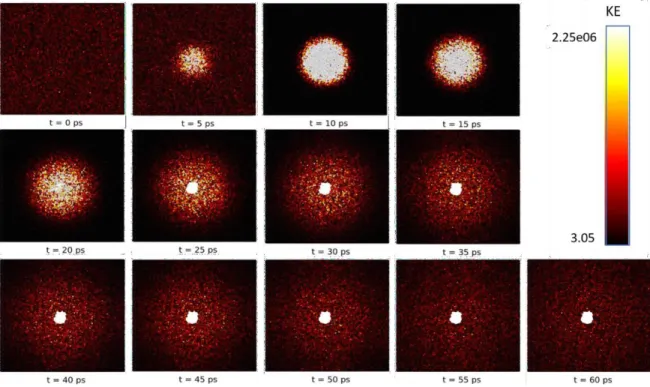
During the laser exposure procedure, a Nose-Hoover global thermostat was used outside the heated area to simulate the thermal dissipation of the laser pulse44. The amount of energy absorbed per atom in the center of the focal volume due to a Gaussian beam with a pulse width of 10 ps and a wavelength of 1064 nm focused by a lens with numerical aperture = 0.6 was modeled. A focal volume of less than 5% of the total volume is used to mitigate boundary effects.
R ESULTS & D ISCUSSION
- Simulated Laser-Induced Residual Density Profile
- Coordination Number Distribution
- Interatomic Bonding
Laser-induced changes in interatomic bond distance reflect bond angle data, where structural changes are most pronounced for Al species and the average Al-O bond length increases with successively higher pulse energy. Since bond length and interbond angle are inversely proportional, the densification process decreases the average bond angle and increases the bond length. Distribution of the average bond angle for Al-O-Al, Si-O-Si and Al-O-Si on the first eleven shells according to the energy of the simulated laser pulse.
C ONCLUSION
Similar to Al-Al, due to a slight increase in coordination as a function of pulse energy, we show that the pairing is susceptible to laser effects. Based on a decreased intensity in Si-Si running coordination number shoulder and increase to Al-Al and Al-Si coordination number, we postulate that the laser effects reduce groups of SiOX units through enhanced mixing of AlOX species and the creation of NBO to charge balance TBO and Al(V). Understanding the complexities of laser-modified glass structure in multicomponent systems such as CAS requires strong fundamental understanding of both short- and medium-range order.
R EFERENCES
Zheng, K.; Zhang, Z.; Yang, F.; Sridhar, S., Molecular dynamics study of structural properties of calcium aluminosilicate slag with different Al2O3/SiO2. Bouhadja, M.; Jakše, N.; Pasturel, A., The striking role of non-bridging oxygen in the glass transition temperature of calcium aluminosilicate glass formers. Okhotnikov, K.; Stevenson, B.; Edén, M., New interatomic potential parameters for molecular dynamics simulations of rare earths (RE = La, Y, Lu, Sc).
Spectroscopic study of laser modified calcium aluminosilicate glasses using low- and high-
I NTRODUCTION
Calcium aluminosilicate's glass-forming region was first reported by Shelby.1 There have been numerous studies on the structure of calcium aluminosilicate glasses2-8. Significant progress has been made in the understanding of pressure and thermal contributions to compaction in calcium. The motivation for this research stems from the emerging need for fundamental understanding and research into laser radiation and subsequent densification.
E XPERIMENTAL P ROCEDURES AND M ETHODS
- Glass Synthesis
- Femtosecond Laser Exposure
- THz-TDS Procedure
- Atomic Force Microscopy
- Raman and Brillouin Spectroscopy
The stage was moved in a two-dimensional location perpendicular to the beam, at speeds of 0.25 mm/s. A numerical aperture of 0.08 was used to focus the beam, producing a Gaussian beam profile with a 1/e2 beam radius of 16µm. MAS NMR spectra were collected using short radiofrequency pulse widths of 0.6 µs (~π/12 tip angle), and averaging from 1000 to 2000 transitions with a retrieval delay of 2 seconds.
R ESULTS AND D ISCUSSION
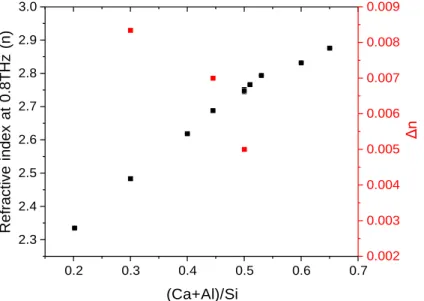
- THz-TDS Results
- Raman & micro-Brillouin
Again, trends in intensity are attributed to laser-modified surface morphology causing scattering of the incident beam. A shift in the center of the Qn band indicates the formation of Q4, as shown in Figure 5.7a, where The position of the Brillouin band in Figure 5.6 illustrates the gradual decline of laser modification in glass.
C ONCLUSION
Based on the 27Al MAS NMR, we know that AlV concentration is inverse. proportional to silica content in the unmodified glasses. Raman and Brillouin spectroscopy provide the evidence of densification in terms of its spatial relationship to the surface and bulk glass, as well as structural . information regarding the formation of a new structure in the glass after exposure to low repetition rate laser radiation. Finally, we established the following: 1) high repetition rate densification is attributed to thermal accumulation and increased fictitious temperature which may also result in higher AlV concentrations, 2) low repetition rate laser radiation forms two regions around the void interface with respectively different elastic moduli, and 3) laser radiation induces the propagation of AlV in low-repetition-rate conditions, showing a relationship between laser fluence and AlV concentration.
A CKNOWLEDGEMENTS
We believe that the increase in fictitious temperature plays a dominant role in the shift of the boson peak. Finally, 27Al MAS NMR data identified the likely mechanism responsible for densification in laser-modified calcium aluminosilicate glasses. These findings are preliminary in nature and warrant refinement for .. a fundamental understanding of a wider range of glass chemistry and laser conditions.
R EFERENCES
K.; Iitaka, T., Pressure-induced structural change of CaO–Al2O3–SiO2 melt: Insights from molecular dynamics simulation. S.; Martinet, C.; Martinez, V.; Sonneville, C.; de Ligny, D., Structure-longitudinal sound velocity relationships in glassy anorthite (CaAl2Si2O8) up to 20 GPa: An in situ Raman and Brillouin spectroscopic study. K.; Sundaram, S.; Youngman, R., Femtosecond laser pulse-induced structural modification of lanthanum aluminosilicate glasses: refractive indices in the visible vs.
Conclusions
Finally, the experimental investigation, presented in Chapter 5, demonstrates CAS densification using low and high repetition rate lasers. High-repetition rate compression is attributed to a fictitious temperature rise, resulting in structural changes such as AlV enrichment. Through Raman, Brillouin and NMR characterization, single pulse exposure experiments validate the model detailed in Chapter 4, where residual density fields from irradiation and post-laser densification lead to the formation of AlV.
Future Work
Appendix
Distribution statistics for Si-O, Si-Si and O-Si-O bonding under ambient and laser-modified conditions in CAS15.70. Distribution statistics for Si-O, Si-Si and O-Si-O bonding under ambient and laser-modified conditions in CAS20.60. Distribution statistics for Al-O, Al-Al, O-Al-O bonding under ambient and laser-modified conditions in CAS25.50.