512
Yong Liu and Charles B. Weinberg*
Abstract
Pricing decisions are particularly challenging for nonprofi t organizations. They have a social rather than a for-profi t objective function, they must obey a legal restriction not to distribute possible fi nancial surpluses to those who control the organization’s assets, and they have the opportunity to receive donations. While historically nonprofi ts have not developed their pricing capabilities as fully as they might have, pricing is becoming increasingly important, especially as many nonprofi t organizations face declining support from government and are unable to increase private giving signifi cantly. The goal of this chapter is to discuss pricing practice and pricing research in the nonprofi t sector. We demonstrate how theoretical models of pricing strategies for nonprofi ts are different from those of for-profi t businesses. Moreover, although only limited empirical data on nonprofi t pricing are available, the data we do have suggest that nonprofi ts charge different (and usually lower) prices than similarly situated businesses.
We survey the literature of nonprofi t pricing to discuss important theoretical and empirical fi ndings, and highlight the unique characteristics of nonprofi ts and the various modeling issues they generate for pricing research. We also discuss unresolved problems and potential research opportunities in nonprofi t pricing.
Overview of nonprofi t organizations and pricing behavior
Nonprofi t organizations are precluded from distributing possible fi nancial surplus to those who control the use of organizational assets (Hansmann, 1980). Such restric- tions are imposed by external regulation or their own governance structure (Steinberg, 2006). As a whole, nonprofi ts are referred to as the third sector of the economy, next to private for-profi t fi rms and the governments. While the existence of nonprofi ts varies widely across industries, the markets where nonprofi ts are the most active include arts and culture, education, health, human services, public and societal benefi t (Boris and Steuerle, 2006). In some industries, nonprofi ts are a major provider of services. For example, Salamon and Anheier (1998) report that nonprofi ts account for 51 percent of all US hospitals.
In the USA, there were more than 1.6 million registered nonprofi ts in 1998 (Boris and Steuerle, 2006). Their numbers have been growing at a steady rate of about 25 000 new nonprofi ts annually. Figure 24.1, which is based on data from Hall and Burke (2006), illustrates this trend.
Not only are nonprofi ts involved in some of the most important sectors of modern life; they also account for an increasingly large share of economic activities. Nonprofi ts produce one-fi fth of research and development (Lakdawalla and Philipson, 2006) and, in 2001, employed 11.7 million individuals, which represents 8.5 percent of total US civilian employment (Leete, 2006).
* The fi nancial support of the Social Sciences and Humanities Research Council of Canada is gratefully acknowledged.
Characteristics of nonprofi ts
Nonprofi ts differ from for-profi t fi rms in several important ways. It is these distinctive features that have made the existence and behavior of nonprofi ts an important phenom- enon for researchers, public policy makers and managers. In anticipation of the pricing focus in this chapter, we discuss four fundamental features of nonprofi ts that have impor- tant implications for their pricing strategies: the objective functions; the nondistribution constraint; being able to seek grants and donations; and increased reliance on marketing tools to survive and grow.
Different from for-profi t fi rms, nonprofi ts tend to pursue socially benefi cial causes that are not profi t-oriented. This is a crucial justifi cation for why certain nonprofi ts are tax- exempted and their donors can receive tax breaks for their contributions. While profi t maximization is typically assumed for for-profi t fi rms and plays a signifi cant role in their pricing behavior, the nonprofi t objective functions are more complex. The literature provides some theoretical guidance on this issue. As summarized by Steinberg (1986), possible nonprofi t objective functions include the maximization of output (or service), budget, prestige, quality and employee income, or a combination of these.
Which of these objectives are observed most frequently is an empirical question.
Focusing on service versus budget maximization, Steinberg (1986) tests this family of nonprofi t objective functions for about 2200 nonprofi t organizations:
Max U5 lS1 ( 12 l)B (24.1)
Among other things, a large budget brings greater power and higher prestige for the organization (and its managers). In the equation, S is service spending in the amount of
400 600 800 1 000 1 200 1 400
1970 1975 1980 1985 1990 1995 2000
Year
Total NPOs (000$)
Source: Hall and Burke (2006).
Figure 24.1 Growth of nonprofi t organizations (1973–96)
x1D(r) 2r, where x is the exogenous resources endowed to the nonprofi t organization, r is the fundraising expenditure, and D(r) is the donation or fundraising response func- tion. B is the total budget composed of endowment and funds raised: B5x1D(r) . As a result, l 50 indicates budget maximization and l 51 indicates service maximization.
The fi rst-order condition of equation (24.1) is dD/dr5 l; thus the marginal rate of donation with regard to fundraising expense can be used as the instrument to test whether the nonprofi ts are service maximizers or budget maximizers. Steinberg shows that public welfare, education and arts nonprofi ts are service maximizers, and health fi rms are budget maximizers. In a later study, Brooks (2005) replicated the main fi nding that most non- profi ts are service maximizers with more recent data from 190 000 nonprofi ts.
Note that in these studies, fi nancial revenue comes from two sources: donation (which is costly for the nonprofi ts to solicit) and exogenous income. The decision variable for the nonprofi ts is the level of fundraising expenses. Price is not an issue since sales of goods are not considered. For many nonprofi ts, one may argue that fundraising decisions may not be the driving force of organizational behavior. Instead, the decision about pricing, as well as what kinds of products or service to provide (e.g. variety and quality) and dis- tribution decisions, can be more fundamental than fundraising. To differentiate the types of models discussed in Steinberg and Brooks from the pricing models we discuss later in the chapter, we shall term them ‘fundraising models’.
In other studies, Jacobs and Wilder (1984) fi nd that the pricing patterns of the Red Cross’s blood service units are consistent with output maximization (subject to a break- even constraint). Gapinski (1984) fi nds that the Royal Shakespeare Company, a non- profi t performing arts organization in the UK, produced more output and set lower prices than would a profi t maximizer. Evidence for service or output maximization can also be found in studies such as Rose-Ackerman (1987), Liu and Weinberg (2004) and Weinberg (1980).
In typical models of profi t maximization, optimality is obtained at an output level where marginal revenue equals marginal cost. It is useful to illustrate how the considera- tion of output in an organization’s utility function might change this principle. Similar to the model of Lakdawalla and Philipson (2006) for an arbitrary organization, we can assume that profi t maximization and output maximization are the two relevant factors in its objective function:
Max U5f(q, p(q) ) (24.2)
where q is nonprofi t output, p is profi t in the amount of p(q) 5p(q)q2c(q) , p(q) is the inverse demand function, and c(q) is cost. The fi rst-order condition is fq1fppq50;
fq and fp refl ect the priorities of the organization ( fq$0, fp$0); fq50 indicates a typical for-profi t and fp50 indicates a nonprofi t that is concerned with output.
Substituting the derivatives in the fi rst-order condition, we have pqq1p5cq2fq/fp. That is, the organization’s preference for quantity (q) reduces the value on the right- hand side of the equality, making it possible to sell greater quantity at reduced marginal revenue. Lakdawalla and Philipson (2006) call this the ‘effective’ marginal cost. In the case of a profi t maximizer ( fq50), the equality restores to the traditional outcome that marginal revenue equals marginal cost.
The nondistribution constraint is another fundamental characteristic of nonprofi ts
(Hansmann, 1980). Because of this constraint, nonprofi ts cannot use their revenue to compensate board members, trustees, or other owners beyond an economic salary. This implies that a nonprofi t has to use all its resources for purposes compatible with its non- fi nancial objectives. Financial surplus, if any, is ‘either retained (as endowment, reserves, or temporarily restricted funds), reinvested (in organizational expansion or the provision of charitable services), or given to other nonprofi t organizations (as grants)’ (Steinberg, 2006, p. 118). In the literature, nondistribution of surplus is typically modeled as a zero- profi t constraint on nonprofi t behavior (e.g. James, 1983; Schiff and Weisbrod, 1993;
Rose-Ackerman, 1987). The following specifi cation is representative of the nondistribu- tion constraint:
pq1D(q, r) 2r2c(q) 50 (24.3)
where p is the price of goods or service per unit, q is the quantity of goods or services provided, and c(q) is the cost function for quantity q. Note that the donation amount received is assumed to be dependent upon both the fundraising expense (r) and the quantity q (Schiff and Weisbrod, 1993; Rose-Ackerman, 1987), implying that potential donors care about the effectiveness of the nonprofi t in providing mission-related products or service.
As suggested in the discussion of nonprofi t objective functions and the nondistribu- tion constraint, nonprofi ts differ from for-profi ts in that their socially benefi cial nature enables them to seek support from donors and government agencies. A useful way of looking at how most nonprofi ts function is to view the customers of nonprofi ts as belong- ing to two different groups – donors and product or service users. (In addition, nonprofi ts also market to volunteers who provide time and talent to the organization.) Nonprofi ts try to appeal to both customer groups at the same time. The two groups are related to each other through the donors’ concern about how well the nonprofi ts serve the users. A general literature in economics has started to address such ‘two-sided’ markets (Rochet and Tirole, 2004; Evans and Schmalensee, 2005). Even for fi rms maximizing profi ts, the two-sided market structure may lead to unusual pricing behavior. For instance, Evans and Schmalensee (2005) suggest that fi rms with two customer groups may fi nd it profi t maximizing to charge prices for one customer group that are below marginal cost or even negative, an argument that has direct implications for the nonprofi t sector.
The implication of donations for pricing behavior of nonprofi ts is mainly through the nondistribution constraint. Everything else being equal, a nonprofi t should be able to lower the price of its products or services if it receives donations to offset overall expenses.
Nevertheless, this is contingent upon the fundraising response function – nonprofi ts are only willing to solicit donations up to the point where fundraising expense no longer helps improve their objective function.1
1 Nonprofi t organizations, in practice, often spend less than the optimal amount as indicated by a marginal analysis: some rating agencies only give approval ratings to nonprofi t organizations for which fundraising (or total administration costs) is below a certain percentage of funds raised (or total spending). For example, the Better Business Bureau’s Wise Giving Alliance gives its approval only to organizations for which the ratio of fundraising expenses to funds raised is less than 35 percent. See www.give.org for further details.
Finally, an important characteristic in the nonprofi t sector is that many nonprofi ts face declining support from government and are unable to increase private giving signifi cantly (Schiff and Weisbrod, 1993, Simon et al., 2006). As a result, nonprofi ts are increasingly turning to commercial activities by selling products or service for revenue in order to maintain their non-defi cit status (Dees, 1998; Dart and Zimmerman, 2000). In fact, revenue from sales is the dominant source of income for nonprofi ts in many large subsec- tors (Brown and Slivinski, 2006). The Urban Institute and the NCCS/GuideStar National Nonprofi t Database report that in 2000, arts and culture organizations derived 29 percent of their revenue from fees for goods and services. This percentage is 49 percent for human services, 47 percent for education, 22 percent for environment groups, 21 percent for public and societal benefi t organizations, 85 percent for health care, and 27 percent for religious groups (Boris and Steuerle, 2006). These revenues include both primary prod- ucts and other activities that support the primary mission of the organization.
Both James (1983) and Schiff and Weisbrod (1993) examine how nonprofi ts make tradeoffs between products or services that are of different values to the organization. In their models, the nonprofi ts derive positive utility from one product or service but nega- tive utility from another. These are termed ‘exempt output’ versus ‘commercial good’
by Schiff and Weisbrod (1993), and ‘core mission activities’ versus ‘ancillary services’ by Oster et al. (2003). The basic economic principle is that the nonprofi t sells commercial goods in order to subsidize activities that produce exempt output. For example, zoos and museums use the revenue from gift shops to subsidize exhibitions and collections, which are also supported by admission revenue. As another example, many universities and col- leges use the revenue from bookstores and cafeteria to support academic activities. This type of product line decisions can be difficult for nonprofi ts since it involves pursuing commercial activities that may be counter to their preference (see Krug and Weinberg, 2004 for a portfolio model approach to help nonprofi ts manage such product line issues).
Furthermore, the existence of donors and their concern about non-mission-related activi- ties make such decisions more crucial.
To provide a clear context for the pricing issues in this chapter, we follow Schiff and Weisbrod (1993) and Oster et al. (2003) to distinguish mission-related products or service from non-mission-related ones. To accommodate discussion and in anticipation of the later analyses of nonprofi ts competing with for-profi ts, we shall terms these ‘nonprofi t outputs’ versus ‘commercial outputs’. Although pricing can be relevant for both outputs, our focus will be on the pricing strategy for the nonprofi t output. As a result, our dis- cussion will be closer to the model of James (1983) than to that of Schiff and Weisbrod (1993). In practice, prices for these nonprofi t outputs can be the (subscription or single- ticket) admission price charged by nonprofi t arts organizations, the annual membership fee for museums, the tuition fees for colleges and universities, the hourly rate for non- profi t daycare centers, or the charges for many hospital services.
Nonprofi t pricing practice
As an extremely diversifi ed economic sector, nonprofi ts differ considerably in the ways they distribute products or services to target customers. As we discussed earlier, many nonprofi ts have found it necessary to charge at least some fee for their nonprofi t output.
It is important to note that to many people, pricing conveys a commercial interest or intent. Pricing behavior is often perceived to be counter to a nonprofi t’s objective. It is
thus not surprising that the nonprofi t sector overall is not experienced with pricing prac- tice. For example, McCready (1988) points out that there is only a sparse literature on the issue of pricing for nonprofi ts. Rentschler et al. (2007), in the context of museums, notes that the use of pricing as an element of the marketing mix seems to be particularly problematic.
Nevertheless, Oster et al. (2003) suggest several situations that are conducive to pricing by nonprofi ts. Charging prices is suitable when demand is relatively inelastic, when col- lecting fees is practical, and when such fees do not violate organizational norms. They also provide several rationales as to why pricing may have several positive effects on the nonprofi t organization in addition to providing fi nancial revenue. For instance, charging a fee helps reduce service bottlenecks and congestion, can motivate staff and client behav- ior, and can yield positive behavioral effects on the clients. When charging a price, non- profi ts need to consider how to serve those who cannot afford to pay at all. One approach is to make the service available for free or at minimal cost to some (as universities do with fi nancial aid) or to have free events, programs, or services. Consider, for example, the offering of free events by arts organizations; many museums offer one night a week in which admission is free. This is possible due to two effects. First, the price charged on regular days enhances the nonprofi t’s ability to offer free service on other days. Second, the value of a free day may be perceived to be higher by some customers when the service is not free on other days.
When a price is not charged, other methods must sometimes be used to achieve some of the positive effects of pricing. For example, Steinberg and Weisbrod (1998) suggest that nonprofi ts are more likely than businesses to use waiting lists (rather than pricing) to allocate demand when capacity is inadequate to meet demand.
Pricing strategies adopted by nonprofi t organizations can be broadly classifi ed into two categories. The fi rst involves simple rules of thumb, which are mostly passive reactions to either cost or demand factors. Some nonprofi ts charge users a price that is based on costs.
The price may equal the marginal cost of providing the product or service, leaving aside all fi xed costs to be covered by foundation funding, government subsidies and develop- ment funds (Oster et al., 2003). Alternatively it may include part or all of the fi xed costs.
A good example of cost-based pricing is the Red Cross Blood Bank that charges all users a processing fee based on the ‘irreducible cost of recruiting, processing, collecting, and distributing the blood to the hospital’ (Weinberg, 1984, p. 264). Others nonprofi ts may use fair pricing; that is, they simply charge whatever price other organizations provid- ing similar products or services are charging. For example, McCready (1988), through a survey of social service providers, fi nds that some children’s centers serving particular consumers (e.g. special needs children) charge fees comparable to those offered by other nearby centers dealing with a non-special need clientele. Other nonprofi t agencies act ‘as a substitute for publicly-provided services (e.g., transportation) but service a particular clientele (the disabled)’ at the same price as the public transit system. Finally, some non- profi ts such as museums have adopted the practice of ‘pay what you can, but pay some- thing’. In such cases, museums have found that suggesting the typical voluntary entrance fee has a signifi cant effect on the average amount that visitors voluntarily pay.
The second category of nonprofi t pricing practice involves more complex pricing deci- sions and, in many cases, explicit price discrimination. For example, many nonprofi t daycare centers use a sliding scale that ties the rate a family has to pay to its annual
income level. Another example is the use of a two-part tariff (Bilodeau and Steinberg, 1999), which requires a joint pricing decision on both the fi xed fee and the per-usage charge. Public universities typically charge different amounts for in-state and out-of-state residents; both public and private universities use a complex system of scholarships, loans and work-study programs to attract a mix of students with differing abilities and willing- ness to pay for a university education.
While dealing with complex pricing issues is new to many nonprofi ts, others fi rst started grappling with such issues many years ago. Consider San Francisco’s American Conservatory Theater (ACT); founded in 1965, it is one of the most prominent reper- tory theater companies in the USA. Its ‘current performance, education, and outreach programs annually reach more than 250,000 people in the San Francisco Bay Area’, and
‘the company continues to produce challenging theater in the rich context of symposia, audience discussions, and community interaction’.2 During a critical stage of its develop- ment in the early 1970s, the management decided to conduct a major research study to help in its strategic planning. One of the pricing issues involved was that the management was unsure whether or not to drop the subscription discount of seven tickets for the price of six. On the one hand, it is critical to maintain a sizable subscriber base to keep a steady fl ow of revenue and a satisfying audience size. On the other hand, the audience seemed to be upscale and had been renewing subscriptions at a fairly high rate. As a result, careful considerations of both users and organizational objectives were critical in making a deci- sion about the price discount. The research study surveyed approximately 9000 season subscribers, and found that the discount itself was not a major factor in subscription deci- sions. As a result, ACT dropped the discount from its pricing scheme, starting with the 1976–77 season. Neither the percentages of subscriptions renewed nor the total subscrip- tion revenue in subsequent years were negatively affected by this change. While many theater companies need to offer a discount in order to acquire and retain subscribers, a combination of market research and market testing can lead to better understanding of the demand function and more informed pricing decisions.
Literature and basic nonprofi t pricing models
Although pricing is now used more often by nonprofi ts, and brings in valuable revenue to keep them operating, there has been very limited research on pricing issues in this sector.
Much of the published research is either conceptual or industry specifi c (mostly focus- ing on the health care market). Other studies, despite including price as a factor in the model, abstract from the pricing issue by assuming exogenous price levels (e.g. Schiff and Weisbrod, 1993). The following studies, mostly situated in a monopoly setting, illustrate several basic properties of nonprofi t pricing models.
In an early work modeling nonprofi t behavior, James (1983) considers the service mix decision together with pricing, formally showing that the nonprofi ts’ involvement in non-mission-related (revenue-generating) activities is not necessarily an indication of the pursuit of commercial interests.
2 Information and quotes were obtained from the ACT website http://act-sf.org/index.cfm?s_
id=&pid=abt_act, 5 June 2007. Other information about this study was obtained from Ryans and Weinberg (1978).
To bridge the gap between nonprofi t optimization and neoclassical profi t maximiza- tion, Lakdawalla and Philipson (2006) proposed a monopoly model for an arbitrary organization that includes profi t maximization and quantity maximization in the objec- tive function. As we discussed earlier, their basic theory is that the nonprofi t’s altruism would enable it to have a lower ‘effective’ marginal cost and thus provide greater output than a comparable for-profi t.3 To derive this result, the nondistribution constraint is not necessary.
McCready (1988) investigates the applicability of Ramsey pricing to social service organizations. In contrast to profi t-maximizing pricing practice, Ramsey pricing gener- ates zero-profi t prices that are Pareto optimal and leads to greater demand for the non- profi t output. However, McCready did not fi nd evidence of such pricing practice in the Ontario, Canada sample of social service agencies that he studies.
Ansari et al. (1996) focus on the issue of service bundling, which includes both how many items to bundle and what prices to charge for different bundles. Besides fi nding that usage-maximizing nonprofi ts charge a lower price and hold more events to attract customers, they point to the critical role of fi xed cost in nonprofi ts’ pricing decisions. This is distinctive from for-profi t optimizations, in which fi xed cost matters only for entry/exit decisions but not pricing.
Steinberg and Weisbrod (2005) model nonprofi t pricing based on the assumption that nonprofi ts care about the amount and distribution of consumer surplus. They show that price discrimination often arises in equilibrium. Weinberg (1984) provides a more com- prehensive model of nonprofi t pricing decisions. He includes three decision variables for a nonprofi t monopolist: price, marketing expenditure to users, and marketing expenditure to donors. Marketing expenditure to users can be interpreted as, for instance, the promo- tional expenditure or the cost of product quality.
Below we use Weinberg (1984)’s main model and results to illustrate the basic prop- erties of nonprofi t pricing. Similar to that of for-profi ts, both price ( p) and marketing expenditure (v) infl uence the demand for nonprofi t output. A general nonprofi t pricing model can be specifi ed as follows:
Max q5f(p, v) (24.4)
subject to pf(p, v) 1D(q, r) 2r2c(q) 2v2F50
where f(p, v) is the demand function at price p and marketing expenditure v. As in equations (24.2) and (24.3), q is the corresponding quantity, c(q) is the cost function, D(q, r) is the donation response to quantity q and fundraising expense r. F is the fi xed cost of running the nonprofi t organization. As compared to the typical for-profi t pricing situation in which marginal cost is the most important factor and fi xed cost F does not infl uence the optimal price levels, F is relevant to nonprofi t pricing. This occurs due to the inclusion of F in the non-defi cit constraint as shown in equation (24.4). Moreover, in contrast to the fundraising models discussed earlier, equation (24.4) highlights the need
3 Rose-Ackerman (1996) provides a more general discussion about how altruism infl uences nonprofi t behavior.
by nonprofi ts to obtain sales revenue to support their mission. The donation function is dependent upon both the level of fundraising effort and the number of users of the service.
A for-profi t, in contrast, has the typical objective function of profi t maximiza- tion, Max p 5pq2c(q) 2v, where q5f(p, v) . Solving the constrained optimization problem for the nonprofi ts involves fi nding the values of p*, v* and r* that jointly maxi- mize f(p,v) . The for-profi t’s optimization involves solving the typical fi rst-order condi- tions 'p/'v50 and 'p/'p50. Particular formats can be specifi ed for the functions in equation (24.4) so that closed-form optimal solutions can be derived.
For the demand and fundraising response functions, Weinberg (1984) adopts the power function that is used frequently in empirical research. It becomes the popular double-log function through log transformations. The cost function is assumed linear with marginal cost c:
q5f(p, v) 5 a0p2a1va2
D(q, r) 5 b0qb1rb2 (24.5)
c(q) 5cq
where a1, a2, b1, b2 > 0. To illustrate the nature of these results and to make concrete the comparison between the nonprofi t and the for-profi t sectors, Weinberg further assumes that a11 a252 and 2b11 b251. An important benefi t of these assumptions is that analytical solutions can be obtained to illustrate how optimal pricing decisions (together with other decisions such as marketing expense) are determined by the relevant factors.4
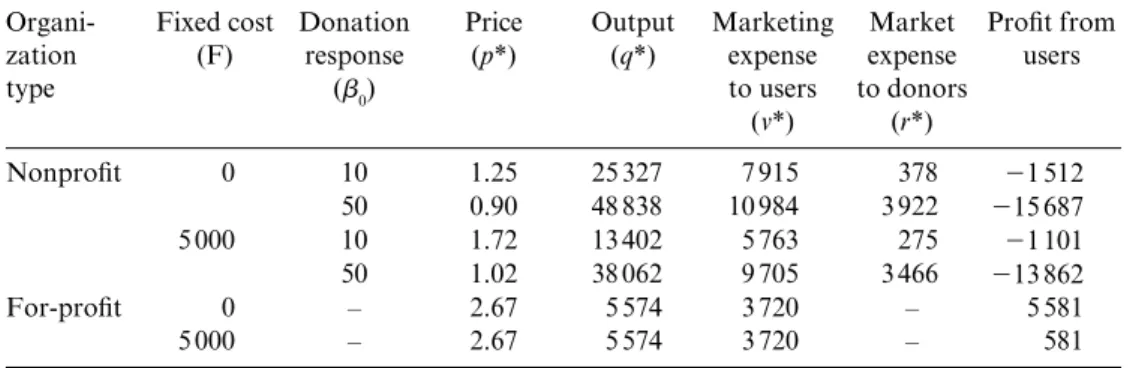
The optimal price for the for-profi t is straightforward: p*f5ca1/(a121 ) . Closed- form solutions for the nonprofi t are in more extensive format. For example, the optimal nonprofi t price is p*n5 (k2"k224cFk2)/2F, where k5k22k11k3, k15 (a0a2/a1)1/(12 a2), k25 (a1k1)/a2, and k35 [2b1(b0b2)1/2b1"k2]/b2. If there is no fi xed cost (F50), then p*n5ck2/(k22k1) . Weinberg (1984) uses various numerical examples to illustrate the patterns of these analytical solutions. Table 24.1 provides some of these examples to highlight the key features of the nonprofi t price model.
First, nonprofi t optimal price is lower than that of the for-profi t, and the difference increases as the donation is more responsive to fundraising effort and the levels of non- profi t output. Consistent with the pricing models discussed earlier, the optimal nonprofi t output is greater than that of the for-profi t.
Second, fi xed cost matters for the nonprofi t pricing decision. Many discussions and debates concerning nonprofi t management focus on the issues of efficiency and inno- vativeness. Fixed cost is one of the major factors that have direct implication for these issues. As shown here, and as we discuss further below, nonprofi ts are more directly infl u- enced by fi xed cost than are for-profi ts, and thus it is likely that they are more constrained in the ability to utilize newer technology than comparable for-profi ts.
4 In practice, the estimation of demand functions may lead to parameter values that do not lead to closed-form solutions. In such cases, numerical methods can be used.
u
Third, the nonprofi t may spend more on marketing expenditures than a similarly situ- ated for-profi t would. This has direct implications for nonprofi ts’ marketing management practice. It has been the tradition that nonprofi ts do not rely as much on commercial techniques such as advertising as for-profi ts do (or perhaps they just use donated adver- tising space by policy, as is the case with the Red Cross). However, this result indicates they may actually benefi t from adopting these techniques, using them even more than comparable for-profi ts do. If marketing expense is interpreted as the cost of product quality, the model here provides analytical guidance for the empirical research that tests how the quality levels differ between for-profi ts and nonprofi ts in specifi c markets (Chou, 2002; Luksetich et al., 2000; Schlesinger, 1998; Krashinsky, 1998).
Weinberg’s result lends support to the fi nding that, at least in some markets, the quality of the nonprofi t’s output can be higher than that of a comparable for-profi t.
More importantly, this result is derived from a perspective that is very different from the typical ‘contract failure’ rationale behind the quality differential between nonprofi ts and for-profi ts. Contract failure refers to the information asymmetry between the seller and buyer. As Hansmann (1987, p. 29) states, in situations where it is difficult for consumers to evaluate the true quality of a product or service,
a for-profi t fi rm has both the incentive and the opportunity to take advantage of customers by providing less service to them than was promised or paid for. A nonprofi t fi rm, in contrast, offers consumers the advantage that, owing to the nondistribution constraint, those who control the organization are constrained in their ability to benefi t personally from providing low-quality services and thus have less incentive to take advantage of customers than do managers of a for-profi t fi rm.
Lastly, while charging a price to help increase operating revenue, the nonprofi t may have negative profi t from users for some products due to donations and cross subsidiza- tion (e.g. James, 1983). Interestingly, a more responsive donation function can potentially benefi t the nonprofi t in all operational aspects – a lower price, more people served and greater marketing (e.g. quality) expenditures. Further empirical testing of these results would be highly instructive.
Table 24.1 Optimal decisions by nonprofi t versus for-profi t monopolist Organi-
zation type
Fixed cost (F)
Donation response
(b0)
Price (p*)
Output (q*)
Marketing expense to users
(v*)
Market expense to donors
(r*)
Profi t from users
Nonprofi t 0 10 1.25 25 327 7 915 378 21 512
50 0.90 48 838 10 984 3 922 215 687
5 000 10 1.72 13 402 5 763 275 21 101
50 1.02 38 062 9 705 3 466 213 862
For-profi t 0 – 2.67 5 574 3 720 – 5 581
5 000 – 2.67 5 574 3 720 – 581
Source: Weinberg (1984), p. 268. Other parameter values: a0 5 1000, a1 5 1.6, a2 5 0.4, b1 5 0.4, b2 5 0.2, c 5 1.0. Minor discrepancies are due to rounding errors.
We now present an example of how pricing can be set in a nonprofi t organization (Weinberg, 1990). The major elements in this case involve the estimation of the demand function and the choice of a nonprofi t objective. The organization (name, location and other details are disguised) is the Korona Community Center (KCC), located in the Midwestern USA. The pricing issue for the KCC is to decide the admission price for its Levy Auditorium, where various performing arts events are held, jointly with the appro- priate advertising budget levels. The KCC needs to pay $4 per seat sold to the performing art group and an additional $6 per seat to cover other operational expenses. It is also responsible for local advertising to promote the performing art groups and the events.
To focus on the pricing issues, we do not consider the opportunity of fundraising for this specifi c event or the fi xed cost of producing it. An extensive operational record kept by the KCC included tickets sold, price and advertising budget information for various events.
Using these data, the demand function for the KCC is estimated to be TICKETS55014PRICE21.54ADV0.35
The optimal marketing mix of price and advertising depends on the objective func- tion. Here we consider two objectives – the maximization of attendance (i.e. tickets sold, subject to the non-defi cit constraint) and the maximization of profi t (i.e. the for-profi t case). The number of tickets sold is maximized approximately at a price of $13 and an advertising budget of $6130. These will generate a demand of 2040 tickets sold and KCC will be able to break even (approximately). On the other hand, if the organization behaves like a for-profi t, the optimal price should be set at about $28.50 and advertising spending should be $3600. This strategy should sell about 500 tickets for a profi t of approximately
$5800. While setting a lower price (than the for-profi t) to increase attendance, KCC should also spend more on advertising to attract an audience for this event.
Besides illustrating the price-setting process for nonprofi ts, the KCC example suggests the importance of data in enhancing the efficiency of organizational decision-making.
Similar to the situation of for-profi t fi rms where data collection, storage and comput- ing technologies have enabled the accumulation of large amounts of consumer data, the value of such data to the nonprofi ts should not be overlooked. While many nonprofi ts have retained extensive data on their fundraising activities, relatively few have substantial databases with which to analyze market demand.
Competition and nonprofi t pricing
The monopoly models discussed in the previous section illustrate the distinctive features of nonprofi t pricing, such as objective functions, nondistribution constraint, donations, and the joint decisions of pricing, fundraising and marketing expenses. In this section, we turn to competitive situations that involve at least one nonprofi t. An important reason to account for competition in nonprofi t pricing is the reality that most nonprofi ts operate in a competitive environment. In many markets, nonprofi ts not only compete with other nonprofi ts for revenue and donation; they also compete with for-profi ts that sell similar products or services. The trend of decreasing public funding and relatively stable private contributions makes such competition only more critical for the nonprofi ts (e.g. Rose- Ackerman, 1990).
The markets where nonprofi ts and for-profi ts coexist are many. They include, for
example, health care, education, child daycare, family counseling and performing arts.
In these ‘mixed’ markets, what drives the pricing behavior of nonprofi ts has important managerial and public policy implications, since most nonprofi ts receive tax and other regulatory advantages that are not available to for-profi ts. These advantages can be the exemption from corporate income tax, reductions or elimination of state and local prop- erty taxes, and a lower postal rate.
Analytical work addressing competitive issues faced by nonprofi ts is growing, but the literature is still in its infancy. As mentioned before, most nonprofi t models focus on the fundraising issues and, if price is involved, an exogenous price is typically assumed (e.g.
Schiff and Weisbrod, 1993). Given the trend of nonprofi ts seeking more revenue from sales of products and services, pricing and price competition appear to be particularly promising issues for modeling.
We focus on a duopoly market to address two different types of price competition – a nonprofi t competing with another nonprofi t, and a nonprofi t competing with a for-profi t.
We follow the modeling framework of Liu and Weinberg (2004), who examine the degree to which a for-profi t’s competitive disadvantage, if any, can be attributed to the favorable policy and regulatory treatments received by the competing nonprofi t. In contrast, in this chapter we will highlight the pricing principles of the nonprofi t in competitive situations and market structure issues such as entry and exit.
We discuss the following issues of nonprofi t pricing in a competitive environment: (1) nonprofi t price reaction functions; (2) Stackelberg price leadership; (3) the roles of fi xed cost and entry/exit in a mixed market where nonprofi ts and for-profi ts compete on price;
and (4) price levels in various markets that have implications for empirical research. The fi rst three issues are addressed in a mixed duopoly market served by a nonprofi t and a competing for-profi t. The fourth issue involves such mixed markets and also the markets where the duopoly competitors are both nonprofi ts. Since our focus is on pricing issues, the price competition models discussed here differ signifi cantly from the literature on the public or government organizations (e.g. Beato and Mas-Colell, 1984; Cremer et al., 1989). Many models there are Cournot games based on quantity competition, and pricing plays a much more passive role.
We keep the previous assumption that the nonprofi ts’ objective function is the maximi- zation of output, and to focus on pricing decisions, we abstract from the donation and the marketing expenditure problems.5 However, we model product differentiation following the well-known approach used, for example, by Shubik and Levitan (1980) and Raju et al. (1995). (See equation 24.6 below.) Modeling heterogeneous products is particularly useful for a mixed market where nonprofi ts and for-profi ts coexist. Rose-Ackerman (1996) suggests that due to their different priorities and managerial preferences, for- profi ts and nonprofi ts may choose to serve different market segments with differentiated products or services.
Product differentiation can be captured with an (exogenous) parameter in the demand model
5 Liu and Weinberg (2004) discuss the robustness of the duopoly model to these assumptions.
They show that the structure of the competitive model and its main results do not change for a wide range of nonprofi t objective functions and donation response functions.
qi5 1
2[12pi1 u(pj2pi) ] (24.6) where qi is the demand for fi rm i’s product at price pi, and u is the degree of product differ- entiation (u > 0). A higher u implies more similar products and thus greater competition.
Using the subscript f to indicate a for-profi t fi rm, the subscript n to indicate a nonprofi t, and retaining the cost factors from the nonprofi t monopoly model, the optimization problems for the nonprofi t and the for-profi t can be specifi ed as follows.
The nonprofi t optimization problem is Max qn51
2[12pn1 u(pf2pn) ] (24.7)
subject to pqn2cqn2F50
The for-profi t optimization problem is
Max pf5pfqf2cqf2F (24.8)
Price is the decision variable for both competitors.
Nonprofi t price reaction in the duopoly model
Liu and Weinberg (2004) show that this demand system leads to well-behaved isoprofi t curves. Solving equations (24.7) and (24.8) separately yields the price reaction functions of the nonprofi t and the for-profi t. Figure 24.2 illustrates the unique pattern of the non- profi t’s price reaction and how it differs from that of the for-profi t.
If Firm 1 is a for-profi t, its price reaction curve will be line BC, an upward-sloping curve following the well-known ‘strategic complement’ pattern documented for price competi- tion (Bulow et al., 1985; Tirole, 1988, pp. 207–8). However, if Firm 1 is a nonprofi t, its
1 = 0 1 > 0 A
B C
0.31 0.33 0.35 0.37
0.35 0.4 0.45 0.5
Price of firm 1
Price of firm 2
Source: Based on Liu and Weinberg (2004), Figure 1.
Figure 24.2 Isoprofi t curves of the duopoly model and the price reaction functions of Firm 1
reaction curve will be AB, where B is the lowest point on the zero isoprofi t curve p1 5 0. This is the case since only the isoprofi t curve representing zero profi t is relevant to the nonprofi t due to the nondistribution constraint. The downward-sloping pattern of AB makes the nonprofi t price reaction curve distinct from that of the for-profi t. It is similar to the ‘strategic substitute’ pattern that has been mainly found for quantity response functions in theoretical models of profi t maximization.
The distinct price reaction pattern is the result of the nonprofi t maximizing output subject to the nondistribution constraint. Thus, in a duopoly market, if a competitor increases its price, the nonprofi t will lower its price to gain more customers. If the com- petitor reduces its price in an attempt to increase demand, the nonprofi t will have to raise its own price. This happens since the nonprofi t is operating at the break-even level.
One implication of this fi nding is that nonprofi ts can be particularly vulnerable in com- petitive markets if their demand models are not accurate. Consistent with the arguments advanced by Gallagher and Weinberg (1991), nonprofi ts typically do not have as much protection from the ‘risk cushion’ that for-profi ts can accumulate from earned profi ts.
As a result, nonprofi t management may need to adopt more long-term orientations to build up their capability of dealing with uncertainties. From the point of view of regula- tion and public policy, nonprofi ts may survive and grow more easily in a competitive environment if they are encouraged to keep sufficient retained assets as a cushion against unforeseen events.
Stackelberg price leadership
Stackelberg price leadership assumes that one fi rm has knowledge or foresight of its competitor’s reaction to its price policies. As a result, the fi rm may credibly announce a price in anticipation of the competitor’s reaction. In contrast to a simultaneous game in which both fi rms act at the same time, the Stackelberg price leader benefi ts from this foresight and is normally better off than in the simultaneous game. In for-profi t pricing models, this happens since the price leader can search the competitor’s reaction function to fi nd a price level that maximizes its profi t (Tirole, 1988). Not surprisingly, this price is usually higher than its equilibrium price in the simultaneous game. Recall that in for- profi t competitions, the pricing pattern is usually strategic complement; thus a higher price by the Stackelberg leader will lead to a higher price by its competitor (Stackelberg follower). The consumers will then be worse off due to these higher prices. As we shall see, different results hold when one of the competitors is a nonprofi t.
Two questions are relevant here. First, if the for-profi t is the Stackelberg price leader, how will its behavior be different now that its competitor is a nonprofi t organization?
Second, if the nonprofi t is the price leader, how may it change its behavior from the equi- librium in the simultaneous game? Figure 24.3 summarizes Liu and Weinberg (2004)’s fi ndings for both questions. It includes the isoprofi t curves of the Stackelberg price leader (which can be either a for-profi t or a nonprofi t), and the price reaction curves of both competitors. Note that, as the intersection of the price reaction curves, pf* and pn* are the equilibrium prices in the simultaneous game, pf*(pn) is the price reaction function of the for-profi t, and pn*(pf) is that of the nonprofi t.
Figure 24.3(a) shows the case of for-profi t being the Stackelberg leader. As the level of product differentiation (captured by parameter u in the demand functions) varies, differ- ent isoprofi t curves are in effect that, in turn, lead to different equilibrium results. Higher
levels of u are associated with curves such as pf1 and pf2 (pf2 > pf1) and lower levels of u lead to curves similar to pf9. The fundamental difference between these two situations is whether the for-profi t’s isoprofi t curves, when moved along its price reaction curve, would be able to intersect with the nonprofi t’s price reaction curve and lead to greater profi ts for the for-profi t. When the market is more competitive (i.e. high u), this is possi- ble. The for-profi t earns a maximum level of profi t pf2 obtained at B, the lowest end-point of pn*(pf). Interestingly, at point B, the for-profi t’s equilibrium price is lower than pf*, its equilibrium price in the simultaneous game (which obtains at the intersection between reaction curves pf*(pn) and pn*(pf)). As discussed earlier, the nonprofi t’s equilibrium price will be increased accordingly. When the market is not sufficiently competitive (i.e. iso- profi t curves similar to pf9 are in effect), the for-profi t will not be able to take advantage of the Stackelberg price leadership to improve its profi t level.
Figure 24.3(b) illustrates the situation of the nonprofi t being the Stackelberg price leader. Since the zero-profi t curve is the one that matters, and the left branch of it makes up the nonprofi t’s price reaction function, the nonprofi t will not change its pricing behavior from the simultaneous case. As a result, when the nonprofi t is the Stackelberg price leader, or when the for-profi t is the leader but the degree of product differentiation is not great, consumers will face the same price levels at equilibrium as they do when the nonprofi t and for-profi t compete simultaneously.
These Stackelberg results are different from (and in many cases opposite to) those obtained in purely for-profi t competition games. They add new situations of price reac- tion curves and price leadership results to the literature on competitive strategies and industrial organization. They also suggest that organizations’ objective functions matter a great deal for the competitive outcome. In this sense, the nonprofi t sector, due to its diversifi ed organizational goals, provides a good opportunity for examining the robust- ness of traditional monopoly and competitive results obtained in the for-profi t context.6
6 Even in the for-profi t world where profi t maximization is the default objective, one may want to be cautions when modeling fi rm behavior at different stages of the product life cycle. For
n = 0 pn
pf
pn* pf*
pn*(pf)
pf*(pn) pf*(pn)
B
(a) For-Profit Stackelberg
pn
pf
pn* pf*
A
(b) Nonprofit Stackelberg f’
f2
f1
Source: Based on Liu and Weinberg (2004), Figure A1.
Figure 24.3 The effects of Stackelberg price leadership
The effect of fi xed cost
By solving through the price reaction functions, closed-form price equilibrium solutions can be obtained for the mixed market. They are in very complex algebraic format, but we can write them as functions of the parameters: pf* 5 pf (u, c, F) and pn* 5 pn (u, c, F).
As we discussed earlier in the chapter, fi xed cost matters for nonprofi t pricing behavior due to the nondistribution constraint. Because of the strategic interactions in the duopoly competition, the for-profi t’s equilibrium price is affected by F as well.
The impact of F on the structure of the mixed market depends upon its magnitude.
Ranking from low to high levels, there are three critical values, denoted as F1, F2 and F3. For comparatively low levels of F (F < F1), the price equilibrium exists so that the for- profi t earns positive profi t and the nonprofi t is able to break even with a positive level of output. As F becomes greater, it becomes more difficult for both organizations to compete.
When F1 < F < F2, the price equilibrium technically exists but the for-profi t’s profi t is negative. Therefore, if market entry is modeled as the fi rst step in a dynamic game, the for-profi t will not want to compete in this market and the duopoly equilibrium does not hold. On the other hand, the nonprofi t is able to break even with positive demand, even when the for-profi t decides to enter. Liu and Weinberg (2004) term this range as the
‘reserved market’ for the nonprofi t.
When F2 < F < F3, neither the for-profi t nor the nonprofi t can survive in the duopoly market. Each of them can, however, survive if there is no competitor – the for-profi t can earn positive profi ts and the nonprofi t can break even as a monopolist. For this situation, the market structure will probably be determined by who is the fi rst mover to enter the market. When one organization establishes itself in the market, its commitment to the market will be a credible signal to deter the other one from entering. As a result, this level of fi xed cost leads to a ‘fi rst-mover monopoly’ situation.
Taking this result to empirical testing, one would expect that certain market situations could be related to a comparatively high level of entry cost that is conducive to early- mover monopoly. For example, nonprofi ts are historically ‘early movers’ in markets such as health care, family counseling, arts and education. If the fi xed cost of operating on some of these markets can be shown to be within this range, nonprofi ts should be expected to continue to dominate these markets.
When F > F3, fi xed cost is so high that neither the for-profi t nor the nonprofi t can survive even as a monopolist. Over the ranges of the fi xed cost, it can be seen that as long as the market (or consumers) is appropriate for nonprofi ts, they are more likely to be in the market than a comparable for-profi t. The existence of the ‘reserved market’ for nonprofi ts is an interesting question for empirical research. As Rose-Ackerman (1996) summarizes, in industries where nonprofi ts and for-profi ts coexist, the nonprofi ts are on average larger than the for-profi ts both in terms of the number of employees and in terms of revenue.
example, Mahajan and Venkatesh (2000) propose several intriguing research questions about mar- keting modeling for e-business. One of the ‘model setup-related challenges’ they discuss focuses on the objective of e-business fi rms – ‘fi rms in e-business typically seem more concerned with maximiz- ing customer share [at least] in the short term’ (p. 220).
Liu and Weinberg (2004) further point out that when fi xed cost is prohibitively high for socially desirable products or services, governments and private donors may respond by helping nonprofi ts overcome the entry barrier. One well-known example of this situ- ation is the provision of accommodation for families of sick children who are receiving treatment for very serious illnesses at tertiary-level children’s hospitals. For example, in Vancouver, Canada, two specially built facilities were opened to provide just such accom- modation for families of children at the British Columbia Children’s Hospital. The Easter Seals House provides 53 rooms at a rate of $18 per night and the Ronald MacDonald House offers 14 rooms at a rate of $12 per night; while the Ronald MacDonald house has a different mission (‘for families of seriously ill children; priority given to children with cancer and bone marrow transplants’) from that of the Easter Seal House, both are within walking distance of the hospital. These rooms provide kitchen facilities and other amenities. Clearly, no for-profi t company can offer these facilities at such a low price; the nearest hotel charges $99 for a room in the off-season.7
The issue of why nonprofi t organizations are more frequently observed in some markets than in others has stimulated a great deal of research. Perhaps the most popular explanation is based on the nonprofi t’s value to the society when market failure occurs.
Steinberg (2006) provides a comprehensive review of this issue, considering the roles of nonprofi ts together with those of for-profi ts and governments. He suggests that as market failure happens due to the inefficiency resulting from for-profi t provision of goods and services, governments and nonprofi ts will respond to regulate or restore the market. As a result, nonprofi ts can be observed more often in markets where the problem of market (and government) failure is more severe. The issues of contract failure and information asymmetry discussed earlier could be good examples of market situations that are condu- cive to nonprofi t operations. Related empirical evidence suggests that in some industries, such as day care and medical services, nonprofi ts are more trusted than the for-profi ts by customers (e.g. Krashinsky, 1998; Brown and Slivinski, 2006). The fi ndings we discuss in this chapter regarding the effects of fi xed cost provide a different perspective on market entry and exit that is distinct from these theories.
Nonprofi ts competing with nonprofi ts
In many markets, nonprofi ts compete with other nonprofi ts for revenue and donations. If we focus on the revenue side of the competition, it is useful to compare the price equilib- rium with that obtained in the mixed market. One benefi t of doing so is to provide guid- ance for empirical research. For example, in a market where there is a for-profi t daycare and a nonprofi t daycare, will the prices of the two organizations be higher or lower than those in a market where there are two nonprofi t daycare centers? As another example, empirical research based on such analytical results can cast light on the important issue of whether some nonprofi ts are just ‘for-profi t in disguise’ (Weisbrod, 1988).
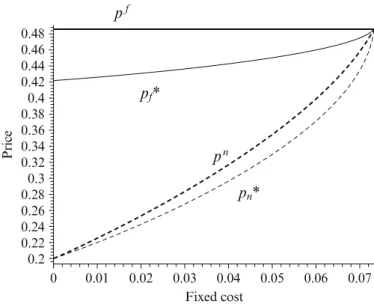
Liu and Weinberg (2004) compare the magnitude of four equilibrium prices: p*f and p*n from the mixed duopoly market, pn from the market with two nonprofi ts, and p f from the market served by two for-profi ts. They fi nd the following ranking for all parameter values of the demand function: p f > p*f > pn > p*n. The most interesting and in many ways
7 All rates are from website www.bcchildrens.ca, accessed on 5 June 2007.
surprising result is probably the comparison of pn and p*n – a nonprofi t charges a higher price when it competes with another nonprofi t than when it competes with a for-profi t.
This happens since the nonprofi t has more fl exibility in setting its price when the competi- tor is a profi t-oriented fi rm rather than an equally low-price-oriented nonprofi t organi- zation. The need to survive (i.e. break even) in a highly competitive market drives up pn to be higher than p*n. Figure 24.4 shows how these four equilibrium prices compare with each other as fi xed cost changes.
Concluding discussion and future research issues
Nonprofi t pricing decisions differ signifi cantly from those of for-profi t businesses due to the unique features of nonprofi t organizations. The objective function and nondis- tribution constraint play particularly important roles in formulating models of pricing and in exploring their intuition and implications. As noted by Weinberg (1983), non- profi ts’ deviation from profi t maximizing complicates any optimum-seeking algorithm.
Researchers working on studying business decisions have developed demand systems and price models that depend on several critical features of the demand function (e.g. a well-behaved profi t curve and specifi c functional forms) to allow for tractable analyses.
Even for the (presumably) simplest objective of maximizing nonprofi t output, closed- form solutions can be complicated to achieve. Nevertheless, as demonstrated in this chapter, an appropriately specifi ed demand system can be very useful in examining the
pf
pn pn* pf*
0 0.2 0.22 0.24 0.26 0.28 0.3 0.32 0.34 0.36 0.38 0.4 0.42 0.44 0.46 0.48
0.01 0.02
Price
0.03 Fixed cost
0.04 0.05 0.06 0.07
Notes: pf: for-profi t equilibrium price when both duopolists are for-profi ts.
pf*: for-profi t equilibrium price when the competitor is a nonprofi t.
pn: nonprofi t equilibrium price when both duopolists are nonprofi ts.
pn*: nonprofi t equilibrium price when the competitor is a for-profi t.
Figure 24.4 Comparison of equilibrium prices in three different duopoly markets (u 5 0.8, c 5 0.2)
pricing behavior of nonprofi ts under a variety of circumstances in both the monopoly and duopoly cases.
In the for-profi t sector, issues of dynamic pricing have become increasingly impor- tant. The areas covered include pricing at various stages of the product life cycle, prices in response to changing cost structures, and pricing to refl ect and infl uence temporal patterns of demand. Such issues are important for nonprofi t organizations as well, but we could identify no papers specifi cally addressing such issues in the nonprofi t sector.
An additional factor for nonprofi ts is how to modify the no-defi cit constraint so that it has meaning in a dynamic setting. It would seem that considerations other than simply applying a cumulative non-defi cit constraint (with a present value discount factor) are pertinent. For example, if a nonprofi t accumulates a surplus in the early years, how does it value the result that some potential clients may not be served due to the imposition of this constraint?
Donations are not explicitly included in the competition model discussed earlier.
Conceptually, donations have an impact on nonprofi ts’ pricing decisions through two distinct mechanisms. One is the effect of increasing funds available, thus reducing pricing pressure and, if quality decisions are involved, helping to improve quality. The other is the usage of funds for fundraising campaigns, which works in the opposite direction to increase the pricing pressure and reduce potential quality levels. Of course, the amount spent raising donations should not exceed the amount raised. Therefore an appropriately specifi ed donation response function is critical to derive useful results for the pricing problem. Empirical research with regard to donations is facilitated by the availability of public data sources. For example, a large data set of revenues and expenditures of non- profi ts, which was collected from the IRS 990 forms fi led annually by 501(c)(3) organiza- tions, can be accessed through the National Center for Charitable Statistics (NCCS) at the Urban Institute (nccsdataweb.urban.org). Boris and Steuerle (2006) provide a list of major IRS nonprofi t data sources.
A very common role of pricing in the for-profi t world is to implement price discrimi- nation. Many models assume consumers can be differentiated along two fundamental dimensions of preference, namely horizontal differentiation and vertical differentiation.
The former refers to the preference space where buyers have heterogeneous ideal points (e.g. Hotelling, 1929), while the latter refers to that where ‘the more, the better’ holds true for everyone (e.g. Shaked and Sutton, 1982). Models have also been constructed for fi rms competing on both dimensions (e.g. Neven and Thisse, 1990). Related to these two dimensions are the typical issues of consumer taste and willingness to pay. While both are straightforward in for-profi t pricing models, they are no longer so for nonprofi ts.
First, the taste for nonprofi t products or service may not be as clearly defi ned as for commercial products. For instance, it is easy to assume that consumers may prefer differ- ent styles of cars (e.g. color, size, or a ‘sporty’ image), but it is not easy to conceptualize the taste for performing arts or family counseling services. This issue becomes particularly complex when the researcher wants to consider the different (and sometimes confl icting) preference of nonprofi t managers and donors. For example, Rose-Ackerman (1987) explicitly models the donor’s preference for a qualitative index of nonprofi t output, which may differ from the preference of the nonprofi t manager. Voss et al. (2000) distinguish fi ve organizational value dimensions for arts organizations: pro-social, artistic, fi nancial, market and achievement. They suggest that there exist underlying tensions between