DAFTAR ISI
1. Cover jurnal
2. Halaman pengesahan
3. Artikel final yang sudah dipublikasi 4. Akreditasi jurnal
5. Submission 6. Review
7. Editing & Proofreading
8. Publish
2.
Halaman Pengesahan
3.
Artikel Final Yang
Sudah Dipublikasi
494
Ceratorhiza Induction towards ORSV Infection on Viability of Phalaenopsis and Dendrobium
Valentina Dwi Anggita Sari
1*, Mahfut
2, Sri Wahyuningsih
2,Tundjung Tripeni Handayani
21
Graduate Student. Department of Biology, Faculty Mathematics and Natural Science, Lampung University, Indonesia. [email protected]
2
Department of Biology, Faculty Mathematics and Natural Science, Lampung University, Indonesia, [email protected], [email protected], [email protected]
Received : 21-03-2021Accepted : 04-05-2021 Available online : 30-05-2021
ABSTRACT
Orchids have a high level of biodiversity, such as Dendrobium and Phalaenopsis, which are epiphytes. Dendrobium can adapt to the condition of where it lives while Phalaenopsis can grow in highlands and depends on sunlight and humidity. Virus infection has become one of the obstacles in cultivating Dendrobium and Phalaenopsis. Efforts to increase fitness and control in Dendrobium and Phalaenopsis cultivation can be done by inducing the plant’s fitness using a mycorrhiza, such as Ceratorhiza. A mycorrhiza is a form of mutualism between fungi and the plant’s root. This research is aimed to give information related to the utilization of Cerathoriza for inducing orchids to suppress Odontoglossum ringspot virus (ORSV) infection, giving it better growth. The research was done in February-March 2021 at Botany Laboratory University of Lampung. A completely randomized factorial design was used on two factors, kind of orchid and mycorrhiza treatment (M), virus (V), and mycorrhiza virus (MV). Variables examined in this research are the amount of living and dead roots and leaves. Data obtained is homogenized using Levene’s test and continued by ANOVA with the significance level of 5% and further testing using Tukey’s test with the significance level of 5%. From this research, it is known that interaction between Phalaenopsis and Dendrobium exists during virus and mycorrhiza administration. It is concluded that Phalaenopsis anabilis is more vulnerable than Dendrobium discolor.
Keywords: ceratorhiza, dendrobium, ORSV, phalaenopsis
ABSTRAK
Anggrek merupakan salah satu tumbuhan yang memiliki keanekargaman sangat tinggi diantaranya Dendrobium dan Phaleonopsis yang merupakan anggrek epifit. Anggrek Dendrobium adalah salah satu anggrek yang mampu beradaptasi dengan kondisi tempat tumbuh anggrek.
Phalenopsis merupakan anggrek epifit yang dapat tumbuh di daerah ketinggian dan membutuhkan cahaya serta kelembaban. Kendala dalam budidaya anggrek Dendrobium dan Phaleonopsis salah satunya karena adanya infeksi virus. Upaya peningkatan ketahanan dan pengendalian budidaya anggrek Dendrobium dan Phaleonopsis dapat dilakakukan dengan menginduksi ketahanan tanaman menggunakan mikoriza Ceratorhiza. Mikoriza merupakan suatu bentuk simbiosis mutualistik antara jamur dan akar tanaman. Tujuan dari penelitian ini dapat memberikan informasi mengenai pemanfaatan mikoriza Ceratorhiza untuk menginduksi tanaman anggrek agar dapat menahan infeksi virus Odontoglossum ringspot virus (ORSV), sehingga pertumbuhannya lebih baik. Waktu dan tempat penelitian dilakukan pada bulan Februari-Maret 2021 di Laboratorium Botani Universitas Lampung. Pada penelitian ini menggunakan Metode rancangan acak lengkap faktorial (RALF) yang terdiri dari dua faktor, yaitu jenis anggrek dan perlakuan mikoriza (M), virus (V), dan mikoriza virus (MV). Variabel
E-ISSN-2580-7129 Print- ISSN-1978-6107
TECHNO: JURNAL PENELITIAN
Journal homepage: http://ejournal.unkhair.ac.id/index.php/Techno
Volume 10 Number 01 May 2021 DOI: http://dx.doi.org/10.33387/tjp.v10i1.3041
TECHNO: Vol. 10 (01) May 2021
495 yang diamati pada penelitian ini adalah jumlah akar yang hidup dan mati, jumlah daun yang hidup dan mati. Data yang diperoleh dihomogenkan dengan menggunakan uji Levene kemudian dianalisis ragam pada taraf nyata 5% menggunakan ANOVA dan uji lanjut dengan Tukey pada taraf nyata 5%. Hasil penelitian menunjukkan bahwa jenis anggrek Phalaenopsis amabilis lebih rentan dibandingkan Dendrobium discolor pada perlakuan mikoriza (M), virus (V), dan mikoriza virus (MV). Terdapat interaksi antara Phalaenopsis dan Dendrobium pada variabel jumlah daun pada perlakuan mikoriza (M) dan virus (V).
Kata Kunci: ceratorhiza, dendrobium, ORSV, phalaenopsis
INTRODUCTION
Orchids is one of the biggest family in Indonesia (Soetopo, 2009). It is widely-spread and can be found in tropical forests in West Sumatera, Java, Kalimantan, Sulawesi, Nusa Tenggara, Maluku, and Papua (Rukmana, 2000). It is categorized into two based on the way of living, namely terrestrial and epiphyte. Terrestrial orchids are orchids that grow and develop on land (Dina and Soetopo, 2019) while epiphyte orchids are orchids that live on host plants but are not parasites. They depend on their hosts. The loss of orchids’ host plants will significantly ruin orchids’ life cycle (Ambari, 2016). Population of orchids in their natural habitat has been decreasing due to deforestation and forest over-exploitation (Johanis et al., 2001). This condition has led to the efforts of cultivation.
Phalaenopsis and Dendrobium are two of the most cultivated orchids (Yudistira et al., 2011).
Unfortunately, virus infection has become one of the biggest challenges in orchids’ cultivation and potential development (Kumalawati et al., 2011). Odontoglossum ringspot virus (ORSV) infects most orchids. Based on previous research by Mahfut (2016), symtomps caused by ORSV include mosaic, streak, chlorotic, and necrosis. Orchids protection measures can be done by genetic recombination resulting ORSV resistant orchids. Therefore, a mycorrhiza, such as Cerathoriza sp., is used as it is eco-friendlier and more effective.
Mycorrhiza is a mutualistic symbiosis between fungi and root. Plants obtain nutrients absorbed by fungi while fungi obtain nutrients resulted from assimilations done by plants.
Mycorrhiza infected the root system of the plant hosts, producing hyphae intensively.
Cerathoriza’s role as a biofertilizer can help the plant’s growth and development in increasing root length, root amount, leaf amount, and leaf width (Brundrett, 2008). Cerathoriza as biocontrol can decrease virus infection levels on plants. Orchids have different resistance levels towards virus infection. Orchids’ resistance increases as root amount and root length have increased after Cerathoriza induction. This research is done to find out the effectiveness of Cerathoriza induction towards Phalaenopsis and Dendrobium and their root viability after infected by ORSV.
According to previous studies, it was reported that the results of Ceratorhiza induction on orchids were known to be effective in inhibiting pathogens (Mahfut, 2019). The results of the study also reported that the early stages of Ceratorhiza induction will cause rotting in roots.
The best time for Ceratorhiza inoculation is on the third and fourth day. It can be concluded
that the faster Ceratorhiza contact with the orchids, the higher its ability to absorb nutrients and
enhance growth (Mahfut et al., 2016).
Sari, V. D. A., Mahfut, M., Wahyuningsih, S., & Handayani, T. T. (2021). Ceratorhiza Induction towards ORSV Infection on Viability of Phalaenopsis and Dendrobium. Techno: Jurnal Penelitian, 10(1), 494-506
496 MATERIALS AND METHOD
Completely randomized factorial design was used on two factors. The first factor was the orchid type used, Phalaenopsis amabilis and Dendrobium discolor while the second factor was mycorrhiza induction (M), virus inoculation (V), and mycorrhiza induction and virus inoculation (MV), resulting in 6 treatments. Each treatment combination was repeated four times, resulting in 24 experimental units. Each experimental unit was a cup consists of growing media, one orchid plant (Phalaenopsis amabilis or Dendrobium discolor) based on treatment combination given. Variables examined are mycorrhiza effectiveness, leaf length, leaf width, leaf amount, root length, and root amount. Positive controls for Phalaenopsis amabilis and Dendrobium discolor, which are not included in the research design, also exists.
Tools used in this research were petri dish, beaker measuring glass 100 ml and 500 ml, mortar and pestel, pen, label, gloves, tissue, and camera. Materials used in this research were bottled seedlings of Phalaenopsis amabilis and Dendrobium discolor, moss sterile media, Potato Dextrose Agar media, Ceratorhiza sp., inoculum of Odontoglossum ringspot virus (ORSV), karborondum, phosphate buffer, water, alcohol.
This research was done through five steps below.
1. Acclimatization
Bottled orchids are grown in the greenhouse for 2 months. After acclimatization, orchid treatment was done until 3-4 leaves have grown.
2. Cerathoriza inoculation
Cerathoriza inoculation was done by growing Cerathoriza isolates on PDA that had been added by chloramphenicol. Isolates on petri dish was taken ± 0.5 cm and was put on the media through three spotting. Incubation was done at room temperature for 5-7 days.
Isolates rejuvenation was done on 8-10 petri dishes.
3. ORSV inoculation
ORSV inoculation towards planlet was done through sample, an ORSV infected tobacco.
Tobacco leaves was ground and added with phosphate buffer with the ratio of 1:10 (m/v).
Phosphate buffer was used to break down the cells, releasing the virus inside. Inoculation towards the orchid was done by rubbing carborundrum evenly, slowly, and manually by finger or cotton bud based on the vein (Calvo et al., 2020). Planlets were replanted on the media and symtomps, including necrosis, chlorosis, mosaic, leaf malformation, streak yellowing, and curling leaf, were examined during incubation time until they appear (15- 30 days).
4. Examination on mycorrhiza effectiveness
Examination on mycorrhiza effectiveness was done on the acclimated Phalaenopsis amabilis and Dendrobium discolour. Rejuvenation on Cerathoriza was done in 3 days and inoculation was done on the first until the fourth day. The examination was done in 30 days.
5. Examination on root viability
Root viability examination was done by examining root length growth and root amount.
RESULTS AND DISCUSSION Result
Mycorrhiza Effectiveness
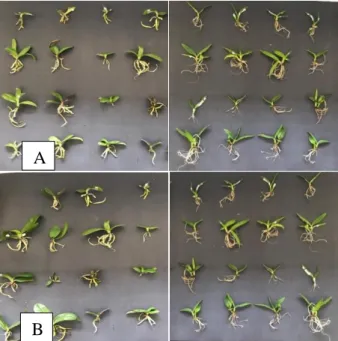
The results of mycorrhiza inoculation performed for up to 4 days showed that hyphae
enveloped the plant roots. The inoculation period indicates the thickness of the hyphae
covering the plant. Myculation inclusions of Phalaenopsis amabilis and Dendrobium discolor
TECHNO: Vol. 10 (01) May 2021
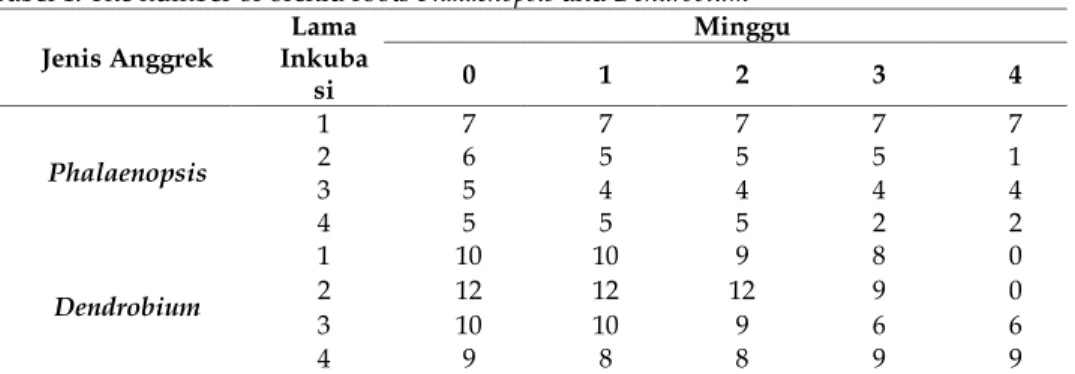
497 orchids are shown in Figure 1. The efficacy of Ceratorhiza performed by observing orchid root growth for post-inoculation survival is shown in Table 1.
Figure 1. Inoculation of Ceratorhiza on orchids (A) Phalaenopsis amabilis and (B) Dendrobium discolor.
Table 1. The number of orchid roots Phalaenopsis and Dendrobium
Orchid kind Incubationtime (Days) Sunday
0 1 2 3 4
Phalaenopsis
1 7 7 7 7 7
2 6 5 5 5 1
3 5 4 4 4 4
4 5 5 5 2 2
Dendrobium
1 1
0 10 9 8 0
2 1
2 12 12 9 0
3 1
0 10 9 6 6
4 9 8 8 9 9
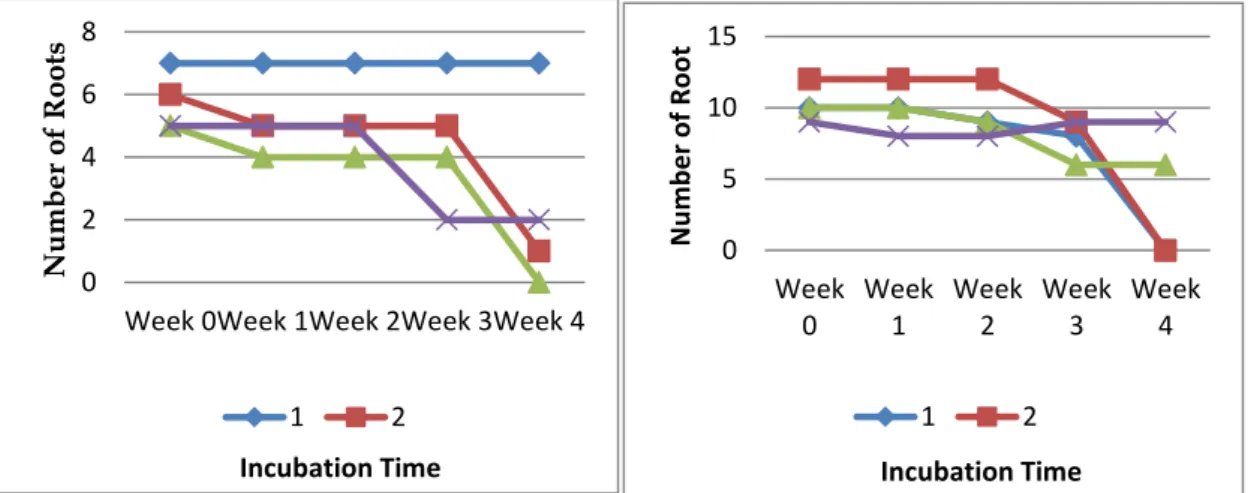
Based on the observations, there was a significant difference between the effectiveness of mycorrhiza and the incubation time. More effective results were obtained on the third day.
The results are shown in Table 1 and Figure 2.
Figure 2. Mycorrhizal efficacy and its effect on the number roots
Based on the data above, there is no difference between Phalaenopsis amabilis and Dendrobium discolor. On the third day of incubation, both orchids showed their presence against
0 2 4 6 8
Week 0Week 1Week 2Week 3Week 4
Number of Roots
Incubation Time
1 2
0 5 10 15
Week 0
Week 1
Week 2
Week 3
Week 4
Number of Root
Incubation Time
1 2
A B
Sari, V. D. A., Mahfut, M., Wahyuningsih, S., & Handayani, T. T. (2021). Ceratorhiza Induction towards ORSV Infection on Viability of Phalaenopsis and Dendrobium. Techno: Jurnal Penelitian, 10(1), 494-506
498 mycorrhiza. This may occur because mycorrhiza absorption has reached its maximum limit on the third day until it decreases by the 4th week.
After the mycorrhiza efficacy test was performed, observation was done from week 0 to week 5 with parameters namely, leaf length, leaf width, leaf number, root length, and root number shown in Figure 6-9. The results of the analysis using the ANOVA method are shown in Table 2-3.
Figure 3. Development of small plants Phalaenopsis amabilis (left) and Dendrobium discolor (right) from mycorrhizal virus inoculation (MV) (A) week 0 (B) week 4.
Root Length
The initial stage of analyzing the root length observation data performed data homogeneity using the Levene test at 5%stage. The test results showed that the diversity of orchid samples were homogeneous. Further, the analysis was continued using ANOVA test, which showed that mycorrhiza (M), virus (V), and mycorrhizal virus (MV) inoculations on orchids gave significantly different results. The analysis was continued using the Tukey test at the 5% real level shown in Table 2. While the interaction between the two samples is seen on the interaction curve of Figure 6.
Based on the Tukey’s test, there was a significant difference from the first factor that is shon in Figure 4. The second factors, mycorrhiza treatment, viruses, and mycorrhiza virus is not visible, this is because in the 0th week of mycorrhiza administration treatment is done after 0 week root length calculation and the result of mycorrhiza administration can be seen in week 1. While in the combination of first and second factor treatment (interaction) is also not visible.
At week 1, it can be seen that in the first factor, Phalaenopsis amabilis and Dendrobium discolor orchid types statistically did not show significant differences explained by Figure 4. In the second factor, treatment of mycorrhiza (M), virus (V), and MV mycorrhiza virus ) have not been seen, this is because in the first week only mycorrhiza treatment is performed. Virus administration was performed after root length calculations for the first week and results were only seen in the 2nd week. Whereas in the combination of first and second factor treatment
A
B
TECHNO: Vol. 10 (01) May 2021
499 (interaction) it was not visible, because at week 1 it was only visible for mycorrhiza treatment and could not be compared with other treatments.
Table 2. Tukey root length test in combination treatment of Phalaenopsis amabilis and Dendrobium discolor orchids by giving Mycorrhizae, Virus, and Mycorrhizae Virus at 0-5 weeks of age.
Sunday- Factor B = Species Factor A = Treatment Marginal mean K
M V MV
0
Phalaenopsis 3.45a ± 0.79 3.85a ± 0.58 2.76a ± 0.32 3.35a 3.66 Dendrobium 3.61a ± 0.34 4.57a ± 0.38 4.80a ± 0.25 4.32b 4.64
Marginal mean 3.53a 4.21a 3.78a
HSD Cell [0.05] = 2.17 ; Columns[0.05] = 1.23 ; Rows[0.05] = 0.83
1
Phalaenopsis 3.37a ± 0.92 3.81a ± 0.28 2.42a ± 0.36 3.2a 3.65 Dendrobium 3.51a ± 0.32 4.45a ± 0.15 4.59a ± 0.16 4.18a 4.66
Marginal mean 3.44a 4.13a 3.50a
HSD Cell[0.05] = 2.02 ; Columns[0.05] = 1.14 ; Rows[0.05] = 0.77
2
Phalaenopsis 2.88 ± 1.17 3.57 ± 0.47 2.43 ± 0.33 2.96a 3.45 Dendrobium 3.41 ± 0.16 4.27 ± 0.25 4.63 ± 0.13 4.10a 4.01
Marginal mean 3.14a 3.92a 3.53a
HSD Cell [0.05] = 2.47 ; Columns[0.05] = 1.4 ; Rows[0.05] = 0.94
3
Phalaenopsis 2.74 ± 1.03 3.59 ± 0.53 2.19 ± 0.47 2.84a 3.16 Dendrobium 2.87 ± 0.29 4.37 ± 0.27 4.63 ± 0.2 3.95a 3.63
Marginal mean 2.80b 3.98a 3.41a
HSD Cell [0.05] = 2.44 ; Columns[0.05] = 1.39 ; Rows[0.05] = 0.93
4
Phalaenopsis 2.74 ± 1.03 3.20 ± 0.54 2.18 ± 0.46 2.70a 3.20 Dendrobium 2.39 ± 0.7 3.46 ± 0.1 4.27 ± 0.35 3.37a 2.82
Marginal mean 2.56a 3.33a 3.22a
HSD Cell [0.05] = 2.72 ; Columns[0.05] = 1.54 ; Rows[0.05] = 1.04
5
Phalaenopsis 2.70 ± 1.05 3.22 ± 0.53 2.21 ± 0.47 2.71a 3.21 Dendrobium 2.03 ± 0.75 3.48 ± 0.1 4.28 ± 0.34 3.26a 2.83
Marginal mean 2.36a 3.35a 3.24a
HSD Cell [0.05] = 2.78 ; Columns[0.05] = 1.58 ; Rows[0.05] = 1.06
From week 2 to week 5, it can be seen that in the first factor, the orchid varieties Phalaenopsis
amabilis and Dendrobium discolor statistically did not show significant differences explained by
Figure 4.In the second factor, mycorrhiza (M) treatment, virus (V), and viral mycorrhiza (MV)
did not show significant differences described in Figure 5. Whereas in the combination of the
first and second factors the treatment (interaction) showed insignificant results, described in
Figure 6.
Sari, V. D. A., Mahfut, M., Wahyuningsih, S., & Handayani, T. T. (2021). Ceratorhiza Induction towards ORSV Infection on Viability of Phalaenopsis and Dendrobium. Techno: Jurnal Penelitian, 10(1), 494-506
500 Figure 4. Comparative diagram of root length for Phalaenopsis amabilis and Dendrobium discolor
Figure 5. Comparative diagram of root length against the treatment of Phalaenopsis amabilis and Dendrobium discolor
3.35 4.32
0 2 4 6
P D
Root Length
Species
3.2 4.18
0 2 4 6
P D
Root Length
Species
2.96 4.1
0 2 4 6
P D
Root Length
Species
2.84 3.95
0 2 4 6
P D
Root Length
Species
2.7 3.37
0 2 4
P D
Root Length
Species
2.71 3.26
0 2 4
P D
Root Length
Species
3.14 3.92 3.53
0 2 4 6
M V MV
Root Length
Treatment
2.8
3.98 3.41
0 2 4 6
M V MV
Root Length
Treatment
2.56
3.33 3.22
0 2 4
M V MV
Root Length
Treatment
2.36
3.35 3.24
0 2 4
M V MV
Root Length
Treatment
TECHNO: Vol. 10 (01) May 2021
501 Figure 6. Interaction of Root Length with Mycorrhizae, Viruses, and Viral Mycorrhizae
Number of Roots
The initial stage of data analysis, observation of the number of roots, perform data homogeneity using Levene test at 5%stage. The test results showed that the diversity of samples on orchids was homogeneous. The analysis was continued using ANOVA test, which showed that mycorrhizal (M), virus (V), and mycorrizhal virus (MV) inoculations on orchids gave significantly different results. The analysis was continued using the Tukey test at the actual level of 5% as shown in Table 3. While the interaction between the two samples is seen on the interaction curve of Figure 9.
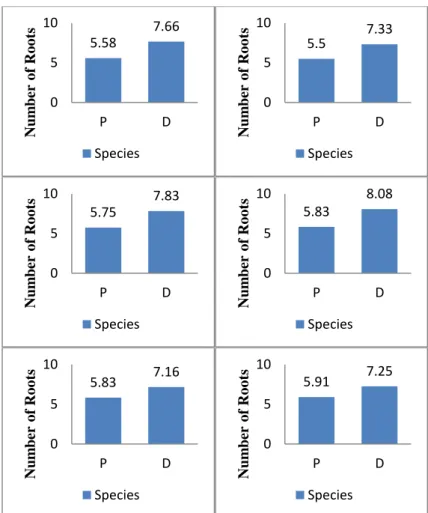
Based on the Tukey test at the actual level of 5% conducted (Table 3), it can be seen that on the first factor, Phalaenopsis amabilis and Dendrobium discolor orchids types statistically showed significant differences explained in Figure 7. factors, mycorrhiza treatment, virus, and mycorrhiza did not can be seen, this is because in week 0 mycorrhiza administration treatment is done after counting the number of roots in week 0 and the result of mycorrhiza administration can be seen in week 1. While in the combination of first and second factor treatment (interaction) is also not visible.
At week 1, it can be seen that in the first factor, Phalaenopsis amabilis and Dendrobium discolor orchid types statistically did not show significant differences explained by Figure 7. In the second factor, treatment of mycorrhizal (M), virus (V), and mycorrhizal virus ( MV) has not been seen, this is because in the first week only mycorrhizal treatment is done. Virus administration was performed after the calculation of the number of roots in the 1st week and the results were only visible in the 2nd week. Whereas in the combination of first and second factor treatment (interaction) it was not visible, because at week 1 it was only visible for mycorrhizal treatment and could not be compared with other treatments.
From week 2 to week 5, it can be seen that on the first factor, the orchid types Phalaenopsis amabilis and Dendrobium discolor statistically did not show significant differences explained by Figure 7. In the second factor, mycorrhiza (M), virus (V) treatment, and viral mycorrhiza (MV) did not show the significant differences described in Figure 8. Although the treatment
0 2 4 6
M V MV
Root Length
Treatment
P
D 0
2 4 6
M V MV
Root Length
Treatment
P D
0 2 4 6
M V MV
Root Length
Treatment
P
D 0
2 4 6
M V MV
Root Length
Treatment
P D
Sari, V. D. A., Mahfut, M., Wahyuningsih, S., & Handayani, T. T. (2021). Ceratorhiza Induction towards ORSV Infection on Viability of Phalaenopsis and Dendrobium. Techno: Jurnal Penelitian, 10(1), 494-506
502 combination of the first and second factors (interactions) showed insignificant results, it was explained in Figure 9.
Table 3. Total Root Tuky Test in combination treatment of Phalaenopsis amabilis and Dendrobium discolored orchids by administering Mycorrhiza Virus, Virus, Mycorrhizae at the age of 0-5 weeks
Sunday
- Factor B =
Species Factor A = Treatment Marginal
mean K
M V MV
0
Phalaenopsis 5.25a ± 1.18 5.75a ± 0.75 5.75a ± 0.63 5.58a 5.25 Dendrobium 6.5a ± 1.66 7.75a ± 0.48 8.75a ± 0.63 7.66a 8
Marginal mean 5.87a 6.75a 7.25a
HSD Cell [0.05] = 4.4 ; Columns[0.05] = 2.5 ; Rows[0.05] = 1.68
1Anggrek
Phalaenopsis 4.75a ± 1.31 6a ± 0.91 5.75a ± 0.48 5.5a 6.5 Dendrobium 6.25a ± 1.55 7.75a ± 0.48 8a ± 0.41 7.33b 8.5
Marginal mean 5.5a 6.87a 6.87a
HSD Cell[0.05] = 4.35 ; Columns[0.05] = 2.47 ; Rows[0.05] = 1.66
2
Phalaenopsis 4.75a ± 1.31 6.5a ± 0.65 6a ± 0.71 5.75a 6.5 Dendrobium 7a ± 1.87 8.25a ± 0.63 8.25a ± 0.75 7.83b 8
Marginal mean 5.87a 7.37a 7.12a
HSD Cell [0.05] = 4.9 ; Columns[0.05] = 2.78 ; Rows[0.05] = 1.87
3
Phalaenopsis 5a ± 1.47 6.5a ± 0.65 6a ± 0.71 5.83a 7.5 Dendrobium 7.75a ± 1.65 8.25a ± 0.63 8.25a ± 0.85 8.08b 8.25
Marginal mean 6.37a 7.37a 7.12a
HSD Cell [0.05] = 4.85 ; Columns[0.05] = 2.75 ; Rows[0.05] = 1.85
4
Phalaenopsis 5a ± 1.47 6.5a ± 0.65 6a ± 0.71 5.83a 7
Dendrobium 6.75a ± 2.02 7,25a ± 0.48 7.5a ± 0.65 7.16a 6.5
Marginal mean 5.87a 6.87a 6.75a
HSD Cell [0.05] = 5.14 ; Columns[0.05] = 2.91 ; Rows[0.05] = 1.96
5
Phalaenopsis 5.25a ± 1.38 6.5a ± 0.65 6a ± 0.71 5.91a 7 Dendrobium 7a ± 1.78 7.25a ± 0.48 7.5a ± 0.65 7.25a 6
Marginal mean 6.12a 6.87a 6.75a
HSD Cell [0.05] = 4.74 ; Columns[0.05] = 2.69 ; Rows[0.05] = 1.8
TECHNO: Vol. 10 (01) May 2021
503 Figure 7. Comparative diagram of the number of roots of Phalaenopsis amabilis and
Dendrobium discolor orchids.
Figure 8. Comparative diagram of the number of treatment roots of Phalaenopsis amabilis and Dendrobium discolor orchids
5.58
7.66
0 5 10
P D
Number of Roots
Species
5.5 7.33
0 5 10
P D
Number of Roots
Species
5.75
7.83
0 5 10
P D
Number of Roots
Species
5.83
8.08
0 5 10
P D
Number of Roots
Species
5.83 7.16
0 5 10
P D
Number of Roots
Species
5.91 7.25
0 5 10
P D
Number of Roots
Species
5.87 7.37 7.12
0 5 10
M V MV
Number of Roots
Treatment
6.37
7.37 7.12
5 6 7 8
M V MV
Number of Roots
Treatment
5.87
6.87 6.75
5 6 7
M V MV
Number of Roots
Treatment
6.12
6.87 6.75
5.5 6 6.5 7
M V MV
Number of Roots
Treatment
Sari, V. D. A., Mahfut, M., Wahyuningsih, S., & Handayani, T. T. (2021). Ceratorhiza Induction towards ORSV Infection on Viability of Phalaenopsis and Dendrobium. Techno: Jurnal Penelitian, 10(1), 494-506
504 Figure 9. Graph of Number of Root Interactions Against Mycorrhizae Viruses,
Viruses, and Mycorrhizae Discussion
The research was conducted with observation for 4 weeks. The parameters observed were mycorrizhal efficacy test, leaf length, leaf width, number of leaves, root length, and number of roots on Phalaenopsis amabilis and Dendrobium discolor orchids. Phalaenopsis and Dendrobium orchids have been inoculated with Ceratorhiza and viruses. Khaterine (2016) explained that live orchids are associated with endophytic fungi. Mycorrhiza treatment can help improve the soil structure around the plant and can increase the length, width, and number of leaves as well as increase the length and number of roots. Meanwhile, viral treatment was used to see the resistance of mycorrhizas inoculated in orchids. In previous research by Lakani (2015), it is explained that the resistance of orchid plants can be seen on inoculated and uninoculated leaves.
Effectiveness of Mycorrhizae
Ceratorhiza efficacy test results on Phalaenopsis and Dendrobium were performed by observing growth and survival skills. Based on observations it is known that Ceratorhiza inoculation is most effective on the 3rd day. At the 3rd and 4th week observations the efficacy of Ceratorhiza showed mortality. Until the entire data was used only up to the second week of observation. This was done to avoid biased data if the entire observational data was applied up to the 4th week. Observations made from week 0 to week 2 could answer questions about the effectiveness of Ceratorhiza inoculation. This is supported by previous research by Mahfut (2020) who explained that mycorrhiza of Trichoderma and Ceratorhiza types showed that the best inoculation time was found on the 3rd and 4th day of inoculation.
The effectiveness of Ceratoriza can also be seen in the increase in the number of roots and leaves. Ceratorhiza treatment can increase the absorption of nutrients to enhance plant growth.
Mahfut (2019) explained that induction of mycorrhiza types Ceratorhiza and Trichoderma can be used as biofertilizers. Ceratorhiza treatment on the 3rd and 4th day had more effect on the increased root volume. This is supported by a previous study by Mahfut (2019) who explained that Ceratorhiza has an influence on the number of dead roots compared to Trichoderma inoculation.
0 5 10
M V MV
Number of Roots
Treatment
P
D 0
5 10
M V MV
Number of Roots
Treatment
P D
0 2 4 6 8
M V MV
Number of Roots
Treatment
P
D 0
2 4 6 8
M V MV
Number of Roots
Treatment
P D
TECHNO: Vol. 10 (01) May 2021
505 Ceratorhiza mycorrhizae can assist orchids in their growth and life cycle. Mahfut (2019) explains that Ceratorhiza mycorrhizae can infect the roots of orchid plants and produce intensive hyphae and can increase plant capacity. At week 3 and week 4 mycorrhiza inoculation the number of roots decreased, this may be due to environmental factors.
According to a previous study by Kurnia (2019) regarding mycorrhiza characteristics, it was said that soil type is a factor that affects the types of mycorrhizae. Other factors that can affect plant growth are temperature, light, water, nutrients, and soil.
Root Length
Based on the data obtained from the analysis results of week 0 to week 5 on the root length variable, there was no significant difference. From week 1 to week 5, the number of leaves has decreased. This is due to treatment of mycorrhiza (M), virus (V), and mycorrhiza virus (MV), giving the virus causing damage to the leaves. If with Phalaenopsis control (3.38) (K); (2.96) (P) and Dendrobium (3.76) (K); (3.86) (P) on treatment showed higher outcomes than control.
However, if viewed based on the type between the two orchids, Dendrobium better maintain the long growth of its roots compared to Phalaenopsis.
Mycorrhiza inoculated at the roots play a role in the growth and development of orchids for survival. Decreased root length growth can be caused by poor physiological processes. This is reinforced by the study of Lakit (2000) who explained that plant growth is a network of plant physiological processes in forming complex organ units with the addition of plant weight and size.
Mycorrhiza inoculated at the roots play a role in the growth and development of orchids for survival. Decreased root length growth can be caused by poor physiological processes. This is reinforced by the study of Lakitan (2000) who explained that plant growth is a network of plant physiological processes in forming complex organ units with the addition of plant weight and size.
Number of Roots
Based on the data obtained from the results of the analysis of week 0 to week 5 on the number of variable causes there was no significant difference. From week 1 to week 5, the number of leaf decreased. If with Phalaenopsis control 6.62 (K); 5.73 (P) and Dendrobium 7.54 (K); 7.55 (P) is similar to the root length variable indicating that Phalaenopsis treatment showed lower results compared to controls. Whereas in Dendrobium, when compared with control, the treatment showed higher results. This is due to treatment of mycorrhiza (M), virus (V), and mycorrhiza virus (MV), giving the virus causing leaf damages. However, if viewed based on the type between the two orchids, Dendrobium better maintains the long growth of its roots compared to Phalaenopsis.
Rianti (2017) explained that the number of plant roots indicates how wide the plant’s reach is to absorb nutrients and nutrients in mycorrhiza (M) treatment, indicating that the ability of orchids to form roots is because they already have leaflets. This is supported by Bey et al., (2006), who explained that radicles will turn into roots with the help of auxin processed by leaves.
CONCLUSION
Cerathoriza induction can increase the effectiveness of Phalaenopsis amabilis and Dendrobium
discolor with 3 days of incubation. Root viability drops in Phalaenopsis amabilis with the root
Sari, V. D. A., Mahfut, M., Wahyuningsih, S., & Handayani, T. T. (2021). Ceratorhiza Induction towards ORSV Infection on Viability of Phalaenopsis and Dendrobium. Techno: Jurnal Penelitian, 10(1), 494-506
506 length of 2.96 cm and root amount of 5.73, while rises in Dendrobium discolor with the root length of 3.86 cm and root amount of 7.55.
REFERENCES
Ambari, P. (2016). Pengaruh Profitabilitas, Free Cash Flow. Invesment Opportunity Set dan kepemilikan Manajerial terhadap Divident Payout Ratio: Likuiditas Sebagai Variabel Moderasi. Jurnal Universitas Muhammadiyah Yogyakarta.
Brundrett, M. (2008). Mycorrhizal Associations: The Web Resource.
http://www.mycorrhizas.info/intro.html
Calvo, R. A., & D’Mello, S. (2010). Affect Detection: An Interdisciplinary Review of Models, Methods, and Their Applications. IEEE Transactions on Affective Computing, 1(1), 18–37.
https://doi.org/10.1109/T-AFFC.2010.1
Johanis, P., G. Djunaedi, W. Harry, E. N. Rusdy, dan I. (2001). Tumbuhan Langka Indonesia. Puslitbang LIPI.
Khaterine, K., & Sri Kasiamdari, Rina. (2016). Uji Antagonisme Tiga Isolat Fungi Endofit Anggrek Bulan terhadap F. Oxysporum Secara in vitro. Biogenesis: Jurnal Ilmiah Biologi, 4(1), 47–52.
https://doi.org/10.24252/bio.v4i1.1120
Kumalawati, A. D., S. Abdullah, B. S. S. & Mahfut. (2011). Study on Genetic Diversity and Conservation of Orchids in Wonosadi Forest, Gunung Kidul Based on Molecular Analysis, p. 72−79.
International Conference on Biological Science: Advances in Biological Science.
Kurnia. (2019). Pengaruh Pemberian Kompos Kulit Kopi terhadap Pertumbuhan Tanaman Kakao Theobroma Kakao L. Padang : Universitas Andalas
Lakani, Suastika, G., Damayanti, T., & Mattjik, N. (2015). Respons Ketahanan Beberapa Spesies Anggrek Terhadap Infeksi Odontoglossum Ringspot Virus (Resistance Response of Several Orchid Species Against Infection of Odontoglossum Ringspot Virus). Jurnal Hortikultura, 25(1), 71–77.
Lakitan. (2000). Dasar-Dasar Fisiologi Tumbuhan. Jakarta: Raja Grafindo Persada.
Latifah, R., Suhermiatin, T., & Ermawati, N. (2017). Optimasi Pertumbuhan Plantlet Cattleya Melalui Kombinasi Kekuatan Media Murashige-Skoog dan Bahan Organik. Agriprima : Journal of Applied Agricultural Sciences, 1(1), 59–62. https://doi.org/10.25047/agriprima.v1i1.20
Mahfut, Joko, T., & Daryono, B. S. (2016). Molecular characterization of odontoglossum ringspot virus (ORSV) in Java and Bali, Indonesia. Asian Journal of Plant Pathology, 10(1–2), 9–14.
https://doi.org/10.3923/ajppaj.2016.9.14
Mahfut, M., Daryono, B., Indrianto, A., & Somowiyarjo, S. (2019). Plant-Virus Interaction on Orchids Infected Odontoglossum ringspot virus (ORSV) in Bogor Botanical Garden, Indonesia.
https://doi.org/10.4108/eai.2-5-2019.2284701
Purnamasari, L., Yolanda, R., & Karno, R. (2016). Jenis-Jenis Anggrek Epifit (Orchidaceae) di Desa Koto Tinggi Kecamatan Rambah Kabupaten Rokan Hulu. Doctoral Dissertation.
Rukmana, R. (2000). Anggrek Bulan. Yogyakarta: Penerbit Kanisius.
Soetopo, L. (2009). Keanekaragaman dan Pelestarian Tanaman Anggrek. Malang : Penerbit Citra.
4.
Akreditasi Jurnal
5.
Submission
6.
Review
1
Ceratorhiza Induction towards ORSV Infection on Viability of
Phalaenopsis and Dendrobium
Valentina Dwi Anggita Sari1, Mahfut2, Sri Wahyuningsih3, Tundjung Tripeni Handayani4
1 Mahasiswa Biologi, FMIPA, Universitas Lampung, Indonesia. Email: 1[email protected]
2 Jurusan Biologi, Fakultas Matematika dan Ilmu Pengetahuan Alam, Universitas Lampung, Indonesia [email protected];
3 Jurusan Biologi, fakultas Matematika dan Ilmu Pengetahuan Alam, Universitas Lampung, Indonesia [email protected]
4Jurusan Biologi, Fakultas Matematika dan Ilmu Pengetahuan Alam, Universitas Lampung, Indonesia [email protected]
Received:
Accepted:
Available online:
ABSTRACT
Orchids are one of the plants with high level of biodiversity, such as Dendrobium and Phalaenopsis, which are epiphytes. Dendrobium is able to adapt to the condition of where it lives while Phalaenopsis can grow in highlands and depends on sunlight and humidity. Virus infection has become one of the obstacles in cultivating Dendrobium and Phalaenopsis. Efforts to increase fitness and control in Dendrobium and Phalaenopsis cultivation can be done by inducing the plant’s fitness using a mycorrhiza, such as Ceratorhiza. Mycorrhiza is a form of mutualism between fungi and the plant’s root. This research is aimed to give information related to the utilization of Cerathoriza for inducing orhcids to suppress Odontoglossum ringspot virus (ORSV) infection, giving it a better growth. The research was done in February-March 2021 in Botany Laboratory University of Lampung. Completely randomized factorial design was used on two factors, kind of orchid and mycorrhiza treatment (M), virus (V), and mycorrhiza virus (MV). Variables examined in this research are amount of living and dead roots, amount of living and dead leaves.
Data obtained is homogenized using Levene’s test and continued by ANOVA with the significance level of 5% and further testing using Tukey’s test with the significance level of 5%.
From this research it is known that an interaction between Phalaenopsis and Dendrobium exists during virus and mycorrhiza administration. It is concluded that Phalaenopsis anabilis is more vulnerable than Dendrobium discolor.
Keywords: Ceratorhiza, Dendrobium, ORSV, Phalaenopsis ABSTRAK
Anggrek merupakan salah satu tumbuhan yang memiliki keanekargaman sangat tinggi diantaranya Dendrobium dan Phaleonopsis yang merupakan anggrek epifit. Anggrek Dendrobium adalah salah satu anggrek yang mampu beradaptasi dengan kondisi tempat tumbuh anggrek.
Phalenopsis merupakan anggrek epifit yang dapat tumbuh di daerah ketinggian dan membutuhkan cahaya serta kelembaban. Kendala dalam budidaya anggrek Dendrobium dan Phaleonopsis salah satunya karena adanya infeksi virus. Upaya peningkatan ketahanan dan pengendalian budidaya anggrek Dendrobium dan Phaleonopsis dapat dilakakukan dengan menginduksi ketahanan tanaman menggunakan mikoriza Ceratorhiza. Mikoriza merupakan suatu bentuk simbiosis mutualistik antara jamur dan akar tanaman. Tujuan dari penelitian ini dapat memberikan informasi mengenai pemanfaatan mikoriza Ceratorhiza untuk menginduksi
E-ISSN-2580-7129 Print- ISSN-1978-6107
TECHNO: JURNAL PENELITIAN
Journal homepage: http://ejournal.unkhair.ac.id/index.php/Techno Issue 09 Number 01 May 2020 DOI: http://dx.doi.org/10.33387/tk.v9i1
Comment [S1]: Fix the grammer (see attachment of grammarly test results)
2 tanaman anggrek agar dapat menahan infeksi virus Odontoglossum ringspot virus (ORSV), sehingga pertumbuhannya lebih baik. Waktu dan tempat penelitian dilakukan pada bulan Februari-Maret 2021 di Laboratorium Botani Universitas Lampung. Pada penelitian ini menggunakan Metode rancangan acak lengkap faktorial (RALF) yang terdiri dari dua faktor, yaitu jenis anggrek dan perlakuan mikoriza (M), virus (V), dan mikoriza virus (MV). Variabel yang diamati pada penelitian ini adalah jumlah akar yang hidup dan mati, jumlah daun yang hidup dan mati. Data yang diperoleh dihomogenkan dengan menggunakan uji Levene kemudian dianalisis ragam pada taraf nyata 5% menggunakan ANOVA dan uji lanjut dengan Tukey pada taraf nyata 5%. Hasil penelitian menunjukkan bahwa jenis anggrek Phalaenopsis amabilis lebih rentan dibandingkan Dendrobium discolor pada perlakuan mikoriza (M), virus (V), dan mikoriza virus (MV). Terdapat interaksi antara Phalaenopsis dan Dendrobium pada variabel jumlah daun pada perlakuan mikoriza (M) dan virus (V).
Kata Kunci: Ceratorhiza, Dendrobium, ORSV, Phalaenopsis
INTRODUCTION
Orchids is one of the biggest family in Indonesia (Soetopo, 2009). Orchids are widely-spread and can be found in tropical forests in West Sumatera, Java, Kalimantan, Sulawesi, Nusa Tenggara, Maluku, and Papua (Rukmana, 2000). Population of orchids in their natural habitat have been decreasing due to deforestation and forest over-exploitation (Johanis et al., 2001).
Orchids are categorized as epiphytes and depend on their hosts. The loss of orchids’ host plants will significantly ruin orhcids’ life cycle (Ambari, 2016).
There are two types of orchids, namely terrestrial and epiphyte. Terrestrial orchids are orchids that grow and develop on land (Dina and Soetopo, 2019) while epiphyte orchids are orchids that live on host plants but are not parasite. Most cultivated orchids are Phalaenopsis and Dendrobium (Yudistira et al., 2011). Virus infection has become the biggest challenge in orchids’
cultivation and potential development (Kumalawati et al., 2011). Odontoglossum ringspot virus (ORSV) infects most orchids. Based on previous research by Mahfut (2016), symptomps caused by ORSV include mosaic, streak, chlorotic, and necrosis. Orchids protection measures can be done by genetic recombination resulting ORSV-resistant orchids. Therefore, mycorrhiza, such as Cerathoriza sp., is used as it is more eco-friendly and effective.
Mycorrhiza is a mutualistic symbiosis between fungi and root. Plants obtain nutrient absorbed by fungi while fungi obtain nutrient resulted from assimilations done by plants. Mycorrhiza infected the root system of the plant hosts, producing hyphae intensively. Cerathoriza’s role as biofertilizer can help the plant’s growth and development in increasing root length, root amount, leaf amount, and leaf width (Brundrett, 2008). Cerathoriza as biocontrol can decrease virus infection level on plants. Orchids have different resistance level towards virus infection.
Orchids’ resistance increases as root amount and root length have increased after Cerathoriza induction. This research is done to find out the effectivity of Cerathoriza induction towards Phalaenopsis and Dendrobium and their root viability after infected by ORSV.
MATERIALS AND METHOD (12, bold)
Completely randomized factorial design was used on two factors. The first factor was the orhcid type used, Phalaenopsis amabilis and Dendrobium discolor while the second factor was
Comment [S2]: add the results of the analysis to previous research that is relevant to this study.
give an overview regarding the originality of this research
Comment [S3]: Use Mendeley Application
3 mycorrhiza induction (M), virus inoculation (V), and mycorrhiza induction and virus inoculation (MV), resulting in 6 treatments. Each treatment combination was repeated four times, resulting in 24 experimental units. Each experimental unit was a cup consists of growing media, one orchid plant (Phlaenopsis amabilis or Dendrobium discolor) based on treatment combination given. Variables examined are mycorrhiza effectivity, leaf length, leaf width, leaf amount, root length, and root amount. Positive controls for Phlaenopsis amabilis and Dendrobium discolor, which are not included in the research design, also exists.
Tools used in this research were petri dish, beaker measuring glass 100 ml and 500 ml, mortar and pestel, pen, label, gloves, tissue, and camera. Materials used in this research were bottled seedlings of Phalaenopsis amabilis and Dendrobium discolor, moss sterile media, Potato Dextrose Agar media, Ceratorhiza sp., inoculum of Odontoglossum ringspot virus (ORSV), karborondum, phosphate buffer, water, alcohol.
This research was done through five steps below.
1. Acclimatization
Bottled orhcids are grown in the greenhouse for 2 months. After acclimatization, orchid treatment was done until 3-4 leaves have grown.
2. Cerathoriza inoculation
Cerathoirza inoculation was done by growing Cerathoriza isolates on PDA that had been added by chloramphenicol. Isolates on petri dish was taken ± 0.5 cm and was put on the media through three spotting. Incubation was done at room temperature for 5-7 days.
Isolates rejuvenation was done on 8-10 petri dishes.
3. ORSV inoculation
ORSV inoculation towards planlet was done through sample, an ORSV-infected tobacco.
Tobacco leaves was grinded and added with phosphate buffer with the ratio of 1:10 (m/v). Phosphate buffer was used to break down the cells, releasing the virus inside.
Inoculation towards the orchid was done by rubbing carborondrum evenly, slowly, and manually by finger or cutton bud based on the vein (Calvo et al., 2020). Planlet was replanted on the media and symptomps, including necrosis, chlorosis, mosaic, leaf malformation, streak yellowing, and curling leaf, were examined during incubation time until they appear (15-30 days).
4. Examination on mycorrhiza effectivity
Examination on mycorrhiza effectivity was done on the aclimated Phalaenopsis amabilis and Dendrobium discolour. Rejuvenation on Cerathoriza was done 3 days and inoculation was done on the first until the fourth day. The examination was done in 30 days.
5. Examinaiton on root viability
Root viability examination was done by examining root length growth and root amount.
RESULTS AND DISCUSSION (12, bold) Result
1. Effectiveness of Mycorrhizae
The results of mycorizal inoculation performed up to 4 days showed that hyphae enveloped the plant roots. The inoculation period indicates the thickness of the hyphae covering the plant. Myculation inclusions of Phalaenopsis amabilis and Dendrobium discolor orchids are shown in Figure 1.
4
Figure 1. Inoculation of Ceratorhiza on orchids (A) Phalaenopsis amabilis and (B) Dendrobium discolor.
The efficacy of Ceratorhiza performed by observing orchid root growth for post-inoculation survival is shown in Table 1.
Tabel 1. The number of orchid roots Phalaenopsis and Dendrobium Jenis Anggrek Lama
Inkuba si
Minggu
0 1 2 3 4
Phalaenopsis
1 7 7 7 7 7
2 6 5 5 5 1
3 5 4 4 4 4
4 5 5 5 2 2
Dendrobium
1 10 10 9 8 0
2 12 12 12 9 0
3 10 10 9 6 6
4 9 8 8 9 9
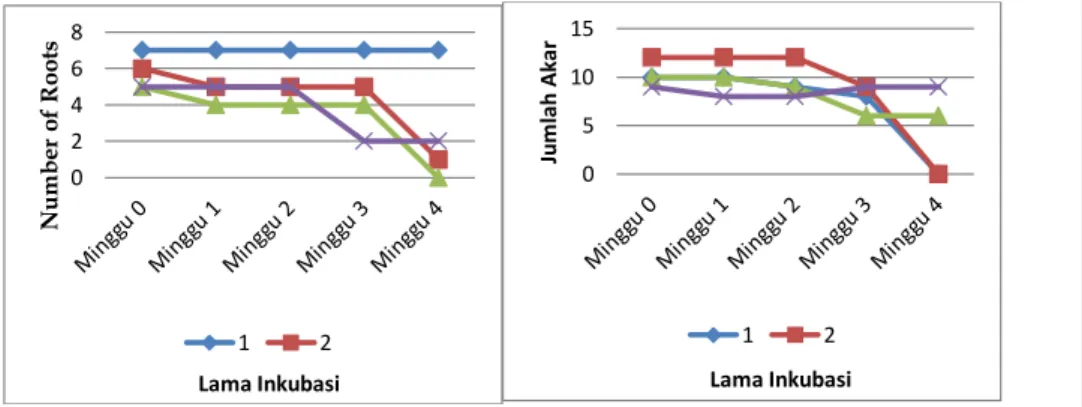
Based on the results of the observations that have been made, this indicates a significant difference in the effectiveness of mycorrhiza based on the incubation time. The data showed that on the third day mycorrhizae showed more effective results in mycorrhizal inoculation of orchid roots. The results are shown in Table 1 and Figure 2.
Figur 2. Graph of mycorrhizal efficacy on the number of orchid roots 0
2 4 6 8
Number of Roots
Lama Inkubasi
1 2
0 5 10 15
Jumlah Akar
Lama Inkubasi
1 2
A B
Comment [S4]: Please translate the information on the Figure 2 into English
5 Based on the above data, there is no difference between the root chart of Phalaenopsis amabilis and Dendrobium discolor. On the 3rd day of incubation, both orchids showed their presence against mycorrhiza. This may occur because mycorrhizal absorption has reached its maximum limit on the third day until it decreases by the 4th week.
After mycorrhizal efficacy test was performed, observations were made from week 0 to week 5 with parameters namely, leaf length, leaf width, leaf number, root length, and root number shown in Figure 6-9. The results of the analysis using the ANOVA method are shown in Table 2-3.
Figur 3. Development of small plants Phalaenopsis amabilis (left) and Dendrobium discolor (right) from mycorrhizal virus inoculation (MV) (A) week 0 (B) week 4.
2. Root Length
The initial stage of analyzing the root length observation data performed data
homogeneity using Levene test at 5%stage. The test results showed that the diversity of samples on orchids was homogeneous. Further, the analysis was continued using ANOVA test, which showed that mycorizal (M), virus (V), and mycorizal virus (MV) inoculations on orchids gave significantly different results. The analysis was continued using the Tukey test at the 5% real level shown in Table 2. While the interaction between the two samples is seen on the interaction curve of Figure 6.
A
B
Comment [S5]: Justify paragraf format
6 Table 2. Tukey root length test in combination treatment of Phalaenopsis amabilis and Dendrobium discolor
orchids by giving Mycorrhizae, Virus, and Mycorrhizae Virus at 0-5 weeks of age.
Minggu ke-
Faktor B = Spesies
Faktor A = Perlakuan Marginal
mean K
M V MV
0 Phalaenopsis 3.45a ± 0.79
3.85a ± 0.58
2.76a ±
0.32 3.35a 3.66
Dendrobium 3.61a ± 0.34
4.57a ± 0.38
4.80a ±
0.25 4.32b 4.64
Marginal
mean 3.53a 4.21a 3.78a
HSD Cell [0.05] = 2.17 ; Columns[0.05] = 1.23 ; Rows[0.05]
= 0.83
1 Phalaenopsis 3.37a ± 0.92
3.81a ± 0.28
2.42a ±
0.36 3.2a 3.65
Dendrobium 3.51a ± 0.32
4.45a ± 0.15
4.59a ±
0.16 4.18a 4.66
Marginal
mean 3.44a 4.13a 3.50a
HSD Cell[0.05] = 2.02 ; Columns[0.05] = 1.14 ; Rows[0.05]
= 0.77
2 Phalaenopsis 2.88 ± 1.17
3.57 ± 0.47
2.43 ±
0.33 2.96a 3.45
Dendrobium 3.41 ± 0.16
4.27 ± 0.25
4.63 ±
0.13 4.10a 4.01
Marginal
mean 3.14a 3.92a 3.53a
HSD Cell [0.05] = 2.47 ; Columns[0.05] = 1.4 ; Rows[0.05]
= 0.94
3 Phalaenopsis 2.74 ± 1.03
3.59 ± 0.53
2.19 ±
0.47 2.84a 3.16
Dendrobium 2.87 ± 0.29
4.37 ± 0.27
4.63 ±
0.2 3.95a 3.63
Marginal
mean 2.80b 3.98a 3.41a
HSD Cell [0.05] = 2.44 ; Columns[0.05] = 1.39 ; Rows[0.05]
= 0.93
4 Phalaenopsis 2.74 ± 1.03
3.20 ± 0.54
2.18 ±
0.46 2.70a 3.20
Dendrobium 2.39 ± 0.7
3.46 ± 0.1
4.27 ±
0.35 3.37a 2.82
Marginal
mean 2.56a 3.33a 3.22a
HSD Cell [0.05] = 2.72 ; Columns[0.05] = 1.54 ; Rows[0.05]
= 1.04
5 Phalaenopsis 2.70 ± 1.05
3.22 ± 0.53
2.21 ±
0.47 2.71a 3.21
Dendrobium 2.03 ± 0.75
3.48 ± 0.1
4.28 ±
0.34 3.26a 2.83
Marginal
mean 2.36a 3.35a 3.24a
HSD Cell [0.05] = 2.78 ; Columns[0.05] = 1.58 ; Rows[0.05]
= 1.06
7 the first factor, the types of Phalaenopsis amabilis and Dendrobium discolor orchids statistically showed significant differences explained in Figure 4. factors, mycorrhizal treatment, viruses, and mycorrhizal virus is not visible, this is because in the 0th week of mycorrhizal administration treatment is done after 0 week root length calculation and the result of mycorrhizal administration can be seen in week 1. While in the combination of first and second factor treatment (interaction) is also not visible.
At week 1, it can be seen that in the first factor, Phalaenopsis amabilis and Dendrobium discolor orchid types statistically did not show significant differences explained by Figure 4. In the second factor, treatment of mycorrhiza (M), virus (V), and MV mycorrhiza virus ) have not been seen, this is because in the first week only mycorrhizal treatment is performed. Virus administration was performed after root length calculations for the first week and results were only seen in the 2nd week. Whereas in the combination of first and second factor treatment (interaction) it was not visible, because at week 1 it was only visible for mycorrhizal treatment and could not be compared with other treatments.
From week 2 to week 5, it can be seen that in the first factor, the orchid varieties Phalaenopsis amabilis and Dendrobium discolor statistically did not show significant differences explained by Figure 4.In the second factor, mycorrhizal (M) treatment, virus (V), and viral mycorrhiza (MV) did not show significant differences described in Figure 5.
Whereas in the combination of the first and second factors the treatment (interaction) showed insignificant results, described in Figure 6.
8 Figure 4. Comparative diagram of root length for Phalaenopsis amabilis and Dendrobium discolor
orchids 3.35 4.32
0 2 4 6
P D
Root Length
Species
3.2 4.18
0 2 4 6
P D
Root Length
Species
2.96 4.1
0 2 4 6
P D
Root Length
Species
2.84 3.95
0 2 4 6
P D
Root Length
Species
2.7 3.37
0 2 4
P D
Root Length
Species
2.71 3.26
0 2 4
P D
Root Length
Species
9 Figure 5. Comparative diagram of root length against treatment of Phalaenopsis amabilis and
Dendrobium discolor orchids
Figure 6. Graph of Root Length Interaction with Mycorrhizae, Viruses, and Viral Mycorrhizae 1. Number of Roots
The initial stage of data analysis, observation of the number of roots, perform data homogeneity using Levene test at 5%stage. The test results showed that the diversity of samples on orchids was homogeneous. Further, the analysis was continued using ANOVA test, which showed that mycorizal (M), virus (V), and mycorizal virus (MV) inoculations on orchids gave significantly different results. The analysis was continued using the Tukey test at the actual level of 5% as shown in Table 3. While the interaction between the two samples is seen on the interaction curve of Figure 9.
3.14 3.92 3.53
0 2 4 6
M V MV
Root Length
Treatment
2.8 3.98 3.41
0 2 4 6
M V MV
Root Length
Treatment
2.56
3.33 3.22
0 2 4
M V MV
Root Length
Treatment
2.36
3.35 3.24
0 2 4
M V MV
Root Length
Treatment
0 2 4 6
M V MV
Root Length
Treatment P
D 0
2 4 6
M V MV
Root Length
Treatment P D
0 2 4 6
M V MV
Root Length
Treatment P
D 0
2 4 6
M V MV
Root Length
Treatment P D
10 Table 3. Total Root Tuky Test in combination treatment of Phalaenopsis amabilis and Dendrobium discolored
orchids by administering Mycorrhizae Virus, Virus, Mycorrhizae at the age of 0-5 weeks Sunday- Factor B =
Spesies
Factor A = Treatment Marginal
mean K
M V MV
0
Phalaenopsis 5.25a ± 1.18
5.75a ± 0.75
5.75a ±
0.63 5.58a 5.25
Dendrobium 6.5a ± 1.66
7.75a ± 0.48
8.75a ±
0.63 7.66a 8
Marginal
mean 5.87a 6.75a 7.25a
HSD Cell [0.05] = 4.4 ; Columns[0.05] = 2.5 ; Rows[0.05] = 1.68
1
Anggrek Phalaenopsis
4.75a ± 1.31
6a ± 0.91
5.75a ±
0.48 5.5a 6.5
Dendrobium 6.25a ± 1.55
7.75a ± 0.48
8a ±
0.41 7.33b 8.5
Marginal
mean 5.5a 6.87a 6.87a
HSD Cell[0.05] = 4.35 ; Columns[0.05] = 2.47 ; Rows[0.05]
= 1.66
2
Phalaenopsis 4.75a ± 1.31
6.5a ± 0.65
6a ±
0.71 5.75a 6.5
Dendrobium 7a ± 1.87
8.25a ± 0.63
8.25a ±
0.75 7.83b 8
Marginal
mean 5.87a 7.37a 7.12a
HSD Cell [0.05] = 4.9 ; Columns[0.05] = 2.78 ; Rows[0.05]
= 1.87
3
Phalaenopsis 5a ± 1.47
6.5a ± 0.65
6a ±
0.71 5.83a 7.5
Dendrobium 7.75a ± 1.65
8.25a ± 0.63
8.25a ±
0.85 8.08b 8.25
Marginal
mean 6.37a 7.37a 7.12a
HSD Cell [0.05] = 4.85 ; Columns[0.05] = 2.75 ; Rows[0.05]
= 1.85
4
Phalaenopsis 5a ± 1.47
6.5a ± 0.65
6a ±
0.71 5.83a 7
Dendrobium 6.75a ± 2.02
7,25a ± 0.48
7.5a ±
0.65 7.16a 6.5
Marginal
mean 5.87a 6.87a 6.75a
HSD Cell [0.05] = 5.14 ; Columns[0.05] = 2.91 ; Rows[0.05]
= 1.96
5
Phalaenopsis 5.25a ± 1.38
6.5a ± 0.65
6a ±
0.71 5.91a 7
Dendrobium 7a ± 1.78
7.25a ± 0.48
7.5a ±
0.65 7.25a 6
Marginal
mean 6.12a 6.87a 6.75a
HSD Cell [0.05] = 4.74 ; Columns[0.05] = 2.69 ; Rows[0.05]
= 1.8
11 Based on the Tukey test at the actual level of 5% conducted (table 3) it can be seen that on the first factor, Phalaenopsis amabilis and Dendrobium discolor orchids types statistically showed significant differences explained in Figure 7. factors, mycorrhizal treatment, virus, and mycorrhizal did not can be seen, this is because in week 0 mycorrhizal administration treatment is done after counting the number of roots in week 0 and the result of mycorrhizal administration can be seen in week 1. While in the combination of first and second factor treatment (interaction) is also not visible.
At week 1, it can be seen that in the first factor, Phalaenopsis amabilis and Dendrobium discolor orchid types statistically did not show significant differences explained by Figure 7. In the second factor, treatment of mycorrhizal (M), virus (V), and mycorrhizal virus ( MV) has not been seen, this is because in the first week only mycorrhizal treatment is done.
Virus administration was performed after the calculation of the number of roots in the 1st week and the results were only visible in the 2nd week. Whereas in the combination of first and second factor treatment (interaction) it was not visible, because at week 1 it was only visible for mycorrhizal treatment and could not be compared with other treatments.
At week 2 to week 5, it can be seen that on the first factor, the orchid types Phalaenopsis amabilis and Dendrobium discolor statistically did not show significant differences explained by Figure 7. In the second factor, mycorizal (M), virus (V) treatment, and viral mycorrhizae (MV) did not show the significant differences described in Figure 8. Although the treatment combination of the first and second factors (interactions) showed insignificant
results, it was explained in Figure 9. Comment [S6]: Justify format paragraf
12 Figure 7. Comparative diagram of the number of roots of Phalaenopsis amabilis and Dendrobium
discolor orchids.
5.58
7.66
0 5 10
P D
Number of Roots
Species
5.5 7.33
0 5 10
P D
Number of Roots
Species
5.75
7.83
0 5 10
P D
Number of Roots
Species
5.83
8.08
0 5 10
P D
Number of Roots
Species
5.83 7.16
0 5 10
P D
Number of Roots
Species
5.91 7.25
0 5 10
P D
Number of Roots
Species
13 Figure 8. Comparative diagram of the number of treatment roots of Phalaenopsis amabilis and
Dendrobium discolor orchids
Figure 9. Graph of Number of Root Interactions Against Mycorrhizae Viruses, Viruses, and Mycorrhizae
5.87 7.37 7.12
0 5 10
M V MV
Number of Roots
Treatment
6.37
7.37 7.12
5 6 7 8
M V MV
Number of Roots
Treatment
5.87
6.87 6.75
5 6 7
M V MV
Number of Roots
Treatment
6.12
6.87 6.75
5.5 6 6.5 7
M V MV
Number of Roots
Treatment
0 5 10
M V MV
Number of Roots
Treatment P
D 0
5 10
M V MV
Number of Roots
Treatment P D
0 2 4 6 8
M V MV
Number of Roots
Treatment P
D 0
2 4 6 8
M V MV
Number of Roots
Treatment P D
14 Discussion
The research was conducted with observation for 4 weeks. The parameters observed were micorizal efficacy test, leaf length, leaf width, number of leaves, root length, and number of roots on
Phalaenopsis amabilis and Dendrobium discolor orchids. Phalaenopsis and Dendrobium orchids have been inoculated with Ceratorhiza and viruses. Khaterine (2016) explained that live orchids are associated with endophytic fungi. Mycorizal treatment can help improve the soil structure around the plant and can increase the length, width and number of leaves as well as increase the length and number of roots. Meanwhile, viral treatment was used to see the resistance of mycorrhizes inoculated in orchids. In a previous research, Lakani (2015) explained that the resistance of orchid plants can be seen in inoculated leaves and in uninoculated leaves.
1. Effectiveness of Mycorrhizae
Ceratorhiza efficacy test results on Phalaenopsis and Dendrobium were performed by observing growth and survival skills. Based on observations it is known that Ceratorhiza inoculation is most effective on the 3rd day. At the 3rd and 4th week observations the efficacy of Ceratorhiza showed mortality. Until the entire data was used only up to the second week of observation. This was done to avoid biased data if the entire observational data was applied up to the 4th week. Observations made at week 0 to week 2 could answer questions about the effectiveness of Ceratorhiza inoculation. This is supported by previous research by Mahfut (2020) who explained that mycorrhiza of Trichoderma and Ceratorhiza types showed that the best inoculation time was found on the 3rd and 4th day of inoculation.
The effectiveness of Ceratoriza can also be seen in the increase in the number of roots and leaves. Ceratorhiza treatment can increase the absorption of nutrients to enhance plant growth.
Mahfut (2019) explained that induction of mycorrhiza types Ceratorhiza and Trichoderma can be used as biofertilizers. Ceratorhiza treatment on the 3rd and 4th day had more effect on the increased root volume. This is supported by a previous study by Mahfut (2019) who explained that Ceratorhiza has an influence on the number of dead roots compared to Trichoderma inoculation.
Ceratorhiza mycorrhizae can assist orchids in their growth and life cycle. Mahfut (2019) explains that Ceratorhiza mycorrhizae can infect the roots of orchid plants and produce intensive hyphae and can increase plant capacity. At week 3 and week 4 mycorrhizal
inoculation the number of roots decreased, this may be due to environmental factors. According to a previous study by Kurnia (2019) regarding mycorrhizal characteristics, it was said that soil type is a factor that affects the types of mycorrhizae. Other factors that can affect plant growth are temperature, light, water, nutrients, and soil.
2. Root length
Based on the data obtained from the analysis results of week 0 to week 5 on the root length variable, there was no significant difference. By week 1 to week 5 the number of leaves has decreased. This is due to treatment of mycorizal (M), virus (V), and mycorizal virus (MV), giving the virus causing damage to the leaves. If with Phalaenopsis control (3.38) (K); (2.96) (P) and Dendrobium (3.76) (K); (3.86) (P) on treatment showed higher outcomes than control.
However, if viewed based on the type between the two orchids, Dendrobium better maintains the long growth of its roots compared to Phalaenopsis.
Mycorrhizae inoculated at the roots play a role in the growth and development of orchids for survival. Decreased root length growth can be caused by poor physiological processes. This is reinforced by the study of Lakit (2000) who explained that plant growth is a network of plant physiological processes in forming complex organ units with the addition of plant weight and size.
15 Mycorrhizae inoculated at the roots play a role in the growth and development of orchids for survival. Decreased root length growth can be caused by poor physiological processes. This is reinforced by the study of Lakit (2000) who explained that plant growth is a network of plant physiological processes in forming complex organ units with the addition of plant weight and size.
3. Number of Roots
Based on the data obtained from the results of the analysis of week 0 to week 5 on the number of variable causes there was no significant difference. At week 1 to week 5 the number of leaves had a pe If with Phalaenopsis control 6.62 (K); 5.73 (P) and Dendrobium 7.54 (K); 7.55 (P) is similar to the root length variable indicating that Phalaenopsis treatment showed lower results compared to controls. Whereas in Dendrobium, when compared with control, treatment showed higher results. descent. This is due to treatment of mycorizal (M), virus (V), and mycorizal virus (MV), giving the virus causing damage to the leaves. However, if viewed based on the type between the two orchids, Dendrobium better maintains the long growth of its roots compared to Phalaenopsis.
Rianti (2017) explained that the number of plant roots indicates how wide the plant’s reach is to absorb nutrients and nutrients in mycorizal (M) treatment, indicating that the ability of orchids to form roots is because they already have leaflets. This is supported by Bey et al., (2006), who explained that radicles will turn into roots with the help of auxin processed by leaves.
CONCLUSION
Conclusions taken based on this research include:
1. Cerathoriza induction can increase the effectivity of Phalaenopsis amabilis and Dendrobium discolor with 3 days of incubation.
2. Root viability drops in Phalaenopsis amabilis with the root length of 2.96 cm and root amount of 5.73, while rises in Dendrobium discolor with the root length of 3.86 cm and root amount of 7.55.
REFERENCES
Adebola MO. and J. E. Amadi. 2010. Screening three Aspergillus species for antagonistic activities against the cocoa black pod organism (Phytophthora palmivora). Agriculture And Biology Journal Of North America. Vol.1 (3): 362-365.
Anonymous. 2005. Anggrek Dendrobium (1). PT Trubus Swadaya. Jakarta.
Bose, T. K. dan Battcharjdd. 1980. Orchids of India. Naya Prakash. Calcuta.
Brundrett, M. 2008. Mycorrhizal Associations: The Web Resource. Section 1. Introduction (Online).
http://www.mycorrhizas.info/intro.html, diakses 31 Desember 2008.
Chattopadhyay, P., N. Banerjee and Chaudhary. 2012. Characterization of Selected Medical Dendrobium (Orchidaceae) Species Using Molecular Markers. Research Journal of Biology. Vol.2 (2): 117-125.
Corbett, K. N. 1967. Some distinguish characteristhic of the orchid strain of Tobacco Mosaic Virus. In Lawson, R. H. and Ali, S. The Hand