Money Creation: An Introduction inancial system and money market
3 Financial system and money market
3.1 Learning outcomes
After studying this text the learner should / should be able to:
1. Describe the financial system.
2. Elucidate the market in which money is created: the money market.
3. Discuss the significance of the interbank markets in money creation.
www.sylvania.com
We do not reinvent the wheel we reinvent light.
Fascinating lighting offers an infinite spectrum of possibilities: Innovative technologies and new markets provide both opportunities and challenges.
An environment in which your expertise is in high demand. Enjoy the supportive working atmosphere within our global group and benefit from international career paths. Implement sustainable ideas in close cooperation with other specialists and contribute to influencing our future. Come and join us in reinventing light every day.
Light is OSRAM
Download free eBooks at bookboon.com
Click on the ad to read more 63
3.2 Introduction
You now know what money is: bank notes, coins and bank deposits. We now need to refine this definition.
Bank notes are the notes of the central bank, and we know that because they are issued by the central bank they are part of its liabilities. Coins in many countries are also issued by the central bank; where this is not the case they are issued by a government department (usually Treasury or the Department of Finance). We will assume they are issued by the central bank for the sake of simplicity. We will call them bank notes and coins or just N&C, with the background knowledge that N&C are liabilities of the central bank. N&C are held by the domestic non-bank private sector (NBPS) and by the banks in their vaults, teller drawers and ATMs. Only the former (N&C held by the NBPS) is regarded as being part of the money stock.
Bank deposit (BD) money is a wide term. The foreign sector, government and banks also bank with banks (the latter is called the interbank deposit or loan market). Generally the deposit part of the money stock is taken to include only the deposits the NBPS. Thus we have:
M = BD + N&C (both in the “hands” of the NBPS).
© Deloitte & Touche LLP and affiliated entities.
360° thinking .
Discover the truth at www.deloitte.ca/careers
© Deloitte & Touche LLP and affiliated entities.
360° thinking .
Discover the truth at www.deloitte.ca/careers
© Deloitte & Touche LLP and affiliated entities.
360° thinking .
Discover the truth at www.deloitte.ca/careers
© Deloitte & Touche LLP and affiliated entities.
360° thinking .
Discover the truth at www.deloitte.ca/careers
Money Creation: An Introduction inancial system and money market
Money exists and is created in the money market. The money market is a financial market and it is one of the financial markets. The financial markets make up the financial system. Therefore, if you are to understand money and money creation clearly, you need to see it as part of the financial system. Next we present a brief elucidation of the financial system, its instruments, its markets, and so on. This is followed by a definition of the money market, an exposition on money market interest rates (because they are the operational variable of monetary policy) and the interbank market/s.
3.3 The financial system
3.3.1 Introduction
Securities FINANCIAL
INTERMEDIARIES Securities
Indirect investment / financing Securities
Direct investment / financing
Figure 1: simplified financial system
ULTIMATE BORROWERS (def icit economic
units)
HOUSEHOLD SECTOR CORPORATE
SECTOR GOVERNMENT
SECTOR FOREIGN
SECTOR
ULTIMATE LENDERS (surplus economic
units)
HOUSEHOLD SECTOR CORPORATE
SECTOR GOVERNMENT
SECTOR FOREIGN
SECTOR Surplus funds
Surplus funds Surplus funds
Figure 1: simplified financial system
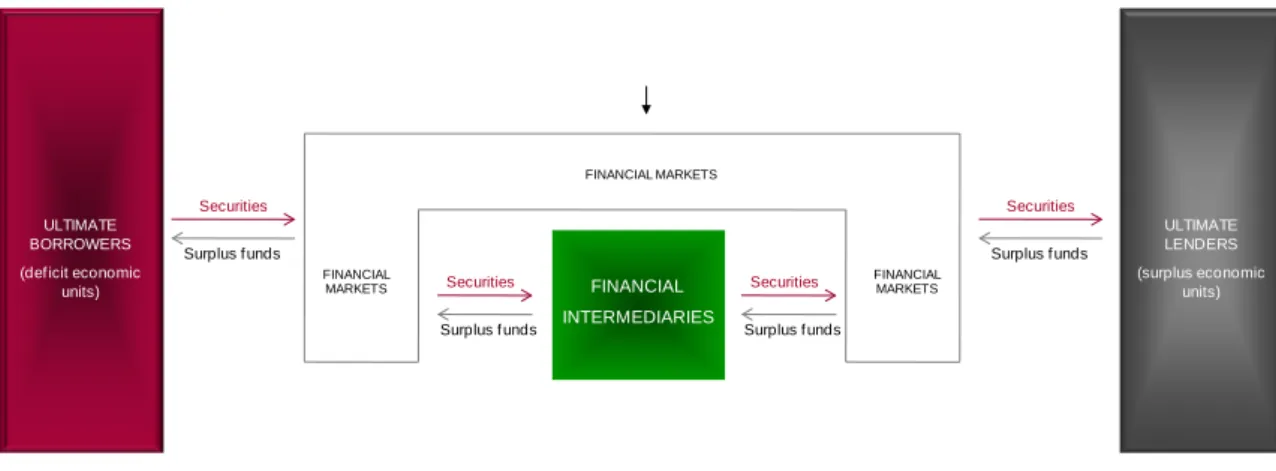
The financial system may be depicted simply as in Figure 1. It is essentially concerned with borrowing and lending and has six parts or elements (not all of which are visible in Figure 1):
• First: lenders (surplus economic units) and borrowers (deficit economic units), i.e. the non- financial-intermediary economic units that undertake lending and borrowing. They may also be called the ultimate lenders and borrowers (to differentiate them from the financial intermediaries who do both). Lenders try and earn the maximum on their surplus money and borrowers try and pay the minimum for money borrowed.
• Second: financial intermediaries, which intermediate the lending and borrowing process; they interpose themselves between the ultimate lenders and borrowers and endeavour to maximise profits from the differential between what they pay for liabilities (borrowings) and earn on assets (overwhelmingly loans). In the case of the banks this is called the bank margin. Obviously, they endeavour to pay the least on deposits and earn the most on loans. (This is why you must be on your guard when they make you an offer for your money or when they want to lend to you.)
Download free eBooks at bookboon.com
65
• Third: financial instruments, which are created to satisfy the financial requirements of the various participants. These instruments may be marketable (e.g. treasury bills) or non-marketable (e.g.
a utilised bank overdraft facility).
• Fourth: the creation of money when demanded. As you know banks (collectively) have the unique ability to create their own deposits (= money) because we the public generally accept their deposits as a means of payment.
• Fifth: financial markets, i.e. the institutional arrangements and conventions that exist for the issue and trading (dealing) of the financial instruments.
• Sixth: price discovery, i.e. the price of shares and the price of debt (the rate of interest) are
“discovered”, i.e. made and determined, in the financial markets. Prices have an allocation of funds function.
We need to present you with a little more information on these six elements.
3.3.2 Lenders and borrowers
The first element is lenders and borrowers. As seen in Figure 1, they can be categorised into the four groups or “sectors” of the economy:
• Household sector (= individuals).
• Corporate sector (= companies – private and government owned).
• Government sector (= all levels of government – local, provincial, central).
• Foreign sector (= any foreign entity – corporate sector, financial intermediaries such as retirement funds).
The members of these sectors may be either lenders or borrowers or both at the same time. For example, a member of the household sector may have a mortgage bond (= borrower by the issue of a non- marketable debt instrument) and at the same time hold a balance on your accounts at the bank (= a lender; a holder of money).
3.3.3 Financial intermediaries
The second element is financial intermediaries. As seen in Figure 1, lending and borrowing takes place either directly between ultimate lenders and borrowers [e.g. when an individual buys a share (also called equity or stock) issued by a company], or indirectly via financial intermediaries. Financial intermediaries essentially solve the differences (or conflicts) that exist between ultimate lenders and borrowers in terms of their requirements: size, risk, return, term of loan, etc.
Money Creation: An Introduction inancial system and money market
An example: your friend Johnny (a member of household sector) has LCC 10 000 he would like to lend out (= invest) for 30 days at low risk. You (a member of household sector) would like to borrow LCC 20 000 for 365 days to buy a car. You don’t mind who you borrow from, because you represent the risk, not the lender. Your and Johnny’s requirements don’t match at all; direct financing won’t work. He places his LCC 10 000 on deposit with a prime bank for 30 days and you borrow LCC 20 000 from the bank for 365 days. You and Johnny are both in high spirits; the bank satisfied your different requirements.
Financial intermediaries exist not only because of the divergence of requirements of lenders and borrowers, but for the specialised services they provide, such as insurance policies (insurance companies), retirement fund products (retirement funds), investment products (securities unit trusts, exchange traded funds), overdraft and deposit facilities (banks), and so on. The banks also provide a payments system, the system we don’t see but rely much on. The central bank provides an interbank settlement system (as we will see later).
We will turn your CV into an opportunity of a lifetime
Do you like cars? Would you like to be a part of a successful brand?
We will appreciate and reward both your enthusiasm and talent. Send us your CV on
Download free eBooks at bookboon.com
67
ULTIMATE LENDERS
HOUSEHOLD SECTOR CORPORATE
SECTOR GOVERNMENT
SECTOR FOREIGN
SECTOR ULTIMATE
BORROWERS
HOUSEHOLD SECTOR CORPORATE
SECTOR GOVERNMENT
SECTOR FOREIGN
SECTOR
INVESTMENT VEHICLES
CIs CISs
AIs CENTRAL
BANK
BANKS
BANKS Debt
Debt
Debt & shares Debt & shares
Debt & shares
Debt & shares
Debt & shares
Deposits
Deposits
Investment vehicle securities
(Pis) QFIs:
DFIs, SPVs, Finance co’s Investment co’s
Debt Interbank
debt
Interbank debt
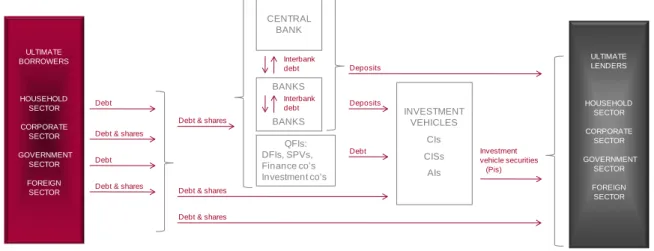
Figure 2: financial intermediaries
Box 1: financial intermediaries
MAINSTREAM FINANCIAL INTERMEDIARIES DEPOSIT INTERMEDIARIES
Central bank (CB) Private sector banks
NON-DEPOSIT INTERMEDIARIES (INVESTMENT VEHICLES) Contractual intermediaries (CIs)
Insurers
Retirement funds (pension funds, provident funds, retirement annuities) Collective investment schemes (CISs)
Securities unit trusts (SUTs) Property unit trusts (PUTs) Exchange traded funds (ETFs) Alternative investments (AIs)
Hedge funds (HFs)
Private equity funds (PEF’s) QUASI-FINANCIAL INTERMEDIARIES (QFIs)
Development finance institutions (DFIs) Special purpose vehicles (SPVs) Finance companies
Investment trusts / companies Micro lenders
Money Creation: An Introduction inancial system and money market
The main financial intermediaries that exist in most countries and their relationships with one another are presented in Figure 2. A useful classification of them is presented in Box 1. Note that the non-deposit intermediaries may also be seen as investment vehicles. Their products (= their liabilities), which can be called participation interests (PIs), are designed as investments for the household sector (and in some cases other financial intermediaries).
3.3.4 Financial instruments
The third element is financial instruments. They are also called securities; borrowers issue securities. They are therefore evidences of debt or shares. They also represent claims on the issuers / borrowers.
Ultimate lenders exchange money (deposits) for securities and ultimate borrowers exchange (issue new) securities for money. Financial intermediaries issue their own securities (e.g. deposits) and hold the securities of the ultimate borrowers (e.g. treasury bills). As you know, the banks have a special and unique role in this market for money in that they are able to create money (bank deposits) by making new loans (buying new securities).
Securities offer a return that is fixed (fixed-interest debt) or variable (variable-rate debt and share dividends). The capital amount of shares and debt is paid back after a period (bonds and preference shares) or not ever (perpetual bonds and shares). Securities are also either marketable of non-marketable.
This is discussed in more detail in the next section.
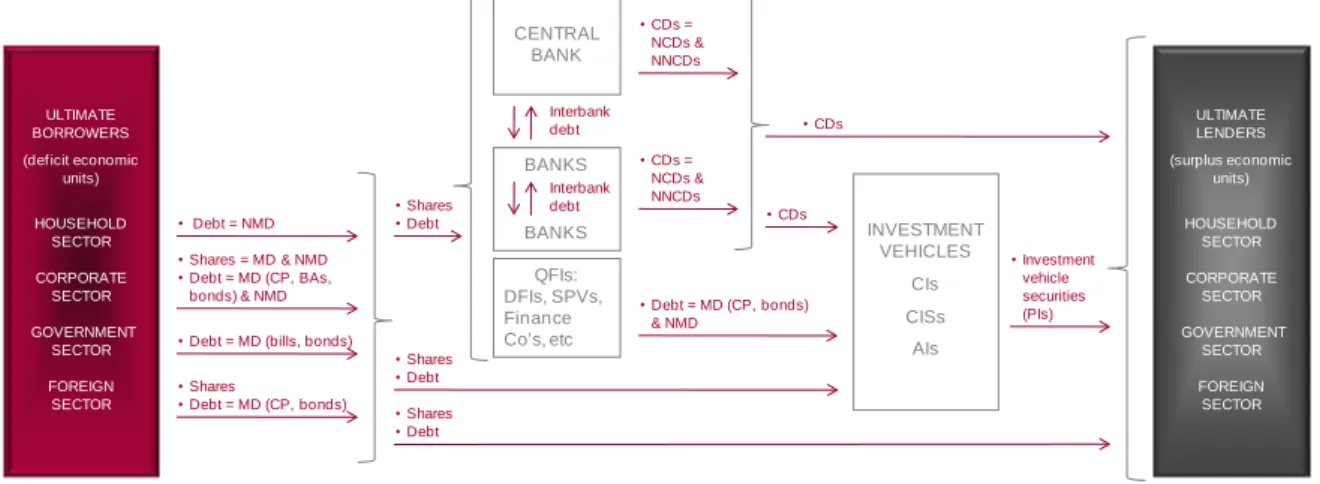
The instruments of the financial system are shown in Figure 3 and outlined below.
INVESTMENT VEHICLES
CIs CISs
AIs CENTRAL
BANK
BANKS
BANKS
•Debt = NMD
•Debt = MD (bills, bonds)
•Shares = MD & NMD
•Debt = MD (CP, BAs, bonds) & NMD
•Shares
•Debt
•Shares
•Debt
•Investment vehicle securities (PIs) QFIs:
DFIs, SPVs, Finance Co’s, etc
•Debt = MD (CP, bonds)
& NMD Interbank debt
Interbank debt
•Shares
•Debt = MD (CP, bonds)
•CDs = NCDs &
NNCDs
•CDs = NCDs &
NNCDs
•Shares
•Debt
•CDs
•CDs
MD = marketable debt; NMD = non-marketable debt; CP = commercial paper; BAs= bankers’ acceptances; CDs = certif icates of deposit (= deposits ); NCDs = negotiable certif icates of deposit; NNCDs = non-negotiable certif icates of deposit; foreign sector issues f oreign shares and f oreign MD (f oreign CP & f oreign bonds); PI = participation interest (units)
ULTIMATE BORROWERS (def icit economic
units)
HOUSEHOLD SECTOR CORPORATE
SECTOR GOVERNMENT
SECTOR FOREIGN
SECTOR
ULTIMATE LENDERS (surplus economic
units)
HOUSEHOLD SECTOR CORPORATE
SECTOR GOVERNMENT
SECTOR FOREIGN SECTOR
Figure 3: financial intermediaries & instruments / securities
Figure 3: financial intermediaries & instruments / securities
There are two categories of financial instruments:
Download free eBooks at bookboon.com
Click on the ad to read more 69
The instruments of debt and shares and their issuers are as follows:
The household sector issues:
• Non-marketable debt (NMD) securities
- Examples: overdraft loan from a bank; mortgage loan from a bank.
The corporate sector issues:
• Share securities (marketable = listed & non-marketable = non-listed) - Ordinary shares (aka common shares).
- Preference shares (aka preferred shares).
• Debt securities
- Non-marketable debt (NMD).
- Marketable debt (MD)
• Examples: corporate bonds, commercial paper (CP), bankers’ acceptances (BAs), promissory notes (PNs).
Maersk.com/Mitas
�e Graduate Programme for Engineers and Geoscientists
Month 16 I was a construction supervisor in the North Sea
advising and helping foremen solve problems I was a
he s
Real work International opportunities
�ree work placements al
Internationa or
�ree wo
I wanted real responsibili�
I joined MITAS because
Maersk.com/Mitas�e Graduate Programme for Engineers and Geoscientists
Month 16 I was a construction supervisor in the North Sea
advising and helping foremen solve problems I was a
he s
Real work International opportunities
�ree work placements al
Internationa or
�ree wo
I wanted real responsibili�
I joined MITAS because
Maersk.com/Mitas
�e Graduate Programme for Engineers and Geoscientists
Month 16 I was a construction supervisor in the North Sea
advising and helping foremen solve problems I was a
he s
Real work International opportunities
�ree work placements al
Internationa or
�ree wo
I wanted real responsibili�
I joined MITAS because
Maersk.com/Mitas
�e Graduate Programme for Engineers and Geoscientists
Month 16 I was a construction supervisor in the North Sea
advising and helping foremen solve problems I was a
he s
Real work International opportunities
�ree work placements al
Internationa or
�ree wo
I wanted real responsibili�
I joined MITAS because
www.discovermitas.com
Money Creation: An Introduction inancial system and money market
The government sector issues:
• Marketable debt (MD) securities - Treasury bills (aka TBs and T-bills).
- Bonds (aka T-bonds).
The foreign sector issues (into the local markets):
• Foreign share securities (inward listings).
• Foreign debt securities (inward listings).
The deposit financial intermediaries (central and private sector banks) issue:
• Deposit securities - Central bank
• Non-negotiable certificates of deposit (NNCDs).
• Notes and coins.
• Central bank securities110. - Private sector banks
• Non-negotiable certificates of deposit (NNCDs).
• Negotiable certificates of deposit (NCDs).
The quasi-financial intermediaries issue:
• Debt securities
- Non-marketable debt (NMD)
• Example: utilised overdraft facility.
- Marketable debt (MD)
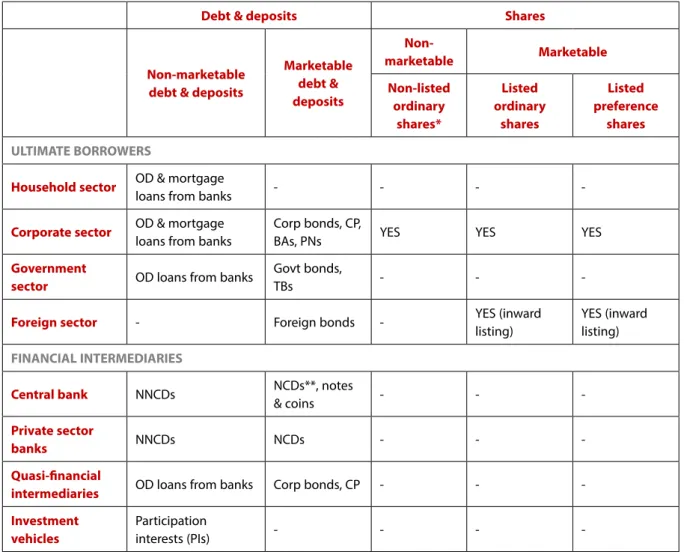
• Examples: bonds, commercial paper (CP) The above may be summarized as in Table 1.
As we have indicated, it is rare that the individual invests in these financial instruments (the exceptions are bank deposits in the form of NNCDs and shares). Rather, they invest in these ultimate financial instruments via the investment vehicles, by buying their PIs.
Download free eBooks at bookboon.com
71
Debt & deposits Shares
Non-marketable debt & deposits
Marketable debt &
deposits
Non-
marketable Marketable
Non-listed ordinary
shares*
Listed ordinary
shares
Listed preference
shares ULTIMATE BORROWERS
Household sector OD & mortgage
loans from banks - - - -
Corporate sector OD & mortgage loans from banks
Corp bonds, CP,
BAs, PNs YES YES YES
Government
sector OD loans from banks Govt bonds,
TBs - - -
Foreign sector - Foreign bonds - YES (inward
listing)
YES (inward listing) FINANCIAL INTERMEDIARIES
Central bank NNCDs NCDs**, notes
& coins - - -
Private sector
banks NNCDs NCDs - - -
Quasi-financial
intermediaries OD loans from banks Corp bonds, CP - - -
Investment vehicles
Participation
interests (PIs) - - - -
OD = overdraft); CP = commercial paper; BAs = bankers’ acceptances; PNs = promissory notes; Corp = corporate; NNCDs = non- negotiable certificates of deposit; NCDs = negotiable certificates of deposit.
* Non-listed preference shares do exist but are rare. ** Central bank (CB) securities, which are akin to NCDs.
Table 1: financial instruments / securities
3.3.5 Financial markets
The fourth element of the financial system is financial markets. Financial markets are categorised according to the securities issued by ultimate borrowers and financial intermediaries. It was noted above that financial securities are either marketable of non-marketable. Examples are non-negotiable certificates of deposit (NNCDs) (= an ordinary deposit receipt) and negotiable certificates of deposit (NCDs) issued by the private sector banks.
There are two market types or forms (see Figure 4): primary market and secondary market. All securities are issued in their primary markets and the marketable ones are traded in the secondary markets. In the primary market the issuer receives the money paid by the lender / buyer. In the secondary market the seller receives the money paid by the buyer.
Money Creation: An Introduction inancial system and money market
LENDERS BORROWERS
BUYERS SELLERS
the difference
the difference Figure 4: primary & secondary markets
Primary market
Secondary market
Funds
Securities
Funds
Securities
Figure 4: primary & secondary markets Figure 5: financial markets
LOCAL FINANCIAL
MARKETS
capital market Debt market
/ interest- bearing market / fixed-interest
market
Money market
Forex market
= conduit
Listed share market Bond
market Forex market
= conduit
FOREIGN FINANCIAL MARKETS FOREIGN
FINANCIAL MARKETS
ST debt market
LT debt market
Share market
= Marketable
part =
Marketable part =
Figure 5: financial markets
There are a number of markets for financial instruments: the market for life policies (a primary market only), the market for PIs (also called units) of securities unit trusts (a primary market and a partial secondary market: the units are saleable to the issuer), the market for PIs in retirement funds (strictly a primary market), the deposit market (primary market for NNCDs and a secondary market for NCDs), the bond market (secondary market), and so on.
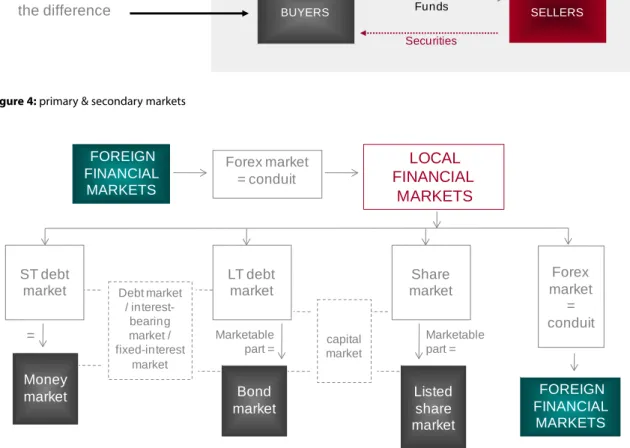
The financial markets are depicted in Figure 5. As we will show later, the money market should be defined as the short-term debt market (STDM = marketable and non-marketable debt), while the bond market is the marketable arm of the long-term debt market (LTDM).
Download free eBooks at bookboon.com
Click on the ad to read more 73
The money market (STDM) and the LTDM together make up the debt market (also known as the interest- bearing market and the fixed-interest market). The terms interest-bearing and fixed-interest oppose the debt market from the share market because the returns on shares are dividends and dividends are not fixed – they depend on the performance of companies. The LTDM and the share market is called the capital market.
The foreign exchange market is not a financial market, because lending and borrowing do not take place in this market. Rather, it is a conduit for foreign investors into local financial markets and for local investors into foreign financial markets.
In addition to these cash or spot markets [where the settlement of deals takes place a few days after transaction date (T+0)] we have the so-called derivative markets. They are comprised of instruments (forwards, futures, swaps, options and “others” such as weather derivatives) that are derived from and get their value from the spot financial markets. Whereas cash markets settle as soon as possible, derivative markets settle at some stage in the future.
Money Creation: An Introduction Figure 6: financial markets inancial system and money market
FINANCIAL INTERMEDIARIES Securities
BROKER- DEALERS
Securities Securities
FINANCIAL MARKETS
FINANCIAL MARKETS FINANCIAL
MARKETS Surplus f unds
Surplus f unds Surplus f unds
Securities Surplus f unds ULTIMATE
BORROWERS (def icit economic
units)
ULTIMATE LENDERS (surplus economic
units)
Figure 6: financial markets
Secondary markets are either over-the-counter (OTC), also called “informal markets” (such as the foreign exchange and the money markets) because there is no exchange involved, and exchange (or formal) markets, such as the share (or stock) exchange. The place of the financial markets in the financial system may be depicted as in Figure 6.
The financial markets do not intermediate the financial lending and borrowing process as do financial intermediaries such as banks; they merely facilitate the primary and secondary markets.
3.3.6 Money creation
The fifth element is creation of money. As this entire text is on money creation, we will not give it much attention here. Here follows a brief summary. When banks make new loans / provide new credit (= buy NMD, MD and shares), they create NBPS deposits (= money).
The referee in this game is the central bank which controls the growth rate in money creation (= new bank deposits resulting from new bank loans) by means that differ from country to country (which are elucidated later). The principal method is the interest rate on banks’ loans (= bank assets) via the central bank’s KIR interest rate, which influences the cost of bank liabilities (i.e. via the bank margin).
3.3.7 Price discovery
The sixth element is price discovery. Primary and secondary markets are important for a number of reasons, the most important of which is price discovery, i.e. the establishment of interest rates for various terms and the prices of shares. Interest rates, as we will see, have an important role to play in the pricing of all assets. The central bank plays a significant role in the establishment of interest rates.
These significant issues are addressed later.
Download free eBooks at bookboon.com
75 3.3.8 Allied participants on the financial system
From the above discussion it will be evident that there are a number of allied participants on the financial system. By this we mean participants other than the principals (those who have financial liabilities or assets or both). As we now know, the principals are:
• Lenders.
• Borrowers.
• Financial intermediaries.
The allied participants, who play a major role in terms of facilitating the lending and borrowing process (the primary market) and the secondary markets are the financial exchanges and their members. Also we need to mention the fund managers, who are actively involved in sophisticated financial market research and therefore play a major role price discovery, and the regulators of the financial markets. Thus the allied non-principal participants in the financial markets are:
• Financial exchanges.
• Broker-dealers.
• Fund managers.
• Regulators.
3.4 The money market
We have described the financial system, and we know that the money market is an essential part of it and the foundation of the other financial markets. We defined the money market as the STDM. As far as debt instruments are concerned, the money market encompasses:
• Primary market: the issue of all forms of short-term instruments of borrowing, that is, the short-term debt of ultimate borrowers and certain QFIs, and short-term deposit instruments.
Deposit instruments are the NNCDs and NCDs of banks and certain instruments of the central bank, the important ones of which are notes and coins (= part of money) and central bank securities (= a form of deposit, and an instrument of monetary policy).
• Secondary market: the exchange of existing marketable short-term debt instruments.
Hidden from the public’s view, however, is an integral part of the money market: the interbank market (and there are three parts to it). These markets play a significant role in money creation and monetary policy. We discuss them in some detail later. In Figure 7 we present a summary of the money market.
Money Creation: An Introduction inancial system and money market
INVESTMENT VEHICLES
CIs CISs
AIs CENTRAL
BANK
BANKS
BANKS
•ST NMD
•ST MD (T-bills)
•ST MD (CP, BAs) &
ST NMD
•ST Debt
•ST Debt
QFIs:
DFIs, SPVs, Finance
Co’s, etc •ST MD (CP) & ST NMD Interbank
debt
Interbank debt
Figure 7: money market
•ST MD (f oreign CP)
•CDs = NCDs &
NNCDs
•CDs = NCDs &
NNCDs
•ST Debt
•CDs
•CDs
MD = marketable debt; NMD = non-marketable debt; CP = commercial paper; BAs= bankers’ acceptances; CDs = certif icates of deposit (= deposits ); NCDs = negotiable certif icates of deposit; NNCDs = non-negotiable certif icates of deposit;
ULTIMATE BORROWERS (def icit economic
units)
HOUSEHOLD SECTOR CORPORATE
SECTOR GOVERNMENT
SECTOR FOREIGN
SECTOR
ULTIMATE LENDERS (surplus economic
units)
HOUSEHOLD SECTOR CORPORATE
SECTOR GOVERNMENT
SECTOR FOREIGN SECTOR
Figure 7: money markets
Download free eBooks at bookboon.com
77
3.5 Money market interest rates
We now need to address money market (or short-term) interest rates. Short-term interest rates, such as the banks’ prime lending rate, deposit rates, and so on, are made (or discovered) in the money market and longer-term interest rates are made in the bond market. How are interest rates made? Interest rates are the price of money: the rate of interest paid on debt, to compensate the lender (buyer of the debt) for foregoing liquidity (= not spending now). Usually111, the longer the debt is the higher the rate is because the lender is foregoing liquidity for longer. Interest rates are made in the primary and secondary debt (and deposit) markets. The players in the market are the lenders and borrowers and the financial intermediaries. Of the latter the central bank is the most important – it is a player and the referee.
It is necessary now to present the concepts time value of money (TVM) and yield curve (YC). TVM is best elucidated with a question: if you were offered the choice of receiving LCC 100 today or LCC 100 in one year’s time, which will you choose? Unless you have a major brain problem you will choose the latter. Why? Because it’s worth more to you: you can invest the money and have more than LCC 100 in a year’s time.
Therefore money has a present value (PV) and a future value (FV). PV is the LCC 100 now and FV is the value the LCC 100 escalated to a number in the future, the difference between the two being the rate of interest for the one-year term to maturity applied to the PV. You will now immediately understand that [ir = interest rate % pa expressed as a unit of 1 (let’s assume 10% pa or 0.1); t = term to maturity in days divided by 365]:
FV = PV + (PV × ir × t).
This equation translates to:
FV = PV × [1 + (ir × t)].
Using the above numbers we have:
FV = PV × [1 + (ir × t)]
= LCC 100 × [1 + (0.1 × 365 / 365)]
= LCC 100 × 1.01
= LCC 110.
The converse is to derive the PV from a known FV:
PV = FV / [1 + (ir × t)].
Money Creation: An Introduction inancial system and money market
Thus if we have a given number of LCC 110 in 365 days’ time (= FV) we are able to calculate the PV at the ruling interest rate for the period (again assume 10% pa):
PV = FV / [1 + (ir × t)]
= LCC 110 / [1 + (0.1 × 365 / 365)]
= LCC 110 / 1.01
= LCC 100.
This PV-FV concept (i.e. time value of money) is the principle underlying the valuation of all assets that have a monetary value / cash flow/s in the future112: money market assets, shares, bonds and income- producing property. This principle is significant in comprehending monetary policy: when interest rates increase the value of assets falls, and vice versa. This has a major impact on aggregate demand and on the demand for bank loans. As we will see, central banks focus on and have control over interest rates.
Figure 8 shows the effect on PV (= the value of the asset) of different rates of interest: the higher the rate, the lower the PV.
T+0 T+12 months
R100 000 R120 000
R110 000
R90 000 Value of
capital
time PV
= R104 761.90
FV
= R110 000
Assume: discount rate = 5% pa
PV = FV / [FV x (ir x t)]
= FV / [1 + (0.05 x 1)]
= FV / 1.05
` = R110 000 / 1.05
= R104 761.90
5% Discount rate = 10%
Discount rate = 20%
Discount rate = 5%
Figure 8: from FV to PV (the principle)
Figure 8: from FV to PV (the principle)
Now, on to the YC. In the example above the “security” had a term to maturity (ttm) of one year and an interest rate of 10% pa. The 10% pa rate is the rate determined in the secondary market for this security. Now imagine tens or hundreds of government securities (bonds and treasury bills) all with
Download free eBooks at bookboon.com
Click on the ad to read more 79
Imagine taking a snapshot of the government securities (remember: government bonds and treasury bills) market at a specific time on a specific day, i.e. you write down the rates at which all the government securities are trading. You have two parameters: ttm and market rate (called yield to maturity – ytm – in the bond market) for each security. You plot this on a chart (in a spreadsheet); you will now have a series of crosses / dots on the screen as indicated in Figure 9. You then use sophisticated stats-maths to draw a best-fit curve as indicated by the solid line in Figure 9. This is the yield curve for government securities. Formally, it is a representation of the relationship between term to maturity and interest rate (ytm) for the government securities market.
We know that the money market is the STDM and the bond market is part of the LTDM. The cut-off point between the two is arbitrarily set at one year. Thus, in the YC the rates on government securities from 1 day to a year are money market rates, and after a year the rates are bond market rates. More essential knowledge: the rates on government securities are also called risk-free rates (rfr), and this is so because if you buy a government security you will definitely114 get your money back plus the fixed rate that applied to it.
“The perfect start of a successful,
international career.”
CLICK HERE
to discover why both socially and academically the University
of Groningen is one of the best places for a student to be
www.rug.nl/feb/education
Excellent Economics and Business programmes at:
Money Creation: An Introduction Figure 9: normal yield curveinancial system and money market
Rate
% pa
Term to maturity
2 years
4 years
6 years
8 years
10 years 6
8 10 12 14
91 days 4
Market rates
YC
x x
x
x x
x x x x
x
x x x
Figure 9: normal yield curve
What is the relevance of this to money creation? It is that money creation takes place in the financial markets and it is closely related to interest rates. The government securities YC can be regarded as the
“norm” or reference, and all other (non-government) rates revolve around the norm. More importantly, the central bank has the tools to influence the bottom end of the YC to a desired level. Thus, the central bank determines the bottom end of the YC, and all other interest rates react to any changes to the YC the central bank brings about.
Also, these rates represent the lowest rates of return that can be expected on investments. Thus, if rates are pushed higher, borrowers will borrow less (= a lower rate of growth in money creation = lower inflation). Individuals will have to pay more on debt, and companies will discover that new projects for which borrowing is required may not be as feasible as before (remember companies offer a return in the form of dividends) (= a lower rate of growth in money creation). Long-term investors such as retirement funds will tend to buy more bonds and fewer shares.
Conclusion: interest rates play a vital role in money creation. But before this section ends there is a need to elucidate the composition of interest rates (see Figure 10). It will be noted that inflation is a component. What influences inflation? Money growth does.
Download free eBooks at bookboon.com
81
Figure 10: composition of nominal interest rates 1 day
1-day nominal rf r
1-day real rf r
Term to maturity
20 years 10 years
Risk-f ree rates (marketable government securities) Rates on marketable prime corporate securities Credit risk premiumcσ
Liquidity-sacrif ice premium (lsp) Interest
rate / ytm (%)
Current inf lation cπ Expected inf lation eπ
Our starting point is the one-day rate on government securities, called the nominal (it means actual) rfr for one day. This is a rate that is available in the real world. The current inflation rate (cπ) is known (at worst it is a few weeks old, but if inflation is steady it does not matter if the next one published is a few points out from the previous one); therefore you can determine the real rfr for one day (nominal rfr – cπ = real rfr).
From this point on the nominal rates on all longer-term government securities are composed of the one-day real rfr, cπ [or expected inflation (eπ) as you go longer], and the liquidity-sacrifice premium (lsp). The investor demands an lsp because s/he is sacrificing the ability to use the money now.115 The lsp increases as the ttm increases because investors demand more return for the longer sacrifice of liquidity.
You will recall that we said that the government security yield curve is the norm for rates. This statement will now become clear. Companies which borrow through the issue of bonds set the rates on their bonds with reference to the rates on government securities, that is, government securities rates are the benchmark rates for corporate bond rates. As indicated in Figure 10, they show a positive relationship with ttm.
In summary the rfr for each ttm is composed as follows:
Each rfr = one-day real rfr + π (current / expected) + lsp.
Corporate bond rates (cbr) are composes as follows (crp = credit risk premium):
Each cbr = one-day real rfr + π (current / expected) + lsp + crp.
Money Creation: An Introduction inancial system and money market
Now we know how interest rates are composed. As a quick aside: instinctively you will derive from this analysis that it is rational to benchmark any potential investment on the risk-free rates. In other words when any investment is assessed its return must be higher than the rfr as follows:
Required rate of return (rrr) = nominal rfr + a premium for credit risk.
Interest rate / ytm (%)
1 day
Term to maturity
20 years 10 years
Figure 11: money market rates & bank margin
One-day nominal rf r
Risk-f ree rates (marketable government securities)
Call deposit rate – large deposits Central bank KIR
Bank prime lending rate
Interbank loan rate
Call deposit rate – small depositors Approximate bank
margin = a - b
a
b
Figure 11: money market rates & bank margin
Back to the money market and specifically to short-term interest rates (see Figure 11).116 We know where the reference one-day nominal rfr is. One day debt / deposit rates are known as “call” rates; for example if you place a large amount of money with a bank and you have the right to withdraw it when it suits you, it is a call money deposit. The call rate can vary daily, depending on money market conditions (explained later in detail). Call rates are critical rates in the money market because this is where all interest rates have their genesis, and, critically, this is where the central bank intervenes to “set” short-term interest rates. As we will see, in some countries this “setting” of rates is virtually exact, and in others less so.
Download free eBooks at bookboon.com
Click on the ad to read more 83
We now need to focus on the bottom end (money market part) of the YC and, even more tightly, to the one-day rates. Note that “one-day rates” refers not only to one-day deposits / loans but to deposits / loans where the rate is changeable daily (in theory, and this includes overdrafts). As explicated earlier, banks endeavour to earn a healthy margin. A large proportion of banks’ deposits are for one day, i.e. on call.
In the case of the household sector consider cheque deposit accounts, savings accounts, transmission accounts and small call deposit accounts. The rate paid on these deposits is represented in Figure 11 by the dot denoted “call deposit rate – small depositors”. For the large deposits at call, which is a major component of banks’ deposits, a higher call rate is paid – the dot denoted “call deposit rate – large depositors”. The latter plays a mammoth role in the money market – which will become clearer later – in that they are savvy as far as what bank call rates should be, and demand the highest rates. If a bank slips on its quote the call deposit money will move to another bank. So, the market for large call deposits is efficient indeed.
All other deposit rates are related to the banks’ call rates for large deposits. As we move further into the longer-term the rates are usually higher, but they are still related to the call rates.
LIGS University
based in Hawaii, USA
▶
enroll by October 31st, 2014 and▶
save up to 11% on the tuition!▶
pay in 10 installments / 2 years▶
Interactive Online education▶ visit www.ligsuniversity.com to find out more!
is currently enrolling in the Interactive Online BBA, MBA, MSc,
DBA and PhD programs:
Note: LIGS University is not accredited by any nationally recognized accrediting agency listed by the US Secretary of Education.
More info here.
Money Creation: An Introduction inancial system and money market
Now consider the bank margin we spoke about earlier. As profit-maximising entities banks endeavour to maximise the margin, by paying the least for deposits and earning the most on loans extended. Their benchmark rate for credit extended is called the prime lending rate, which we will call prime rate. This is called a benchmark rate because it is a high profile rate, i.e. published at all times. It is the rate for low risk customers; all other bank credit rates are benchmarked on prime rate. Thus, you may be paying prime + 1% pa for your overdraft facility utilised while your wealthy pal may be paying prime. A large company may pay prime minus 1.5% pa, while a smaller one may be paying prime and so on and so forth. In figure 11 the bank margin is approximately denoted.
Two other one-day rates are indicated in Figure 11 that we have not spoken of before: the interbank rate and the central bank’s lending rate to banks, the KIR. Both these are interbank rates, and we now turn to these and related issues.
3.6 The interbank markets
3.6.1 Introduction
Part of the money market is 1-day loans of banks to other banks, called the interbank loan market or just the interbank market (IBM). Here we need to differentiate the private sector banks and the central bank. We also need to reintroduce the balance sheets of these two very different types of banks: see Balance Sheets 1 and 2. Note that in order to simplify the analysis, we make the following assumptions (which do not affect the principles discussed):
• Private sector banks are denoted banks.
• Capital and reserves, other assets and other liabilities are ignored.
• Government only banks with the central bank (which is the case in most countries).
• Loans to government sector means holdings of government bonds and treasury bills.
• We regard all deposits as short-term (= money).
• The banks hold no foreign deposits / assets.
• Bank notes do not rank as reserves, which does apply in a number of countries. We assume this because when bank notes rank as reserves the story becomes complicated and detracts from the principles we are attempting to bring across clearly.
From the balance sheets of the central bank we can gauge its main functions, which we will discuss in more detail later. Banks are uncomplicated intermediaries; they take deposits from the public and provide loans to government and the NBPS – or do they? In a static balance sheet it seems so, but when their balance sheets expand the story is different – as you now know, new loans creates new money. Apart from this main function they have transactions with the central bank as you can see from the other balance sheet items. Note the highlighted items: it is through these accounts that the IBM functions.
Download free eBooks at bookboon.com
85
BALANCE SHEET 1: CENTRAL BANK (LCC BILLIONS)
Assets Liabilities
D. Foreign assets E. Loans to government
F. Loans to banks (borrowed reserves – BR)
1 000 1 100 400
A. Notes and coins B. Deposits
1. Government
2. Banks’ reserve accounts (TR) a. Required reserves (RR = 500) b. Excess reserves (ER = 0) C. Foreign loans
1 000 900 500
100
Total 2 500 Total 2 500
BALANCE SHEET 2: BANKS (LCC BILLIONS)
Assets Liabilities
C. Notes and coins
D. Reserves with central bank (TR) 1. Required reserves (RR = 500) 2. Excess reserves (ER = 0) F. Loans to government G. Loans to private sector
100 500
1 000 3 800
A. Deposits of NBPS (BD) B. Loans from central bank (BR)
5 000 400
Total 5 400 Total 5 400
The IBM is where the settlement of interbank claims takes place and where monetary policy begins.
In some countries banks have two accounts with the central bank: a reserve account on which required reserves (RR) are held and a settlement account (SA) over which the settlement of interbank claims takes place. In other countries banks have one account with the central bank, and it has many names: reserve account, settlement account, cash reserve account, and so on. Here we refer to it as reserve account. On these accounts the banks hold their required RR and (if any) their excess reserves (ER). The total of the two amounts we call total reserves (TR). Thus:
TR = RR + ER.
There are three interbank “markets” of which only one is a true market, i.e. where a market rate is determined (the IBM rate – see Figure 12117, note that it is below the KIR).
Money Creation: An Introduction inancial system and money market
3.6.2 The bank-to-central bank interbank market
The first IBM is the bank-to-central bank interbank “market”, or b2cb IBM. It is an “administrative”
market in which the flow is one-way: from the banks to the central bank in the form of the cash reserve requirement. As mentioned earlier we will refer to the cash reserve requirement amount as required reserves (RR). The banks’ RR are held on their reserve accounts with the central bank. In the vast majority of countries the RR balances earn no interest, which is an essential element in monetary policy (as we will elucidate later). Another important element of monetary policy in most countries is that banks are kept chronically short of reserves by the central bank (see later), such that ER for the banking system does not exist.
Download free eBooks at bookboon.com
87
Figure 12: IBM rate & KIR
5 7 9 11 13 15 17 19 21
97 99 01 03 05 07
interbank rate repo rate
Figure 12: IBM rate & KIR
KIR
IBM rate
To elucidate the RR further: in most countries banks are required by statute to hold a certain ratio of their deposits in an account with the central bank. It has its origin in the gold coin reserves held by the goldsmith-bankers from the seventeenth century and later in voluntary note and deposit holdings with the Bank of England. In our accompanying balance sheets (1 and 2) the banks have deposits (BD) of LCC 5 000 billion, an assumed statutory RR ratio (rr) of 10% of deposits, and RR with the central bank of LCC 500 billion. They therefore are holding the minimum required (TR = RR), and they do so because, as noted, the central bank does not pay interest118 on reserves. Note also in this example that the banks are borrowing LCC 400 billion from the central bank, so it will not have ER (this critical issue is illuminated in much detail below). In summary, as regards the b2cb IBM:
BD × rr = RR = TR.
LCC 5 000 billion × 0.10 = LCC 500 billion = TR.
ER = 0.
3.6.3 The central bank-to-bank interbank market
The second IBM is the central bank-to-bank interbank “market”, or cb2b IBM. It is also an “administrative”
market, and it is at the centre of the vast majority of countries’ monetary policy. It represents loans from the central bank to the banks (also called borrowed reserves – BR). The central bank provides these reserves at its KIR. As seen in the balance sheets above:
BR = LCC 400 billion.
Money Creation: An Introduction inancial system and money market
In most countries monetary policy is aimed at ensuring that the banks are indebted to the central bank at all times so that the KIR is applied and therefore is “made effective” on part of the liabilities of the banks (recall from Figure 2: bank liabilities = BD + BR). The KIR has a major influence on the banks’
deposit rates and, via the more or less static bank margin, on the banks’ prime rate119. This, as we will show later in some detail, is an extremely successful policy protocol.
3.6.4 The bank-to-bank interbank market
The third interbank market is a true market: the bank-to-bank interbank market, or b2b IBM. This market operates during the banking day but particularly at the close of business each day (banks “close off their books” every day). Allow us present an example: a large corporate customer (Company A) withdraws LCC 100 billion of its call money deposits from Bank A and deposits it with Bank B – because Bank B offered a higher call money rate.
How does the settlement of these transactions take place between the two banks? It takes place over the banks’ reserve accounts: item B2 in Balance Sheet 1, and item D in the Balance Sheet 2. Balance Sheets 3 – 6 elucidate the story.
BALANCE SHEET 3: COMPANY A (LCC BILLIONS)
Assets Liabilities
Deposit at Bank A Deposit at Bank B
-100 +100
Total 0 Total 0
BALANCE SHEET 4: BANK A (LCC BILLIONS)
Assets Liabilities
Reserve account at CB -100 Deposits (Company A) -100
Total -100 Total -100
BALANCE SHEET 5: BANK B (LCC BILLIONS)
Assets Liabilities
Reserve account at CB +100 Deposits (Company A) +100
Total +100 Total +100
Download free eBooks at bookboon.com
Click on the ad to read more 89
BALANCE SHEET 6: CENTRAL BANK (LCC BILLIONS)
Assets Liabilities
Reserve accounts:
Bank A
Bank B -100
+100
Total 0 Total 0
Assuming that at the close of business yesterday the two banks were not borrowing from the central bank (BR = 0) and they did not have any surpluses with the central bank (TR = RR; ER = 0):
• Bank A is now short of RR by LCC 100 billion, and therefore does not comply with the RR (TR < RR).
• Bank B now has surplus reserves (TR > RR or TR – RR = ER = LCC 100 billion).
BALANCE SHEET 7: BANK A (LCC BILLIONS)
Assets Liabilities
Deposits (Company A) Loan (Bank B)
-100 +100
Total 0 Total 0
www.mastersopenday.nl Visit us and find out why we are the best!
Master’s Open Day: 22 February 2014
Join the best at
the Maastricht University School of Business and Economics!
Top master’s programmes
• 33rd place Financial Times worldwide ranking: MSc International Business
• 1st place: MSc International Business
• 1st place: MSc Financial Economics
• 2nd place: MSc Management of Learning
• 2nd place: MSc Economics
• 2nd place: MSc Econometrics and Operations Research
• 2nd place: MSc Global Supply Chain Management and Change
Sources: Keuzegids Master ranking 2013; Elsevier ‘Beste Studies’ ranking 2012;
Financial Times Global Masters in Management ranking 2012
Maastricht University is the best specialist
university in the Netherlands
(Elsevier)
Money Creation: An Introduction inancial system and money market
BALANCE SHEET 8: BANK B (LCC BILLIONS)
Assets Liabilities
Loan to Bank A +100 Deposits (Company A) +100
Total +100 Total +100
We assume this is the only transaction that takes place during the day, and that bank B does not have outstanding borrowings from the central bank. We are now at the close of business. The electronic interbank settlement system presents the two banks with the above information that pertains to each of them. Bank A needs to borrow LCC 100 billion and Bank B would like to place its ER somewhere at a rate of interest. The somewhere at the end of the business day is only the other banks (in this case Bank A).
The final interbank clearing process at the end of the business day takes place over these same reserve accounts with the central bank. In this b2b IBM the surplus bank, Bank B, will place its ER of LCC 100 billion with Bank A, and this will take place at the IBM rate (after some haggling). Bank B will instruct the central bank to debit its reserve account and credit Bank A’s reserve account. The central bank’s balance sheet will be unchanged, and the banks’ balance sheets appear as in Balance Sheets 7 and 8.
Thus, in the b2b IBM, banks place funds with or receive funds from other banks depending on the outcome of the clearing. Surpluses are placed at the IBM rate. A critical issue here is that this rate is closely related to the KIR (as shown in Figure 12) because banks endeavour to satisfy their liquidity needs in this market before last resort borrowing from the central bank at the KIR. In this example it was possible. Later we will show that when the central bank does a deal in the open market (= open market operations or OMO) it affects bank liquidity. And as you now know, when one speaks of bank liquidity one makes reference to the state of balances on the banks’ reserve accounts: the status of TR, RR, ER and BR. As we will demonstrate later, the central bank has total control over bank liquidity, and therefore over interest rates. Figure 13: interbank markets
CENTRAL BANK
BANKS
BANKS Required reserves (RR) (b2cb IBM)
IBM loans (b2b IBM)
Loans to = borrowed reserves (BR) (cb2b IBM) Securities
ULTIMATE LENDERS
HOUSEHOLD SECTOR CORPORATE
SECTOR GOVERNMENT
SECTOR FOREIGN
SECTOR ULTIMATE
BORROWERS
HOUSEHOLD SECTOR CORPORATE
SECTOR GOVERNMENT
SECTOR FOREIGN
SECTOR OTHER
FINANCIAL INTERMEDIARIES Securities
Securities
Securities
Figure 13: interbank markets
Download free eBooks at bookboon.com
91
In the b2b IBM no new funds are created; existing funds are merely shifted around. New funds (reserves) are created in the cb2b IBM (in the long term). The latter is a function of the ability of banks to create money in the form of deposit money120. This they are able to do without restraint121 and the central bank supports this by the creation of the additional RR (a function of deposit growth). Is it as simple as this?
We will answer this essential question a little later.
We portray the interbank markets in Figure 13.
In order to concretise comprehension of the b2b IBM we present another example:
• Company A sells goods to Company B to the value of LCC 100 million; Company A’s banker is Bank A.
• Company B borrows LCC 100 million to buy the goods; Company B’s banker in Bank B.
It will be evident that this is a case of bank deposit money creation; the balance sheets appear as in Balance Sheets 9–13 just before the final interbank market clearing takes place. Note that we ignore the effect of the transactions on RR for now.
BALANCE SHEET 9: COMPANY A (LCC MILLIONS)
Assets Liabilities
Goods
Deposits at Bank A
-100 +100
Total 0 Total 0
BALANCE SHEET 10: BANK A (LCC MILLIONS)
Assets Liabilities
Reserve account at CB +100 Deposits (Company A) +100
Total +100 Total +100
BALANCE SHEET 11: COMPANY B (LCC MILLIONS)
Assets Liabilities
Goods +100 Loans from Bank B +100
Total +100 Total +100
Money Creation: An Introduction inancial system and money market
BALANCE SHEET 12: BANK B (LCC MILLIONS)
Assets Liabilities
Loans to Company B Reserve account at CB
+100 -100
Total 0 Total 0
BALANCE SHEET 13: CENTRAL BANK (LCC MILLIONS)
Assets Liabilities
Reserve accounts:
Bank A Bank B
+100 -100
Total 0 Total 0
The final IBM takes place: Bank A makes an interbank loan to Bank B at the interbank rate, and instructs the central bank to debit its account and credit the account of Bank B. Company A’s and Company B’s balance sheets do not change; only the banks’ do and end up as indicated in Balance Sheets 14–15.
> Apply now
redefine your future
AxA globAl grAduAte
progrAm 2015
Download free eBooks at bookboon.com
93
BALANCE SHEET 14: BANK A (LCC MILLIONS)
Assets Liabilities
Loan to Bank B +100 Deposits (Company A) +100
Total +100 Total +100
BALANCE SHEET 15: BANK B (LCC MILLIONS)
Assets Liabilities
Loans to Company B +100 Loan from Bank A +100
Total +100 Total +100
It will be evident that the money stock has increased by LCC 100 million (= deposit of Company A) and the BSCoC is the bank credit increase of LCC 100 million; the real cause is the demand for credit by Company B which was satisfied by its banker, Bank B.
3.6.5 Money creation and the central bank-to-bank interbank market
The b2cb IBM represents the banks’ RR (= a ratio of BD required by statute) on which interest is not