5 Metal Packaging
Bev Page, Mike Edwards and Nick May
5.1 OVERVIEW OF MARKET FOR METAL CANS
The total world market for metal containers is estimated at 410 billion units per annum. Of this, drink cans account for 320 billion and processed food cans account for 75 billion. The remainder are aerosol and general line cans. Drink cans may be divided into those for non- carbonated drinks (liquid coffee, tea, sports drinks, etc.) and carbonated beverages (soft drinks and beer), many of which pass through a pasteurisation process.
Tinplate cans for processed foods have been in existence for about 200 years. The first true canning factory in the world, which had been set up in Bermondsey, London, by John Hall and Bryan Donkin, sold perishable foods to the public packed in tinplate containers, for the first time, in 1812.
5.2 CONTAINER PERFORMANCE REQUIREMENTS
Metal packages for food products must perform the following basic functions if the contents are to be delivered to the ultimate consumer in a safe and wholesome manner:
r
preserve and protect the productr
resist chemical actions of the productr
withstand the handling and processing conditionsr
withstand the external environment conditionsr
have the correct dimensions and the ability to be practically interchangeable with similar products from other supply sources (when necessary)r
have the required shelf display properties at the point of saler
give easy opening and simple/safe product removalr
be constructed from recyclable raw materialsIn addition, these functions must continue to be performed satisfactorily until well after the end of the stated shelf-life period. Most filled food and drink containers for ambient shelf storage are subjected to some form of heat process to prolong the shelf life of the product. For food cans, this will normally provide a shelf life of up to 2–3 years or more. The heat process cycles used to achieve this are particularly severe, and the containers must be specifically designed to withstand these conditions of temperature and pressure cycles in a steam/water atmosphere. Following
Food and Beverage Packaging Technology, Second Edition. Edited by Richard Coles and Mark Kirwan.
C 2011 by Blackwell Publishing Ltd. Published 2011 by Blackwell Publishing Ltd.
heat processing, when the can temperature has returned to ambient, there will normally be a negative pressure in the can, i.e. a vacuum. Under these conditions, the food product itself does not provide any strength to the can to resist external loads.
In the case of carbonated beverage cans, which form the bulk of drink cans filled, once the container is closed, the carbonation pressure continues to provide significant physical support to the container until the moment of opening. In the case of still liquids, such as juices, juice drinks and wine, nitrogen gas may be used to provide the necessary internal pressure for rigidity and compression strength of thin-walled DWI containers.
5.3 CONTAINER DESIGNS
Regardless of the particular can-forming process used, the shapes of metal containers are very relevant to their cost, physical performance and compatibility with the filled product.
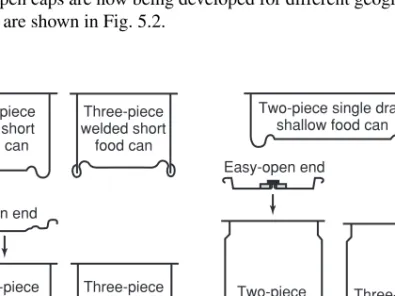
For most metal food and drink containers the cost of the metal itself is 60–70% of the total container cost. The amount of metal in any particular container is, therefore, the most significant cost item, and this is related to the metal thickness, temper and its surface area. In can design, metal thickness is determined by the need for physical performance in handling, processing and storage of the filled container. Surface area is determined by the volume contents and the chosen shape of the container. For ease of manufacture, handling, filling and closing, most food and drink cans have a circular cross section. However, for different physical performance, cost and product uses, cans may vary from shallow (height less than the diameter) to tall (height greater than the diameter). Fig. 5.1 demonstrates typical circular food and drink container shapes.
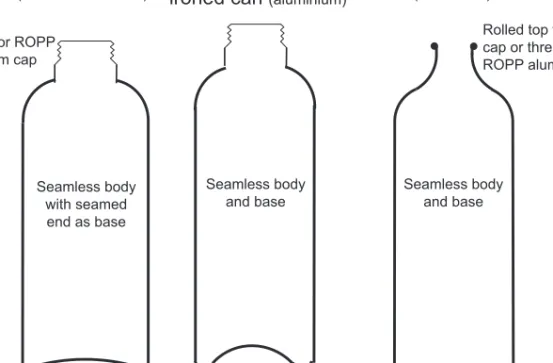
In 2001, the first metal bottle shaped can with a ROPPTM(roll on pilfer proof) aluminium cap was produced commercially in Japan. New designs of bottle cans with reclosable caps, crown corks or other easy-open caps are now being developed for different geographical markets, and some typical designs are shown in Fig. 5.2.
Two-piece DRD short food can
Two-piece single draw shallow food can Easy-open end
Two-piece DWI drink
can
Three-piece welded drink
can Two-piece
DWI or DRD tall food can with side wall beads
Three-piece welded short food can
Three-piece welded tall
food can with side wall beads Plain end
Fig. 5.1 Typical round section food and drink cans.
Impact extruded can
(aluminium)
Drawn can
(steel or aluminium)
Seamless body with seamed end as base
Seamless body and base Thread for ROPP
aluminium cap
Rolled top for crown cap or thread for ROPP aluminium cap
Drawn and wall ironed can (aluminium)
Seamless body and base
Fig. 5.2 Typical bottle cans.
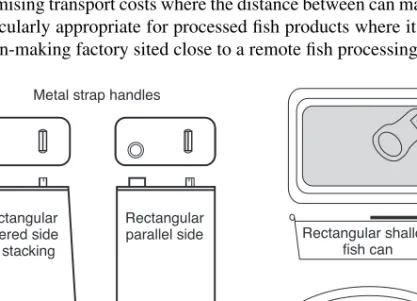
Non-round cross section containers are typically used for fish and meats that are heat pro- cessed, as well as for products, such as edible oils, which do not need to be processed. These are described in Fig. 5.3.
Shallow tapered wall seamless cans, whether round or non-round, allow empty containers to be nested for minimising transport costs where the distance between can maker and filler is very great. This is particularly appropriate for processed fish products where it is not economically viable to have a can-making factory sited close to a remote fish processing and packing unit.
Metal strap handles
Plastic drop handle Wire drop handle
Pouring aperture Edible oil cans Rectangular
tapered side for stacking
Rectangular parallel side
Oval shallow fish can Rectangular shallow
fish can
Fig. 5.3 Typical non-round section food cans.
Open trays of round or non-round section are used for baked food products or with lids as take away food containers. Powder products, such as dried milk, instant coffee and infant formulae, are packed into circular cans with lever lids and diaphragm seals.
Closure systems for food and drink cans are by necessity very different in their mode of operation. Food cans require an aperture with either total or virtually full internal diameter of the container through which to remove the product, whereas the aperture for drink cans is designed to suit the method of consumption. Historically, food cans have required a can-opening tool to remove the plain lid. In more recent years, full aperture easy-open ends (FAEOs) have been developed based on designs originally used for drink products. Whether plain or easy-open ends are used, the end panel for virtually all food and drink cans is mechanically seamed-on to produce a double seam that is capable of withstanding all the heat-processing cycles in use.
Further developments of food can ends have produced a peelable membrane end that com- prises an aluminium membrane heat sealed onto a plain end, which has had the centre section of the panel removed. In this case, the heat seal operation is performed by the can-maker in a clean environment prior to the complete end being mechanically seamed onto the can after filling.
While heat-sealing of foil lids onto metal containers also withstands full-heat process cycles, provided overpressure is applied to the retort to reduce the expansion load on the foil membrane, a recent design of peelable membrane end is capable of withstanding full-heat process cycles without over pressure being applied.
Other pack sealing systems, commonly used for less demanding products, have screw top closures with wads or sealant material to ensure adequate performance.
5.4 RAW MATERIALS FOR CAN-MAKING
Steel and aluminium are used for metal container and closure construction for food and drink products. Both are relatively low-cost materials that are non-toxic, having adequate strength and are capable of being work hardened.
5.4.1 Steel
Steel is used in the form of a low-carbon steel that is initially produced as blackplate. This is then converted into tinplate or tin-free steel (TFS) for container and closure manufacture.
Tinplate is created by electrolytically coating blackplate with a thin layer of tin. The tin is coated on both sides of the plate in thickness to suit the internally packed product and the external environment. Different thicknesses of tin may be applied to each side of the plate.
Tin, plated in sufficient thickness, provides good corrosion-resisting properties to steel, and is suitable for direct contact with many products, including specific foodstuffs, such as white fruits (e.g. peaches, apricots, pineapple and pears) and certain tomato-based products (e.g. tomatoes in juice and beans in tomato sauce). However, for most foods and drinks it is necessary to apply an organic coating to the inside surfaces of the tinplate container to provide an inert barrier between the metal and the product packed. This barrier acts to prevent chemical action between the product and container and to prevent taint or staining of the product by direct contact with the metal (see later). The tin surface assists in providing good electrical current flow during welding processes. Being a very soft metal, it also acts as a solid lubricant during the wall ironing process of forming two-piece thin wall cans.
TFS, also referred to as electrolytic chromium/chrome oxide coated steel (ECCS), is created by electrolytically coating blackplate with a thin layer of chrome/chrome oxide. This must then be coated with an organic material to provide a complete corrosion-resistant surface. The metallic layer of ECCS provides an excellent key for adhesion of liquid coatings or laminates to the surface. ECCS is usually marginally less expensive than tinplate. However, being a matt surface, after coating with clear lacquer it does not provide a reflective surface like tinplate. ECCS in its standard form is not suitable for welding without prior removal of the chrome/chrome oxide layer. The Japanese steel makers have developed modified tin-free metallic coatings for steel that do permit satisfactory welding of this material.
5.4.2 Aluminium
Aluminium for light metal packaging is used in a relatively pure form, with manganese and magnesium added to improve the strength properties. This material cannot be welded by can- making systems and can only be used for seamless (two-piece) containers. The internal surfaces of aluminium containers are always coated with an organic lacquer because of the products normally packed.
5.4.3 How steel and aluminium are used in metal packaging Aluminium is inherently less strong than steel, so this limits where it may be economically used for the construction of metal packaging. Also, as stated in Section 5.4.2, aluminium cannot be used for making three-piece welded side seam containers. Aluminium is, however, used for pressurised containers, where wall strength is not so critical, for products, such as beer, carbonated drinks in DWI cans and also for seamless impact extruded aerosols and collapsible tubes. It is used for shallow or short drawn seamless cans for processed foods, such as fish and pˆat´e. (Economic wall strength is not sufficient to withstand full heat process conditions in tall food cans.) Only aluminium can be used for roll-on pilfer proof caps as the metal must be soft to take up the shape of the underlying bottle thread.
Steel can be used to make all types of metal package except where impact extrusion is employed for forming a two-piece seamless body, because steel is not soft enough to respond to this particular forming process. Steel may be used for all other metal packaging formats except roll-on pilfer proof caps. ECCS (tin-free steel) cannot normally be used for welding as the chromium surface is not compatible with the welding process (special systems have been used for first removing the chrome from the steel surface but these are not very practical). ECCS can only be used for DWI cans when extruded polymers have first been applied to the metal surfaces; however, these processes are still in the development stage.
Most steel-based packaging is formed from tinplate as the presence of tin on the surfaces gives good corrosion resistance (and electrical conductivity to aid the welding process). Blackplate, steel with no additional metallic coating, is restricted to use on welded containers for non- corrosive products, such as oils and greases. The surface of tin-free steel provides better adhesion for liquid organic coatings or polymer coatings than does tinplate. Tin-free steel is then used where good adhesion is particularly important. Examples of these are can-ends, where the process of making and seaming them on to can bodies results in severe deformation of the metal, and in the manufacture of polymer-coated steel for drawn food cans. Tin-free steel is also a little less expensive than most ‘low tin weight’ tinplate.
5.4.4 Sustainability – the infinite recycling loop of metal for packaging
5.4.4.1 Saving CO2 and natures resources
The natural resources required for the manufacture of metal packaging are some of the most plentiful elements available from our natural resource base, with aluminium and iron-ore being the 3rd and 4th most available after oxygen and silicon. Recycling of metals significantly cuts down the use of virgin raw materials and energy. The more metals are recycled, the more their environmental credentials are improved by effectively reducing the amount of CO2 released.
The increased recycling of steel and aluminium will save on natural resources and further reduce the carbon emissions for steel and aluminium packaging.
5.4.4.2 Light-weighting and yield
Over the last 20 years, metal cans have become considerably lighter. Improvements in can- making technology and the continuous development of metal grades have made possible the down-gauging (light-weighting) of cans in the can-making process. The reduction of the weight of cans is a major contributor to the prevention of waste.
There has always been a great emphasis on reduction of metal used at source in can-making operations because, as already mentioned in Section 5.3, the value of the metal used is generally in the order of 60–70% of the manufacturing cost and, therefore, also affects the efficiency of material use a criterion for sustainability. Metals for packaging are mostly purchased by area, which makes it possible to closely align purchase quantities with those actually used. For the same reasons, over the years, many developments have been introduced across the industry to minimise material waste from offcuts, web scrap and finished product scrap. Light-weighting has additionally also been ongoing for years on the back of technical process improvements.
The introduction of the DWI can for drinks and later processed foods being one of the main drivers in this, together with other processes where high throughput speeds and high efficiencies can be achieved. Data recently released by EMPAC (European Metal Packaging, the European trade association for the metal packaging industry) demonstrates that over the last 20 years the market for food and drinks cans, in steel and aluminium, has increased by 57%. Over this same period, the absolute quantity of virgin metal used had reduced by 20%, net CO2emissions and net energy usage have reduced by 50 and 60%, respectively. To maintain and improve on this excellent record, it will be necessary to increase the percentage of containers recycled into new metal from sources of post consumer waste.
5.4.4.3 Closed-material loop
When it comes to recycling there are two different streams: the pre-consumer (from production) and post-consumer (end of life time) scrap streams. Recycling waste material from the can- making process into new metal has been a very high priority for many years because these materials have inherent value in the economics of these processes. Not only that but every metal production plant is a recycling plant – recycled material is a vital part of the metal-making process. Metal is different to other packaging materials like paper and plastic because metals (steel and aluminium) are recycled on an atomic level. This means that once re-melted, recycled metal is indistinguishable from new metal smelted from ore and that these metals may be re- melted an infinite number of times without loss of properties. This material property makes it a
unique packaging material. During the re-melting process minor contaminants, such as tin and organic coatings do not cause any problems in the steel making itself. Gaseous effluents arising from these are contained within the steel-making process. In some cases, tin metal can also be reused in the packaging steel-making process.
Steel scrap from packaging and non-packaging sources is needed in the steel-making process to control liquid iron temperature in a converter during the exothermic reaction at carbon reduction by flushing oxygen. This effectively means an old bridge may become a new can and an old can may become part of a new car and so on. In Europe, roughly 80% of all steel used goes back into the metal recycling loop over and over again.
5.4.4.4 Recycling reduces CO2
Recent studies on sustainability of metal packaging confirm that an increased recycling of post- consumer metal-packaging waste (after end of life) reduces the amount of new metal that needs to be produced as virgin material. The use of recycled metal is infinitely more beneficial in the reduction of CO2emissions than the reduction of energy, transport or metal usage in container manufacture and delivery. With metals, the energy used in the mining, transportation of raw materials and smelting operations to produce new metal from ore can be seen as being locked-up in the metal forever to be used in a next material life, whatever it is used for.
5.4.4.5 Minimised green house gas (GHG) and food waste
The food supply chain has been highlighted as a significant contributor to green house gas (GHG) emissions. Canned food can offer a low energy route to preserving food when it is not possible to supply fresh, locally grown, in season, produce. The benefits of canned food, in terms of reduced GHG emissions, are significant when compared to alternative forms of preserving food, such as freezing.
One of the main environmental benefits arising from fresh food packed into metal cans, which are then heat processed, is that the pack is then stored at ambient temperature for the remainder of its life. Metal packaging has excellent barrier properties – 100% protection from light, air and water – ensuring maximum product quality. Products packed in metal do not require additives to preserve them. Canned food may be stored for years – no further energy being required purely to preserve the integrity of the product. In many underdeveloped countries, vast quantities of agricultural products go to waste because they have become inedible before they can be consumed. Preserving these products by packing into heat-processed metal containers at source can provide a satisfactory solution to this issue. Furthermore, it does not matter how far away the final customer is located from the original source of the fresh product or how long it takes to arrive, as the contents once opened will still be fresh with no additional energy required to keep it so.
5.5 CAN-MAKING PROCESSES
Food and drink cans may be constructed either as three-piece or two-piece containers. Three- piece cans consist of a cylindrical body rolled from a piece of flat metal with a longitudinal seam (usually formed by welding) together with two can ends, which are seamed onto each end of the body. The three-piece can-making process is very flexible, as it is possible to produce
almost any practical combination of height and diameter. This process is particularly suitable for making cans of mixed specifications, as it is relatively simple to change the equipment to make cans of different dimension. Container size flexibility facilitates the use of pack promotions, offering free extra product.
Two-piece cans are made from a disc of metal that is reformed into a cylinder with an integral end to become a seamless container. To this is seamed a loose end to finally close the can. Drawing is the operation of reforming sheet metal without changing its thickness.
Re-drawing is the operation of reforming a two-piece can into one of smaller diameter, and therefore greater height, also without changing its thickness. Drawn and re-drawn containers are often referred to as DRD cans.
Ironing is the operation of thinning the wall of a two-piece can by passing it through hardened circular dies. The draw and wall ironing process (DWI) is very economical for making cans where the height is greater than the diameter and is particularly suited for making large numbers of cans of the same basic specification.
Two-piece impact extruded cans, which may only be formed in aluminium, are commonly used for making pressurised aerosol containers. The advent of bottle shaped cans has brought this technology into use for some designs of drink container. This process, like the DWI system, is used for containers where the height is greater than the diameter.
5.5.1 Three-piece welded cans
Three-piece welded food cans are only constructed from steel, as aluminium is not suitable for welding by this particular process. Coils of steel, after delivery from the steel maker, are cut into sheets approximately one metre square. The cut sheets are then coated, and printed if necessary, to protect and decorate the surfaces. Areas where the weld will be made on the can body are left without coating or print to ensure the weld is always sound. The coatings and inks are normally dried by passing the sheets through a thermally heated oven where the temperature is in the range 150–205◦C. Alternatively, for some non-food contact uses, ultraviolet (UV)-sensitive materials may be applied. These are cured instantaneously by passing the wet coating/ink under a UV lamp.
The sheets are next slit into small individual blanks, one for each can body, each blank being rolled into a cylinder with the two longitudinal edges overlapping by approximately 0.4 mm.
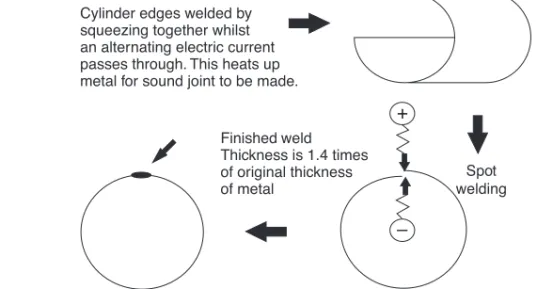
The two edges are welded by squeezing them together whilst passing an alternating electric current across the two thicknesses of metal (see Fig. 5.4). This heats up and softens the metal sufficiently for a sound joint to be made. If the can is internally coated with lacquer, it is generally necessary to apply a repair side stripe lacquer coat to the inside of the weld to ensure coating continuity over the whole can.
For food cans, the can body now passes through a flanging machine where the top and bottom of the can body are flanged outwards to accept the can ends. For drink cans, the top and bottom edges of the can body are necked-in to reduce the diameter prior to the creation of the flanges.
This permits ends to be fitted, which are smaller in diameter than that of the can body, reducing the cost of the end and the space taken up by the seamed can.
For both food and drink cans, one end is then mechanically seamed on to the bottom of the can body. This end is commonly referred to as the maker’s end (ME). Where easy-open ends are fitted to three-piece cans, it is common practice for this end to be fitted at this point, leaving the plain end (non-easy-open) to be fitted after filling. This practice allows the seamed easy-open end to pass through the finished can-testing process. The end applied by the packer/filler after can filling is commonly referred to as the canner’s end (CE).
Cylinder rolling Flat blank
Cylinder edges welded by squeezing together whilst an alternating electric current passes through. This heats up metal for sound joint to be made.
Finished weld Thickness is 1.4 times of original thickness of metal
Spot welding
Necking, flanging, beading as for DWI can
+
–
Fig. 5.4 Three-piece can welding principles.
At this stage, tall food cans (height-to-diameter ratio more than 1.0) pass through a beading machine where the body wall has circumferential beads formed into it. The beads provide additional hoop strength to prevent implosion of the can during subsequent heat process cycles.
All cans finally pass through an air pressure tester, which automatically rejects any cans with pinholes or fractures. This completes the manufacture of empty three-piece food and drink cans.
In Europe, USA and some of the far eastern countries, three-piece welded side seam cans largely replaced those with soldered side seams during the 1980s. Other countries have now followed so that relatively few soldered side seam cans are now made in the world. Of these, some for special products use pure tin solder, which is not very strong and, therefore, can only be used for heavyweight cans.
5.5.2 Two-piece single drawn and multiple drawn (DRD) cans Pre-coated, laminated and printed tinplate or TFS is fed in sheet or coil form in a reciprocating press that may have single or multiple tools. At each tool station the press cycle cuts a circular disc (blank) from the metal, and whilst in the same station draws this in to a shallow can (cup).
During the drawing process the metal is reformed from flat metal into a three-dimensional can without changing the metal thickness at any point. After this single draw, the can may be already at its finished dimension. However, by passing this cup through a similar process with different tooling, it may be re-drawn into a can of smaller diameter and greater height to make a draw–redraw can (DRD). This process may be repeated once more to achieve the maximum height can. At each of these steps, the can base and wall thickness remain effectively unchanged from that of the original flat metal. These processes are shown in Fig. 5.5. Following this body-forming operation, necking, flanging and beading operations follow according to the end use and height-to-diameter ratio of the can (as for three-piece welded cans).
The DRD forming process lends itself to the manufacture of round and non-round shallow taper wall containers in either aluminium or TFS. The economic benefits of utilising these containers for certain markets is described in Section 5.3.
Drawn into Disc cut from coil or sheet
shallow can
Flange formed in top wall
Drawn into Disc cut from coil or sheet
shallow cup
Redrawn into cup with smaller
diameter
Redrawn into can with final diameter Single draw shallow can
Multiple draw tall can (necking, flanging, beading as for DWI can) Fig. 5.5 Two-piece drawn can forming.
For all two-piece cans pinhole and crack detection on finished cans is carried out in a light- testing machine. This measures the amount of light passing across the can wall, using high levels of external illumination. One advantage of two-piece cans is that there is only one can end instead of two, meaning that one major critical control hazard point is eliminated.
The single drawing process is also used to make aluminium, or steel, tapered shallow trays for eventual heat-sealing with coated metal foil. The container bodies are constructed from metal laminated with organic film. The single drawing process is also used for the manufacture of folded aluminium baking trays and take away containers. In this process, the aluminium is allowed to fold, as the metal is converted from a flat sheet into a shaped container.
5.5.3 Two-piece drawn and wall ironed (DWI) cans
The DWI cans are constructed from uncoated tinplate or aluminium. However, DWI cans for processed food are only made from tinplate as thin wall aluminium cans do not have sufficient strength to withstand the heat process cycles.
For this process, which is described in Fig. 5.6, the coiled metal, as it is unwound, is covered with a thin film of water-soluble synthetic lubricant before being fed continuously into a cupping press. This machine blanks and draws multiple shallow cups for each stroke, as described under the section entitled Drawn cans above. The cups are then fed to parallel body-making machines that convert the cups into tall cans. This is the drawing and ironing process where the cups are first redrawn to the final can diameter and then rammed through a series of rings with tungsten carbide internal surfaces, which thin (iron) the can walls whilst at the same time increasing the can height. During this process, the can body is flooded with the same type of lubricant used in the cupping operation. In addition to assisting the ironing process, the lubricant cools the can body and flushes away any metallic debris. No heat is applied to the can during this process – any heat generated being from the cold working of the metal as it is thinned. After the forming of the can body the uneven top edge of the can is trimmed to leave a clean edge and a can of the correct overall height. Trimmed can bodies are passed through chemical washers and then dried. This process removes all traces of lubricant and prepares the metal surfaces for internal and external coating and ultimately external decoration (drink cans only).
Flange formed in top wall
Flange formed in top wall Strengthening
beads formed in side wall
Top wall necked in
Drink cans Food cans
Drawn into Disc cut from coil
shallow cup
Redrawn into cup with smaller
diameter
Wall thinned by ironing
Fig. 5.6 Two-piece drawn and wall ironed (DWI) can forming.
For food cans, which will ultimately receive a paper label, an external coating is applied by passing them under a series of waterfalls of clear lacquer that protects the surface against corrosion. The lacquer is dried by passing the cans through a heated oven. Following this, the can body now passes through a flanging machine where the top of the can is flanged outwards to accept the can end, which will be fitted after the can is filled with product. The flanged can is next passed through a beading machine that forms circumferential beads in the can wall, to give added strength to the can. After all the mechanical forming operations have been completed, every can is tested by passing through a light tester that automatically rejects any cans with pinholes or fractures. The inside of each can is then coated with lacquer using an airless spray system. The special lacquer is applied to protect the can itself from corrosion and prevent its contents from interacting with the metal. This lacquer is finally dried in a thermal oven at a temperature of about 210◦C.
For drink cans, the clean cans are coated externally with a clear or pigmented base coat that forms a good surface for the printing inks. The coating is then dried by passing the cans through a thermally heated oven. The next step is a high-speed printer/decorator that applies the printed design around the outside of the can wall in up to eight colours plus a varnish. A rim coater applies a heavy varnish to the base of each can in order to provide added protection against scuffing during distribution and external corrosion, especially as such products are often kept in the cold humid conditions of chilled refrigerators. The cans now pass through a second oven to dry the ink and varnish. The inside of each can is coated with lacquer using an airless spray system. The special lacquer is applied to protect the can itself from corrosion and prevent its contents from interacting with the metal. This lacquer is finally dried in an oven at a temperature of about 210◦C. Following this, the can body now passes through a necker/flanger machine where the diameter of the top wall is first reduced (necked-in) before the top edge is
flanged outwards to accept the can end. After all the mechanical forming operations have been completed, every can is tested by passing it through a light tester that automatically rejects any cans with pinholes or fractures.
5.5.4 Two-piece impact extruded cans
In this forming process, a thick disc of uncoated aluminium, equal in diameter to that of the finished can, is punched at high speed whilst being retained in a fixed die of the same diameter.
The end of the punch tool is the diameter of the inside of the finished can. The can wall is generated as the cold metal flows up the side of the punch. From this point onwards, most of the subsequent mechanical operations are very similar to those used for DWI cans. These cans are always printed in-line to take advantage of the bright surface condition of the aluminium metal. After all the coating and printing operations have been completed, the top of the can is shaped or swaged down to a significantly smaller diameter to accept the closure that may be, in the case of a bottle can for example, a screw cap or crown top.
5.6 END-MAKING PROCESSES
Can ends for mechanical double seaming are constructed from aluminium, tinplate or TFS.
Aluminium and TFS are always coated on both sides with organic lacquer or film laminate whilst the metal is still in coil or flat sheet form. For tinplate these coatings are optional, depending upon the product being packed in the container and the specified external environmental conditions.
The base of a three-piece can will always be a plain end (non-easy-open). For food cans, the top may be plain (requiring an opening tool), full aperture easy-open (FAEO) or peelable membrane. Historically, rectangular solid meat cans have employed a key opening device to detach both the scored body section and ME; these are now gradually being replaced by rectangular panel full aperture easy-open ends. For drink cans, the top is usually referred to as a Stay-on Tab (SOT), enabling the opening tab and pierce-open end section to be retained on the can. The SOT end has largely superseded the traditional ring-pull end.
All ends for processed food cans have a number of circular beads in the centre panel area to provide flexibility. These allow the panel to move outwards, as internal pressure is generated in the can during the heating cycle of the process, and so reduce the ultimate pressure achieved in the can. During the cooling process, this flexibility permits the centre panel to return to its original position.
Ends for beer and carbonated drink cans do not require the above feature as the can’s internal pressure is always positive. The plate thickness and temper have to be appropriate to the level of carbonation of the product and, if applicable, pasteurisation treatment; otherwise, excessive internal pressure may cause can ends to peak or distort.
5.6.1 Plain food can ends and shells for food/drink easy-open ends
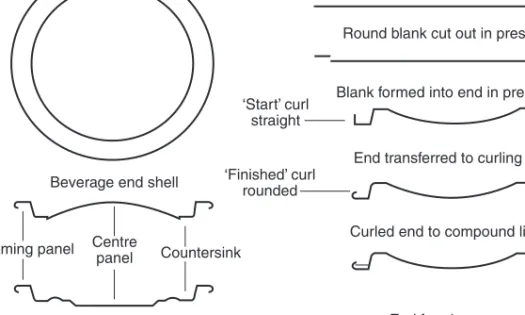
The initial processes for making plain food can ends and easy-open ends for food and drink cans are the same. The body of an end that will be ultimately converted into an easy-open end is referred to as a shell.
Beverage end shell
Centre
panel Countersink Seaming panel
Plain food end End forming process
Curled end to compound lining End transferred to curling tool Blank formed into end in press tool
Round blank cut out in press tool Prepared metal sheet or strip
‘Start’ curl straight
‘Finished’ curl rounded
Fig. 5.7 Plain end forming.
Plain ends/shells may be stamped directly from wide coils of metal or from sheets cut from coils. Whether from coil or sheet, the metal is fed through a press that produces multiple stampings for every stroke. After removal from the forming tool, the edges of the end shells are then curled over slightly to aid in the final operation of mechanical seaming the end onto the flange of the filled can. After curling, the end shells are passed through a lining machine that applies a bead of liquid-lining compound around the inside of the curl. This process is described in Fig. 5.7.
The compound lining is a resilient material that, during mechanical forming, will flow into the crevices of the double seam and thereby provide a hermetic seal.
5.6.2 Conversion of end shells into easy-open ends
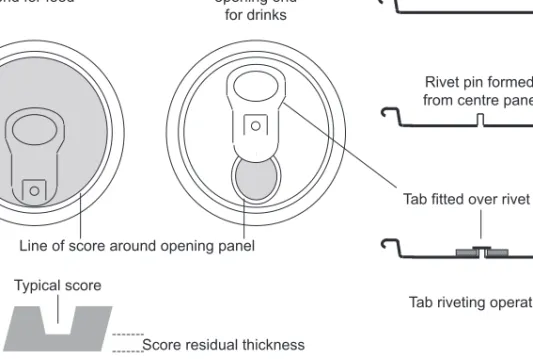
The principles used in the conversion of end shells are the same for both full aperture food easy-open ends and small aperture drink easy-open ends. The conversion operations comprise scoring (partially cutting through) the perimeter of the opening panel and attaching a metal tab with which to tear-open the panel. These operations are described in Fig. 5.8. Scoring is necessary to reduce the force required to open the end to an acceptable level.
The pull-tab is made from a narrow strip of pre-coated aluminium or steel, which is in coil form. The strip is first pierced and cut, and then the tab is formed in two further stages before it is ready to be joined to the end shell.
The shells pass through a series of dies that score them and form a hollow upstanding rivet in the centre panel of the shell. The tab is then placed over the upstanding rivet on the shell, and the rivet is deformed to make a joint between the two components. The finished ends, ready for capping the filled cans, are packed into paper sleeves and palletised for shipment to the can filler.
Typical score
Internal surface of end
Score residual thickness
Plain end shell
Rivet pin formed from centre panel
Tab fitted over rivet pin Full panel opening
end for food
Stay-on-tab opening end for drinks
Tab riveting operation Line of score around opening panel
Fig. 5.8 Easy-open end conversion.
5.6.3 Peelable membrane ends for food cans
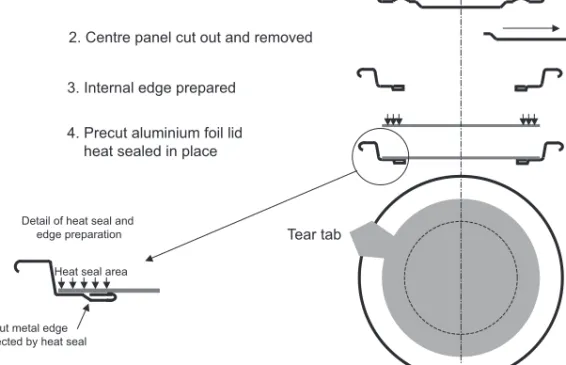
A peelable membrane end is essentially a plain aluminium or steel food can end with part of the centre panel removed as a disc and replaced by a pre-cut aluminium membrane that is heat sealed to the remaining part of the centre panel. Fig. 5.9 shows the assembly of this end from which it will be noted that the cut edge remaining after removal of the disc is folded back on itself so that the raw metal edge is protected within the heat seal area.
5.7 COATINGS, FILM LAMINATES AND INKS
Organic materials are used to provide barrier or decorative coatings to metal containers and closures. These may be in the form of liquid-applied coatings and inks, film laminates or hot extruded polymer. Film laminates and hot extruded polymers are generally applied by the metal manufacturer prior to dispatch to the can maker. For three-piece cans, two-piece drawn containers and can ends, the metal is coated and printed by the can maker while it is flat, in coil or sheet form, prior to the can or end-forming operations. For two-piece drawn and wall-ironed containers all coating and decoration is carried out after the can body has been formed.
The coating of metal coil or sheet is always done by roller-coating. For three-piece welded cans with an internal coating, it is usually necessary to apply a coating to the inside of the weld area after the body has been made. This may be done by roller-coating or powder/liquid spray.
The internal surfaces of two-piece DWI cans are coated by airless spray. Although lacquer coatings provide a barrier to metal pick-up, there may be defects present, such as micro-channels, micro-cracks or fissures through which metallic ions can transfer to the product. The degree of metal exposure in a lacquered DWI can may be tested by conductivity measurements, using an electrolyte solution. For DWI food cans, where paper labels are normally applied, the outside
Tear tab 1. Standard plain end
2. Centre panel cut out and removed
3. Internal edge prepared
4. Precut aluminium foil lid heat sealed in place
Detail of heat seal and edge preparation
Heat seal area
Cut metal edge protected by heat seal
Fig. 5.9 Peelable membrane end.
surface is flood coated with clear lacquer with the can in the upturned position. Drink cans have an optional external coating that is applied by roller, prior to printing. This is used to enhance the can decoration and, for this reason, is usually white.
Metal printing of these products may be onto flat sheet or circular cans, as appropriate.
The processes used are, respectively, offset lithography or dry offset. Inks and coatings are formulated for curing by either thermal oven or ultra violet (UV) lamp, depending on the particular chemistry of the material. Selection of these materials for thermal or UV curing is dependent on the specific end product and whether food or lip contact is an issue.
5.8 PROCESSING OF FOOD AND DRINKS IN METAL PACKAGES
It is beyond the scope of this text to discuss the production of the full range of food and drink products that are put into metal containers. This section focuses on the production of foods and drinks in cans, rather than, for example, aluminium trays, though equivalent process stages can be assumed. The text covers stages that will be common to many processes, highlighting generalised good practice where the process challenges the container.
5.8.1 Can reception at the packer
The suitability of a can and end for a given application should be confirmed with the supplier before use. In an ideal world, this would also involve shelf-life trials to ensure that product quality is maintained throughout the intended shelf life, though with long-life products, production may commence before full results are available.
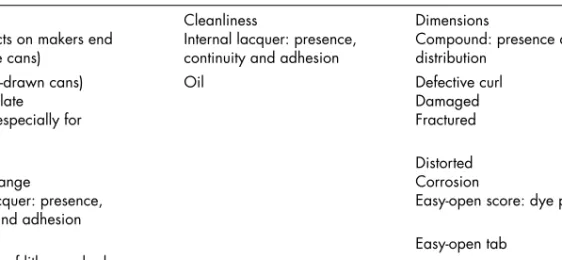
Table 5.1 Summary of quality assurance checks on in-coming containers at food packers.
External inspection of can bodies
Internal inspection of can
bodies Inspection of can ends
Dimensions Cleanliness Dimensions
Seam defects on makers end (three piece cans)
Internal lacquer: presence, continuity and adhesion
Compound: presence and distribution
Welds (non-drawn cans) Oil Defective curl
Fractured plate Damaged
Pin holed (especially for embossing)
Fractured
Damaged Distorted
Defective flange Corrosion
External lacquer: presence, continuity and adhesion
Easy-open score: dye penetration
Rust Easy-open tab
Print quality of lithographed cans
The level of inspection of containers and ends when delivered to the food/drink packer depends upon the working relationship with the supplier. Some packing companies, with well- established relationships, do no inspection and rely upon certificates of conformance. Other packers carry out inspections according to long established practice, e.g. a small sample per bulk delivery, whilst others use statistical sampling plans.
Each unit of cans delivered, e.g. pallet, should be identified to allow traceability to the production lot. Inkjet coding of can bodies aids traceability. It is a good practice to use can lots in production sequence so that when defects are identified at packing, the whole lot can be put on hold more easily. Likewise, the time of use of a lot of cans should be recorded, so that when a defect is identified after packing the affected finished product can be recalled.
Packers should maintain a library of defective containers, and at the earliest possible opportunity classify defective containers that are found into critical, major or minor in order to keep findings in perspective. Samples of defects are commonly retained for examination by agents of the can suppliers, to aid in decision making on the fate of a lot. Inspections of empty cans may include the checks in Table 5.1.
Cans awaiting use should be kept in appropriate dry, clean conditions and free from potential mechanical damage. Extra care is required for partially used pallets returned to stock, to ensure they are adequately re-protected.
5.8.2 Filling and exhausting
Cans should be depalletised outside of food production areas to minimise the risk of secondary packaging contaminating the food. It is common to see ends being removed from paper sleeves in food production areas, near the can seamers, but it is not the best practice. Cans should be inverted and cleaned prior to filling. The cleaning may be carried out by an air jet, steam or water (or a combination) depending on the anticipated contamination risk. Ideally, the can cleaning operation will start automatically when the filling line begins because when the cleaning machines are in the roof space of a factory they can accidentally remain switched off.
Filling should be carried out accurately, as consistency is important for the performance of the container through later process stages (food safety and legality are also considerations
though outside of the scope of this text). The operation should also take place without damage to the can. Product should not be filled in such a manner as to physically prevent the placement of the end on the can. The operation should avoid external contamination of the can and the flange area. Food contamination of can flanges can affect the formation of the seam at closing.
In some industry sectors, contamination of the flange is difficult to avoid, e.g. canning of small fish where it is difficult to prevent fins from overlapping the can. Manufacturing controls should be in place to minimise the possibility of such cans being seamed, e.g. pre-seamer inspection.
After filling, food cans are commonly exhausted to create a vacuum in the headspace, once the end is applied. Exhausting may be by hot-filling of the product, passing cans through a heated chamber (exhausting box), injection of steam into the headspace or seaming in a vacuum chamber. A vacuum between 10 and 20 in.Hg is common for canned foods; however, alternative levels may be seen for containers with low headspace (0–6 in.Hg) or high vacuum packs, such as sweet-corn in a little brine (26 in.Hg). The vacuum created is multifunctional. For some products, a high vacuum is required to minimise oxidative deterioration of product, e.g. fat rancidity, discolouration or corrosion of the can itself (see later). For some packs, the vacuum level must be tightly controlled to prevent container damage due to gas expansion during the sterilisation process. The extent to which this is an issue will depend upon the tendency of the can contents to expand, particularly the headspace, and the sensitivity of the container, e.g.
cans with easy-open ends or weak plate. Where pack damage is likely the can vacuum will be routinely monitored after seaming.
Historically, the presence of a vacuum in food cans has been used as an indicator of freedom from spoilage of the contents. Loss of vacuum is therefore sometimes detected by dud-detection systems as an indicator of pack failure prior to finished product labelling.
The objectives for pressure control in beverage and beer cans are quite different from food cans, as the aim is a positive pressure in the finished pack. However, excessively high pressures must be avoided. Control involves de-aeration of ingredients and using low filling temperatures to give greater stability of the carbonation. The use of low filling temperatures does create a risk of external condensation after closure.
For carbonated beverages at the filling head there is a balance in the force required to hold the can against the head and that required to restrain pressures developed during filling.
Its has been suggested that can pressurisation might be used for food cans as a means of light-weighting cans, but so far this technology has not been taken up by industry.
Effective washing of cans after filling is required to minimise external carry over of food/drink components that may contribute to container corrosion at a later process stage, e.g. acid syrups or brine.
5.8.3 Seaming
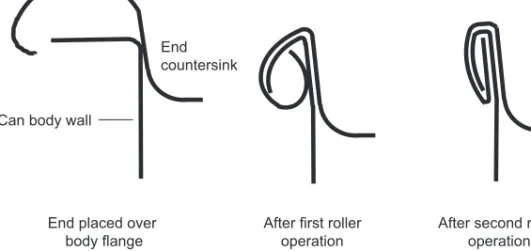
The most important closure type used for metal containers is the double seam. The seam is formed in two operations from the curl of the can end and the flange of the can body (Fig. 5.10).
However, foil trays such as those used on the pet food industry can be heat sealed to achieve an equivalent hermetic closure.
For heat sterilised foods, the operation of the can seamer/sealer is critical to process safety and would normally be regarded as a critical control point in a hazard analysis for such products. The control is the correct set-up of the can seamer for the can being closed. This critical control point will be monitored by periodic visual inspection, e.g. every 30 minutes and measurements from seam tear-downs or cut sections (e.g. one can per seamer head every four hours of continuous
End placed over body flange
After first roller operation
After second roller operation Can body wall
End seaming panel
End countersink
Fig. 5.10 Stages in the formation of a double seam.
production) (Department of Health, 1994). For beverage cans, the safety risks are less significant but seam defects can have huge financial implications, so standards are equally high. Additional inspections should be carried out after jams where cans have become trapped in the seamer.
A successful operation requires well trained staff to maintain and operate the seamers and to assess seam quality.
Ideally, seam specifications are provided by the can maker, though under some circumstances in-house standards are used (though it would be unwise to allow greater tolerances than those given by the can maker). To aid comparison between suppliers, general seam standards are available from organisations, such as the Metal Packaging Manufacturers Association (MPMA, 1993, 2001). These define seam parameters, and clarify those that are considered critical for acceptable can seams. In the UK, a typical list would include the following parameters:
r
seam thicknessr
seam height (length)r
overlapr
free spacer
body hook buttingr
% wrinkle or tightness rating (this parameter is unusual as it is not measured from the seam section but by visual inspection of the removed cover hook)These parameters are measures of the extent of folding of the hook created by the can body flange into the hook created by the end curl, ensuring that there is sufficient overlap and that the layers of metal are sufficiently compressed together (Fig. 5.11).
In other parts of the world, different parameters may be emphasised. For example, in the USA, body hook butting is commonly not considered, while greater emphasis is placed upon overlap and the presence of a visible and continuous pressure ridge.
It should be noted that although there is some interchangeability between seamer tooling and can suppliers, it is a good practice to recheck seamer performance when changes are planned.
When assessing a seam, it is normal to take multiple sections. For cans with a soldered or welded side seam, the weld is taken as 12 o’clock, and sections would typically be taken from 2 and 10 o’clock, which is historically where most problems occur. For drawn cans two points opposite each other are used. For more complex shapes, which are more difficult to seam, a
F E A G
D
B
A – Seam length B – Seam thickness C – Countersink depth D – Body hook E – End hook F – Overlap G – Seam gap
C
Fig. 5.11 The main measured parameters in a double seam.
greater number of sections are taken, e.g. two long sides and all four corners of a rectangular can.
It is a good practice to produce control charts of the critical seam parameters so drift or step changes in values can be quickly identified, and corrected. There are moves towards seamers that are intelligent enough to manage the seam formation process, preventing the formation of defective seams.
5.8.4 Heat processing
The temperatures to which cans are exposed to during food and drink sterilisation and pasteurisa- tion processes is relatively low compared to those used in the can manufacturing process, so will not generally be a limiting factor. However, the combined temperature/mechanical conditions in a retort are challenging to containers.
When cans undergo sterilisation or pasteurisation by heating, internal pressure developed inside the container can be sufficient to cause distortion of the container, or opening of easy- open scores on can ends. This potential is greatest at periods of maximum pressure differential between the process medium and the can interior, for example during the change from heating to cooling. The design of cans allows for the pressure developed during normal food manufacturing operations; however, this still relies upon correct operation of the heating equipment to ensure that pressure differentials are not excessive. For example, for a classic batch steam retort, when cooling commences it is common for the operator to introduce both water and compressed air into the retort so that as the steam collapses, the air provides the external pressure to prevent the can from distending. Failure to control the air pressure profile correctly will cause significant damage to batches of cans, typically referred to as peaking (distension) or panelling (collapse).
Likewise, in continuous sterilisation systems, such as reel and spiral retorts that operate with transfer valves between pressurised shells, these valves must maintain the correct pressure.
Loading of batch heat processing systems may be by layers of cans into a basket, commonly onto a false bottom that drops with successive layers (a Busse system) or scramble packed.
Generally, scramble packing will present greater challenges to the container than layered loading due to container-container impacts. The effect of these impacts can be minimised by loading the baskets in a water tank.
Rotary batch retort systems require layers of cans to be clamped down into baskets using a pneumatic or mechanical press, preventing can movement during the heat process that will result in impact/scuffing damage. However, balanced against the desire to restrain movement is the need to avoid crushing of any part of the load.
The heating environment can create extra difficulties in terms of prevention of external container corrosion as electrochemical reactions can be established between the machinery and container, through process water (Mannheim et al., 1983). In steam retorts, carry over of boiler chemicals and entrapment of air in the retort may also have some impact upon corrosion. Older retorts tend to be constructed of mild steel that gradually corrodes, rust particles present on cans at the end of the heat process will add to corrosion problems on containers.
Some plant and retort designs are inherently damaging to the lacquers on can ends because the cans are rolled on their seams. Embossed codes used by packers can also challenge can integrity and corrosion protection.
Beverage cans requiring pasteurisation are typically heat processed in tunnel pasteurisers, or hot filling may be sufficient.
5.8.5 Post-process drying
The drying of sterilised food containers after cooling is critical to minimise microbiological recontamination risks. For both food and beverage cans, drying of cans is important to prevent external container corrosion during storage.
It is well established that can double seams are not completely settled immediately after heat processing, to the extent that very small volumes of water may be sucked back through the seams.
If water entering the can carries microorganisms, the recontamination can lead to either food poisoning or spoilage (CCFRA, 1980). This possibility can be minimised by ensuring seams are of good quality (and that the pack is free from other puncture defects), by ensuring good hygienic conditions immediately after sterilisation and by drying containers. One means of minimising microbiological recontamination risks is to use cooling water containing biocides, such as free chlorine, though levels should be controlled to prevent accelerated container corrosion.
To a large extent food can drying may be achieved by removing containers from the heat process at a temperature sufficiently high to drive off residual moisture. There is, however, an upper temperature limit, as commercially sterile products should not be held within the growth temperature range of thermophilic microorganisms that will survive the heat process. A (shaken can) temperature of about 40◦C is recommended for cans leaving a retort.
Various types of drying aide can be used, including:
r
tipping devices to empty water from countersunk endsr
air knivesr
hot beds upon which cans are rolledLabelling, and shrink wrapping of pallets, when cans are wet is particularly problematic because of prolonged entrapment of water.
5.8.6 Container handling
Any visual defect on a container should be regarded as significant, simply because it may influence a customer’s decision to purchase that container. Where the defect is severe this may
threaten the integrity of the container either by puncture or by allowing corrosion. The US National Food Processors Association has published guidelines for sorting of defective food cans (NFPA, 1975).
Failure to re-engineer container handling systems that repeatedly cause damage must be regarded as bad practice. Impacts during handling after the heat process, especially on seam areas, play a significant part in allowing microbiological recontamination of can contents.
Guide-rails on conveyor systems should avoid contact with sensitive seam areas. Necked in designs for cans reduce seam to seam impacts.
5.8.7 Storage and distribution
Both processed and empty cans should be stored in controlled conditions. Condensation, which can lead to corrosion (see Section 5.14), is a major issue if inappropriate combinations of container temperature, air temperature and air humidity are allowed to occur. The risk of condensation at a given set of storage conditions can be predicted, using psychrometric charts.
Historically, the use of tempering rooms to avoid sudden changes of temperature has been recommended but the use of desiccants within secondary packaging is more realistic. Freezing of filled cans should also be avoided to prevent deformation of cans due to ice expansion.
Absence of water is important to minimise external corrosion and also to prevent ingress of bacteria through the can seams. For example, shipping containers and any building used for storage should be water tight.
Pallet systems used for transporting cans should restrain the load in a manner, which min- imises the risk of damage during distribution. This may involve using a frame on top of the pallet, straps and/or shrink wrapping. The pallets themselves should be in a good mechanical condition. Protruding nails can present a food safety risk by can puncture, it is also a bad practice to use staple guns in close proximity to finished cans for the same reason. The moisture content and chemistry of pallet wood and other secondary packaging materials should be suitable to prevent corrosion issues.
Can specifications should include the axial loads that they can sustain, which enables makers to advise on maximum stacking heights for storage of finished goods, to prevent compression of lower cases of product. Warehouse practices should ensure even distributions of weight on supporting pallets. Containers should be held off the floor, and away from walls, to prevent moisture build-up. Division of stocks into smaller units will aid in ventilation.
Stocks of canned goods should be regularly inspected to remove damaged containers, as one defective container can trigger a chain reaction through the spread of moisture and corrosive product spills through a stack.
Many instances of food poisoning associated with post-process leakage of cans have resulted from case cutter damage at the point of opening for retail display (Stersky et al., 1980).
5.9 SHELF LIFE OF CANNED FOODS
Canning of foods is a method of food preservation that relies upon the hermetic sealing of foods inside a metallic container and the sterilisation of the food by heat treatment. No preservatives are, therefore, necessary to prevent the food spoiling due to the growth of microorganisms.
Some chemical reactions can, however, continue to take place inside the can, albeit slowly;
these include breakdown of colour, flavour and other natural food components. In addition, the food interacts with the container.
The shelf life of canned foods is determined by a variety of factors but all relate to deteriorative reactions of some form or another, either those introduced during production or processing activities or those occurring during storage. In order to understand these processes better, it is important to be able to define shelf life more exactly. Shelf life can be defined in two ways:
minimum durability and technical shelf life.
1. Minimum durability is defined as the period of time under normal storage conditions during which a product will remain fully marketable and will retain any specific qualities for which express claims have been made. However, beyond this point the food may still be satisfactory for consumption.
2. Technical shelf life is defined as the period of time under normal storage conditions after which the product will not be fit to eat.
For example:
r
a canned fruit product is being sold with the claim ‘contains 10 mg/100 g of vitamin C’.On production, the product contained more than 10 mg/100 g but after 18 months storage the vitamin C has been broken down to only 7.5 mg/100 g. The minimum durability has, therefore, been exceeded but this loss of vitamin does not make the food unfit to eat. The technical shelf life has, therefore, not been reached
r
a second product is found after 2 years to contain 250 mg/kg of tin. This level is above the maximum EU legal level of 200 mg/kg tin (Commission Regulation No. 242/2004 of 12 February 2004 amending Regulation No 466/2004), and so the technical shelf life has been exceededThree main factors affect the shelf life of canned foods and are implicated in deteriorative reactions.
1. Sensory quality of the foodstuff; including colour, flavour (plus taints), texture.
2. Nutritional stability.
3. Interactions with the container.
The first two of these are outside the scope of this chapter, the remainder of which will con- centrate on container interactions, both with the can contents and with the external environment.
5.9.1 Interactions between the can and its contents
All foods interact with the internal surface of the can in which they are packed. The most common form of this interaction is as corrosion. In plain tinplate containers, this takes the form of etching or pitting corrosion and staining of the surface may also occur. However, as described earlier in this chapter, internal lacquers are available that reduce this effect by providing a barrier between the food and the metal can wall. This also allows the use of other forms of metal container (e.g. tin-free steel or aluminium) that would otherwise be corroded very quickly.
Only tinplate has any corrosion resistance to the acids found in foods in the unlacquered form: all the other metals must be lacquered. Even tinplate must be lacquered where particularly aggressive products are packed, such as tomato pur´ee, or where there is a danger of pitting corrosion or surface staining (e.g. in meat products).
5.9.2 The role of tin
Conventional food cans are composed primarily of steel with a thin layer of tin applied to the internal and external surfaces. The tin coating is an essential component of the can construction and plays an active role in determining shelf life. The most significant aspect of the role of the tin coating is that it protects the steel base-plate, which is the structural component of the can.
Without a coating of tin, the exposed steel would be attacked by the product, and this would cause serious discoloration and off-flavours in the product and swelling of the cans; in extreme cases, the steel could be perforated and the cans would lose their integrity. The second role of tin is that it provides a chemically reducing environment, any oxygen in the can at the time of sealing being rapidly consumed by the dissolution of tin. This minimises product oxidation and prevents colour loss and flavour loss in certain products. It is this positive aspect of tin that makes it appropriate for particular product types, e.g. tomato-based products, to be packed in plain tinplate containers. Several attempts to replicate this effect of quality preservation, e.g. by introducing tin into lacquers and adding permitted tin salts, have been made, but none are as effective as the normal tinplate can. The increasing use of fully lacquered cans for some of these products in recent years, in order to reduce the tin content of the product, is generally believed by the food manufacturers to have resulted in some loss of quality in the food product.
In order to confer these positive attributes the tin must dissolve into the product. The rate of dissolution is normally relatively slow and shelf life is specified such that the level of tin remains below the EU legal limit of 200 mg/kg for most canned products within the anticipated shelf life. Container and product specifications are defined to ensure that this is achieved.
Tin corrodes preferentially off tinplate surfaces due to the ability of tin to act as a sacrificial anode in the corrosion process. The corrosion of tin is, however, relatively slow due to the large hydrogen over-potential, which exists on its surface. This protects the steel from corrosion and explains why a relatively thin layer of tin is able to provide such good corrosion protection, see Fig. 5.12.
Sn Plain
Fe
H2
Fig. 5.12 Corrosion processes in a plain, unlacquered tinplate can. Normally the tin dissolves evenly. If localised detinning occurs, however, the underlying iron is attacked and hydrogen is evolved.
Most food materials contain very low levels of tin (⬍10 mg/kg), although foods packed in containers that have internally exposed tin may, under certain conditions, contain much higher levels.
5.9.3 Tin toxicity
High concentrations of tin in food irritate the gastrointestinal tract and may cause stomach upsets in some individuals, with symptoms that include nausea, vomiting, diarrhoea, abdominal cramps, abdominal bloating, fever and headache. These are short-term symptoms with recovery expected soon after exposure. These effects may occur in some individuals at tin concentrations above 200 mg/kg (the legal limit) with an increased risk of effects at concentrations above 250 mg/kg. Long-term effects are not expected from tin in the diet.
Tin corrosion occurs throughout the shelf life of the product. It is, therefore, imperative to take steps to reduce the rate of corrosion. Accelerating factors include heat, oxygen, nitrate and certain particularly aggressive food types (e.g. celery, rhubarb). As noted above, there is a legal maximum level of 200 mg/kg of tin in most food products in the EU (Commission Regulation No. 242/2004 of 12 February 2004 amending Regulation No 466/2004), and this level becomes the limiting shelf life time point in most cases.
5.9.4 The dissolution of tin from the can surface
Tin in canned food is derived from the tin coating that is dissolved into the product during storage. This time dependence, together with the many other factors that control tin content, make the concept of mean tin levels difficult to deal with, even for a single product. One of the few generalisations that can be made is that tin levels in products packed in fully lacquered cans are very low. In cans with an unlacquered component, however, corrosion is essential in that it confers electrochemical protection to the iron that makes up the structural component of the can. Tin pick-up is normally relatively slow and should not give rise to excessive tin levels within the expected storage life of a product. Under certain and unusual circumstances, however, dissolution of the tin is more rapid than it should be and high tin levels can be reached. Many factors interact in a complex way to affect the rate at which tin concentration increases in the food. It is because of these complex interactions that the only way of reliably predicting the rate of tin pick-up, and therefore shelf life, is through packing trials and the previous experience of the product. There are numerous factors that influence the rate of tin pick-up, and these factors are well established:
r
time and temperature: Tin is dissolved over time at a rate influenced by storage temperature, initially at a higher rate than later in storager
exposure of the tinplate: The area of exposure of tin is less important than the presence or absence of exposed metal. Containers with no exposed tin will give low tin levels, whereas products where there is even partial exposure, e.g. asparagus cans with one plain end or a tin fillet, will dissolve tin at significant levelsr
tin-coating weight: Although the thickness of the tin coating will ultimately limit the maxi- mum possible level of tin, the rate of tin pick-up is increased when thinner tin coatings are used. Many other aspects of container specification are also important, e.g. tin crystal size, passivation treatment, etcFig. 5.13 Tin dissolution in acidic foods, schematic rate curve. (Adapted from Mannheim & Passy, 1982.)
r
type and composition of the product: Several factors, such as acidity/pH, have a direct influence on the rate of tin dissolution. Certain compounds, such as specific organic acids and natural pigments, may complex metals to alter the corrosivity of the product in respect of tin and ironr
presence of certain ions: Certain ions, such as nitrates, can greatly increase the rate of corrosion. These can arise from the product itself, from ingredients, such as water and sugar, or from contaminants, such as certain pesticide residuesTwo chemical factors that increase the rate of tin pick-up are residual oxygen and the presence of chemical compounds, such as nitrates (sometimes referred to as cathodic depolarisers) (Fig.
5.13). These accelerators are used up as tin is dissolved, and therefore primarily influence the earlier stages of corrosion (phase 1). This means that as storage continues and the tin concentration increases, the rate at which tin is dissolved normally falls and the level of tin tends to plateau off (phase 2). This