BUKTI SCOPUS
https://www.scopus.com/authid/detail.uri?authorId=57188573982
BUKTI KORESPONDENSI
https://drive.google.com/file/d/12bM27vjP6dZiCXHvJREZIhi07Aw0R_vz/view?usp=sharing
DAFTAR ISI
https://iopscience.iop.org/issue/1755-1315/907/1
No. : 032-22DEACE/VIII/2021 Surabaya, 8 August 2021
Subject: Le er of Acceptance in DEACE2021
To:
Rully Damayan , Bramasta Putra Redyantanu, Florian Kossak
Dear, Rully Damayan , Bramasta Putra Redyantanu, Florian Kossak
On behalf of the commi ee of Digital and Empathic Engagement in the New Era for Architecture and Civil Engineering, we are pleased to announce that your paper en tled [ A Study of Place Senses In Museum Online-Visits ] with the paper number #38 is accepted to be presented at the conference, provided that you revise your paper as suggested by the reviewers.
A er your presenta on, your paper will be further checked by our editorial staff for errors and plagiarism, in order to meet the standard of IOP Conference Proceeding. If the editorial staff found that your paper needs some improvements, the authors are required to revise the paper in the future. The commi ee of Digital and Empathic Engagement in the New Era for Architecture and Civil Engineering is not responsible when IOP Conference Proceedings do not include the paper for publica on in the electronic publica on for such reason stated above.
Herewith, the conference commi ee sincerely invites you to come to present your paper DEACE 2021 Conference day that will be held from 20-21 August 2021. The details regarding your presenta on schedule will be updated in a few days.
On a related note, below is important informa on for your presence at the conference:
● You should confirm your a endance and pay the registra on fee. In case the registra on is not completed by the due date, we will consider you to have withdrawn from the conference, and your posi on will be replaced by other par cipants.
● You are en tled to a cer ficate only if you a end the conference and present your paper.
Thank you for your coopera on and a en on.
Best Regards,
Doddy Prayogo, S.T., M.T., M.Sc., Ph.D.
Coordinator of Conference Technical Event Division - DEACE 2021
Digital and Empathic Engagement in the New Era for Architecture and Civil Engineering 2021
1/28/22, 4:35 PM Petra Christian University Mail - [DEACE 2021] Conference Publication
https://mail.google.com/mail/u/1/?ik=7d1559d681&view=pt&search=all&permthid=thread-f%3A1717216462597024168&simpl=msg-f%3A171721… 1/1
Bramasta Putra Redyantanu <[email protected]>
[DEACE 2021] Conference Publication
1 message
DEACE 2021 <[email protected]> Tue, Nov 23, 2021 at 6:00 PM To: [email protected], Bramasta Putra Redyantanu <[email protected]>
Dear Author,
We are pleased to inform you that your conference paper has finally been published in the IOP Conference Series:
Earth and Environmental Science. You can access the publication through this link https://iopscience.iop.org/
issue/1755-1315/907/1
We want to inform you that the indexing process of international databases, in this case, SCOPUS, can take months or even over a year.
Thank you very much for your participation and contribution to DEACE 2021.
We are looking forward to seeing you at the next conference.
Regards,
DEACE Committee
1/28/22, 4:33 PM Petra Christian University Mail - DEACE 2021 notification for paper 38
https://mail.google.com/mail/u/1/?ik=7d1559d681&view=pt&search=all&permthid=thread-f%3A1707675093907195815&simpl=msg-f%3A170767… 1/2
Bramasta Putra Redyantanu <[email protected]>
DEACE 2021 notification for paper 38
1 message
DEACE 2021 <[email protected]> Tue, Aug 10, 2021 at 10:24 AM To: Bramasta Putra Redyantanu <[email protected]>
Dear Bramasta Putra Redyantanu,
Many thanks for submitting your manuscript to Digital and Empathic Engagement in the New Era for Architecture and Civil Engineering 2021; the review cycle is now completed, and we can come back to you with our conclusion about your paper.
After consulting experienced reviewers and our own assessment of the paper, I am happy to inform you that we offer you the opportunity of a major revision. The reviewers identified several significant concerns that need to be
addressed for the paper to be acceptable.
Therefore, I am inviting you to submit a revised version of the paper, for further review. Please note that the resubmission does not guarantee acceptance.
Revised papers may be sent to the previous and new reviewers based on the level of changes. Authors are expected to address any new comments after the review.
After submitting your revision, I will go for another round of review. Please attach a detailed response (revision notes) stating how the revision requests of referees have been addressed in the new version of the paper.
I would like to inform you that your paper is projected to be published in IOP (International proceeding indexed by Scopus). Please fill the registration form by follow this link: https://petra.id/DEACE-Conference . On the registration form, please attached the Proof of Payment (scanned). For further information regarding registration and payment, please contact [email protected] or https://deace.petra.ac.id/registration. The payment deadline for early bird is until July 19, 2021.
I thank you again for considering our Conference for publication of your papers.
General notes for all paper:
1. If it possible, please use email address from your institution as the email for correspondence, as it will increase your reputation.
2. In particular, please kindly pay attention to carefully proof-read the English writing and follow the DEACE paper format, available at https://deace.petra.ac.id/call-for-paper
3. For revision, please submit using editable Microsoft Word format.
Best regards,
The Scientific Committee
Digital and Empathic Engagement in the New Era
for Architecture and Civil Engineering 2021 (DEACE 2021) SUBMISSION: 38
TITLE: A STUDY OF PLACE SENSES IN MUSEUM ONLINE-VISITS
--- REVIEW 1 --- SUBMISSION: 38
TITLE: A STUDY OF PLACE SENSES IN MUSEUM ONLINE-VISITS
AUTHORS: Rully Damayanti, Bramasta Putra Redyantanu and Florian Kossak --- Overall evaluation ---
SCORE: 2 (accept) --- TEXT:
This paper is contextual with the current issue of pandemic and gives valuable suggestions, even though the analysis of space was not clear yet according to Pallasma, how focus on chemical, aural and kinetic aspects can be surveyed virtually?
--- REVIEW 2 --- SUBMISSION: 38
TITLE: A STUDY OF PLACE SENSES IN MUSEUM ONLINE-VISITS
AUTHORS: Rully Damayanti, Bramasta Putra Redyantanu and Florian Kossak
1/28/22, 4:33 PM Petra Christian University Mail - DEACE 2021 notification for paper 38
https://mail.google.com/mail/u/1/?ik=7d1559d681&view=pt&search=all&permthid=thread-f%3A1707675093907195815&simpl=msg-f%3A170767… 2/2
--- Overall evaluation --- SCORE: 1 (weak accept)
--- TEXT:
The article is quite well written with findings, however a lot of weakness for revision and clarification, such as (1) the title is too broad,
• it should be specific to show the purpose, the findings of the research including the cases and in line with term used in the discussion and conclusion sections namely the words ‘Place Senses OR ‘Architecture and Place Senses;
(2) it should follow the standard writing guidelines, such as:
• p. 3 Pallasmaa should be Pallasmaa (2015), (Champion, 2018) demonstrates should be Champion (2018) demonstrates…, according to (Saunders et al., 2011): … should be according to Saunders et al. (2011): … ,
• similar mistake also applies to this sentence: The approach given by (Lucas & ….) .. .
• Figures should be mentioned in the sentences, such as p. 4: Lucas and Romice (year?) have found ….. (figure 1). As a note, a double title for the same figure? (figure 1 or table 1)
• P. 7, what M1, M2, M3 means: it should mentioned in the previously sentence/paragraph namely Museum 1 (M1) …
(3) methodology:
• for sampling techniques there is no explanation for selecting the 3 museums (why these three?) and the respondents (architecture students and their twenties, why not the questioners are randomly distributed to the commoners to avoid bias) and the number of respondents (why only 3 respondents? It must be more respondents to avoid subjectivity as mention in conclusion),
• the Radar Diagram should be stated clearly as the method of analysis
• In p.4 states that Lucas and Romice’s methodology (should be descriptors or categories in a specific term) was adopted and modified, no description in what ways it has been modified: see Figure 1 and Figure 4
BUKTI KORESPONDENSI ARTIKEL JURNAL
Judul Artikel : A STUDY OF PLACE SENSES IN MUSEUM ONLINE-VISITS
Konferensi : DEACE 2021 | Digital and Empathic Engagement in the New Era for Architecture and Civil Engineering 2021
Faculty of Civil Engineering and Planning Petra Christian University, Surabaya Penulis : Rully Damayanti
Bramasta Putra Redyantanu
No Perihal Tanggal
1 Bukti Submit Artikel 30 Juli 2021
2 Bukti Revisi Artikel 10 Agustus 2021
3 Bukti Submit Revisi 10 Agustus 2021
4 Bukti Undangan Konferensi 18 Agustus 2021
5 Bukti Keikutsertaan Konferensi 15 September 2021
6 Bukti Publikasi 23 November 2021
01 BUKTI SUBMIT ARTIKEL 30 JULI 2021
02 BUKTI REVISI ARTIKEL 10 AGUSTUS 2021
03 BUKTI SUBMIT REVISI 10 AGUSTUS 2021
04 BUKTI UNDANGAN KONFERENSI 18 AGUSTUS 2021
05 BUKTI KEIKUTSERTAAN KONFERENSI 15 SEPTEMBER 2021
06 BUKTI PUBLIKASI ARTIKEL 23 NOVEMBER 2021 https://iopscience.iop.org/issue/1755-1315/907/1
https://doi.org/10.1088/1755-1315/907/1/012020
IOP Conference Series: Earth and Environmental Science
PAPER • OPEN ACCESS
A study of multi-sensory senses in museum virtual-visits
To cite this article: Rully Damayanti et al 2021 IOP Conf. Ser.: Earth Environ. Sci. 907 012020
View the article online for updates and enhancements.
This content was downloaded from IP address 103.121.18.71 on 13/11/2021 at 00:27
Content from this work may be used under the terms of theCreative Commons Attribution 3.0 licence. Any further distribution of this work must maintain attribution to the author(s) and the title of the work, journal citation and DOI.
Published under licence by IOP Publishing Ltd
DEACE 2021
IOP Conf. Series: Earth and Environmental Science907 (2021) 012020
IOP Publishing doi:10.1088/1755-1315/907/1/012020
1
A study of multi-sensory senses in museum virtual-visits
Rully Damayanti1, Bramasta Putra Redyantanu1,3 and Florian Kossak2
1 Department of Architecture, Petra Christian University, Surabaya, Indonesia
2 HafenCity Universität Hamburg, Germany
3 Corresponding author: [email protected]
Abstract. In the forced situation of living virtual during the recent pandemic, also human spatial perception needs to develop through experience and senses during virtual activities.
People can go to new places using virtual media such as pictures, 360 panoramas, movies, Google Street View, and virtual tours while being physically separated and socially isolated.
This also applies to museum visits when visitors can simply observe. This article offers data from a mixed-methods empirical study that examines how three Indonesian museums, Museum Pendidikan Surabaya, Museum Tsunami Aceh and Museum Bank Indonesia Jakarta, altered their perceptions in establishing a feeling of virtual space. The study has undertaken an identification of place descriptors related to senses multi-sensory systems. The respondents are young people in their twenties who have no prior museum experience. It demonstrates that in a virtual spatial experience, the respondents' perceptions are mostly influenced by the sensory system, which gets diverse information from the media, rather than social signals, which are frequently cited as the most important aspects in perceiving locations in real life. The component of familiarity (recalling memory) is also essential in detecting and identifying the sensory descriptors in this study. In a virtual spatial experience, all sensory systems perform differently; in this study, the visual and auditory sensory systems are the two strongest, while the chemical sensory system is the weakest. Virtual visits, although on a lesser scale than physical visits, can benefit from the multi-sensory system, which is crucial in museums.
1. Introduction
In the current situation of pandemic, virtual and virtual spaces become real in our daily lives. Spatial perception is developed through the virtual experience and senses in virtual activities. Since the pandemic, people are isolated in their home and less frequently visited public facilities including museums. Through virtual visits and tour such as via Google Street View & 360, people could experience new interesting places while in distance and isolation. The visitors will develop perceptions differently to places that they never visited before. The variety of interpretation and perception of new places are based on individual visual literacy [1]. For someone who has more experience and literacy, it will be easier to interpret virtual places.
Today, many virtual tour websites are made by museum creators or managers around the world.
Museums are one of the interesting objects to be observed since museums designed by prioritizing not only the artefacts but also the experience of space, so virtual tour is one of the suitable media to be able to represent it. In some cases, the development of virtual tours has even reached the level of reconstruction of historical buildings. Its use has even integrated a virtual environment based on the site's original location. This is not for research and education purposes only, but also for entertainment and tourism needs [2].
DEACE 2021
IOP Conf. Series: Earth and Environmental Science907 (2021) 012020
IOP Publishing doi:10.1088/1755-1315/907/1/012020
2
A study on virtual museums states that the experience of exploring a virtual museum can provide an indirect experience for users. Its application can save time and money for visiting physical museums [3]. The use of virtual museums can not only facilitate the learning process about historical aspects but can also help visitors become aware of culture, history, and preservation [4]. This is very logical because virtual technology will reach more of the younger generation who are more aware of digital life.
This paper is based on empirical study that attempts to discover place descriptors disclosed in a spatial perception survey conducted during a virtual visit to three Indonesian museums. Small, medium, and big scales are represented by the three museums. The goal of the virtual museums research is to investigate the phenomenology of virtual spaces, which is first established through the visual senses by seeing the resources available (photos and videos). It also uses a theoretical multi- sensory system to examine people's perceptions of how they like (or don't appreciate) virtual architecture and environments.
2. Theoretical background
Scholars from a variety of disciplines are increasingly interested in the concept of virtual environments. Many studies have been created, according to Jiang & Ormeling [5], as tools for studying various characteristics of these places. In practice, the terms virtual environments have similarities and differences. Virtual spaces (or, on a larger scale, virtual worlds) are non-physical locations that are analogous to the real world and are related to the setting of second life, which refers to people's lives in virtual environments [6].
The real physical places that are observed through and captured by media technologies as digital or virtual spaces are the subject of this research. As a result, the spatial experience in virtual places is quite similar to the real one. Both virtual and virtual environments share two characteristics that might help people feel like they're in the right place and that they're not alone [6].
According to Pallasmaa [7] multi-sensory of the five-senses system: visual, taste-smell, fundamental orienting, and haptic, experiencing and comprehending environments and their qualities are measured equally. " The eye collaborates with the body and other senses', says Pallasmaa. The eye receives environmental stimuli first, and then collaborates with other senses. The haptic system is viewed as an extension of the other senses (touch). Inner reception, which is made up of innate senses that receive external stimulations, naturally shapes human experience. Sensory systems that work together to create human perception are developed by the senses. As a result, Pallasmaa and other academics and artists agreed on the term the eyes of the skin as an analogue for expressing depth, warmth, direction, and materiality. This spatial perception stimulates the haptic system depending on people's memories; for example, people may experience cold through their eyes based on their memories of specific materiality that transmits cold stimuli.
Experiencing phenomena in a place is crucial in making sense of it because the sense of place, or genius loci as Norberg-Schulz called it, is a wholeness comprised by both meaning and structure, with meaning connected to its relationship to other things, which is phenomena [8]. Furthermore, Palasmaa emphasizes the sense of sight as the beginning point for developing a feeling of location, implying that other senses will grow after sight. In terms of virtual/virtual worlds, there is a debate on whether virtual/virtual places can evoke a feeling of place because there is no direct engagement with the item and its surroundings [9]. Scholars regularly inquire about the phenomenology of place while experiencing the feeling of location virtually/ virtual.
The awareness of context is essential in creating phenomenology in both actual and virtual settings, according to Relph [10]. It's nearly difficult to imagine space without considering its relationship to the surrounding environment, which creates space phenomena. In terms of topology/ topography or the look of space, phenomenology has a significant link with location [9]. (Malpas, 2018). Malpas also emphasized the existence of time in both actual and virtual space, in addition to appearance.
Furthermore, Malpas stated that virtual space may provide humans with unprecedented levels of freedom in terms of controlling space and time. Champion demonstrates empirically in virtual games
DEACE 2021
IOP Conf. Series: Earth and Environmental Science907 (2021) 012020
IOP Publishing doi:10.1088/1755-1315/907/1/012020
3
that, despite the lack of a feeling of location in virtual settings, personalization in terms of boundary and embodiment is greater than in actual places. As a result, phenomenology in virtual environments develops first through the many things that may be viewed through the media, then organically through other senses [11].
Familiarity with things in terms of their meaning and sensation (how they are sensed) is also essential in virtual worlds, which is formed by human perception. The presence of architecture and location as recognized by familiarity is understood in three dimensions, according to Saunders [6] : directionality, social contact, and interaction with objects. These characteristics are driven by a sensation of being in (Saunders et al. used the term "immersed in"), which relies on sensory rather than social cues, in a similar way to real-world settings. Architecture, according to Pallasmaa [7] is not perceived as a collection of discrete visual representations, but in its completely embodied material and spiritual presence. As a result, by presenting a variety of sensory inputs, the presence of place may be highlighted. The information supplied by the object or the medium of architecture and space also contributes to the phenomenology or feeling of place in this situation.
Since various academics have conducted several studies on sense of space, a common narrative to investigate human perception in their multi-sensory capacity is urgently required. The approach given by Lucas & Romice [13] was used in this study to explore and showcase the multi-sensory experience in architecture and urban area. This approach might be used to investigate virtual places since spatial awareness is established initially through visual senses, whether in actual or virtual/virtual settings.
We have found particular terms (which they refer to as descriptors) that describe sensory experience in the six sense systems: visual, auditory, tactile, kinetic, thermal, and chemical. The approach was developed by listing the descriptors and then putting it to the test with individuals who had used the venues. It attempted to expand on Palasmaa's idea of the eyes of the skin, implying that the eyes could detect non-visual qualities as well. The numerous descriptors of each sense in the six-sense system are shown in Figure 1.
Descriptor Chart for Sensory Notation. The aim is to provide clear terminology for additional description of sensory experience of urban spaces
DESCRIPTION
VISUAL AURAL TACTICLE KINETIC THERMAL CHEMICAL
Dark High Pitch Static Strong Hot Weak
Bright Low Pitch Mobile Light Cold Intense
Saturated Quiet Rough Free Dry Stagnant
Neutral Loud Smooth Bound Wet Fresh
Perspectival Clear Light Indirect Natural Musky Flat Reverberant Heavy Direct Artificial Putrid Intimate Vocal Porous Level Ambient Floral Vast Non-Vocal Resistant Graded Source Fruit Solid Natural Hard Sustained Radiant Spice Void Artificial Soft Quick Convective Resin
Detailed Attack Warm Crowded Contant Meaty
Blank Decay Cold Empty Responsive Oily
Figure 1. Descriptor Chart for Sensory Notation, based on Lucas & Romice p269 [13].
Museums are essential to examine as a public facility that is accessible to all groups of people, especially during internet visits when individuals live in isolation. The architecture of today's museums emphasizes symbolic above practicality or that form and spatial expression are more essential than function [14]. In contrast to previous museums, where the arts/artefacts are of equal quality to the architectural wonders of the buildings, new museums emphasize the architectural
DEACE 2021
IOP Conf. Series: Earth and Environmental Science907 (2021) 012020
IOP Publishing doi:10.1088/1755-1315/907/1/012020
4
wonders of the structures. The use of technology in museum visits, according to Charitonos [15], is to promote the meaning-making between visitors and the arts/artefacts. Through knowledge on space design, architecture, and presentation, technology might improve the significance of artefacts. This study looked at museums with good spatial design, architecture, and meaningful artifacts for visitors.
3. Research method
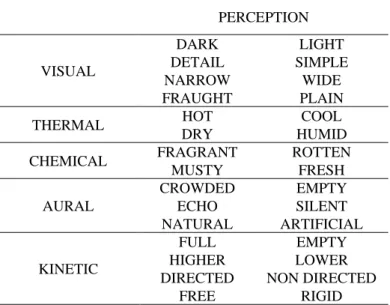
The survey technique for identifying descriptors was adopted and modified from Lucas and Romice's methodology [13], notably the usage of descriptor names, notation, and radar diagrams based on multi-sensory perception. The identification of the descriptors qualitatively to discuss the existence of phenomenology in virtual life was argued by scholars as to the lack of sense of place. Through an online tour form, we asked around twelve final year architecture students to visit the museum as responders (Figure 2). The radar graphic was generated in a quantitative approach based on the number of respondents who could feel / name the descriptions while watching/ viewing the virtual tour of the museums. Each human sense is represented by one of the radar's legs. This radar depicts the results of several points that reflect the amount of sensory awareness from each sense.
Figure 2. The architecture of the three museums as the research objects (Museum 1 : Museum Pendidikan Surabaya; Museum 2 : Museum Tsunami Aceh; Museum 3 : Museum Bank Indonesia
Jakarta).
Figure 3. The virtual tour of the three museums as the research objects (Museum 1 : Museum Pendidikan Surabaya; Museum 2 : Museum Tsunami Aceh;
Museum 3 : Museum Bank Indonesia Jakarta).
We picked three museums to represent the different museum scales: small, medium, and huge (Figure 3). After providing respondents virtual tours of three museums, the researchers conducted a survey using Google-form. Museum Pendidikan Surabaya (M1 = small scale museum), Museum Tsunami Aceh (M2 = medium scale museum) and Museum Bank Indonesia Jakarta (M3 = large scale museum) are the museums; the first to the last illustrate the scale and service of the buildings. The three museums have a varying range of functions, but they all employ photographs, Google Street View & 360, and films in their virtual tours. The researchers obtain the material from the internet and
DEACE 2021
IOP Conf. Series: Earth and Environmental Science907 (2021) 012020
IOP Publishing doi:10.1088/1755-1315/907/1/012020
5
copy it into the survey form. The architecture and environment of museums are distinctive; thus, their spatial qualities might transmit diverse stimulants to produce a user's experience through the inner reception. The responders are architectural students in their early twenties with no prior museum exposure.
The investigation was carried out in three stages:
• Preparation entails sorting suitable descriptors from Lucas and Romice [13] and then asking them in the survey; and identification of architectures including identifying particular interior spaces.
• Survey using Google-form which includes the link for virtual tour distributed to the respondent in May 2021 (http://petra.id/RISETPERSEPSIVIRTUAL)
• Analysis is the visualization/data presentation of the radar diagram defining the descriptors in five categories: visual, auditory, chemical, kinetics, and thermal, with the goal of discussing the sense of place in relation to the development of the phenomenological sense of place (Figure 4).
PERCEPTION
VISUAL
DARK LIGHT
DETAIL SIMPLE NARROW WIDE FRAUGHT PLAIN
THERMAL HOT COOL
DRY HUMID
CHEMICAL FRAGRANT ROTTEN MUSTY FRESH AURAL
CROWDED EMPTY ECHO SILENT NATURAL ARTIFICIAL
KINETIC
FULL EMPTY
HIGHER LOWER DIRECTED NON DIRECTED
FREE RIGID
Figure 4. Modified descriptors from Lucas Romice used in our Google Form.
4. Findings
The results of the descriptors identification survey, which was conducted as part of the third stage of this research, are discussed in this section. The findings are broken down into three sections: the first is about the physical features of the three museums, the second is about the respondents' multi-sensory system, and the third is about media preferences in virtual encounters.
4.1. The museum
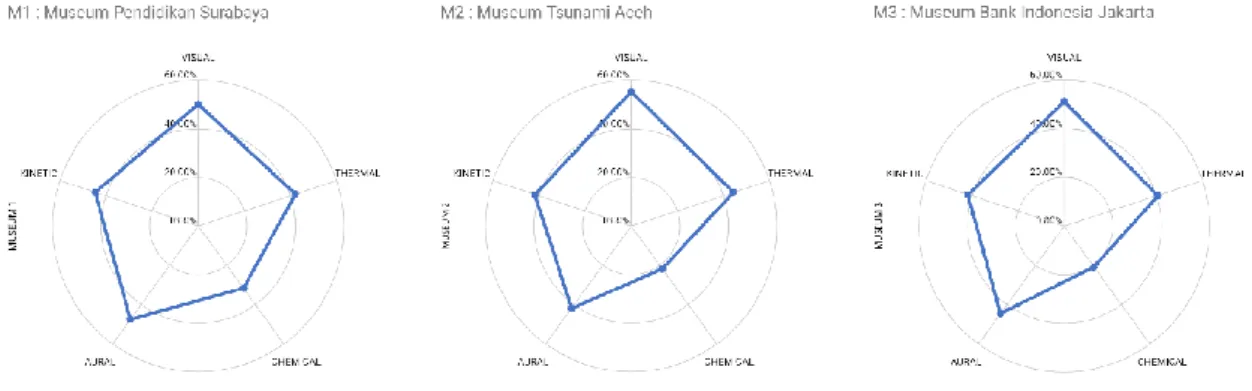
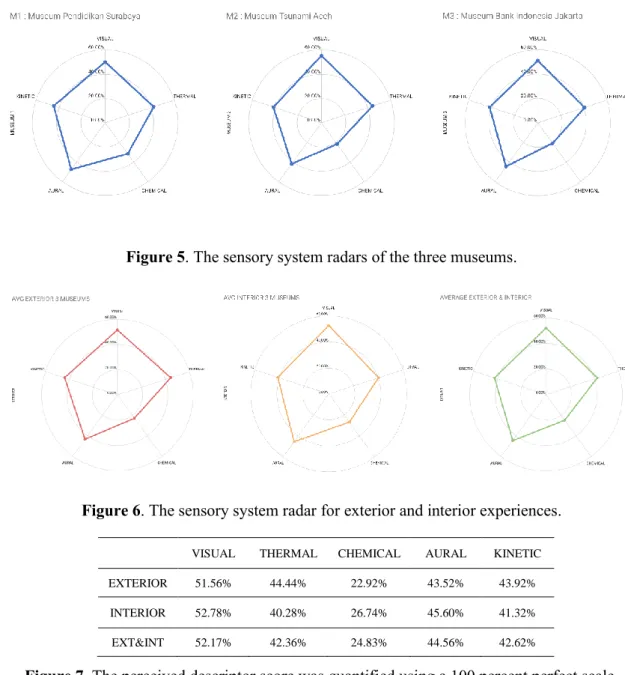
Figure 5 depicts the findings of each museum's visitor description observations. In the virtual visitor sensor study, the variation in museum scale does not make a substantial effect, as seen in the diagram.
Figure 6 & 7 shows that the visual and aural sensory systems are the strongest sensory systems experienced by the respondents, as seen on the sensory radar of each museum, while thermal and kinetic sensory follows them. The chemical sensory system is the weakest, and the responders have even less experience with it. The five most commonly used visual and auditory descriptions to characterize the three museums are brilliant, dark, hot, detailed, and chilly. Museum Pendidikan Surabaya (M1) is described as bright, artificial, and silent; Museum Tsunami Aceh (M2) is described as dark, detailed, and large; and Museum Bank Indonesia Jakarta (M3) is described as brilliant, detailed, and reverberant, as shown below on real picture of each museum on Figure 8.
DEACE 2021
IOP Conf. Series: Earth and Environmental Science907 (2021) 012020
IOP Publishing doi:10.1088/1755-1315/907/1/012020
6
Figure 5. The sensory system radars of the three museums.
Figure 6. The sensory system radar for exterior and interior experiences.
VISUAL THERMAL CHEMICAL AURAL KINETIC
EXTERIOR 51.56% 44.44% 22.92% 43.52% 43.92%
INTERIOR 52.78% 40.28% 26.74% 45.60% 41.32%
EXT&INT 52.17% 42.36% 24.83% 44.56% 42.62%
Figure 7. The perceived descriptor score was quantified using a 100 percent perfect scale.
Figure 8. A comparison of the three museums' ambience (Museum 1 : Museum Pendidikan Surabaya;
Museum 2 : Museum Tsunami Aceh; Museum 3 : Museum Bank Indonesia Jakarta).
DEACE 2021
IOP Conf. Series: Earth and Environmental Science907 (2021) 012020
IOP Publishing doi:10.1088/1755-1315/907/1/012020
7
The descriptor within this system is the highest cited among other descriptors in the five senses systems, rather than the weak sense that is connected to the kinetic system. The strongest sense experienced throughout the virtual trip is a sense of height. Even though M1 and M3 responders perceive freshness on the outside and musky on the inside, the chemical sense is the weakest system.
The responders could perceive stillness, artificial environment, and reverberant in the auditory system, which was not as strong as the other four systems. The human sensory orientation is developed by the sense of the aural and kinetic systems. The findings related to the aural and kinetic systems are relatively weak compared to the visual and thermal systems. However, the respondents navigate better in M1 and M2 than M3 because they can sense direction, movement and freedom. Especially in M1, the respondents also feel empty while in M2 they feel crowded. The sense is directly related to the design of each museum while M1 to M3 is ranked according to the building scale.
4.2. Respondents
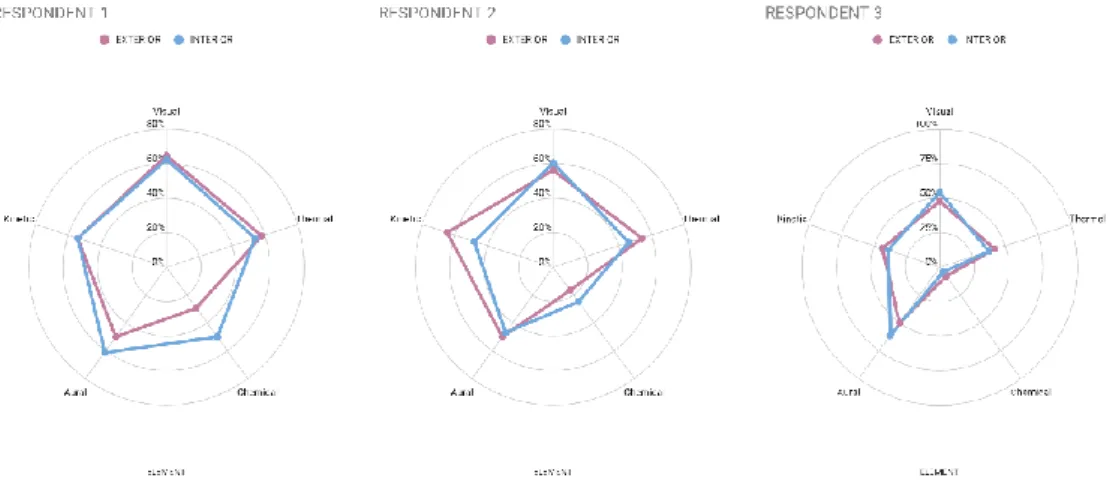
We provide examples of three responders from among the twelve who we believe best illustrate the findings of their virtual observations. Three radars of three exemplary respondents are shown in Figure 9; each respondent exhibits a distinct quality of sensory system in each of the three museums.
This is to show each individual respondent who took part in the survey, followed by a qualitative and quantitative description of the findings. There is consistency in each system in terms of the external and interior characteristics that they detect, which implies that when the strongest system in perceiving exterior/architecture is visual, the same is true for the interior/space quality. When it comes to virtual architecture and space, the first respondent has about equal strengths for each system, despite the fact that the chemical sense is the weakest. In the strongest sense, the kinetic system, the second respondent exhibits a slight difference. The chemical system has no senses for the third respondent, whereas the aural system is the most powerful.
Figure 9. The sensory system radar of three exemplary respondents.
4.3. Media
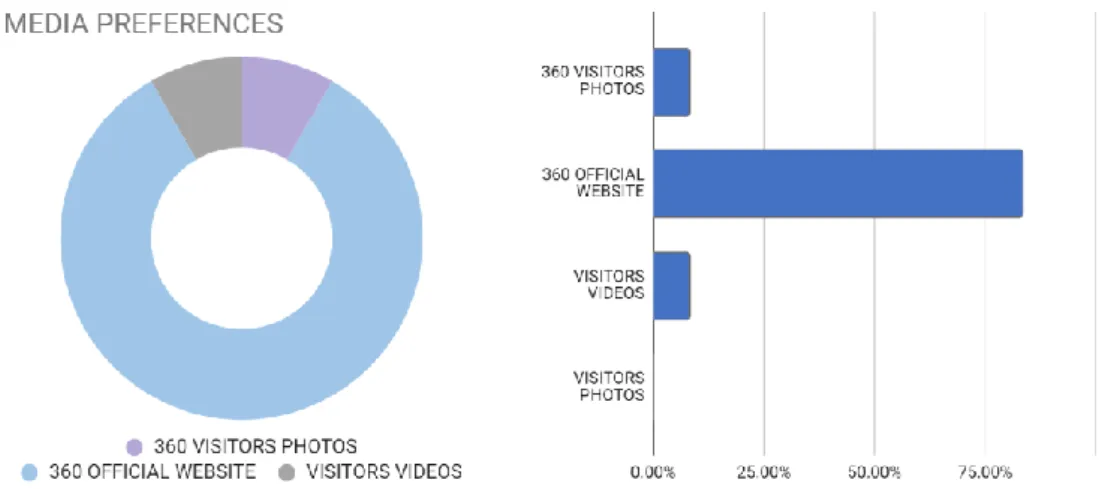
Figure 10 depicts the respondents' degree of virtual media preference. The majority of respondents choose to visit the virtual museum via the official website, which has interactive 360 panoramic images of the excursions. Visitors' 360 panorama photographs and video movies are preferred as the second medium. The contents of public visitors may be simply found on the Google reviews page's website. The most important reason was that official websites could represent the whole ambience of a room or location. The third argument is that, like a physical museum, websites may help to enhance navigational orientation. Another reason is that this medium is capable of displaying visual quality in a powerful and clear manner.
DEACE 2021
IOP Conf. Series: Earth and Environmental Science907 (2021) 012020
IOP Publishing doi:10.1088/1755-1315/907/1/012020
8
Figure 10. The media preferences in experiencing the virtual museums.
5. Discussion
Experiencing architecture and place is a certain embodied modality of senses and body, as Pallasmaa previously stated. He claims that perceiving place via the body brings a spiritual presence rather than only the physical presence that the multisensory system detects. This is when the occurrences or qualities of a location may give it cultural significance. The spiritual presence of humans in the virtual setting is primarily carried by the human sensory system, which receives sensory information from virtual media rather than social cues, in terms of virtual life, experiencing space and architecture via videos and photos as the main focus of this research. Familiarity (recalling memories) is another key element for responders to experience and subsequently recognize the sensory descriptors of this study.
This study demonstrates that all sensory systems contribute to the development of a spatial sense of virtual architecture and space in varying degrees. The visual and aural sensory systems are the two most powerful, whereas the chemical sensory system is the weakest. Among other systems, the feeling of scale in terms of height (in the category of the kinetic system) is the most mentioned description.
This discovery is devoid of a feeling of time, such as the stimulant's sense of frequency or rhythm.
Depending on when the pictures/videos were taken, the respondent perceives the architecture and space as a static setting. Despite the fact that Lucas and Romice's descriptors identification technique includes the identification of the feeling of time, this method is only suitable for real-time situations.
The users' temporal flexibility to explore virtual architecture and space separates the real-time and virtual conditions.
The phenomena linked to the social and chronological elements of space are less relevant than the memory aspects in terms of phenomenology of space. Because memory is related to each individual, subjectivity is strong. However, the stimulants send a consistent message/meaning to the respondents' multi-sensory systems, such as agreement of certain sensations, such as bright and cold for Museum 1, dark and hot for Museum 2, and brilliant and detailed for Museum 3. Almost all of the adjectives requested of the respondents are seen by them in varied qualities, indicating that subjectivity exists but that a pattern of agreement can be detected.
6. Conclusion
We may infer from this research that a museum's physical presence, both actual and virtual, is the most comprehensive experience of space that can be felt by the rest of the human senses after the eyes.
Because of the epidemic, virtual technology is being used to circumvent the constraints of physical visits. Virtual visits have been shown in studies to impact not just the sense of vision or visual, but also other senses indirectly. Visual media can elicit not just visual sensations, but also other senses, depending on the visitor's perceptions. In general, virtual museums are successful not just in replicating the visual state of a museum, but also in representing experiences molded by senses other
DEACE 2021
IOP Conf. Series: Earth and Environmental Science907 (2021) 012020
IOP Publishing doi:10.1088/1755-1315/907/1/012020
9
than vision, albeit on a restricted scale. Physical museums will continue to be the primary experience, while virtual museums will reach a broader audience with an equally engaging experience.
References
[1] Yazdanfar S, Heidari ali akbar and Aghajari N 2015 Comparison of Architects’ and Non- Architects’ Perception of Place Procedia - Soc. Behav. Sci. 170 690–9
[2] Nugraha Bahar Y 2011 Enhancing the National Identity through Historic Buildings Conservation using VR Technology Olympiade Karya Tulis Inovatif (Olympiade of Innovative Writing) (Paris, France)
[3] Syahrial Z and Suparman A 2017 International journal of multicultural and multireligious understanding virtual museum: A learning material of Indonesia national history 51–60 [4] Mortara M, Catalano C E, Bellotti F, Fiucci G, Houry-Panchetti M and Petridis P 2014 Learning
cultural heritage by serious games J. Cult. Herit. 15 318–25
[5] Jiang B and Ormeling F 2000 Mapping Cyberspace: Visualizing, Analysing and Exploring Virtual Worlds Cartogr. J. 37 117–22
[6] Saunders C, Rutkowski A F, Van Genuchten M, Vogel D and Orrego J M 2011 Virtual space and place: Theory and test MIS Q. Manag. Inf. Syst. 35 1079–98
[7] Pallasmaa J 2012 The Eyes of the Skin: Architecture and the Senses (Wiley)
[8] Norberg-Schulz C and Borsano G 1980 Genius Loci: Towards a Phenomenology of Architecture (Rizzoli)
[9] Malpas J 2018 Place and Experience: A Philosophical Topography (Taylor \& Francis)
[10] Relph E 2019 The Inconspicuous Familiarity of Landscape Phenomenol. Real Virtual Places 12–23
[11] Champion E 2018 Norberg-Schulz: Culture, Presence and a Sense of Virtual Place Phenomenol.
Real Virtual Places, . 142–63
[12] Pallasmaa J and Holl S 2007 The Eyes of the skin. Architecture and the Senses
[13] Lucas R and Romice O 2010 Evaluación de las cualidades multisensoriales del espacio urbano:
Un enfoque metodológico y sistema de notación para el registro y diseño de la experiencia multisensorial en el espacio urbano Psyecology 1 263–76
[14] Shiner L 2007 Architecture vs. Art: The Aesthetics of Art Museum Design Contemp. Aesthet. 5 [15] Charitonos K, Blake C, Scanlon E and Jones A 2012 Museum learning via social and mobile
technologies: (How) can online interactions enhance the visitor experience? Br. J. Educ.
Technol. 43 802–19
![Figure 1. Descriptor Chart for Sensory Notation, based on Lucas & Romice p269 [13]](https://thumb-ap.123doks.com/thumbv2/123dok/11707171.0/22.892.205.670.702.972/figure-descriptor-chart-sensory-notation-based-lucas-romice.webp)