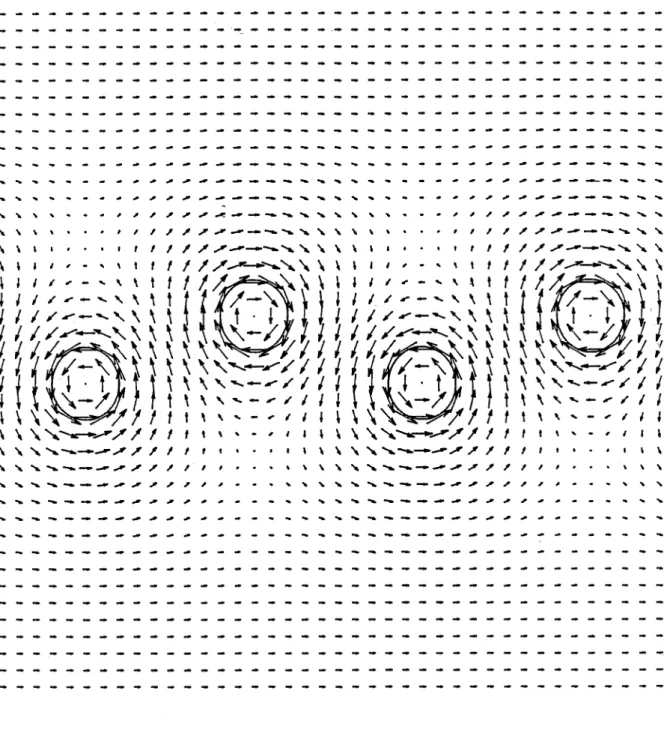
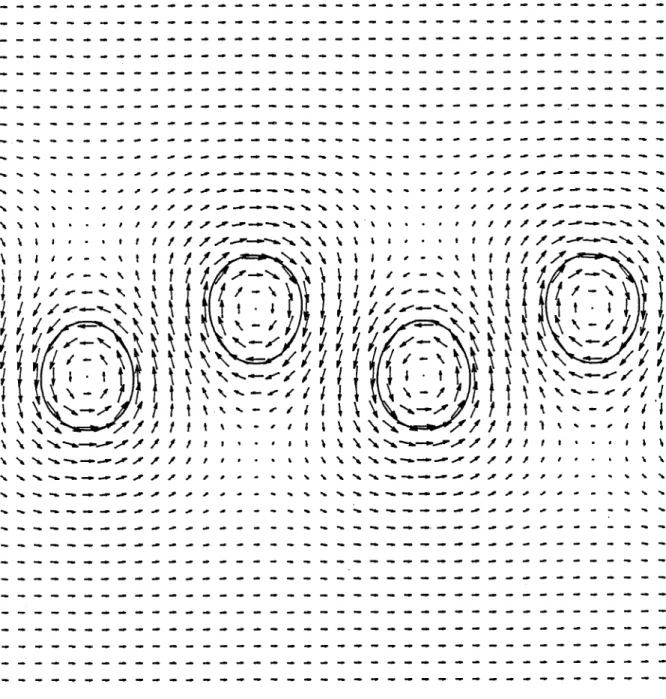
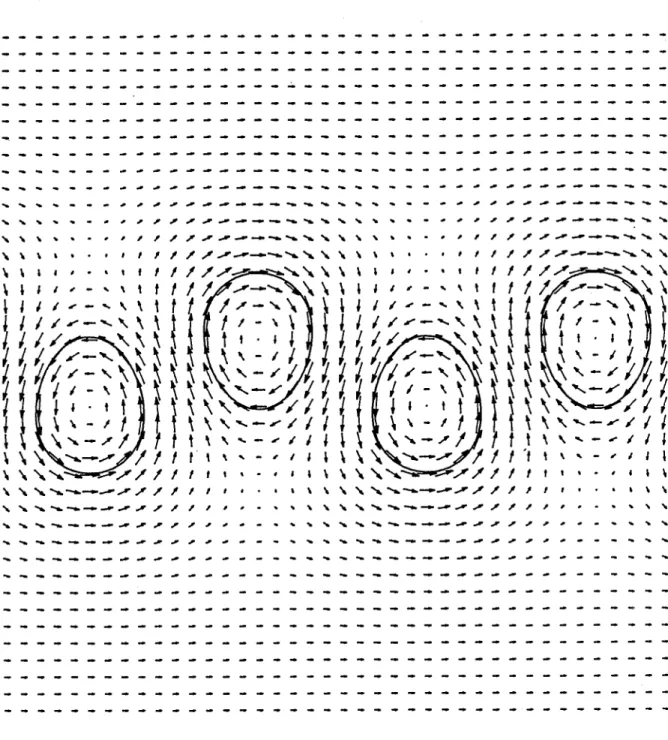
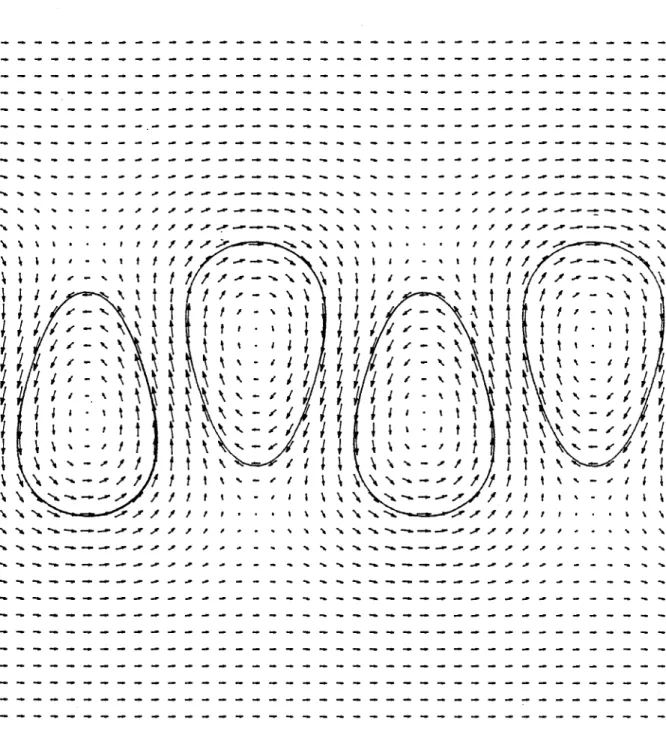
I am grateful that I had the opportunity to study at Caltech, and in particular the Applied Mathematics option. My work has been supported by Caltech in the form of Graduate Research Assistantships, Graduate Teaching Assistantships, a Caltech Fellowship, and by the Department of Energy (Office of Basic Energy Sciences). In the wake of a two-dimensional rock body placed in a uniform flow, a characteristic pattern of vortices is observed at a sufficiently large but not too large flow velocity.
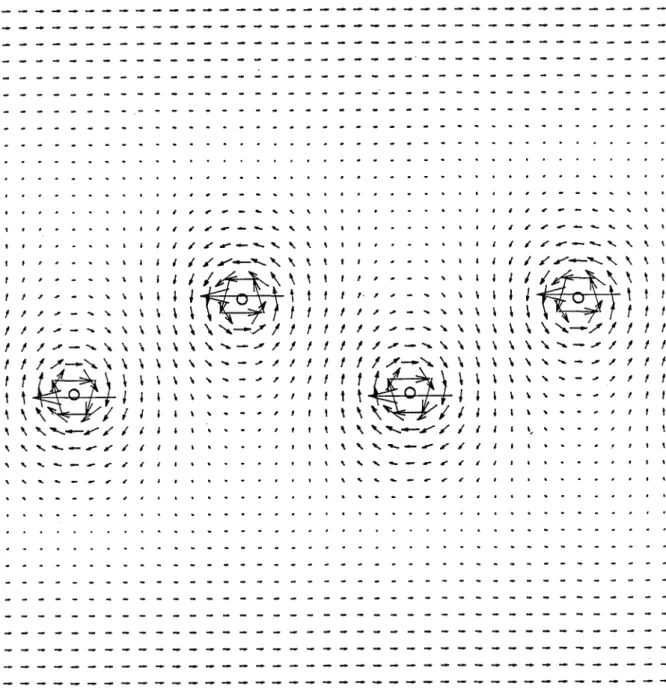
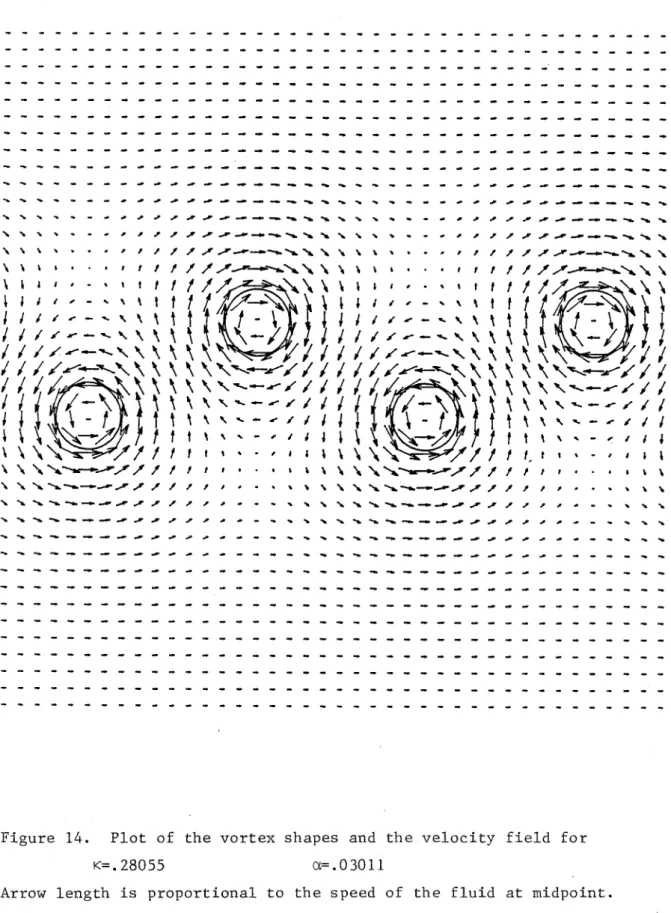
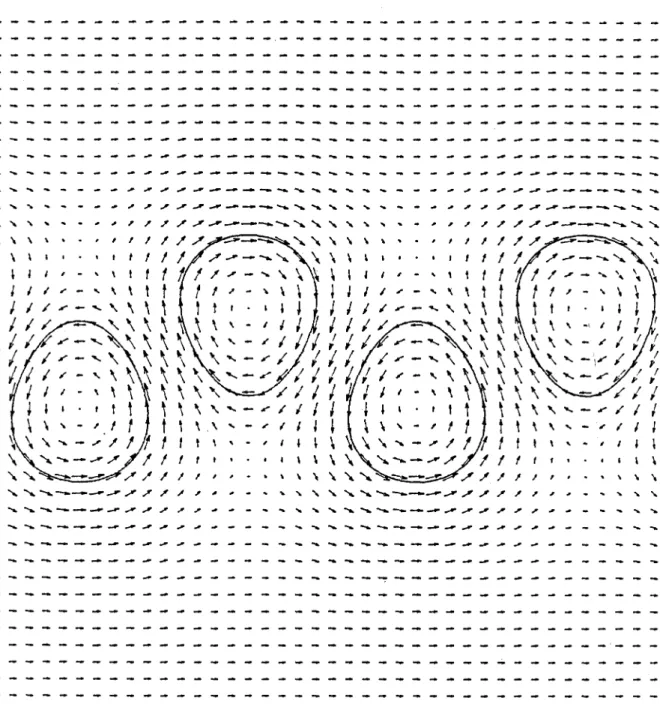
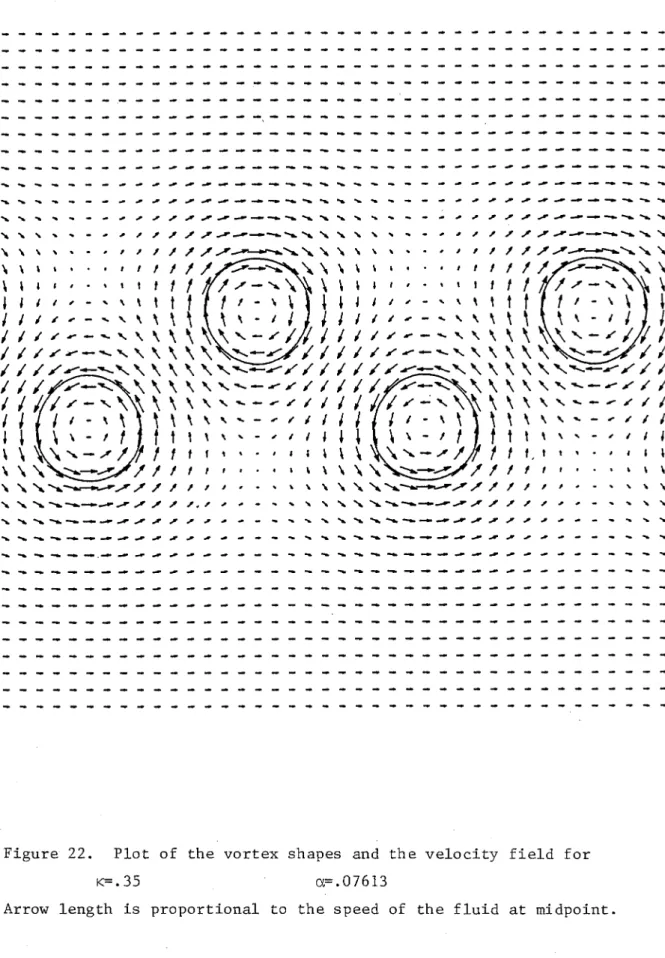
These vortices are organized into two nearly parallel staggered rows of vortices with opposite direction of rotation. This thesis is a report on the analysis of a model for the von Karman vortex street. The model is invisible, incompressible, two-dimensional, and consists of finite-area vortices and uniform vorticity.
The first part of this thesis contains a brief overview of the work on this problem, and an explanation of the approach used in the current work: the second. The calculations indicate that the vortex wake can be stabilized by a sufficiently large surface area of the vortices.
Historical Overview and General Introduction
- Introduction
- Formulation
- Circular Vortex Approximation
- Asymptotic Analysis for Small Area
- Numerical N!ethods
- Results of the Calculations
Viscosity of necessity is involved in generating the vortex layers through the body. An integro-ditherential equation is then solved to obtain the steady-state shapes of the vortices. A solution can be calculated with an expansion for the vortex shape of the shape.
This part of the thesis discusses the stability of these stable solutions to two-dimensional perturbations. It is expected that the coefficients of the equation for the eigenvalues are analytic functions of IC and ex. Domm, The Stability of Vortex Streets Considering the Dispersion of Vortices by the Individual Vortices, J.
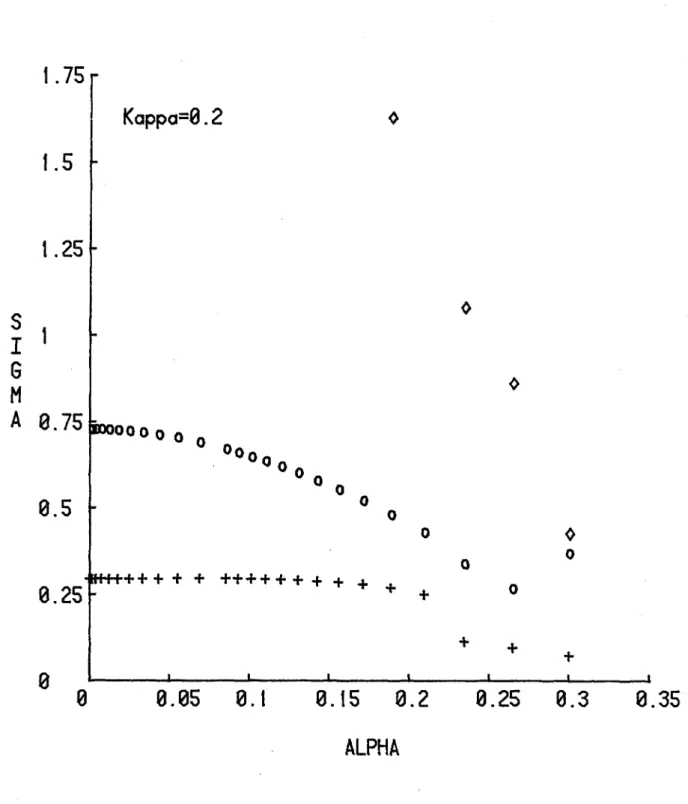
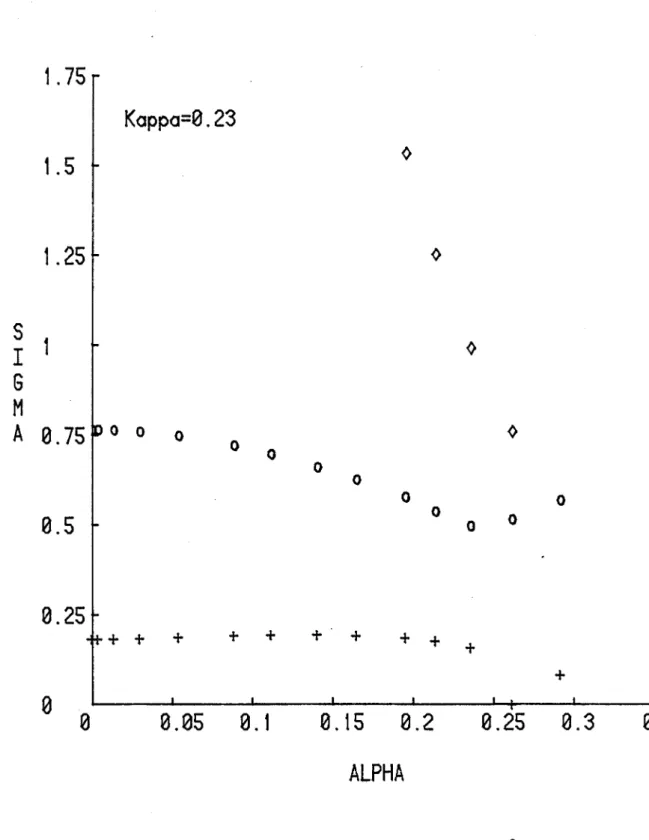
Calculated non-dimensional real part (growth rate) of the eigenvalues (cr•l2/r) from the linear stability analysis. Calculated non-dimensional real part (growth rate) of the eigenvalues (0•12/r) from the linear stability analysis.
Stability
Introduction
The Karman vortex street is a regular pattern of vortices consisting of two parallel staggered rows, which for a certain range 'Of Reynolds number; is observed in the wake of two-dimensional blunt bodies placed in a uniform flow. In the previous part of this thesis, an inviscid model for the wake flow was described, which consists of two rows of displaced vortices of finite size extending to infinity in both directions. A normal mode analysis is performed and the growth rates and frequencies of the modes are calculated for a range of values of the vortex size and separation/spading ratio for the street.
The results for superharmonic perturbations are in agreement with those predicted by energy arguments based on the Kelvin variational principle. It will be pointed out that trying to apply these energy arguments to subharmonic disturbances leads to wrong conclusions.
Subharmonic Instabilities of the Point Vortex Array
Since the steady stream has wavelength l, it follows from Floquet's or Bloch's wave theory that the normal modes of the system (both for finite and point vortices) have this form. However, Kochin (1939) discovered that this "stable" configuration is in fact unstable on second order approximation of the perturbation amplitude (for an. The perturbations for the p=0.5, tc=tec case grow in time as e8t where e > 0 is proportional to the initial perturbation, in contrast to the e'"Rt behavior (aR, independent of the initial conditions) that occurs in the unstable region, away from the stability/instability boundary.
The right-hand sides of (Hamilton's) equations can be expanded in Taylor series about the stable solutions Xi, Yi· The linearized equations reproduce figure 46. The stability limits in figure 46 will of course be disturbed by the effect of the finite size of vortices, and the degenerate saddle will separate in one of the options marked with the dotted lines in the figure. If case 1 is the situation, then there will be stability to infinitesimal perturbations for a limited range of IC i.
In principle, the problem of setting between case 1 and case 2 can be handled by perturbation theory by expanding the powers of the vortex zone, i.e., it is clearly sufficient to consider only the subharmonic (pairing) distance with p= 0.5, and for this reason we restrict attention from now on to perturbations that are periodic with period 2l in the x direction.
Analysis of the Stability
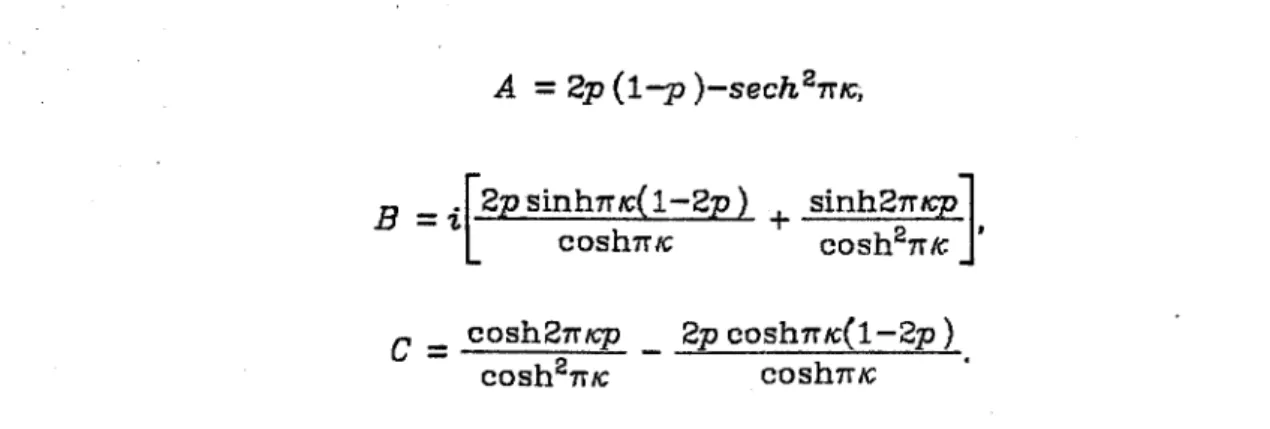
To calculate the .change in the flow field due to the complete perturbation, three terms in the form (9.3). The real parts of the eigenvalues of this system then give the growth rates for the corresponding normal modes. For numerical purposes, the system (9.17) can be simplified somewhat by recognizing the symmetry of the problem.
This simplification reduces the size of the system to 4N+2 equations in two sets of Fourier coefficients. Calculations of the eigensystem were performed with standard library routines using an IBM 3033 computer (64 bit floating point). This property showed itself in a great sensitivity of the calculated small eigenvalues to errors in the steady state calculations (hence the matrices A and B).
With the exception of the smaller energy state in the non-unique region (between curves 1 and 2 in figure 69), all eigenvalues corresponding to superharmonic perturbations were found to be purely imaginary. 9.22) (Invariance .to changes in the sign of the vortex requires that the coefficients be even functions of O!).
The Energy Criterion for Stability
The roots, as functions of O!, will have branch point singularities corresponding to a change in the stability of the system, where the quartic roots are not different, i.e. 9.23). The results shown in Figure 70 indicate that this equation, when expanded into (1C-te0) and ex, takes the approximate form. that it is necessary to go to fourth order in ex to determine the behavior of the eigenvalues for a small area. This is ensured by keeping the distance between the centers of gravity of the two rows constant.
Since E is clearly bounded above, E 1 is an absolute maximum and configuration (1) is stable; from the similarity of (1) and (3) it follows that configuration (3) is stable for all superharmonic disturbances, and this will remain true for all oc below curve 2 in Fig. 69. When two states exist, the one with the lower energy will be unstable. ) This confirms our calculations of superharmonic instability, but state (3) is not stable to subharmonic perturbations for ICs outside the region shown in Fig. 69 and will therefore be at minimum energy in this region. Now we can show from the calculations of the system with d=O that E 2< E 3 can occur when a is large. However; the exact calculation of the border area is sinfully expensive and he did not undertake it.
According to this argument, the stability region lies between curves 3 and 4 in Figure 69 and, moreover, it is a stability region for finite amplitude perturbations that are not too large. Besides, there is no evidence to suggest that the symmetric configuration (d=O) can be stabilized by a finite size, but Taneda (1965) reported that oscillation of the body produced streets with symmetrical vortices.
Conclusion
As previously noted, there are unresolved questions regarding the stability of the inviscid model described herein. A conclusive resolution of the questions of neutral versus true stability and stability under three-dimensional perturbations would be highly desirable to complete the theoretical understanding of this idealized model. These are quite subtle but general problems, and a solution could provide some general insight into the class of invisible but rotating currents.
These extensions require only minor modifications to the methods used for the model problem considered here. A more difficult extension of the model would deal with non-uniform vorticity, although still in the context of turbulent flow. From the point of view of the .experimentalist and applied fluid dynamics, probably the most unsatisfactory aspect of the present work is the neglect of viscosity.
Viscous effects are fundamentally important in real physical systems that produce Karman vortices, but their presence greatly complicates the theoretical analysis, and a fully satisfactory treatment of the viscous problem has not yet been achieved. Unfortunately, z is on the boundary of one of the integrals when (5.6) is solved to obtain the vortex shapes. For the second numerical scheme, R'IJ was approximated by a fourth-order centered finite difference' formula, and Z'IJ was then obtained from this.
The calculation of the kinetic energy for the infinite vortex street is almost identical to that for the infinite linear array (Saffman and Szeto, (1981)). The functional form of x depends on the assumed symmetry between the two rows of the street. Saffman, Numerical evidence for the existence of new types of gravitational waves with a permanent shape at deep water, Studies in Appl.
Davies, A comparison of the wake structure of a stationary and oscillating dumb body, using a conditional averaging technique, J. Gerrard, The calculation of the fluctuating lift on a circular cylinder and its application to the determination of aeolian tone density, A.G.A.R.D. Gerrard, Numerical Calculation of the Magnitude and Frequency of Lift on a Circular Cylinder, Phil.
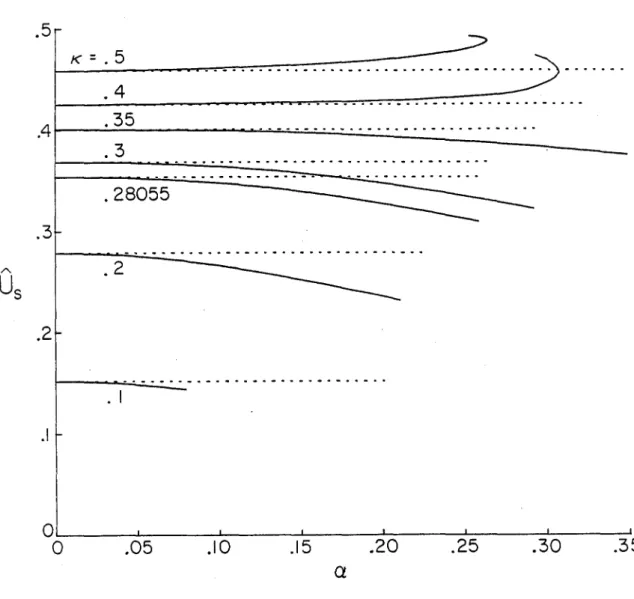
White, numerical solution of the time-dependent Navier-Stokes equations in the presence of an oscillating cylinder, non-steady-state fluid dynamics: ASME Proc. Solid lines indicate the calculated values for the exact problem and dashed lines indicate the circular vortex approximation. The segment corresponding to the smaller K should be considered as a lower bound for the maximum area.
Logarithmic plot of the critical area a where stabilization occurs versus the distance in K away from Kc.
Directions for Further Research