Democracy and Development in Indonesia: A Natural Resource Curse By: Budi Kurniawan
Lecturer in Government Studies, University of Lampung
Abstract
Few researchers have investigated the issue of resource curse as a political factor in Indonesia's current development. So far, the literature has only explained the economic factors that influence the middle-income trap's condition. This article aims to examine the issue of development in Indonesia because of the resources curse from the standpoint of political economy. The Indonesian case is particularly well-suited to investigating theories of the middle- resource curse. To investigate this research puzzle, I use quantitative methods. I conduct quantitative research to create a model of the relationship between natural resources and democracy quality, and then the relationship between democracy and development. The dataset is produced by combining the data from Indonesia Democracy Index, Human Development Index and some government and media reports. This paper argues that there is a resource curse at the subnational level; provinces with abundant natural resources have a negative relationship with political institutions. This research also finds that there is a positive relationship between democracy quality and development. Higher in democracy means higher in the quality of development.
Keywords: development, resource curse, democracy
1. Introduction
Until the late 1980s, economists assumed or argued that a country's natural resource endowment facilitated its economic performance. According to Rostow (1959), such endowments were critical in a country's "take-off," or transition from a traditional society based on agriculture to a more industrialized society with high consumption. Douglas North, likewise,
emphasized the importance of natural resource stocks as a driving component of a society's long- term output (North, 1990). However, by the early 1990s, this optimistic view of resources in development had been tested empirically. When compared to resource-scarce countries elsewhere, many resource-rich countries, primarily in Africa, the Middle East, and Latin America, have tended to have low-income levels, unstable growth, and generally poor performance on broader development indicators. Auty ([1994], 2001)was the first to coin the term "resource curse" to describe this phenomenon.
So far, few scholars have studied the impact of the resource curse on democracy in Indonesia.
Most studies discuss the economic impact of rich natural resources (Afiff & Lowe, 2007;
Hilmawan & Clark, 2019; Komarulzaman & Alisjahbana, n.d.; McCarthy, 2007; Resosudarmo, 2005; Spiegel, 2012) or Indonesia political setting on the cold war. From cold war setting, for example, Rosser (2007) argues that Indonesia can escape from the resource curse and create rapid growth was due to two more fundamental factors: the counter-revolutionary social forces' political victory over radical nationalist and communist social forces in Indonesia during the 1960s; and the country's strategic Cold War location and proximity to Japan. Arif (2019) has also made the same argument when comparing Indonesia and Nigeria agriculture in rural areas. The fear against the emerging of communism in rural areas made Suharto channel the oil boom in the 1970s to build better development in the rural and agricultural areas compared to Nigeria.
However, to our knowledge, no one has studied Indonesia's setting of coal boom after the New Order era from the perspective of political science. This paper wants to fulfil this gap.
1.1 Research Questions
This paper aims to answer the following research questions in order to fill the gaps described above:
1. What is the correlation between rich in coal and oil and the quality of democracy at the sub-national level of Indonesia?
2. What is the correlation between the quality of democracy and development at the sub- national level of Indonesia?
2. Theoretical Framework
2.1. Natural Resource Curse
When they find natural resources, countries might think that they will benefit more. Natural resources will increase their income revenue. As a result, they believe that it will increase their economic growth. However, most resource-rich developing countries remain underdeveloped despite decades of extraction of various natural resources. In most cases, this wealth has caused the emergence of new economic, political, and social problems, each of which has its own set of development challenges.
On the other hand, some countries have experienced significant economic development despite having low levels of natural resources. The Asian Tigers, a group of resource-poor countries including Singapore, South Korea, Taiwan, and Hong Kong, have developed industries that compete successfully in the global market with industries from more advanced economies.
However, countries with relatively high natural resources, such as Chad, Angola, Nigeria, and Yemen, are among the world's poorest economies. What went wrong with these countries?
To answer this question, some political scientists come up with the idea of the resource curse;
they argue that being rich in natural resources has a negative impact on economic development.
The condition when most developing countries endowed with natural resources have lagged their resource-poor counterparts is termed as a natural resource curse (Auty, 2001). On the other hand, some economists provide the idea of Dutch Diseases. I begin my explanation with an economic perceptive on the resource curse.
Economists try to answer the phenomena of the resource curse with the concept of Dutch diseases. The term "Dutch Disease" refers to the negative effects of natural gas discoveries in the 1960s on Dutch manufacturing, primarily due to the subsequent appreciation of the Dutch real exchange rate. After finding resources, there is a resource boom, but the exchange rate
appreciates after a resource boom, reducing the economy's ability to export. In many cases, the manufacturing sector as a significant component of the traded sector is crowded out, resulting in long-term deindustrialization of the economy (Corden, 1984).
A severe limitation of the Dutch Diseases study is that the Netherlands is different from the developing countries. Developing countries have lacked industry and manufacturing since the beginning of independent countries. They use natural resources as their primary trade commodities as taken for granted. As a result, how then do we connect the Dutch diseases to countries like Indonesia and other countries in Africa? The natural resources of developing countries are typically exported as primary products, with little price control in most cases.
In contrast to industrialized countries, developing countries are price takers instead of price makers, not only in their exports but also in their import commodities. As a result, Dutch Diseases theory cannot fully explain the phenomena in developing countries. To fill this gap, political perspective come up with the political economy explanation.
In many cases, the resource curse problem is not just the problem of economic but also political issues. Economic and political issues are frequently interrelated. The role of bad governance and corruption in igniting political problems in resource-rich economies should not be underestimated. Therefore, the trend resource curse shifted to the issue of political issues rather than just economic issues. The issue of rich with natural resources related to the issue what Acemoglu and Robinson (Acemoglu & Robinson, 2012) called “extractive institutions” both politics and economy. They argue that resource abundance problems cause the problem of corruption and bad governance within public institutions. These variables are the driving forces behind the curse (Ross, 1999, 2012, 2015; Sala-i-Martin & Subramanian, 2013). Additionally, scholars (Ross, 2012) and (Collier & Hoeffler, 2005) have linked natural resources to political instability and civil war.
2.2 Natural Resource Curse, Democracy and Development
Acemoglu and Robinson (2012) argue that the requirement for welfare is both economic and political institution must be incisive. This paper focuses on inclusive political institutions.
According to Acemoglu and Robinson, Inclusive political institution is a political institution that allows for broad participation or pluralism while also imposing constraints and checks on politicians is known as an inclusive political institution. Extractive institutions, in contrast to inclusive ones, imply absolutism when power is concentrated in the hands of a few people without checks and balances or the rule of law. In short, inclusive political institution is democracy, and extractive institution is authoritarianism.
However, being rich in natural resources can be used to stifle the growth of democracy and democratic institutions within a nation. According to Collier and Hoeffler (2009), weak democracy in developing countries can lead to a lack of checks and balances, which can stifle economic growth, authoritarian regimes in oil-rich countries last longer (Smith, 2007, 2004). Authoritarian regimes and economic dependence on oil and mineral resources are linked, according to Jensen and Wantchekon (2004), Rose-Ackerman (1978), and Ross (2004). Resource wealth also allows dictators to buy off political opponents, delaying the transition to democracy (Acemoglu et al., 2004). Ross (2012) explains why it was easy for protesters in oil-poor countries like Tunisia and Egypt to overthrow their rulers following the recent uprisings in the Middle East and North Africa, dubbed the 'Arab Spring.' Oil-rich states like Libya, Bahrain, Algeria, and Saudi Arabia, on the other hand, could be able to hold out for much longer. In addition, according to Huntington (1993), until the 1970s, oil producers were as democratic or undemocratic as other countries.
Except for petroleum-rich countries in the Middle East, most undemocratic countries converted to a democratic system after this period. This pattern can be found in the Middle East and throughout the developing world, particularly in Africa and Russia.
Until the late 1980s, economists assumed or argued that a country's natural resource endowment facilitated its economic performance. According to Rostow(1960), such endowments were critical in a country's "take-off," or transition from a traditional society based on agriculture to a more
industrialized society with high consumption. Douglas North, likewise, emphasized the importance of natural resource stocks as a driving component of a society's long-term output (North, 1990). However, by the early 1990s, this optimistic view of resources in development had been tested empirically. Compared to resource-scarce countries elsewhere, many resource-rich countries, primarily in Africa, the Middle East, and Latin America, have tended to have low- income levels, unstable growth, and generally poor performance on broader development indicators. Auty (2001) was the first to coin the term "resource curse" to describe this phenomenon.
Economists use the concept of Dutch Diseases to explain the resource curse phenomenon. The term "Dutch Disease" refers to the negative effects of natural gas discoveries on Dutch manufacturing in the 1960s, primarily due to the subsequent appreciation of the Dutch real exchange rate. After a resource is discovered, there is a resource boom, but the exchange rate appreciates, reducing the economy's ability to export. As a significant component of the traded sector, the manufacturing sector is frequently squeezed out, resulting in long-term de- industrialization of the economy (Corden, 1984).
In many cases, the problem of the resource curse is complex. As economists have pointed out, the issue is not only one of economics but also one of politics. In many cases, the resource curse is not only an economic issue but also a political one. Frequently, economic and political issues are intertwined. It is important not to underestimate the role of bad governance and corruption in igniting political problems in resource-rich economies. As a result, the resource curse has shifted to a political issue rather than an economic issue. The issue of natural resource curse was connected to what Acemoglu and Robinson (2012) referred to as "extractive institutions." They argue that rich natural resources can influence the problem of corruption and bad governance within public institutions. These variables are the driving forces behind the curse (Ross, 1999, 2012, 2015; Sala-i-Martin & Subramanian, 2013). Natural resources have also been linked to political conflict and civil war (Ross, 2012; Collier & Hoeffler, 2005).
The famous explanation of the relationship between resource curses and the middle-income trap is exploring the intervening variable between natural resources and institutions. Institutions are the "rules of the game" in a society. They are artificial constraints used to shape incentives (North, 1990). In other words, institutions organize society's social, economic, and political interactions.
Weak institutions can lead to poor governance, hindering a country's economic progress (Acemoglu et al., 2001; Acemoglu & Robinson, 2016; Rodrik et al., 2002). The political aspect of natural resources may create low economic growth by weakening economic institutions, according to Sala-i-Martin & Subramanian (2013).
However, the story of the natural resource curse is complex. We can also find countries with rich natural resources, but they can grow their economy better with these natural resource. Mehlum et al. (2006) argue that natural resources increase aggregate income in countries with inclusive institutions while decreasing aggregate income in extractive institutions. It is then a strong argument why in the Scandinavian countries that have inclusive institutions, the oil boom is a blessing for their economy and welfare rather than a curse. Mehlum et al. (2006) also show in a theoretical model that if institutions are inclusive, Individuals are encouraged to pursue entrepreneurship and work in the manufacturing sector. However, if institutions are extractive, corrupt activities and rent-seekers rise in the economy instead of entrepreneurship. As a result, the natural resource makes people prefer to engage in rent-seeking rather than productive activities. However, Mehlum et al. has not addressed the reality that Scandinavian countries have a long story of inclusive institution. The tax regime has come first before the finding of natural resources. The oil boom came to these countries after they had built inclusive institutions.
According to Acemoglu et al. (2000, 2002), Norway, Canada, Australia, the United States, and New Zealand are examples of countries with inclusive institutions when natural resource discoveries were made. Countries like Angola, Nigeria, Sierra Leone, the Democratic Republic of Congo, and Venezuela, on the other hand, has extractive institution when the natural resource has been found.
Another intervening variable related to the causality relationship between resource curse and middle-income trap is the variable of corruption. Corruption's negative effects are seen to be more distinct in resource-dependent economies. Major economists argue that corruption is bad for economic growth, and being rich with natural resources can increase corruption (Sala-i-Martin &
Subramanian, 2013). Corruption and institution themselves are related to each other; to link these two interactive independent variables to the economic performance can be traced to the taxation system. Compared to developed economies, developing countries with rich natural resources collect less tax revenue. The lack of taxation by resource revenues significantly impacts how these countries' states and societies interact. A society with low taxation because of natural resources revenue tends to have less demand for transparency and accountability of government because they have loss incentive due to taxation. As a result, corruption is more accessible in a country with rich natural resources when the tax system is also weak (Moore, 2007; Ross, 2012).
To sum up, this paper uses a framework that rich in natural resources can weaken the quality of democracy, and the quality of democracy can stifle the quality of development. Based on this theoretical framework, this research’s hypotheses are:
• H1: the low quality of democracy has a relationship to the lack of development
• H2: Rich in oil and coal has a relationship to the low quality of democracy
3. Research Method
I use quantitative research in order to investigate my research puzzles. Quantitative method is the best way to examine the causality relationship between independent variables and dependent variable. I use the Indonesia Democracy Index dataset, a dataset issued by the Indonesian Bureau of Statistics (BPS), an official government institution. Every year government of Indonesia assess the quality of democracy in every province in Indonesia based on this index.
This index itself is the modification of the democracy index provided by Freedom House. For
assessing the development output, I also use the dataset from BPS that provide the assessment of the Human Development Index, an index that is based on the UNDP’s Human Development Index methods. For the data of province revenue on natural resources, I use the data provided by the Ministry of Finance. In addition, I get the data also from katadata.com, a website that provides many data set about Indonesia, including the economic condition, income, etc. I then combined this data to become a data set called “NaturalCurseIndonesia”1. Table 1 show
“naturalCurseIndonesia” Dataset.
Table 1: “NaturalCurseIndonesia” Data set. GDRP Percapita (Gross Domestic Regional Product Percapita) is GDP Percapita of each Province. Resource Rev: Revenue from the natural resource as income for each province.
To operationalize the abstract concept of democracy, I use the variable of Democracy Index 2020 (Democracy_Index_2020). Democracy Index 2020 is the average of three variables: political rights, Civil liberty, and democratic institutions. To operationalize the concept of development, I prefer to use the Human Development Index rather than GDP Percapita. Since Indonesia Gini ratio is high (0.384), GDP Per capita cannot capture the reality of development due to economic
1Data set link: https://www.bps.go.id/indicator/34/638/1/indeks-demokrasi-indonesia-idi-enurut-indikator.html and https://databoks.katadata.co.id/datapublish/2021/09/30/provinsi-mana-saja-yang-menerima-dana-bagi-hasil- sumber-daya-alam-pada-2020,
inequality issues. High Gini ratio means the curve of income distribution is right skew curve when just a limited number of populations dominate the proportion of income. As a result, the human development index is more precise to assess development.
To indicate the natural resource, I use the dummy variable. Provinces have oil or coal; I give one (1) as the rank for code. On the other hand, provinces have no oil or coal; I give it rank zero (0) for coding. Why oil and coal? Oil and coal are the primary economic income in Indonesia.
4. Results
4.1 Economic Impact of Resource Boom: De-industrialization
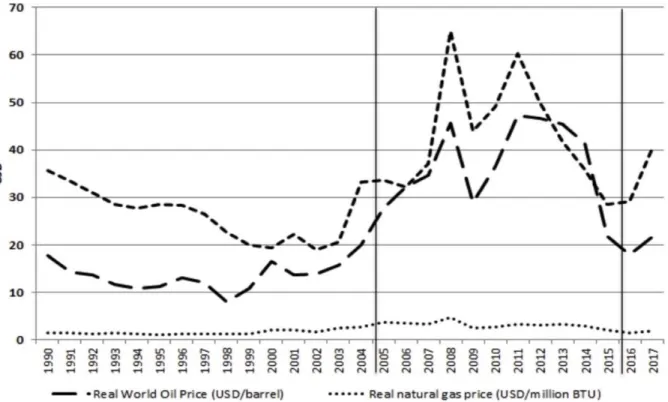
Industrialization, according to scholars, is the key to South Korea and other East Asian countries escaping the middle-income trap (Lee & Keun, 2019). On the other hand, industrialization in Indonesia is hindered by a lack of government and elite incentives. As a result, the first impact of Indonesia's coal and palm oil boom is a reduction in the incentive to build industry because increasing revenue from natural resources is the simplest way for Yudhoyono's government to build economic growth rather than going through the complex process of industrialization. Figure 1 shows the coal and oil boom graphic in Indonesia under Yudhoyono era (2004-2014).
Figure 1: Source: BP Statistical Review of World Energy (Hilmawan & Clark, 2019)
Since 2003, the price of coal has risen dramatically. As a result, Indonesian economic growth increased significantly from 2004 (the start of the Yudhoyono era) to 2012, with the exception of 2008, when economic growth decreased due to the global financial crisis (Figure.3). The price of palm oil follows the same pattern. Indonesia is the world's second-largest exporter of palm oil (Figure 2).
Figure 2: Palm Oil Price from 2000 to 2020.
Figure 2 shows that there is a significant increase from 2004 until 2008 in palm oil price, and after the global economic crisis in 2008, the trend once again increases significantly until the end of Yudhoyono era in 2014 when there is stagnation after that.
Figure 3: Indonesian economic growth in percentage from 1998 to 2019
To sum up, deindustrialization is a result of the resource boom. Even though Indonesia's economy is expanding rapidly, there has been little significant innovation in manufacturing products or the development of new markets for new industrial products. Natural resources continue to dominate the Indonesian economy. Non-commodity and non-natural resource exports from Indonesia are becoming less competitive. In 1992 and 2012, Indonesia's non-oil export portfolio's share of the global market (for the same portfolio) only slightly decreased from 1.3 per cent to 1.2 per cent, and Thailand's non-oil export portfolio's share of the global market (for the same portfolio) only slightly decreased from 1.3 per cent to 1.2 per cent (Basri et al., 2016).
4.2 Political Impact: Democracy and Development
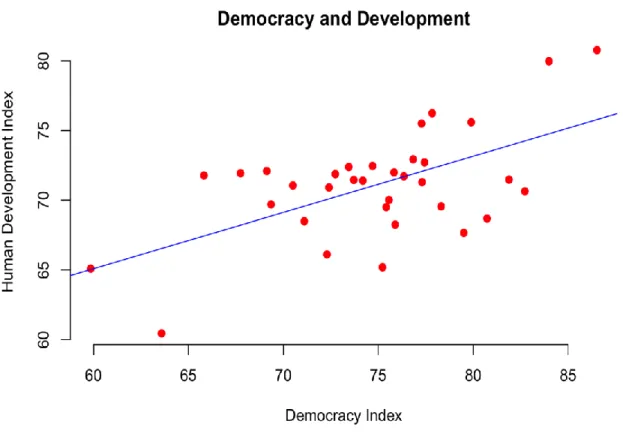
This research wants to investigate the relationship between democracy and development and the relationship between democracy and rich in natural resources. To test hypothesis 1, I use a regression model to find the relationship between democracy (independent variable) and development (dependent variable). Figure 4 show the regression model of this relationship.
Figure 4: Democracy and Development model on Indonesia sub-national.
From this model, we can conclude that there is a positive relationship between democracy quality and human development index rank. The more democratic province will be higher in terms of human development index. This finding is no surprise; it is the same result with global results that some scholars have addressed in the context of comparative countries (Acemoglu &
Robinson, 2006).
Table 2: Summary of regression first model.
The dependent variable is Human Development Index
Independent Variable
Democracy Index 0.8529 ***
(0.2082) [t=4.096 N= 35 R2 = 0.3235
Table 2 shows the regression summary of the relationship between democracy and development.
It is a significant correlation with coefficient 0.8529, standard error is 0.2081 and R2 is 0.3235. R2 indicate that this model is relatively strong in goodness of fit.
4.3 Democracy and Natural Resource
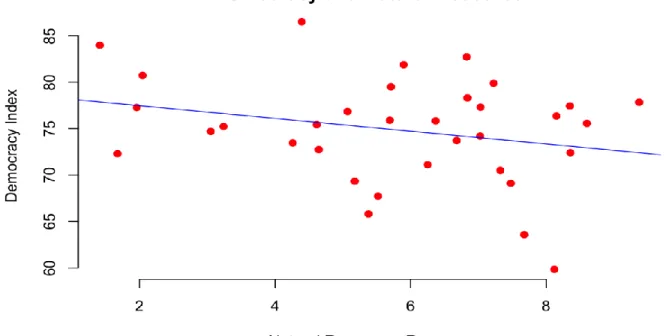
The remaining puzzles then what factor then influence the quality of democracy. With the framework of resource curse theory, the second model (figure 4) tries to find the relationship between rich natural resources and the quality of democracy. Using the variable of human development index data as the dependent variable and the portion of the income from the natural resource as the independent variable, we found a negative relationship between higher income on natural resources and the quality of democracy. Figure 5 show this relationship.
Figure 5: Natural Resource and Democracy model on Indonesia sub-national.
We can conclude from this model that there is a negative relationship between the number of natural resource incomes and the quality of democracy. The more income from natural resources means the lower of democracy quality. This finding is the same result with the global context mentioned in the literature review.
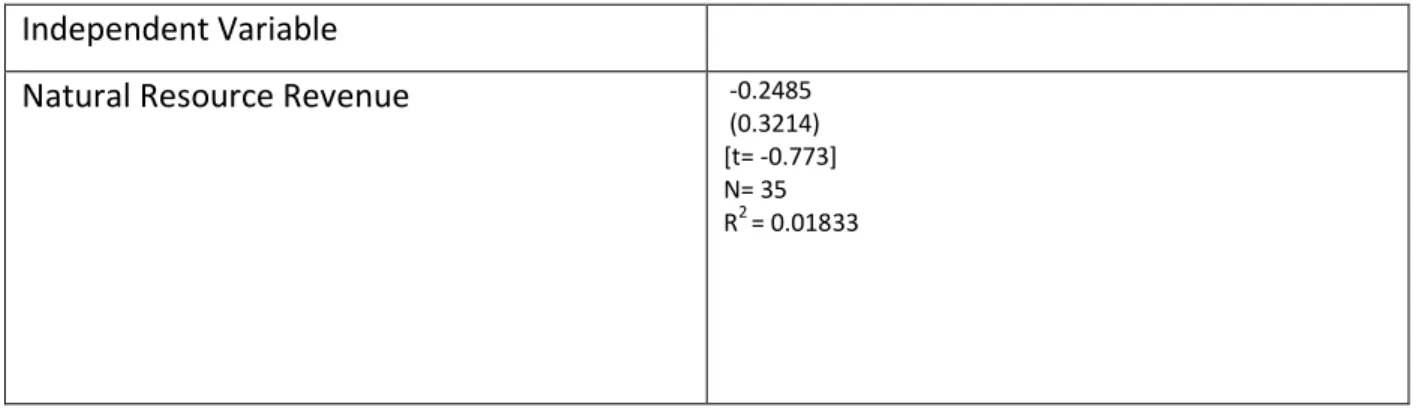
However, the second model is not so strong regarding significant relationships and goodness of fit. The limited number of unit analyses can cause it. In this dataset, the unit of analysis is the province, and the number of populations is only 35 provinces. As a result, it is challenging to build a suitable model in terms of goodness of fit and a solid and significant relationship. Table 3 summary the regression model of these two variables.
Table 3: Summary of second model Regression.
The dependent variable is democracy index Independent Variable
Natural Resource Revenue -0.2485
(0.3214) [t= -0.773]
N= 35 R2 = 0.01833
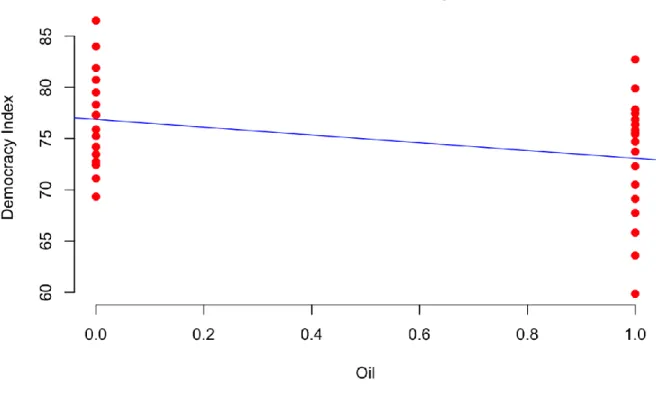
In order to find a more reliable model, we then deploy the dummy variable as the independent variable. We try to find the relationship between oil and democracy and coal and democracy. For the provinces that do not have oil, we code 0, and for those with oil fields, we code 1. The same treatment for coal. The third model (Figure 6) shows the relationship between the existence of the oil field and democracy; table 4 summarize the regression result.
Figure 6: Oil and Democracy Model
We can argue from this model that the presence of oil wells and the quality of democracy have a negative relationship. A province with an oil field will be lower in the quality of democracy.
This result is also the same as what I mentioned in the literature review for the global context.
From table 4, we can see that the significance of dummy variable is better than the previous model. The coefficient is -3.798, with standard error is 1.862. In terms of goodness of fit, this third model is also relatively better, with r2 is 0.115.
Table 4: Summary of third model Regression.
Dependent variable is democracy index
The fourth model tries to find the correlation between coal mining and the quality of democracy.
Again, we find a negative relationship between the presence of oil fields and democracy. Figure 7 show the fourth model:
Figure 6: Coal and Democracy model Independent variable
Oil -3.798*
(1.862) [t= -2.04]
N=35 R2 = 0.115
Table 5: Summary of Coal dan Democracy Regression Relationship Democracy Index
We can argue from this model that the presence of coal mining and the quality of democracy have a negative relationship. A province with coal fields will be lower in the quality of democracy.
From table 5, we can find that the significance of dummy variable for coal is stronger than the previous oil model. The coefficient is -4,899, with standard error is 1.792. In terms of goodness of fit, this coal model is also relatively better, with r2 is 0.1894.
5. Discussion
5.1 A curse rather than a blessing in the context of clientelism democracy
In the history of Indonesia, Indonesia has had two experiences of the resource boom. First, in the era of Suharto, when the oil price was higher due to the Arab-Israel war in the 1970s. Some scholars argue that Indonesia can use this oil boom to provide a better public good to their society compared with other countries in Africa due to fear of threat against communism (Rosser, 2007).
This finding parallels to the theory of rational choice who argues that the elite's fear of mass threats can be a powerful tool for overcoming their collective action problem and forming a unified front to protect their political survival (Bellin, 2000).
However, in the context of Indonesia after the Suharto era, the condition is different. The communist ghost already disappeared. So, what is the fear of threat nowadays? The only fear by
Independent variable
Coal -4.899*
(1.792) [t= -2.734]
N=35 R2 = 0.1894
elites in the new era of democracy is losing their power. For keeping them in the office, there are two ways in the era of free election: First, the elite build better public goods like infrastructure, free health care, of free education. Second, the elite can buy the voters’ vote with mining and palm oil money. In the context of clientelism, democracy, rich in natural resources, can be a curse rather than a blessing in Indonesia.
The connection between mining businesspeople and political parties in Indonesia is closed. Table 6 how parties in the Indonesian parliament are led by businessmen who have business in natural resources.
Table 6: Political Parties and natural resource businessmen
Political Parties Leaders Natural Resources Business Ex-Military Generals Back up
PDIP
Golkar Party
Megawati Sukarnoputri
• Airlangga Hartarto
• General LB Panjaitan
• Aburizal Bakrie (2009-2015)
• Jusuf Kalla (2004- 2009)
Family Party of Sukarno with a lot of funding resources from Chinese businessmen
• Airlangga Hartarto is mining businessman
• Abu Rizal Bakrie is conglomerate who is the owner Kaltim Prima Coal, the biggest mining company in Indonesia
• Jusuf Kalla is the former vice President, owner of Kalla Group who have business in every sector in Indonesia in particularly
infrastructure contract
• Retired General AM
Hendropriyono (Father in law General Andika Prakasa, the current Chief of Military
Force/TNI)
• General Ryamizard Ryacudu, Megawati loyalist
• General LB Panjaitan
• General Ludwig etc
Gerindra
Democrat Party
National Mandate Party (PAN)
National Democrat Party (Nasdem)
• Prabowo Subianto
• Sandia Uno
• Hasyim
Djojohadikusumo
• Susilo B.
Yudhoyono (SBY)
• Agus Harimurti Yudhoyono (AHY)
• Hatta Rajasa (2010-2015)
• Zulkifli Hassan
• Surya Paloh
• The money machine of Gerindra is Hasyim Djojohadikusumo, Prabowo’s brother.
One of the richest men in Indonesia. He has coal mining, oil gas, timber and palm oil company under Arsari Group
• Sandiaga Uno is also one of the richest men in Indonesia.
• Murdaya Poo, one of the richest women in Indonesia, have a lot of palm oil and mining concessions
• Chairul Tanjung, top 5 Indonesian riches man who has some business related to natural resource
• Has company doing business in oil and gas, oil import license cooperates with Riza Chalid, “the oil-gas
mafia” of
Indonesia(’€˜Godfather of Fuel’€™ on the Brink - National - The Jakarta Post, n.d.)
• Surya Paloh has an oil and gas company
connected with
Sonangol, the oil company from China.
They cooperate to explore some oil fields.
Surya Paloh also with Sonangol get import license of oil from Angola (Surya Paloh Eyes Expiring Oil and Gas Blocks -
• Gerindra is the most
militaryism
Party in
Indonesia when Prabowo himself formal general
• SBY and his Son AHY is retired military
No military backup
• General Sutiyoso
• General Endiartono Sutarto
Katadata.Co.Id, n.d.).
Source: data from some media such as katadata, Jakarta post and Forbes
Mining and palm oil sponsored candidates at the local level also win in some governor elections.
For example, a study from (Kurniawan et al., 2019) and shows the role of Sugar Group Company, the biggest sugar company in Indonesia that has a huge land exploitation permit from the government, support his candidate with massive financial funding for vote-buying to win local election against his competitors. The same phenomenon also occurred in some provinces. For example, the governor of Central Kalimantan, Sugianto Sabran, is the most prominent local coal mining and palm oil businessman in Borneo Islands (Illegal Logging, Palm Oil and Politics in Central Kalimantan | REDD-Monitor, n.d.).
To sum up, the cause of this problem is clientelism elections in which political costs are high and political terms are short. As a result, only wealthy politicians or politicians sponsored by mining or palm oil companies can participate in Indonesian democracy. The easiest way to get money for vote-buying is mining and palm oil money. Mining and palm oil concessions from a business- friendly government are also the quickest ways to recover funds after a high-spending election.
In this case, the resource boom in Indonesia is a curse rather than a blessing like some models provided by this paper.
5.2 Potential for better research
One of my most considerable barriers in this research is to find data about ratio between tax and income from the natural resource. Not every province provides open data about their budget. If I have time, I think it can be a better model to capture the resource curse in Indonesia. Some scholar has channelled the resource curse and democrat via the tax system. For example, Ross (2012) argues that countries which most of their income from the tax will be more democratic.
In contrast, most of their revenue is not from tax in countries with many natural resources. Tax systems encourage people to demand more participation in policymaking and demand the government be more transparent and accountable due to loss of incentive by paying the tax.
Therefore, participation, accountability and transparency are the main elements of democracy and inclusive political institution, and inclusive institution is the condition for better development (Acemoglu, 2012).
I also find some special extreme cases that can potentially be qualitative case studies research (Gerring, 2007). For example, I found South Sumatera Province, the second largest income from natural resources since the colonial era, has bad quality both in democracy and development. I also found that three provinces are good both in development and democracy despite not having natural resources but with particular context as the tourism destination in Indonesia. Is tourism can promote democracy? It will be good research to explore.
6. Conclusion
This study finds that democracy quality and development have a positive relationship. A higher level of democracy equates to a higher level of development quality (Hypothesis 1). This paper finds that at the subnational level, there is a resource curse, in which provinces with abundant natural resources have a negative relationship with democracy (Hypothesis 2)
In the era of clientelism democracy, where political costs are high, and terms are short, are the root of the resource curse problem. As a result, Indonesian democracy is limited to wealthy politicians or politicians backed by mining or palm oil companies. Mining and palm oil are the easiest ways to get money for vote-buying. A business-friendly government's mining and palm oil concessions are also the quickest ways to recover election funds after a high-spending money election. In this case, the resource boom in Indonesia is a curse rather than a blessing, as some of our models presented in this paper.
7. DATA AVAILABILITY STATEMENT
Replication files, including R code and dataset, are available at:
https://www.dropbox.com/sh/z08n9oea94z3gd2/AADbsZFJyflJBN1xsYXwIZ9na?dl=0
Reference
Acemoglu, D., & Robinson, J. A. (2006). Economic Origin of Dictatorship and Democracy.
Cambridge University Press Cambridge University Press.
Acemoglu, D., & Robinson, J. A. (2012). Why Nations Fail : The Origins of Power , Prosperity and Poverty. Crown Business. https://doi.org/10.1080/17550912.2012.718670
Afiff, S., & Lowe, C. (2007). Claiming Indigenous Community: Political Discourse and Natural Resources Right in Indonesia. Alternatives, 32, 73–79.
Arif, S. (2019). Cursed by Oil? Rural Threats, Agricultural Policy Changes and the Impact of Oil on Indonesia’s and Nigeria’s Rural Development. Journal of International Development, 31(2), 165–181. https://doi.org/10.1002/jid.3399
Auty, R. M. (2001). Resource Abundance and Economic Development (Auty, Ed.). Oxford University Press.
Basri, M. C., Rahardja, S., & Fitrania, S. N. (2016). Not a trap, but slow transition? Indonesia's pursuit to high income status. Asian Economic Papers, 15(2), 1-22.
Collier, P., & Hoeffler, A. (2005). Resource Rents, Governance, and Conflict. Journal of Conflict Resolution, 49(4), 625–633. https://doi.org/10.1177/0022002705277551
Corden, W. M. (1984). Booming Sector and Dutch Disease Economics: Survey and Consolidation.
New Series, 36(3), 359–380. https://www.jstor.org/stable/2662669
’€˜Godfather of fuel’€™ on the brink - National - The Jakarta Post. (n.d.). Retrieved December 5, 2021, from https://www.thejakartapost.com/news/2015/12/10/godfather-fuel-brink.html Gerring, J. (2007). Case Study Research: Principles and Practices. In Social Science (Vol. 1).
Cambridge University Press. https://doi.org/10.1017/S0022381607080243
Hilmawan, R., & Clark, J. (2019). An investigation of the resource curse in Indonesia. Resources Policy, 64, 101483. https://doi.org/10.1016/J.RESOURPOL.2019.101483
Illegal logging, palm oil and politics in Central Kalimantan | REDD-Monitor. (n.d.). Retrieved December 5, 2021, from https://redd-monitor.org/2016/05/20/illegal-logging-palm-oil- and-politics-in-central-kalimantan/
Komarulzaman, A., & Alisjahbana, A. S. (n.d.). Testing the Natural Resource Curse Hypothesis in Indonesia: Evidence at the Regional Level. 17.
Kurniawan, R. C., Hermawan, D., Indrajat, H., & Kurniawan, B. (2019). Capitalism and Corporate in Lampung Local Politics. KOMUNITAS: International Journal of Indonesian Society and Culture, 11(1), 22–31. https://doi.org/10.15294/KOMUNITAS.V11I1.13161
McCarthy, J. F. (2007). The demonstration effect: Natural resources, ethnonationalism and the Aceh conflict. Singapore Journal of Tropical Geography, 28(3), 314–333.
https://doi.org/10.1111/j.1467-9493.2007.00304.x
North, D. C. (1990). Institutions, Institutional Change and Economic Performance. In Cambridge University Press. https://doi.org/10.1017/CBO9780511606892.012
Resosudarmo, B. P. (Ed). (2005). The Politics and Economics of Indonesia ’ s Natural Resources.
Rosser, A. (2007). Escaping the resource curse: The case of Indonesia. Journal of Contemporary Asia, 37(1), 38–58. https://doi.org/10.1080/00472330601104557
Ross, M. L. (1999). The Political Economy of the Resource Curse. World Politics, 51(2), 297–322.
https://doi.org/10.2307/25054077
Ross, M. L. (2012). The Oil Curse. How Petroleum Wealth Shapes the Development of Nations. In How Petroleum Wealth Shapes The …. Princeton University Press.
https://doi.org/10.2307/j.ctt7s3wz
Ross, M. L. (2015). What Have We Learned about the Resource Curse? Annual Review of Political Science, 18(1), 239–259. https://doi.org/10.1146/annurev-polisci-052213-040359
Rostow, W. W. (1959). The stages of economic growth. The economic history review, 12(1), 1-16.
Sala-i-Martin, X., & Subramanian, A. (2013). Addressing the Natural Resource Curse: An Illustration from Nigeria. Journal of African Economies, 22(4), 570–615.
https://doi.org/10.1093/JAE/EJS033
Spiegel, S. J. (2012). Governance Institutions, Resource Rights Regimes, and the Informal Mining Sector: Regulatory Complexities in Indonesia. World Development, 40(1), 189–205.
https://doi.org/10.1016/j.worlddev.2011.05.015
Surya Paloh eyes expiring Oil and Gas Blocks - Katadata.co.id. (n.d.). Retrieved December 5, 2021, from https://en.katadata.co.id/news/2015/09/22/surya-paloh-eyes-expiring-oil-and-gas- blocks