14-1
Prepared by Coby Harmon
University of California, Santa Barbara Westmont College
1. Describe the nature of bonds and indicate the accounting for bond issuances.
2. Explain the accounting for long- term notes payable.
LEARNING OBJECTIVES
3. Explain the accounting for the extinguishment of non-current liabilities.
4. Indicate how to present and analyze non-current liabilities.
After studying this chapter, you should be able to:
Non-Current Liabilities
CHAPTER 14
14-3
PREVIEW OF CHAPTER 14
Intermediate Accounting IFRS 3rd Edition
Kieso ● Weygandt ● Warfield
Non-current liabilities (long-term debt) consist of an
expected outflow of resources arising from present obligations that are not payable within a year or the operating cycle of the company, whichever is longer.
Examples:
► Bonds payable
► Long-term notes payable
► Mortgages payable
► Pension liabilities
► Lease liabilities
Long-term debt has various covenants or restrictions.
Bonds Payable
LEARNING OBJECTIVE 1 Describe the nature of bonds and indicate the accounting for bond issuances.14-5
Types of Bonds
Common types found in practice:
Secured and Unsecured (debenture) bonds.
Term, Serial, and Callable bonds.
Convertible, Commodity-Backed, Deep-Discount bonds.
Registered and Bearer (Coupon) bonds.
Income and Revenue bonds.
LO 1
Bond contract known as a bond indenture.
Represents a promise to pay:
(1) sum of money at designated maturity date, plus (2) periodic interest at a specified rate on the maturity
amount (face value).
Paper certificate, typically a €1,000 face value.
Interest payments usually made semiannually.
Used when the amount of capital needed is too large for one lender to supply.
Issuing Bonds
14-7
Corporate bond listing.
Company Name
Interest rate paid as a % of par value
Price as a % of par
Interest rate based on price
Creditworthiness
What Do the Numbers Mean?
LO 1
Valuation and Accounting for Bonds
Issuance and marketing of bonds to the public:
Usually takes weeks or months.
Issuing company must
► Arrange for underwriters.
► Obtain regulatory approval of the bond issue, undergo audits, and issue a prospectus.
► Have bond certificates printed.
14-9
Selling price of a bond issue is set by the
supply and demand of buyers and sellers,
relative risk,
market conditions, and
state of the economy.
Investment community values a bond at the present value of its expected future cash flows, which consist of
(1) interest and (2) principal.
LO 1
Valuation and Accounting for Bonds
Interest Rate
Stated, coupon, or nominal rate = Rate written in the terms of the bond indenture.
► Bond issuer sets this rate.
► Stated as a percentage of bond face value (par).
Market rate or effective yield = Rate that provides an acceptable return commensurate with the issuer’s risk.
► Rate of interest actually earned by the bondholders.
Valuation and Accounting for Bonds
14-11
How do you calculate the amount of interest that is actually paid to the bondholder each period?
How do you calculate the amount of interest that is actually recorded as interest expense by the issuer of the bonds?
(Stated rate x Face Value of the bond)
(Market rate x Carrying Value of the bond)
LO 1
Valuation and Accounting for Bonds
Bonds Sold At Market Interest
6%
8%
10%
Premium Par Value
Discount
Assume Stated Rate of 8%
Valuation and Accounting for Bonds
14-13
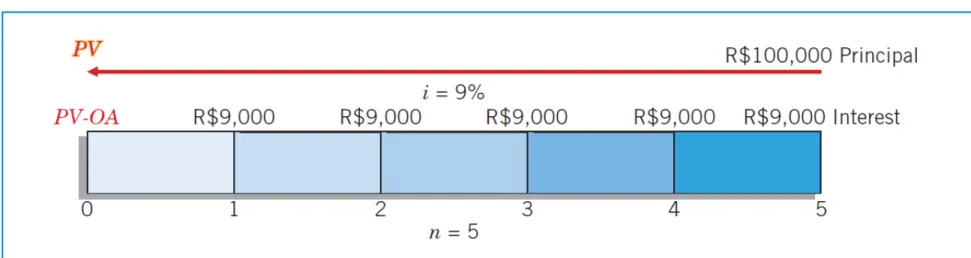
Illustration: Santos SA issues R$100,000 in bonds dated January 1, 2019, due in five years with 9 percent interest payable annually on January 1. At the time of issue, the market rate for such bonds is 9 percent.
Bonds Issued at Par
ILLUSTRATION 14.1
Time Diagram for Bonds Issued at Par
LO 1
Bonds Issued at Par
ILLUSTRATION 14.2 Present Value
Computation of Bond Selling at Par
ILLUSTRATION 14.1 Time Diagram for Bonds Issued at Par
14-15
Journal entry on date of issue, Jan. 1, 2019.
Bonds Issued at Par
Cash 100,000
Bonds payable 100,000
Journal entry to record accrued interest at Dec. 31, 2019.
Interest expense 9,000
Interest payable 9,000
Journal entry to record first payment on Jan. 1, 2020.
Interest payable 9,000
Cash 9,000
LO 1
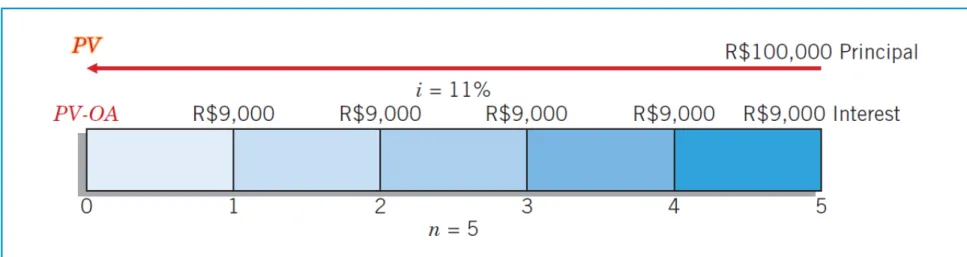
Illustration: Assuming now that Santos issues R$100,000 in bonds, due in five years with 9 percent interest payable
annually at year-end. At the time of issue, the market rate for such bonds is 11 percent.
Bonds Issued at a Discount
ILLUSTRATION 14.3
Time Diagram for Bonds Issued at a Discount
14-17
Bonds Issued at a Discount
ILLUSTRATION 14.3 Time Diagram for Bonds Issued at a DiscountILLUSTRATION 14.4 Present Value
Computation of Bond Selling at Discount
LO 1
Journal entry on date of issue, Jan. 1, 2019.
Bonds Issued at a Discount
Cash 92,608
Bonds payable 92,608
Journal entry to record accrued interest at Dec. 31, 2019.
Interest expense ($92,608 x 11%) 10,187
Cash 9,000
Bonds payable 1,187
14-19
When bonds sell at less than face value:
► Investors demand a rate of interest higher than stated rate.
► Usually occurs because investors can earn a higher rate on alternative investments of equal risk.
► Cannot change stated rate so investors refuse to pay face value for the bonds.
► Investors receive interest at the stated rate computed on the face value, but they actually earn at an effective rate because they paid less than face value for the bonds.
Bonds Issued at a Discount
LO 1
Bond issued at a discount
- amount paid at maturity is more than the issue amount.Bonds issued at a premium
- company pays less at maturity relative to the issue price.Adjustment to the cost is recorded as bond interest expense over the life of the bonds through a process called amortization.
Required procedure for amortization is the effective-interest method (also called present value amortization).
Effective-Interest Method
14-21
Effective-interest method produces a periodic interest expense equal to a constant percentage of the carrying value of the bonds.
Effective-Interest Method
ILLUSTRATION 14.5
Bond Discount and Premium Amortization Computation
LO 1
Effective-Interest Method
Bonds Issued at a Discount
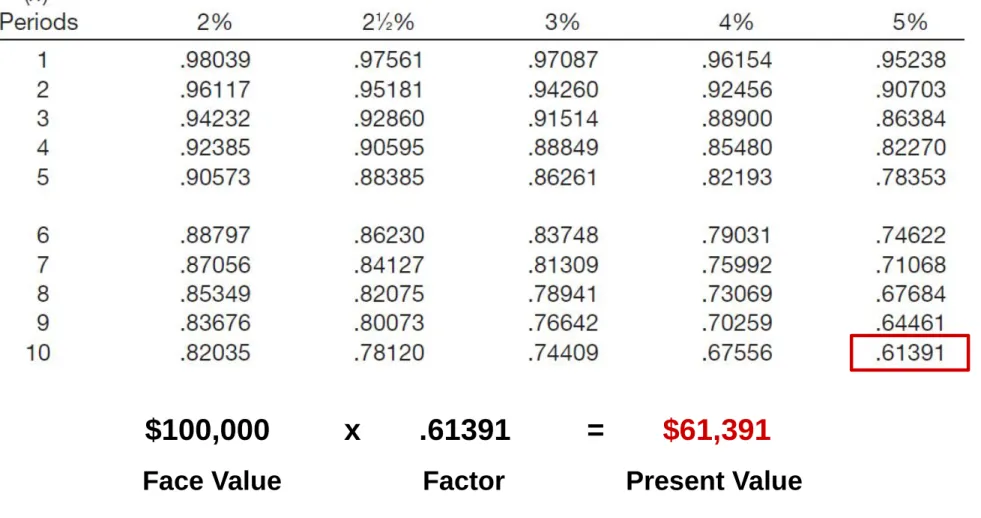
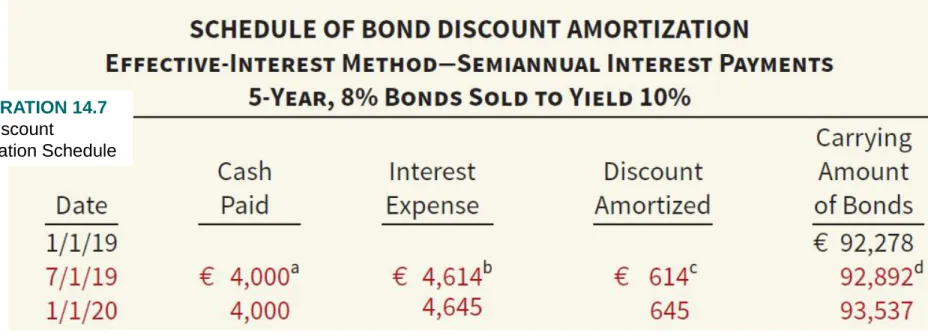
Illustration: Evermaster AG issued €100,000 of 8% term bonds on January 1, 2019, due on January 1, 2024, with interest payable each July 1 and January 1. Investors require an effective-interest rate of 10%. Calculate the bond proceeds.
ILLUSTRATION 14.6
Computation of Discount on Bonds Payable
14-23
$100,000
Face Value Factor Present Value
x .61391 = $61,391
TABLE 6.2 PRESENT VALUE OF 1 (PRESENT VALUE OF A SINGLE SUM)
Effective-Interest Method
LO 1
$4,000
Semiannual
Payment Factor Present Value
x 7.72173 = $30,887
TABLE 6.4 PRESENT VALUE OF AN ORDINARY ANNUITY OF 1
Effective-Interest Method
14-25
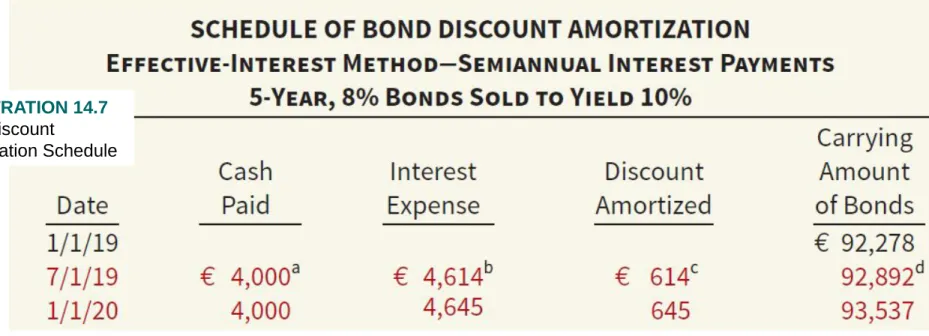
ILLUSTRATION 14.7 Bond Discount
Amortization Schedule
ILLUSTRATION 14.7 Bond Discount
Amortization Schedule
Journal entry on date of issue, Jan. 1, 2019.
Cash 92,278
Bonds Payable 92,278
14-27
ILLUSTRATION 14.7 Bond Discount
Amortization Schedule
Journal entry to record first payment and amortization of the discount on July 1, 2019.
Interest expense 4,614
Bonds payable 614
Cash 4,000
LO 1
ILLUSTRATION 14.7 Bond Discount
Amortization Schedule
Journal entry to record accrued interest and amortization of the discount on Dec. 31, 2019.
Interest expense 4,645
Interest payable 4,000
Bonds payable 645
14-29
Illustration: Evermaster Corporation issued €100,000 of 8%
term bonds on January 1, 2019, due on January 1, 2024, with interest payable each July 1 and January 1. Investors require an effective-interest rate of 6%. Calculate the bond proceeds.
Bonds Issued at a Premium
ILLUSTRATION 14.8
Computation of Premium on Bonds Payable
LO 1
Effective-Interest Method
$100,000
Face Value Factor Present Value
x .74409 = $74,409
TABLE 6.2 PRESENT VALUE OF 1 (PRESENT VALUE OF A SINGLE SUM)
Effective-Interest Method
14-31
$4,000
Semiannual
Payment Factor Present Value
x 8.53020 = $34,121
TABLE 6.4 PRESENT VALUE OF AN ORDINARY ANNUITY OF 1
LO 1
Effective-Interest Method
ILLUSTRATION 14.9 Bond Premium
Amortization Schedule
14-33
Journal entry on date of issue, Jan. 1, 2019.
Cash 108,530
Bonds Payable 108,530
ILLUSTRATION 14.9 Bond Premium
Amortization Schedule
LO 1
Journal entry to record first payment and amortization of the discount on July 1, 2019.
Interest expense 3,256
Bonds payable 744
Cash 4,000
ILLUSTRATION 14.9 Bond Premium
Amortization Schedule
14-35
What happens if Evermaster prepares financial statements at the end of February 2019? In this case, the company prorates the premium by the appropriate number of months to arrive at the proper interest expense, as follows.
Accrued Interest
ILLUSTRATION 14.10
Computation of Interest Expense
LO 1
Effective-Interest Method
Evermaster records this accrual as follows.
Interest expense 1,085.33
Bonds payable 248.00
Interest payable 1,333.33
Accrued Interest
ILLUSTRATION 14.10Computation of Interest Expense
Effective-Interest Method
14-37
Bond investors will pay the issuer the interest accrued from the last interest payment date to the date of issue.
On the next semiannual interest payment date, bond
investors will receive the full six months’ interest payment.
Bonds Issued Between Interest Dates
LO 1
Effective-Interest Method
Illustration: Assume Evermaster issued its five-year bonds, dated January 1, 2019, on May 1, 2019, at par (€100,000).
Evermaster records the issuance of the bonds between interest dates as follows.
Cash 100,000
Bonds payable 100,000
Cash 2,667
Interest expense 2,667
(€100,000 x .08 x 4/12) = €2,667
Bonds Issued at Par
Effective-Interest Method
14-39
On July 1, 2019, two months after the date of purchase,
Evermaster pays the investors six months’ interest, by making the following entry.
Interest expense 4,000
Cash 4,000
($100,000 x .08 x 1/2) = $4,000
Bonds Issued at Par
LO 1
Effective-Interest Method
Bonds Issued at Discount or Premium
Illustration: Assume that the Evermaster 8 percent bonds were issued on May 1, 2019, to yield 6 percent. Thus, the bonds are issued at a premium price of €108,039. Evermaster records the issuance of the bonds between interest dates as follows.
Cash 108,039
Bonds payable 108,039
Cash 2,667
Interest expense 2,667
Effective-Interest Method
(€100,000 x .08 x 4/12) = €2,667
14-41
Evermaster then determines interest expense from the date of sale (May 1, 2019), not from the date of the bonds (January 1, 2019).
Bonds Issued at Discount or Premium
ILLUSTRATION 14.12
Partial Period Interest Amortization
LO 1
Effective-Interest Method
The premium amortization of the bonds is also for only two months.
Bonds Issued at Discount or Premium
ILLUSTRATION 14.13
Partial Period Interest Amortization
Effective-Interest Method
14-43
Evermaster therefore makes the following entries on July 1, 2019, to record the interest payment and the premium
amortization.
Interest expense 4,000
Cash 4,000
Bonds payable 253
Interest expense 253
Bonds Issued at Discount or Premium
LO 1
Effective-Interest Method
The Interest Expense account now contains a debit balance of
€1,080 (€4,000 − €2,667 − €253).
Accounting is Similar to Bonds
A note is valued at the present value of its future interest and principal cash flows.
Company amortizes any discount or premium over the life of the note.
Long-Term Notes Payable
LEARNING OBJECTIVE 2 Explain the accounting for long-term notes payable.14-45
Illustration: Scandinavian Imports issues a €10,000, three-year note, at face value to Bigelow ASA. The stated rate and the
effective rate were both 10 percent. Scandinavian would record the issuance of the note as follows.
Notes Issued at Face Value
Cash 10,000
Notes Payable 10,000
Interest Expense 1,000
Cash 1,000
(€10,000 x .10 = €1,000)
Scandinavian Imports would recognize the interest incurred each year as follows.
LO 3
Notes Not Issued at Face Value
Issuing company records the difference between the face amount and the present value (cash received) as
a discount and
amortizes that amount to interest expense over the life of the note.
Zero-Interest-Bearing Notes
14-47
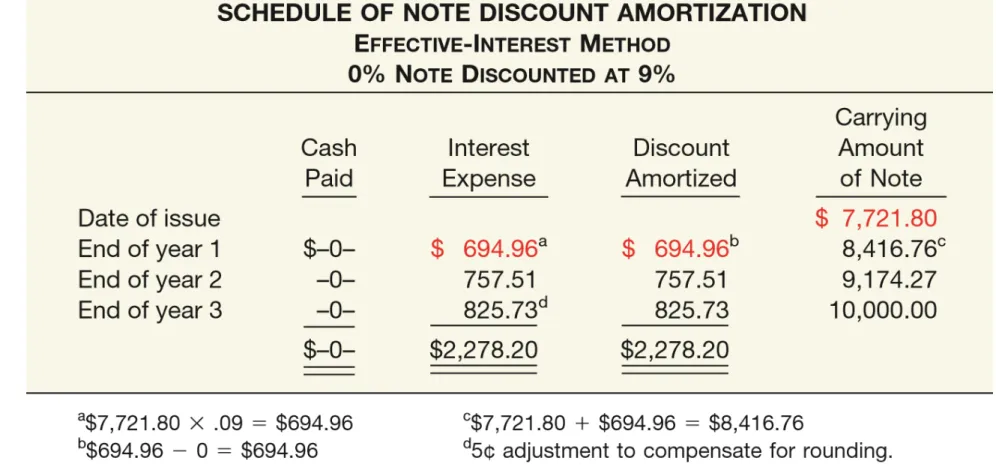
Illustration: Turtle Cove Company issued the three-year,
$10,000, zero-interest-bearing note to Jeremiah Company. The implicit rate that equated the total cash to be paid ($10,000 at maturity) to the present value of the future cash flows ($7,721.80 cash proceeds at date of issuance) was 9 percent.
Zero-Interest-Bearing Notes
ILLUSTRATION 14.14
Time Diagram for Zero-Interest Note
LO 2
Illustration: Turtle Cove Company issued the three-year,
$10,000, zero-interest-bearing note to Jeremiah Company. The implicit rate that equated the total cash to be paid ($10,000 at maturity) to the present value of the future cash flows ($7,721.80 cash proceeds at date of issuance) was 9 percent.
Turtle Cove records issuance of the note as follows.
Zero-Interest-Bearing Notes
Cash 7,721.80
Notes Payable 7,721.80
14-49
Interest Expense 694.96
Notes Payable 694.96 Turtle Cove records interest expense at the end of the first year as follows.
ILLUSTRATION 14.15 Schedule of Note Discount Amortization
LO 3
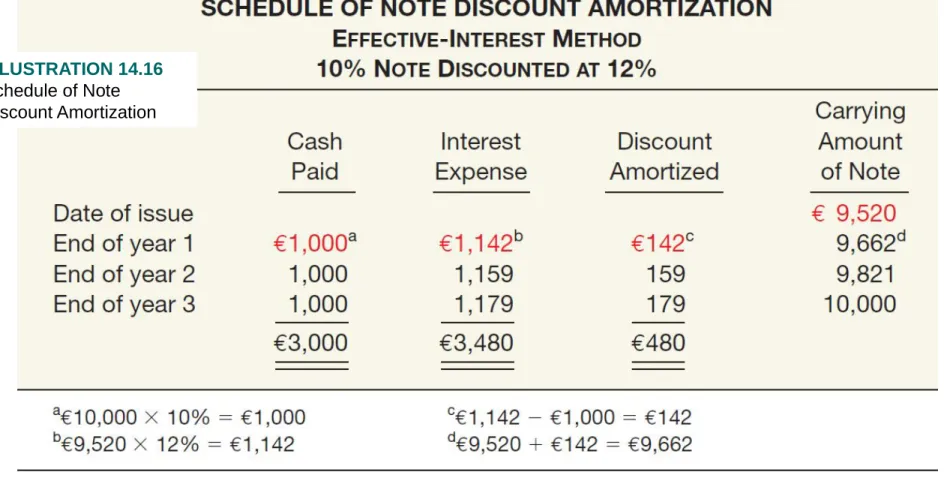
Illustration: Marie Co. issued for cash a €10,000, three-year note bearing interest at 10 percent to Morgan Corp. The market rate of interest for a note of similar risk is 12 percent. In this case, because the effective rate of interest (12%) is greater than the stated rate (10%), the present value of the note is less than the face value. That is, the note is exchanged at a discount.
Interest-Bearing Notes
ILLUSTRATION 7-16 Computation of Present Value—
Effective Rate Different from Stated Rate
14-51
Illustration: Marie Co. issued for cash a €10,000, three-year note bearing interest at 10 percent to Morgan Group. The market rate of interest for a note of similar risk is 12 percent. In this case, because the effective rate of interest (12%) is greater than the stated rate (10%), the present value of the note is less than the face value. That is, the note is exchanged at a discount.
Marie Co. records the issuance of the note as follows.
Interest-Bearing Notes
Cash 9,520
Notes Payable 9,520
LO 2
Marie Co. records the following entry at the end of year 1.
Interest Expense 1,142
Notes Payable 142
Cash 1,000
ILLUSTRATION 14.16 Schedule of Note Discount Amortization
14-53
Notes Issued for Property, Goods, or Services
Special Notes Payable Situations
When exchanging the debt instrument for property, goods, or services in a bargained transaction, the stated interest rate is presumed to be fair unless:
1. No interest rate is stated, or
2. The stated interest rate is unreasonable, or
3. The stated face amount is materially different from the
current cash price for the same or similar items or from the current fair value of the debt instrument.
LO 2
Special Notes Payable Situations
If a company cannot determine the fair value of the
property, goods, services, or other rights, and if the note has no ready market, the present value of the note must be
determined by the company to approximate an applicable interest rate (imputation).
Choice of rate is affected by:
► Prevailing rates for similar instruments.
► Factors such as restrictive covenants, collateral, payment schedule, and the existing prime interest rate.
Choice of Interest Rates
14-55
Special Notes Payable Situations
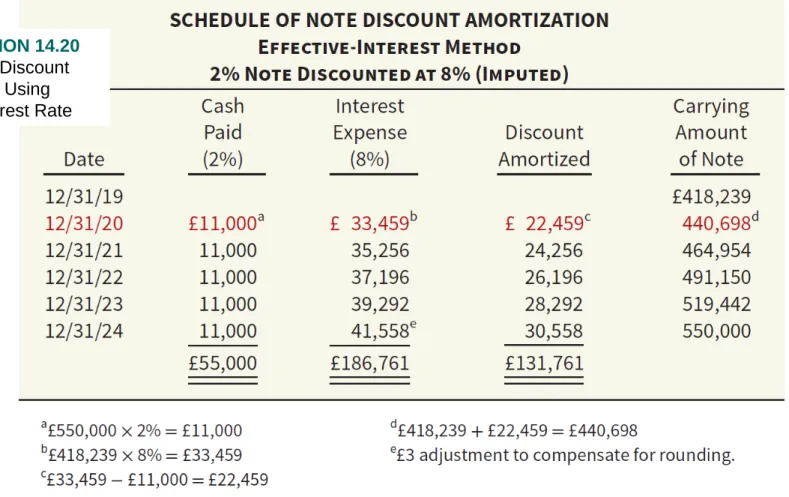
Illustration: On December 31, 2019, Wunderlich plc issued a promissory note to Brown Interiors Company for architectural services. The note has a face value of £550,000, a due date of December 31, 2024, and bears a stated interest rate of 2 percent, payable at the end of each year. Wunderlich cannot readily
determine the fair value of the architectural services, nor is the note readily marketable. On the basis of Wunderlich’s credit rating, the absence of collateral, the prime interest rate at that date, and the prevailing interest on Wunderlich’s other outstanding debt, the company imputes an 8 percent interest rate as appropriate in this circumstance.
LO 2
Special Notes Payable Situations
ILLUSTRATION 14.18 Time Diagram for Interest-Bearing NoteILLUSTRATION 14.19
Computation of Imputed Fair Value and Note Discount
14-57
Special Notes Payable Situations
On December 31, 2019, Wunderlich records issuance of the note in payment for the architectural services as follows.
Building (or Construction in Process) 418,239 Notes Payable 418,239
ILLUSTRATION 14.19
Computation of Imputed Fair Value and Note Discount
LO 2
Payment of first year’s interest and amortization of the discount.
Interest Expense 33,459
Notes Payable 22,459
Cash 11,000
ILLUSTRATION 14.20 Schedule of Discount Amortization Using Imputed Interest Rate
14-59
Mortgage Notes Payable
A promissory note secured by a document called a mortgage that pledges title to property as security for the loan.
Common form of long-term notes payable.
Payable in full at maturity or in installments.
Fixed-rate mortgage.
Variable-rate mortgage.
LO 2
Three common situations besides payment at maturity:
1. Extinguishment with cash before maturity,
2. Extinguishment by transferring assets or securities, and 3. Extinguishment with modification of terms.
Extinguishment of Non-Current
Liabilities
LEARNING OBJECTIVE 3 Explain the accounting for extinguishment of non- current liabilities.
14-61
Net carrying amount > Reacquisition price = Gain
Reacquisition price > Net carrying amount = Loss
At time of reacquisition, unamortized premium or discount must be amortized up to the
reacquisition date.
Extinguishment of Non-Current Liabilities
Extinguishment with Cash before Maturity
LO 3
Illustration: Evermaster bonds issued at a discount on January 1, 2019. These bonds are due in five years. The bonds have a par value of €100,000, a coupon rate of 8 percent paid semiannually, and were sold to yield 10 percent.
Extinguishment with Cash before Maturity
ILLUSTRATION 14.21
Bond Premium Amortization Schedule, Bond Extinguishment
14-63
Two years after the issue date on January 1, 2021, Evermaster calls the entire issue at 101 and cancels it.
Evermaster records the reacquisition and cancellation of the bonds as follows.
Bonds Payable 94,925
Loss on Extinguishment of Debt 6,075
Cash 101,000
ILLUSTRATION 14.22
Computation of Loss on Redemption of Bonds
LO 3
Extinguishment with Cash before Maturity
Creditor should account for the non-cash assets or equity interest received at their fair value.
Debtor recognizes a gain equal to the excess of the
carrying amount of the payable over the fair value of the assets or equity transferred (gain).
Extinguishment of Non-Current Liabilities
Extinguishment by Exchanging Assets or
Securities
14-65
Illustration: Hamburg Bank loaned €20,000,000 to Bonn Mortgage Company. Bonn, in turn, invested these monies in residential apartment buildings. However, because of low occupancy rates, it cannot meet its loan obligations. Hamburg Bank agrees to accept from Bonn Mortgage real estate with a fair value of €16,000,000 in full settlement of the
€20,000,000 loan obligation. The real estate has a carrying value of
€21,000,000 on the books of Bonn Mortgage. Bonn (debtor) records this transaction as follows.
Note Payable (to Hamburg Bank) 20,000,000 Loss on Disposal of Real Estate 5,000,000
Real Estate 21,000,000
Gain on Extinguishment of Debt 4,000,000
Transfer of Assets
LO 3
Illustration: Now assume that Hamburg Bank agrees to accept from Bonn Mortgage 320,000 ordinary shares (€10 par) that have a fair value of €16,000,000, in full settlement of the €20,000,000 loan obligation.
Bonn Mortgage (debtor) records this transaction as follows.
Notes Payable (to Hamburg Bank) 20,000,000 Share Capital—Ordinary 3,200,000
Share Premium—Ordinary 12,800,000 Gain on Extinguishment of Debt 4,000,000
Granting of Equity Interest
14-67
Creditor may offer one or a combination of the following modifications:
1. Reduction of the stated interest rate.
2. Extension of the maturity date of the face amount of the debt.
3. Reduction of the face amount of the debt.
4. Reduction or deferral of any accrued interest.
LO 3
Extinguishment of Non-Current Liabilities
Extinguishment with Modification of Terms
Illustration: On December 31, 2019, Morgan National Bank enters into a debt modification agreement with Resorts Development Group.
The bank restructures a ¥10,500,000 loan receivable issued at par (interest paid to date) by:
► Reducing the principal obligation from ¥10,500,000 to
¥9,000,000;
► Extending the maturity date from December 31, 2019, to December 31, 2023; and
► Reducing the interest rate from the historical effective rate of 12 percent to 8 percent. Given Resorts Development’s financial distress, its market-based borrowing rate is 15 percent.
Modification of Terms
14-69
IFRS requires the modification to be accounted for as an
extinguishment of the old note and issuance of the new note, measured at fair value.
Modification of Terms
ILLUSTRATION 14.23
Fair Value of Restructured Note
LO 3
The gain on the modification is ¥3,298,664, which is the
difference between the prior carrying value (¥10,500,000) and the fair value of the restructured note, as computed in
Illustration 14.23 (¥7,201,336). Given this information, Resorts Development makes the following entry to record the
modification.
Note Payable (old) 10,500,000
Gain on Extinguishment of Debt 3,298,664 Note Payable (new) 7,201,336
Modification of Terms
14-71 LO 3
Resorts Development recognizes interest expense
on this note using the effective rate of 15 percent. Thus, on
December 31, 2020 (date of first interest payment after restructure), Resorts Development makes the following entry.
Interest Expense 1,080,200
Notes Payable 360,200
Cash 720,000
ILLUSTRATION 14.24 Schedule of Interest and Amortization after Debt Modification
Resorts Development makes a similar entry
(except for different amounts for credits to Notes Payable and debits to Interest Expense) each year until maturity. At maturity, Resorts Development makes the following entry.
Notes Payable 9,000,000
Cash 9,000,000
ILLUSTRATION 14.24 Schedule of Interest and Amortization after Debt Modification
14-73
Presentation and Analysis
Companies have the option to record fair value in their accounts for most financial assets and liabilities, including bonds and notes payable.
The IASB believes that fair value measurement for financial instruments, including financial liabilities, provides more
relevant and understandable information than amortized cost.
LO 4 LEARNING OBJECTIVE 4 Indicate how to present and analyze non-current
liabilities.
Fair Value Option
Non-current liabilities are recorded at fair value, with unrealized holding gains or losses reported as part of net income.
Fair Value Measurement
Illustrations: Edmonds SE has issued €500,000 of 6 percent bonds at face value on May 1, 2019. Edmonds chooses the fair value option for these bonds. At December 31, 2019, the value of the bonds is now €480,000 because interest rates in the market have increased to 8 percent.
Bonds Payable (€500,000 - €480,000) 20,000
Unrealized Holding Gain or Loss—Income 20,000
Fair Value Option
14-75
Off-balance-sheet financing is an attempt to borrow
monies in such a way to prevent recording the obligations.
Off-Balance-Sheet Financing
Different Forms:
► Non-Consolidated Subsidiary
► Special Purpose Entity (SPE)
LO 4
Off-Balance-Sheet Financing
Rationale
► Removing debt enhances the quality of the balance sheet and permits credit to be obtained more readily and at less cost.
► Loan covenants often limit the amount of debt a company may have. These types of commitments might not be
considered in computing the debt limitation.
► Some argue that the asset side of the balance sheet is severely understated.
14-77
Note disclosures generally indicate the nature of the liabilities, maturity dates, interest rates, call provisions, conversion
privileges, restrictions imposed by the creditors, and assets designated or pledged as security.
Fair value of the debt should be disclosed.
Must disclose future payments for sinking fund requirements and maturity amounts of long-term debt during each of the
next five years.
Presentation and Analysis
Presentation of Non-Current Liabilities
LO 4
Analysis of Non-Current Liabilities
One ratio that provides information about debt-paying ability and long-run solvency is:
Total Liabilities Total Assets Debt to Assets =
The higher the percentage of total liabilities to total assets, the greater the risk that the company may be unable to meet its maturing obligations.
Presentation and Analysis
14-79
A second ratio that provides information about debt-paying ability and long-run solvency is:
Income before Income Taxes and Interest Expense
Interest Expense Times
Interest
Earned =
Indicates the company’s ability to meet interest payments as they come due.
Analysis of Non-Current Liabilities
Presentation and Analysis
LO 4
Illustration: Novartis has total liabilities of $54,434 million, total assets of $131,556 million, interest expense of $655 million,
income taxes of $1,106 million, and net income of $17,794 million.
We compute Novartis’s debt to assets and times interest earned ratios as shown.
Presentation and Analysis
ILLUSTRATION 14.28
Computation of Long-Term Debt Ratios for Novartis
14-81
U.S. GAAP and IFRS have similar definitions for liabilities. In addition, the accounting for current liabilities is essentially the same under both IFRS and U.S. GAAP. However, there are substantial differences in terminology related to noncurrent liabilities as well as some differences in the accounting for various types of long-term debt transactions.
GLOBAL ACCOUNTING INSIGHTS
LEARNING OBJECTIVE 5
Compare the accounting for liabilities under IFRS and U.S. GAAP.
LO 5
Relevant Facts
Similarities
• U.S. GAAP and IFRS have similar liability definitions. Both also classify liabilities as current and non-current.
• Much of the accounting for bonds and long-term notes is the same under U.S. GAAP and IFRS.
• Under U.S. GAAP and IFRS, bond issue costs are netted against the carrying amount of the bonds.
• Both U.S. GAAP and IFRS require the best estimate of a probable loss. In U.S. GAAP, the minimum amount in a range is used. Under IFRS, if a range of estimates is predicted and no amount in the range is more likely than any other amount in the range, the midpoint of the range is used to measure the liability.
GLOBAL ACCOUNTING INSIGHTS
14-83
Relevant Facts
Similarities
• Both U.S. GAAP and IFRS prohibit the recognition of liabilities for future losses.
Differences
• Under U.S. GAAP, companies must classify a refinancing as current only if it is completed before the financial statements are issued. IFRS requires that the current portion of long-term debt be classified as current unless an agreement to refinance on a long-term basis is completed before the reporting date.
• U.S. GAAP uses the term contingency in a different way than IFRS. A contingency under U.S. GAAP may be reported as a liability under certain situations. IFRS does not permit a contingency to be recorded as a liability.
GLOBAL ACCOUNTING INSIGHTS
LO 5
Relevant Facts
Differences
• U.S. GAAP uses the term estimated liabilities to discuss various liability items that have some uncertainty related to timing or amount. IFRS generally uses the term provisions.
• U.S. GAAP and IFRS are similar in the treatment of environmental liabilities.
However, the recognition criteria for environmental liabilities are more stringent under U.S. GAAP: Environmental liabilities are not recognized unless there is a present legal obligation and the fair value of the obligation can be reasonably estimated.
• U.S. GAAP uses the term troubled debt restructurings and develops recognition rules related to this category. IFRS generally assumes that all restructurings should be considered extinguishments of debt.
GLOBAL ACCOUNTING INSIGHTS
14-85
Relevant Facts
Differences
• Under U.S. GAAP, companies are permitted to use the straight-line method of amortization for bond discount or premium, provided that the amount recorded is not materially different than that resulting from effective-interest amortization. However, the effective-interest method is preferred and is generally used. Under IFRS, companies must use the effective-interest method.
• Under U.S. GAAP, companies record discounts and premiums in separate accounts (see the About the Numbers section). Under IFRS, companies do not use premium or discount accounts but instead show the bond at its net amount.
GLOBAL ACCOUNTING INSIGHTS
LO 5
Relevant Facts
Differences
• Under U.S. GAAP, losses on onerous contract are generally not recognized unless addressed by industry- or transaction-specific requirements. IFRS requires a liability and related expense or cost be recognized when a contract is onerous.
GLOBAL ACCOUNTING INSIGHTS
14-87
About The Numbers
GLOBAL ACCOUNTING INSIGHTS
Under IFRS, premiums and discounts are netted against the face value of the bonds for recording purposes. Under U.S. GAAP, discounts and premiums are recorded in separate accounts.
LO 5
On the Horizon
As indicated in Chapter 2, the IASB and FASB are working on a conceptual framework project, part of which will examine the definition of a liability. In addition, the two Boards are attempting to clarify the accounting related to provisions and related contingencies. The FASB has a project that will align the classification of debt to be refinanced in a manner similar to IFRS.
GLOBAL ACCOUNTING INSIGHTS
14-89
Copyright © 2018 John Wiley & Sons, Inc. All rights reserved.
Reproduction or translation of this work beyond that permitted in Section 117 of the 1976 United States Copyright Act without the express written permission of the copyright owner is unlawful.
Request for further information should be addressed to the Permissions Department, John Wiley & Sons, Inc. The purchaser may make back-up copies for his/her own use only and not for distribution or resale. The Publisher assumes no responsibility for errors, omissions, or damages, caused by the use of these programs or from the use of the information contained herein.