KINETIC STUDIES WITH o<. -CHYMOTRYPSIN
EFFECT OF DILANTIN UPON ETHER NARCOSIS IN THE CAT
Thesis by Robert J. Foster
In Partial Fulfillment of the Requirements for the Degree of
Doctor of Philosophy
California Institute of Technology- Pasadena, California
19.52
I am deeply grateful to Professor Carl Niemann for his helpful guidance of my investigations of the interesting problems he suggested. Working with him has been a privilege and a pleasure. I also ¥rish to acknowledge the cooperation and companionship of my fellow graduate students and other members of the staff of the Chemistry Division.
To Professor Anthonie van Harreveld I wish to extend my thanks for his help with the interesting problem in physiology investigated by Dr. G. Fasman and myself for our minor
requirements. I feel that this excursion into a related discipline was a very valuable experience.
I wish to thank the California Institute of Technology for Teaching Assistantships and Tuition Scholarships in the years 1949-1951. The financial assistance afforded by the Federal and State Governments through their Veteran's Aruninistrations was greatly appreciated.
I am grateful for the patience, understanding, and encouragement of my parents, Mr. and Mrs. Joel P. Foster, my Aunt and Uncle, Mr. and Mrs. J~eland P. Baker, and my v'life Helen, to whom this thesis is dedicated.
The structure of the monoacetyl derivative of 2,4-diamino- 6-ni trotoluene formed by reaction with an equimolar quantity of acetic anhydride in dry acetone at room temperature has been shown to be 2-amino-4-aceta."llido-6-nitrotoluene.
The kinetic constants for the enantiomorphic pair of
acetyl-phenylalaninamides and
°'-
-chymotrypsin at 25° and pH 7. 9 in aqueous solution have been determined. The relationships of these constants with others determined for similar enantio-morphi c pairs is discussed. · Equations for the competitive hydrol- ysis of two substrates at the same catalytically active site of an enzyme have been derived and have been tested experimentally.
The kinetic constants for L-tyrosine-hydroxamide and ()(-chymotrypsin have been determined at pH 6.9 and 25°. With this hydroxamide as substrate, the enzyme-inhibitor complex dis- sociation constants have been determined.for a series of
inhibitors at pH 6.9 and
25°.
The differences between these constants and those at pH7.9
is discussed and the charge state of the catalytically active site is inferTed.The effect of the anti-convulsant dilantin upon ether narcosis in the cat has been determined and is discussed in its relation to present theories of nervous propagation and narcosis.
Part I.
Part II.
Part III.
The monoacetylation of 2-,4-diamino-6-ni tro- Page 1 toluene
Introduction
Discussion of Results Experimental
References
1 1
3 9
Kinetic studies w:L th o( -ch:nnotrypsin at pH 7. 9 10
Introduction 10
Discussion of Results 20
Experimental 23
References 28
Tables 29
Figures 31
E:inetic studies vvi th r:;J. -chymotrypsin at pH 6. 9 51
Introduction 51
Discussion of Hesults 53
Experimental 54
References 59
Tables 60
Figures 63
PROPOSITIONS
in the cat'<
Introduction
Discussion of Results Experimental
Ref er enc es Tables Figures
94
97 101 104 105 112 116
*
This work done in collaboration with Dr. G. FasmanTHE MONOACETYLATION OF 2,4-DIAMIN0-6-NITRO-
TOLUENE
Introduction
When equimolar quantities of acetic anhydride and 2,4- diamino-6-nitrotoluene are allowed to react in dry acetone at room temperature, a monoacetyl derivative is formed in good yield. Parkes and Farthing(1) state that the latter compound can be deaminated via diazotization to give after hydrolysis 2-nitro-4-am.inotoluene, and infer that the monoacetyl derivative is 2-amino-4-acetamido-6-nitrotoluene. However, in the experi- mental section of their paper it is reported that, when 2,4- diamino-6-ni trotoluene is monoacetylated by three different procedures, including that described above, 2-acetamido-4- amino-6-nitrotoluene is the compound obtained, and that it can be converted into 2-amino-6-nitrotoluene in the usual manner.
The question as to which of the above conflicting state- ments is correct has been answered by the.demonstration that the monoacetylation of 2,4-diamino-6-nitrotoluene proceeds
under the conditions specified by Parkes and Farthing as methods a.) and c.) to form 2-amino-4-acetamido-6-nitrotoluene.
Discussion of Results
The monoacetyl derivative of 2,4-dia.inino-6-nitrotoluene was prepared by two converging routes from TNT. One route,
that of Parkes and Farthing, is shown schematically in Table I,
I-III, while the other is I-IV-V-III. 4-Amino-2,6-dinitro- toluene (IV), which had been prepared by Rosicky(2) .from TNT, was acetylated to its known acetyl derivativeC1 )(V). This compound, 4-acetamido-2,6-dinitrotoluene, was reduced to 2- amino-4-acetamido-6-nitrotoluene (III) which had the same melt- ing point as the monoacetyl derivative prepared by the other route. No depression was observed when mixed melting points were taken.
Before it was realized that the product obtained by mono- acetylation of 2,4-diamino-6-nitrotoluene was acetylated in the 4 position and that therefore deamination and hydrolysis would lead to the easily obtainable 4-amino-2-nitrotoluene, effort was expended in improving the yields of the deamination procedure.
Since only tarry products could be obtained with the classical ethyl alcohol reduction of the diazonium chloride, hypophosphorous acid was tried. This mild and straightforward method was first described by Kornblum and Iffland(J). The short life of the diazonium salt of hypophosphorous acid in the acid medium and the generally mild conditions are undoubtedly the reasons why very little coupling takes place. This procedure is recommended as a very clean method of deamination.
The 4-~~ino-2-nitrotoluene (VII) obtained by hydrolysis of 4-acetamido-2-nitrotoluene (VI) which was obtained by the hypo- phosphorous acid-sodium nitrite deamination of III, was identical
with that formed by reduction of 2,4-dinitrotoluene (VIII).
An authentic sample of the compound Parkes and Farthing reported to result from the deamination and hydrolysis of
their monoacetyl derivative had been obtained by deamination of 4-amino-2,6-dinitrotoluene (IV) to the known 2,6-dinitrotoluene (IX) and subsequent reduction to 2-amino-6-nitrotoluene(2).
This compound was clearly different from the one prepared by deamination and hydrolysis of the monoacetyl derivative of 2,4- diamino-6-nitrotoluene since their mixed melting point was depressed 25° and spread over a 1
o
0 range.Experimental ~A-
2-Amino-4-acetarnido-6-nitrotoluene (III) - First route - One hundred gm. of E. K. white label TNT was added slowly to 1250 ml. of
95%
ethanol that had been saturated with ammonia and hydrogen sulfide at 5°.. The suspension was stirred very vigorously during the addition and its teniperature was kept below5°.
As the reaction proceeded the solution turned red, the color developing first at the surface of the finely divided TNT crystals. The reaction mixture was allowed to stand over night. Decantation through a filter was used to separate the~t All melting point values are corrected. All microanalyses were by Dr. A. Elek.
red solution from the yellow sulfur precipitate which was fonned.
One and one-half 1. of water was added to the filtrate and the alcohol stripped off under reduced pressure. The sulfur pre- cipitate was extracted with 1 1. of boiling water. After
1.5
1.of alcohol-water mixture had been stripped from the original filtrate, the extracts from the sulfur were added to it and the volume reduced further. This combined and concentrated filtrate was then heated to
95°,
and filtered hot to remove remaining sulfur. Crude yield was55.5
gm.(75%).
After recrystalliza- tion from 2 1. water, the melting point of the shining red plate- lets was132.,5!134°
with a yield of45
gm.(61%).
Parkes and Farthing reported a melting point of135°.
Twenty and one-half gm.
(0.123M)
of the diamine prepared above was dissolved in100
ml. of dry, redistilled acetone and12.5
gm.(0.123M)
of acetic anhydride was dissolved in40
ml. of the acetone. The acetylating agent was added slowly to the well stirred amine solution at room temperature over a40
minute period. After standing for three hours, the reaction mixture was evaporated to dryness on a water bath. The crude yellow- brown product was recrystallized from720
ml. of15%
(volume) ethanol. Yield of purified product, clusters of fine yellow needles melting155°
to158°,
was23.5
gm. (92%). Parkes and Farthing report a melting point of155°.
To obtain a product which analyzed correctly as the anhydrous amine, drying in vacuo at11 o
0 was needed. This product melted at160°-161°.
Analysis calculated for
c
9H11o
3N
3:
c,
51e7; H, 5.3; N, 20.1. Found:c,
51.6; H, 5.4; N, 20.1 •. Alternate route: 4-amino-2,6-dinitrotoluene (IV) prepared
by Fred Rosicky(2), orange needles melting at 171°-172°
(Holleman and Boeseken (5) reported 171°), was acetylated by the same procedure used above to monoacetylate 2,4-diamino-6-
nitrotoluene except a slight excess of acetic anhydride was employed. The yield of
v,
4-acetamido-2,6-dinitrotoluene, vra.s 66% of ~nite needles melting from 223°-225°. An analytical sample, melting point 224.5°-225°, was obtained by recrystal- lizing from toluene. Parkes and Farthing reported a melting point of 221.5°.Analysis calculated for
c
9
rr
9
o
5N
3 :
c,
45.2; H, 3.8; N, 17.6. Fo\llld: C, 45.3; H,3.9;
N, 17.5.2-Amino-4-acetamido-6-nitrotoluene (III), melting point 160°-161°, was produced in 60% yield when V was reduced using
the sarn.e conditions used to prepare II, 2,4-diamino-6-nit,rotoluene, from TNT. The melting point of a mixture of III prepared by
these two routes was 160°-161°. An analytical sample was pre- pared as with the first route by drying in vacuo at 11
o
0•Analysis calculated for
c
9H11
o
3N
3 : c,
51.7; H,5.3;
N, 20.1. Found:
c,
51.6; H, 5.4; N, 20.0.4-Amino-2-nitrotoluene (VII) -- 520 ml. of 50% hypo- phosphorous acid was chilled to ice temperature and
52.J
gm.(O. 25M) of III added slowly and dissolved. 19 gm. (O. 27M) of sodimn nitrite was dissolved in 60 ml. of ice water and this solution was slowly added to the acid solution of the a.mine salt. The time of addition 1vas governed by the rate of
dissipation of the nitrogen bubbles. The solution turned red but remained clear and no solid phase formed. Water was added to bring the volume to
1250
ml. and the hydrogen ion concent- ration to four formal. The amide bond was hydrolyzed at95°.
In one experiment the time of hydrolysis was three hours and the product isolated could be separated into a neutral and a basic component. The neutral component was shown to be the acetyl derivative of the basic one by further hydrolysis and by acetylation of the basic component. Wnen the time of hydrol- ysis was eight hours, only the basic component could be isolated and that in
40%
yield. The melting point of yellow orangeplatelets after recrystallization from water was
78°-79°.
Beilstein and Kuhlberg(
6)
reported a melting point of77.5°
for their product from the reduction of 2,4-dinitrotoluene.
Analysis calculated for c
7
H8
o~2
:c, 55.J;
H,5.J;
N,18.4.
Found:c, 55.2;
H,5.4;
N,18.5.
After recrystallization from
50%
aqueous ethanol the orange needles of the acetyl derivative melted from 145°-146°.Bogert and Kropff(7) reported a melting point of 77.5° for 4-acetamido-2-nitrotoluene.
Analysis calculated for
c
9
1Li
0o
3N2: C, 55. 7; H,
5 ..
2; N, 14.4. Found: C,55.8;
H, 5.1; N,14.4.
Another route for preparing 4-amino-2-ni trotoluene was that of Bogert and Kropff(
7).
1\venty-five ml. of ethanol was saturated with ammonia and hydrogen sulfide at5°.
Two gm. of2,4-dinitrotoluene, melting point
70°-11°
as prepared by Fred Rosicky, was added with swirling. After half an hour thesolution was poured into
50
ml. of water. Alcohol was stripped off and the orange precipitate was dissolved in dilute hydro- chloric acid, treated ~Tith norite and filtered hot. The solution was then neutralized with sodium hydroxide pellets.Yellowish plates started forming and became orange as they increased in size. The compound was purified by recrystal- lization from water and the crystals were dried in vacuo.
Melting point of the orange platelets was
78°-79.5°
and when mixed with the basic component from deamination and hydrolysis of the monoacetyl derivative of 2,4-diamino-6-nitrotoluene, the melting point was still78°-79.5°.
CH3
0
NH2I
.J..
Table I
N02
I I
"\Y c~
0
NH2x
VIII
1.
2.
J.
4.
5.
6.
1.
References
Parkes, G. D., and Farthing, A.
c.,
Jour. Chem. Soc., 12T5 (1948).Rosicky, F.
G.,
Masterrs Thesis, Calif. Inst. of Tech.(1949).
Kornblum, N., and Iffland, D.
c.,
Jour. Am. Chem. Soc., 71, 2137 (1949).Rugg'.ij.,
P.,
and Zaeslin, H., Helv. Chim. Acta, 19, 434(1936). -
Holleman, A., and Boeseken, J., Rec. Trav. Chim., 16,
425 (1897). -
Beilstein, F., and Kuhlberg, A., Ann., 155, 1 (1870).
Bogert, M. T., and Kropff, A. H., Jour. Am. Chem. Soc.,
12._,
841 (1909).KINEl'IC STUDIES WITH
ot.-CHYMOTRYPSIN AT pH 7. 9
Introduction The discovery of Warburg(1
) in 1905 that pancreatic
extracts capable of catalyzing the hydrolysis of proteins were also able to facilitate the hydrolysis of amino acid esters foreshadowed the observation by Neurath(2) and others that the proteolytic enzyme chymotrypsin, first crystallized by Kunitz and Northrop(3) in 1933, had specific esterase activity. As a result of these discoveries the structural requirements of specific substrates and inhibitors of this enzyme have been extensively investigated. The relative stability of this
enzyme has also allowed investigations of the effect of tempera- ture and pressure on its activity c ( 4).
The effects of any changes in an enzyme catalyzed system, whether in the structure of the substrate, inhibitor or enzyme or in the environment of the reaction -- i.e., temperature, pressure, pH, ionic strength, etc., are best expressed by changes in the kinetic constants of the enzyme catalyzed reaction. In work with chymotrypsin, the constants usually evaluated are: the Wdchaelis-Menten constant, (5) K
3, the rate of break-down of the enzyme-substrate complex to yield products, k3, and the enzyme-inhibitor dissociation constant, KI.
Assumptions made in the following derivations will be indi- cated where they are significant.*
*
These derivations are based on those of Haldane.Co)The reaction system is as follows: The enzyme and sub- strate u.Iiite to form a complex which breaks down in some manner (probably attack by OH- or H
2o) to yield the products and the enzyme. In this treatment the affinity of the products for the enzyme will be ignored since for the extent of hydrol- ysis used in the experiments recorded and for the products produced the effect is negligible.* For competitive inhibition there is another equilibrium to consider: enzyme and inhibitor in equilibrium with an inhibitor-enzyme complex.
E + S
~
ES k3> E + p (1)E +I (2)
A further assumption is that the concentrations of 11511 and
"I''
are much greater than the concentration of "E" so that:
[s] =
total concentration of"S" g
free concentration of 113fl,
[r] =
If"
ti"I'' g
fl If II "I II,[E] =
It"
II "E"'~~= II II II enzyme-substrate complex,
~ii= II fl ti enzyme-inhibitor complex, (
[FJ - [Efil
-[Et] ) = concentration of free enzyme.The next assumption is that a steady state is reached in which
* ~~;-~and
Niemann(7) for a treatment of a case where affinity of products for enzyme is not negligible.Then;
or
K8
ffifil
= ( ~] -11:§1 - [EI) )[s] ,
(3a)where - k2 + ~
- k1
and = ( [~ -
(4)
where
Dividing equation (4) by equation (3) and solving for
IBD,
fj] KS
lj;IJ
=Kr
(13] ~~ • (5)Substituting for ~jl in equation (3a),
KS Q:]
KS ~~ = {]:] - [];~ ( 1 +[}SJ KI) ' ( 6)
which may be solved for
ffisJ :
· RS ttJ ·
Ks +[s](1
+im
KI )(7)
From the assumption of a steady state it is seen from equation
. -d
s
(1) that dt = k
3
ES • Then,d ~] - k3 [E] (§]
- d't -
~J + K-(1 +DJ) •--s
KI(8)
Since in this system
(Es]
has a maximum value of0;], -
d dtlfilhas a maximum value k
3 I]:]
:=
V.Thus,
d
[5-J
- dt = v 115]
• (9)This may be inverted to give
1 1 1 K5
rT,
· ;; = v+v "-1"(
1+it'),
. I
which may be integrated to give
(10)
I
W~
k3 (];] t
= [s]
0 -[s]
+ 2.3 log10Ks
(1 +KI)iru·
(11) If..!_
(initial velocity reciprocal) is plotted against~
, a straight line is obtained if the VOsyst~m
can be formu- lated as above(S). The slope of the line is2
(1 +~
andv
AIthe intercept at
~ =
0 is~
• In practice the KS and V (for a given enzyme concentration) are determined in this manner with{j:] =
O. A competitive inhibitor when tested in this manner will give a. family of straight lines having the same intercept as given by the substrate alone but with a slope of ( 1 +~
) times the original slope.I
Several series of cross-checks -- that is the determination of the
Kr
of an inhibitor using two or more substrates have all yielded the information that there is only one kind of hydrolytic site on the chymotrypsin molecule( 9 ). Recentstudies of inhibition by di-isopropyl-fluoro-phosphate and related phosphate esters of the esteratic and proteolytic function also lend credence to this belief(1
o).
Therefore it seemed appropriate to develop the kinetic expressions for simultaneous competitive hydrolysis of tvvo substrates at the same site of a hydrolytic enzyme. The symbols used below are defined as above, the only changes being the addition of obvious identifying subscripts. The system is formulated as:~ .1 k
E +
s
1 ~ ES1 ).1, E + p1'
(12.1)k2.1
k1.2 k
E + s2'
'
ES 3•
2~
E + p2 • (1 2. 2) k2.22
With the assumption of a steady state, i.e.,
( ~]
(
~]
d ~si] ct [s~
dt
<<
dt and ct dt -~s~< <
ct dt [s~ '[Es~ ~sJ ) ~U
~~ - Es~ ) ~~
~
• 1 =~s~
C k2. 1 + k3. 1 ) ( 13. 1 )~.
2
= ~sj (k 2• 2 + k3•2).(13.2)By dividing equation (13.1 ) by (13.2), substituting KS and 1
K82 for their corresponding expressions, and solving for ~S~ , (14)
Equation (13.1 ) then becomes,
Then,
(16.1)
Since and
- d
~il =
• (18.1)~
2In a completely analogous manner it can be show.n that
(18. 2)
Therefore the total velocity vT is:
• (19)
This may be solved for
1
[si]
+rs;i
K51
!S;
1
(20)
which is in the form of equation (10) with an apparent maximum rate VT ,
with an apparent
Ks
of T•
'
(21)( 22)
·Equation (22) simply means that when initial conditions are investigated for competitive hydrolysis, the apparent KS
T is such that its reciprocal is the weighted average of the reciprocals of the individual KS values. The apparent kJ
T for .the competitive reaction is the average of the individual k
3
values weighted by the function1 ~]
as an investigation of equation (21 ), will reveal. Some interesting consequences ofthese expressions will be discussed later.
An integral expression similar to equation (11) may be derived as follows for either one of the substrates. Equation (18.1) may be solved for -v1dt,
• ( 23)
When equations (18.1) and (18. 2) are put in the form of their lowest common denominator (as was done to obtain
(19)),
their quotient may be expressed as:(24)
which may be written in the form
(25)
where Then,
log ~aj = )l log ~tl +log
c,
(26)or
@~
= C~i])i ,
(26a)• Substituting for ~~ in equation (23) and integrating from
[311,
to[s1] ,
KS1 C
r,
:'1( )(]+
KS
2x L ~il
o -rsil . ·
( 27)This equation differs from that for a single substrate only in the added term in the exponential.
The enzyme-inhibitor dissociation constant ~ is a true equilibriwn constant and the free
reaction E +I -~ EI may be
energy change for the
calculated as - JlF = RT ln
K
1•
I Since in the case of the proteolytic enzymes a way has not been found yet to measure either
11'
k2, or their quotient directly for the reaction E + S ---~ ES, one is left with the choice of k3
greater than, equal to, or less than k2 for thecomplete reaction of equation (1). However, certain systematic structural changes in inhibitors and substrates alter the
constants Ks, KI' and k
3
in such a manner that the most logical explanation is that k2 is larger than k3 and that therefore Ks is indeed a quasi equilibriwn constant for ot.-chymotrypsin and the more active of the substrates discussed below.
cx-chymotrypsin catalyses the cleavage of the bond indicated <11
) in R(R' )CHCO-R" where R may be hydrogen, chlorine, hydroxyl, amino or acylamido, R' may be such that
R'CHNH
2
co~ is L-norvaline, norleucine, methionine, tryptophan, phenylalanine or many substitution products thereof as well ashexahydrophenylalanine,, while R" H may be an alcohol,, ammonia, hydroxylamine or hydrazine. The different combinations that have been studied so far vary widely in affinity for the enzyme and also in susceptibility to hydrolysis. Derivatives of L-tryptophan and L-phenylalanine and its substitution products may be called the "typical" substrates for rJ. -chyme- trypsin because of their relatively greater affinities and susceptibilities to hydrolysis. ·rhe pH at which the reaction system is buffered affects the relative affinities of compounds of varying R with the other variants held constant. For example,, compounds with free amino groups have pH- optima more acid than those with acylamido groups for R. This phase of the specificity is discussed more fully in Part III of this thesis. The relative susceptibility of the bond indicated above to hydrolysis in the presence of the enzyrne decreases in the order ester> hydroJcylamide:> amide::> methylamide.
Present data indicate that for derivatives of amino acids there is complete stereochemical specificity;i.e., only those amino acid derivatives belonging to the L series are
subjec.t to chymotryptic hydrolysis. However in all cases but one reported so far, the KI for the D antipode is less than the
Ks
for the L substrate. It is interesting to note in this instance - the carboethoxy-tyrosinamides(12) - that
this acyl group and the carbobenzo.:xy group are the two which disturb the antipodal specificity of the papain catalyzed synthesis of acyl phenylalanine phenylhydrazides(1
3).
There are of course inhibitors in the L family too. Some of these have no hydrolyzable bond - viz~acetyl-L-tryptophan,
while others have such a bond but hydrolysis proceeds so slowly that they can be treated as inhibitors in a system with a more susceptible substrate. A case in point is acetyl-L-tryptophan methylamide in the presence of acetyl-L-tryptophanamide. A more detailed discussion of the structural requirements of inhibitors is reserved for Part III of this thesis.
To further the understanding of the mode of action of chymotrypsin, the kinetic constants for the enantiomorphic pair of acetyl phenylalaninamides have been determined. The
equations for competitive hydrolysis developed in the intro- duction have been tested for two pairs of substrates: acetyl- L-tyrosinamide, acetyl-L-phenylalaninamide; and acetyl-1- tyrosinamide and acetyl-L-tryptophanamide.
Discussion of Results
H. T. Huang and
c.
Niemann detected certain characteristic differences in ~ and KI values when the structures ofsubstrat~s
and inhibitors were changed in a systematicmanner~7,9,
14~
For acyl-L-tyrosinamides and acyl-L-tryptophanamides, a change
of acyl groups from acetyl to nicotinyl resulted in a two- fold decrease of
Ks
while for the corresponding D enantio- morphs the same change brought about a two-fold decrease of KI. The change in - ~F for the formation of the enzyme- inhibi tor constants was 400 calories per mole for the acyl shifts noted above. Comparison of the ''K" values showed that substitution of 13-indolyl-methyl for para-hydro:xy- benzyl decreased them five-fold. This is an increase of- C>.F of 1000 calories for the inhibitors. For the enantio-
morphic pairs above, the constant for the D compound was nearly one-half of that for the L substrate.
It was desired to extend these studies to include the corresponding phenylalaninamides and while H. T. Huang was investigating the nicotinyl phenylalanine amides the present author determined the constants for the acetyl compounds.(1
5).
The results are tabulated below.
Acetyl-L-phenylalaninamide Acetyl-D-phenylalaninamide Nicotinyl-L-phenylalaninamide Nicotinyl-D-phenylalaninamide
34
14 187
- fl.F
o.s
20002. 1
2530 2380 2930
The - AF values for the substrates are valid of course only
0 k2
with the assumption that Ks
=
~•
The substitutions ofnicotinyl for acetyl and D for L in the acyJ:-phenylalanin- amides have the same effect on the ratios of the KS,I values as they had in the tyrosine and tryptophan series. ·The loss of the para-hydroxyl group increased the
Ks,r
values only by10%
whereas it decreased k3 by almost
70%.
In view of the fact that the constants for acetyl-L- tyrosinamide and acetyl-L-tryptophanamide had been determined with a reasonable degree of precision<7,16), it was decided to check the hypothesis that there was only one kind of enzymat1c site on the
°'
-chymotrypsin molecule by employing theequations for competitive hydrolysis derived in the intro- duction. Two series of experiments each with two different ratios of substrates are summarized in Table I. The hydrolyses for these experiments are presented in Figures 7 to 16. The KS T values found experimentally agree very well with the calculated ones, whereas the kJ values were about 10% high. This is still
T
within the limits of experimental error but part of this dis- crepancy may be explained.
The high values of ~ found experimentally can be T
explained partially by studying the consequences of the equations for competitive hydrolysis and the method used for evaluating initial velocities. If the experimental values of k3 and Ks for acetyl-L-tyrosinamide and acetyl-L-tryptophan- amide are substituted in equation (24), it is seen that the
ratio of hydrolysis of the tryptophan derivative to that of the tyrosine derivative is 1.2 times the ratio of their concentration. However, from equation (19) it is seen that a higher percentage of the tryptophan derivative decreases the total rate. Thus, as the hydrolysis proceeds, the ratio of tyrosine substrate to tryptophan substrate increases and so does the apparent rate constant ~ • Since the initial
T
velocity is estimated graphically or analytically from a
series of eight determinations of total product concent.ration, each initial velocity computed is higher than it would have been for a single substrate with the same kinetic constants.
This point is illustrated in Table 3 which compares percentage of hydrolysis rates and relative rates for tvro different
t . f acetyl-L-tryptophanamide A f th h k ra ios o acetyl-L-tyrosinamide • s a ur er c ec on the validity of the expressions derived for competitive hydrol- ysis,the pair acetyl-L-tyrosinamide and acetyl-L-phenylalanin- amide was studied. The constants found for these experiments are given in Table 2. The individual hydrolyses are presented graphically in Figures 17 to 19.
Experimental*
Acetyl-L-phenylalaninamide - Two grams of acetyl-L-
phenylalanine methyl ester(15) was added to
50
ml. of methanol saturated with ammonia ato
0• After standing for two days at*
All melting point values are corrected. All microanalyses by Dr. A. Elek.room temperature, the solvent was evaporated to dryness and the solid recrystallized twice from water. The melting point of the fine white needles was
176°-177°, ['~Jii5
= +27°
( c, 1%
in methanol).Analysis calculated for
c
11JLi 4
02N2:c, 64.1;
H,6.9;
N,13.6
Found:
c, 64. 2;
H,6.8;
N,13.6
Acetyl-D-phenylalaninami.de - One gram of acetyl-D-phe:nyl- alanine methyl ester(
15)
was ammonolyzed as above. The melt- ing point of the fine white needles after two recrystallizations from water was176°-177°, [~~
5= -27° (C, 1%
in methanol).Analysis calculated for
c 11 R-t40
2N2:c, 64.1;
H,6.9;
N,13.6
Found:
c, 64.2;
H,6.8;
N,13.6
Acetyl-L-tyrosinarnide - Am.monolysis of 10 grams of acetyl- L-tyrosine ethyl ester<
16)
gave4.1
grams of acetyl-L-tyrosin- amide. The small rhombs melted at225.5°-226°
after recrystal-liza~ion from methanol and drying in vacuo over P2
o 5 •
The melting point of the product was not depressed ·when mixed with an authentic specimen (16). [ oe.] ii5
= + 50.7 (
C,o. 8%
inwater).
Acetyl-L-tryptophanamide - Ammonolysis of 10 grams of acetyl-L-tryptophan methyl ester(7) gave 8.0 grams of acetyl-
L-tryptophanamide which melted at 189°-191° after recrystal- lization from water and drying in vacuo over P
2
o
5 •
A mixed melting point with an authentic specimen(7) showed nodepression.
[cr..]~5
= + 20.5°(c, 2%
in methanol).Enzyme - The enzyme used in all of these experiments was an Armour product, lot 90402. Several analyses yielded a value of 1
o.
l~% for the protein nitrogen content, which was determined as follows: An accurately weighed sample of the chymotrypsin preparation, dissolved in water, was precipitated with an equal volume of5%
trichloracetic acid. The precipitate was collected on a previously weighed sintered glass crucible and dried. The crucible was reweighed and the nitrogen content of the precipi- tate determined.%
prot. N =wt.
wt. of samples of ppt.%
N in ppt.All of the experiments in this part of the thesis were conducted with an enzyme concentration of 0.208 mg. protein nitrogen per ml. of reaction solution. The dry enzyine preparation was put into solution shortly before use and placed in a thermostat at 25.0°.
Buff er - A tris-(hydroJcy111ethyl)-amino-methane-hydro- chloric acid bui'fer was employed to keep the pH between 7.8- 7.95 since it had been shown that the maxi.mum activity of
chymotrypsin for these substrates included this range(7, 1
5,
16).The technical amine from Commercial Solvents Corporation was
recrystallized twice from ethanol to a melting point of 168°- 168 •
.5°.
A stock solution 0.2 F in the amine component was prepared and1.oo
ml. was used for the 10.0 ml. reaction solutions.Temperature - The temperature was maintained at 2,5.0°
.± o.1
by a "Sargent" water bath thermostat for all hydrolyses.Analysis - The method used for analysis was potentiometric formol titration of 1.00 ml. aliquots taken at selected time intervals(17
>.
A Beckman pH meter model G, with special narrow bore electrodes, models 290 - 11 x (glass) and 270 - 6 ( calomel), was employed to measure the pH. Titration curves were plotted of pH versus ml. of 0.0100 N sodiurn hydroxide standard solution (prepared carbonate free from50%
sodium hydroxideC18)). The point of inflection was chosen as the endpoint of each titration.A sample set of titration curves for one hydrolysis is shown in Figure 1.
Calculations - The initial value for each substrate
concentration was determined by extrapolation of the hydrolysis curves to zero time. This value is the formol titration of the buffer, enzyme, inhibitor if present, and the substrate.
The main component is of course that due to the buff er and for this reason the buffer concentration was maintained as low as was consistent with a satisfactory buffering. For the .first few points of each determination this buffer blank amounted to
as much as 90% of the total titration and decreased to less than
50%
at the end for higher substrate concentrations.The most critical part of the determinations was the evaluation of the initial velocity from the primary data. The reason for this is that the order of the reaction is neither zero, first, nor even constant. · As may be seen from an ex.am- ination of the equations for the enzymatic hydrolysis, first order kinetics are approximated if the initial concentration is much less than the Ks· However, the value of K
8 for sub- strates used in these studies is such that concentrations small enough to give a good first order approximation would create other experimental limitations. With substrate concen- trations considerably greater than the K
5 value, zero order kinetics are approximated but unfortunately, the low solu- bility of the substrates precludes such concentrations. For the above reasons the initial velocity of most o<·Chymo- tryptic hydrolyses must be evaluated graphically.
The values of the kinetic constants k 3, K
5, and
Kr
forsingle substrate hydrolyses and k
3 an:i K8 for competitive
T T
hydrolyses were obtained from appropriate plots of equations (10) and (20).
1.
2.
3.
4.
5.
6.
7.
8.
9.
1
o.
11.
12.
13.
14.
15.
16.
17.
18.
References
Warburg,
o.,
Ber., 381, 187 (1905).Snoke, J.E., Schwert, G.W., and Neurath, H., Jour. Biol.
Chem., 175, 7 (1948).
Kunitz, M. ai1CI"'"'Northrop, J.H., Science, 78, 588 (1933).
Curl, A.L., and Jansen, E.F., Jour. Biol. Chem., 184,
45
(1950). -
Michaelis, L. and Menten, M.L., Biochem.
z., 49,
333(1913).
Haldane, J.B.
s.,
"Enzymes", Longmans-Green and Co., London (1930).Huang, H.T. and Niemann,
c.,
Jour. Am. Chem. Soc., 73,1541 (1951). ...
Lineweaver, H. and Burke, D., Jour. Am. Chem. Soc.,
56,
658 (1934). -
Huang, H.T. and Niemann,
c.,
Jour. Am. Chem. Soc., 73,1555
(1951). . -Jansen, E.F., Fellows-Nutting, M.D., Jang,
R.,
and Balls, A.K., Jour. Biol. Chem.,179,
189(1949).
Neurath, H. and Schwert, G., CE"'eiii. Reviews,
46, 69 (1950).
Manning,
D.,
This laboratory, to be published.Schulle~( W.H. and Niemann,
c.,
Jour. Am. Chem. Soc.,Jl.,
1644 ( 19 51 ) •
Huang, H.T. and Niemann,
c.,
Jour. Am. Chem. Soc., 73,3223 (1951 ). -
Huang, H.T., Foster, R.J., and Niemann,
c.,
Jour. Am" Chem.Soc., in press.
Thomas, D.W., MacAllister, R.W., and Niemann,
c.,
Jour. Am.Chem. Soc., 73, 1.548 (1951 ).
Iselin, B. and Niemann,
c.,
Jour. Biol. Chem., 182, 831(1950). -
Swift, E.H., "Introductory Quantitative Analysis", Prentice Hall Inc. (1950).
Table 1
0(-Chymotrypsin Catalyzed Competitive Hydrolysis of Acetyl-L-Tryptophanamide and Acetyl-L-Tyrosinamidea Mole
%
Mole% KS dk3
eS1 b s2 c Exptl. Cal ed. Exptl. Calcd.
100 0
5.Jf
0.50 f50 50 9.0 9.1
o.86
0.7825
75
13.8 13.9 1.3 1.20 100 30.5g 2.4g
a., in aqueous solutions at
25°
and pH7.9;
b., acetyl-L- tryptophanamide; c., acetyl-L-tyrosinamide; d., in units of 1 0 -J molar; e., in units of 0 . . 1 -3 mole. 1. -1 nun. . -1 c· mg. prot.N. rnl.-1)-1
;
f.,
cf. ref. 7; g., cf. ref. 16.Table 2
0( -Chymotrypsin catalyzed Competitive Hydrolysis of Acetyl- L-Phenylalanina:rnide and Acetyl-L-Tyrosinamidea
Mole
%
Mole%Ks . d k3
es
bs
c Exptl. Cal ed. Exptl. Calcd.1 2
100 0 34 f
0.1
f5o
50 33 321.7
1.60 100 J0.5g 2.4 g
b., acetyl-L-phenylalaninamide;
r.,
this thesis; all other footnotes see Table 1 above.Table 3
The Relative Velocities of Hydrolysis in the Competitive Hydrolysis of Acetyl-L-Tryptophan- amide and Acetyl-L-Tyrosinamidea
s
bT
s
c1
s
d2 Total
%
of ST%
of vT%
of ST%
Of VT Velocity920 25 29
75
71 1.2660
25
2975
71 1. 7120
50 55 50 45
1.0060
50 55 50
45 1.25a., calculated from equations (19) and
(24);
b., in units of 1o-3
molar;c.,
Acetyl-Ir-tryptophanamide; d., Acetyl- L-Tyrosine amide; e., relative to initial velocity of competitive hydrolysis of 1o-
2 molars
1 and 1o-
2 molars
2•Figure 1
8
7
6
5
1.3 1.4 1.5
1.61.7
1.8Sample t:L tration curves
Ordinate: pH of formaldehyde solution of one ml. aliquots plus added base.
Abscissa: Ml. of 0.01 N NaOH added.
Figure 2.
0
0 20
40 60
80Chymotryptic hydrolysis of acetyl-L-phenylalaninamide.
Ordinate: Substrate concentration in units of 10-3 M.
Abscissa: Time in minutes~
100
3
0 20
40 60
80 . 100Chymotryptic hydrolysis of acetyl-L-phenylalanillamide Ordinate: Natural log of substra·te concentration in units of
10-3 M. .
Abscissa: Time in minutes.
30
20
0 0
Figure
4 ..
0
0
2
40
60 80Determination of kinetic constants for the
chymotryptic hydrolysis of acetyl-L-phenylalaninamide 100
Ordinate: Initial velocity reciprocal in units of 10-3 min.
l./mole. · -
Abscissa: Reciprocal of substrate concentration in units of
l.~mole. 3 1 1 ~
1
-1K8
=
35 x 10- M; ~ ==o.
7 x 10- mole 1- min- (mg. proto N .. ml )20
10
0
0 20
40
60 80Inhibition by a.cetyl-D-phenylalaninamide of the ' cbymotryptic hydrolysis of acetyl-L-tyrosinamide Ordinate and abscissa as in Figure 2.
Inhibitor concentration 1
o-
2 M.100
Figure 6.
2
. 0 20
40
60 80Inhibition by acetyl-D-phenylalanincimide of the
~hymotryptic hydrolysis of acetyl-L-tyrosina.nd,.de Ordinate and abscissa as in Figure
3.
Inhibitor concentration
10-~.
100
2
0 0
40
60 80Determtnation of KI for, acetyl-D-,phenylalamnamide Ordinate and abscissa as in Figure
4.
100
1 -2 Base line represents I =
o,
upper line is for I = 0 'MKI = 12 x 1
o-3
M.10
0 10 20 30
40
Competitive chymotrjptic hydrolysis of acetyl-L-tryptophanamide (25%) and acetyl-1-tyrosinamide (75%). _
Ordinate and abscissa as in Figure 2.
50
1.1
1..,1 ..
1
0 10 20 30
40
Competitive c hymotryptic hydrolysis of ac etyl-L- trytophan- amide
(25%)
and acetyl-L-~yrosina.'llide(75%)
50
Ordinate: Log base 10 of substrate concentration in units of 10-3 M.
Abscissa: Time in minutes~ -
10 0
Figure 1 O ..
10 20 30
40
0Competitive chymotryptic ltydro~sis of ~cetyl-L-tryptophanamide
(25%)
and acetyl-L-tyrosinamide(75%)
Ordinate and abscissa as in Figure 2.
1.1
1.0
0 10 20 3
4'o
0Competitive chymotryptic hydrolysis of acetyl-L-tryptophan- amide
(25%)
and acetyl-L-tyrosinamide( 7 5%)
Ordinate and abscissa as in Fi~ure 9.
6
5
2
1
Figure 1 2o
0
0 10 20 30
40 50
Jetermination of apparent kinetic constants for the competitive chymotrypt.ic. hydrolysis of acetyl-L-tryptophanamide ( 25%) and acetyl-L-tyrosinamide
(75%)
Ordinate and abscissa as in Figure
4.
Open and closed circles for two series of experiments.
K-
=
1) •. 8 x 10⁻³ M.1'T .
1 -3 -1 . -1'
~ = • 3 x 1 O mole, L .. ; lill.n, T
. ' -1 -1
(mg. prot. N'.ml )
10
0 10 20 30
40 50
Competitive ohymotry:ptic hydrolysis of acetyl-L-tryptophanamide
(50%)
and acetyl-L-tyrosiilamide(50%)
Ordinate and abscissa as in Figure 2e
60
1.8
1.6
1.0
0
li'igure
14.
10 20 30
40 50
. .
Competitive chymotryptic lydrolysis of acetyl-L-tryptophanamide
(50%)
and acetyl-L-flyrosinarnide(50%)
Ordinate a11d abscissa as in Figure 9o
60
30
20
0 10 20 30
40 50
Competitive chymotryptic Hydrolysis of acetyl-L-tryptophanamide (50%) and acetyl-L-tyrosinamide (.50%)
Ordinate and abscissa as in Figure 2G
60
1.5
1.3
1 1 0
Figure 16.
10 20 30
40
0Competitive chymotryptic hydrolysis of acetyl-L-'tryptophanamide
(50%)
and acetyl-L-tyrosinamide(50%)
Ordinate and a~scissa as in Figure 9~
60
8
7
6
5
0
0 10 20
30 40 50
Determination· of apparent ldnetic constants for the competitive C:hymotryptic Hydrolysis oi ~etyl-L··tryptophanamide (505~) and a cetyl-L-t'yrosinamide ( 50%)
Ordinate and abscissa as in Figure
4.
Open and clos~d circles for two series of experiments~
Ks = 9., 1 x 1
o-3
MT 86 1 -3 . -1 . -1 -1 ,-1
~
= o..
x 0 mole, l..., min,, (mg. prot.. N ml /20
.b'igure 18.
0
0 10 20 30
40 50
Competitive chymotryptic cydrolysis ·of acetyl-L-phenylalanin- amide ( 50%) and .~cetyl-L-tyrosinaµrl.de (50%) ·
Ordinate and abscissa as in Figure 2.
2
0 10 0
4 50
Competitive cbym.otryptic hydrolysis of acetyl-r,...,phenylalanin- amide (50%) and acetyl-L-:tyrosinamide (50%)
Ordinate and abscissa as in Figure 3.
12
10
8
6
4
2
Figure 20.
0 20
40 60 80
100Determination of apparent kinetic C:on~tants for . the competitive chymotryptic hydrolysis of acetyl-L-p'henylalaninamide (50%) and acetyl-L-tyrosinamide (50%) ·
Ordinate and abscissa as in Figure
4.
Ks
=
33 x 10-J MT 1 1 1 - 1
k 3T
= ..
1 7 X 10⁻³ mo 1 1-e. " nu.·n- ( ·. mg. pro+,. '-! N ml- ·'J°"-CHYMOTRYPSIN AT pH 6.9
Introduction
The phenomenon of an optimum pH is a characteristic feature of enzyme catalyzed reactions. This is not surprising since the enzyme is a protein which contains groups whose electric charges are dependent upon the concentration of hydrogen ions. Hydro- lytic reactions present still other reasons for a pH dependency since the products of the hydrolysis are usually substances whose structures are profoundly affected by the pH.
The pH optima have been used widely as a means of class- ifying enzymes. It must be realized however, that the optimum pH for an enzymatic reaction depends upon both the substrate and the enzyme. Thus the pH optimum for the chymotryptic digestion of insulin is 8.6(1
), while 1vith 1-tyrosine-ethyl-ester it is 6.2(2). It may be noted also that for the chymotryptic synthesis of the phenylhydrazide from acetyl-1-phenylalanine and phenyl- hydrazine the optimum pH is
5.50).
Most pH optima that have been obtained refer only to the overall rate of reaction. There- fore their interpretation is difficult since there is no reason to believe that the formation of the enzyme-inhibitor complex and its subsequent breakdown to free enzyme and products are both affected by pH changes to the same degree or even in the same direction.Enzyme-inhibitor dissociation constants also are affected
by a change in the pH. This is of course to be expected since specific inhibitors of ()(-chymotrypsin are closely related in structure to substrates. The following classes of substances have been found to be competitive inhibitors of 0(-chymotrypsin::
1. Antipodes of specific substrates,
2. Other degradation and substitution products of specific substrates (including the hydrolysis products) vh ich are not hydrolyzed bydChymotrypsin. For example, indole, tryptamine, acetyl-tryptamine,
Id
-indolyl-3-propionic acid and its amide, D and L-tryptophan, D and L-tryptophanamide and D and L-tryptophan- metbylamide are a few of the inhibitors related to the specificsubstrate acetyl-L-tryptophanamide.
Certain esters of phosphoric acid inhibit Q\-chymotrypsin(4) but this inhibition seems to be irreversible and not competitive.
Since a competitive inhibitor of 0(.-chymotrypsin may be neutral, acidic, or basic, a study of the effect of pH on the enzyme-inhibitor complex dissociation constant for several of each charge type might reveal information as to the possibility of charges near the catalytic site of the enzyme. L-Tyrosine- hydroxamide was investigated as a specific substrate with which to investigate enzyme-inhibitor dissociation constants at a pH other than
7.9
since pH optima for oc.-chymotrypsin substrates had been demonstrated to depend upon the state of the ()(.-amino- nitrogen.Discussion of Results
It was found that the concentration of L-tyrosine-hydrox- amide was proportional to the absorption of light by its complex with ferric iron. The molar extinction at the maximum.,
505 mµ ,
is 1.05x1o+3 for a solution 0.02 Fin Fec1
3, 0.028 Fin HCl, 0.01 F in tris-(hydro:xymethyl)-aminomethane and from 10-4 to 10-3 F in Tu-tyrosine-hydro.xamide. 1'he solvent was 8.5% methanol, 15% water.
Figure 1 contains the spectrum for a solution of the above composition and Figure 2 demonstrates the linear relationship between concentration of the substrate and extinction.
As s hmm by Figure 3, the pH optimum for L-tyrosine-hydrox- amide was found to be
6.9.
At this pH the kinetic constants for the substrate are:KS = 32
.:!:
2x10⁻³ M,1 -3 -1 . -1 . -1 k3
=
3.0.±
O.Jx 0 Ml nu.n (mg. N) ml •The individual hydrolyses for the determination of the kinetic constants are sh:>wn in Figures
4
and5
and lt'igure 6 is the plot used to evaluateKs
andkr
Figure 7 shows the experimentalpoints for many hydrolyses superimposed, with suitable translations along the time axis, on a plot of the integrated rate equation.
The dissociation constant, K
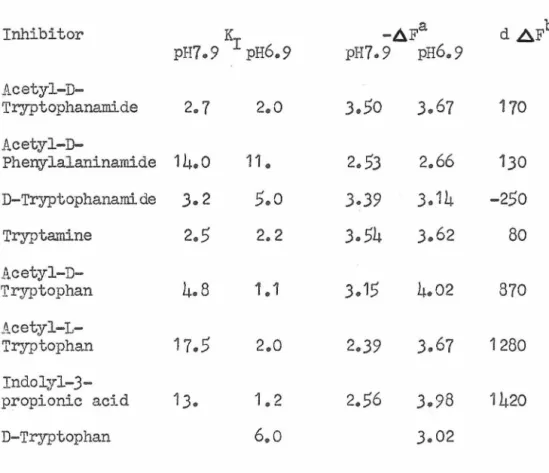
1, of the enzyme-inhibitor complex was determined for a series of compounds related to acetyl-L-tryptophanamide. Table III compares the values of KI
and -
l!tJ'
for the enzyme-inhibitor complexes at pH 6.9 with those at pH 7.9. It is seen that the inhibitors for which there is a marked change (an increase) in affinity for the enzyme in going from pH 7.9 to pH 6.9 are the free carbox.ylic acids. This suggests strongly that there is a negatively charged center at or near the catalytically active site of the enzyme and that a change of one pH unit diminishes the negative charge considerably.Experimental
L-Tyrosine-hydroxamide(5) - 19.5 gm. (0.10 mole) of L- tyrosine-methyl ·ester(6) was suspended in 200 ml. of methanol and chilled to ice temperature.
7.65
gm. (0.11 mole) of hydro.:xyl- amine-hydrochloride was also placed in 200 ml. of methanol and chilled. 110 ml. of 1. 0 N sodium me tho.xi.de in methanol was added to the hydroxylamine-hydrochloride solution. The free hydrox.yl- a.mine solution was separated from a sodiwn chloride precipitate by centrifugation and added slowly to the solution of the ester.The resultant solution was allowed to stand in the cold room for three days and then concentrated by evaporation in a dry air stream. The white crystals which formed were collected, dried and recrystallized severa~ tifiles from water. The yield of puri- fied product, melting at 161-162° vlith decomposition, was 12.5
gm. (64%).
cogii 5 =
+ 63°(c,
0.3% in water).Analysis calculated for
c
9H 1 2
o
3N 2: c,
55.1;
H,6.1;
N, 14.J.* 4
Found:
c, 55.1;
H, 6.0; N, 14 ••Inhibitors - With the exception of the D-tryptophan, which was prepared by Mr. Richard Bernhard, the inhibitors used in this study were prepared by Dr. H. T. Huang who also determined their kinetic constants at pH
7.9C 7 ,s).
For the D-tryptophan,[°'] ~
= + 32 •.5°
(C, 0 •.5
in water). Berg(9)
reported32.4.5°.
Enzyme - The enzyme preparations were exactly as described in Part II of this thesis except that the final concentration of enzyme in all experiments in this part of the thesis was o.104 mg. prot. N/ml.
Buffers - For the detennination of the various kinetic constants at pH 6.9, the final buffer concentration was 0.10 F in tris-(hydroxymethyl)-aminomethane with sufficient hydrochloric acid to give the required pH. Cacodylic acid-sodium cacodylate buffers were used for the lower pH region of the pH-activity curve and suitable tris-(hydroxymethyl)-aminomethane buffers for the higher region. The two buffers were used in an over- lapping manner (hydrolyses were performed with tris-(hydroxy- methyl)-aminomethane-hydrochloric acid buffers dovm to pH 6.6 and with cacodylate up to pH
7.4)
and, as sho-wn by Figure 3, a smooth curve can be dra~m through all of the points.-~~ Microanalysis by Dr. A. Elek.