ACI W ORLD A IRPORT IT S TANDING C OMMITTEE ACI - A
IRPORTC
OMMUNITYR
ECOMMENDEDI
NFORMATIONS
ERVICESWG
S
EAMLESST
RAVEL- B
USINESSR
EQUIREMENTD
OCUMENTDocument Status: Draft Version: v0.99
Page 2 of 234
1 Revision History
The change log describes the modifications in each version of the document. .
Version Date Name Description of Change
0.9 11/04/2016 M. Rogal/S. Stiffel BRD issued for review
0.99 03/08/2017 M. Rogal/S. Stiffel BRD finalized for WAITSC review
Document References
The document references contain the references to documents
Key Document Version Description
Semantic Model
ACI ACRIS Semantic Model
Implementati on Guideline
Seamless Travel Implementation Guideline.docx
0.99 The implementation guideline for the Seamless Travel project. Contains data model and interface details.
Page 3 of 234
2 Table of Contents
1 Revision History ... 2
2 Table of Contents ... 3
3 Introduction ... 5
3.1 Purpose and Scope of the Document ... 5
3.2 About this Document ... 5
3.3 The ACI ACRIS Working Group ... 5
3.4 ACRIS Semantic Model ... 5
3.5 Project participants and Contributors ... 6
3.6 IATA and ACI collaboration ... 7
3.7 Intended Audience ... 7
4 Benefits and Business Objectives ... 8
5 Project Background, scope and context ... 9
5.1 Scope ... 10
5.2 Out of Scope... 10
6 Use Cases Clusters ... 11
7 Seamless Travel Use Cases v2.0 ... 12
7.1 Seamless Travel Actors ... 12
7.2 Seamless Travel Use Cases v2.0 ... 13
7.3 Seamless Travel Use Cases v2.0 ... 14
7.4 Account ... 15
7.5 Airline ... 54
7.6 Airport ... 79
7.7 Flight ... 124
7.8 Location ... 153
7.9 Services ... 163
7.10 Trip ... 201
7.11 Seamless Travel Terms ... 221
7.12 Party Role Term Taxonomy ... 225
7.13 State Term Taxonomy ... 225
7.14 Service Offering Term Taxonomy ... 226
7.15 Location Term Taxonomy ... 226
7.16 Aircraft Movement Term Taxonomy ... 227
7.17 Time Period Term Taxonomy ... 228
7.18 Transport Term Taxonomy ... 228
7.19 Facility Term Taxonomy ... 229
7.20 System Term Taxonomy ... 229
7.21 Item Term Taxonomy ... 230
7.22 Passenger Movement Concept Map ... 231
Page 4 of 234
7.23 Passenger Movement Logical Model ... 232 8 Management and Further Development of the Standard ... 233 9 Points of Contact ... 234
3 Introduction
3.1 Purpose and Scope of the Document
This document describes the background and the business requirements of the Seamless Travel project.
The following content was developed by the ACI ACRIS Seamless Travel project participants listed in chapter 3.4, supported by the whole ACI ACRIS Working group and partners.
It is designed to help business people and decision makers from airports and airlines to understand how communication with other airports, airlines and partners via the Seamless Travel interface can improve their own business and the various possibilities for new and innovative ideas.
3.2 About this Document
The document is structured as follows:
Section 1: Revision History
Section 2: Table of content
Section 3: Introduction
This section introduces the guideline document and describes its purpose, the scope, the environment and the conditions.
Section 4: Project background
This section describes the general background why ACRIS started this initiative and the global context.
Section 5: Use cases
This section explains the use cases defined in the project’s scope.
Section 6: Data Model
This section describes the logic of the data model that is used throughout the project.
3.3 The ACI ACRIS Working Group
ACRIS is an acronym for “Aviation Community Recommended Information Services”, and is one of the working groups under ACI World. Members of the working group are airports, airlines and vendors.
The purpose of this working group is to define standard data models and web interfaces for exchanging operational and passenger related data between the partners in a standardized way.
Two working group face-to-face meetings are being held each year and additional meetings or conference calls are scheduled as required by the projects and topics. The working group is open for airports, airlines and partners from the aviation industry; participation is on voluntary base. All contribution on meetings or projects is done on the own expense of the participants.
For more information on ACI ACRIS working group visit the homepage (http://groups.aci.aero/home) or have a look at the ACI ACRIS information video (https://www.youtube.com/watch?v=Fj7xcAauCSo).
Further details on ACI World can be found at http://www.aci.aero/.
3.4 ACRIS Semantic Model
The ACRIS Semantic Model is a collection of knowledge-driven models organized to support meaningful communication for business collaboration.
The models:
Represent the business context for communication between organizations as o Collaboration process models
o Domain vocabularies o Domain knowledge
Establish standards for information sharing o Standard data item names and format
Page 6 of 234
Enable the creation of information services o XML schema artefacts
o JSON artefacts
o Web service description language artefact
The following chapters are giving a brief overview on the ACRIS Semantic Model, for more information see http://groups.aci.aero/home.
3.4.1 Purpose of ACRIS Semantic Model
The purpose of the ACRIS Semantic Model is to solve typical collaboration communication problems like:
Industry Silo
o Many XML schemas and JSON formats that are not based on a common model view of the business
o XML schema and JSON formats are applicable focused
o Many industry standards organizations with many groups working in silo
Semantic ambiguity
o Uncontrolled business vocabulary o Fragmented business knowledge
o Poor data standards – XML is not data standard o Lack of data governance
o Data quality issues – lack of meaningful data
The ACRIS Semantic Model is a collaboration communication solution, which brings semantic Dis- ambiguity and data harmonization:
Establish a controlled vocabulary
Identify concept and meaning from terms
Establish concept classification to capture business context
Establish concept maps to capture business rules and policies
Use concept maps to standardize data element names
3.4.2 ACRIS Semantic Model management principles:
Collaborate and seek global participation
Leverage industry models, incorporate partner, industry models at all levels
Adopt global standards to:
o Formally represent and use airport communication knowledge
UN/CFACT UMM, CCTS and OMG UML
o Formally manage changes to model and service configuration
ITIL based change management process o Data element names and formats
ISO 11179, ISO 15000 and UN/CFACT NDR 3.0
Apply automation appropriately – allow for various levels of technology maturity
3.4.3 Tools and Technologies
ACI ACRIS website for Semantic Model collaboration
o Model change workflow, RFC management and document management o Currently under construction on the new website
Sparxsystems Enterprise Architect
o UN/CFACT UMM & UPCC3 profiles
o Sparxsystems schema builder for UN/CFACT NDR 3.0
MS Word & Excel Spreadsheet Templates o Data items mapping
3.5 Project participants and Contributors
As the participation on ACI ACRIS projects is on a voluntary base, some airlines, airports and partners were working in the project continuously, others supported the project in different phases according to their capacity or special knowledge.
Page 7 of 234 The following list shows all contributors:
Changi Airport
Fraport
London Heathrow
Munich Airport
Schiphol Group
Swedavia
Orlando Airport
San Francisco Airport
Lufthansa
ACI World
Amadeus
APD
Barich Inc.
IATA
Rockport Software
Rockwell Collins
SITA
T-Systems
3.6 IATA and ACI collaboration
As many players in the aviation industry are interested in efficient and high quality services for their customers – including passengers – it make sense to define common standards for information exchange and data models. There are well known organizations for the different areas within the aviation industry representing their members but it is also important to think outside the box. IATA has started the “Simplify the Business” (STB) initiative which shares under the roof of the “Travel Communication” project a lot of the goals with ACRIS Seamless Travel. IATA participated in the ACRIS Seamless Travel project from the beginning and the aim is to create an industry wide common standard that is approved and actively used by airport as well as airline representatives.
3.7 Intended Audience
This document is designed for business people and decision makers of airports, airlines, aviation related vendors and service providers to understand the background, meaning and powerful possibilities of the ACI ACRIS Seamless Travel data model and Web services. Service providers in this context are all companies providing services for passengers like:
Railway and local public transport
Car rental companies
Taxi services
Shops
Restaurants
etc.
Page 8 of 234
4 Benefits and Business Objectives
Data interchange in the aviation industry is a big challenge and strategic factor. And that not only means to exchange some data, but to ensure that there is a common understanding of the content,
independently which data is exchanged and how many partners are using that content.
Within the aviation industry airports should understand their position in terms of data provisioning and usage. The objectives can be summarized as following:
Airports have a new role as information broker to increase non-aviation revenue across the travel value chain.
Airports can improve operational efficiencies by distributing operational data to their service providers and tenants to decrease costs associated in operations, maintenance and disruptions handling.
Airports can improve the customer/passenger experience by providing real-time data services to streamline service requests through multiple channels such as mobile apps, web sites and third- party integrations.
How do the ACI ACRIS Seamless Travel data model and web services fit to these objectives? Why should this standard be chosen over implementing proprietary interfaces for your Open Data initiative?
Consider the following reasons:
No bilateral negotiation between partners to define data model and interfaces
Common understanding of the data content
Simple familiarization with defined use cases
Same interface between different partners for B2B as well as B2C scenarios
Fast implementation by reusing implementation files (i.e. JSON definition files)
High quality of pre-existing and proven interfaces
Data exchange with many different partners via one common interface
Page 9 of 234
5 Project Background, scope and context
Many aviation related companies use the term “Seamless Travel” and of course, there are many different meanings of this term. The purpose of this chapter is to explain why Seamless Travel is a topic for ACI ACRIS and what exactly the meaning of Seamless Travel in this context is.
The Seamless Travel topic was introduced to the ACI ACRIS working group in 2013 by Munich Airport.
The idea behind it is to provide passengers as well as visitors with all relevant information and give them the possibility to book services of companies from the whole aviation industry ecosystem. This includes not only airlines and airports, but also ground transportation providers and commercial tenants.
One of the industry observations, namely that people don’t want to download a large number of mobile applications to their smartphone in order to get all necessary information and service possibilities for a single trip was the crucial factor to start a project. Currently business travelers are required to have 30 or more apps from different airports and airlines installed on their phones which does not only result in a bad usability experience but also drives heavy users to third-party applications with less trustworthy data sources.
Another fact is that airlines and airports want to offer different information and services to passengers during their journey. This starts with simple information about upcoming flights or places at the airport but also includes bookable services like paid lounge access. An important goal is to give the passenger reliable and trusted information during the whole journey.
The challenge is to find new ways for airports and airlines to approach the customer and to give them the possibility to distribute high quality information - including services - via many distribution channels.
A customer in this context can be:
a passenger
a visitor at the airport
someone picking up someone else from the airport
someone bringing someone else to the airport
To face this challenge, different approaches are conceivable. One is to have a single common app for the whole aviation industry, which is a utopian idea and only feasible for a modest number of companies. The other one is to define a common data model and according interfaces to exchange data. This standard would allow the embedding of trusted information (including services) from all partners in other
applications.
One example scenario is a passenger travelling from Munich via Frankfurt to New York. This passenger should not be forced to download the Lufthansa, Munich airport, Frankfurt airport, and JFK airport applications in order to get all travel details. Each of these apps is capable of displaying reliable information on a particular flight segment and interesting services at a specific location. More precisely:
The Munich airport app could be enabled to show transfer information for the next segment (Frankfurt to New York), to book a lounge at Frankfurt Airport, or find a location and the fastest way from the baggage belt to a specific restaurant in New York. For the airports and airline involved in this trip, Seamless Travel is a great chance to provide better information and sell more services, independent of which app the passenger downloaded.
For such a scenario, the following data exchange is imaginable:
Information about flights and all relevant data like boarding gate and time
Information on restaurants and shops at the airport, including their location or menu respectively their offers
Information on parking and public transportation including reservation of a parking lot or buying train tickets
Bookable services at the airport (departure, transfer and arrival airport) like lounge or fast lane access
Vouchers for any kind of service at the airport
Navigation at the airport
Miscellaneous information like weather
All this and much more information is available in the IT systems of the partners. The ACI ACRIS
Seamless Travel data model and Web service interface will make it possible to exchange these pieces of information between all partners in a common and standardizes way.
Page 10 of 234
Munich airport has started working on this topic some years in advance, so some of the definitions were used as base for the ACI ACRIS standard definition. The project management was also done by Munich airport.
5.1 Scope
The project scope was defined as:
Definition of data model
The standard describes the different entities with all attributes and properties.
Alignment to ACI ACRIS Semantic Model
The semantic model represents the airport community common knowledge. It comprises of ideas (business concepts) and connections between the ideas and is a collection of terms in the form of diagrams made by aviation industry professionals.
Define Web service interfaces
The standard describes all interfaces to handle transactions and exchange information corresponding the defined entities.
Pilot implementation
Proof the manageability of these interfaces by providing one or more prototype implementations (e.g. mobile applications, web services, etc.)
5.2 Out of Scope
This document does not contain the following items:
Definition of specific services
The standard does not define which kind of services can be offered via the Seamless Travel interface.
Interconnectivity
The defined interfaces can be used for direct connection between partners as well as there can be one or many platform providers / data integrators as a central connection point where the partners interlink.
Regulations or contracts
In real world scenarios partners will need to have regulations or contractual agreements for their legal relationship and data exchange (e.g. SLA, privacy issues). Because these details differ for each relationship, they are not defined in this project’s context.
Page 11 of 234
6 Use Cases Clusters
One of the first tasks for the project group was to define relevant B2B and B2C use cases. As there are different perspectives regarding airport, airline, provider and passenger, the use cases where clustered as shown in the diagram below.
As described in 3.4 Sparxsystems Enterprise Architect is used for specifying the ACRIS Semantic Model including use cases. This whole chapter is the Enterprise Architect representation of the use cases.
Airport
Airline
Flight
Trip Service
Location
Account
Page 12 of 234
7 Seamless Travel Use Cases v2.0
Package in package 'Seamless Travel Use Cases'
The Seamless Travel use cases have been collected and categorised according to their area of interest. These areas are intended to align with the ACI Semantic Model concepts.
7.1 Seamless Travel Actors
The following diagram illustrates the actors involved in the Seamless Travel Use Cases.
Figure 1: Seamless Travel Actors
User Application
Airline Airport
Partner
Page 13 of 234
7.2 Seamless Travel Use Cases v2.0
Package diagram in package 'Seamless Travel Use Cases v2.0'
Figure 2: Seamless Travel Use Cases v2.0
Serv ices
+ Book Service
+ Book/Change/Cancel Service + Bookmark Service
+ Cancel Booked Service + List History of Booked Services + List Unfulfilled Booked Services + Preparation/Reservation of Services + Receive Available Service Providers + Receive List of Booked Services + Remove Bookmark of Service + View Service Information
Account
+ Change Airport
+ Change Password for the Seamless Travel Platform + Create Account
+ Delete Account
+ Login Seamless Travel platform + Provide Information to PAX + Provide Known Traveler credentials + Receive Passenger Itinerary + Select Default Airport + Share User Information + Update Account
+ Visa and Passport requirements (transit and arrival airport)
Airline
+ Get Bag Status / Location + Receive Baggage Information + Share Aircrafts (Type) in Use + Share information with Partners + Share Specific Airline Information + Show Airline Information + Supply Lost & Found Details
Airport
+ Overview Airport Services
+ Pax Info - Availability of automated border control (arrival airport) + Pax Info - Availability of automated border control (departure airport) + Pax Info - Availability of automated border control (transit airport) + Pax Info - Availability of security fast track
+ Pax Info - Baggage tag and drop options to passenger + Pax Info - Gate information
+ Pax Info - Security screening regulations + Pax Info - Security waiting times + Search Airport Services + Share Airport-specific Information + Share Weather Information + Show Airport-Information
Flight
+ Bookmark Flight + Pax Info - Cancellations + Pax Info - Flight delays + Remove Bookmark of Flight + Search Flight
+ Share Flight Information + Share passenger numbers + Show Flight Overview
Location
+ Passenger Tracking + Show Route from A to B + Show User Location on Map
Trip
+ Add Item to Trip + Create Trip
+ Overview Trip Services + Remove Item from Trip + Search Trip Services + Show Trip Information
Page 14 of 234
7.3 Seamless Travel Use Cases v2.0
Use Case diagram in package 'Seamless Travel Use Cases v2.0'
Figure 3: Seamless Travel Use Cases v2.0
Share User
Information Add Item to Trip Book Serv ice Book/Change/Cancel Serv ice
Bookmark Flight Bookmark Serv ice
Cancel Booked
Serv ice Change Airport
Change Passw ord for the Seamless
Trav el Platform
Create Account Create Trip Delete Account
Get Bag Status / Location
List History of Booked Serv ices
List Unfulfilled Booked Serv ices
Login Seamless Trav el platform
Ov erv iew Airport Serv ices
Ov erv iew Trip Serv ices
Passenger Tracking
Pax Info - Av ailability of automated border
control (arriv al airport)
Pax Info - Av ailability of automated border control (departure
airport)
Pax Info - Av ailability of automated border
control (transit airport)
Pax Info - Av ailability of security fast track
Pax Info - Baggage tag and drop options
to passenger
Pax Info - Cancellations
Pax Info - Flight delays
Pax Info - Gate information
Pax Info - Security screening regulations
Pax Info - Security
w aiting times Preparation/Reserv ation of Serv ices
Prov ide Information to PAX
Prov ide Know n Trav eler credentials
Receiv e Av ailable Serv ice Prov iders
Receiv e Baggage Information
Receiv e List of Booked Serv ices
Receiv e Passenger Itinerary
Remov e Bookmark of Flight
Remov e Bookmark of Serv ice
Remov e Item from Trip
Search Airport
Serv ices Search Flight Search Trip
Serv ices
Select Default Airport
Share Aircrafts (Type) in Use
Share Airport- specific Information
Share Flight Information
Share Specific Airline Information
Share Weather Information
Share information w ith Partners
Share passenger numbers
Show Airline Information
Show Airport- Information
Show Flight Ov erv iew
Show Route from A to B
Show Trip Information
Show User Location on Map
Supply Lost & Found
Details Update Account View Serv ice
Information
Visa and Passport requirements (transit and arriv al
airport)
Page 15 of 234
7.4 Account
Package in package 'Seamless Travel Use Cases v2.0'
The Account package contains those use cases that concern the identification, characteristics and preferences of the user.
7.4.1 Account
Use Case diagram in package 'Account'
Figure 4: Account Account
Delete Account
Change Airport Create Account
Login Seamless Trav el platform
Select Default Airport Update Account
Change Passw ord for the Seamless
Trav el Platform
Receiv e Passenger Itinerary User
Airport
Airline Prov ide Know n
Trav eler credentials
Prov ide Information to PAX Visa and Passport
requirements (transit and arriv al
airport)
Share User Information
Page 16 of 234
7.4.2 Change Airport
UseCase in package 'Account'
Element Notes
USE CASE ID: 1.4
USE CASE DESCRIPTION:
The user either manually selects a different than his default airport or it is automatically selected based on the user's location.
ACTORS (GOAL):
The users wants to change the current selected airport The application loads the new Airport Information.
PERFORMANCE GOALS:
PRE CONDITIONS:
User has an account for the seamless travel platform
POST CONDITIONS:
The new Airport is stored in the user profile.
SCENARIO:
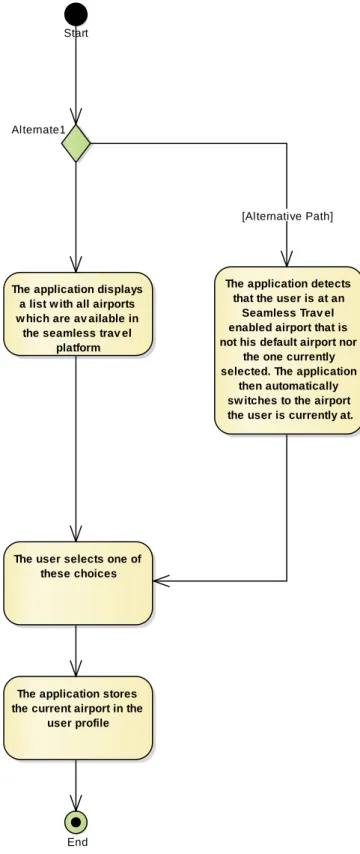
1. The application displays a list with all airports which are available in the seamless travel platform 2. The user selects one of these choices
3. The application stores the current airport in the user profile
EXTENSION POINT:
ALTERNATIVE SCENARIO:
The application detects that the user is at an Seamless Travel enabled airport that is not his default airport nor the one currently selected. The application then automatically switches to the airport the user is currently at.
RELATED REQUIREMENTS:
RELATED RULES:
PERFORMANCE MEASURES:
VERSION/HISTORY:
0.1; 19.06.15; Lücking; added actors
0.2; 25.06.15; Stiffel; added description & scenario
Page 17 of 234
7.4.2.1 Change Airport_ActivityGraph
Activity owned by 'Change Airport', in package 'Account'
Figure 5: Change Airport_ActivityGraph Start
Alternate1
The application detects that the user is at an
Seamless Trav el enabled airport that is not his default airport nor
the one currently selected. The application
then automatically sw itches to the airport the user is currently at.
The application displays a list w ith all airports w hich are av ailable in
the seamless trav el platform
The user selects one of these choices
The application stores the current airport in the
user profile
End
[Alternative Path]
Page 18 of 234
7.4.2.2 Change Airport_SequenceDiagram
Interaction owned by 'Change Airport', in package 'Account'
1a_Alternative Path
Interaction diagram in package 'Account'
Figure 6: 1a_Alternative Path
1_Basic_Path
Interaction diagram in package 'Account'
Airport: Airport User: User
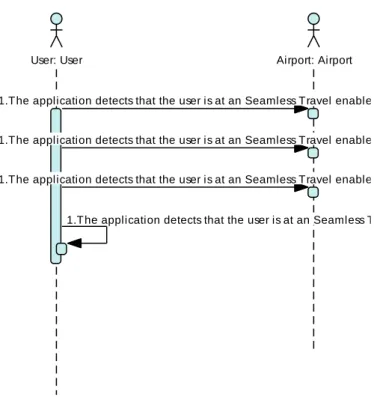
1.The application detects that the user is at an Seamless Travel enabled airport that is not his default airport nor the one currently selected. The application then automatically switches to the airport the user is currently at.() 1.The application detects that the user is at an Seamless Travel enabled airport that is not his default airport nor the one currently selected. The application then automatically switches to the airport the user is currently at.()
1.The application detects that the user is at an Seamless Travel enabled airport that is not his default airport nor the one currently selected. The application then automatically switches to the airport the user is currently at.() 1.The application detects that the user is at an Seamless Travel enabled airport that is not his default airport nor the one currently selected. The application then automatically switches to the airport the user is currently at.()
Page 19 of 234 Figure 7: 1_Basic_Path
User: User Airport: Airport
2.The user selects one of these choices()
3.The application stores the current airport in the user profile()
Page 20 of 234
7.4.3 Change Password for the Seamless Travel Platform
UseCase in package 'Account'Element Notes
USE CASE ID: 1.2
USE CASE DESCRIPTION:
The user has selected the change password page of the seamless travel platform. He enters his current credentials and the new password. After the system has checked the password policy, the new password is stored for the account.
ACTORS (GOAL):
The user wants to change the password for the Seamless Travel platform.
The application validates the new password against the password policy of the Seamless travel platform.
PERFORMANCE GOALS:
PRE CONDITIONS:
User has an account for the seamless travel platform
POST CONDITIONS:
The password is changed.
SCENARIO:
1. The user selects the change password screen 2. The user enters the login name and old password 3. The user enters the new password
4. The system checks that the password policy is correct 5. Password is changed
EXTENSION POINT:
ALTERNATIVE SCENARIO:
RELATED REQUIREMENTS:
RELATED RULES:
PERFORMANCE MEASURES:
VERSION/HISTORY:
0.1; 28.5.15; Rogal; created
0.2; 5.6.15; Rogal; More detailed description
0.3; 10.6.15; Stiffel; Changed UN/PW to credentials (workshop result)
Page 21 of 234
7.4.3.1 Change Password for the Seamless Travel Platform_ActivityGraph
Activity owned by 'Change Password for the Seamless Travel Platform', in package 'Account'
Start
The user selects the change passw ord
screen
The user enters the login name and old passw ord
The user enters the new passw ord
The system checks that the passw ord policy is
correct
Passw ord is changed
End
Page 22 of 234
Figure 8: Change Password for the Seamless Travel Platform_ActivityGraph
Page 23 of 234
7.4.3.2 Change Password for the Seamless Travel Platform_SequenceDiagram
Interaction owned by 'Change Password for the Seamless Travel Platform', in package 'Account'
1_Basic_Path
Interaction diagram in package 'Account'
Figure 9: 1_Basic_Path User: User
1.The user selects the change password screen()
3.The user enters the new password()
2.The user enters the login name and old password()
Page 24 of 234
7.4.4 Create Account
UseCase in package 'Account'
Element Notes
USE CASE ID: 1.5
USE CASE DESCRIPTION:
The user creates an account for the Seamless Travel Platform.
ACTORS (GOAL):
The user wants to create a new account
The application create a new account with the mandatory fields The authorization/identity-provider is requested for the user’s data
PERFORMANCE GOALS:
PRE CONDITIONS:
POST CONDITIONS:
SCENARIO:
1. The application displays a sign up form
2. The user fills out the input fields (at least the compulsory ones) 3. The user submits the form.
4. The application validates the entered data, if not valid: jumps to (1) and shows error message, otherwise creates an user account and stores the data entered.
EXTENSION POINT:
ALTERNATIVE SCENARIO:
RELATED REQUIREMENTS:
RELATED RULES:
PERFORMANCE MEASURES:
VERSION/HISTORY:
0.1; 19.06.15; Lücking; added actors 0.2; 01.07.15; Stiffel; Added Scenario
Page 25 of 234
7.4.4.1 Create Account_ActivityGraph
Activity owned by 'Create Account', in package 'Account'
Figure 10: Create Account_ActivityGraph Start
The application displays a sign up form
The user fills out the input fields (at least the
compulsory ones)
The user submits the form.
The application v alidates the entered data, if not v alid: j umps to (1) and show s error message, otherw ise creates an user account and stores
the data entered.
End
Page 26 of 234
7.4.4.2 Create Account_SequenceDiagram
Interaction owned by 'Create Account', in package 'Account'
1_Basic_Path
Interaction diagram in package 'Account'
Figure 11: 1_Basic_Path
User: User
2.The user fills out the input fields (at least the compulsory ones)
3.The user submits the form.()
4.The application validates the entered data, if not valid: jumps to (1) and shows error message, otherwise creates an user account and stores the data entered.
Page 27 of 234
7.4.5 Delete Account
UseCase in package 'Account'
Element Notes
USE CASE ID: 1.6
USE CASE DESCRIPTION:
The user deletes an account from the Seamless Travel Platform.
ACTORS (GOAL):
The user wants to delete the account
The application marks the account as to be removed
PERFORMANCE GOALS:
PRE CONDITIONS:
POST CONDITIONS:
SCENARIO:
1. The user selects ""delete account"" from the account overview screen within the app.
2. The app asks for confirmation.
3. The user confirms the wish to irrecoverably delete the account.
4. The app deletes the account.
EXTENSION POINT:
ALTERNATIVE SCENARIO:
RELATED REQUIREMENTS:
RELATED RULES:
PERFORMANCE MEASURES:
VERSION/HISTORY:
0.1; 19.06.15; Lücking; added actors 0.2; 01.07.15; Stiffel; Added Scenario
Page 28 of 234
7.4.5.1 Delete Account_ActivityGraph
Activity owned by 'Delete Account', in package 'Account'
Figure 12: Delete Account_ActivityGraph Start
The user selects ""delete account"" from the account ov erv iew screen w ithin the app.
The app asks for confirmation.
The user confirms the w ish to irrecov erably delete the account.
The app deletes the account.
End
Page 29 of 234
7.4.5.2 Delete Account_SequenceDiagram
Interaction owned by 'Delete Account', in package 'Account'
1_Basic_Path
Interaction diagram in package 'Account'
Figure 13: 1_Basic_Path User: User
1.The user selects ""delete account"" from the account overview screen within the app.()
3.The user confirms the wish to irrecoverably delete the account.()
Page 30 of 234
7.4.6 Login Seamless Travel platform
UseCase in package 'Account'
Element Notes
USE CASE ID: 1.1
USE CASE DESCRIPTION:
The user has selected the login page for login to the seamless travel platform. He has to enter credentials.
ACTORS (GOAL):
The user wants to login into the Seamless Travel platform to access information and services.
The application validates the user login data and give access to the application site.
PERFORMANCE GOALS:
PRE CONDITIONS:
User has an account for the seamless travel platform
POST CONDITIONS:
SCENARIO:
"1. The user selects the login screen
2. The user enters the login name and password 3. The application validates the username and password 4. The application logs in the user and shows next screen"
EXTENSION POINT:
ALTERNATIVE SCENARIO:
RELATED REQUIREMENTS:
RELATED RULES:
PERFORMANCE MEASURES:
VERSION/HISTORY:
"0.1; 28.5.15; Rogal; created
0.2; 5.6.15; Rogal; More detailed description
0.3; 10.6.15; Stiffel; Changed UN/PW to credentials (workshop result)"
Page 31 of 234
7.4.6.1 Login Seamless Travel platform_ActivityGraph
Activity owned by 'Login Seamless Travel platform', in package 'Account'
Figure 14: Login Seamless Travel platform_ActivityGraph Start
The user selects the login screen
The user enters the login name and passw ord
The application v alidates the username and
passw ord
The application logs in the user and show s next
screen
End
Page 32 of 234
7.4.6.2 Login Seamless Travel platform_SequenceDiagram
Interaction owned by 'Login Seamless Travel platform', in package 'Account'
1_Basic_Path
Interaction diagram in package 'Account'
Figure 15: 1_Basic_Path User: User
4.The application logs in the user and shows next screen() 1.The user selects the login screen()
2.The user enters the login name and password()
Page 33 of 234
7.4.7 Provide Information to PAX
UseCase in package 'Account'
Element Notes
USE CASE ID: 1.8
USE CASE DESCRIPTION:
The application displays either general relevant information (e.g. advertisements or warnings) or context sensitive information (e.g. delays, confirmations, cancellations) on the user's screen (e.g. push notification, via email)
ACTORS (GOAL):
The user receives information
The application sends information to user
Application/Airline/Airport/Service-Provider want to send important information
PERFORMANCE GOALS:
PRE CONDITIONS:
POST CONDITIONS:
SCENARIO:
1. The user receives the information on a screen
2. The user can discard the information or react to it, where applicable (e.g. open a link, jump into a specific function)
EXTENSION POINT:
ALTERNATIVE SCENARIO:
RELATED REQUIREMENTS:
RELATED RULES:
PERFORMANCE MEASURES:
VERSION/HISTORY:
0.1; 19.06.15; Lücking; added actors
0.2; 25.06.15; Stiffel; added description & scenario
Page 34 of 234
7.4.7.1 Provide Information to PAX_ActivityGraph
Activity owned by 'Provide Information to PAX', in package 'Account'
Figure 16: Provide Information to PAX_ActivityGraph
7.4.7.2 Provide Information to PAX_SequenceDiagram
Interaction owned by 'Provide Information to PAX', in package 'Account'
1_Basic_Path
Interaction diagram in package 'Account'
Start
The user receiv es the information on a screen
The user can discard the information or react to it, w here applicable (e.g.
open a link, j ump into a specific function)
End
Page 35 of 234 Figure 17: 1_Basic_Path
7.4.8 Provide Known Traveler credentials
UseCase in package 'Account'User: User
2.The user can discard the information or react to it, where applicable (e.g. open a link, jump into a specific function) 1.The user receives the information on a screen()
Page 36 of 234 Element Notes
USE CASE ID: 1.9.1
USE CASE DESCRIPTION:
User stores any Known Traveler (TSA Pre-check, Clear, Airline credentials, etc.) in the app for easy reference
ACTORS (GOAL):
The application provides secure known traveler credentials for airline, airport, security clearance and boarding
PERFORMANCE GOALS:
PRE CONDITIONS:
Known Traveler enrollment
POST CONDITIONS:
SCENARIO:
1. User completes Known Traveler process. 2. User requests Credential file from issuer. 3. User imports credential file into the Application.
EXTENSION POINT:
ALTERNATIVE SCENARIO:
RELATED REQUIREMENTS:
RELATED RULES:
PERFORMANCE MEASURES:
VERSION/HISTORY:
0.1; 24.7.15; Barich created
Page 37 of 234
7.4.8.1 Provide Known Traveler credentials_ActivityGraph
Activity owned by 'Provide Known Traveler credentials', in package 'Account'
Figure 18: Provide Known Traveler credentials_ActivityGraph Start
User completes Know n Trav eler process.
User requests Credential file from issuer.
User imports credential file into the Application.
End
Page 38 of 234
7.4.8.2 Provide Known Traveler credentials_SequenceDiagram
Interaction owned by 'Provide Known Traveler credentials', in package 'Account'
1_Basic_Path
Interaction diagram in package 'Account'
Figure 19: 1_Basic_Path User: User
1.User completes Known Traveler process.()
3.User imports credential file into the Application.() 2.User requests Credential file from issuer.()
Page 39 of 234
7.4.9 Receive Passenger Itinerary
UseCase in package 'Account'
Element Notes
USE CASE ID: 1.3.1
USE CASE DESCRIPTION:
The user allows booking agent to send new trip itinerary to app.
ACTORS (GOAL):
User wants to import new trip itinerary into the app rather than keying in the data herself.
PERFORMANCE GOALS:
PRE CONDITIONS:
User has an account for the seamless travel platform
POST CONDITIONS:
The complete travel iteinerary is stored in the user data/profile/trip
SCENARIO:
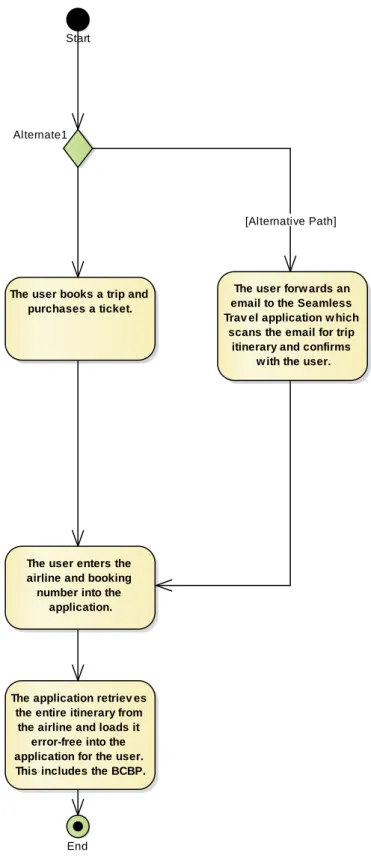
1. The user books a trip and purchases a ticket.
2. The user enters the airline and booking number into the application.
3. The application retrieves the entire itinerary from the airline and loads it error-free into the application for the user. This includes the BCBP.
EXTENSION POINT:
ALTERNATIVE SCENARIO:
The user forwards an email to the Seamless Travel application which scans the email for trip itinerary and confirms with the user.
RELATED REQUIREMENTS:
RELATED RULES:
PERFORMANCE MEASURES:
VERSION/HISTORY:
0.1; 24.7.15; Barich created scenario
Page 40 of 234
7.4.9.1 Receive Passenger Itinerary_ActivityGraph
Activity owned by 'Receive Passenger Itinerary', in package 'Account'
Figure 20: Receive Passenger Itinerary_ActivityGraph Start
Alternate1
The user forw ards an email to the Seamless Trav el application w hich
scans the email for trip itinerary and confirms
w ith the user.
The user books a trip and purchases a ticket.
The user enters the airline and booking number into the
application.
The application retriev es the entire itinerary from
the airline and loads it error-free into the application for the user.
This includes the BCBP.
End
[Alternative Path]
Page 41 of 234
7.4.9.2 Receive Passenger Itinerary_SequenceDiagram
Interaction owned by 'Receive Passenger Itinerary', in package 'Account'
1a_Alternative Path
Interaction diagram in package 'Account'
Figure 21: 1a_Alternative Path
1_Basic_Path
Interaction diagram in package 'Account'
User: User
1.The user forwards an email to the Seamless Travel application which scans the email for trip itinerary and confirms with the user.()
Page 42 of 234 Figure 22: 1_Basic_Path
User: User Airline: Airline
3.The application retrieves the entire itinerary from the airline and loads it error-free into the application for the user. This includes the BCBP.() 2.The user enters the airline and booking number into the application.()
1.The user books a trip and purchases a ticket.()
Page 43 of 234
7.4.10 Select Default Airport
UseCase in package 'Account'
Element Notes
USE CASE ID: 1.3
USE CASE DESCRIPTION:
The user selects his default airport from a list of airports.
This is needed for pre selections in the app.
ACTORS (GOAL):
The user wants to change the default airport The application saves the new default airport setting
PERFORMANCE GOALS:
PRE CONDITIONS:
User has an account for the seamless travel platform
POST CONDITIONS:
The default Airport is stored in the user profile.
SCENARIO:
1. The application displays a list with all airports which are available in the seamless travel platform 2. The user select one of the Airports as his default Airport
3. The application stores the default Airport in the user profile
4. The application shows the Seamless Travel site of the default Airport
EXTENSION POINT:
ALTERNATIVE SCENARIO:
RELATED REQUIREMENTS:
RELATED RULES:
PERFORMANCE MEASURES:
VERSION/HISTORY:
0.1; 28.5.15; Rogal; created
0.2; 5.6.15; Rogal; More detailed description
0.3; 10.6.15; Stiffel; Changed “home” to “default” airport (workshop result)
Page 44 of 234
7.4.10.1 Select Default Airport_ActivityGraph
Activity owned by 'Select Default Airport', in package 'Account'
Figure 23: Select Default Airport_ActivityGraph Start
The application displays a list w ith all airports w hich are av ailable in
the seamless trav el platform
The user select one of the Airports as his
default Airport
The application stores the default Airport in the
user profile
The application show s the Seamless Trav el site
of the default Airport
End
Page 45 of 234
7.4.10.2 Select Default Airport_SequenceDiagram
Interaction owned by 'Select Default Airport', in package 'Account'
1_Basic_Path
Interaction diagram in package 'Account'
Figure 24: 1_Basic_Path User: User
2.The user select one of the Airports as his default Airport()
3.The application stores the default Airport in the user profile()
Page 46 of 234
7.4.11 Share User Information
UseCase in package 'Account'
Element Notes
USE CASE ID: 1.9
USE CASE DESCRIPTION:
Details about the user are shared
ACTORS (GOAL):
The service-provider/Airport/Airline wants to load user information.
The application send the information to the requester.
The user allows information sharing.
PERFORMANCE GOALS:
PRE CONDITIONS:
POST CONDITIONS:
SCENARIO:
EXTENSION POINT:
ALTERNATIVE SCENARIO:
RELATED REQUIREMENTS:
Data privacy, subject to regulation, user might be pax (passenger information) or guest (e.g. profile), should be OPT IN
RELATED RULES:
PERFORMANCE MEASURES:
VERSION/HISTORY:
0.1; 28.5.15; Lücking; created
0.2; 5.6.15; Rogal; More detailed description
0.3; 10.6.15; Stiffel; Added related requirements, e.g. PCI compliance (workshop result)
Page 47 of 234
7.4.11.1 Share User Information_ActivityGraph
Activity owned by 'Share User Information', in package 'Account'
Figure 25: Share User Information_ActivityGraph Start
End
Page 48 of 234
7.4.12 Update Account
UseCase in package 'Account'
Element Notes
USE CASE ID: 1.7
USE CASE DESCRIPTION:
The user changes settings or profile details (e.g. email address, phone number) that are stored on the servers of the Seamless Travel Platform.
ACTORS (GOAL):
The user wants to update the account data The application saves the new user-data
PERFORMANCE GOALS:
PRE CONDITIONS:
POST CONDITIONS:
SCENARIO:
1. The user wants to update it’s personal preferences 2. The application persists the user’s new preferences
EXTENSION POINT:
ALTERNATIVE SCENARIO:
RELATED REQUIREMENTS:
RELATED RULES:
PERFORMANCE MEASURES:
VERSION/HISTORY:
0.1; 19.06.15; Lücking; added actors 0.2; 01.07.15; Stiffel; Added Scenario
Page 49 of 234
7.4.12.1 Update Account_ActivityGraph
Activity owned by 'Update Account', in package 'Account'
Figure 26: Update Account_ActivityGraph Start
The user w ants to update it’s personal preferences
The application persists the user’s new
preferences
End
Page 50 of 234
7.4.12.2 Update Account_SequenceDiagram
Interaction owned by 'Update Account', in package 'Account'
1_Basic_Path
Interaction diagram in package 'Account'
Figure 27: 1_Basic_Path User: User
1.The user wants to update it’s personal preferences() 2.The application persists the user’s new preferences()
Page 51 of 234
7.4.13 Visa and Passport requirements (transit and arrival airport)
UseCase in package 'Account'Element Notes
USE CASE ID: 1.7
USE CASE DESCRIPTION:
The user changes settings or profile details (e.g. email address, phone number) that are stored on the servers of the Seamless Travel Platform.
ACTORS (GOAL):
The user wants to update the account data The application saves the new user-data
PERFORMANCE GOALS:
PRE CONDITIONS:
POST CONDITIONS:
SCENARIO:
1. The user wants to update it’s personal preferences 2. The application persists the user’s new preferences EXTENSION POINT:
ALTERNATIVE SCENARIO:
RELATED REQUIREMENTS:
RELATED RULES:
PERFORMANCE MEASURES:
VERSION/HISTORY:
0.1; 19.06.15; Lücking; added actors 0.2; 01.07.15; Stiffel; Added Scenario
Page 52 of 234
7.4.13.1 Visa and Passport requirements (transit and arrival airport)_ActivityGraph
Activity owned by 'Visa and Passport requirements (transit and arrival airport)', in package 'Account'
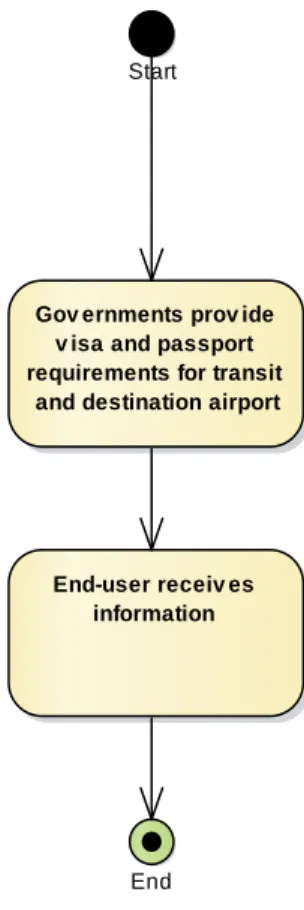
Figure 28: Visa and Passport requirements (transit and arrival airport)_ActivityGraph Start
Gov ernments prov ide v isa and passport requirements for transit
and destination airport
End-user receiv es information
End
Page 53 of 234
7.4.13.2 Visa and Passport requirements (transit and arrival airport)_SequenceDiagram
Interaction owned by 'Visa and Passport requirements (transit and arrival airport)', in package 'Account'
1_Basic_Path
Interaction diagram in package 'Account'
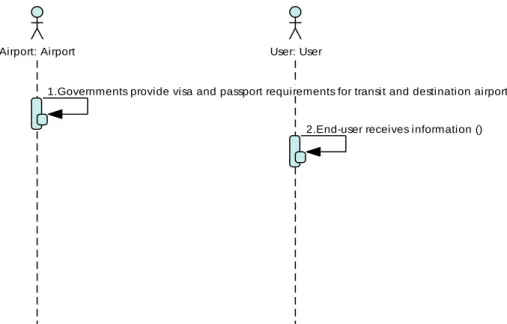
Figure 29: 1_Basic_Path
Airport: Airport User: User
1.Governments provide visa and passport requirements for transit and destination airport()
2.End-user receives information ()
Page 54 of 234
7.5 Airline
Package in package 'Seamless Travel Use Cases v2.0'
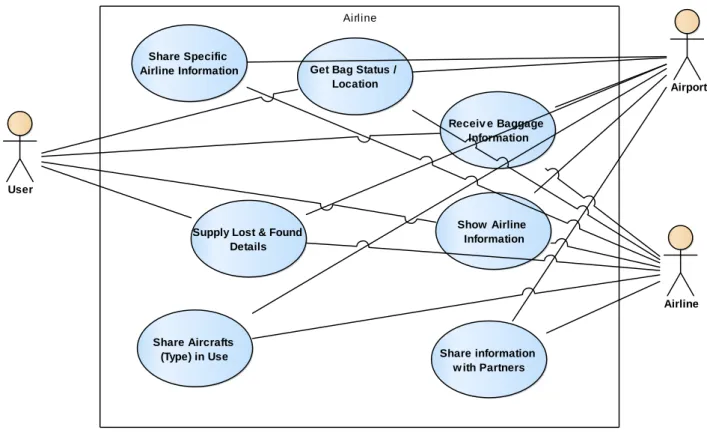
The Airline package contains those use cases that concern the airline and passenger bag information.
7.5.1 Airline
Use Case diagram in package 'Airline'
Figure 30: Airline Airline
Share Specific
Airline Information Get Bag Status / Location
Receiv e Baggage Information
Share Aircrafts (Type) in Use
Show Airline Information Supply Lost & Found
Details User
Airport
Airline
Share information w ith Partners
Page 55 of 234
7.5.2 Get Bag Status / Location
UseCase in package 'Airline'
Element Notes
USE CASE ID: 7.3
USE CASE DESCRIPTION:
The user wants to know what the status and where the checked-in baggage currently is.
ACTORS (GOAL):
The user wants to know the current bag-status
The application request the current bag status from the baggage handler The baggage handler provides the current bag-status
PERFORMANCE GOALS:
PRE CONDITIONS:
POST CONDITIONS:
SCENARIO:
1. The user selects a flight and sees the checked in baggage 2. The user selects a piece of baggage by tapping/clicking on it
3. The application retrieves status/location information for that piece and displays it
EXTENSION POINT:
ALTERNATIVE SCENARIO:
RELATED REQUIREMENTS:
RELATED RULES:
PERFORMANCE MEASURES:
VERSION/HISTORY:
Page 56 of 234
7.5.2.1 Get Bag Status / Location_ActivityGraph
Activity owned by 'Get Bag Status / Location', in package 'Airline'
Figure 31: Get Bag Status / Location_ActivityGraph Start
The user selects a flight and sees the checked in
baggage
The user selects a piece of baggage by tapping/clicking on it
The application retriev es status/location information for that piece
and displays it
End
Page 57 of 234
7.5.2.2 Get Bag Status / Location_SequenceDiagram
Interaction owned by 'Get Bag Status / Location', in package 'Airline'
1_Basic_Path
Interaction diagram in package 'Airline'
Figure 32: 1_Basic_Path User: User
2.The user selects a piece of baggage by tapping/clicking on it() 1.The user selects a flight and sees the checked in baggage()
Page 58 of 234
7.5.3 Receive Baggage Information
UseCase in package 'Airline'
Element Notes
USE CASE ID: 7.9
USE CASE DESCRIPTION:
Receive information about baggage from partner (airline, airport or ground handler).
ACTORS (GOAL):
Airport or Airline or Ground-Handler provides information about baggage-status.
The application consumes the information.
PERFORMANCE GOALS:
PRE CONDITIONS:
POST CONDITIONS:
SCENARIO:
1. A partner requests information about a baggage status, where the piece of luggage is identified by a unique identifier.
2. The airport, airline, or ground handler replies with the current status (and possibly position)
EXTENSION POINT:
ALTERNATIVE SCENARIO:
RELATED REQUIREMENTS:
RELATED RULES:
PERFORMANCE MEASURES:
VERSION/HISTORY:
Page 59 of 234
7.5.3.1 Receive Baggage Information_ActivityGraph
Activity owned by 'Receive Baggage Information', in package 'Airline'
Figure 33: Receive Baggage Information_ActivityGraph Start
A partner requests information about a baggage status, w here the piece of luggage is identified by a unique
identifier.
The airport, airline, or ground handler replies w ith the current status (and possibly position)
End
Page 60 of 234
7.5.3.2 Receive Baggage Information_SequenceDiagram
Interaction owned by 'Receive Baggage Information', in package 'Airline'
1_Basic_Path
Interaction diagram in package 'Airline'
Figure 34: 1_Basic_Path
Airport: Airport Airline: Airline
2.The airport, airline, or ground handler replies with the current status (and possibly position)
Page 61 of 234
7.5.4 Share Aircrafts (Type) in Use
UseCase in package 'Airline'
Element Notes
USE CASE ID: 7.8
USE CASE DESCRIPTION:
Receive aircraft information (types, seat maps, …) from airport or airline.
ACTORS (GOAL):
The airport offers information about aircraft-types used at the airport.
The airline provides information about their fleet (aircraft-types).
The application consumes the information.
PERFORMANCE GOALS:
PRE CONDITIONS:
POST CONDITIONS:
SCENARIO:
1. A partner requests information about aircraft types (either at an airport or by an airline) 2. The airport or airline replies with a list of aircraft types and their flight plan.
EXTENSION POINT:
ALTERNATIVE SCENARIO:
RELATED REQUIREMENTS:
RELATED RULES:
PERFORMANCE MEASURES:
VERSION/HISTORY:
Page 62 of 234
7.5.4.1 Share Aircrafts (Type) in Use_ActivityGraph
Activity owned by 'Share Aircrafts (Type) in Use', in package 'Airline'
Figure 35: Share Aircrafts (Type) in Use_ActivityGraph Start
A partner requests information about aircraft types (either at an airport
or by an airline)
The airport or airline replies w ith a list of aircraft types and their
flight plan.
End
Page 63 of 234
7.5.4.2 Share Aircrafts (Type) in Use_SequenceDiagram
Interaction owned by 'Share Aircrafts (Type) in Use', in package 'Airline'
1_Basic_Path
Interaction diagram in package 'Airline'
Figure 36: 1_Basic_Path
Airport: Airport Airline: Airline
2.The airport or airline replies with a list of aircraft types and their flight plan.()
1.A partner requests information about aircraft types (either at an airport or by an airline)
Page 64 of 234
7.5.5 Share Specific Airline Information
UseCase in package 'Airline'Element Notes
USE CASE ID: 7.7
USE CASE DESCRIPTION:
Receive airlines information (e.g. services, facilities, PRM options, contact details).
ACTORS (GOAL):
The airport offers local airline-information.
The airline offers information about the airline’s service, facilities or PRM options etc. at the airport.
The application consumes the information.
PERFORMANCE GOALS:
PRE CONDITIONS:
POST CONDITIONS:
SCENARIO:
1. A partner requests information about airlines at an airport.
2. The airport replies with a list of airlines and their details.
EXTENSION POINT:
ALTERNATIVE SCENARIO:
RELATED REQUIREMENTS:
Notes: PRM options, services provided by airline
RELATED RULES:
PERFORMANCE MEASURES:
VERSION/HISTORY:
Page 65 of 234
7.5.5.1 Share Specific Airline Information_ActivityGraph
Activity owned by 'Share Specific Airline Information', in package 'Airline'
Figure 37: Share Specific Airline Information_ActivityGraph Start
A partner requests information about airlines at an airport.
The airport replies w ith a list of airlines and their
details.
End
Page 66 of 234
7.5.5.2 Share Specific Airline Information_SequenceDiagram
Interaction owned by 'Share Specific Airline Information', in package 'Airline'
1_Basic_Path
Interaction diagram in package 'Airline'
Figure 38: 1_Basic_Path Airport: Airport
2.The airport replies with a list of airlines and their details.() 1.A partner requests information about airlines at an airport.()
Page 67 of 234
7.5.6 Share information with Partners
UseCase in package 'Airline'
Element Notes
USE CASE ID: 9.3
USE CASE DESCRIPTION:
The information will help forecasting FTE, manage passenger flows, take decisons and better serve the customer
ACTORS (GOAL):
The airports, airlines and partners provide information to better serve the passenger
PERFORMANCE GOALS:
PRE CONDITIONS:
POST CONDITIONS:
SCENARIO:
1. Airport, Airlines and Partners requests information 2. The information is provided
3. Airport, Airline and partner make use of the information to better serve the customer
EXTENSION POINT:
ALTERNATIVE SCENARIO:
RELATED REQUIREMENTS:
RELATED RULES:
PERFORMANCE MEASURES:
VERSION/HISTORY: