Australian Forestry
ISSN: (Print) (Online) Journal homepage: www.tandfonline.com/journals/tfor20
Active management: a definition and
considerations for implementation in forests of temperate Australia
L. T. Bennett, T. A. Fairman, R. M. Ford, R. J. Keenan, M.-S. Fletcher & C. R.
Nitschke
To cite this article: L. T. Bennett, T. A. Fairman, R. M. Ford, R. J. Keenan, M.-S. Fletcher
& C. R. Nitschke (2024) Active management: a definition and considerations for
implementation in forests of temperate Australia, Australian Forestry, 87:3, 125-147, DOI:
10.1080/00049158.2024.2381846
To link to this article: https://doi.org/10.1080/00049158.2024.2381846
© 2024 The Author(s). Published by Informa UK Limited, trading as Taylor & Francis Group.
Published online: 16 Aug 2024.
Submit your article to this journal
Article views: 1407
View related articles
View Crossmark data
Citing articles: 1 View citing articles
Full Terms & Conditions of access and use can be found at
https://www.tandfonline.com/action/journalInformation?journalCode=tfor20
Active management: a definition and considerations for implementation in forests of temperate Australia
L. T. Bennetta, T. A. Fairmana, R. M. Forda, R. J. Keenana, M.-S. Fletcherb and C. R. Nitschkea
aSchool of Agriculture, Food and Ecosystem Sciences, The University of Melbourne, Melbourne, Victoria, Australia; bSchool of Geography, Earth and Atmospheric Sciences, The University of Melbourne, Melbourne, Victoria, Australia
ABSTRACT
Active management is often mentioned but rarely defined in current policies and strategies for native forests of temperate Australia. Lack of clarity about active management could mean that policies to support forest health and human involvement with forests are not fit for purpose. In this paper, we summarise the policy context for active management in Victoria (as a case study for temperate Australia) and review representations of active management in the broader temperate-forest litera- ture, including its place in relation to associated concepts like adaptive management. Based on the review, we provide a definition of active management that focuses on human activities in forests – deliberate practices for diverse purposes and goals – situated within broader operational approaches (e.g. adaptive management frameworks) that enact the overarching philosophy and paradigm(s) of forest management. Our definition acknowledges multiple potential framings of active management that encompass diverse philosophies and sociocultural relationships with forests and require govern- ance structures that foster inclusive understandings. Additional considerations for implementing active management in Australia’s temperate forests include refreshed visions for forest management, clearly stated goals for active management, criteria for choosing among practices under uncertainty, revised operational guidelines for diverse practices, and commitment to building the evidence base for active management through iterative learning and targeted experiments within an adaptive management or analogous framework.
ARTICLE HISTORY Received 28 March 2024 Accepted 23 June 2024 KEYWORDS adaptation; adaptation pathway; adaptive management; forest practices; passive management; sustainable forest management;
temperate Australia
Introduction
Active management is often mentioned in relation to Australia’s temperate native forests. Recent examples are available from Western Australia (DBCA 2022), Tasmania (Sustainable Timber Tasmania 2024) and New South Wales (DPI 2021). However, for introductory context, we focus on active management in policy documents for Victoria’s for- ests – as a case study representing many of the challenges facing forest management in temperate Australia, including those posed by shifting societal expectations and changing climate and disturbance regimes.
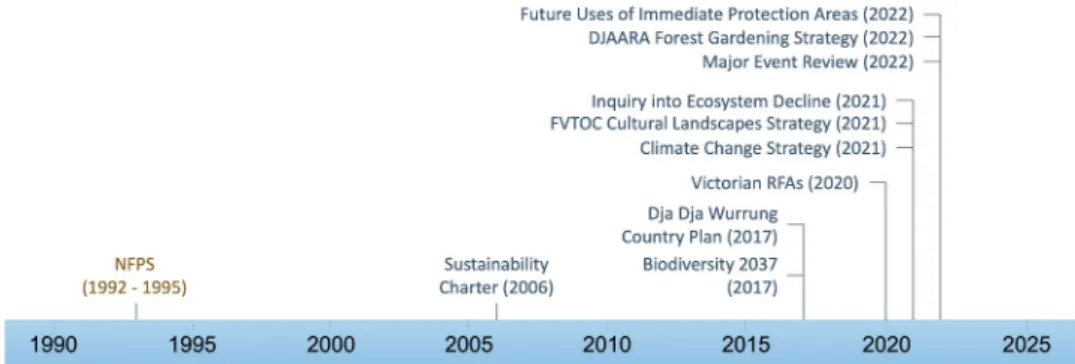
Active management has increasingly been used in policies and strategies relevant to Victoria’s native for- ests. The term first appeared in Australia’s National Forest Policy Statement (Commonwealth of Australia 1995;
Figure 1). Policy references relevant to Victoria’s forests were few in the early 2000s (except for the Sustainability Charter for Victoria’s State Forests; DSE 2006) but increased sharply from the late 2010s (Figure 1). For example, in 2017, the Victorian Government’s Biodiversity 2037 plan (DELWP 2017) stated a vision of biodiversity that is ‘actively cared for’ and noted that
‘active and adaptive’ management is consistent with Traditional Owner approaches for maintaining healthy landscapes. In the same year, active management was referred to in the Country Plan of the Dja Dja Wurrung Clans Aboriginal Corporation (2017) in Central Victoria.
Thereafter, active management was recommended in
multiple clauses in the 2020 variation of Victoria’s Regional Forest Agreements (RFAs; State of Victoria 2020), as well as in an independent major review follow- ing severe bushfires (Sparkes et al. 2022) and various policy documents relating to threatened species decline (LCEPC 2021), climate change (DELWP 2021b) and First Nations cultural landscapes (FVTOC 2021).
The desired outcomes of active management in these policies and plans for Victoria’s forests are diverse and wide- ranging. The National Forest Policy Statement from the 1990s indicated that active management was needed to balance wood production and nature conservation in private native forests (Commonwealth of Australia 1995). In comparison, the emphasis in the Sustainability Charter for Victoria’s State Forests (DSE 2006) was for active management to ‘promote healthy forests’ by minimising the negative impacts of both
‘natural and human induced’ disturbances. This emphasis is consistent with more recent aspirations in Victoria’s 2020 RFAs for active management to ‘build resilience and diversity’
and control processes that threaten listed species and com- munities (State of Victoria 2020). The RFAs also state that active management is needed to ‘reduce bushfire risk and support the recovery of forests’ and to ‘support a range of forest values and uses, including forest industries’ (State of Victoria 2020).
Wide-ranging aspirations for active management in Victoria’s forests are reiterated in the Major Event Review of the 2019−2020 Bushfires (Sparkes et al. 2022) and are consis- tent with those conveyed in Victoria’s Climate Change
CONTACT L. T. Bennett [email protected] School of Agriculture, Food and Ecosystem Sciences, The University of Melbourne, Melbourne, Victoria 3010, Australia
2024, VOL. 87, NO. 3, 125–147
https://doi.org/10.1080/00049158.2024.2381846
© 2024 The Author(s). Published by Informa UK Limited, trading as Taylor & Francis Group.
This is an Open Access article distributed under the terms of the Creative Commons Attribution-NonCommercial-NoDerivatives License (http://creativecommons.org/licenses/by-nc-nd/4.
0/), which permits non-commercial re-use, distribution, and reproduction in any medium, provided the original work is properly cited, and is not altered, transformed, or built upon in any way. The terms on which this article has been published allow the posting of the Accepted Manuscript in a repository by the author(s) or with their consent.
Strategy that active management can help to ‘balance some- times competing values and uses’ (DELWP 2021b). The National Forest Policy Statement suggested that such balance was principally achieved by protecting high conservation values in reserves and confining active management to pri- vate land (Commonwealth of Australia 1995). However, more recent documents acknowledge the importance of active management of all tenures, including parks and reserves (LCEPC 2021) and new reserves that were created to protect forests of high conservation value in a first step towards the cessation of commercial harvesting in Victoria’s state forests (DELWP 2022).
Despite the increasing use of the term ‘active manage- ment’ in policy documents for Victoria’s forests, the mechan- isms for achieving the diverse desired outcomes are not entirely clear. Active management has not been clearly defined in these policy documents but has been variously identified as a ‘proactive measure’ (State of Victoria 2020) and
‘strategies’ (Sparkes et al. 2022). Limited elaboration about the form of active management indicates that it involves the implementation of practices, including pest, weed or disease control (DSE 2006; State of Victoria 2020); reseeding or reve- getation (State of Victoria 2020; LCEPC 2021); prescribed burning (DSE 2006; Sparkes et al. 2022); and ‘silviculture practices to improve the forest’s structure and condition’
(State of Victoria 2020). Active management has also been described in recent government documents as the ‘applica- tion of Traditional Owner knowledge and practice’ (DELWP 2022). This is consistent with calls by Traditional Owners to lead the healing of Country through ‘active management such as forest thinning, cultural water flows and cultural fire’
(FVTOC 2021), with the important distinction that Indigenous active management is not new but is long-standing and based in worldviews and traditions that have been disrupted by colonisation and associated laws (FVTOC 2021; DJAARA 2022).
Addressing ambiguities about the active management of forests is timely, given the changing context of native forest management in Australia. Recent substantive changes include the end of commercial timber harvesting of public native forests in Victoria (DEECA 2022) and Western Australia (DBCA 2022) and an impending end in southeast Queensland (DAF 2023). These changes are consistent with contemporary societal values and priorities, with wood production rated less important by the public in southeastern Australia than experi- ential and cultural forest attributes (Anderson et al. 2018).
They also reflect increasing recognition of diverse relation- ships with forests, including those based in Indigenous
knowledge and culture (Fletcher, Romano et al. 2021) and roles like environmental volunteering, which combines experiencing, caring for and learning about forests (Reid et al. 2011). Shifting societal priorities, coupled with a rapidly changing climate and associated disturbance regimes (CSIRO and BoM 2022), provide a challenging setting for forest management in temperate Australia and highlight the pressing need for clarity about active management – what is it, and how can it best be implemented?
In this review, we examine understandings and applica- tions of active management of forests. We summarise general definitions of active management in relation to forests and conduct a systematic review of active management under- standings and implementation in an unbiased sample of published papers relating to temperate forests. For purposes of clarity, we also examine the positioning of active manage- ment in relation to associated concepts, including adaptive management. Our aim is to provide a clear definition of active management and to present different framings and consid- erations relevant to diverse aspirations for its implementation in the forests of temperate Australia.
Defining active management General definitions
There have been very few explicit definitions of active man- agement in the broad forest literature, with the handful that do exist varying in scope and simplicity. Concise definitions of active management focus on the implementation of actions.
For example, active management was defined by Götmark (2013) as ‘manipulation/treatment of habitats and/or species’
and by Carey (2007) as occurring ‘anytime silvicultural prac- tices are implemented’. These framings are broadly consistent with an early interpretation in relation to Australian forests that active management ‘logically includes logging’ (Brown 1996). Such concise definitions contrast with others that link actions to wide-ranging goals for active management. For example, noting the absence of a standard definition, the Society of American Foresters (2003) defined active manage- ment as: ‘ . . . attaining desired forest objectives and future conditions using cultural operations and forest management practices’, where cultural operations are defined as vegeta- tion manipulations to meet stand composition or structure objectives and forest management as ‘practical application’
of a range of principles to meet goals for diverse values from
‘aesthetics, fish, [and] recreation’ to ‘wilderness, wildlife, [and]
wood products’. Likewise, in relation to Australian forests,
Figure 1. Timeline of when and where active management has been mentioned in policies, agreements and strategy documents in the context of Victoria’s native forests, including (in brown) the National Forest Policy Statement (Commonwealth of Australia 1995)
Jackson et al. (2021) defined active management as: ‘a pre- paredness to conduct interventions that will conserve and restore biological diversity, ecological functions and evolu- tionary processes at multiple spatial and temporal scales’.
Reflecting these varied scopes, such definitions of active management point to a range of understandings about the possible practices that might be included. While some defini- tions indicate that forest active management has a focus on silvicultural practices – either as simply ‘logging’ (Brown 1996) or as a diverse suite of harvesting, tree tending and regenera- tion techniques (Carey 2007) – others provide a more expan- sive list, also including fertiliser addition, weed control, grazing, erosion control, road building and maintenance, recreation management, and fire management practices, including suppression, fuel treatment and prescribed burning (Society of American Foresters 2003). Of the latter, Jackson et al. (2021) recognised ‘Aboriginal land management and cultural burning’ in their definition of active management for Australian forests, which is consistent with Götmark’s (2013) characterisation of active management as involving ‘strong human/cultural influence’ on forests.
Active management is also defined by what it is not. For example, the alternative ‘passive management’ of forests is defined by Carey (2007) as ‘the choice . . . not to intervene in any way except to reduce or exclude human activities’, and by the Society of American Foresters (2003) as allowing ‘forests to evolve with minimal human intervention’. More general contrasts to active management have included ‘benign neglect’ (Brown 1996; Carey 2006a), ‘leaving nature to takes its course’ and the forest ‘untouched’ (Jackson et al. 2021), and a ‘laissez faire’ approach in which ‘forests are not mana- ged in any way except through the agencies of nature’
(Brown 1996).
Consistent with its use in Australia’s National Forest Policy Statement (Commonwealth of Australia 1995), papers that define active management often link it with resource- focused land uses like timber production, whereas passive contrasts are typically identified with reserves and protected zones (Brown 1996; Society of American Foresters 2003; Carey 2006a, 2006b). Nonetheless, some recognise that reserve- based passive management can include occasional ‘appro- priate’ actions like ‘fire threat reduction and restoration activ- ities’ (Carey 2007). Similarly, while some present active management as a better option than strictly passive approaches to forest management (Brown 1996; Society of American Foresters 2003), others argue that passive manage- ment is needed in at least some parts of the landscape to achieve goals like the ‘protection of old-growth forest’ (Carey 2007).
Active management representation in temperate-forest literature
Approach
To examine understandings of active management in tempe- rate forests, we took a systematic approach to compile and evaluate relevant published peer-reviewed papers in Australia and worldwide. Our searches (see Appendix for details) were intended to provide an unbiased ‘sample’ of how active management is understood in temperate-forest literature. One search used the Web of Science database, which only includes journals that meet recognised standards of quality and allows for exhaustive searches of published
papers based on search terms present in paper titles, abstracts, author keywords and/or ‘keywords plus’.
The second search used Google Scholar, with the aim of sourcing more accessible papers that might better capture a broader range of understandings of active management.
Searches in Google Scholar are restricted to either the paper title (too restrictive) or include the entire article (too gener- ous, given, for example, that papers can be returned based on words included in their reference list). Papers chosen from the Google Scholar search were thus restricted to the 20 ‘most relevant’ reviews, as ranked by Google Scholar.
The searches returned a total of 70 papers (listed in Appendix), which we evaluated with a focus on the represen- tation of active management. This involved whether explicit definitions of active management were provided, the stated or implied understandings of active management (e.g. high- level aspiration and/or implementation of practices), the form of implementation (e.g. part of a broader management fra- mework, temporal and spatial scales), and the types of active management goals and practices (if mentioned). These sum- maries provided an objective basis for evaluating the breadth of usage and understanding of active management in tem- perate forests around the world and for highlighting incon- sistencies, limitations and knowledge gaps.
Understandings of active management in temperate-forest literature
Reflecting mixed general definitions, the term ‘active man- agement’ has been used in a variety of ways in relation to temperate forests throughout the world. Of the 70 reviewed papers, most focused on forests in Europe (26), followed by the United States (16) and Australia (6), with 17 considering temperate forests across multiple continents. The earliest mentions of active management in the reviewed papers date from the mid-1990s (e.g. Gurnell et al. 1995; Brown 1996), with the majority (46) published between 2010 and 2019. This timing is consistent with observations from an earlier temperate-forest review (Götmark 2013) and reflects lags between the emergence of new paradigms for forest management in the early 1990s (highlighting the need to balance active management with ‘non-intervention’
approaches for a range of conservation- and production- focused goals), and the evaluation of associated practices in the scientific literature (Bernes et al. 2015). Nonetheless, despite nearly 30 years of use, the concept of active manage- ment itself has had very little evaluation and development in the context of temperate forests, with, for example, just 2 of the 70 papers providing a definition of it (Brown 1996;
Götmark 2013; see ‘General definitions’).
The use of the term ‘active management’ is inexplicit in several of the 70 reviewed papers. Some papers make only passing mention of active management without clear appli- cation (e.g. McMahon et al. 2015; Kristensen et al. 2015; Sing et al. 2018; Mölder et al. 2019), and others use the term to refer to a broad type of management without specifications (e.g. Lucas et al. 2011, Węgiel et al. 2019; Loeb and Powell 2020; Mayer et al. 2020). Also in a general sense, the term active management is used to highlight the need to do some- thing – to respond to potential threats and degradation (Millar and Stephenson 2015; Bennett et al. 2017) or to restore threatened or fragmented forests (Lindenmayer et al. 2010;
Allek et al. 2023; Havrdová et al. 2023; Pedley et al. 2023;
Mantero et al. 2024) – rather than to rely on non-intervention
or non-assisted ecosystem processes to ensure forest persistence.
Many of the reviewed papers use a less-active contrast to convey their interpretation of active management in the context of temperate forests. Several papers contrast active management with the absence of intervention or manage- ment (Antos et al. 2008; Ishii et al. 2016; Baker et al. 2023;
Havrdová et al. 2023; Spînu et al. 2023) and/or with conserva- tion or protection in reserves (Battles et al. 2001; Killey et al.
2010; Nunery and Keeton 2010; Sebek et al. 2015; Zumr et al.
2021), which are occasionally equated to ‘pristine’ (Loeb and Powell 2020) or ‘natural’ states (Vance 2018). Consistent with this understanding of passive management as a lack of human intervention if not an untouched state, others equate active management with the re-establishment of historical management regimes after prolonged periods of ‘neglect’
(Buckley and Mills 2015). For example, active management is mentioned in relation to re-establishing European coppi- cing systems that were used for hundreds of years before abandonment in the twentieth century (Hedl et al. 2010;
McMahon et al. 2015; Hamřík et al. 2023). This perspective suggests that active management involves regular and sus- tained tending (Buckley and Mills 2015; Sebek et al. 2015) rather than once-off intervention, which fits with interpreta- tions that active management requires ‘strategic repetition’
(Wood et al. 2020) and ‘years of ongoing’ management (Larkin et al. 2014). Thus, while passive management can imply no human activity over extended periods, active man- agement can involve regular activity, with one recent study equating more frequent and extensive silvicultural treat- ments with more intensive active management (Duan et al.
2023).
Implementation of active management in temperate-forest literature
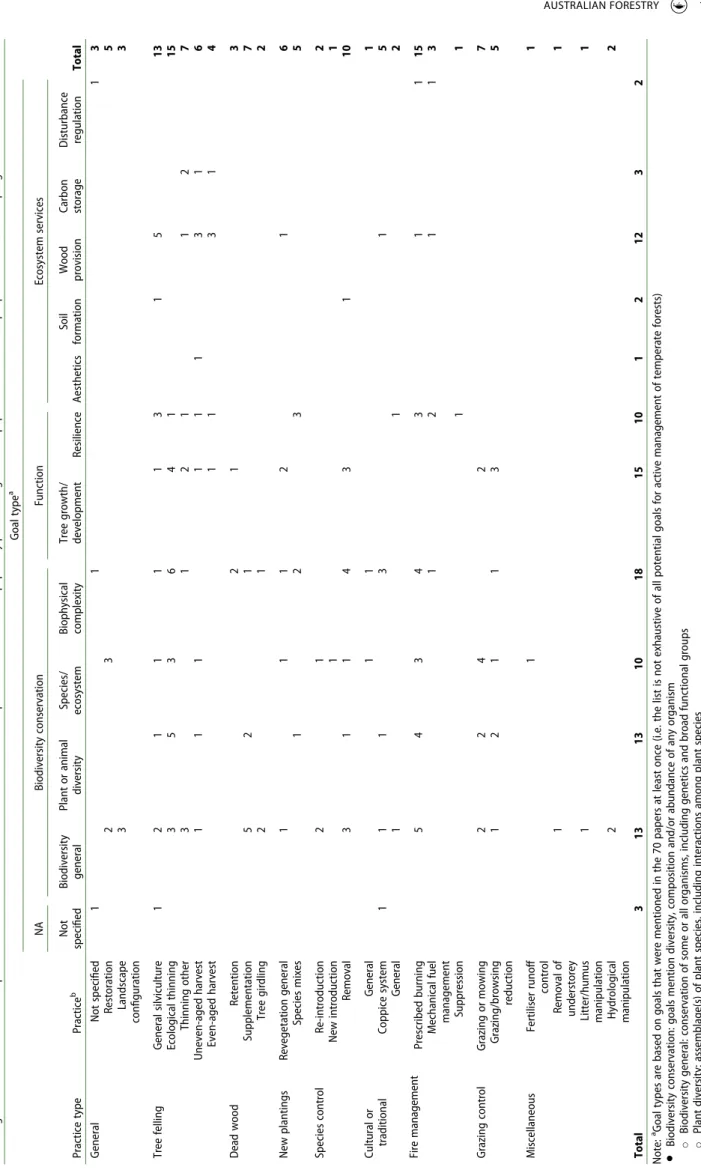
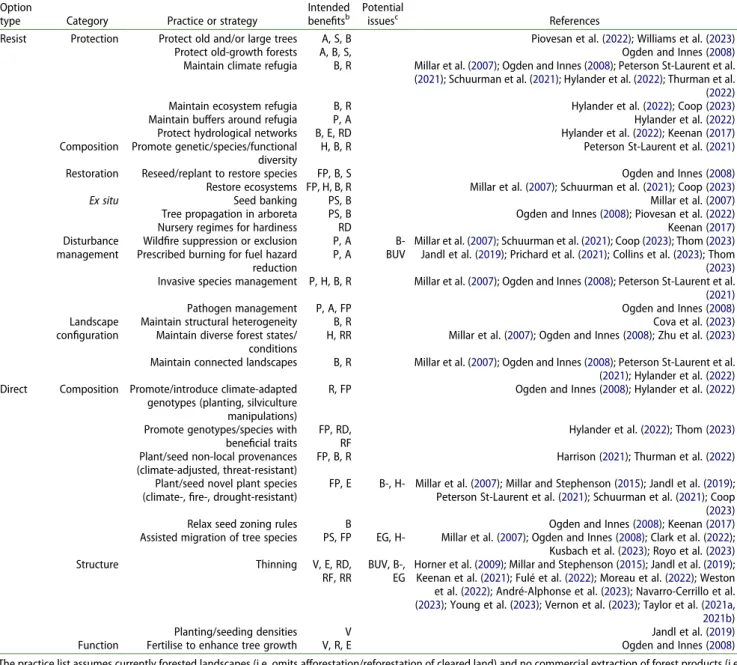
Although expressed in a myriad of ways, active management in the reviewed papers is conveyed consistently as a form of human intervention. Of the 70 papers, 67 link active manage- ment – either clearly or through inference – to the use of forest practices that encompass a broad range of activities (Table 1), from tree felling and the manipulation of dead wood, species and grazing, to new plantings and fire man- agement (see Table 1 for practice descriptions). Of all prac- tices, active management is most frequently mentioned in relation to ecological thinning (15 papers) and prescribed burning (15), ‘general silviculture’ (i.e. practices broadly or collectively described as silviculture; 13), and removal of undesirable species (10). Also mentioned multiple times are general thinning (not ecological; 7), dead wood supplemen- tation (7), grazing or mowing (7), uneven-aged harvesting (6), grazing or browsing reduction (5), and restoration practices either not specified (5) or relating to general revegetation (6) or to species mixes (5; Table 1). In some cases, active manage- ment is linked to an intervention to exclude a practice; for example, delaying harvesting to retain mature forest (Węgiel et al. 2019), or not removing dead wood (Zumr et al. 2021).
Rules for recognising practices as active management were not always clear in the reviewed papers. For example, although fire suppression clearly involves human interven- tion, it was identified as active management in just one paper (Bennett et al. 2017), whereas others presented suppression as a contrast to active management in the form of prescribed burning (Eales et al. 2018) or only included suppression in
comparative scenarios that were not identified as active man- agement (Battles et al. 2001; Halofsky et al. 2017). In a similar vein, recognition of traditional practices as active manage- ment was most often in the form of European coppicing systems (Hedl et al. 2010; Buckley and Mills 2015; McMahon et al. 2015; Roth et al. 2021; Hamřík et al. 2023) and rarely in the form of longer-term practices like Indigenous cultural burning (Götmark 2013), which were otherwise mentioned in relation to the historical context of forest condition rather than explicitly linked to active management (e.g. Brown 1996;
Weston et al. 2022).
Practices could be linked to goals in most (67) of the reviewed papers, suggesting that active management involves intentional intervention. Reflecting the diversity of practices, the papers included a wide range of active manage- ment goals, which we have grouped into three types: biodi- versity conservation, ecosystem function and ecosystem services (see Table 1 for goal descriptions). The most fre- quently mentioned goals related to biophysical complexity (i.e. heterogeneity to support biodiversity; 18 papers) and tree growth and development (including tree regeneration, survi- val and productivity; 15), followed equally by biodiversity in general (13), plant or animal diversity (13), and the provision of wood products (12). Less frequently, active management was also mentioned in the context of goals for the manage- ment of targeted species or ecosystems (10 papers) and to support forest resilience mostly in relation to threats posed by changing climate (10). The most frequent combinations of practices and goals (noting that a link here does not necessa- rily indicate practice efficacy towards the goal) were ecologi- cal thinning with biophysical complexity (6 papers) and plant or animal diversity (5), dead-wood supplementation or pre- scribed burning with general biodiversity (5 each), and gen- eral silviculture with the provision of wood products (5;
Table 1).
Of the 70 reviewed papers, 23 explicitly tested practices relative to goals. Of these, the majority (19) examined practice effects at tree to stand scales, with just four evaluating active management practices in the context of landscape-scale con- figurations or modelled scenarios. Most evaluations (56%) involved multiple rather than single applications of a practice or practices, consistent with mentions of active management as cycles of practices (e.g. coppice system;
Buckley and Mills 2015). Where practices were explicitly iden- tified, they were sometimes combined (e.g. thinning with prescribed burning; Weston et al. 2022), including sets of prescriptions (e.g. silvicultural systems comprising harvesting and regeneration practices; Dey et al. 2019). Active manage- ment is also occasionally noted as involving strategic combi- nations of practices across landscapes (Brown 1996; Götmark 2013; Bernes et al. 2014) or responsive selections of practices from a suite, depending on the ongoing state of the ecosys- tem (Larkin et al. 2014). Nonetheless, the majority (66) of the 70 reviewed papers did not clearly identify active manage- ment as involving coordinated or strategic management across broad spatial and temporal scales.
Synopsis: active management in temperate-forest literature
Overall, the reviewed papers present active management in temperate forests as a mostly operational concept. That is, rather than an overarching philosophy or principle for forest management, active management is principally represented
Table 1. Goals and practices associated with active management in temperate-forest literature. Cell values represent the number of 70 review papers that mention a practice linked to a goal in the context of active management, without indicating the nature of the relationship between the two. Row and column values do not add up to the total number of papers by practice or goal where papers mentioned multiple practices and/or multiple goals Goal typea NABiodiversity conservationFunctionEcosystem services Practice typePracticebNot specifiedBiodiversity generalPlant or animal diversitySpecies/ ecosystemBiophysical complexityTree growth/ developmentResilienceAestheticsSoil formationWood provisionCarbon storageDisturbance regulationTotal GeneralNot specified1113 Restoration235 Landscape configuration33 Tree fellingGeneral silviculture12111131513 Ecological thinning35364115 Thinning other3121127 Uneven-aged harvest111111316 Even-aged harvest11314 Dead woodRetention213 Supplementation5217 Tree girdling212 New plantingsRevegetation general111216 Species mixes1235 Species controlRe-introduction212 New introduction11 Removal31143110 Cultural or traditionalGeneral111 Coppice system111315 Fire management
General112 Prescribed burning543431115 Mechanical fuel management12113 Suppression11 Grazing controlGrazing or mowing22427 Grazing/browsing reduction121135 MiscellaneousFertiliser runoff control11 Removal of understorey11 Litter/humus manipulation11 Hydrological manipulation22 Total3131310181510121232 Note: aGoal types are based on goals that were mentioned in the 70 papers at least once (i.e. the list is not exhaustive of all potential goals for active management of temperate forests) ●Biodiversity conservation: goals mention diversity, composition and/or abundance of any organism ○Biodiversity general: conservation of some or all organisms, including genetics and broad functional groups ○Plant diversity: assemblage(s) of plant species, including interactions among plant species ○Animal diversity: assemblage(s) of animal species, including interactions among animal species
○Species/ecosystem: individual species (plant or animal) or ecosystem type, including rare and threatened species or ecosystems, and keystone, umbrella, focal or flagship species ○Biophysical complexity: arrangement of biotic and abiotic elements explicitly linked to biodiversity conservation based on principles of complexity or habitat/niche provisioning (including desired forest states and landscape configurations as surrogates for biodiversity) ●Function: goals mention an ecosystems process or functional capacity ○Tree growth/development: tree or woody plant regeneration, growth/productivity and/or development, including tree survival or mortality and development of large trees ○Resilience: capacity to recover and/or persistence and/or adaptability of species or populations to external stress in general and/or in relation to climate change or disturbance regimes ●Ecosystem services: goals mention ecosystem services as listed. b Practices and practice types are based on those mentioned in the 70 papers at least once (i.e. the list is not exhaustive of all potential active management practices in temperate forests) ●General: practices either not specified or aligned with a practice intention without specifics ●Tree felling ○General silviculture: practices broadly or collectively identified as ‘silviculture’ ○Ecological thinning: thinning mentioned in context of ecological objectives other than commercial wood production ○Thinning other: thinning with a production focus or no explicit focus, including stand-density manipulation ○Uneven-aged harvest: removal of stems using silvicultural regimes that lead to uneven-aged stands, including single tree selection, group selection, partial harvest and shelterwood harvesting ○Even-aged harvest: removal of stems using silvicultural regimes that lead to even-aged stands, including clearfell and seedtree harvesting ●Dead wood ○Retention: deliberate retention of fallen or standing dead wood, including protection from damaging agents like fire ○Supplementation: deliberate introduction or creation of dead wood, either standing or fallen ○Tree girdling: deliberate girdling of stems for intentions other than creation of dead wood ●New plantings ○Revegetation general: including planting and seeding without specification and assisted natural regeneration ○Species mixes: intentional management/planting/establishment of plant species mixes ●Species control ○Re-introduction: Re-establishment or augmentation (including rewilding of apex predators) ○New introduction: introduction of species new to an area ○Removal: removal of undesirable plant and/or animal species, including weeds, pests and invasive species ●Cultural or traditional ○General: individual practices or collections of practices identified by the paper’s authors as cultural or traditional ○Coppice system: management of coppice identified as traditional by the paper’s authors, including coppice-with-standards ●Fire management: either mentioned generally or in relation to listed practices ●Grazing control ○Grazing or mowing: use of either grazing animals or mechanical machinery for mowing ○Grazing/browsing reduction: management of grazers/browsers including exclusion and culling ●Miscellaneous: as listed, hydrological manipulation includes flooding regimes and soil drainage.
as the implementation of practices to manipulate forest attri- butes (structure, composition, function) towards goals for diverse outcomes (e.g. forest biodiversity, function and/or ecosystem services). It can involve single or multiple practices applied once or in cycles through time, most commonly at tree to stand scales, with some consideration of spatial con- figuration of practices at larger scales. In this sense, active management involves the presence and influence of humans who are engaged in attentive, deliberate and coordinated activity in forests and forest landscapes. While providing some clarity about its scope, this synopsis nonetheless pre- sents active management as a catch-all term for all human activity in forests. Whether it is a useful, stand-alone concept requires further examination, including where and how it fits with other concepts in forest management.
Positioning active management relative to associated concepts
Our review identified that active management is principally used in an operational context in temperate-forest literature.
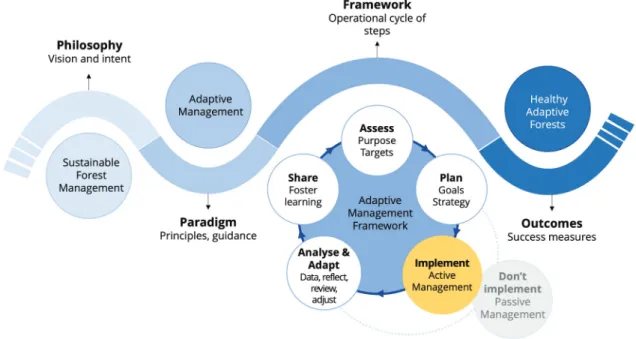
Here, we offer further insights into the nature of active man- agement by presenting its position relative to other forest management concepts. Broadly, we suggest that active man- agement is an implementation step embedded within an operational framework, which puts into effect the overarch- ing vision and principles of forest management (consistent with active management as a ‘technique’ within a broader system of ‘active intentional management’; Carey 2006b, 2007). To illustrate, we examine the place of active manage- ment in a conceptual ‘instrumental’ path (Figure 2), named to reflect planning approaches common in forest management (Sapkota et al. 2024) that involve instrumentalising policies set by management agencies through a series of ‘rational, organised’ steps, including defining the problem, setting goals, identifying options and actioning solutions (Leeuwis 2004). To avoid consideration of multiple potential models of
forest management (see Lane and McDonald 2002), we have designed the instrumental path to be consistent with sustain- able forest management (SFM) (Figure 2). This path is for illustration purposes only – it conveys just one way of seeing and thinking about human relationships with forests.
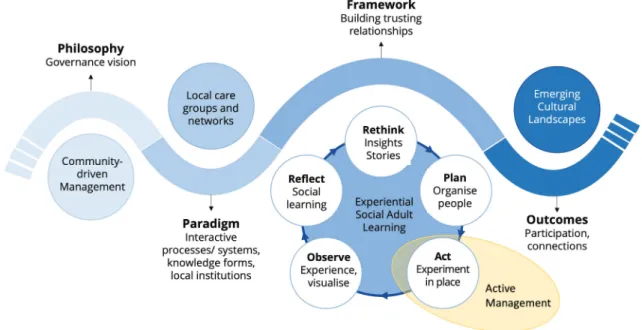
Alternative paths – relevant to different philosophies, para- digms, frameworks and outcomes – could be developed (e.g.
Figure 3), although we suggest that active management would maintain a similar relative position in those paths.
This highlights that active management is an inclusive con- cept that need not be constrained by instrumental approaches but can be aligned with a range of different approaches and philosophies for forests.
Our example instrumental path (Figure 2) conveys a hierarchy of interconnected concepts, starting with an over- arching philosophy of SFM that is ultimately linked to a broad outcome of healthy adaptive forests. This is not the only path that could be developed with SFM as the starting point because there are multiple alternative terms and embedded concepts that could be considered at each level (see Table 2).
Our purpose in using this form of an instrumental path is to show the position of ‘active management’ relative to ‘adap- tive management’ because the two concepts are often used together but are rarely distinctly defined. Since alternative paths – based on different philosophies, paradigms and frameworks – can be defined, our framing illustrates that active management will not always be planned with adaptive principles as a foremost priority; equally, not all adaptive management will be active (see below).
Placing SFM as the first link in our instrumental path is consistent with the stated overarching vision for ‘ecologi- cally sustainable management of Australia’s forests’ in the National Forest Policy Statement (Commonwealth of Australia 1995). ‘Sustainable’ in this context broadly requires maintenance of forest ecological processes and biodiversity, and optimisation of benefits derived from ‘all uses within ecological constraints’ (Commonwealth of
Figure 2. Example positioning of active management relative to associated concepts in an ‘instrumental’ path, which applies a philosophy of sustainable forest management and an adaptive management paradigm with the intended outcome of healthy adaptive forests. Active management (in yellow) involves the implementation of practices within an operational framework (in this case, an adaptive management framework, modified from CMP 2020). Decisions (based on assessment and planning) to not implement in-forest practices are consistent with the concept of passive management (grey), represented as an alternative to active management within an adaptive management cycle
Australia 1995). As per the comparable concept of ‘eco- system management’ (Lane and McDonald 2002; Table 2), SFM places importance on ecological processes to sustain the composition, structure and function of a forest and to meet society’s diverse cultural, economic and political needs (Safford and Vallejo 2019).
As acknowledged in the National Forest Policy Statement (Commonwealth of Australia 1995), SFM needs to adapt to accommodate change. That is, the philosophy of SFM accom- modates many of the management responses that will be required to maintain forest function under uncertainty, includ- ing climate change (Ogden and Innes 2008). This need to adapt describes ‘adaptive management’ in its broadest sense – being agile in response to unpredictable and changing conditions, learning through experience, and iteratively integrating learn- ings into ongoing management (Millar et al. 2007). Adaptive management at this broad paradigm level (Figure 2) provides principles that guide decision-making under uncertainty (Lane and McDonald 2002). At a comparable level (Table 2), the paradigm of ecological restoration provides principles that guide the process of assisting the recovery of a degraded ecosystem towards a reference model that describes the pre- degradation condition, typically informed by historical data (Murcia et al. 2014; Gann et al. 2019). However, other para- digms are premised on a wider range of potential adaptive responses that are less constrained by historical fidelity. For example, the resist–accept–direct (RAD) paradigm recognises that unprecedented environmental change is pushing many ecosystems beyond irreversible thresholds to novel states ‘that diverge dramatically from prior structure and function’ (Lynch et al. 2021). RAD allows managers to consider alternatives to resisting change (focusing on maintaining historical or current conditions) by presenting the possibility of accepting change trajectories that emerge without human intervention or of directing trajectories by intervening to deliberately shape eco- system structure and function (Lynch et al. 2021; Schuurman et al. 2021). Clearly, although both ecological restoration and RAD are arguably consistent with SFM, commitment to one or the other as a guiding paradigm could lead to divergent deci- sions further down an instrumental path.
Although the term ‘adaptive management’ can be used in a general sense, it also refers to an operational framework, which in our example includes active management as an embedded step (Figure 2). At this level, adaptive manage- ment is a type of decision-support framework that aims to reduce uncertainty by using iterative learning to inform future decisions (Hemming et al. 2022). Our example com- prises a cycle of assessment, planning, implementation, ana- lysis and sharing steps (CMP 2020), with active management as the implementation step, which is informed by, and in turn informs, all other steps in the cycle (Figure 2). As previously indicated, alternative paradigms like ecological restoration and RAD could be chosen at the preceding level in the path because both can and should be implemented within an adaptive management framework (Gann et al. 2019; Lynch et al. 2022). Equally, alternative frameworks could be substi- tuted at this level, including ecological risk assessment (USEPA 1998) and other decision-support frameworks (e.g.
priority threat management and systematic conservation planning; Hemming et al. 2022). This illustrates that active management can be embedded in a different framework that might not be identified as adaptive.
Adaptive management frameworks can be described as either active or passive – providing a potential source of con- fusion in our ‘active management’ context. However, these qualifiers refer to whether implementation options in the adaptive management framework are examined and/or tested rather than the nature of those options. For example, passive adaptive management involves using a single best-response model based on current understandings to screen and choose practices, whereas active adaptive management involves the development and screening of a range of alternative response models to identify multiple practices that can be tested at the implementation step (Walters and Holling 1990). This evalua- tion (or not) of potential practices occurs at the ‘assess’ and
‘plan’ steps, which precede the active management step in our example adaptive management cycle (Figure 2). The ‘assess’
step, for example, defines the purpose, targets and potential options of a management program (CMP 2020), which, in our example, can be checked for alignment with the adaptive
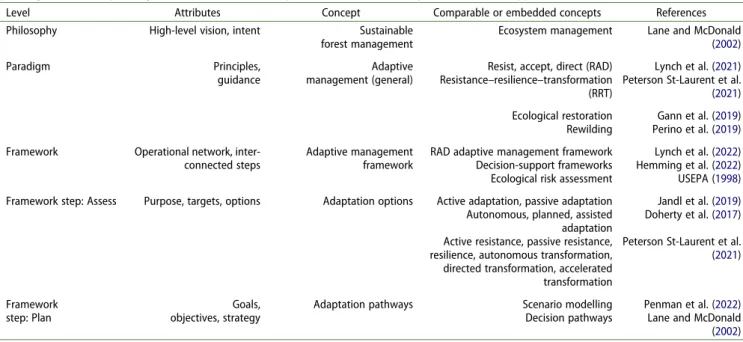
Table 2. Additional concepts associated with active management. Concepts are listed by the levels or steps that precede active management in a hypothetical path (e.g. instrumental path; Figure 2) and are linked to comparable or embedded concepts, as described or applied in the cited references
Level Attributes Concept Comparable or embedded concepts References
Philosophy High-level vision, intent Sustainable
forest management
Ecosystem management Lane and McDonald
(2002)
Paradigm Principles, Adaptive Resist, accept, direct (RAD) Lynch et al. (2021)
guidance management (general) Resistance–resilience–transformation
(RRT)
Peterson St-Laurent et al.
(2021)
Ecological restoration Gann et al. (2019)
Rewilding Perino et al. (2019)
Framework Operational network, inter-
connected steps
Adaptive management framework
RAD adaptive management framework Lynch et al. (2022)
Decision-support frameworks Hemming et al. (2022)
Ecological risk assessment USEPA (1998)
Framework step: Assess Purpose, targets, options Adaptation options Active adaptation, passive adaptation Jandl et al. (2019)
Autonomous, planned, assisted adaptation
Doherty et al. (2017) Active resistance, passive resistance,
resilience, autonomous transformation, directed transformation, accelerated transformation
Peterson St-Laurent et al.
(2021)
Framework Goals, Adaptation pathways Scenario modelling Penman et al. (2022)
step: Plan objectives, strategy Decision pathways Lane and McDonald
(2002)
management paradigm and overarching SFM philosophy.
Potential adaptation options are available in a range of typol- ogies (see Table 2), which – again potentially confusing in our active management context – can broadly be grouped under passive or active adaptation. Passive forms of management adaptation rely on the ‘autonomous adaptation’ (Doherty et al. 2017) of the forest ecosystem (without human interven- tion) to maintain current species and states (Peterson St- Laurent et al. 2021) by ‘exert[ing] a dynamic self-regulation’
based on ‘inherent resilience’ (Jandl et al. 2019). In contrast, active or ‘planned’ (Doherty et al. 2017) adaptation involves deliberate responses to changing conditions like those pre- sented by the RAD framework (Lynch et al. 2021) and by the resistance–resilience–transformation six-point scale, including options designed to support the resilience of current states or to support ecosystem transformations that are autonomous, directed or accelerated (Peterson St-Laurent et al. 2021).
Ideally, before their implementation as active management, the expected long-term outcomes of different adaptation options would be conceptually or quantitatively modelled, including associated uncertainties (Walters and Holling 1990).
In a rigorous planning step within the adaptive management cycle (Figure 2, Table 2), this could involve generating adapta- tion pathways that visualise and support current and future decisions in favour of desired forest states by identifying a sequence of aligned strategies and responses that are trig- gered by potential future changes in environmental and/or social conditions as they evolve (Barnett et al. 2014). This type of approach lends itself to scenario modelling based on spatial simulation models, like those often employed in risk assess- ment frameworks to support fire management (e.g. Penman et al. 2022).
The ‘assess’ and ‘plan’ steps in our adaptive management framework provide the rationale for the ‘implement’ step, which we equate to active management (Figure 2). That is, active management enacts the planning and decisions of preceding steps by implementing in-field practices, which can be selected from a diverse range (e.g. Table 1). Here, the decision can also be made to not implement practices, typically characterised as passive management (Figure 2).
Like active management, passive management can be embedded within an adaptive management cycle and used to manage for forest conditions or states according to the rationale provided in the preceding steps (e.g. based on adaptation options and pathways evaluated against targets and goals). Subsequent monitoring and analysis are then used to foster learning and modify targets and goals in an iterative manner and with stronger understanding of uncer- tainties associated with incomplete knowledge (Schreiber et al. 2004). In this way, passive management is not equated to the complete absence of humans but more to a hiatus in human activity or a decision to not implement a practice for that adaptive management cycle. Alternatively, passive man- agement could be abandoned as a redundant concept, replaced by concepts like ‘minimal intervention’ (Götmark 2013) that recognise low-intensity practices (e.g. human influ- ences on ungulate densities and browsing pressure; Götmark 2013) on an active management spectrum. This framing cap- tures the ubiquitous influence of humans on all forest land- scapes and better acknowledges the functional roles of Indigenous place-based societies in forest ecosystems and their active long-term stewardship (Bliege and Nimmo 2018;
Fletcher, Hamilton et al. 2021).
The outcome of our instrumental path is healthy adap- tive forests (Figure 2). From a biophysical perspective,
‘healthy’ can be defined as the capacity of a forest eco- system to maintain vigour and organisation through resi- lience to stress (Costanza 1992). However, a ‘healthy’
forest or forest landscape can have many interpretations, including those that better reflect the diversity and depth of human relationships with forests and the interconnect- edness of human health and ecosystem health. In any case, that the forest is ‘adaptive’ rather than ‘adapted’
highlights both that adaptation remains an ongoing pro- cess and that a sustainable ecosystem (consistent with SFM) is a healthy one – it maintains its capacity to recover from shocks and disturbances through autogenic pro- cesses, which can include humans but does not require ongoing or intensive interventions (Chapin et al. 1996;
Whisenant 1999).
Refined definition of active management of forests Based on our review of its usage in temperate-forest literature and considering associated concepts, we provide the follow- ing definition of active management:
Active management is deliberate human tending of a forest or forest landscape by implementing practices or sets of practices to maintain and modify composition, structure or function towards a diverse range of potential purposes and goals. Active manage- ment sits within broader frameworks or approaches, which enact the overarching philosophy, paradigm and desired outcomes of forest management.
We use the word ‘tending’ to reflect the need for ongoing attention and to evoke practices that are inclusive of a diverse range of human–forest relationships, including, for example, those within First Nations cultures that are often centred in caring rather than more instrumental values. Our definition also highlights that active manage- ment is a part of, rather than a type of, forest management, which in this context is a higher-level concept that also encompasses the principles, paradigms and frameworks or approaches of management.
Considerations for implementing active management
Our definition of active management highlights considera- tions for its effective implementation, including clear over- arching visions (based on the philosophy, paradigms and desired outcomes of management) to guide directions and/
or decisions, and an agreed approach or framework to enact the vision(s). The following subsections expand on these considerations and are roughly ordered to reflect their rela- tive position on a conceptual path like our instrumental path (Figure 2).
Refreshed visions for forest management
Changing social and environmental contexts of Australia’s temperate forests highlight the need for refreshed philoso- phies and visions to inform and guide the frameworks that support active management. The Sustainability Charter for Victoria’s State Forests (DSE 2006), for example, includes a vision to ‘protect the environment and promote social and economic development for all Victorians . . . [including] the
long-term future of our forests, regional communities and the timber industry . . . ’. While elements of this vision remain relevant, commitment to the long-term future of the timber industry is now inconsistent with the 2024 cessation of com- mercial timber harvesting in Victoria’s state forests. In addi- tion, the Charter (DSE 2006) and the National Forest Policy Statement (Commonwealth of Australia 1995) make little to no mention of the challenges presented to Australia’s tempe- rate forests by changing climate and fire regimes (e.g.
Fairman et al. 2016) – challenges that are posing threats to the biophysical health of temperate forests throughout the world (Millar and Stephenson 2015; Steel et al. 2023). The Charter and National Forest Policy Statement also predate the sharp increase in policy mentions of active management from the late 2010s (Figure 1) and do not consider related concepts like adaptive management, suggesting shifts in management thinking since their release.
The development of refreshed visions for Australia’s tem- perate forests presents opportunities – within the constraints of regulatory requirements and societal expectations – for consideration of a range of paradigms and associated princi- ples relevant to active management. Frequent mention of adaptive management in policy documents, for example, suggests scope to explore related concepts, including those described by paradigms like RAD (Lynch et al. 2021;
Schuurman et al. 2021) and resistance–resilience–transforma- tion (RRT; Peterson St-Laurent et al. 2021), which offer princi- ples to guide management for diverse outcomes, including resilient current forest states or transformed states. Similarly, ecological restoration has clearly stated principles to ‘explain, define, guide, and measure the activities and outcomes’ of restoration practices, including principles for engaging stake- holders and drawing on different types of knowledge (Gann et al. 2019). Such principles are relevant to diverse forest contexts, offering scope to define cross-tenure visions that recognise the need for coordinated planning of active man- agement across landscapes and that remove a persistent tenure-based dichotomy of active management only in pro- duction landscapes and passive management only in reserves
and protected zones (see ‘Understandings of active manage- ment in temperate-forest literature’).
Inclusive understandings and governance structures
With reimagined paradigms come opportunities to establish inclusive understandings and governance structures for active management that recognise and enable diverse values and cultural relationships with forests. In our review, goals for active management were overwhelmingly focused on bio- physical values (Table 1), with just one paper including a goal of ‘aesthetic appeal’ (Webster and Jensen 2007).
There were also very few mentions of social or cultural forest practices in relation to active management – an exclusion that extended to Indigenous cultural burning (except for Jackson et al. 2021), despite recognition in temperate Australia of its importance in shaping forest landscapes (Brown 1996). This absence of social and cultural values from active management literature reflects a predominance of authoritative and managerial relationships in Australian forest management, as opposed to interactive and relational approaches, which have a stronger focus on community par- ticipation in decision-making and establishing trusting rela- tionships (Sapkota et al. 2024). It also reflects a focus on biophysical components in SFM frameworks, which can fail to capture the full range of social values (Ford et al. 2017).
Our framing of active management allows for more inclu- sive approaches to its implementation. To illustrate, we have also developed a ‘local communities’ path (Figure 3), which has a focus on participation and relationship values and potentially expands the repertoire of active management by providing a place for community-based forest practices.
However, while conceptually useful, establishing such a path requires several foundational steps, including invest- ment in social capital, sustained support and resourcing, and collaborative design of agreed and clear governance struc- tures, including processes for resolving conflicts (e.g.
Matthews and Missingham 2009). Volunteer ‘Friends’ groups,
Figure 3. Example of a ‘local communities’ path applying a philosophy of community-driven management and a paradigm of interactive relationships with the intended outcome of emerging cultural landscapes. Active management is consistent with the ‘act’ step within a framework of experiential social adult learning