Shortly after the discovery of remarkable fossils from the Burgess Shale in British Columbia in 1910, Dr. . The edges of the fuselage are clearly marked on the illustrated specimen, especially on the opposite side, which is a mold of the exterior.
If this were to prove to be the case, it would be a matter of the greatest interest."
NO. 3 BURGESS SHALE FOSSILS WALCOTT 9
85 pendant in position or an uninjured body part. thicker than Burgcssia hella, and the body is firmly attached to the fused segments which form the posterior carapace, and there is a close union between the body of the cephalic region and the carapace. a, antennae; as, anal segment; ds, reflex margin of posterior carapace; da, endopodite; ex, exopodite; i, intestine; m, mandible; m', maxilla; ;»",maxillula;. sey, segmented posterior shield; st, abdomen; t, telson. The true cephalic shield or shell fold is attached to the cephalic somites near its anterior part, probably as in the newer Apodidae or the associated Burgcssia and also along line of body as far back as anterior margin of posterior carapace. Not known to have had a reflexed anterior border with a labrum at- Carapace wider than long, with a somewhat uniformly rounded outline except posteriorly where it is almost transverse , it probably had a ventral as well as a dorsal membrane, between which the large diaphragm was placed much like the shell glands of the Apodidae.' For some unknown reason, the front part of the carapace is usually distorted by being pushed back to wrinkle and shorten it.
The large shield of the posterior part of the exoskeleton is composed of 14 fused segments with a narrow border.
12 SMITHSONIAN MISCELLANEOUS COLLECTIONS VOL. 85 to the genera Ogygopsis or Orria/ except that the median lobe is not
NO. 3 BURGESS SHALE FOSSILS WALCOTT I3
14 SMITHSONIAN MISCELLANEOUS COLLECTIONS VOL. 85 slightly constricted at the union of the trunk segments and extends
NO. 3 BURGESS SHALE FOSSILS WALCOTT 15
The exact shape and position of the proximal joints of the cephalic limbs is unknown, but their general outline and position is roughly as outlined.
NO. 3 BURGESS SHALE FOSSILS WALCOTT 1
Exopoditeisan elongate oval, apparently unfused lobe as seen in the specimen represented by Figure 4, Plate 17; a fringe of fine, short filaments occurs on ventral and outer margins; the delicate structure and small size make it difficult to determine its exact nature, but as far as is known. Digestive Organs.—-The mouth was situated on the ventral side, and probably bounded in front by the labrum and on the sides by the mandibles; the mouth supposed:)ly opened into an esophagus which passed into a large .stomach apparently divided or forked anteriorly: from the back of the stomach a straight intestine extended back to the anus. A strong, comparatively large tube is given ofi^ from each side of the abdomen about the fifth segment; these have strong branches at the proximal end, one extending anteriorly and another posteriorly, both of which have short two-branched branches both externally and internally.
In almost all well-preserved specimens the large tube and often the large connectors are rounded, so that they expanded when buried in the sediment; this would be consistent with the view that these were large digestive glands that contained food.
NO. 3 BURGESS SHALE FOSSILS WALCOTT 19 digestion, the ultimate or hepatic caeca secreting a digestive juice as
85Functions of the appendages.— Functions of the cephalic and Functions of the appendages.— The functions of the cephalic and thoracic Hmbs were probably similar to those of Marrellasplendens. The posterior border of the abdominal segments bears four or more strong spines with a fringe of small, short, sharp spines between them. Most of the data on which this figure is based is shown by the specimens illustrated in Plates 19 and 20.
The general dimensions of the various parts are shown by figure 4, plate 27, of the 1912 paper.
NO. 3 BURGESS SHALE FOSSILS WALCOTT 23
24 SMITHSONIAN MISCELLANEOUS COLLECTIONS VOL. 85
DIGESTIVE ORGANS
NO. 3 BURGESS SHALE FOSSILS WALCOTT 2$
85Carapace.- Because of its extreme tightness, there is usually little carapace.- Because of its extreme tightness, there is usually little. more than a dark membrane on the slate, clearly outlined, and shining through the traces of the digestive organs and ventral limbs. The transverse cephalic carapace resembles Marrella without the large median spines; it is often curved in the middle of its anterior margin and projects laterally into long backward-curving, spine-like extensions so slender as to suggest that the cephalic shield was formed by a delicate membrane. X7.). No details of the segments of the posterior carapace are preserved, but the segments are clearly outlined.
The intestine is very clearly visible, including the fact that it contracted at each segment and expanded into a stomach under the head shield. Only the proximal part of the limbs is outlined, although fragments of the distal part are preserved on one specimen. The thoracic part of the carapace is clearly divided into two specimens, and in others there are traces of segmentation, but usually there is only a black spot on the shale with the outline of the intestine.
None of the 29 special males in the collection show the outline of the middle lobe, although one has a slight elevation along the line of the gut.
NO. 3 BURGESS SHALE FOSSILS WALCOTT 2^
28 SMITHSONIAN MISCELLANEOUS COLLECTIONS VOL. 85 associated, in the character of the thoracic segments and pygidium
NO. 3 BURGESS SHALE FOSSILS WALCOTT 29
30 SMITHSONIAN MISCELLANEOUS COLLECTIONS VOL. 85 (b) that they were of a very deHcate structure and readily destroyed
XO. 3 BURGESS SHALE FOSSILS WALCOTT 3
Thoracic climbs. The biramous thoracic climbs appear to be uniform. characteristic from the cephalon to the tiny plate-like telson at the posterior end of the body. Protopodite.^— The large protopodite is attached by its inner end to the underside of the body segment, about halfway between the. This figure indicates the point of attachment of the limb to the body, as well as the approximate position of the intestine. . The ventral midline and rounded exterior of the body apparently resemble the trunk limbs of Apns, except that in the latter there is no evidence that the protopodite served as a gnathobasis.
The . The first five joints of the forelimbs are rather straight and wide. BURGESS SHAI,E FOSSILS WALCOTT 33 . sides; narrow and thin dorsally and ventrally; short, very fine spines appear at their distal end and on the side of the joints. Usually, the first joint of the endopodite of the fourth pair of limbs is slightly expanded, the first and second. on the joints from the fifth to the seventh pair of limbs and the first five joints from the eighth to the twentieth pair of limbs.
The expanded joint varies in degree of expansion from slight enlargement of the fourth limb to .. where the transverse diameter is considerably greater than the length of the joint. The latter reminiscent of the transversely flattened joints of the endopodite of the trilobitc Triarthnts hecki.^. Diagrammatic enlargement of a section of the exopodite showing the bodv and the attached cylindrical filaments.
In some specimens where the expanded joints are visible, the extended portion from base to tip is very narrow, and gives the effect of a strong spine projecting from the center of the joint; in other specimens the base is as long as the joint and the apex is blunt, which is the prevailing form. Exopodite. – The exopodite is attached to the protopodite about half the length of the latter.

34 SMITHSONIAN MISCELLANEOUS COLLECTIONS VOL. 85 (formerly round) filament, which is beautifully preserved in some
However, it is likely that, given their position and shape, they were helpful in bringing food to the mouth. The endopodites of the biramous stem appendages probably served as both a walking and walking leg, although they were apparently little used in walking because of their delicate distal joints. The long, strong filaments attached to the segments of the exopodite are similar to the filaments of the exopodite of the trilobite Ncolcuus, and the comments about them should be read in this context.
The long body, with its numerous segments, is attached to the carapace only in its head region. On the right side the entire series of protopodites and endopodites forming the sternum is represented; the shape of the inner end of the protopodite is based on indications given by several specimens, although the protopodite is usually crushed flat and appears to be of the same size throughout its length. The relative position and shape of exopodite, endopodite and protopodite is shown in text figure 10.
This free-swimming, delicate crustacean settled to the bottom of the bottom and was quickly buried by fine mud that settled over it.
36 SMITHSONIAN MISCELLANEOUS COLLECTIONS VOL. 85 thin film and matted those parts resting on each other together unless
OBSERVATIONS
SIMILAR CHARACTERS
NO. 3 BURGESS SHALE FOSSILS WALCOTT 37
COMPARISON WITH CRUST.\CEANS
38 SMITHSONIAN MISCELLANEOUS COLLECTIONS VOL. 85
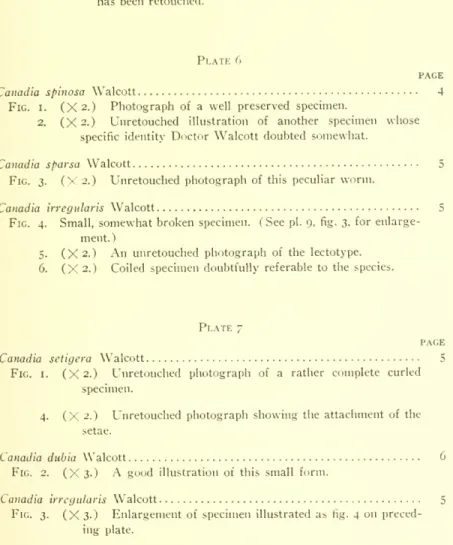
EXPLANATION OF PLATES
NO. 3 BURGESS SHALE FOSSILS WALCOTT 39
40 SMITHSONIAN MISCELLANEOUS COLLECTIONS VOL. 85 Plate 8
NO. 3 BURGESS SHALE FOSSILS WALCOTT 4I
42 SMITHSONIAN MISCELLANEOUS COLLECTIONS VOL. 85 Plate 15
NO. 3 BURGESS SHALE FOSSILS WALCOTT 43
44 SMITHSONIAN MISCELLANEOUS COLLECTIONS VOL. 8 =
Side view of a flattened specimen illustrating the shape of the carapace, with one side crushed upwards and backwards. The thoracic limb exopodites appear to have the same structure as those of Wapfia fieldensis. X--) A touched figure of an excellent specimen. X4.). Dorsal view of a specimen showing the mandibles, the antenna on the left extending next to the mandible, and the exopodites refer to the maxillae and maxillulae. What may be the axillary dopodite is shown on the right below the edge filaments of the maxillary exopodite. X4-).
In this ventral view, the mandibles have been pushed forward, so that the mandible and antenna on the right side are in a vertical position and next to each other, and the endopodites of the maxilla and maxilla are in front of their natural position; on the left, two endopodites of the thoracic limbs are faintly outlined. X4-) Abdominal view of a specimen in which the joints of the mandibles are pressed together and slightly shortened; the proximal joint on the right is clearly visible because the labrum has been pushed forward; the inner edge of the joint is serrated, but not as clearly visible as on the specimen shown in Fig. 2. The dorsal view of this specimen is illustrated. the position of the antenna on the right, which is the same as the antenna on the left in fig. i, and on both sides in Fig. Figure 5: The position of the mandibles is also well shown. X4-) Ventral view showing the position of the mandibles. in addition to the labrum, also the exopodites of the maxillae and maxillulae behind it; it appears that the antennae have been torn away as the mandibles push forward. X4-) Ventral view of a specimen showing the mandibles, with the right side preserving the proximal joint with a serrated inner edge. This lower jaw is colored white to make it stand out more clearly in the reproduction; the thoracic exopodites are very clearly visible on both sides, with the endopodites largely exfoliated. X4-) Ventral view of a specimen preserving a complete human.
46 SMITHSONIAN MISCELLANEOUS COLLECTIONS VOL. 85
BURGESS SHALE FOSSILS