This study examines whether adult ESL programs in north Mississippi satisfactorily meet those needs. Literature in the fields of second language acquisition, pedagogy, and adult ESL classroom research is reviewed, along with statistical background information relevant to the geographic region examined. Results from six program coordinators and seven students of adult ESL programs in the cities of Oxford and Tupelo, Mississippi, indicate that transportation is not a.
Adult ESL programs in this area are sufficiently improving students' English listening and speaking skills, but are perceived to be failing to provide adequate instruction to improve students' English reading and writing skills.
INTRODUCTION
This study explores the availability, accessibility, and student satisfaction of ESL classes for adults in North Mississippi. The study of second language acquisition, or SLA, is the study of how someone learns a second language and how that process differs from the process of learning a first language. Furthermore, first language acquisition (FLA) refers to the process of learning the first language from birth.
The concepts of ambivalence and resistance are compared in the context of students' perceived barriers to attending adult ESL classes.
LITERATURE REVIEW
Second language acquisition differs from first language acquisition in particular in the way it is learned. A commonly used activity to facilitate dialogue in the second language classroom is cross-cultural comparisons (Lee, 2015). Cultural conversations in the second language classroom are therefore essential to achieve a goal of acceptance.
Most ESL programs for adults in the United States are free or very inexpensive for students (Carter, 2016; Eyring, 2014). Due to the few regulations for adult ESL programs in the United States, student evaluation methods vary between programs (National Board for Professional Teaching Standards, 2019; Eyring, 2014). Two-thirds of adult ESL programs in the United States are federally funded, and the other third are privately funded.
METHODOLOGY
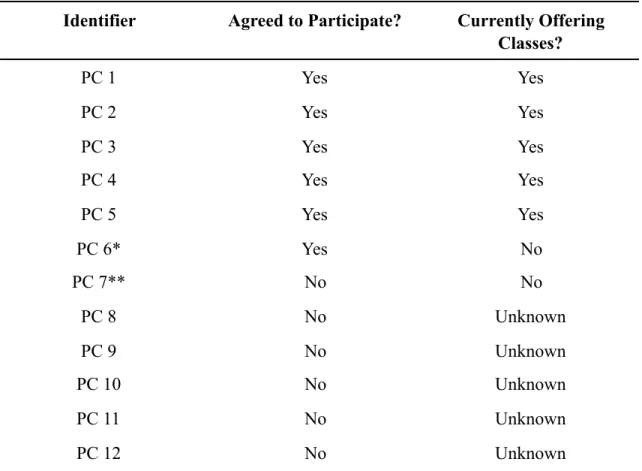
The second survey of twelve statements was for students in the programs, with the first statement verifying that participants were at least 18 years old (see Appendix D: “Make sure you are at least 18 years old.”). In total, I found 10 programs in the Oxford and Tupelo areas that, to my knowledge, are currently offering classes. Please note that there is no difference between the two consent forms, except for the link that says 'CLICK HERE IF YOU AGREE TO PARTICIPATE', which goes to each group's respective survey.
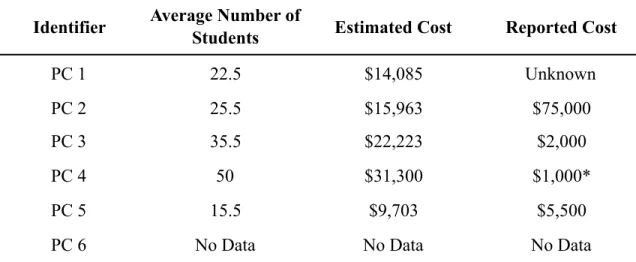
One program coordinator was not currently offering classes, but he/she shared some program features with me via email. Student' or 'PC.' The first part of my analysis examined the demographic information of programs, including the total number of programs, classroom gender ratio, average number of students, etc. I can see the total number of adult ESL students in the Oxford and Tupelo areas; However, I can estimate the total number of students in the programs who agreed to participate in my study.
I made an estimate by summing the PC respondents' answers to Question 3, "How many students are enrolled in the program?" (see Appendix C). I created the lower bound of my estimate by summing the lowest values in the range for . I created the upper bound of my estimate in the same way by summing the largest values in the range of each recorded response.
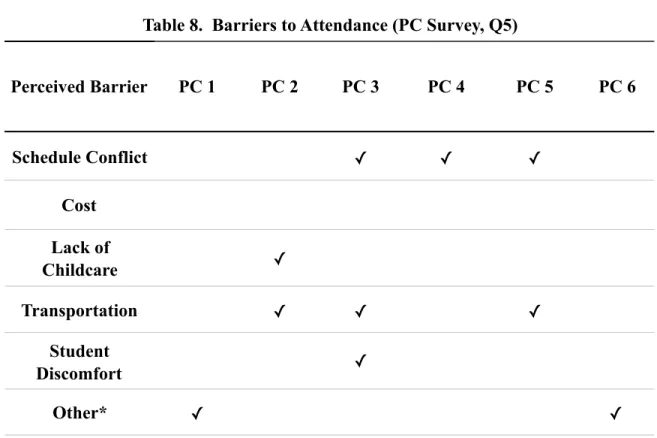
This number is disappointing, but I must keep in mind that many of these students face barriers to completing the survey, such as limited English proficiency (LEP) or limited Internet access, which also accounts for the gap in the percentage of responses for each subject category ( 50% for program coordinators and only 4.47% for students), as program coordinators are extremely unlikely to experience these problems. Other questions lead to a qualitative discussion of what program features drive certain outcomes, such as Question 5 in the Program Coordinator Survey, "What do you think are some barriers to attendance?", which I consider the most important question of that questionnaire.
RESULTS
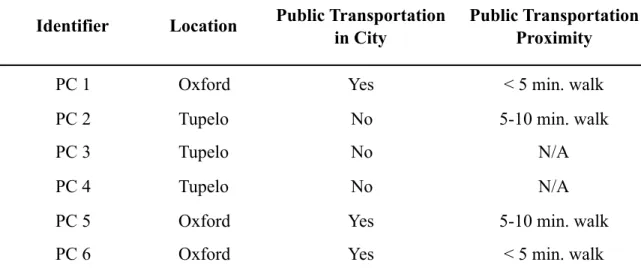
Of the five programs currently running, none reported a large number of students age 40 or older. Finally, three of the five responding programs always provided child care during classes, while one program sometimes provided child care services, and one program never provided. Two of the three programs in Oxford were located within a five-minute walk of the nearest public transport stop, which was the shortest answer option for this multiple choice question.
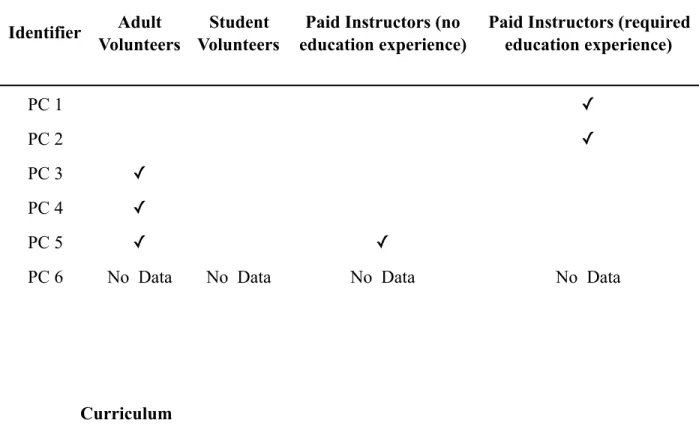
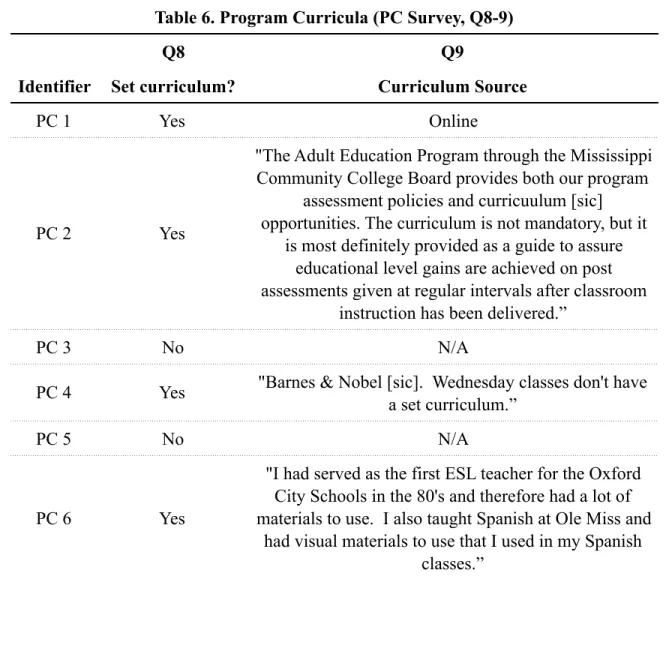
Adult volunteers were the most frequently used instructor type, while none of the programs used student volunteers. Additionally, of the programs that hired paid instructors to teach classes, slightly more programs required some kind of educational background for instructors than programs that did not. Four of the six programs used some type of set curriculum, with PC 3's and PC 5's programs being the two exceptions.
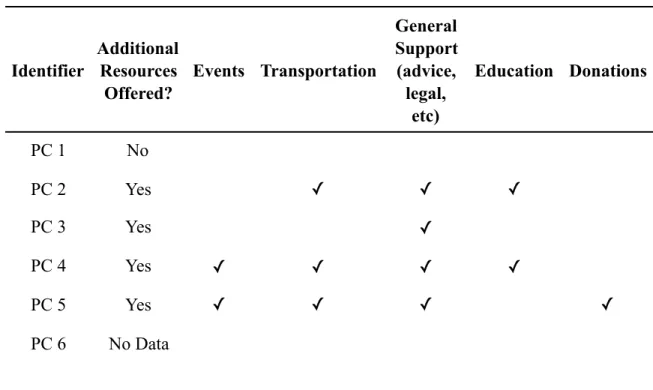
Two of the three programs located in Tupelo cited transportation as a primary conflict for students. Of the respondents to these questions (PC 1-5), PC 1 was the only program that did not provide additional resources for students. In addition, Student 3 was the only respondent who ranked the difficulty of the class as "very easy." Given the measures taken to ensure participant anonymity, there is no way to link Student 3's responses to a specific program.
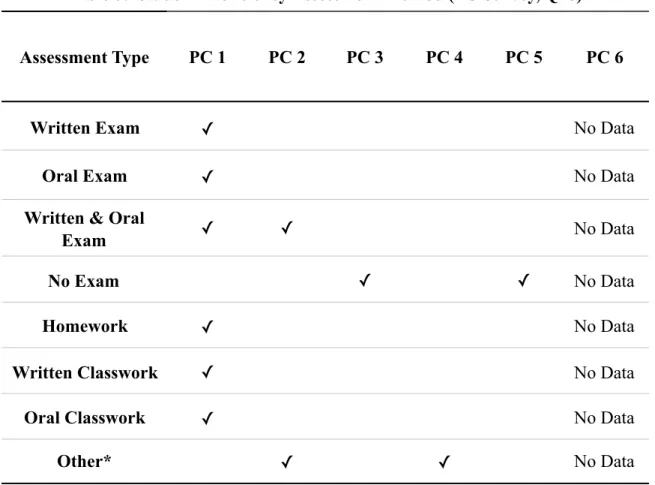
I included individual responses to Statement 7, which measures students' comfort in the social environment of their classroom, because this is one of the key statements in the student survey for this study. Only two of the five courses with available data had mandatory testing for students.
DISCUSSION OF RESULTS
Time conflict, especially with work or family commitments, is consistently cited as a major barrier to attendance for ESL students (Wu, Wu, & Le, 2014; . Kouritzin, 2000; Hayes, 1989). Given the results of this study, there are no immediate obvious barriers to attendance for currently enrolled students, but it is possible that schedule conflicts or student discomfort in the classroom may be barriers. Additional research is needed to determine whether these factors are in fact significant barriers to attendance.
Finally, lack of childcare is not a strong disincentive to attending the subject group due to the number of programs that offer this service, but it can be an important factor. Transportation costs were not found to be a significant barrier to student attendance (see Public Transportation, Chapter 5), despite the fact that program coordinators ranked transportation as the top two barriers to student attendance from their perspective. This program was the only one that charged a tuition fee ($4,750 per semester plus fees), and PC 1 responded that there was no barrier to attendance for him/her because the program implemented an attendance policy.
Other barriers to participation mentioned by program coordinators include lack of childcare by PC 2, whose program only offers childcare sometimes, and students. While lack of classroom childcare has been shown to be a significant barrier to participation in previous research, this barrier is not always remedied by the implementation of childcare services by program coordinators. Every program coordinator whose program always offers childcare did not mention lack of childcare as a barrier to attendance.
Unfortunately, there is no statement on the student survey that measures whether a lack of childcare is a real barrier for students, but since 60% of the programs surveyed offer childcare, an absence of childcare is unlikely to be a major barrier not be for attendance. Because PC 6's program, which no longer offers classes due to lack of enrollment, was located in Oxford, and there are at least two other programs in the city that still offer programs, further investigation into other barriers to attendance ( other than students') are further investigated. English acquisition) that may have caused a decline in enrollment is needed. Thus, it is likely that PC 6's program experienced the same barriers to attendance as other surveyed programs, but may have had stronger disincentives to enroll new students than other programs.
In conclusion, there are no apparent strong barriers to attendance for students currently enrolled in these programs, but scheduling conflicts or student disruption in class may cause some students to miss class.
CONCLUSION
Free ESL programs for adults in these two areas are not providing a satisfactory level of student assessment through classroom work (written or oral). Written classroom assignment exercises have been shown to improve students' English reading and writing skills, and studies have shown that adult ESL programs are generally not facilitating enough classroom exercises to adequately develop these skills ( Harklau, 2002; Hinkel, 2004; August, 2006; Rossiter, 2001; Fernandez et al., 2017; Wang, 1999). Finally, this research study confirms that ESL programs for adults are not perceived by the participants as satisfactory improvement of students.
This addition would more directly link program characteristics to student satisfaction, providing a very specific model of the ideal adult ESL program based on an analysis of negative and positive program characteristics. There is a need for further study on the following topics: the effect of instructor salary on student achievement in the adult ESL classroom, the effect of tuition cost per student. In the first question of the survey, you must confirm that you are at least 18 years old.
The purpose of this research is to evaluate the availability and quality of ESL programs for adults by comparing their characteristics across a rural and urban area. There is no direct benefit from your participation, but the researchers hope to gain knowledge that will improve the quality of ESL programs for adults. Program and Classroom Factors Affecting Attendance Patterns of Hispanic Participants in Adult ESL Education.” All Theses and Dissertations.
An examination of writing instruction in adult ESL programs: Do teaching practices meet the needs of adult learners? Pathways and outcomes: Tracking ESL student achievement: A longitudinal study of adult ESL service at City College of San Francisco.