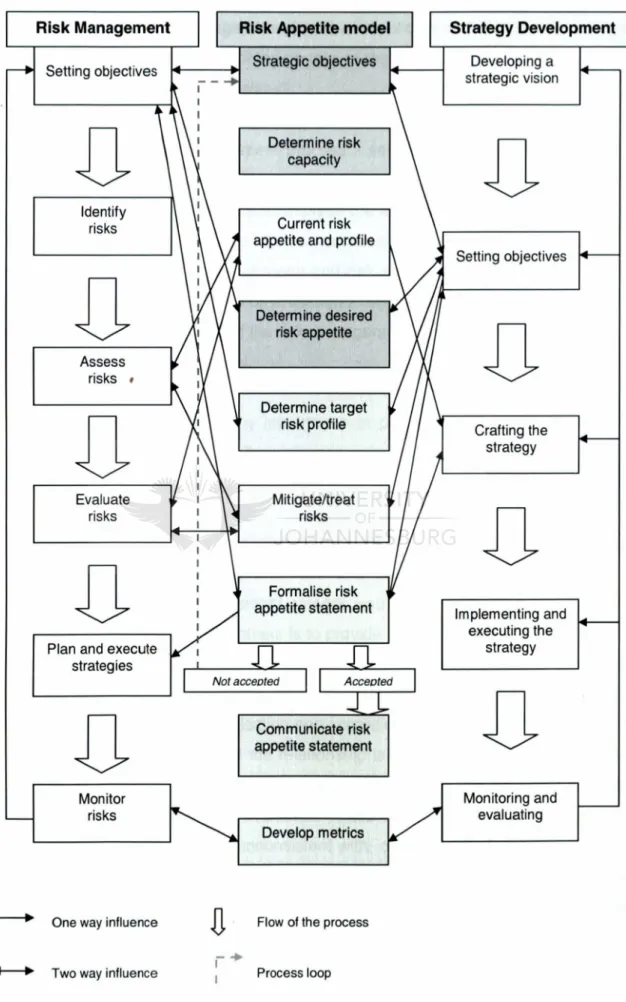
There is no scientific/academic evidence and no model or framework as to what the alignment between an organization's strategy and risk appetite is. Therefore, the purpose of this study is to develop a risk appetite model to align the organization's strategy and risk management so that management can improve its decision-making. The research design is based on a qualitative evaluation of various concepts in the literature on strategy, risk management and risk appetite.
In addition, face-to-face interviews were conducted with senior risk, strategy and finance managers in the South African financial services sector to test the risk appetite model and determine the relevance and robustness of the risk appetite model.
INTRODUCTION
- BACKGROUND TO THE STUDY
- Strategy and risk
- Strategic risk
- PROBLEM STATEMENT
- PURPOSE OF THE RESEARCH
- Research objectives
- Research questions
- OUTLINE OF RESEARCH METHODOLOGY
- CHAPTER OUTLINE
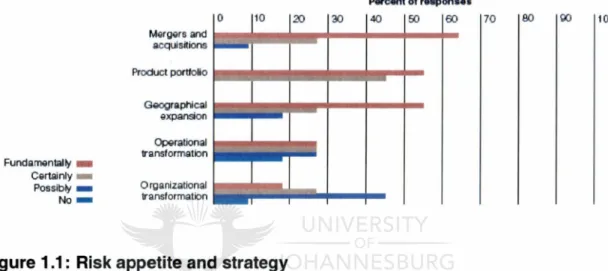
Is there a link between risk management and strategy, and in particular a link between risk appetite and an organization's strategy. The interdependence between strategy and risk appetite is discussed, which will be considered as a whole. This research begins with a literature study on the topics of risk management, strategy, and risk appetite.
First, risk management and risk appetite are discussed and links to strategy are defined.
LITERATURE REVIEW
- INTRODUCTION
- ENTERPRISE RISK MANAGEMENT
- STRATEGIC MANAGEMENT
- Strategy development process
- CONCLUSION
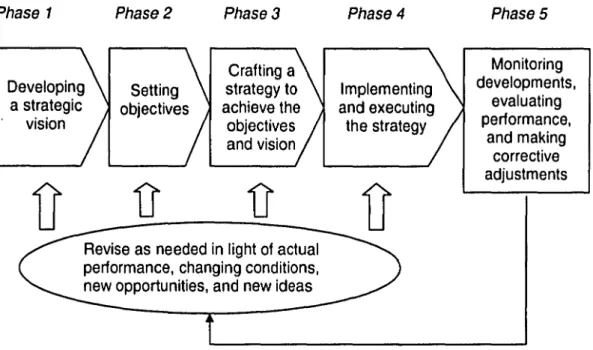
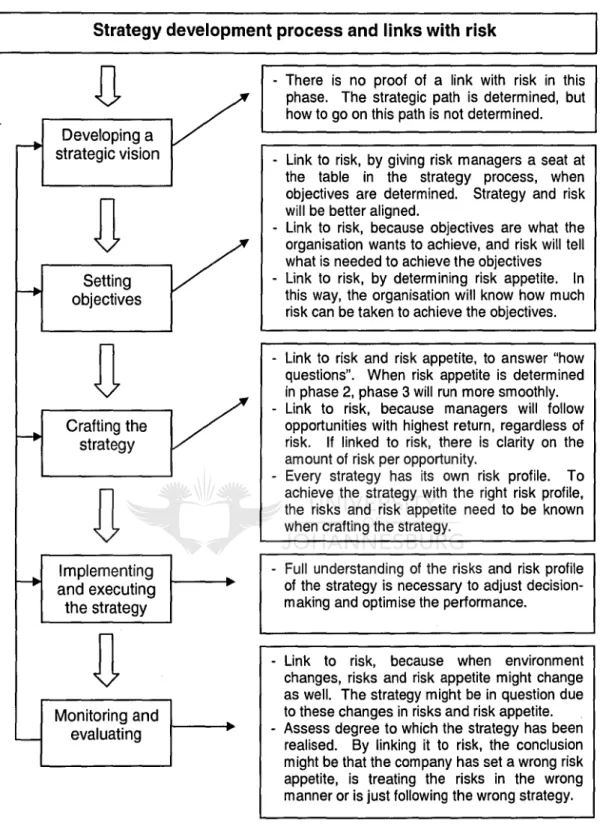
Risk appetite can change if the strategic objectives of the organization change and a process. Thus, risk management should be part of the early stages of the strategy development process so that risk appetite can be determined. In the strategy development process, while defining objectives and goals, risk management should play an important role and risk appetite should be determined.
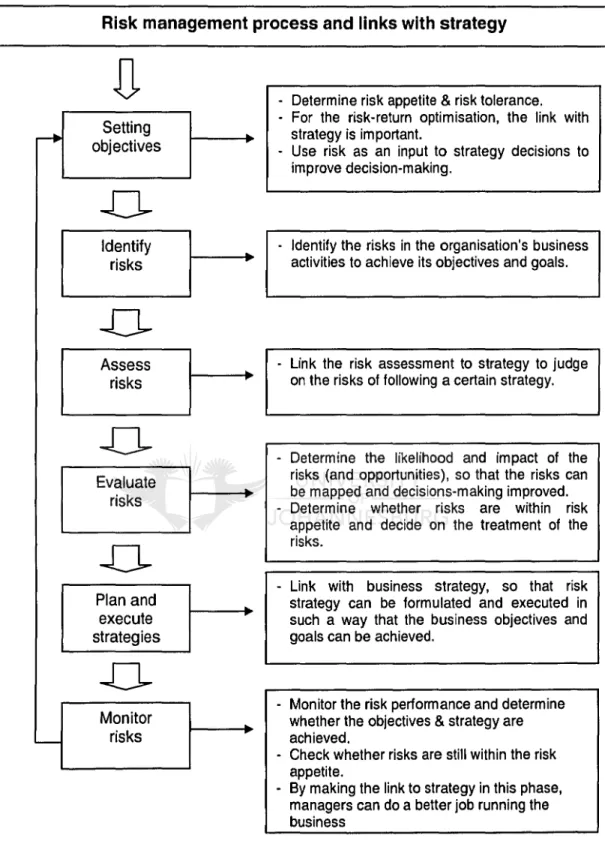
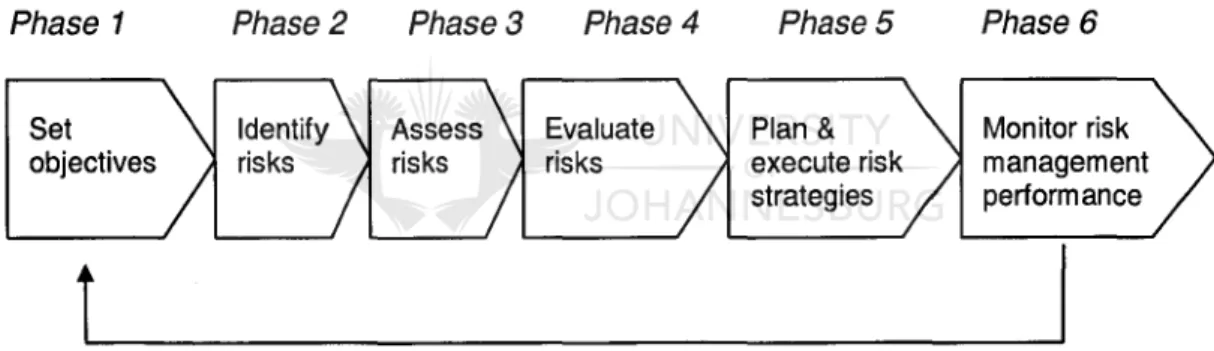
During the goal-setting phase (phase 1) of the risk management process, the overall risk appetite and risk tolerances for the organization are determined. Risk management should thus again be part of the early stages of the strategy development process, so that risk appetite can be determined. Therefore, the risk appetite must be determined in phase two (setting goals) of the strategy development process (risk appetite will be a central part again in phase 3 of the strategy formulation/design phase).
RISK APPETITE
- INTRODUCTION
- BENEFITS OF DEFINING A RISK APPETITE
- TOP-DOWN AND BOTTOM-UP APPROACH TO RISK APPETITE
- RISK APPETITE IN THE FINANCIAL SERVICES INDUSTRY
- Risk appetite and external influencers
- INCORPORATING RISK APPETITE IN A RISK APPETITE FRAMEWORK .1 Developing and implementing the risk appetite framework
- INTEGRATING RISK APPETITE INTO THE RISK MANAGEMENT AND THE STRATEGY DEVELOPMENT PROCESS
- CONCLUSION
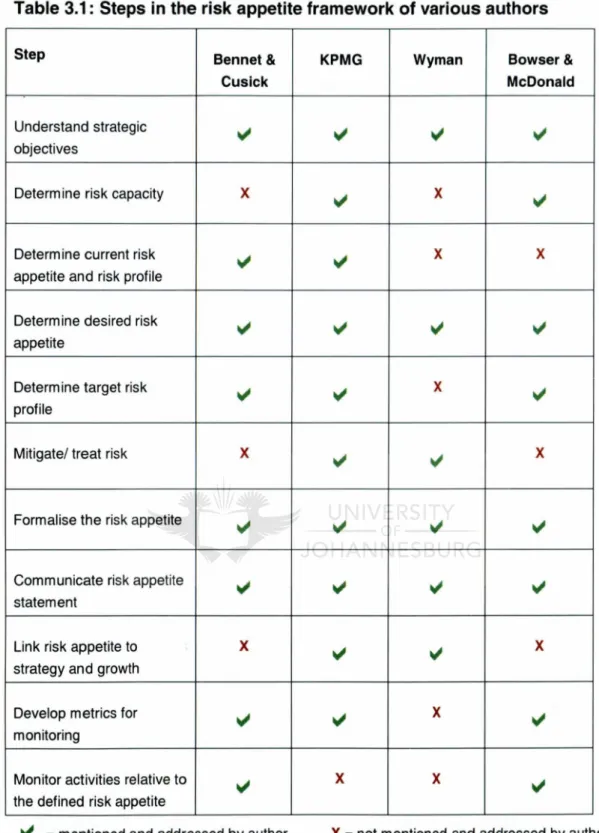
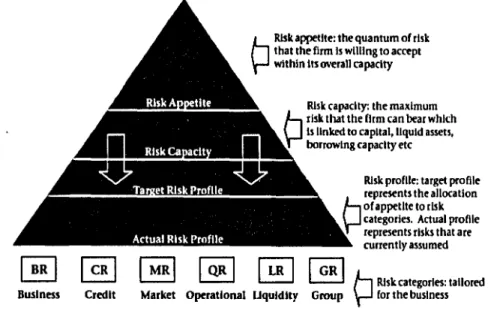
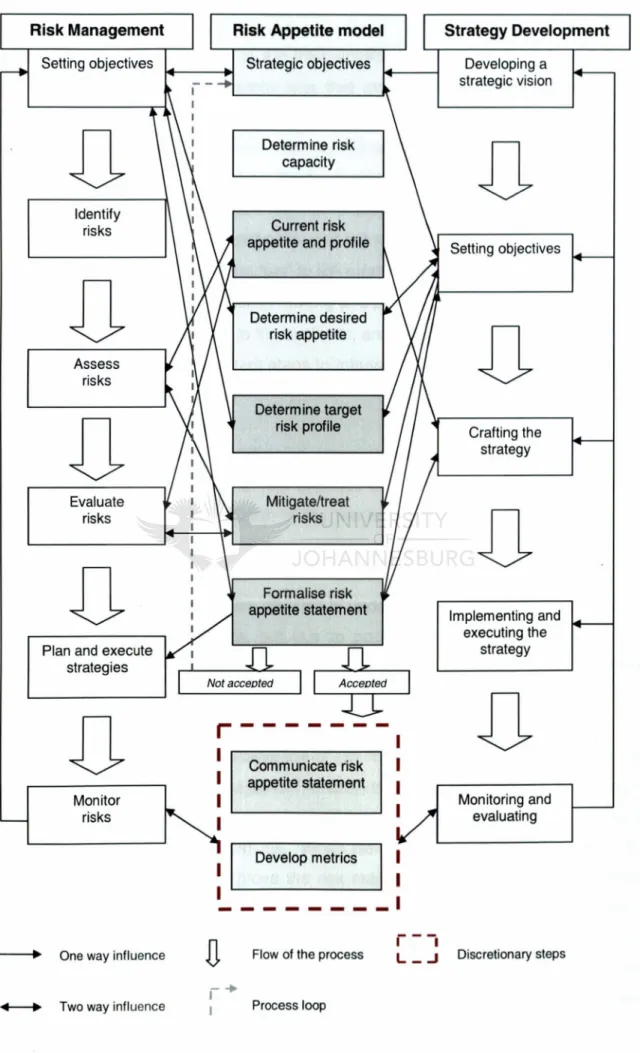
Senior management then attempts to merge the risk tolerances into a comprehensive risk appetite for the organization. Both the current risk appetite and the risk profile of the organization must be determined. Phase 1 of the risk management process – setting objectives – requires determining the overall risk appetite and risk tolerances for the organization.
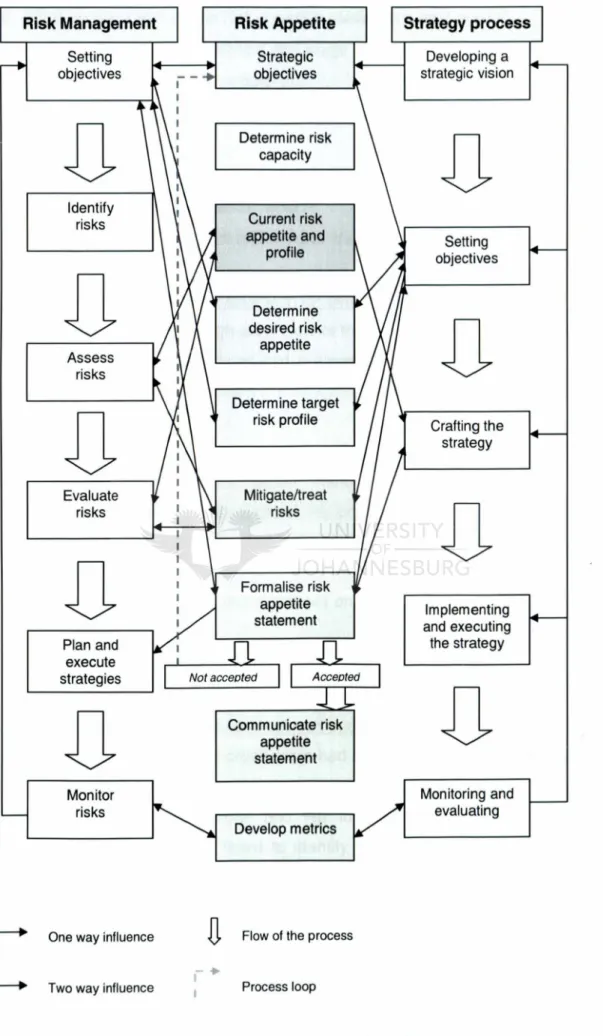
That is why phase 1 of the risk management process is linked to steps 1, 4, 5 and 7 of the risk appetite model. That is why phases 3 and 4 of the risk management process are linked to steps 3 and 6 of the risk appetite model. Therefore, phase 2 of the strategy development process is linked to steps 7 of the risk appetite model.
Linking risk appetite with the risk management process is particularly important in phases 3 and 4.
INTERVIEWS
- INTRODUCTION
- RESEARCH METHODOLOGY
- QUESTIONNAIRE
- IMPACT OF THE RESPONSES ON THE RISK APPETITE MODEL
- CONCLUSION
This reflects the risk appetite of the shareholders and is the fundamental analysis of risk appetite. This is discussed in more detail in section 4.3, which discusses the impact of the responses on the risk appetite model. Risk appetite is 'that' that integrates risk management and strategy into the risk appetite model.
Thus, using a mix of approaches, the organization can determine the risk appetite that will optimize risks and returns. Only with proper communication and translation will the risk appetite model improve the risk management function. Risk appetite will be the gel that binds the risk management function to the strategy function.
Ownership needs to be taken across the organization and there should not be a risk group looking after the risk appetite model. Once the metrics are developed in step 9 of the risk appetite model, they should be passed to the risk management function for monitoring. Looking at the outcome of question 12, the risk appetite model will improve the risk management function in organizations.
However, the researcher improved the risk appetite model based on the suggestions of the interviewees by placing a box around steps 8 and 9. The researcher will leave it to the organization using the risk appetite model to use these steps or not. .
IMPORTANCE OF THE RISK APPETITE MODEL
- INTRODUCTION
- RESEARCH METHODOLOGY
- BACKGROUND TO THE GLOBAL CREDIT CRISIS
- THE RISK APPETITE MODEL AND THE GLOBAL CREDIT CRISIS
- Interpretation of findings
- OVERALL INTERPRETATION
- THE IMPACT OF THE RISK APPETITE MODEL
- CONCLUSION
Looking at the risk appetite model, the interviewees indicated that by using the model, the role of risk management will change in a positive way. Therefore, losses could be limited if a risk appetite model were used during the credit crisis. Finally, in paragraph 2.2.1, Karow (2006) stated the importance of risk appetite in better corporate governance.
In paragraph 3.4, IBM (2008) mentions that risk appetite plays an important role in the integration of risk management. To improve the integration of risk management, risk managers should be involved in the strategy process and risk appetite can play an important role in the integration of risk management. The focus was not so much on the risk management function and the importance of risk appetite was not recognized, which ultimately harmed organizations.
In addition, most financial services organizations do not have an integrated risk management function and have not clearly stated and communicated the organization's risk appetite, resulting in a lack of understanding of risk appetite. The risk appetite model takes a comprehensive view of risk management and risk managers will play a more influential role. Compliance and risk mitigation still play an important role, but the risk appetite model shows the wider potential benefits of managing risk with a holistic view.
The interviewees agreed that the application of the risk appetite model could have limited (but not prevented) the losses resulting from the credit crisis. Risk appetite will be better understood in the risk appetite model and with the shared understanding of the organization's risk appetite, everyone in an organization can be seen as a risk manager as risk management becomes a way of thinking in the business.
RESULTS, CONCLUSION AND RECOMMENDATIONS
- RESULTS
- CONCLUSION
- RECOMMENDATIONS
When financial services organizations wish to optimize risk versus return, risk appetite must be determined by considering the organization's strategy and risk management, ie. risk appetite should always be related to strategy and risk. The benefits of setting a risk appetite are that an organization has clarity on the risks the organization is willing to take and indicates the risk attitudes of senior management. The risk appetite model is primarily a top-down approach and illustrates where risk management links to the risk appetite model and strategy development process, and where strategy links to the risk appetite model and process of risk management.
The risk appetite model thus provides management with a tool to integrate strategy, risk management and risk appetite to improve decision-making in organizations. To test the relevance and robustness of the risk appetite model, interviews were conducted and the risk appetite model was linked to the credit crisis. In addition to the above advantages of the risk appetite model, it can be concluded that the risk appetite model allows organizations to be proactive in their risk management, embed a risk awareness culture, see the upside and downside of risks and reduce the probability of failure.
Linking the risk appetite model to the credit crisis and taking into account the opinions of the interviewees, it was concluded that the risk appetite model, when implemented and managed correctly, would have limited the losses resulting from the credit crisis, but would not have prevented the losses. Finally, the risk appetite model showed that effective risk management enables (financial) organizations to exploit valuable opportunities and increase their competitive advantage, i.e. to take risks within the organization's risk appetite. Current and timely results are required to make appropriate management decisions, and the risk appetite model can play an important role in achieving this goal.
The researcher also recommends further study on the relationship with all parts of the business and especially the finance function to ensure that the risk appetite model is fully integrated throughout the organization. Finally, the researcher recommends testing the risk appetite model in the 'field', by implementing the model in an organization to see how it works and to what extent it actually integrates the organization's strategy with risk management.
APPENDIX A QUESTIONNAIRE
Now that the risk capacity and current risk appetite and risk profile of the organization are known, the desired risk appetite of the organization must be determined. The result of the first six steps should be formalized by documenting the organization's risk appetite in a formal risk appetite statement. The risk appetite statement must be communicated throughout the organization to allow managers at all levels of the business to make decisions that are consistent with.
The risk profile should be measured regularly to ensure that it remains within the parameters of the risk appetite. To be effective, the framework must be properly communicated throughout the organization. This means that risk appetite must be appropriately allocated to the different business units of an organization. The risk appetite statement should be communicated throughout the organization to ensure that the risk appetite is understood from the highest to the lowest levels.
Once the risk identification is done, how are the risks quantified to measure them against risk appetite. Do you think a risk appetite model would improve the risk management function in your organization? In the risk appetite model, the organization's strategy and risk are interconnected, and the board and management work together to determine the risk appetite for the organization.
How would you describe the level of integration of risk appetite with strategy, risk management and operational management in your organization? How would the risk appetite model improve the level of integration of the risk management function in your organization.
GLOSSARY OF TERMS