Since 1902, articles relating to the botanical collections of the Natural History Museum have been published in the Bulletin series under the title Contributions from the United States National Herbarium, and since 1959 in Bulletins under the title "Museum Contributions". Interest in astronomy became widespread in 1844, stimulated by the appearance of a large comet the previous year. He loved the company of intelligent people, poets and scientists, personal friends and even random visitors.
In the winter of 1847-48 he made a diagram of the stars in the Orion Nebula with the aid of a freshly polished 7j/2-inch speculum. He never published a price list, although astronomers demanded it; he would not even show his instruments at any of the popular international exhibitions.34 What is. The government or – as in the case of the 30-inch disks for the Russian observatory in Pulkovo – when they are imported by the foreign minister.45.
This was the first of five times the Clarks would gradually surpass the world record forexist lens size. The table held the tool, a cast iron shot of the same curvature as the lens, but reversed. The extent of the absorption of light by large lenses was greatly exaggerated, as a recent experiment in his factory showed.
Extensive preparations were made to observe every solar eclipse that occurred during the second half of the 19th century.

July 1878 Alvan Graham was at Creston, Wyoming, a member
The University of Pittsburgh's Allegheny Observatory employed the Clarks in the 1870s; then they relied on local ones. The observatory's original equipment included an 8-inch Clark equatorial with a focal length of 9 feet. Modeled after the experimental 13-inch Boydente Telescope of the Harvard College Observatory (q.v.), the Denver instrument can be used for visual or photographic work.
This included the measurements of the main telescope — 8}4 in. aperture and 9 ft. 4 in. focus — and of the two collimators — the same. Rogers, "On the Original Graduation of the Harvard College Meridian Circle insitu,^ Sidereal Messenger, vol. CoastSurvey Expedition to observe the Sun Rock from Labrador. The two components of the \l/\ -inch objective, made by Clarks, were separated, thus that best visual and photographic focus.

94 1 the University of Santa Clara, in California, bought a 16-inch equatorial refracting telescope from the Pacific Electric Railway
The large twice-crossed prism spectroscope is attached to the eyepiece of the 9.4-inch-aperture equatorial refracting telescope. Silliman, "On the Examination of the Bessemer Flame with Colored Glass and with the Spectroscope," American Journal of Science, vol. The purpose of the photographs was to determine the distance, at various times, that Venus traveled across the surface of the Sun.
Although none of the observations gave a satisfactory value for the solar parallax, the American photographic method was considered the most successful. The equipment was used again for the Venus transit in 1882 and on. In 1878 Alvan Graham used e.g. a Dallmeyer portrait lens, held on one of the Venus transit equatorial mounts, to. 6280.22° The movement of this telescope was regulated by the spring governor taken from the 12-inch formerly owned by Henry Draper before it was sent to the LickObservatory (qq.v.). The Observatory and.
Shortly after installing the Pistor& Martins meridian circle in 1865, the Clarks reworked most of its optical surfaces: the collimator lenses, the eyepieces, and the 8^4-inch objective. Then, along with all the other instruments, the meridian circle was overhauled for removal. Nautical Almanac Reports of Observations of the Total Solar Eclipse, August 7, 1869, pp. letters in U.S.Naval Observatory Papers, National Archives, Record Group78). The tube, objective, and micrometer of the old 9.6-inch-aperture refractor, mounted inside the shortened tube of the 26-inch equatorial, served as a guiding telescope.
This delay gave them a chance to learn from some of the mistakes of the Washington instrument. For example, the inner surfaces of the Virginia 26-inch objective were given slightly different radii, to avoid the annoying "object glass ghost". The drift clock was connected to a Seth Thomas clock located in the observatory's computer room. Many of the telescopes originally made by Henry Fitz in the 1850s were later extensively rebuilt.
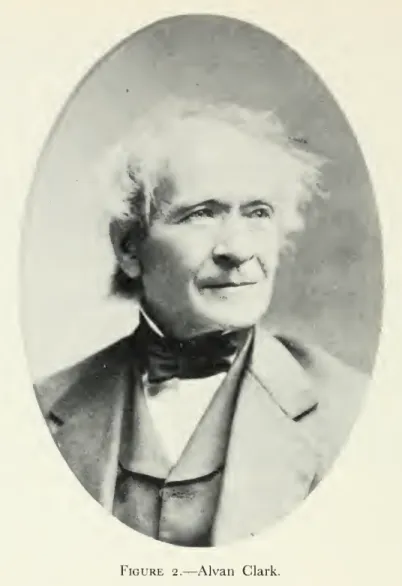
Dawes (q.v.), Webb purchased this telescope in 1859 and used it for observations of the Great Comet two years later.24S In 1886, after Webb's death, the telescope was sold to Stonyhurst College (q.v.). Alvan Graham, who Wendell wrote for The Cambridge Tribune, was drafted at the request of the family, as someone who stood near him. Its equatorial refracting telescope from the Clark workshop was said to perform according to its creators' reputation. The achromatic objective had a clear aperture of 9 inches and a focus of only 9 feet 1 inch. The tube, which was of stiff but light pine, was one of the last wooden ones made by Clarks.

FARL #36,795-
Clark family group - Alvan and Maria Pease Clark with three of their children, Alvan Graham, Caroline Amelia and MariaLouisa. The lower right corner of this painting is blank, supposedly because Alvan Clark could not paint his own hands. Two identical portraits of different sizes of a very young boy believed to be Alvan Graham Clark. Worcester Art Museum, Worcester, Mass.; formerly owned by ElizabethW. Miniature, like a baby sleeping on its pillow.
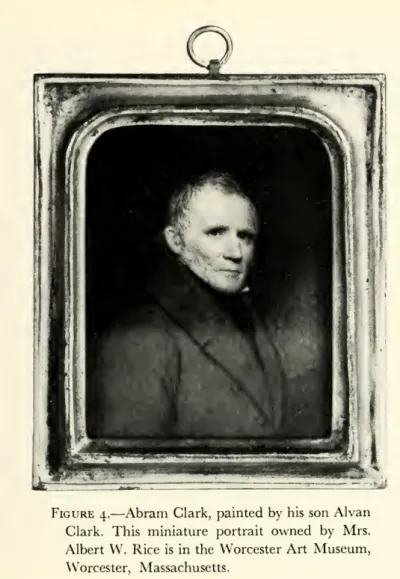
Oval miniature, exhibited in 1838 and 1839 by the ApolloAssociation at Harding's Gallery, Boston, Mass., and at the National Academy of Design, New York, N.Y., in 1838. Owned by the Clark family until the turn of the century, when it was transferred to a successor of Prof.
FARL #21,655
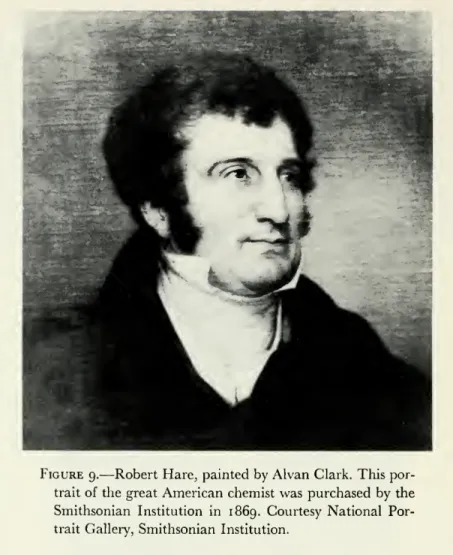
Fine Arts, Boston, Mass. This is probably the miniature listed in the Frick Art Reference Library (FARL #21 657) as belonging to Caroline Amelia Clark Eastman, mother of Alvan Clark Eastman.