An Exploration of Educator Linguistic Knowledge and Expertise
By Hannah Krimm
Dissertation
Submitted to the Faculty of the Graduate School of Vanderbilt University
in partial fulfillment of the requirements for the degree of
DOCTOR OF PHILOSOPHY in
Hearing and Speech Sciences May 10, 2019 Nashville, Tennessee
Approved:
C. Melanie Schuele, Ph.D.
James Bodfish, Ph.D.
Christopher Lemons, Ph.D.
Paul Yoder, Ph.D.
ii
TABLE OF CONTENTS
Page
LIST OF TABLES ... iii
LIST OF FIGURES ... iv
Chapter I. Introduction ... 1
Relation between Spoken Language and Reading Outcomes ... 1
Roles and Responsibilities of SLPs within a Collaborative Model of Reading Instruction ... 3
Relation between Educator Knowledge and Reading Outcomes ... 4
Characterizing Language Science Knowledge ... 5
II. Study 1 ... 8
Method ... 8
Results ... 17
III. Study 2 ... 20
Method ... 20
Results ... 23
IV. Discussion ... 25
Explicit Phonemic Awareness ... 26
Orthographic Knowledge ... 27
Derivational Morphology Knowledge ... 28
Considerations for Measuring Language Science Knowledge ... 28
Conclusions ... 29
Future Directions ... 30
APPENDIX ... 31
REFERENCES ... 34
iii
LIST OF TABLES
Table Page
1. Tennessee District Demographics ...9
2. Study 1 Participant Characteristics ...12
3. Descriptive Statistics for Study Measures ...17
4. Correlations between Study Measures and Demographic Variables ...18
5. Study 2 Participant Characteristics ...22
iv
LIST OF FIGURES
Figure Page
1. Group performance on study 1 measures ...19 2. Correlations between demographic variables, study 1 measures, and derivational
morphology knowledge ...23 3. Group performance on the derivational morphology knowledge measure ...24
1 CHAPTER I
INTRODUCTION
American literacy is in crisis. Merely a third of 4th, 8th, and 12th graders read
proficiently for their grade level, and these rates have remained stagnant for more than a decade (National Center for Education Statistics, 2003, 2015). Among the two thirds of children who fail to achieve proficiency are children with reading disabilities, many of whom have early spoken language deficits. Given that spoken language skills lay the foundation for literacy acquisition, speech-language pathologists (SLPs) must work collaboratively as literacy team members to support reading acquisition in children with early language deficits. SLPs, however, report a general lack of preparation for doing so (Blood, Mamett, Gordon, & Blood, 2010).
Improving SLPs’ competence for supporting reading acquisition requires identifying specific areas of weakness. Thus, the purpose of this study was to objectively characterize SLPs’
knowledge for supporting literacy acquisition.
Relation between Spoken Language and Reading Outcomes
Reading disabilities exist within a constellation of symptoms that include early language deficits such as phonological processing deficits and nonphonological language deficits (Catts, Fey, Zhang, & Tomblin, 2001; Vellutino, Fletcher, Snowling, & Scanlon, 2004). Phonological processing deficits cause reading disabilities characterized by effortful and inaccurate decoding (i.e., dyslexia; Wagner & Torgesen, 1987). These deficits are apparent in children as young as five years old and may manifest as deficits in phonemic awareness, multisyllabic word
2
production, word retrieval, and/or verbal memory (Catts, 1997; Scarborough, 1990; Wagner &
Torgesen, 1987). Nonphonological language deficits such as poor grammatical understanding and limited vocabulary underlie reading disabilities characterized by impaired reading
comprehension (Catts, Adlof, & Ellis Weismer, 2006). These deficits are apparent in children as young as two and a half years old and may manifest as short utterance length, decreased
syntactic complexity, and deficits in receptive vocabulary (Bishop & Adams, 1990; Scarborough, 1990).
Early identification and intervention can mitigate the effect of early language deficits on reading acquisition. In terms of decoding, improving phonological processing skills has a substantial and lasting effect, especially for children who enter school with less developed skills (Connor, Morrison, & Slominski, 2006; Torgesen, 2000). Dyslexia is less prevalent in the later grades among children who receive explicit phonological processing instruction in kindergarten (Connor et al., 2006; Torgesen, 2000). In terms of reading comprehension, improving
derivational morphology knowledge and, consequently, vocabulary knowledge efficiently and effectively improves reading comprehension outcomes, especially for less able readers (Goodwin
& Ahn, 2010).
Despite early language deficits and the robust benefits of preventive intervention for children at risk for reading disabilities, at-risk children often go unidentified until 3rd or 4th grade (Katusic, Colligan, Barbaresi, Schaid, & Jacobsen, 2001). Late identification substantially limits the amount of progress that can be expected and precipitates a range of negative emotional and social consequences such as anxiety, depression, and delinquency (Katsiyannis, Ryan, Zhang, &
Spann, 2008; Vaughn, Moody, & Schumm, 1998; Wilcutt & Pennington, 2000). Further, reading difficulties produce a compounding effect in which children with early language deficits miss out
3
on the opportunities for language and cognitive growth that reading provides (Cunningham &
Stanovich, 1998). In short, the tragedy of the status quo is that “we wait—they fail” (Lyon et al., 2001, p. 260).
Roles and Responsibilities of SLPs within a Collaborative Model of Reading Instruction As the links between spoken language and written language have become clearer, SLPs’
roles have expanded to include a responsibility for reading acquisition. A position statement released by the American Speech-Language Hearing Association (ASHA, 2001) states that SLPs should be intimately involved in preventing reading disabilities, assessing reading skills, and intervening to support reading acquisition. More recently, the Every Student Succeeds Act (2016) classified SLPs as specialized instructional support personnel, reiterating their role as critical members of literacy teams (ASHA, 2016a).
Although SLPs can and should strive to prevent or minimize reading disabilities in
children with early language deficits, there is considerable variability in the extent to which SLPs support reading acquisition. Few SLPs incorporate activities that support reading acquisition into speech-language therapy, and SLPs spend minimal time collaborating with classroom teachers (ASHA, 2018). SLP experience, caseload size, and perceived time pressures do not explain the variance in SLPs’ practices for supporting reading acquisition (Tambyraja, Schmitt, Justice, Logan, & Schwarz, 2014).
SLPs’ knowledge may be a major factor contributing to their reluctance to actively support reading acquisition (Ehren & Ehren, 2001). School-based SLPs traditionally have operated as ancillary personnel whose role is confined to speech sound production and spoken language. Many SLPs report unsatisfactory training for preventing, identifying, and remediating
4
reading disabilities (Blood et al., 2010; Davis & Murza, 2018). Effective collaboration requires that collaborators share common knowledge and understand one another’s professional expertise (Postrel, 2002). Currently, SLPs may abstain from literacy-related assessment and intervention because they do not share common knowledge with classroom teachers and/or do not recognize their own professional expertise.
Relation between Educator Knowledge and Reading Outcomes
Educator knowledge directly and indirectly influences children’s reading outcomes (McCutchen et al., 2002; Piasta, Connor, Fishman, & Morrison, 2009). More knowledgeable educators are better prepared to engage in effective instructional practices such as explicit instruction, which requires explanations, modeling, and guided practice (Heilman, Blair, &
Rupley, 2002; Moats, 2009; National Institute of Child Health and Human Development, 2000).
More knowledgeable educators also spend more instructional time targeting linguistic skills that support reading acquisition, and this increased instructional time relates to better reading
outcomes in the elementary grades (Cunningham, Zibulsky, Stanovich, & Stanovich, 2009;
Fallon & Katz, 2011; Piasta et al., 2009; Taylor, Pearson, Clark, & Walpole, 2000). The relation between knowledge and intervention practices holds for SLPs as well – SLPs who believe they have received adequate training are more likely to target reading-related skills (Fallon & Katz, 2011). Importantly, improving educator knowledge can improve children’s reading outcomes (Podhajski, Mather, Nathan, & Sammons, 2009).
5
Characterizing Language Science Knowledge
Most efforts to improve educator knowledge are costly and ineffective (e.g., Brady et al., 2009; Folsom, Smith, Burk, & Oakley, 2017; Goldschmidt & Phelps, 2010). For example, Folsom et al. (2017) reported that after intensive professional development that included
coaching, professional learning groups, and didactic instruction, general education teachers and special education teachers in Mississippi answered, on average, only one more question correctly at post-test than they did at pre-test on a measure of educator knowledge.
Efforts to improve educator knowledge may be ineffective because these efforts attempt to improve knowledge across multiple constructs simultaneously (e.g., Folsom et al., 2017).
Objective measures that have been used to assess educator knowledge and drive professional development efforts represent educator knowledge across multiple constructs including linguistic skill, pedagogical knowledge, and language science knowledge. Linguistic skill is implicit understanding of language structure (e.g., “If tife is a word, the letter “i” would probably sound like the “i” in which word?”; Bos, Mather, Dickson, Podhajski, & Chard, 2001, p. 107).
Pedagogical knowledge is declarative knowledge of teaching practices (e.g., “What type of task would this be? Say the word ‘cat.’ Now say cat without the /c/ sound,”; Bos et al., 2001, p. 107).
Language science knowledge is conscious knowledge of the relations between structures and functions of spoken and written language (Moats, 2009; Moats & Foorman, 2003).
Most literate adults can be assumed to have linguistic skill. If simply having linguistic skill prepared one to effectively teach reading, America would not be experiencing the literacy crisis that has plagued the nation for decades. An effective educator must be able to explicitly explain why the i in tife makes the “long i” sound, not just recognize that it does. Similarly, an
6
educator may have pedagogical knowledge but be unable to model tasks appropriately or to provide the scaffolding and feedback needed for guided practice.
Language science knowledge in the domains of explicit phonemic awareness,
orthographic knowledge, and derivational morphology knowledge are critical for engaging in effective reading instruction (Moats, 2009). Explicit phonemic awareness is the ability to “think beyond print” to analyze phonemic structure (Moats & Lyon, 1996, p. 83). Orthographic
knowledge is conscious knowledge of English spelling conventions. Derivational morphology knowledge is knowledge of morphological relations between words and knowledge of individual morpheme meanings.
In the context of explicit instruction, educators need language science knowledge to explain, model, and guide practice in the linguistic skills that support reading acquisition. They need explicit phonemic awareness to model phonemic awareness activities and provide
corrective feedback. They need orthographic knowledge to provide accurate explanations of orthographic conventions within phonics instruction, such as the contexts in which c represents /s/ rather than /k/. Educators need derivational morphology knowledge to engage in vocabulary instruction that substantially improves reading comprehension outcomes, especially for the least able readers (Goodwin & Ahn, 2010).
Improving SLPs’ language science knowledge requires determining the strengths and weaknesses in their current knowledge base. Limited data exist about SLPs’ knowledge for supporting reading acquisition; most available data provide only SLPs’ self-reported knowledge and preparation (Blood et al., 2010; Davis & Murza, 2018). SLPs substantially outperform other educators (e.g., general education teachers, special education teachers, reading specialists) on explicit phonemic awareness tasks (d = 1.47 for phoneme segmentation tasks) but SLPs and
7
other educators perform well below what would be expected of experts responsible for teaching reading (Spencer, Schuele, Guillot, & Lee, 2008). We identified no studies that objectively characterized SLPs’ orthographic knowledge or derivational morphology knowledge. Thus, to inform the development of efficient and effective professional development opportunities that prepare SLPs to prevent reading disabilities in at-risk children, researchers must objectively identify SLPs’ language science knowledge needs. The purpose of this study was to do so. We answered three research questions:
1. How does SLPs’ explicit phonemic awareness compare to kindergarten teachers’
explicit phonemic awareness?
2. How does SLPs’ orthographic knowledge compare to kindergarten teachers’
orthographic knowledge?
3. How does SLPs’ derivational morphology knowledge compare to kindergarten teachers’ derivational morphology knowledge?
8 CHAPTER II
STUDY 1
Method
The Vanderbilt University Institutional Review Board approved the methods for this study.
Participants
Participants were public school SLPs with experience serving kindergarteners
(n = 29) and public school kindergarten teachers with experience teaching kindergarten (n = 29).
One SLP was completing the clinical fellowship year (n = 1). The study sample was selected to include (a) SLPs who provided emails for teachers who also completed the study (n = 10 SLPs; n
= 12 teachers), (b) teachers and SLPs who work in the same district (n = 9 SLPs; n = 10
teachers), and (c) teachers and SLPs who work in districts with comparable reading achievement scores (n = 10 SLPs; n = 7 teachers; Tennessee Department of Education, 2015). SLPs were drawn from twelve districts and teachers were drawn from seven districts. Fifty-six participants were from eleven districts in Tennessee. Table 1 displays district demographic and achievement information for the districts in Tennessee. Two participants were from one district in Missouri, which is not represented in Table 1. In this district, 10.4% of students receive special education services and 18.7% of students did not achieve proficiency on third-grade English Language Arts state achievement testing in 2017 (Missouri Department of Elementary and Secondary
Education, 2018). Table 1 displays demographic, educational, and certification information about study participants from Tennessee school districts.
10
Participants were recruited in three waves. In wave one, SLPs from three participating school districts in middle Tennessee received an email inviting them to participate in the study (n = 95). SLPs followed a link in the email to consent and complete the study measures (n = 15;
18%). Two of the 15 SLPs who completed the study measures were excluded from the sample because they did not indicate kindergarten experience. Upon completing the study measures, SLPs provided email addresses for up to six kindergarten teachers who currently teach or have in the past taught children on the SLP’s caseload. Providing emails was optional; 8 SLPs provided a total of 32 email addresses for kindergarten teachers (mean = 2 email addresses provided; range
= 0 - 6). Email invitations were sent to the kindergarten teachers. Seven of the 32 teachers invited in this wave completed the study (22%). One of the 32 teachers reported that her current position is school or district coach for reading/literacy; she was excluded from the sample.
In wave two, an invitation email was sent to the Vanderbilt University Medical Center Child Language and Literacy Lab email distribution list. This list includes over 1,251 SLPs and other educators who have attended professional development workshops conducted by the Child Language and Literacy Lab. Recipients followed a link in the email to complete the study measures (n = 40 SLPs; 3%; n = 4 general education teachers; 0.32%). One of the 40 SLPs who completed the study measures did not indicate experience working with kindergarteners and was excluded from the sample. Two of the 40 SLPs who completed the study measures did not indicate that they work in public schools and were excluded from the sample. Upon completing the study measures, SLPs provided email addresses for up to six kindergarten teachers who currently teach or have in the past taught children on the SLP’s caseload. Providing emails was optional; 19 SLPs provided emails for a total of 43 kindergarten teachers (mean = 1 email address provided; range = 0 - 6). Email invitations were sent to the kindergarten teachers. Seven
11
of the 43 kindergarten teachers invited in this wave completed the study (16%).
In wave three, an invitation email was sent to all general education kindergarten teachers in two of the three school districts from which we recruited SLPs in wave one who had not been previously invited to participate (n = 152 teachers). Teacher emails for the third district were not publicly available. Teachers followed a link in the email to complete the study measures
(n = 12; 8%).
Measures
Demographics.
All participants completed an optional demographic questionnaire. Questions about certification, experience, and training were taken from teacher and special education teacher questionnaires used for the Early Childhood Longitudinal Study (Westat, 2012, 2013). Table 2 displays participant characteristics.
12 Table 2
Study 1 Participant Characteristics
SLP (n = 29) Teacher (n = 29)
Mean SD Range Mean SD Range
Age (years) 40.76 10.80 26 - 65 36.00 8.41 23 - 53
Total experience (years) 11.59 (7.78 22 - 28 11.10 6.77 21 - 29 Experience with kindergarteners (years) 11.59 (8.35 21 - 29 17.84 6.89 21 - 29
n % n %
Sex
Female 28.31 (97%) 28.31 (97%)
Male 21.31 (3%) 21.31 (3%)
Race
American Indian or Alaska Native 20.31 20.31
Asian 20.31 20.31
Black or African American 21.31 (3%) 23.31 (10%)
Native Hawaiian or Other Pacific Islander 20.31 20.31
White 28.31 (97%) 25.31 (86%)
Highest Degree
Bachelor’s degree 0.3 11.31 (38%)
Master’s degree 27.31 (93%) 14.31 (48%)
Advanced professional degree* 2.3 9(7%) 14.31 (14%)
Highly Qualified Teacher** n/a11 24.31 (83%)
Certification+
Elementary Education 4.1 (14%) 24.31 (82%)
Early Childhood Education 2.1 9(7%) 13.31 (45%)
Special Education 3.1 (10%) 11.31 9(3%)
Speech-Language Pathology 28.11 (97%) 10.31 9(0%)
Structured Literacy Certification 0.1 9(0%) 12.31 9(7%)
Note. SLP = speech-language pathologist; *Advanced professional degree beyond a master’s degree; **Defined according to state requirements; +Certification percentages do not sum to 100 because participants were asked to select all appropriate certification categories.
13 Language science knowledge.
Experimental measures of language science knowledge were administered. To minimize the amount of time to complete study measures, measures included 20 items or fewer. Because measures included few items, items with high discrimination indices in pilot data were selected whenever possible. Measures can be found in the Appendix.
Explicit phonemic awareness.
Explicit phonemic awareness was measured with phoneme segmentation and phoneme manipulation tasks. For phoneme segmentation participants selected all words that have only three sounds on a list of ten words. A participant’s response for each word was scored as correct or incorrect. Phoneme segmentation score was the percentage of words answered correctly.
Cronbach’s α for phoneme segmentation in this sample was .72.
The phoneme segmentation items were adapted from the items used by Spencer et al.
(2008). In Spencer et al. (2008), participants provided the number of phonemes in words via free response. Using Spencer et al.’s (2008) dataset, discrimination indices and item difficulty were calculated for each item. Eight items that demonstrated adequate discrimination indices and difficulty between .4 and .7 were selected (Ebel & Frisbie, 1991). Mean discrimination index for the selected items was .66 (range .32 to .84). Box and quick showed adequate discrimination indices, but box was replaced with fox and quick was replaced with quick. Box is commonly used in educational resources as an example of a word with opaque orthography (e.g., Moats, 2010).
Thus, participants may recall that box has four phonemes without having generalized phoneme segmentation ability; fox combats the possibility of a memorized correct response to box. Quick was replaced with quit to remove the ck digraph. The items were presented as ten answer choices
14
to a single multiple selection question: “Which of the following words have only three sounds?
Select all that apply.”
The phoneme manipulation items were created for this study. For phoneme manipulation (five items; multiple choice), participants selected the one word from a choice of four that results when the phonemes in a given word are reversed (e.g., If you say “pay” and then reverse the order of the sounds, “pay” would be: (a) ape; (b) app; (c) yap; (d) yep). All phoneme
manipulation items had opaque orthography (i.e., a mismatch between the number of phonemes and the number of letters) to ensure that participants could not give the correct answer by simply rearranging the spelling (e.g., reversing the sounds in pay results in ape, not yap). Most foils were incorrect answers given by pilot participants who completed potential items via open response. After foils were created, 15 potential multiple-choice items were administered to pilot participants. Each item was scored as correct or incorrect. Phoneme manipulation score was the percentage of items answered correctly. Items with adequate discrimination indices were selected. Average item discrimination index for selected items was .60 (range .25 – 1.0).
Cronbach’s α for phoneme manipulation in this sample was .65.
Orthographic knowledge.
For orthographic knowledge items (five items; multiple choice), participants selected one set of words from a choice of four sets that contained only words that follow a given
orthographic generalization (e.g., which of the following sets of words contain four words that follow the “silent e” phonics generalization: (a) fine, cake, tube, done; (b) make, please, raise, kite; (c) bake, spoke, fuse, shine; (d) bee, pie, blue, shoe). All items were scored as correct or incorrect. Orthographic knowledge score was the percentage of items answered correctly.
Cronbach’s α for orthographic knowledge in this sample was .51. The orthographic knowledge
15
items were created for this study. They were pilot tested with ten adults and results from piloting informed the final items. Average item discrimination index of the piloted items was .60
(range .33 – 1.0). Average item difficulty was .580 (range .3 – .8).
Procedure
Data collection.
Participants completed the study measures online using a data capture tool hosted at Vanderbilt University (Harris et al., 2009). They accessed the informed consent document via the invitation email. After electronically signing the informed consent they completed an optional demographic questionnaire and a self-assessment of their current skill level for supporting literacy acquisition. Self-assessment data were collected to inform future studies and are not reported here. All participants completed the study measures in the same order [(1) phoneme segmentation, (2) phoneme manipulation, (3) orthographic knowledge] because counterbalancing administration order was impractical. Some participants also completed the Teacher Knowledge of Early Literacy Skills survey (Folsom et al., 2017) and/or a derivational morphology
knowledge measure. Teacher Knowledge of Early Literacy Skills survey data were collected to inform future studies and are not reported here. Results from the derivational morphology knowledge measure are reported in study 2.
Participants also completed an orthographic identification measure that was created for this study but was not piloted prior to administration for this study. The orthographic identification measure demonstrated poor psychometric validity in this sample and we conducted no further analysis on this measure.
Scoring and reliability.
Data were scored automatically using Excel. To confirm scoring accuracy, 20% of
16
participant records were scored manually and compared to the automatic scoring. No discrepancies were found.
17 Results
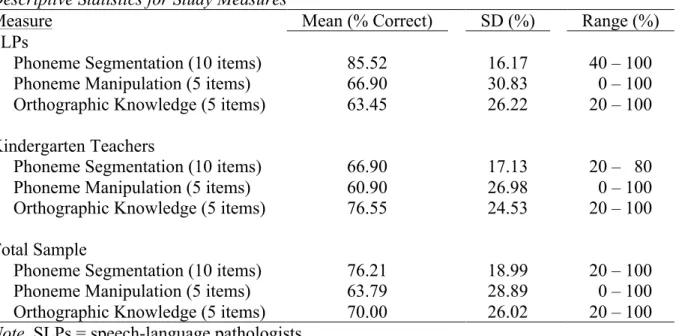
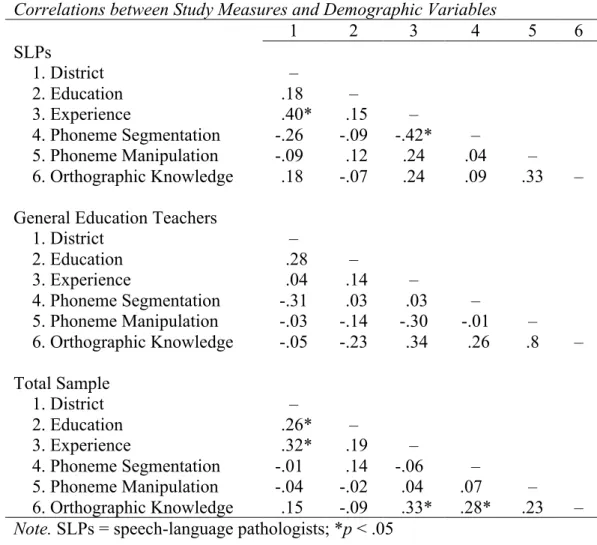
Table 3 displays descriptive statistics on study measures for each group and for the entire sample. Table 4 displays correlations between study measures and demographic variables.
Table 3
Descriptive Statistics for Study Measures
Measure Mean (% Correct) SD (%) Range (%)
SLPs
Phoneme Segmentation (10 items) 85.52 16.17 40 – 100
Phoneme Manipulation (5 items) 66.90 30.83 20 – 100
Orthographic Knowledge (5 items) 63.45 26.22 20 – 100
Kindergarten Teachers
Phoneme Segmentation (10 items) 66.90 17.13 20 – 180
Phoneme Manipulation (5 items) 60.90 26.98 20 – 100
Orthographic Knowledge (5 items) 76.55 24.53 20 – 100
Total Sample
Phoneme Segmentation (10 items) 76.21 18.99 20 – 100
Phoneme Manipulation (5 items) 63.79 28.89 20 – 100
Orthographic Knowledge (5 items) 70.00 26.02 20 – 100
Note. SLPs = speech-language pathologists.
18
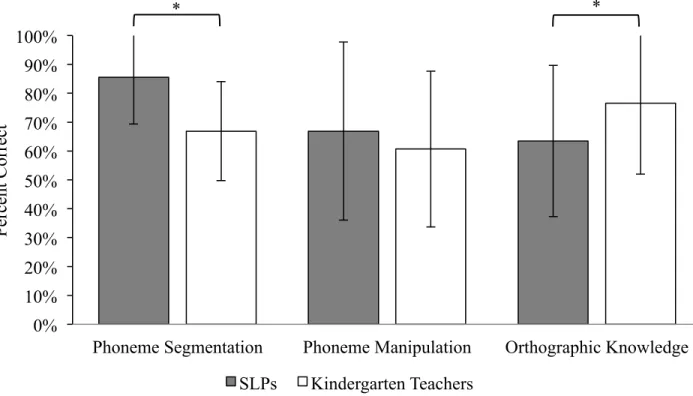
Figure 1 illustrates group performance on study measures. Three independent samples t- tests were used to compare SLPs’ performance on study measures to kindergarten teachers’
performance. The Benjamini-Hochberg procedure (Benjamini & Hochberg, 1995) was used to protect against inflated type II error due to multiple comparisons; false discovery rate was set to .33.
For phoneme segmentation, there was a statistically significant difference between groups (t(55.81) = 4.26, p < .001). The effect was large (d = 1.12). SLPs outperformed teachers on phoneme segmentation. For phoneme manipulation, there was not a statistically significant difference between groups (t(55.03) = 0.82, p = 0.42).
Table 4
Correlations between Study Measures and Demographic Variables
1 2 3 4 5 6
SLPs
1. District –
2. Education -.18* –
3. Experience -.40* -.15 –
4. Phoneme Segmentation -.26* -.09 -.42* –
5. Phoneme Manipulation -.09* -.12 .24 .04 – 6. Orthographic Knowledge -.18* -.07 .24 .09 .33 – General Education Teachers
1. District –
2. Education -.28 –
3. Experience -.04 -.14 –
4. Phoneme Segmentation -.31 -.03 -.03 –
5. Phoneme Manipulation -.03 -.14 -.30 -.01 – 6. Orthographic Knowledge -.05 -.23 -.34 -.26 .8 – Total Sample
1. District –
2. Education -.26* –
3. Experience -.32* -.19 –
4. Phoneme Segmentation -.01* -.14 -.06* –
5. Phoneme Manipulation -.04* -.02 -.04* .07* – 6. Orthographic Knowledge -.15* -.09 -.33* .28* .23 – Note. SLPs = speech-language pathologists; *p < .05
19
For orthographic knowledge, there was a statistically significant difference between groups (t(55.75) = 1.96, p = .05; Benjamini-Hochberg critical p = .22). The effect was medium
(d = 0.52). Kindergarten teachers outperformed SLPs on the orthographic knowledge measure.
0%
10%
20%
30%
40%
50%
60%
70%
80%
90%
100%
Phoneme Segmentation Phoneme Manipulation Orthographic Knowledge
Percent Correct
SLPs Kindergarten Teachers
* *
Figure 1. Group performance on study 1 measures. Error bars represent 1 SD. SLP = speech-language pathologist.
20 CHAPTER III
STUDY 2
Method
The Vanderbilt University Institutional Review Board approved the methods for this study.
Participants
SLP participants (n = 5) were a subset of the participants from study 1 who completed a derivational morphology knowledge measure after completing the study 1 measures. We excluded SLP participants who attended (a) a district-wide workshop for SLPs on derivational morphology conducted by the author and/or (b) the 2018 School SLP Conference at Vanderbilt which included sessions on derivational morphology. The teacher participants (n = 6) were participants from study 1 who teach in the districts represented by the SLP participants. Table 5 displays demographic, educational, and certification information for study participants.
Measure
Derivational morphology knowledge was measured with an experimental measure that includes morphological judgment and morpheme definition tasks (See Appendix). For
morphological judgment items, participants selected all pairs of words that share at least one morpheme (e.g., oppose; opposite) on a list of 13 word pairs. For morpheme definitions items (five items; multiple choice), participants selected one definition that defined a given base from
21
four choices (e.g., tract: (a) to pull; (b) to carry; (c) to write; (d) to take, to seize). Each item was scored as correct or incorrect. Percentage of items answered correctly for each task was
converted to a z-score using the sample data. Z-scores were averaged to create the derivational morphology knowledge score. Cronbach’s α for derivational morphology knowledge in this sample was .83.
The derivational morphology knowledge measure was created for this study as follows.
We generated a pool of 193 items. To ensure relevance to educational practice, definition items were drawn from a vocabulary curriculum that focuses on morphological analysis (Ebbers, 2004). All items were pilot tested with 25 SLPs prior to a district-wide professional development session they were required to attend. We calculated discrimination indices and item difficulty for each item. We selected items that demonstrated discrimination indices of at least .4 and difficulty between .4 and .7 (Ebel & Frisbie, 1991). Mean discrimination index for the selected items was .67 (range .57 - .86). All selected were pairs of words that do share a morpheme. To ensure a mix of word pairs that do and do not share a morpheme, we included three additional morpheme judgment items that were pairs of words that do not share a morpheme in the presentation of stimuli. These items all had discrimination indices of 0 in pilot data and were not included in the calculation of derivational morphology knowledge scores.
Procedure
Participants completed the study measures online using a data capture tool hosted at Vanderbilt University (Harris et al., 2009) after completing the study 1 measures. Data were scored automatically using Excel. To confirm scoring accuracy, 20% of participant records were scored manually and compared to the automatic scoring. No discrepancies were found.
22 Table 5
Study 2 Participant Characteristics
SLP (n = 5) Teacher (n = 6)
Mean SD Range Mean SD Range
Age (years) 44.40 (6.56) 36 - 54 36.67 (10.17) 27 - 52
Total experience (years) 16.20 ((8.01) 25 - 26 12.33 (7.20) 26 - 25
Experience with kindergarteners (years) 16.00 ((8.37) 24 - 26 10.33 (8.45) 21 - 24
n % n %
Sex
Female 5 (100%) 6 (100%)
Race
American Indian or Alaska Native 0 0
Asian 0 0
Black or African American 1 (20%) 1 (17%)
Native Hawaiian or Other Pacific Islander 0 0
White 4 (80%) 5 (83%)
Highest Degree
Bachelor’s degree 0 2 (33%)
Master’s degree 3 (60%) 2 (33%)
Advanced professional degree* 2 (40%) 2 (33%)
Highly Qualified Teacher n/a 6 (100%)
Certification**
Elementary Education 0 5 (83%)
Early Childhood Education 0 3 (50%)
Special Education 0 0
Speech-Language Pathology 5 (100%) 0
Structured Literacy Certification 0 0
Note. SLP = speech-language pathologist; *Advanced professional degree beyond a master’s degree; **Defined according to state requirements; +Certification percentages do not sum to 100 because participants were asked to select all appropriate certification categories
23 Results
Figure 2 displays scatterplots of correlations between the derivational morphology knowledge measure, study 1 measures, and demographic variables.
Figure 2. Correlations between demographic variables, study 1 measures, and
derivational morphology knowledge. Data were jittered to aid visualization. Open circles represent speech-language pathologists; filled circles represent kindergarten teachers.
Education levels are: 1 = bachelor’s degree, 2 = master’s degree, 3 = advanced degree.
24
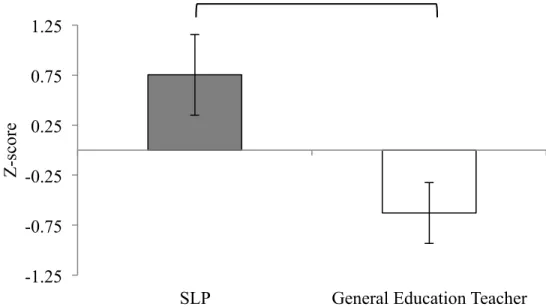
Figure 3 illustrates group performance on the derivational morphology knowledge measure. An independent samples t-tests was used to compare SLPs’ performance to kindergarten teachers’ performance. There was a statistically significant difference between groups (t(6.23) = 5.06, p < .05). The effect was large (d = 3.13). SLPs outperformed
kindergarten teachers on derivational morphology knowledge.
Figure 3. Group performance on the derivational morphology knowledge measure. Error bars represent one standard deviation; SLP = speech-language pathologist.
-1.25 -0.75 -0.25 0.25 0.75 1.25
SLP General Education Teacher
Z-score
*
25 CHAPTER IV
DISCUSSION
Prior studies have characterized educator knowledge across multiple constructs and/or in heterogeneous educator groups that include pre-service and in-service educators who serve children across multiple grade levels (e.g., Cunningham, Perry, Stanovich, & Stanovich, 2004;
Folsom et al., 2017; Spencer et al., 2008). We focused specifically on three domains of language science knowledge (explicit phonemic awareness, orthographic knowledge, derivational
morphology knowledge) among the educators primarily responsible for literacy acquisition in kindergarten children with early language deficits (general education teacher and SLP). Our results demonstrate uneven knowledge distribution across professions.
We replicated Spencer et al.’s (2008) finding that SLPs have greater explicit phoneme segmentation skills than kindergarten teachers. We extended Spencer’s findings by examining explicit phoneme manipulation and found no difference between SLPs and kindergarten teachers.
We found that kindergarten teachers have greater orthographic knowledge than SLPs, and SLPs have greater derivational morphology knowledge than kindergarten teachers. These findings highlight the domains of language science in which SLPs are best equipped to contribute to literacy teams: phonemic awareness and derivational morphology. The findings also suggest the need for improvement across domains for SLPs and kindergarten teachers.
26
Explicit Phonemic Awareness
We replicated Spencer et al.’s (2008) finding that SLPs outperform teachers on explicit phonemic awareness tasks. This finding suggests that SLPs are better equipped than kindergarten teachers to identify and remediate phonemic awareness deficits and thus must take a more active role in identification and remediation. Identifying and remediating phonemic awareness deficits is crucial for ensuring that children with early language deficits access the general education curriculum; thus, it is well within SLPs’ scope of practice (American Speech-Language-Hearing Association, 2016b). SLPs can take responsibility for screening phonemic awareness, at least for children with early language deficits. Doing so aids identification of children at risk for reading disabilities (Garfield & Bryant, 2018). Early identification situates these children to benefit from early phonemic awareness intervention that can be embedded into speech-language therapy (Catts, 1991) and avoids the cascade of negative consequences that follows late identification (Wilcutt & Pennington, 2000).
Although SLPs are well positioned to identify and remediate phonemic awareness deficits, kindergarten teachers must also provide explicit phonemic awareness instruction (NICHD, 2000). Adding phonetics coursework to teacher preparation programs may better prepare teachers to deliver explicit phonemic awareness instruction. Learning phonetic
transcription requires adults to override their knowledge of English spelling to analyze the sound structure of words; doing so improves their explicit phonemic awareness skills (Werfel, 2017).
Especially at universities that already offer phonetic transcription courses in linguistics or communication sciences and disorders departments, enrolling pre-service teachers in these courses is a relatively low-cost solution to teachers’ persistent explicit phonemic awareness deficits and may translate to improved phonemic awareness instruction. Additionally, SLPs
27
should collaborate with general education classroom teachers to promote effective phonemic awareness instruction in the classroom (ASHA Roles and Responsibilities of SLPs in Schools Working Group, 2012).
Phonetics coursework may establish basic explicit phonemic awareness skill, but is likely insufficient for establishing expert phonemic awareness skills (Werfel, 2017). We extended Spencer et al.’s (2008) findings by comparing phoneme manipulation skills between SLPs and teachers. Phoneme manipulation is a more sensitive indicator of phonemic awareness than phoneme segmentation (Catts et al., 2001; Kilpatrick, 2012). Thus, it may more validly indicate whether educators have the expert explicit phonemic awareness skills required for explicit instruction. Both groups performed poorly on the phoneme manipulation measure. Considered with our finding that neither group achieved ceiling performance on the phoneme segmentation task (which is consistent with Spencer et al.’s (2008) finding), poor performance on explicit phoneme manipulation suggests that both groups require additional instruction to achieve expert explicit phonemic awareness skill. SLPs and teachers may themselves require explicit phonemic awareness instruction. Future professional development efforts should aim to deliver such instruction and establish expert skills.
Orthographic Knowledge
Our finding that kindergarten teachers had greater orthographic knowledge than SLPs confirms SLPs’ self-reported concerns about their preparation for supporting reading acquisition.
Although SLPs are not primarily responsible for directly teaching orthographic conventions, they require orthographic knowledge to support the efforts of the classroom teacher. Neither SLPs nor teachers performed as well on the orthographic knowledge measure as would be expected of
28
experts responsible for teaching the orthographic code. The findings reiterate the continued call for improvements in educator language science knowledge (e.g., Moats, 2009).
Derivational Morphology Knowledge
Our finding that SLPs have greater derivational morphology knowledge than
kindergarten teachers suggests that SLPs have specialized knowledge that can be leveraged for vocabulary instruction. Children with language deficits have vocabularies of limited breadth and depth and take longer than children with typical language to acquire new vocabulary (McGregor, Oleson, Bahnsen, & Duff, 2013; Windfuhr, Faragher, & Conti-Ramsden, 2019). These
vocabulary deficits negatively influence reading comprehension, but explicit instruction in derivational morphology improves vocabulary and reading comprehension (Catts et al., 2006;
Goodwin & Ahn, 2010). Because derivational morphology instruction typically is reserved for middle school and beyond, SLPs should proactively target morpheme analysis skills in children with early language deficits. Doing so may minimize the effect of early language deficits on reading comprehension (Halaas Lyster, 2002; Pullen, Tuckwiller, Konold, Maynard, & Coyne, 2010).
Considerations for Measuring Language Science Knowledge
We designed experimental measures for this study; our findings would be strengthened with additional measure validation. For phoneme manipulation, internal consistency in this sample was slightly lower than desired. The lack of correlation with the phoneme segmentation task calls construct validity into question, although the lack of correlation may result from limited variance in phoneme manipulation. As mentioned, phoneme manipulation is likely a
29
better index of explicit phonemic awareness than phoneme segmentation. Future efforts should focus on developing and validating reliable measures of phoneme manipulation.
For orthographic knowledge, internal consistency in this sample was low. Low internal consistency may have resulted from some items drawing on phoneme segmentation skills as well as orthographic knowledge (e.g., Which of the following sets of words contain four words with consonant digraphs?), whereas other items draw more singularly on declarative knowledge of orthographic concepts (e.g., Which of the following sets of words contains four words that follow the “drop the silent e” phonics generalization?). Declarative knowledge questions, such as
“In what context does c represent /s/?” might be more informative for identifying educators’
orthographic knowledge needs.
For derivational morphology knowledge, we used morpheme judgment to avoid the pitfalls associated with morpheme counting tasks. The primary shortcoming of morpheme judgment is that it can be completed successfully without explicit knowledge of individual morphemes. For example, a participant could recognize that oppose and opposite share a
morpheme without knowing that both words contain the prefix op- (toward, against; variant of -ob; New Oxford American Dictionary, 2013) and the base pos (to place; New Oxford American Dictionary, 2013). The validity of morpheme judgment would be improved if participants
indicated which morphemes two words share.
Conclusions
Our findings are consistent with previous findings that educators lack the language science knowledge to engage in effective reading instruction. This study adds to the knowledge base by objectively characterizing language science knowledge in two groups: SLPs and
30
kindergarten teachers. The uneven distribution of language science knowledge across groups points to a previously unidentified barrier to interdisciplinary collaboration in schools: lack of shared knowledge. SLPs are better equipped than kindergarten teachers to support phonemic awareness and vocabulary, whereas kindergarten teachers are better equipped to deliver phonics instruction.
Future Directions
The uneven distribution of language science knowledge among SLPs and kindergarten teachers likely impedes these professionals’ collaborative efforts. Effective interdisciplinary collaboration requires a shared knowledge base (Banks & Millward, 2007; Kvarnström, 2008;
Postrel, 2002). Multimedia tools, however, can be used to increase educators’ language science knowledge (Kennedy, Driver, Pullen, Ely, & Cole, 2013). In future work, we will leverage multimedia tools to create salient professional development opportunities that are accessible to all literacy team members. We hypothesize that such opportunities will elevate and equalize language science knowledge across team members, promote interdisciplinary collaboration, and ultimately improve reading outcomes for children with early language deficits.
31 APPENDIX
Language Science Knowledge Measures Explicit Phonemic Awareness
Phoneme Segmentation
Which of the following words have only three sounds? Select all that apply.
¨ Yes
¨ Ball
¨ Thin
¨ Stop
¨ Think
¨ Squirrel
¨ Quit
¨ Fox
¨ Start
¨ Knuckle
Phoneme Manipulation
1) If you say “stow” and then reverse the order of the sounds, “stow” would be:
a) Watts b) Oats c) Woes d) Outs
2) If you say “skate” and then reverse the order of the sounds, “skate” would be:
a) Tacks b) Take c) Takes d) Cakes
3) If you say “talk” and then reverse the order of the sounds, “talk” would be:
a) Clot b) Clout c) Caught d) Cat
4) If you say “owed” and then reverse the order of the sounds, “owed” would be:
a) Duo b) Dough c) Dew d) Do
5) If you say “pay” and then reverse the order of the sounds, “pay” would be:
a) Ape b) App c) Yap d) Yep
32 Orthographic Knowledge
Select the best answer for each question.
1) Which of the following sets of words contains four words that follow the “silent e” phonics generalization?
a) Fine, cake, tube, done b) Make, please, raise, kite c) Bake, spoke, fuse, shine d) Bee, pie, blue, shoe
2) Which of the following sets of words contains four words with consonant digraphs?
a) Stack, push, cold, nest b) Them, grand, back, stick c) Ship, muck, this, chat d) Just, stop, sleep, smell
3) Which of the following sets of words contains four words with vowel teams?
a) Reach, seed, boat, rain b) Snow, shoe, floor, more c) need, react, coat, out d) does, their, head, create
4) Which of the following sets of words contains four words with consonant blends?
a) Stop, clean, best, brim b) Cloud, lost, rash, green c) Clank, black, shuck, drink d) Stick, table, walk, draw
5) Which of the following sets of words contains words that follow the “drop the silent e”
phonics generalization?
a) Hoping, diving, tacking, wiping b) Biting, fining, planking, icing c) Taken, strengthen, ashen, woven d) Toning, mining, chaser, widest Derivational Morphology Knowledge Morphological Judgment
Which of the following word pairs share at least one morpheme? Select all that apply.
¨ oppose; opposite
¨ epilogue; epilepsy
¨ recipe; resin
¨ addict; adduct
¨ inspect; spectate
¨ different; difference
¨ offer; infer
¨ transmit; commit
¨ both; bother
33
¨ division; visionary
¨ obstruct; obtain
¨ commit; commission
¨ duplex; duplicate Morpheme Definitions
Select the correct definition for each base.
1) Tract a) To pull b) To carry c) To write
d) To take, to seize 2) Spir
a) To tell, to say b) To breathe c) To carry d) To believe 3) Pel
a) To die
b) To drive, to push c) To tell, to say d) To send 4) Vert
a) To drive, to push b) To die
c) To turn
d) To force, to seize 5) Pan
a) Self
b) Distant, far c) Suffering, disease d) All, whole
6) Scope
a) Instrument used to measure b) Instrument used to observe c) Time
d) Star, heavens
34
REFERENCES
American Speech-Language-Hearing Association. (2001). Roles and responsibilities of speech- language pathologists with respect to reading and writing in children and adolescents.
[Position Statement]. Retrieved from http://www.asha.org/policy
American Speech-Language-Hearing Association. (2016a). Every Student Succeeds Act Analysis.
Retrieved from http://www.asha.org/uploadedfiles/Every-Student-Succeeds-Act- Key-Issues.pdf
American Speech-Language-Hearing Association. (2016b). Scope of practice in speech-language pathology [scope of practice]. Retrieved from http://www.asha.org/policy/
American Speech-Language-Hearing Association. (2018). 2018 Schools Survey. Survey Summary Report: Numbers and Types of Responses, SLPs. Retrieved from http://www.asha.org
American Speech-Language-Hearing Association Roles and Responsibilities of SLPs in Schools Working Group. (2012). Do's and Don'ts for the Role of the SLP in Schools. Retrieved from https://www.asha.org/slp/schools/prof-consult/guidelines.htm
Banks, A., & Millward, L. (2007). Differentiating knowledge in teams: The effect of shared declarative and procedural knowledge on team performance. Group Dynamics: Theory, Research, and Practice, 11, 95 - 106.
Benjamini, Y., & Hochberg, Y. (1995). Controlling the false discovery rate: A practical and powerful approach to multiple testing. Journal of the Royal Statistical Society. Series B (Methodological), 57, 289-300.
35
Bishop, D., & Adams, C. (1990). A prospective study of the relationship between specific language impairment, phonological disorders, and reading achievement. Journal of Child Psychology and Psychiatry, 31, 1027-1050. doi:10.1111/j.1469-7610.1990.tb00844.x Blood, G., Mamett, C., Gordon, R., & Blood, I. (2010). Written language disorders: Speech-
language pathologists' training, knowledge, and confidence. Language, Speech, &
Hearing Services in Schools, 41, 416-428.
Bos, C., Mather, N., Dickson, S., Podhajski, B., & Chard, D. (2001). Perceptions and knowledge of preservice and inservice educators about early reading instruction. Annals of Dyslexia, 51, 97-120. doi:10.1007/s11881-001-0007-0
Brady, S. A., Gillis, M., Smith, T., Lavalette, M., Liss-Bronstein, L., Lowe, E., . . . Wilder, T. D.
(2009). First grade teachers' knowledge of phonological awareness and code concepts:
Examining gains from an intensive form of professional development and corresponding teacher attitudes. Reading and Writing, 22, 425-455. doi:10.1007/s11145-009-9166-x Catts, H. (1991). Facilitation phonological awareness: Role of speech-language pathologists.
Language, Speech, & Hearing Services in Schools, 22, 196-203.
Catts, H. (1997). The early identification of language-based reading disabilities. Language, Speech, & Hearing Services in Schools, 28, 86 - 89.
Catts, H., Adlof, S., & Ellis Weismer, S. (2006). Language deficits in poor comprehenders: A case for the simple view of reading. Journal of Speech, Language, and Hearing Research, 49, 278-293. doi:10.1044/1092-4388(2006/023)
Catts, H., Fey, M., Zhang, X., & Tomblin, J. B. (2001). Estimating the risk of future reading difficulties in kindergarten children: A research-based model and its clinical
implementation. Language, Speech, and Hearing Services in Schools, 32(1), 38-50.
36
Connor, C. M., Morrison, F., & Slominski, L. (2006). Preschool instruction and children's emergent literacy growth. Journal of Educational Psychology, 98, 665-690.
doi:10.1037/0022-0663.98.4.665
Cunningham, A., Perry, K., Stanovich, K., & Stanovich, P. (2004). Disciplinary knowledge of K- 3 teachers and their knowledge calibration in the domain of early literacy. Annals of Dyslexia, 54, 139-167. doi:10.1007/s11881-004-0007-y
Cunningham, A., & Stanovich, K. (1998). What reading does for the mind. Journal of Direct Instruction, 1, 137-149.
Cunningham, A., Zibulsky, J., Stanovich, K., & Stanovich, P. (2009). How teachers would spend their time teaching language arts: The mismatch between self-reported and best practices.
Journal of Learning Disabilities, 42, 418-430.
Davis, K., & Murza, K. (2018). Disciplinary literacy: Virginia school-based speech-language pathologists' knowledge and confidence. Communication Disorders Quarterly, 40, 77-87.
doi:10.1177/1525740118771905
Ebel, R. L., & Frisbie, D. A. (1991). Essentials of Educational Measurement (5th ed.).
Englewood Cliffs, NJ: Prentice-Hall, Inc.
Ehren, B. J., & Ehren, T. (2001). New or expanded literacy roles for speech-language
pathologists: Making it happen in the schools. Seminars in Speech and Language, 22, 233-243.
Every Student Succeeds Act, Pub. L. No. 114-95 (2016).
Fallon, K., & Katz, L. (2011). Providing written language services in the schools: The time is now. Language, Speech, & Hearing Services in Schools, 42, 3-17.
37
Folsom, J., Smith, K. G., Burk, K., & Oakley, N. (2017). Educator outcomes associated with implementation of Mississippi's K-3 early literacy professional development initiative.
Retrieved from
https://ies.ed.gov/ncee/edlabs/regions/southeast/pdf/REL_2017270.pdf
Garfield, R., & Bryant, C. (2018). The role of the SLP in screening for dyslexia. Paper presented at the Annual Convention of the American Speech-Language-Hearing Association, Boston, MA.
Goldschmidt, P., & Phelps, G. (2010). Does teacher professional development affect content and pedagogical knowledge: How much and for how long? Economics of Education Review, 29, 432-439.
Goodwin, A. P., & Ahn, S. (2010). A meta-analysis of morphological interventions: Effects on literacy achievement of children with literacy difficulties. Annals of Dyslexia, 60, 183- 208. doi:10.1007/s11881-010-0041-x
Halaas Lyster, S. (2002). The effects of morphological versus phonological awareness training in kindergarten on reading development. Reading and Writing: An Interdisciplinary
Journal, 15, 261-294.
Harris, P. A., Taylor, R., Thielke, R., Payne, J., Gonzalez, N., & Conde, J. G. (2009). Research electronic data capture (REDCap) - A metadata-driven methodology and workflow process for providing translational research informatics support. Journal of Biomedical Informatics, 42, 337-381.
Heilman, A., Blair, T., & Rupley, W. (2002). Principles and practices of teaching reading (10th ed.). Columbus, OH: Merrill.
38
Katsiyannis, A., Ryan, J. B., Zhang, D., & Spann, A. (2008). Juvenile delinquency and
recidivism: The impact of academic achievement. Reading and Writing Quarterly, 24, 177-196. doi:10.1080/10573560701808460
Katusic, S., Colligan, R., Barbaresi, W., Schaid, D., & Jacobsen, S. (2001). Incidence of reading disability in a population-based birth cohort, 1976-1982, Rochester, Minn. Mayo Clinic Proceedings, 76, 1081-1092.
Kennedy, M. J., Driver, M. K., Pullen, P. C., Ely, E., & Cole, M. (2013). Improving teacher candidates' knowledge of phonological awareness: A multimedia approach. Computers and Education, 64, 42-51. doi:10.1016/j.compedu.2013.01.010
Kilpatrick, D. (2012). Phonological segmentation assessment is not enough: A comparison of three phonological awareness tests with first and second graders. Canadian Journal of School Psychology, 27, 150-165. doi:10.1177/0829573512438635
Kvarnström, S. (2008). Difficulties in collaboration: A critical incident study of interprofessional healthcare teamwork. Journal of Interprofessional Care, 22, 191-203.
doi:10.1080/13561820701760600
Lyon, G. R., Fletcher, J., Shaywitz, S., Shaywitz, B., Torgesen, J., Wood, F., . . . Olson, R.
(2001). Rethinking learning disabilities. Rethinking special education for a new century (pp. 259-287).
McCutchen, D., Abbott, R., Green, L., Beretvas, S. N., Cox, S., Potter, N. S., . . . Gray, A. L.
(2002). Beginning literacy: Links among teacher knowledge, teacher practice, and student learning. Journal of Learning Disabilities, 35, 69-86.
McGregor, K., Oleson, J., Bahnsen, A., & Duff, D. (2013). Children with developmental language impairment have vocabulary deficits characterized by limited breadth and
39
depth. International Journal of Language & Communication Disorders, 48, 307-319.
doi:10.1111/1460-6984.12008
Missouri Department of Elementary and Secondary Education. (2018). At-A-Glance Information. Retrieved from https://apps.dese.mo.gov/MCDS/home.aspx
Moats, L. C. (2009). Still wanted: Teachers with knowledge of language. Journal of Learning Disabilities, 42, 387-391.
Moats, L. C. (2010). Speech to Print: Language Essentials for Teachers (2nd ed.). Baltimore, MD: Paul H. Brookes.
Moats, L. C., & Foorman, B. (2003). Measuring teachers' content knowledge of language and reading. Annals of Dyslexia, 53, 23-45.
Moats, L. C., & Lyon, G. R. (1996). Wanted: Teachers with knowledge of language. Topics in Language Disorders, 16(2), 73-86.
National Institute of Child Health and Human Development. (2000). Report of the National Reading Panel: Teaching children to read: Reports of the subgroups (00-4754).
Washington, DC: U.S. Government Printing Office.
New Oxford American Dictionary. (2013). New York, NY: Oxford University Press.
Piasta, S. B., Connor, C. M., Fishman, B., & Morrison, F. (2009). Teachers' knowledge of literacy concepts, classroom practices, and student reading growth. Scientific Studies of Reading, 13, 224-248. doi:10.1080/10888430902851364
Podhajski, B., Mather, N., Nathan, J., & Sammons, J. (2009). Professional development in scientifically based reading instruction. Journal of Learning Disabilities, 42, 403-417.
40
Postrel, S. (2002). Islands of shared knowledge: Specialization and mutual understanding in problem-solving teams. Organization Science, 13, 303-320.
doi:10.1287/orsc.13.3.303.2773
Pullen, P. C., Tuckwiller, E. D., Konold, T. R., Maynard, K. L., & Coyne, M. (2010). A tiered intervention model for ealy vocabulary instruction: The effects of tiered instruction for young students at risk for reading disability. Learning Disabilities Research and Practice, 25, 110-123.
Scarborough, H. (1990). Very early language deficits in dyslexic children. Child Development, 61, 1728-1743.
Spencer, E., Schuele, C. M., Guillot, K., & Lee, M. (2008). Phonemic awareness skill of speech- language pathologists and other educators. Language, Speech, and Hearing Services in Schools, 39, 512-520.
Tambyraja, S., Schmitt, M., Justice, L., Logan, J., & Schwarz, S. (2014). Integration of literacy into speech-language therapy: A descriptive analysis of treatment practices. Journal of Communication Disorders, 47, 34-46.
Taylor, B., Pearson, P., Clark, K., & Walpole, S. (2000). Effective schools and accomplished teachers: Lessons about primary-grade reading instruction in low-income schools. The Elementary School Journal, 101, 121-165.
Tennessee Department of Education. (2015). District-level Achievement. Retrieved from:
https://www.tn.gov/content/tn/education/data/data-downloads.html
Tennessee Department of Education. (2018a). Tennessee District-Level Assessment. Retrieved from: https://www.tn.gov/content/tn/education/data/data-downloads.html
41
Tennessee Department of Education. (2018b). Tennessee District-Level Profile and Demographic Information. Retrieved from:
https://www.tn.gov/content/tn/education/data/data-downloads.html
Torgesen, J. (2000). Individual differences in response to early interventions in reading: The lingering problem of treatment resisters. Learning Disabilities Research and Practice, 15, 55-64.
Vaughn, S., Moody, S. W., & Schumm, J. S. (1998). Broken promises: Reading instruction in the resource room. Exceptional Children, 64, 211-225.
Vellutino, F., Fletcher, J., Snowling, M., & Scanlon, D. (2004). Specific reading disability (dyslexia): What have we learned in the past four decades? Journal of Child Psychology and Psychiatry, 45, 2-40.
Wagner, R., & Torgesen, J. (1987). The nature of phonological processing and its causal role in the acquisition of reading skills. Psychological Bulletin, 101, 192-212.
Werfel, K. L. (2017). Phonetic transcription training improves adults' explicit phonemic
awareness: Evidence from undergraduate students. Communication Disorders Quarterly, 39, 281-287. doi:10.1177/1525740117702456
Westat. (2012). ECLS Spring 2012 Teacher Questionnaire. Rockville, MD.
Westat. (2013). ECLS Spring 2013 Special Education Teacher Questionnaire A. Rockville, MD.
Wilcutt, E. G., & Pennington, B. F. (2000). Psychiatric comorbidity in children and adolescents with reading disability. Journal of Child Psychiatry, 41, 1039-1048.
Windfuhr, K., Faragher, B., & Conti-Ramsden, G. (2019). Lexical learning skills in young children with specific language impairment (SLI). International Journal of Language &
Communication Disorders, 37, 415-432. doi:10.1080/1368282021000007758