by
SANTIAGO J. VILLASIS
A Thesis
Submitted to College of Graduate Studies in Partial Fulfillment of
the Requirements for the Degree of Master of Science in Economics
at the
University of Idaho May 1996
Major Professor: John T. Wenders
This Thesis of Santiago J. Villasis, submitted for the degree of Master of Science with a major in Economics and titled “An Optimal Pricing Mechanism For Internet’s End-Users,” has been reviewed in final form, as indicated by the signatures and dates given below. Permission is now granted to submit final copies to the College of Graduate Studies for Approval.
Major Professor Date John T. Wenders
Committee
Members Date John Knudsen
Date David Van Over
Department
Administrator Date Shaikh M. Ghazanfar
Discipline’s
College Dean Date Byron Dangerfield
Final Approval and Acceptance by the College of Graduate Studies
Date Jean’ne M. Shreeve
A
BSTRACTAN OPTIMAL PRICING MECHANISM FOR INTERNET’S END-USERS
by
SANTIAGO J. VILLASIS Submitted to College of Graduate Studies
in Partial Fulfillment of the Requirements for the Degree of
Master of Science in Economics at the
University of Idaho May 1996
This thesis provides an economic understanding of the Internet. It describes the structure and function of the Internet. It outlines the history of the Internet. It shows the derivation of the end-user’s demand for Internet access and usage. It illustrates how the Internet is priced at present. In considering the aforementioned, it investigates the need for traffic-based pricing and current pricing schemes on the Internet. The thesis specifically focuses on the
implementation of the rate-of-transfer concept as an optimal pricing mechanism and its limitations.
Thesis Chairman: John T. Wenders, Professor of Economics.
A
CKNOWLEDGMENTI want to express my deepest gratitude to Dr. John Wenders, the chairman of the thesis committee, for his very helpful assistance and critique throughout the investigation. I would like to thank Dr. John Knudsen for his thorough review of this thesis and Dr. David Van Over for his constructive comments. Also, I offer my sincerest thanks to Dr. Raymond Dacey for his guidance throughout my graduate studies, for his important comments and contributions to this thesis, and for providing me with a research assistantship without which none of this would have been possible.
I am very grateful to the Faculty and Staff of the Department of Economics, in particular to Dr. S. M. Ghazanfar for his support and trust, and Dr. Felix Kwan for his guidance in putting the literature review together. I also want to acknowledge my appreciation to the
Department for granting me with a fellowship. A special “thanks” to Karen Gillespie, the secretary, for lending me a computer that was used in preparing this thesis.
I am also fortunate to have worked for the Computer Services Department. This experience allowed me to deepen my knowledge of computers and learn about the Internet. I especially appreciate the support of Sandy Dennis, who is a great boss. Further, I am in debt to Sharee Paull, of the McCarthy lab, for her kind help in editing this thesis.
I would also like to thank my friends the Kirklands for offering me a place in their home and my friends the Macraes for sharing some great times with my wife and I. Most importantly, I want to thank my parents Fausto and Nancy for their unmatched support throughout my academic career.
D
EDICATIONThis thesis is dedicated to Sylvia, my wife:
• Who is always there with her love, encouragement, understanding, and exceptional sense of humor which made the writing of this thesis substantially easier,
• Who helped me set up the slide projections for the thesis defense, and
• Whose dedication to me fulfilling this project is embodied in every word written.
T
ABLE OFC
ONTENTSAUTHORIZATION TO SUBMIT THESIS...ii
ABSTRACT...iii
ACKNOWLEDGMENT...iv
DEDICATION...v
TABLE OF CONTENTS...vi
TABLE OF FIGURES...ix
LIST OF TABLES...xi
1. INTRODUCTION...1
1.1. PROBLEM STATEMENT...4
1.2. STRUCTURE OF THE STUDY...5
1.3. METHODOLOGY...5
1.3.1. Literature Review...6
1.3.2. Collection of Data...8
1.3.3. Interviews...8
2. UNDERSTANDING THE INTERNET...10
2.1. WHAT IS THE INTERNET?...10
2.2. HOW THE INTERNET WORKS...11
2.3. INTERNET CONNECTIVITY...14
2.4. INTERNET USES...18
2.5. INTERNET SERVICES...18
2.6. COMMON INTERNET TOOLS...18
2.6.1. E-Mail...19
2.6.2. File Transfer...19
2.6.3. Telnet...19
2.6.4. Newsgroups...20
2.6.5. Gopher...20
2.6.6. World Wide Web...20
2.7. COMMON WAYS TO ACCESS THE INTERNET...21
2.7.1. Dial-up Internet Connections...22
2.7.1.1. Terminal Access (via vendor-provided host VT-100 shell accounts)...22
2.7.1.2. Workstation SLIP (Serial Line Internet Protocol) or PPP (Point to Point Protocol) Access...23
2.7.1.3. Internet Gateway Access (via commercial on-line provider)...23
2.7.2. Leased Line Internet Connections...24
2.7.2.1. OPAC Gateways...25
2.7.2.2. Local Area Network (LAN) Access...25
2.8. HARDWARE AND SOFTWARE COMPONENTS...26
2.8.1. Minimum Hardware Requirements...28
2.8.2. Additional Hardware Equipment...29
2.8.3. Software Requirements...31
2.9. SUMMARY...31
3. BASIC TOPOLOGY OF THE INTERNET...32
3.1. INTERNET SERVICE PROVIDERS (ISPS)...36
3.1.1. Difference Between ISP And On-Line Service...40
3.2. NAPS-NETWORK ACCESS POINTS...40
3.3. VBNS-VERY HIGH SPEED BACKBONE NETWORK SERVICE...41
3.4. THE INTERNET AS AN ORGANIZATION...42
3.5. SUMMARY...44
4. THE ROAD TO PRESENT: INTERNET HISTORY...45
4.1. PACKET SWITCHING AND THE EXPERIMENTAL NETWORK...45
4.1.1. The Advanced Research Projects Agency Network (ARPANET)...46
4.1.2. Internetting And Standardization...47
4.1.3. Transition From ARPANET To NSFNET: Increased U.S. Government Interest In Networking...48
4.2. NSFNET BACKBONE...49
4.2.1. Expansion Need...49
4.3. NSFNET: COMMERCIALIZATION, PRIVATIZATION, AND DECOMMISSION...50
4.3.1. Commercialization...51
4.3.2. Privatization...53
4.3.3. Decommission...54
4.4. THE INTEGRATED NETWORK AND WHAT’S AHEAD...55
5. END-USER’S INTERNET DEMAND FOR ACCESS AND USAGE...58
5.1. INTERNET EXTERNALITIES...59
5.2. END-USER’S INTERNET DEMAND FOR ACCESS...61
5.3. END-USER’S ACCESS COSTS...62
5.4. SOME STATISTICS ON INTERNET ACCESS...63
5.4.1. Exponential Growth...64
5.4.2. Number Of Users On The Internet...65
5.4.3. Access Locations...67
5.4.4. Computer Type...69
5.5. END USER’S DEMAND FOR INTERNET USAGE...69
5.6. END-USER’S USAGE COSTS...76
5.7. SOME STATISTICS ON USAGE...77
5.7.1. Access Speed...77
5.7.2. Uses Of The Internet...78
5.7.2.1. Internet Tool Usage By % Of Total Internet Users 16+ Using The Internet In The Past 24 Hours...78
5.7.2.2. Internet Tool Usage By % Of Total Users 16+ Using The Internet Over The Last 24 Hours...79
5.8. SUMMARY...80
6. HOW INTERNET PROVISION SHOULD BE PRICED...82
6.1. BACKGROUND...82
6.2. ISP’S ACCESS COSTS...84
6.2.1. ISP’s Installation Costs...85
6.2.2. Customer-Activation Costs...86
6.3. ISP’S USAGE COSTS...86
6.3.1. Maintenance Costs...87
6.3.2. Network Load Costs...87
6.4. SOME ISP STATISTICS...89
6.5. MOTIVATION FOR TRAFFIC-BASED PRICING...89
6.5.1. Traffic-Sensitive Pricing For End-Users...91
6.5.2. Traffic-Sensitive Pricing Among ISPs (Interconnection)...91
6.5.3. Traffic-Sensitive Pricing For Institutions...92
6.6. AN OPTIMAL PRICING SCHEME...94
6.6.1. An Optimal Pricing Tariff...94
6.7. CURRENT NETWORK LOAD: RANKING THE USE OF CONGESTED RESOURCES...96
6.8. RATE-OF-TRANSFER PRICING...98
6.9. SMART MARKET VS. RATE-OF-TRANSFER PRICING...100
6.10. PROBLEMS OF RATE-OF-TRANSFER PRICING...102
6.11. THE PROBLEMS OF VOLUME DISCOUNTS...103
6.12. WHEN PRICES ARE NOT OPTIMAL...103
6.13. WHEN MARGINAL-COST PRICING REVENUES DO NOT COVER COSTS...104
6.14. SUMMARY...106
7. HOW THE INTERNET IS PRICED AT PRESENT...110
7.1. BACKGROUND...110
7.2. ISP INTERCONNECTION: PROMOTING NON-USAGE SENSITIVE PRICING MECHANISMS ON END-USERS...113
7.3. OTHER CHARACTERISTICS OF THE CURRENT INTERNET...117
7.4. CURRENT PRICING MECHANISMS...117
7.5. ADVANTAGES AND DISADVANTAGES OF NON-TRAFFIC SENSITIVE PRICING SCHEMES...120
7.6. HOW CONGESTION IS PRESENTLY DEALT WITH...120
7.7. SUMMARY...121
8. FROM NON-TRAFFIC-SENSITIVE TO TRAFFIC-SENSITIVE PRICING MECHANISMS: THE TRANSITION...123
8.1. IMPLEMENTATION OF AN OPTIMAL PRICING SCHEME...128
8.2. PROBLEMS OF THIS PRICING SCHEME...131
8.3. AN ALTERNATIVE TO DEALING WITH CONGESTION...131
8.4. SUMMARY...132
9. CONCLUSIONS AND FURTHER AREAS OF RESEARCH...133
APPENDIX A: THE U.S. TELECOMMUNICATIONS SECTOR...136
FACTORS PROMOTING COMPETITION IN TODAY’S TELECOMMUNICATIONS MARKET...137
APPENDIX B: INTERNET SERVICE PROVIDER (ISP) PEERING...139
COMPARING SKA PEERING MODEL WITH THE FINANCIAL SETTLEMENTS STRUCTURE...140
AN EXAMPLE OF AN SKA MODEL: THE CIX INTERCONNECTION MODEL...141
ISP PEERING PROBLEMS: THE CIX-ANS DISPUTE...142
APPENDIX C: CHARACTERISTICS OF THE INTERNET PROTOCOL VERSION 6 (IPV6)...144
THE IMPORTANT FEATURES OF IPV6 INCLUDE:...144
10. GLOSSARY...147
11. BIBLIOGRAPHY...167
T
ABLE OFF
IGURESFIGURE 1. POINT-TO-POINT VS. PEER-TO-PEER CONNECTION...12
FIGURE 2. BANDWIDTH RATE OF TRANSMISSION...13
FIGURE 3. DATA TRANSPORT SKETCH...17
FIGURE 4. INTERNET SERVICE PROVIDER (ISP) NETWORK WITH A DIAL-UP CONNECTION...27
FIGURE 5. NEW NSFNET BACKBONE (APRIL 1995)...35
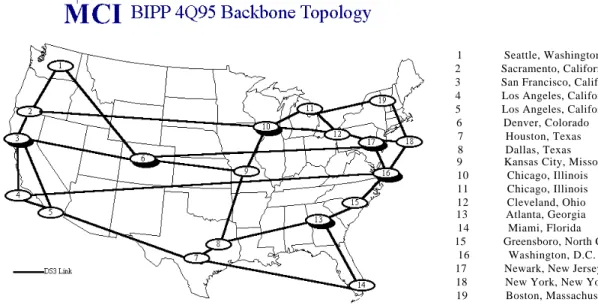
FIGURE 6. MCI BACKBONE—THE LARGEST BACKBONE (JANUARY 1996)...36
FIGURE 7. BASIC INTERNET TOPOLOGY...38
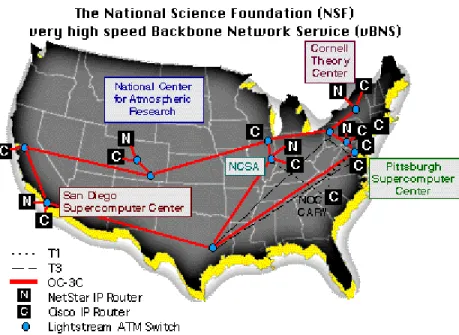
FIGURE 8. VERY HIGH-SPEED BACKBONE (VBNS)...42
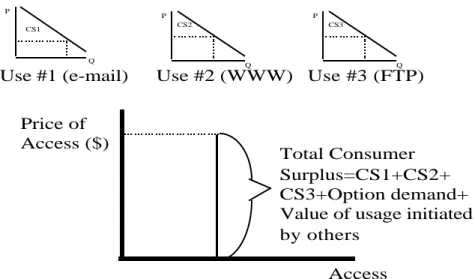
FIGURE 9. OBTAINING THE DEMAND FOR ACCESS FOR THE USER’S OWN INITIATED USAGE...62
FIGURE 10. EXPONENTIAL GROWTH OF INTERNET HOSTS...65
FIGURE 11. INTERNET ACCESS METHOD...69
FIGURE 12. MAP OF INTERNET NETWORKS (PLACE OF REGISTRATION) IN THE U.S...74
FIGURE 13. OBTAINING THE DEMAND FOR USAGE...76
FIGURE 14. INTERNET TOOL USAGE IN THE PAST 24 HOURS...79
FIGURE 15. INTERNET TOOL USAGE OVER THE LAST 24 HOURS...80
FIGURE 16. TOP FIVE ISPS RANKED BY NUMBER OF SUBSCRIBERS (IN THOUSANDS)...89
FIGURE 17. TYPES OF INTERNET TOOLS...100
FIGURE 18. NONOPTIMAL PRICING OF ACCESS AND USAGE...104
FIGURE 19. AN INDIVIDUAL’S INTERNET ACCESS DEMAND...106
FIGURE 20. LAYOUT OF AN OPTIMAL PRICING MECHANISM...129
L
IST OFT
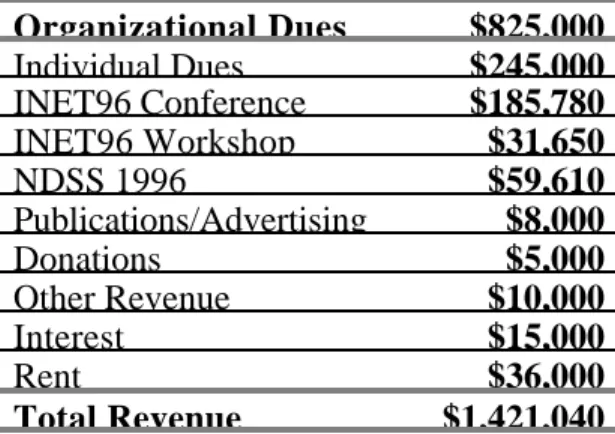
ABLESTABLE 1. 1996 INTERNET SOCIETY’S REVENUE SOURCES...44 TABLE 2. ACCESS LOCATIONS...68 TABLE 3. ACCESS SPEED...77
”[E]xponenetial growth is going to exacerbate the need for understanding the economics of these systems and how to deal with charging for use of resources.”
(Vinton G. Cerf, The On-Line User’s Encyclopedia, p. 532.)
As a result of the initiative of the U.S. government, the rapid fall of technological barriers, and the more active role of industry, global access to the Internet is becoming much more
widespread. It is speculated that within the next decade a sizable fraction of homes in the industrialized world will have Internet access. In the United States, this widespread
connectivity rests on two pillars. One pillar is the government’s double-plan of supporting the idea of public access to the Internet by increasing Internet connectivity to schools, libraries, hospitals, etc., and its backbone capacity-expansion projects compensating for the increase in demand of Internet access. The other pillar is the vast increase in commercial provision of Internet access. The deployment of this revolutionary technology will
undoubtedly produce major changes in people’s lifestyles in the coming years. Further, the most significant benefits will be realized when the Internet and other networks, such as telephony, cable, satellite, and radio finally merge, forming an integrated network such as the one envisioned in the concept of the Information Superhighway. This thesis will focus on the development of one of these networks: The Internet in the United States.
The Internet is an enormous computer network for the transmission of digitized data. Given present technology, the Internet is used as: An educational tool, a business tool, a political
tool, and an entertainment tool, among others. From this set of uses, more categories are plausible as human creativity expands. Nevertheless, the fundamental purpose will still be the same: a tool for communication.
From an economic perspective, the Internet is a valuable resource that has been gradually made available to the public. It started as a network reserved for scientific research and with time has turned into a very powerful computer network for the public community. Paul Baran, first advocate of this network, envisioned the early Internet as a possible “non- existent public utility.” Many experts have followed suit, comparing the Internet to public utilities and developing similar schemes of operation and management. The truth is that the Internet began after a government initiative, and through another government initiative, in 1990, it started a commercialization and privatization stage. Yet, today, the market structure of the Internet is not clearly defined, but this market in many ways resembles that of the telephone network.
Because, at present demand exceeds supply, the major problem the Internet faces is
congestion. For a short or long period, congestion will be present in parts of the Internet at one point or another. Different tools designed to fight this problem have been used but with no observable results so far. There is an inability of technological resources to control congestion, an inefficient non-usage based pricing mechanism that makes usage costless for the demanders, and a set of social forces resisting what economic theory would predict to be an appropriate pricing scheme. Appropriate pricing—traffic-based pricing based on the user’s rate of transfer requested—may help straighten out three problems (all related to congestion) of today’s Internet: (1) The efficient allocation of scarce resources; (2) the extant free-rider problem on the Internet, where low-usage users are subsidizing high-usage users;
and (3) the exclusion cost that one user imposes on another during congestion times.
Economic theory suggests that individuals must face actual costs of resources in order to have an appropriate pricing mechanism. A specific type of traffic-based pricing (to be described
later) will allow suppliers to efficiently recover costs for capacity expansion. Economic efficiency and network efficiency will be obtained by allocating resources according to the value users place on their requests. Users who place a higher value on the packets requested should pay a higher price. This practice should help control the above-mentioned problems.
Pricing mechanisms are, however, constrained by two issues: Technology and the policy of Universal Service. On the one hand, current technology does not allow the charging of users on a rate-of-transfer basis. In a rate-of-transfer pricing mechanism users would be charged by the value they place on rate of transfer of their packets. Packets from different applications can obtain both the desired or required rates of transfer and the required type of service (ranging from elastic to inelastic) for optimum functioning. And, since a better (faster) service, presumably, will be selected by most users, prices should vary positively with a faster rate of transfer. In this way, scarce resources, such as bandwidth, will be efficiently allocated as this pricing mechanism allows users to select their choice of rate of transfer, according to the valuations they place on their desired service. Additionally, since this type of pricing scheme charges users by their own personal valuations about the speed of the service required, cross-subsidization and the free-rider problem that take place with current pricing schemes can be controlled. Furthermore, since the rate of transfer mechanism works together with an admission control protocol, which admits a certain number of requests, this pricing mechanism will be able to guarantee a rate of transfer satisfying the needs of users.
On the other hand, special interest groups are lobbying in favor of a policy of Universal Service by which every individual should be granted Internet access by means of a subsidy.
While the technology issue refers to usage pricing, the Universal Service issue refers to access pricing. Offering Internet access at no cost to authorized individuals both encourages
undisciplined use of the Internet and inhibits private investment in that market. If Universal Service is to remain a goal, the least disruptive subsidization scheme should be considered.
The complete picture is, however, more complicated. Pricing may occur at different levels (national, regional, or local) on the Internet market. It would be beyond the scope of this paper to attempt to study the whole market. In this paper I will specifically describe current pricing schemes and proposed pricing solutions and their limitations between the last bridge of the Internet interconnection chain: Local Internet Service Providers (ISPs) and end-users1. In so doing, I will attempt to show how the critical pricing problem at this level of the Internet arises. I will briefly refer to the problem of pricing interconnection on the Internet, as interconnecting networks are the key to the Internet. If it were not for interconnection, the Internet would not be nearly as big and useful as it is.
1.1. Problem Statement
The general objective of this study is to describe an optimal pricing mechanism
implemented by local Internet Service Providers (ISPs) on end-users of the Internet.
In order to do so, it is important to first understand the basis on which the Internet works.
Only then can one explore the economics of the system and identify its inefficiencies, if any, and hence propose economically sound solutions to the problems.
Specific objectives include:
1. To understand how the Internet came into being, its structure and how it works, why a user may decide to obtain access, and the different types of access to this network;
2. To describe how the demand for Internet access and Internet usage are derived;
3. To indicate the current pricing mechanisms and their characteristics;
1 Local ISPs provide end-users connectivity to the Internet via a dial-up or a leased line and they interconnect with other ISPs for the transport of data. There are two types of end-users, institutions such as, universities and corporations, and individuals at homes and other places with access to the Internet.
4. To present an optimal pricing method to be implemented by local Internet Service Providers (ISPs) on end-users that would allow an efficient allocation of resources;
solving the most critical economic problem surrounding today’s Internet: Congestion.
1.2. Structure of the Study
Chapters 2 and 3 attempt to set up the basis for an understanding of the Internet’s structure.
Chapter 4 shows how we have arrived to the current stage. Chapter 5 describes the
derivation of the demand for Internet access and usage, which will be the basis for the pricing analysis. Chapter 6 proposes an optimal pricing mechanism of how the Internet should be priced. Chapter 7 presents an overview of how the Internet is priced at present. Chapter 8 describes the transition process to attain the proposed traffic-based pricing scheme. Finally, Chapter 9 presents the conclusions of this study and critical areas of research.
1.3. Methodology
The building of this study followed three basic steps: Review of the literature, collection of data, and interviews. The review of literature allowed me to obtain a general understanding of the Internet, from a technological perspective to an economic perspective. On the technical side, it has shown me that current technical standards would have to change in order for the rate-of-transfer pricing to be instituted. On the economic side, it showed me that the Internet field is in its early theoretical and empirical stages. Several pricing mechanisms have been proposed; none of which has considered the rate of data transfer as proposed in this
investigation. I have also learned that there is a great need of empirical studies verifying many of the hypotheses proposed.
The data collected permitted me to observe that the major economic problem of today’s Internet is congestion. Also, I can attest to the need for more sources of data, as the vast majority of the sources found were either repetitive or little reliable. I have also found that,
as a student, it is very difficult to obtain data to work with. Specifically, I could not find any accessible data on end-user’s usage measured on a per-packet, type-of-service, or rate-of- transfer requested basis that would have had allowed me to fit an econometric model for pricing purposes. As a result, this study is at large theoretical. Interviews were conducted to clarify certain aspects of the investigation and obtain more data in certain areas, such as costs;
however, much of the data is proprietary and a competitive environment does not favor openness.
1.3.1. Literature Review
The bulk of the literature review for this thesis essentially came from three areas of study—
history, economic theory, and telecommunications. Literature on the history of the Internet constituted the first targeted area. Vinton Cerf (1989, 1993, 1995) wrote simple overview papers that provide a general idea of how the Internet has come to its present state. Henry E.
Hardy (1993) Master’s thesis, The History of the Net represents a very informative piece that describes the evolution of the network until 1992. Michael Hauben and Ronda Hauben (1996) present a comprehensive paper (electronic document) on the history of the Internet called Netizens: On the History and Impact of the Net, which depicts the Internet up to the beginning of the commercialization stage of the Internet (1990). In addition, Karen Frazer’s NSFNET: Final report 1987-1995, details the transition period from the government-funded backbone (1987) to its decommission in April 1995, when the Internet is said to have been officially privatized. Supplementary papers and on-line documents were used to corroborate the information used in this study.
Literature on the technical functioning of the Internet was the second area researched. Carl Grzybowski (1994) wrote a paper titled Internet: Connectivity Handbook. It presents basic layouts of the different types of access to the Internet. Other documents made available electronically by the National Science Foundation, MERIT, Inc., MCI, Ameritech, Pacific Bell were used to understand the underlying technical infrastructure of the Internet. Personal
interviews with Michael Lasher, Assistant Director of Telecommunications Technology, and John Dickinson, Chair of the Department of Computer Science, both from the University of Idaho, helped in this area too. Economic theory was another area targeted for this study.
Basic economic theory, for example, Microeconomic Theory: Basic Principles and Extensions by Walter Nicholson, 1995 allowed an understanding of the extant and proposed pricing models. Internet pricing models have been written, especially over the last five years, during the commercialization period of the Internet. Bohn, et al. (1993) suggested using a mixture of altruism and quotas to implement priority-based routing. They proposed charging users based on the requested priority. MacKie-Mason and Varian (1992) introduced the idea of the Smart Market mechanism that followed the ideas of Bohn, et. al., but accounted for
congestion externalities. Cocchi, et al. (1991, 1992) interlaced the idea of efficient pricing policies with network efficiencies concluding that both are compatible under the type-of- service (TOS)2 pricing mechanism. Faulhaber (1992, 1995) analyzes the type of subsidy that should be put in place and he also speculates on the future integrated communications market.
Shenker (1993) and MacKie-Mason and Varian (1993, 1994, 1995) have written several papers on pricing issues related to the Internet, including some analyses of advantages and disadvantages of usage-based and flat-fee based models. MacKie-Mason, Murphy, and Murphy (1995) present a very comprehensive paper summarizing previous issues on the role of pricing on the Internet. Additional economic papers contributing to the above ideas were also taken into account. Sandra Schickele (1993) presents a case for the subsidy of the Internet by pointing out its benefits and market failure problems.
Additional important economic literature came from the proceedings of various Internet- related conferences. In particular, the proceedings from the Public Access to the Internet conference (held at Harvard University on May 26-27, 1993), and the Internet Economics Workshop (held at MIT on March 9-10, 1995) were used. Other important documents were the Request For Comments (RFC) posted on-line on various topics related to the Internet.
2 Type-of-service (TOS) pricing is an interchangeable term with quality-of-service (QOS) pricing.
These economic and technical papers constituted the bulk of the literature used for this study.
A technical understanding of the telecommunication industry was also necessary. For this purpose electronic documents made available by MCI and Sprint as well as books by Wenders (1987) and Taylor (1993) were reviewed. Also, handouts obtained from Professor Wenders contributed to the understanding of the technical aspect. A number of other papers and documents available electronically were reviewed.
1.3.2. Collection of Data
I started collecting data during the Fall of 1993. The gathering of bibliographic references on these topics was completely carried out using Internet services: File Transfer Protocol (FTP), World Wide Web (WWW), Telnet, Gopher, and E-mail. Working papers,
documentation on presentations, conference proceedings, RFC (Request for Comments), and library searches became the main source of information. They provided me with an
understanding of the current status of the Internet. A great part of the sources was
downloaded, saved, and printed. Most of them were found at the computers of other U.S.
universities, research centers, and government agencies. Other sources were gathered at the university library or requested from the owners. Assembling the data was largely a personal effort. However, I was always guided by my thesis committee. In addition, I enrolled in a directed-study course on Fall 1995, which refined my understanding of the subject.
1.3.3. Interviews
Interviews were conducted personally and through e-mail. The following people were interviewed:
• John Wenders, Professor of Economics, thesis chairman and telecommunications consultant, University of Idaho.
• Raymond Dacey, Professor of International Business, University of Idaho.
• John Dickinson, Chairman and Professor of Computer Science, University of Idaho.
• David A. Staudt, Associate Program Director, NSFNET, National Science Foundation.
• Michael Lasher, Assistant Director of Telecommunications Technology, University of Idaho.
• Zbigniew J. Tyrlik, Founder and System Administrator, APK Net Ltd., Cleveland, Ohio.
2. Understanding The Internet
Understanding the structure of the Internet is critical for the analysis of pricing. In this chapter, I will describe what the Internet is, how it works, and why a user may want to access the Internet. In so doing, I will show the different ways of connecting to the Internet, the equipment required to connect, and the different services that the Internet can provide.
The reader must be advised that many technical terms are introduced here, so he is advised to refer to the Glossary of this study for further details.
2.1. What Is The Internet?
The Internet is often described as:
A government initiative The network of networks The most powerful tool ever invented
A spider web A national obsession
A new democracy A major cultural event A cyberspace of living knowledge A tool with rich information channels.
All the above descriptions have been gradually thrown out, but a more precise description is provided by the Federal Networking Council (FNC). The FNC, an organization that
provides Internet coordination for the U.S. government, stated (on October 24, 1995) that
Internet refers to the global information system that: (i) is logically linked together by a globally unique address space based on the Internet Protocol (IP) or its subsequent extensions/follow-ons; (ii) is able to support
communications using the Transmission Control Protocol/Internet Protocol (TCP/IP) suite or its subsequent extensions/follow-ons, and/or other IP- compatible protocols; and (iii) provides, uses or makes accessible, either publicly or privately, high level services layered on the communications and related infrastructure described herein. 3
2.2. How The Internet Works
The Internet is a network of thousands of interconnected networks around the world.
Internet Service Providers (ISPs) and phone companies, similar to the post office and
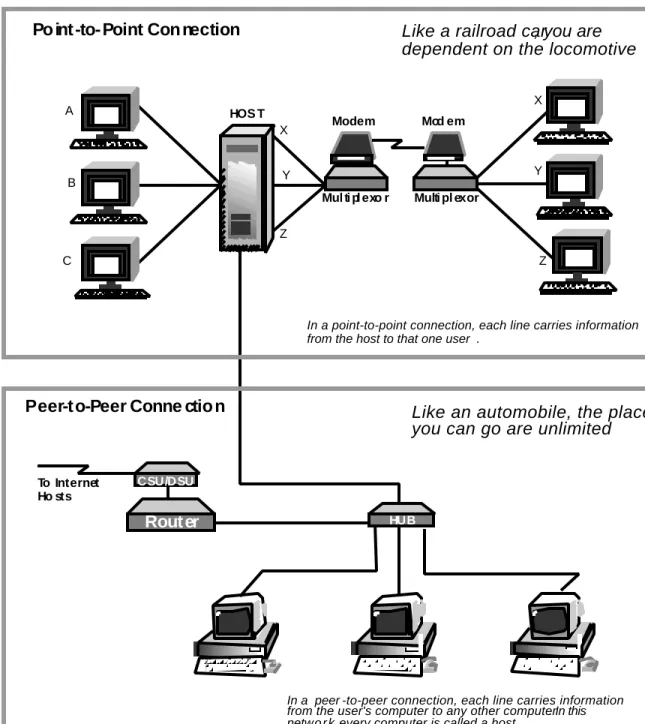
transportation systems, work together to deliver data packets around the world. Today, the physical link connecting two networks can be a full time, point-to-point, dedicated phone line, or a peer-to-peer connection, which are two different types of types of common network arrangements (see Figure 1).
3 See FNC Resolution at http://www.fnc.gov/Internet_res.html
Figure 1. Point-to-Point vs. Peer-to-Peer Connection
Source: Internet: Connectivity Handbook, Carl Grzybowsky, 1994 HUB
Mod em
Multi pl exor Modem
Mul ti pl exo r
X
Y
Z X
Y
Z A
B
C
Rout er
CSU/DSU To Internet
Ho sts
In a point-to-point connection, each line carries information from the host to that one user .
HOS T
In a peer -to-peer connection, each line carries information from the user's computer to any other computer. In this netwo r k, every computer is called a host.
Po int -to- Point Con nection
Peer-t o-Peer Conne ctio n
Like a railroad car, you are dependent on the locomotive
Like an automobile, the places you can go are unlimited
A digital service with bandwidths (speeds) of 56 Kbps or T1 (1.5 Mbps) is the most common type for these dedicated lines (see Figure 2).
Figure 2. Bandwidth Rate of Transmission
100-page book (only ASCII text)
9600 bps 56,000 bps T1
10 seconds
< 2 minutes 14 minutes
Source: NSF: Final report 1987-1995, 1995.
The core technical concept of the Internet is packet switching. A packet is a small amount of digitized data ranging between 50 and 1500 characters in length (depending on the capacity of the network), and with a destination address on the header, which allows it to be put in line with packets from other hosts (computers) and sent in turns down a line. 4 Several packets make up a digital file. Packet-switching technology was proposed about 30 years ago by Bolt Beranek and Newman, Inc. (BBN) as an efficient way of using expensive long-distance
telecommunications circuits (Hauben and Hauben, 1996). Packet switching is a
communications process in which all files are broken up into equal size packets that are transmitted, scattered and then reassembled. In this way, short, medium, and long messages are transferred with minimum delay (Kleinrock, 1976), and the cost of the link is divided among several users.
Packet-switching technology differs from circuit-switching technology—the one used by telephone network. A voice phone line is an analog sound-wave or digital connection that is switched (only in use when you lift the hand set). When you place a call the phone company temporarily connects your circuit to another by setting up a full path from the sender’s telephone to the receiver’s telephone. Packet-switched technology does not set up the entire
4 A link is the physical copper/fiber optics line connecting to computers or routers.
route at once, rather each packet is independent from each other and is moved in steps from one computer to the next until it gets to the final destination.
The use of this circuit-switched system is the most common method for an individual’s computer to dial up to an Internet Service Provider (ISP). There are different types of ISPs (local, regional, and national), which will be illustrated in detail in Chapter 3. For now, it is important to note that commercial on-line providers such as, America On-Line, CompuServe, and Prodigy are certainly a type of Internet Provider, but are not Internet Service Providers (ISPs) in the sense I will use the term ISP in this study. For more detail see Section 3.1.
Just like interstate highways, the Internet uses the telephone’s high bandwidth service for high speed backbones that interconnect many other major networks. The U.S. government began the Internet project back in the early 60’s, funded several networks, and during the 1980’s turned it over to the private sector for provision as part of the U.S. National
Information Infrastructure Program. The government-funded backbones, like the Advanced Research Projects Network (ARPANET) and the National Science Foundation Network (NSFNET), are restricted to education and research.5 Commercial use of the Internet is now driving the growth of the Internet with backbone providers that include MCI, Sprint, AT&T, and WilTel.
2.3. Internet Connectivity
6Businesses, universities, on-line providers, and ISPs among others install and maintain the equipment and routers that direct traffic on the Internet. The number of ISPs has grown significantly over the last five years; at present there are over 3,200 at present.7 In addition, cable companies, telephone companies and other individuals running operations out of their
5 See Chapter 3 for a more detailed description.
6 This section is based on Carl Grzybowsky’s Internet: Connectivity Handbook.
7 Boardwatch Magazine. December 1995.
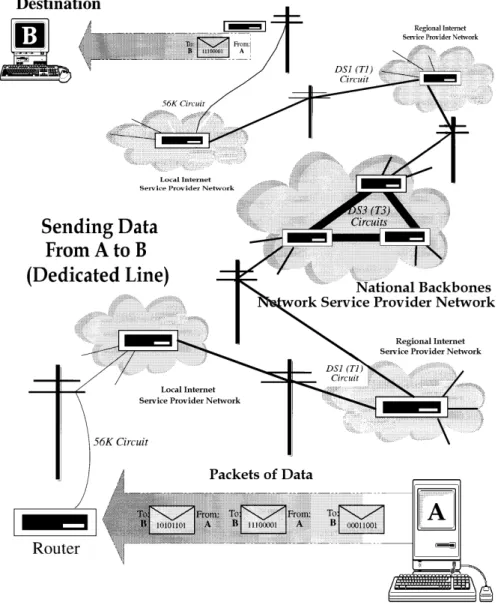
homes have become Internet providers.8 For one computer to send data to another it uses an interface that splits the to-be-transferred file (e.g., an e-mail message) in data packets. Like envelopes sent through the post office, each packet header contains source and destination information. Each packet goes independently from the source computer (home A) to the local ISP’s router (local post office) to the regional ISP’s router to the national ISP’s router (regional and national post offices), and then finally to the regional ISP’s router to the local ISP’s router (local post office) closest to the destination computer (home B).
A packet may take different paths to the same destination, depending on traffic. Or, a packet may never need to get to an ISP’s router. For example, if the destination user is within the same regional ISP’s reach, then packets do not leave to the national ISP’s router, unless bad routing occurs. At the destination ISP’s router, they are checked for accuracy and
reassembled into the file sent. Until now, Internet’s network technology design has been very democratic: All packets are created equal. However, attempts are being made to
recognize real-time packets and move them along more quickly than others that do not require low latency (intensive-bandwidth use) (Staudt, 1996). Given the type of service required (e.g., e-mail, video, telephone-on-the-Internet) and increasing use of low latency (little delay) applications, packet price discrimination (pricing of packets from different applications) may begin to be more common.
When airborne, all pilots in the world are required to speak English. In the same way, a common standardized communication protocol allows different kinds of computers using different operating systems to communicate with each other over the Internet. This protocol is called TCP/IP. The Transmission Control Protocol (TCP/IP) contains rules to divide large files into smaller packets at the same source and reassemble them later at the destination. The Internet Protocol (IP) contains the rules that manage the addressing scheme to deliver streams
8 Do not confuse the term Internet provider, which refers to all entities providing access to the Internet, with the term Internet Service Provider (ISP), which refers to one type of Internet provider.
of packets from one computer to another.9 Inside the package are instructions relating to the purpose of the transmission. Like pigeon holes, ports identify the type of application, i.e., E-mail, gopher, FTP, HTTP, and Telnet (see Figure 3).
9 New protocols, such as the ATM/SONET protocol, currently used by big capacity routers, are evolving, but in the end they will all serve the same purpose: connect computers.
Figure 3. Data Transport Sketch
Source: Carl Grzybowsky, 1994.
2.4. Internet Uses
Why would I want to use the Internet? The reason why people use the Internet is because it is an affordable means to other goods such as, a fax, a telephone call, a library, a video game, a magazine, a newspaper, a book, etc.
2.5. Internet Services
What service can I get? An individual can use the Internet to obtain uses that include:
• Mail service
• Advertising
• Contacting people
• News
• Research
• Entertainment.
Therefore, Internet substitutes include the postal service, newspapers, magazines, telephone, libraries, VCRs, movies, and books.
2.6. Common Internet Tools
Despite the Internet’s presumed anarchic system, standards or protocols allow the Internet to interconnect different computer brands for various purposes. Internet tools, such as e- mail, FTP, Telnet, Gopher, and WWW use specific protocols that allow computers to be compatible with each other. At present, all these Internet tools use one single protocol—the
TCP/IP—to transit the Internet. Other protocols are used in certain stretches, but TCP/IP is the most common one.
2.6.1. E-Mail
Electronic mail programs may use protocols, such as SMTP (Simple Mail Transfer Protocol), POP (Post Office Protocol), IMAP (Interactive Mail Access Protocol). Electronic mail is a communications tool that allows messages to automatically be passed from one computer user to another, often through computer networks and/or via modems over telephone lines.
An electronic message usually begins with several lines of headers giving the name and
electronic mail address of the sender and recipient(s), the time and date when it was sent, and the subject. There are many other headers that may get added by different message handling systems during delivery. The message is eventually delivered to the recipient’s mailbox; a file which can be read by using a mail reading program. Common e-mail applications include:
Pine, Eudora, Pegasus, and Netscape.
2.6.2. File Transfer
File transferring is based on the FTP—File Transfer Protocol—which allows a user on one computer to transfer files to and from another computer over a TCP/IP network. These files can be any type of digitized data: Text, pictures, voice, and video. Common FTP
applications include, Win Sock FTP, UNIX FTP, and FSP.
2.6.3. Telnet
Telnet is the Internet standard protocol for remote login (access to a computer), which runs on top of TCP/IP. Some Telnet applications include: Lynx, Unix Telnet, Novell Telnet and Netscape. Telnet accessing allows the user to run commands and perform tasks while not being physically present at the accessed computer.
2.6.4. Newsgroups
Newsgroups option is based on the NNTP (Network News Transfer Protocol), a distributed bulletin board system supported mainly by Unix machines and the people who post and read articles thereon. Originally implemented in 1980 by Steve Bellovin, Jim Ellis, Tom Truscott, and Steve Daniel at Duke University, it has swiftly grown to become international in scope and is now probably the largest decentralized information utility in existence. Some
newsgroup applications include: News X, Gopher, Netscape, and Mosaic.
2.6.5. Gopher
Gopher accessing users the Gopher protocol, and it is a document retrieval system that started as a Campus Wide Information System at the University of Minnesota. Despite its graphic limitations, many hosts on the Internet still run Gopher servers which provide a menu of documents. A document may be a plain text file, sound, image, sub-menu or other Gopher object type. It may be stored on another host or may provide the ability to search through certain files for a given concept. Some Gopher applications include: Gopher, Lynx, Netscape, and Mosaic.
2.6.6. World Wide Web
It is uses the HyperText Transfer Protocol (HTTP). World Wide Web (WWW) is an Internet HyperText distributed information retrieval system that originated from the European Laboratory for Particle Physics (CERN) in Geneva, Switzerland. On the WWW everything (documents, menus, indices) is represented to the user as a HyperText object in HyperText Markup Language (HTML) format. HyperText links refer to other documents by their Uniform Resources Locators (URLs) to connect to other places. These can refer to local or remote resources accessible via FTP, Gopher, Telnet or news, as well as those available via the HTTP protocol used to transfer HyperText documents. Some WWW applications include: Lynx, Netscape, and Mosaic.
On of the most interesting features of the World Wide Web is that it supports what is termed Home Pages. A home page is a file written on a sub-directory of an Internet host normally dedicated to the support of home pages only. A home page is the entry point for other users to start browsing the information that the owner of that home page has authored by using HTML. From the home page, Internet users are able to follow links to other sources of information that the owner has posted. Typically, home pages contain:
• A formal resume to be accessed by potential employers,
• Pictures of people or interesting objects,
• Links to other favorite sites on the Web to visit,
• Addresses, telephone numbers, or e-mail addresses to access the home page author,
• Other personal information that the author may want to share with home page readers.
2.7. Common Ways To Access The Internet
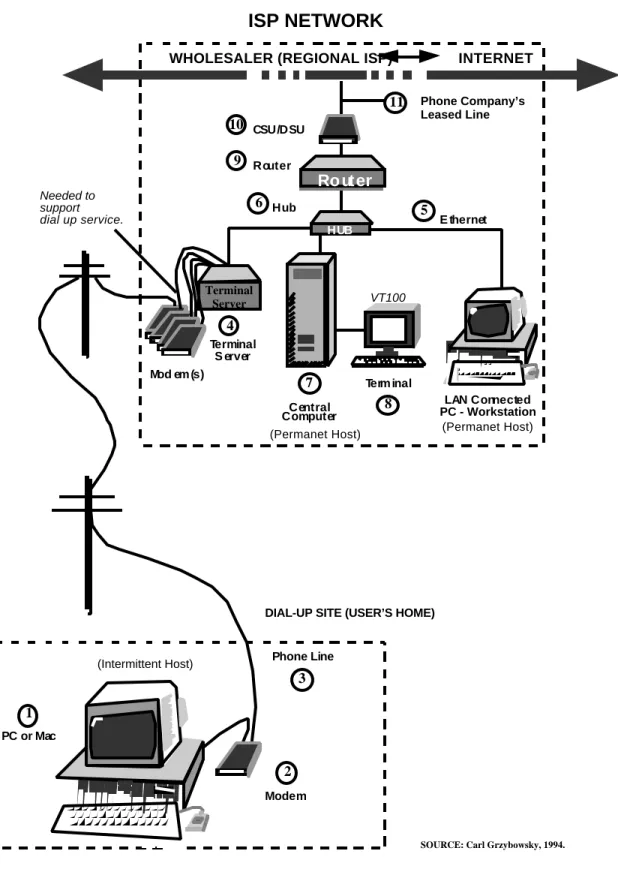
10It is possible to conceptualize Internet access in several ways. One useful approach is to compare dial-up versus leased line connections. Dial-up access is typically associated with relatively low-speed (2400 to 28,800 bits per second) connection available using a modem with an ordinary phone line. However, ISDN (integrated services digital network) high-speed dial access is being implemented in some areas supporting 128,000 bits per second data transfer rates. Leased-line access is most often associated with leased point-to-point circuits that connect the user’s location (LAN) with the Internet provider’s network (ISP). For the following description refer to Figure 4.
10 This section is based on Carl Grzybowsky’s Internet: Connectivity Handbook, 1994.
Many new high-speed leased line connections are being introduced that may prove even more cost-effective than simple leased lines. Some of them include, frame relay, SMDS (switched multi-megabyte data service), and ATM (asynchronous transfer mode). These leased services vary greatly in capacity (speed of service), price, and how they are billed. Often there will be multiple communication charges assessed. For example, there may be a fixed monthly fee for the “local loop”—a point-to-point connection from the ISP’s network to the vendor’s service point-of-presence (wholesaler or regional ISP), and an additional monthly charge (fixed or variable) for the switched service (phone company’s leased line).
2.7.1. Dial-up Internet Connections
All of the communication alternatives referenced above can be configured to support a variety of Internet service requirements. However, low-speed and relatively low-cost dial-up access is typically associated with supporting either one or a small number of
terminals/workstations. The equipment necessary for this type of connection includes a computer, a modem, and a phone line. The phone line does not have to be “data grade,” a regular voice grade line is usually adequate. Telecommunications software, which is usually bundled with the modem, distributed as freeware or shareware, or available at low cost, is also required. Three types of service often associated with dial-up access are:
2.7.1.1. Terminal Access (via vendor-provided host VT-100 shell accounts).
The computer workstation runs software that allows it to emulate a terminal. The terminal accesses a vendor-provided host computer connected to the Internet. The Internet protocol known as TCP/IP stops at the host. Therefore, it is not very useful. Because TCP/IP does not reach all the way to the computer workstation, the user will not be able to use graphical applications such as, Netscape or Mosaic with a terminal connection. Users also will not be able to use packet video teleconferencing, which requires TCP/IP all the way to the desktop.
However, users will be able to use the WWW through text-based browsers like Lynx or “The Internet Adaptor” (TIA). Furthermore, users will be able to use the entire Internet suite of tools: Electronic mail, Telnet, FTP, Gopher, WWW, and others. Pricing options include both a flat fee with unlimited connect time and a monthly charge plus connect time services.
2.7.1.2. Workstation SLIP (Serial Line Internet Protocol) or PPP (Point to Point Protocol) Access.
These types of connections give a computer workstation its own Internet address. This makes the computer an Internet host running TCP/IP (for the duration of the connection11).
Unlike terminal access, SLIP and PPP allow users to use graphical Internet tools such as video teleconferencing and multimedia access to the WWW. SLIP and PPP connections have become more accessible for Windows or Macintosh users.
It is possible for multiple workstations on a local area network (LAN) to share a SLIP or PPP dial-up connection, allowing several users to access the Internet simultaneously. With this connection, more than a handful of concurrent users can slow network speed to the point where it is of dubious value. Pricing of SLIP and PPP connections is similar to that of terminal accounts, using both flat fee with unlimited connect time and monthly charge plus connect time models.
2.7.1.3. Internet Gateway Access (via commercial on-line provider).
Some commercial on-line services (e.g., America On-Line, Prodigy, or CompuServe) offer users a graphical interface (dial-up connection) through a terminal connection to the Internet.
Sometimes while using this access type, users have only an e-mail gateway. In other
11 Unlike a direct connection, where a computer is a permanent Internet host, through SLIP/PPP dial-up a computer turns into a temporary Internet host.
instances, users may be able to use the service provider’s Gopher, but not use other, off-site gophers around the world. Or perhaps users will not have access to the WWW or FTP.
Most of these types of dial-ups will not provide TCP/IP all the way to the desktop, so packet video and other applications requiring TCP/IP will not work in this configuration. As ISDN services become available, dial-up connectivity will be able to support some of the more robust connection alternatives described below.
2.7.2. Leased Line Internet Connections
Leased line access describes a variety of communication services. This type of connection typically requires a dedicated point-to-point communications circuit from the service
provider’s network (ISP) to the user’s LAN.12 The user pays the ISP a monthly fee for this line plus initial installation charges. Typically, the ISP will get in charge of paying any additional fees to the phone company on behalf of the user, so the user needs to deal only with the ISP. The lines come in various speeds or bandwidth, such as 56K (56,000 bits per second) or T1 (1.5 million bits per second). The user will generally need some special CPE (or customer premise equipment), called a CSU/DSU, to use this service. A special type of communications port may also be required for the library’s computer or router.
This type of connectivity will almost always include TCP/IP or similar protocols, which will allow the user to run sophisticated software, use packet video, and operate Gopher or WWW tools, which would reside in his own machine. Generally there are no connect time charges, but this is not always the case. Computers connected to the user’s local area network (LAN) can use the Internet at the same time. Two common types of connectivity associated with leased line service are:
12 Recall the set-up of a LAN is similar to that of an ISP, except that it is only the ISP network that connects directly to the Internet (through a wholesaler or regional ISP).
2.7.2.1. OPAC Gateways
A number of on-line public access catalog (OPAC) vendors now include an Internet gateway as part of the OPAC. For example, a user at an OPAC terminal might encounter a menu of Internet services such as Telnet, FTP, Gopher sites, or other applications would appear. The user then selects the desired application from the menu. As with terminal shell accounts, users are limited to text-based Internet tools (TCP/IP is usually not passed to the desktop).
When graphical user interfaces (GUI) are offered, they are typically proprietary to the OPAC vendor.
Developments in this type of connectivity are occurring rapidly. Many new applications and gateways are appearing as of this writing. To some degree Internet-based OPAC
gateways are a “turnkey” solution (providing both software and hardware) for large users that may want connectivity and services without managing the connection directly themselves.
Use of this type of connectivity, however, makes the user very dependent on the vendor and the degree to which the vendor will upgrade and support the system for the specific needs of the user.
2.7.2.2. Local Area Network (LAN) Access.
Other large users have installed LANs to provide computer workstations with shared access to CD-ROMs. A user can install an Internet gateway router to connect these LANs to the Internet. Computer workstations can be configured to support TCP/IP and will be able to access the full range of Internet services via the LAN’s gateway router. This configuration would also be capable of supporting Internet Gopher or WWW servers—making their content available not only to directly to the connected patrons but to remotely (dial-up) connected Internet subscribers as well.
2.8. Hardware and Software Components
From here on, I will focus the description only on the types of connections between an individual (end-user) and an Internet provider (ISP). The hardware and software required for a connection depends on the type of access selected by the user. They mainly enjoy two types of Internet access: A dial-up connection and a dedicated line connection. These methods will be detailed in the next section. However, it is worth noting that while dial-up connection links a user (computer-phone line-modem) to the ISP’s network; a dedicated or direct connection links a user’s Local Area Network (LAN) to the Internet. The latter allows larger speeds of transfer than the former.
If an individual selects a dial-up connection, then minimum hardware is required. If an
individual decides to be an ISP or connect his LAN to the Internet then additional hardware is required. Here I will show some basic set-ups for these two types of connections. Notice that the set-up of a user’s LAN is similar to that of an ISP. In fact, this is the reason why I will argue that businesses and universities are a type of Internet provider. See Figure 4 for an illustration.
Figure 4. Internet Service Provider (ISP) Network with a Dial-up Connection
9
Ro ut er
E thernet
Mod em (s)
Central Computer
Term inal
LAN Connected PC - Workstation
Modem HUB Router
CSU/DSU
Hub
Terminal S erver
PC or Mac
DIAL-UP SITE (USER’S HOME) VT100 Needed to
support dial up service.
Phone Line
10
6 5
4
7
1
3
2
8
Terminal Server
ISP NETWORK
SOURCE: Carl Grzybowsky, 1994.
WHOLESALER (REGIONAL ISP) INTERNET
(Permanet Host) (Permanet Host)
(Intermittent Host)
11 Phone Company’s Leased Line
2.8.1. Minimum Hardware Requirements
The following minimum computer hardware is necessary for the dial-up connection.
1 . PERSONAL COMPUTER
The computer consists of a monitor, Central Process Unit (CPU), keyboard and often a mouse. Most common personal computers connected to the Internet are IBM-
compatible and Macintosh, which can be connected in two ways: (1) Remote (dial-up), via a modem and phone line, or (2) direct, via a network interface card. A computer directly connected to the ISP network is a permanent host. A computer remotely connected to the ISP network is an intermittent host, as it's on only during dial-up. For example, the computers at a university’s computer lab are often permanent hosts, and an individual user connecting through a modem from his home is an intermittent host.
2 . MODEM
Modulator/demodulator: An electronic device for converting between serial data from a computer and an audio signal suitable for transmission over telephone lines. In one scheme the audio signal is composed of silence (no data) or one of two frequencies representing 0 and 1. Modems are devices that allow computers to make a call and send data by sound waves over standard voice grade telephone lines. A pair of modems is needed for computers to communicate. Modem speeds vary and the connection speed is determined by the slowest modem of the pair.
3 . PHONE LINE
Just like any other call m