Analysis of Dunc-13 and its role in establishing ethanol tolerance in Drosophila Melanogaster. Alcohol abuse is one of the most prevalent and costly forms of drug abuse in the United States. Characterizing the physiological development that contributes to increased tolerance to ethanol is therefore of critical importance to families worldwide, as tolerance plays such an important role in the development of alcoholism.
This interaction results in depression of the nervous system due to a net reduction in synaptic output. In addition, membrane mass lipids are implicated in the development of sensitivity and tolerance to ethanol (RAO 1991). Flies were included in the test until 90% of the flies in one of the vials had LOR.
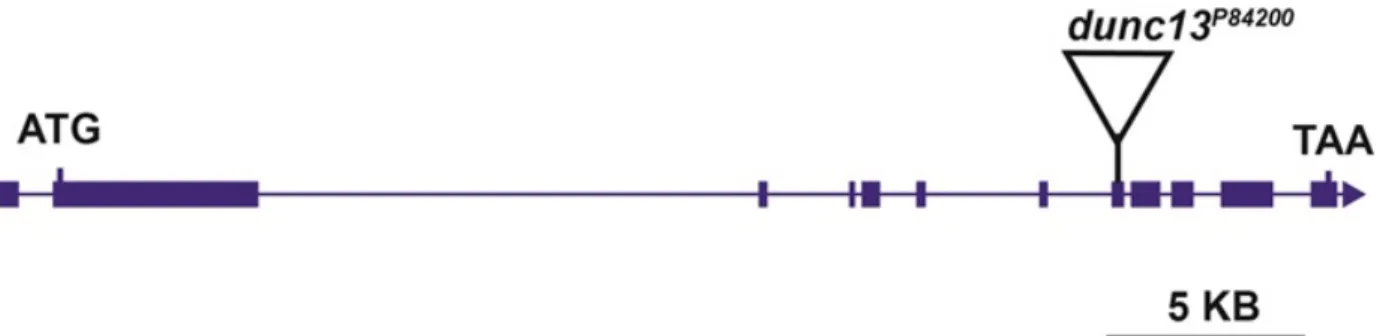
The element was inserted at nucleotide 2441, which is at the end of the first C2 domain of this protein. FlyBar diagram detailing the setup of the device used to induce sedation (van der Linde, Fumagalli et al. 2014).
Results
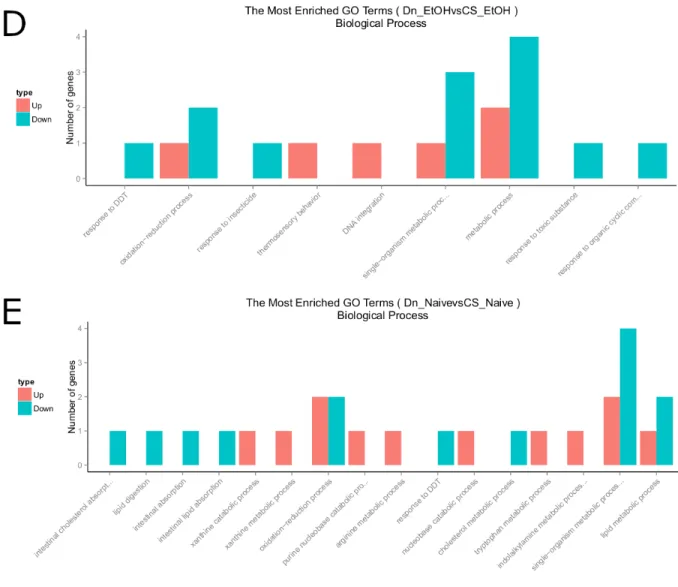
Previously exposed CS flies and naïve Dunc13P84200/+ heterozygotes had 1087 genes that were differentially upregulated and 87 genes that were differentially downregulated (Figure 5A; Appendix). Previously exposed CS flies and naive CS flies had 41 differentially up-regulated genes and 99 genes that were differentially down-regulated (Figure 5C). CS and Dunc13P84200/+ heterozygotes, both previously exposed to ethanol, had 4 genes that were differentially up-regulated and 6 genes that were differentially down-regulated (Figure 5D).
Naive CS flies and naive Dunc13P84200/+ heterozygotes had 6 different genes that were up-regulated and 7 that were down-regulated ( Figure 5E ). A total of 1281 unique genes were identified that were differentially expressed between all four classes of flies tested. Genes responsible for the stress response were among the genes most differentially expressed between previously exposed and naïve CS flies.
Conversely, most of the genes differentially expressed between previously exposed CS flies and naive Dunc13P84200/+ heterozygotes were upregulated, with genes affecting proteolysis and transmembrane transport being the most abundant (Figure 6C). Many of the differentially expressed genes found between previously exposed Dunc13P84200/+ heterozygotes and previously exposed CS flies affected metabolic processes (Figure 6D).
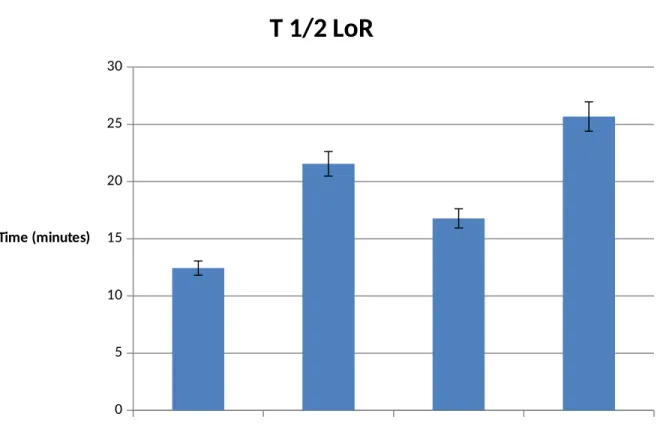
T 1/2 LoR
Time (minutes)
These values represent the amount of time it takes for 50% of flies to lose the righting reflex for each condition. Volcano plots of differentially expressed genes derived from mRNA samples collected from 4 classes of flies, where the X-axis represents the fold change in gene expression between samples, and the Y-axis represents the significance of the differential gene expression. Card titles labeled Dn_Naive for Dunc13P84200/+ naive flies, Dn_EtOH for previously exposed Dunc13P84200/+ flies, CS_EtOH for previously exposed Canton-S flies, and CS_Naive for naive Canton-S flies.
GO terms are derived from bioinformatics collected from a wide range of species (Young, Wakefield et al. 2010). This enables a unified representation of the molecular processes affected by a specific gene from a separate species. The biological process affected by the differentially expressed genes is plotted on the Y-axis, and the number of genes for each process is plotted on the X-axis.
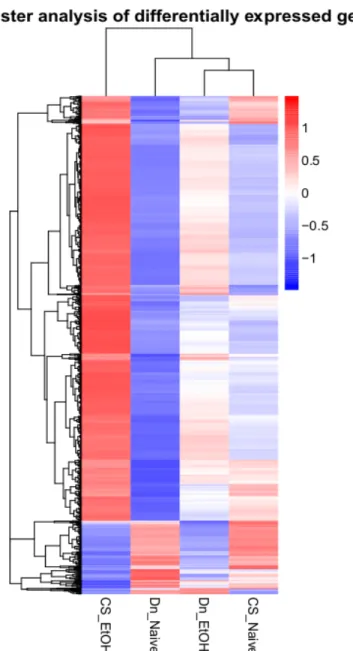
A heat map where genes that have similar expression patterns are clustered with regions of different colors indicating the relative expression levels of those gene groups. Chart titles label Dn_Naive for naive Dunc13P84200/+ flies, Dn_EtOH for pre-exposed Dunc13P84200/+ flies, CS_EtOH for pre-exposed Canton-S flies, and CS_Naive for naïve Canton-S flies.
Discussion
A role for Dunc13 in ethanol tolerance formation
Transcriptional responses to ethanol in wildtype flies
In the Morozova experiment, fly heads were collected 2 hours after the last exposure to ethanol, rather than the 4 hours used in this experiment. In the Kong experiment, flies were exposed to ethanol-saturated air for 30 min and allowed 4 h to recover before RNA was extracted. However, the role that several of these genes play in the responses to ethanol is confirmed by the process of identification across several similar studies.
The Effect of Dunc13 mutations transcriptional responses to ethanol
The function of many of the differentially expressed genes fits the context of alcohol exposure in that these genes play a role in the stress response. The high number of genes that play a role in transmembrane transport that were observed to be upregulated in the previously exposed CS vs. This may be due to the time at which the mRNA was extracted from the fly heads, as different genes may experience a different transcription course at different times.
Notably, ry expression was observed to be different in the 2 analyzes comparing naive Dunc13P84200/+ heterozygotes with naive CS and tolerant CS flies. Slowpoke was expected to experience differential expression as this protein has been shown to be required for the acquisition of tolerance (Cowmeadow, Krishnan et al. Although not initially observed to be differentially expressed, this may be due to alternative splicing events that created an isoform of the mRNA , who were not.
Dunc13P84200/+ heterozygotes appear to be much less responsive to ethanol, as gene expression in naïve Dunc13P84200/+ heterozygotes starts quite low. This may be similar to a phenomenon observed in chronic alcoholics, in that they require the administration of ethanol to return to a set point of normality, as their brains are highly adapted to the presence of this substance (Gilpin and Koob 2008). The heat set profile of previously exposed Dunc13P84200/+ heterozygotes is much closer to that of naive CS flies, which may be a demonstration of the effects of the counter-adaptive theory of drug tolerance, where adaptations arising in response to a drug cause the withdrawal symptoms associated with drug withdrawal (Eddy, Halbach et al.
This can be compared to the physiology of a neuron beginning to adapt to the presence of ethanol in the case of flies previously exposed to CS, which would require the synthesis of proteins to help counteract the effect of ethanol on the nervous system. Gene expression patterns are significantly increased when CS flies are exposed to ethanol, as shown by comparison with the heat naive CS group.
Summary
The societal benefits that could come with this discovery are immense, as the propensity to become an alcoholic would be reduced, thus alleviating much of the suffering that this condition unfortunately entails.
Future Work/Unanswered Questions
Further, slowpoke might be expected to be expressed differently because this gene has been shown to be necessary for the acquisition of tolerance. Since wild-type CS flies can acquire tolerance after an ethanol exposure, the slo gene is expected to be differentially expressed when CS-exposed flies are compared to CS-naive flies. This gene was also not found to be differentially expressed in the Kong, Morozova, or Urizar experiments (Morozova, Anholt et al. 2006, Kong, Allouche et al. 2010, Urizar, Yang et al. 2007).
Slowpoke expression peaks between 21 and 24 h after ethanol exposure, which matches the time frame during which RNA was collected from the flies used in the Urizar experiment (Cowmeadow, Krishnan et al. 2006). Perhaps this gene could be located by searching for a specific slow promoter responsible for neuronal expression. Dunc13 expression could be further elucidated by collecting more sequences at a different time point after ethanol exposure.
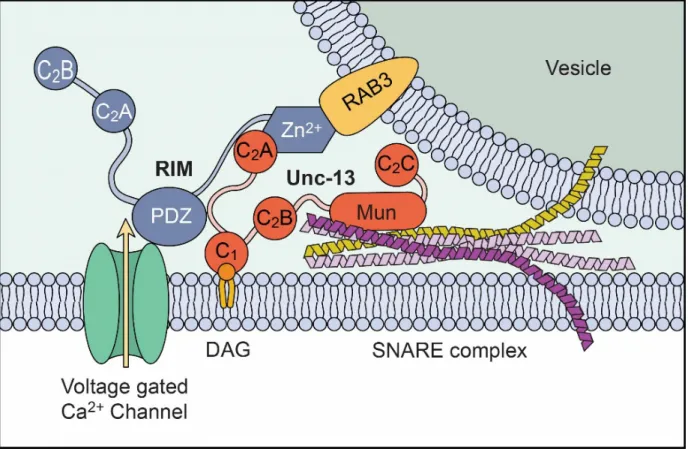
We used a four-hour time point, so if the induction of slowpoke expression after ethanol exposure occurs later, we may have missed this in our experiment. Furthermore, it would be interesting to see whether introducing a mutation in Dunc13 into the C1 domain of this protein would reduce the magnitude of ethanol resistance observed in Dunc13P84200/+ heterozygotes. Alcohol binds to the C1 domain of this protein, and by replacing a glutamate residue present in the C1 domain of Munc13-1 with histidine, alanine or leucine residues, alcohol binding is reduced (Das, Xu et al. 2013 ).
If this amino acid substitution alters the ethanol resistance phenotype observed in Dunc13P84200/+ heterozygotes, further investigation may provide a more meaningful basis.
List of References
34; Ethanol-regulated genes contributing to ethanol sensitivity and rapid tolerance in Drosophila." Alcoholism, Clinical and Experimental Research.
Appendix
CS EtOH vs CS Naïve Down Regulated Genes
CS EtOH vs CS Naïve Up Regulated Genes
CS EtOH vs Dunc – 13 Naïve Down Regulated Genes
CS EtOH vs Dunc – 13 Naïve Up Regulated Genes
Dunc – 13 EtOH vs CS EtOH Down Regulated Genes
Dunc – 13 EtOH vs CS EtOH Up Regulated Genes
Dunc – 13 EtOH vs CS Naïve Down Regulated Genes
Dunc – 13 EtOH vs CS Naïve Up Regulated Genes
Dunc – 13 Naïve vs CS Naïve Down Regulated Genes
Dunc – 13 Naïve vs CS Naïve Up Regulated Genes