In light of their growing importance, this paper aims to analyze the role of bilateral investment treaties in Sino-Latin American relations. Overall, the paper finds that the normal motivations for Chinese investment in Latin America do not apply to the signing of bilateral investment treaties. One of the most significant codifications of China's growing influence in Latin America has been the growth of bilateral investment treaties.
Since 1992, China has signed twelve different bilateral investment treaties with various Latin American countries (United Nations Conference on Trade and Development). This article attempts to answer two questions related to the importance of bilateral investment treaties in the China-Latin America relationship. The second question this article aims to answer is more fundamental: are bilateral investment treaties important instruments for Chinese investment and influence in Latin America?
In the qualitative section, bilateral investment treaties are critically analyzed to gain a deeper understanding of Sino-Latin American economic relations. In light of this, this paper assumes bilateral investment treaties as an indicator of China's and Latin American countries' mutual commitment to investment.
HYPOTHESES
Furthermore, I argue that signing a bilateral investment treaty means committing to higher levels of trade and investment. This postulation follows from the evidence presented in my literature review showing China's investment motivations as well as the importance of bilateral investment treaties. Therefore, since resource-rich countries with leftist governments should be attractive targets for Chinese investment, they should sign bilateral investment treaties with China more quickly.
METHODOLOGY
Another method to test the speed with which the bilateral investment treaties between China and Latin American countries were signed is the Kaplan-Meier Survival Estimate. This descriptive method displays in the analysis a graph of the percentage of Latin American countries that have signed a bilateral agreement. These 262 observations represent every year in which it was possible that a Latin American country had signed a bilateral investment treaty with China.
In this case, the spells represent the period in which any Latin American country could sign a bilateral investment treaty with China. The dependent variable in this study will be the time from China's economic opening in 1978 to the country signing a bilateral investment treaty with a Latin American nation. This is determined using the United Nations Conference on Trade and Development Data and includes data from twelve Latin American countries.
Time was chosen as the dependent variable in this study because it allows comparison between the different Latin American countries. The first of these is whether or not the Latin American country is a major oil producer. The second of these two specific natural resources variables measures whether or not the Latin American country is a major mineral producer.
The fourth independent variable in this study is the political identity of the Latin American countries. Baker's research assigns Latin American political candidates ideological scores on a scale of 1-20 (1 being ultra-left and 20 being ultra-right) by analyzing the candidates' voting behavior. The last independent variable in this study is whether or not the Latin American country has a bilateral investment agreement with the United States.
Using all these independent variables, this quantitative study seeks to investigate the important factors that contribute to the signing of bilateral investment treaties between China and Latin American countries.
QUANTITATIVE DATA ANALYSIS
Mainly, it can be observed that the majority of Latin American countries receiving FDI from China have a bilateral investment treaty in force. Rather surprisingly, however, the two largest recipients of China's FDI in Latin America, Brazil and Venezuela, do not have a bilateral investment treaty with China. This is notable because it runs counter to both the conventional wisdom and empirical evidence surrounding the relationship between BITs and FDI.
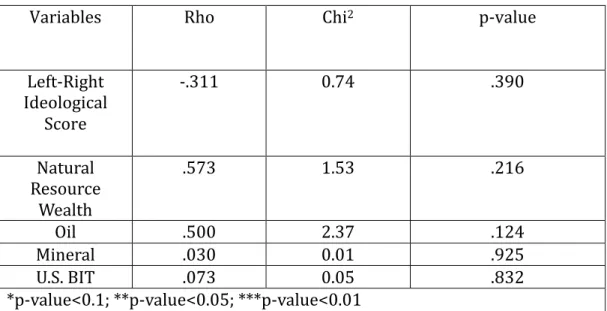
Three of the top five recipients do not have a bilateral investment treaty, including the largest recipient, Panama, calling into question their importance. Cox's proportional hazards model is used in this paper to examine in more detail the motives for forming a bilateral investment treaty. As explained in the methodology, the model analyzes the effect of various independent variables on the probability that a Latin American country will sign a bilateral investment treaty with China.
First and foremost, the two primary theoretical motivations for Chinese investment, leftist ideology and natural resource wealth, are not associated with a greater likelihood of signing a bilateral investment treaty. Neither "Left-Right Ideological Score" nor "Natural Resource Wealth" is statistically significant in affecting the likelihood of signing a bilateral investment treaty. Countries that have a bilateral investment treaty with the United States experience an increase in the likelihood of signing a bilateral.
This could seemingly indicate that some countries simply prefer to sign bilateral investment treaties in general, while other countries are more reluctant or prefer different investment strategies. The much more likely second explanation for the model's results is that bilateral investment treaties are not accurate predictors of increased investment, at least when it comes to the Chinese-Latin American economic relationship. In fact, the results of the Cox Proportional Hazards analysis are more consistent with the earlier, less sophisticated data analysis in this article, which noted that several of China's top recipients of foreign direct investment have not signed a bilateral investment treaty with China.
If it is true that bilateral investment treaties are not important tools for increasing trade and investment between China and Latin America, then some fundamental questions remain: Why do bilateral investment treaties exist in Sino-Latin American economic relations?

CASE STUDIES Method of Qualitative Analysis
Of course, the significant economic engagement between the two countries raises the question: why do they still lack a bilateral investment treaty? Perhaps the simplest explanation for the lack of a bilateral investment treaty between China and Brazil is that it is simply unnecessary. However, research suggests that there are other factors, from both the Chinese and Brazilian perspectives, that contribute to the lack of a bilateral investment treaty between the two countries.
Unlike Brazil, Bolivia signed and ratified a bilateral investment treaty with China in the early 1990s, well before the development of their international partnership. In an interesting twist, China's bilateral investment treaties in Latin America serve as a kind of symbolic counterpoint to the traditional U.S. As we will see in the following analysis, China's bilateral investment treaties employ several unique features that have political and economic significance. .
In 2014, political analyst and China expert Amos Irwin made an interesting discovery about China's bilateral investment treaties in Latin America. Until 1998, China's bilateral investment treaties had prohibited foreign investors from suing their host governments in international arbitration courts. In light of these developments, this case study will examine the bilateral investment treaties of two Latin American countries: Ecuador and Colombia.
Ecuador signed its bilateral investment treaty with China in 1994, while Colombia did not sign one until 2008. The first significant distinction between Ecuador's and Colombia's bilateral investment treaties is in their respective obligations. Thus, the lack of a national treatment clause in the China-Ecuador bilateral investment treaty is striking.
However, the lack of a national treatment clause is far from the only difference in the two countries' bilateral investment agreements. Throughout this analysis, it appears that Colombia has a superior bilateral investment treaty with China compared to the Ecuadorian treaty. Once again, the level of foreign direct investment from China in the two countries challenges the notion that more and better bilateral investment agreements lead to greater investment.
CONCLUSION
While the findings in this paper do not directly contradict the general causal theory of the factors motivating Chinese investment in Latin America, they offer a twist to the conventional narrative of BITs. Large deposits of rare earth minerals and radical leftist governments may lead to greater Chinese investment, but do not seem to lead to Chinese investment deals. This finding is interesting because it casts doubt on the effectiveness of bilateral investment treaties as a method of increasing investment.
In other words, if signing a bilateral investment treaty does not lead to higher levels of investment, then what is the point of doing so. Future researchers could examine the efficacy of bilateral investment treaties between China and the rest of the world (especially in Africa, where Chinese investment has fueled similar hypotheses regarding natural resource extraction). It would also be valuable to analyze whether bilateral investment treaties are more effective in certain regions of the world.
It is likely that BITs are a useful tool for Western countries but have limited applicability for Asian, African and Latin American countries. In conclusion, the research conducted in this paper provides a starting point for a more detailed examination of bilateral investment treaties and their role in shaping the future global economy. Campello, Daniel & Leany Lemos “Nonratification of Bilateral Investment Treaties in Brazil: A Story of Conflict in the Land of Cooperation”, Review of International Political Economy.
Do bilateral investment treaties increase foreign direct investment to developing countries?” LSE Research Online, February 34; China in Latin America: Lessons for South-South Cooperation and Sustainable Development." The China-Latin America Axis, Boston University, April Energy Information Administration - EIA - Independent Statistics and Analysis." China Overtook United States as World's Largest Crude Oil Importer in 2017 - Energy Today - US
Do bilateral investment treaties lead to more foreign investment?” Investment Treaty News, International Institute for Sustainable Development, 30 Apr.