ANNALS OF THE SOUTH AFRICAN MUSEUM ANNALE VAN DIE SUID-AFRIKAANSE MUSEUM
Volume
69Band June
1976Junie Part 11 Deel
ISOPODAN AND TANAIDACEAN CRUSTACEA FROM THE ST PAUL AND AMSTERDAM ISLANDS,
SOUTHERN INDIAN OCEAN
are issued in parts at irregular intervals as material becomes available
word uitgegee in dele op ongereelde tye na beskikbaarheid van stof
OUT OF PRINT/urr DRUK
1,2(1,3,5-8), 3(1-2,4-5, t.-pj.), 5(1-3, 5,7-9), 6(1, t.-p.L), 7(1-4), 8,9(1-2), 10(1), 11(1-2, 5, 7, t.-p.L), 15(5),24(2),27, 31(1-3), 33
Price of this part/Prys van hierdie deel R5,OO
Trustees of the South African Museum © Trustees van die Suid-Afrikaanse Museum 1976
Printed in South Africa by The Rustica Press, Pty., Ltd., Court Road, Wynberg, Cape
In Suid·Afrika gedruk deur DieRustica-pers, Edms., Bpk., Courtweg, Wynberg, Kaap
ISOPODAN AND TANAIDACEAN CRUSTACEA FROM THE ST PAUL AND AMSTERDAM ISLANDS, SOUTHERN INDIAN OCEAN
By
BRIAN KENSLEY
South African Museum, Cape Town (With 26 figures)
[MS accepted26February 1976]
ABSTRACT
A collection of land and marine Isopoda and Tanaidacea from the St Paul and Amsterdam Islands, southern Indian Ocean, is dealt with. Three species of tanaids and thirty-four species of isopods are discussed. Of these, seven new species are described, viz.Eisothistos crateris, Panathura amstelodami, Cymodocella sapmeri, Munnogonium subtilis, Coulmannia unicornis, Echinomunna uroventralis, and 1anisera trepidus. The latter species belongs to the new genus Ianisera, while a species of Janira, viz.J. angusta Barnard, is transferred to the new genus laniroides. The isopod fauna is analysed into zoogeographical components. It is shown that there is a strong endemic fauna (27%), as well as a South American/Antarctic/Subantarctic and a widespread component, but by far the largest component (35 %) is that group common to the islands and South Africa (mostly the west coast of South Africa). It is concluded that the isopod fauna of the St Paul and Amsterdam Islands falls into the cold-temperate faunal category with strong affinities to the fauna of South Africa.
PAGE
Introduction. 261
Review of published work . 262
Species list . 263
Station list . 268
Systematic discussion . 271 Zoogeographical discussion 318
Acknowledgements . 321
References . 321
During 1971-2, a research programme centred on the St Paul and Amster- dam Islands was sponsored by Terres Australes et Antarctiques, with the logistic support of the Societe Anonyme de Peche Maritime et de Ravitaille- ment (S.A.P.M.E.R.). As part of this programme, J. Beurois of the Station Marine d'Endoume et Centre Oceanographie, Marseille, made extensive collections of invertebrates from these islands, both intertidally and subtidally.
The marine and the few terrestrial isopods collected were submitted to the author for identification. The following is an account of the species found, with a discussion of their zoogeographical implications. Most of the type specimens are deposited in the Paris Museum of Natural History. A few para- types are deposited in the South African Museum, and are designated 'SAM'.
REVIEW OF PUBLISHED WORK ON ISOPODA FROM THE ST PAUL AND AMSTERDAM ISLANDS
The St Paul and Amsterdam Islands, situated at 38.438, 77.32E and 37.55S, 77.40E respectively (see fig. 1), almost midway in the southern Indian Ocean, and just north of the Subtropical Convergence, have been visited by biologists at infrequent intervals. The Austrian frigate Novara called at the islands during its circumnavigation of the earth in 1857-9. A preliminary report on the isopods by C. Heller was published in 1861, while the full report appeared in 1865. This dealt with five species of isopods and one tanaid: Idotea nitida, Clean tis granulosa, Porcellio paulensis, Sphaeroma per/orata, Cirolana rugicauda and Tanais gracilis.
Brocchi (1877) reported on a collection of isopods made by Velain and d'Lisle during the French mission sent to observe the passage of Venus. Nine species were dealt with, viz. Idotea nitida, Porcellio paulensis, Sphaeroma per/orata, Sphaeroma tuberculata, Cymodoce picta, Cirolana rugicauda, Rocinela major and Cymothoa gadorum. This material, unfortunately, cannot be located and must be presumed lost.
The German South-Polar Expedition of 1901-3 visited the islands on the Gauss. Vanh6ffen (1914) reported on the marine isopods, listing seven species and one tan aid :Cirolana rugicauda, Cycloidura per/orata, Dynamenella brunnea, Jaeropsis paulensis, Antias hispidus, Antias marmoratus, Janira sp. and Tanais gracilis. Budde-Lund (1906) dealt with the land isopods of this expedition and mentions Deto armata from St Paul. Finally, Andre (1932) lists three species, viz.Paridotea ungulata, Cycloidura per/orata and Porcellio paulensis.
To date, the total number of isopods from the St Paul and Amsterdam Islands numbers 16 species, 4 of these being of uncertain identity. The present collection includes 35 species, bringing the total number of isopods to 44, this more-than-doubling of the number being a reflection of the very thorough collecting carried out by J. Beurois.
Amsterdam Is
s,P.';I Is
SPECIES LIST
In the following list, the species are arranged in the order in which they are dealt with in the systematic section.
*-not dealt with in systematic section. iiJ0'tI
St Paul and Amsterdam habitat
g
and depth distribution General distribution >
Z
Upper South America ~t:I
SPECIES Littoral infralittoral Sublittoral Endemic South Africa Antarctic Other ~
Z>
TANAIDACEA S
Anatanais gracilis (Heller) . - among kelp under stones Liideritz to - Ceylon >n
m
roots, stones and sponges, Durban ~
25-50m n
Leptochelia barnardi Brown - among kelp among stones Table Bay
- -
:00roots and algae False Bay C
'"
Leptochelia savignyi (Kr6yer) . among kelp among stones Liideritz to North and
..,
- - >
roots and algae M09ambique and South Q
Atlantic >
Mediter- "11:00
ranean 0
Indo-Pacific ~
'"
ISOPODA 0c
*Cleantis granulosa Heller under gravel
-
Argentina -..,
and stones Tierra del :t:m
Fuego ~
Idotea metallica Bosc
-
on buoy cable Cape to Straits of Greenland, ZMo.;ambique Magellan Tristan Patagonia Nova Scotia ~
Antarctic
Paridotea nitido (Heller) - among kelp among algae
+ -
--
0roots, stones, and sponges ~
algae,3-4m 25-30m
Paridotea reticulata Barnard - onMacrocystis Liideritz to
- -
N'leaves' 0-5 m False Bay 0-V.>
St Paul and Amsterdam habitat IV0\
and depth distribution General distribution .j:>.
Upper South America
SPECIES Littoral infralittoral Sublittoral Emlemic South Africa Antarctic Other
Eisothistos erateris sp. noy.
-
from rock -+
scrapings, on sponges,
bryozoa >
Panathura amstelodami sp. noy.
-
among kelp from rock,+
-- -
~
roots algae, sponges,
SQ.-80m t""
en
Panathura serrieauda (Barnard)
-
among kelp - Liideritz to-
- 0roots, algae False Bay 'tl
Cirolana rugieaudaHeller .
-
among kelp, - Port Nolloth --
~algae, stones, St Helena Bay en
sponges in 0
organic debris, 0,6 m ~
*
Cymodoeea pieta Brocchi ~Cymodoeella sapmeri sp. noy .. amongst algae among kelp among algae,
+ - - -
roots, algae, sponges, 1-4m bryozoa, 60 m ~
Dynamenella brunnea amongst among kelp ~
Vanhoffen algae, stones roots, stones,
- +
- - - centl1sponges, C
1-4m ~
Dynamenella dioxus Barnard . - among kelp from sponges, Liideritz to
roots 3-4m algae, False Bay
2S-60m
Parisocladus per/oratus intertidal amongst Rocky Point,
(H. M. Edwards) pools among algae, in black
-
S.W.A.,tostones, algae sediment3m East London
*
Spheroma tubereulata BrocchiLimnoria quadripunetata
Holthuis
-
in kelp roots in red algae Chile North Sea30m California
• CymotlJoa gadorum Brocchi LirOMC4 raynoudii
(H. M. Edwards)
Aega antillensis SchiOdte&
Meinert
*
Rocinela majorBrocchi Stenetrium crassimanus BarnardCaecianiropsis ectiformis (VanhOffen) .
on gill cover of Latris lineata
on
Thyrsites atun
among kelp, algae
among kelp, algae, sponges
Table Bay New Zealand,
Durban Japan, ....
Tasmania,
'"
Australia ~
g
Natal Japan, ~
West Indies
among Table Bay, ~
sponges, East London t:l
corals, ~
6D-70m ~
S
among algae, False Bay >n
corals, Natal
~
sponges
among algae, Saldanha Bay n
sponges, False Bay ~c:
SD-90m Still Bay
'"
amongst Chile
~
organic Kerguelen
debris, algae, '11
sponges, from ~
coarse sand, s::
SD-80m 0
'"
among algae, Auckland Is. c:
sponges, Falkland Is. ~
in black Antarctic m
sediment, ~
SD-60m
~
among algae, South Georgia
sponges,
stones, 0
4S-100m Q
scrapings Kerguelen Is. ~
from boulder
among algae, False Bay tv
sponges, 2Sm VI0'\
St Paul and Amsterdam habitat tv
and depth distribution General distribution 0'10'1
Upper South America
SPECIES Littoral infralittoral Sublittoral Endemic South Africa Antarctic Other
Ianisera trepidus sp. novo
- -
among +sponges, bryozoa,
~
corals, 3O-l00m
Janira capensis Barnard
-
among kelp among stones, Liideritz to --
l'"''"
roots on algae, False Bay 0
Macrocystis sponges, "ll
0,6m bryozoa
Ianiropsis palpalis Barnard among algae, among algae, among stones, Liideritz to -
-
~stones, sponges, kelp sponges, East London ~
intertidal 0,6m algae, c::
pools bryozoa, on ~
gorgonian, ~
4o-l20m
Jaeropsis beuroisi Kensley . - among kelp among corals, + -
- -
~roots 0,3 m bryozoa, ~
sponges, a::
2S-S0m
~
Jaeropsis paulensis Vanhoffen .
-
among kelp on sponges,-
Gough Is.-
roots, stones, bryozoa a::
organic debris
Munnogonium subtilis sp. novo
- -
So-60m +Coulmannia unicornis sp. novo
- -
SO-100m +Echinomunna. uroventralis
sp. novo
- -
on bryozoa, +corals, sponges
Munna nana Nordenstam . - on kelp roots, among algae, Chile
among Ulva corals, Falkland Is.
0,6m bryozoa,
sponges, SO-120m
upper and mid-littoral crevices, under stones
feeding on kelp washed ashore
on coral, sponges, SO-100m
Rocky Point, S.W.A.,to Knysna
Tristan da Cunha, St Helena Is.
AMSTERDAM ISLAND (AMS) Station
No. Date Depth (metres)
bl b2/1a b2/1b b2/2 b3 cl
10.2.1971 10.2.1971 11.2.1971 11.2.1971 11.2.1971 11.2.1971 27.2.1971 27.2.1971 27.2.1971 12.2.1971
12.2.1971 12.2.1971 12.2.1971 14.2.1971 14.2.1971 14.2.1971 9.2.1971 19.2.1971
19.2.1971 19.2.1971 22.2.1971 23.2.1971 23.2.1971 24.2.1971 27.2.1971 9.3.1971 9.3.1971 9.3.1971 5.12.1971 5.12.1971 11.12.1971 13.12.1971 13.12.1971 14.12.1971
upper infralittoral upper infralittoral upper infralittoral upper infralittoral midlittoral between midlittoral and sublittoral littoral
lower midlittoral midlittoral upper infralittoral midlittoral midlittoral upper infralittoral
upper infralittoral low tide 0,5 40-50 midlittoral upper midlittoral midlittoral upper sublittoral 120
80-100 SO-I 00
So-loo
Locality and ecological data north coast; obtained from scraping 400 cms amongst abundant algae
north coast; obtained from scraping 400 ems amongst Ulvaand Splachnidium
north coast; obtained from scraping 400 ems amongst Splachnidium
north coast; among rock crevices and kelp holdfasts
north coast; inLaminaria holdfasts north coast, amongst algae
north coast, under stones, and in clean sediment
north coast, under stones north coast among boulders north coast, in wet sediment
north - north-east coast; amongst algae and sponges
north - north-east coast; amongst small molluscs and algae
north-north-east coast
north-north-east coast amongst Porphyra and Splachnidium
north - north-east coast under stones east coast; scrapings from algal growth on wall
east coast; scrapings from wall east coast; scrapings from cavity north coast; algae from lobster pot north coast, from Macrocystis holdfast washed ashore
north coast, from Macrocystis holdfast washed ashore
north coast, from Laminaria holdfast north coast, from Lominaria holdfast north coast, under stones
north coast, natural tide-pool north coast, under stones south-east coast from lobster pot north coast, under stones north coast, in tide-pools north coast
north coast, amongst red algae onMacrocystis fronds
north-east coast, from coralligenous bottom, with bryozoa, sponges, and corals north-east coast, from coralligenous bottom north-east coast from antipatharian epifauna
north-east coast, from encrusting fauna of stones, sponges, bryozoans, etc.
north-east coast, from antipatharian epifauna
Station
No. Date Depth (metres) Locality and ecological data
48 16.12.1971 80-100 north-east coast from bryozoans encrusting antipatharian trunk
60 2.1.1972 80-100 south-east coast from gorgonacian
Acanthogorgia
64a 3.1.1972 80 south-east coast epifauna from cable sub-
merged for one year
64b 3.1.1972 south-east coast, from buoy and 3-metre
floating cable
73 6.1.1972 80-100 north-east coast, from coralligenous bottom
74 8.1.1972 north-east coast, from encrusting fauna of
stone
78 9.1.1972 25 from buoy cable
83 9.1.1972 south-east coast, from encrusting fauna of
stones
94 13.1.1972 60-100 north-east coast, from bryozoans encrusting antipatharian trunk
96 13.1.1972 80-100 north-east and south coasts, washed from variety of coralligenous organisms
100 14.1.1972 0-5 north-east coast, on Macrocystis fronds 101 14.1.1972 80-100 east coast, from epifauna of antipatharian 103 15.1.1972 80-100 north-east coast, from epifauna of anti-
patharian
111 16.1.1972 80-100 north-east coast, from encrusting fauna of stones
119 20.1.1972 80 north-east coast, from epifauna of bryozoan 132 22.1.1972 80-100 east coast, from epifauna of gorgonacian
Acanthogorgia
133 23.1.1972 80-100 north coast, from sponges and corals
142a 25.1.1972 50 south-west coast, from epifauna of bryo-
zoans and sponges
142b 25.1.1972 50 south-west coast, from epifauna of algae and sponges
143 25.1.1972 25-30 south-west coast, from amongst red algae and sponges
147 25.1.1972 60 west coast, from amongst algae, corals, and sponges
148 25.1.1972 80 west coast, from sponge on antipatharian
base
173 12.2.1972 50-60 north-east coast, from epifauna of anti- patharian trunk
Dl 6.12.1971 80-90 south-east of island
D7 2.1.1972 60-80 east coast
D12 23.2.1972 40-50 north coast
D9 23.1.1972 50-60 east coast
B9 17.12.1971 50 north-east coast
In the following stations, the date of collection is also the station number:
Date Depth (metres) Locality and ecological data
2.5.1969 27.3.197Oa 27.3.1970b 28.3.1970a
sublittoral sublittoral sublittoral
east coast, from amongst alga Pterocladia north coast, from crevices in rocks north coast, from crevices in rOcks north coast, from crevices in rocks and under stones
north coast, from rocky wall and pools
12.12.1970 16.1.1971 17.1.1971
Depth (metres) 70 30 30
Locality and ecological on dead antipatharian trunk
north-east coast, from Macrocystis holdfast east coast, from encrusting fauna of rock Isopods from the following stations were all taken from the stomach and digestive tracts of the fishAcantholatris monodactylus, all taken with a line, from 2 to 3 metres depth, in February- March 1971:
PI, P2, P6, P7, P13a, P13b, PlI, P16, P17, P23, P26, P27, P28, P29, P30, P31, P33, P34, P36, P37, P38, P39, P42, P44, P46, P47, P48, P49, P50.
Isopods from the following station were taken from the stomach contents of the rock lobster Jasus paulensis:
111.
ST PAUL ISLAND Station
No. Date
3 19.12.1971
6a 19.12.1971 6c 19.12.1971 7a 20.12.1971 7b 20.12.1971 8a 20.12.1971 8b 20.12.1971 8c 20.12.1971 14 21.12.1971 15 21.12.1971 16 21.12.1971 18 21.12.1971 19 21.12.1971 20 21.12.1971 22a 22.12.1971 22b 22.12.1971 22c 22.12.1971 23 22.12.1971 23a 22.12.1971 24a 22.12.1971 24b 22.12.1971 26 23.12.1971 27 23.12.1971 28 23.12.1971 30a 23.12.1971 30b 23.12.1971 32 23.12.1971 35 26.12.1971
Depth (metres) 2-3
sublittoral sublittoral sublittoral sublittoral mid- to sublittoral
upper sublittoral littoral
sublittoral sublittoral
upper sublittoral upper sublittoral littoral
littoral littoral 0,6 0,6 0,6 3,0
Locality and ecological data north edge of crater, from amongst sponges, bryozoans, and ascidians growing on sub- merged gill net
inside crater, amongst algae inside crater, amongst Ulva inside crater, amongst algae inside crater, from under stones
inside crater, amongst stones and algae inside crater, from black sediment between stones and algae
inside crater, amongst organic debris and green algae
exterior of north jetty, amongst red algae exterior of north jetty, from amongst Splachnidium rugosum
exterior of north jetty, on rocks
inside crater, aInQ,figSt encrusting algae, sponges, and ascidians
from rock scrapings from rock scrapings
inside crater, amongst encrusting corals, bryozoa, and worm tubes on boulders inside crater, amongst encrusting algae on boulders
inside crater, amongst encrusting ascidians, sponges and bryozoans
amongst encrusting algae, sponges and bryozoans
amongst encrusting algae, sponges, and ascidians
fromLaminaria holdfast from Laminaria holdfast exterior of crater, east coast exterior of crater, east coast
amongst algae exterior of crater, east coast inside crater, from Laminaria holdfast inside crater, from Laminaria holdfast inside crater, from Macrocystis fronds inside crater, amongst sponges, ascidians and algae
Station
No. Date
59 28.1.1972
67 30.1.1972
77a 2.2.1972
77b 2.2.1972
82 4.2.1972
85 4.2.1972
90 15.2.1972
91 15.2.1972
B7 24.12.1971 B19 27.1.1972
D3 30.1.1972
D5a 30.1.1972 D5b 30.1.1972 D5c 30.1.1972
D6 16.2.1972
D8 16.2.1972
Locality and ecological data from stomach contents of fish Thyrsites atun
south-east coast, amongst encrusting algae, bryozoans and ascidians
from Macrocystis holdfast from Macrocystis holdfast
on operculum of fish, Lotris lineata north-east coast, from encrusting sponges, worm tubes, and corals
inside crater, from encrusting sponges, bryo- zoans, ascidians, etc.
inside crater, from encrusting worm tubes, and green algae
inside crater, from encrusting bryozoans, worm tubes and algae on stones
exterior of crater, amongst red algae and bryozoans
north-east coast, from coarse sandy bottom east coast, from Laminaria holdfast east coast, from Laminaria holdfast east coast, from red algae
north-east coast, from red algae, and bryozoans
north-east coast, from coarse sediment 45
30 50-80 3-4 3-4 3-4 40-50
In the following stations the date of collections is also the station number:
Date Depth (metres) Locality and ecological data
1970 29.12.1970
1.1.1971 3.1.1971 29.1.1971
exterior of crater, from Macrocystis exterior of crater, amongst sponges, ascidians and hydroids
on floating buoy
interior of crater, found in fishing boat exterior of crater, from submerged cable
Family Tanaidae Anatanais gracilis (Heller)
Tanais gracilis Heller, 1865: 133, pI. 12 (fig. 3). VanhOffen, 1914: 468, fig. 6a-g. Barnard, 1925a: 381; 1940: 489.
Previous records
Liideritzbucht to Durban, St Paul and Amsterdam Islands, Ceylon.
AMS a4 1
b3 1
11 1
74 1
142b 1
6c 1
7a 2
7b 1
lovig.~+1 1 ovig. ~ + 1
18 2
20 3
22b 1 ovig. ~ 77a 2
90 3
93 2
8a D5jc
Leptochelia barnardi Brown
Leptochelia barnardiBrown, 1957: 406, figs 4a-e, 5a.
Previous records
False Bay, Table Bay.
Leptochelia savignyi (Kroyer)
Leptochelia savignyi: Brown, 1957: 404, fig. 5b (synonymy).
Previous records
Liideritzbucht to Mo~ambique, north and south Atlantic, Mediterranean, Indo-Pacific.
St Paul B7 1
7b 1
D5jc 1
19 1
90 2
Order ISOPODA Suborder VALVIFERA Family Idoteidae Idotea metallica Bosc
Idotea metallica: Barnard, 1914: 203; 1940: 507. Schultz, 1969: 78, fig. 97.
Previous records
Wide-ranging, almost cosmopolitan: Cape, Mo~ambique, Natal, Tristan da Cunha, Greenland, Nova Scotia, Straits of Magellan.
Genus Paridotea Stebbing
Heller (1861, 1865) and Brocchi (1877) in their lists ofisopods from St Paul and Amsterdam Islands both include Idotea nitida. Hale (1924), Andre (1932), and Sheppard (1957) place 1. nitida in the synonymy of Paridotea ungulata (Pallas). Examination of the idoteids from St Paul and Amsterdam Islands in the present collection, however, revealed two abundant species of Paridotea, neither being P. ungulata. Examination of Heller's type material, and com- parison with P. ungulatafrom the Cape, make it clear that P. nitida is a valid species.
Paridotea nitida (Heller) Fig. 2B, D, F
ldotaea nitida Heller, 1861: 497.
Idatea nitida Heller, 1865: 131, pI. 12 (fig. 1). Brocchi, 1877: 97.
Previous records St Paul Island.
Material
AMS 2.5.69 1 d' 5n St Paul DS/b 1 ~
a4 2 d'd' 2 ~~ D5/c 3 d'd' 4~'?
a5 2 ~~ 6c 2 d'd' 1 ovig. ~
a6 16 d'd' 24 ~~ 17 juv. 7a 2 d'd'
a7 2 d'd' 14 26 d'd' 21 ~~
a8 Id' 1 ~ 19 2 d'd' 2 ovig. ~~
Cl 12 d'd' 18 ~~ 20 1 ~ 1 ovig. ~
C2 Id' 1 ~ 28 6 d'd' 2'?~
C3 3 d'd' 3~'? 59 Id'
16 3 d'd'
3 10 d'd' 13~'? 5juv.
143 2juv.
P16 1 ~
P13 Id'
P29 1 d' 1 ~
P30 2 d'd' 2 ~~
P34 4 d'd' 3~'?
P37 1 ~
P38 8 d'd' 11 ~~ 1 ovig. ~
P42 1 ~
P46 1 d'
P49 1 d' 5 ~~
P50 2 ~~
Remarks
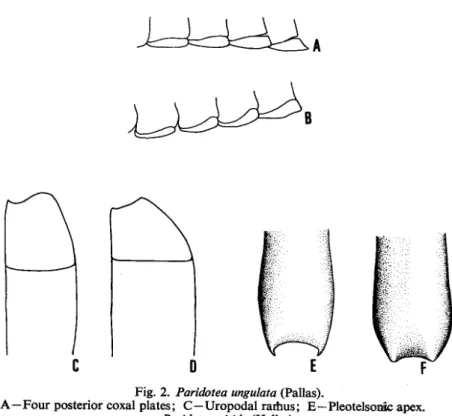
P. nitida can be separated from P. ungulata, with which it was for many years confused, by the structure of the pleotelsonic apex (distal corners rounded, separated by shallow concave distal margin in P. nitida, distal corners acute and spinose, with more concave distal margin in P. ungulata), the uropodal ramus (distinctly broader than long inP. nitida,as long as wide inP. ungulata), and the shape of the coxal plates of the last four pereional segments. (See fig. 2A, C, E.)
Fig. 2. Paridotea ungulata (Pallas).
A-Four posterior coxal plates; C-Uropodal ramus; E-Pleotelsomcapex.
Paridotea nitida (Heller).
B-Four posterior coxal plates; D-Uropoda.! ramus; F-Pleotelsonic apex.
Separation of P. nitida from P. apposita Barnard, 1965, recorded from Gough Island, however, is more difficult. The pleotelsonic structure is identical in these two species, the uropodal ramus very similar (possibly not as wide in P. apposita as in P. nitida), while the seventh pereional coxal plate is perhaps more acute and produced in P. apposita. These differences, however, are very subtle, and more material from Gough Island may well prove the species to be synonymous, the subtle differences being a reflection of the isolation of the population.
Paridotea reticulata Barnard
Paridotea reticulata Barnard, 1914: 424, pI. 36D; 1940: 507; 1955: 6.
Previous records
Ltideritzbucht, Port Nolloth, Lamberts Bay, Table Bay, False Bay.
Material
AMS 23
79 100
1 d'
8 d'd' 155f5f 3juv.
4 d'd' 55f5f 1 ovig.5f 7 juv.
Remarks
The notch found on the sternum of the seventh pereional segment in South African specimens is not present in specimens from the St Paul and Amsterdam Islands. The spines of the disto-Iateral corner of the pleotelson are sometimes absent, possibly worn away.
Suborder ANTHURIDEA Family Anthuridae Eisothistos crateris sp. novo
Fig.3A-G Description
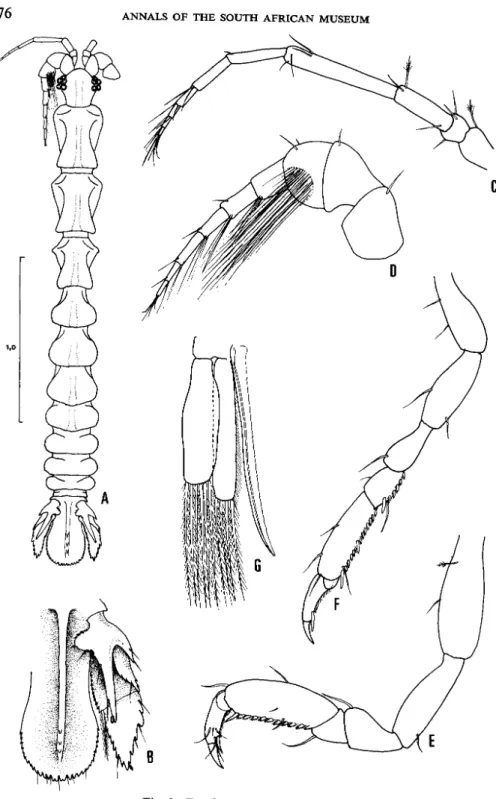
Male: (head and mouthparts damaged). Head with anterior margin between eyes evenly convex, about half length of pereional segment I, with poorly defined median ridge. Pereional segments I-III subequal, each with anterior 'shoulder' and medio-dorsal ridge not quite reaching anterior margin.
Pereional segments IV-VII posteriorly expanded, rounded, also with medio- dorsal ridge. Segment VII somewhat shorter than preceding segments. Dorso- lateral keels obvious on anterior three segments only. Anterior three pleonal segments wider than long, laterally rounded, 4th and 5th segments not distinct, possibly fused, much shorter and narrower than preceding segments.
Eyes well developed, ocelli large, distinct.
Antennular peduncle consisting of three stout segments, distal segment bearing pad of elongate setae; flagellum 6-segmented.
Antennal peduncle consisting of two short proximal segments plus two slenoer elongate segments; flagellum 6-segmented.
Pereiopod I dactylus with well-developedunguis; propodus two and a half times longer than wide, ventral margin bearing single distal spine plus 10 small serrate spines; carpus short, triangular.
Following pereiopods essentially similar to pereiopod I, but with carpi slightly longer, not underriding the propodi.
Pleopod 2 with elongate rami, exopod carrying six slender setae, endopod with four setae and sabre-shaped stylet on inner margin reaching well beyond apex of ramus, apically acute.
Uropods and telson indurated. Uropodal exopod tripartite, consisting of inner rounded basal process armed with three to four small spines, median spike-like elongate portion and outer spine-like process; endopod just reaching apex of telson, apically acute, margins dentate.
Telson evenly rounded, distally wider than proximally, latero-distal margins serrate; strong flattened medio-dorsal keel present, bearing three or four small spines distally.
Fig. 3.Eisothistos crateris sp. novo
A-Holotype in dorsal view; B-Telson and uropod; C-Antennule; D-Antenna;
E-Pereiopod I; F-Pereiopod VII; G-Pleopod 2.
Material
Holotype: St Paul 90 1.1. Paris Museum Is. 1001
Remarks
Of the three species of Eisothistos described, E. vermiformis Haswell and E. atlanticus Vanhoffen are easily separated from the present species, either by general body shape, or on the nature of the telson. There is a marked resem- blance to E. antarcticus Vanhoffen 1914. The telson of the Antarctic species differs from the present species in having the medio-dorsal ridge armed with numerous spines (instead of four obscure spines), and in the outer process of the uropodal exopod, which is blunt and dentate (rather than spiniform).
These differences could perhaps be due to variation within the same species.
Another obvious difference is in the pleonal structure. The present specimen has the anterior three pleonal segments large and laterally rounded and the posterior segments obscure, while in E. antarcticus the anterior five pleonal segments are subequal.
The species is named craterisas it was collected from the crater of 8t Paul Island which is open to the sea.
Panathura amstelodami sp. novo Figs 4A-H, 5A-F Description
Male: Anterior margin of head with median point; eye spots lateral.
Pereional segment I twice length of head, segment II slightly shorter than I, segments III-VI subequal, VIIth somewhat shorter. Pleonal segments distinct.
Antennule with 5-segmented peduncle, two basal segments as broad as long, 3rd and 4th segments subequal, wider than long, 5th segment more elongate, flagellum 4-segmented. Antenna with 3-segmented peduncle, 3-segmented flagellum. Mandibular palp 3-segmented, 1st and 3rd segments subequal, each about half length of middle segment; third segment bearing row of 7 spines, proximal 4 spines short; incisor portion of mandible consisting of three strong teeth plus thin plate with dentate margin.
Maxilla slender, bearing 6 spines.
Maxillipedal palp 4 or 5-segmented, 3rd segment largest, endite extending on inner margin to distal level of 3rd palp segment, distally tapered.
Pereiopod I propodus with strong proximal triangular tooth forming a 'thumb', palm with two smaller proximal and one distal tooth; unguis of dactylus large and well-defined.
Pereiopod II more slender and longer than I, palm with strong proximal 'thumb' and small tooth at base, larger distal tooth; carpus with two spines on ventral margin. Pereiopods III-VII similar, propodus twice length of carpus, both segments bearing ventral fringed spines; carpus hardly underriding propodus.
H
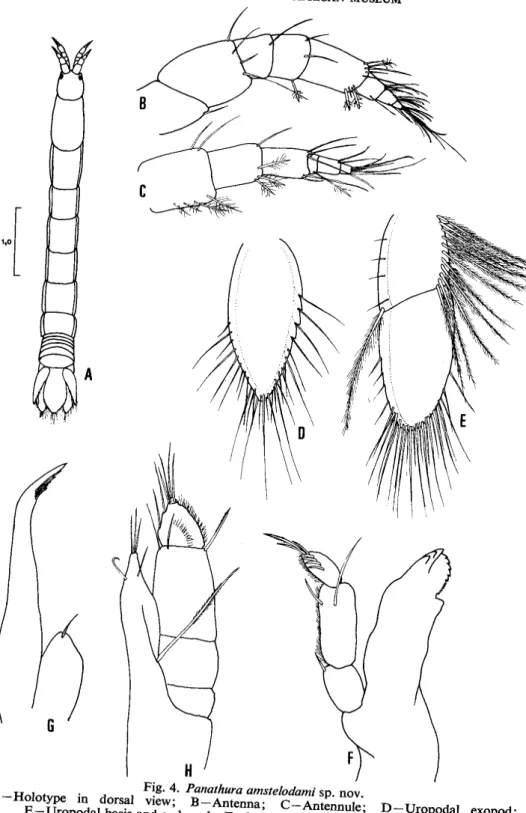
Fig. 4. Panathura amstelodami sp. novo
A-Holotype in dorsal view; B-Antenna; C-Antennule; D-Uropodal exopod;
E-Uropodal basis and endopod; F-Mandible; G-Maxilla; H-MaxiIliped.
Fig. 5.Panathura amstelodami sp. novo
A-Pereiopod I; B-Pereiopod II; C-Telson; D-Pereiopod VII; E-Pleopod 1;
F - Pleopod 2.
Pleopod 1 exopod broad, operculiform, fringed with 13-14 plumose setae;
endopod less than half length of exopod, very narrow, triangular, with single terminal plumose seta.
Pleopod 2 exopod and endopod equal in length, former distally truncate, latter distally rounded.
Uropodal exopod leaf-shaped, bearing numerous marginal setae, outer margin with four to five serrations in hyaline border; endopod with distal segment longer than proximal, with hyaline border non-serrate.
Telson widest in distal half, with broad hyaline border, latter finely dentate distally, apical region bearing numerous simple setae.
Material
Holotype AMS a4 13 total length 5,0 mm Paris Museum Is. 1002 Paratypes AMS 119 3 ~~ 3,0 mm 3,2 mm 4,4 mm SAM-A14994
Paratypes AMS 142b 2 ~~ 3,2 mm 3,8 mm Paris Museum Is. 1003 Remarks
Barnard (1925b) definesPanathura as similar toApanthura, but possessing a 6-segmented maxilliped and with the palm of pereiopod I straight. The distinctive maxilliped, together with the distinct pleonal segments, operculiform 1st pleopods, and the 5th segment of pereiopods IV-VII underriding the 6th segment, complete the generic definition. The present material agrees with all these features, with the possible exception of the pereiopodal carpi, which only just underride the propodi. The present species differs from P. serricauda, with which it was collected, on several counts. The telson and uropods in Barnard's species are indurated and obviously serrated, and the uropodal exopod is a broad structure. In P. amstelodami the telson and uropods are not indurated, and possess a thin hyaline border, the exopod is a leaf-shaped structure, and although slightly serrate on the outer margin does not approach the almost dentate condition inP. serricauda. Further differences may be seen in the pereiopodal structure, as well as in the 1st pleopod with its reduced endopod. P. formosa Menzies & Frankenberg (1966), recorded from deep water off Georgia, U.S.A. possesses a very distinctive pleotelsonic structure, while the endite is not as developed as in the present species.
Panathura serricauda (Barnard) Fig.6A-D
Apanthura serricauda Barnard, 1920: 339, pI. 15 (figs 11-12).
Panathura serricauda: Barnard, 1940: 490, 497; 1955: 5.
Previous records
Liideritzbucht, Saldanha Bay, Table Bay, False Bay.
ISOPODAN AND TANAIDACEAN CRUSTACEA FROM SOUTHERN INDIAN OCEAN 281
Fig. 6. Panathura serricauda (Barnard).
A-Animal in dorsal view; B- Maxilliped; C-four distal segments of pereiopod I; D-Telson.
Material
AMS a4 7 ovig. ~~
+
20 specimens a5 1 specimena6 1 specimen
Family Cirolanidae Cirolana rugicauda Heller
Ciro/ana rugicauda Heller, 1861: 497; 1865: 142, pI. 12 (fig. 13). Bracehi, 1877: 99. Hansen, 1890: 358. Vanhoffen, 1914: 503, fig. 40. Barnard, 1940: 397, fig. 8.
St Paul Island, Port Nolloth, St Helena Bay.
Material
AMS a1 a2 a3
a4as
a6 a7 a8
a9 a10 b3 C1 C3 P46 6b 8 10 24a 2.5.1969 27.3. 1970/b
St Paul
1JUY. 6c 2 ~~ 3 ~~ 7JUY.
1JUY. 7a 1 ~ 3 ~~ 5JUY.
1JUY. 7b 9 ~~ 10 ~~ 6juy.
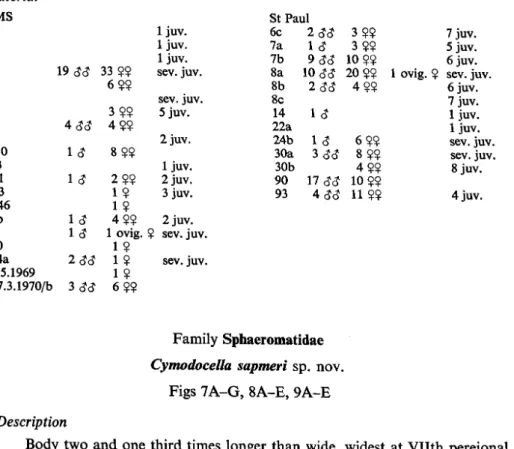
19 ~~ 33 ~~ sey.JUY. 8a 10 ~~ 20 ~~ 1 oyig. ~ sey.JUY.
6n 8b 2 ~~ 4 ~~ 6juy.
sey.JUY. 8e 7JUY.
3 ~~ 5juy. 14 1 ~ 1JUY.
4M 4 ~~ 22a 1JUY.
2juy. 24b 1 ~ 6n sey. juv.
1 ~ 8 ~~ 30a 3 ~~ 8 ~~ sey.JUY.
1JUY. 30b 4 ~~ 8juy.
1 ~ 2 ~~ 2juy. 90 17 ~~ 10 ~~
1~ 3JUY. 93 4 ~~ Un 4juy.
1 ~
1 ~ 4n 2juy.
1 ~ 1 oyig. ~ sey.JUY.
1 ~
2 ~~ 1 ~ sey.JUY.
1 ~ 3 ~d' 6 ~~
Family Sphaeromatidae Cymodocella sapmeri sp. nov.
Figs 7A-G, 8A-E, 9A-E Description
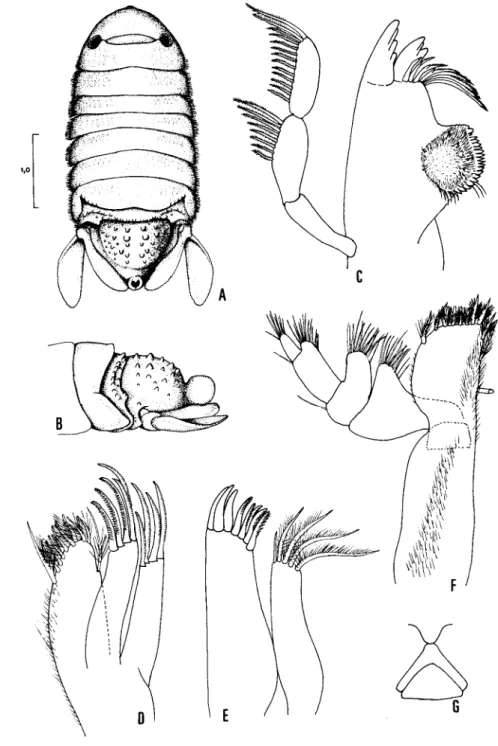
Body two and one third times longer than wide, widest at VIIth pereional segment; head and pereional segments I-VI smooth; posterior margin of VIIth segment slightly nodose; pleon segment 1 usually concealed by pereion;
last pleonal segment bearing irregular row of ten to twelve small conical tubercles. Pleotelson very convex, bearing numerous tubercles, some rounded, most conical. Apex of pleotelson forming dorsally flexed tube, the opening of which has tiny spike or papilla protruding into it. Coxal plates of pereional segments bearing pile of short hairs.
Epistome A-shaped, with slender rami.
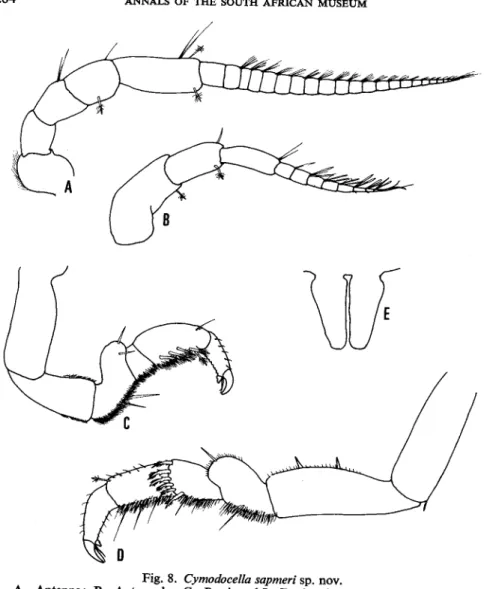
Antennules shorter than antennae, with 3-segmented peduncle longer than flagellum. Antennal peduncle 5-segmented, distal segment longest; flagellum of about twenty-two segments, longer than peduncle.
Mandibular palp 3-segmented, terminal segment with thirteen pectinate setae, middle segment with eight pectinate setae; incisor process of four teeth, lacinia mobilis of three teeth; setal row of eight penicilis; molar process broad, with dentate margin.
Inner ramus of first maxilla bearing four elongate fringe setae, plus shorter simple seta; outer ramus tipped with eight dentate spines, degree of dentition varying from fairly smooth to many large denticles.
Fig. 7. Cymodocella sapmeri sp. novo
A-Holotype in dorsal view; B-Pleotelson in lateral view; C-Left mandible;
D-Second maxilla; E-First maxilla; F-Maxilliped; G-Epistome.
\If
Fig. 8. Cymodocella sapmeri sp. novo
A-Antenna; B-Antennule; C-Pereiopod I; D-Pereiopod VII; E-Penes.
Second maxilla, inner ramus with about ten fringed spines, both lobes of outer ramus tipped with four or five pectinate curved spines.
Maxillipedal palp 5-segmented, second segment longest; segments two, three and four somewhat lobed, lobes bearing clumps of simple setae; endite bearing about ten fringed spines, and single coupling hook.
Pereiopod I willi propodus, carpus, merus, and distal part of ischium bearing pile of fine short setules; propodus bearing five fringed spines; carpus very short; dactylus tipped with distal curved spine with shorter blunt spine at its base. :Pereiopods increasing slightly in length posteriorly.
Pereiopod VII with carpus bearing six fringed spines; ischium with two strong spines on dorsal margin.
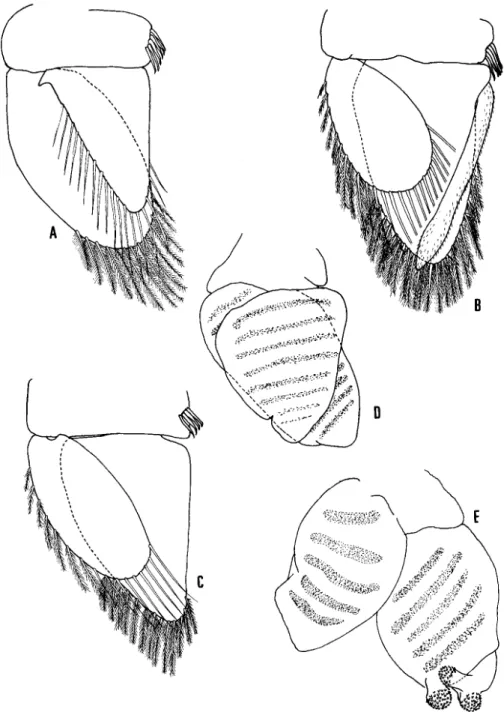
Fig. 9. Cymodocella sapmeri sp. novo
A-Pleopod 1; B-Pleopod 2; C-Pleopod 3; D-Pleopod 4; E-Pleopod 5.
Rami of penis moderately elongate, tapering slightly.
Pleopod 1 exopod broadly oval, longer than triangular endopod.
Pleopod 2 exopod oval, much smaller and shorter than triangular endopod;
latter with stylet on median margin, stylet slightly longer than endopod, distally dilated, apically narrowly rounded.
Pleopod 3 with oval exopod shorter than triangular endopod.
Pleopods 4 and 5 with both rami membranous, pleated.
Both rami of uropod elongate-oval, of equal length, distally rounded, margins slightly serrulate.
Pleotelson of female less obviously tuberculate than that of male.
Material
Holotype Allotype Paratypes Paratypes
AMS C3 1 6 Paris Museum Is. 1004
AMS C2 1 ovig. <j> Paris Museum Is. 1005
St Paul D5jc 13 66 9 <j><j>6 ovig. <j><j>Paris Museum Is. 1006 AMS Cl 566 12 <j><j> 14ovig. <j><j>SAM-A14995
AMS St Paul
a2 5 <j><j>1 juv. Dj5a 3 <j><j>1 ovig. <j> 2 juv.
a3 1 <j> 1 juv. D5jb 1 ovig. <j>
a4 3 <j><j> 14 466
IOn
5 juv.a5 1 6 1 <j> 16 1 6 1 <j>
a6 3 <j><j> 1 ovig. <j> 2 juv. 19 2 ovig. <j><j>
bl 1 <j> 20 1 6 1 <j> 1 ovig. <j><j>
b2j2 6 <j><j> 6 juv. 22b 16
C2 566 7<j><j>10 ovig. <j><j>17 juv. 28 7 <j><j> 1 ovig. <j> 11 juv.
C3 466 1 <j> 30vig. <j><j>7 juv. 90 666 16
n
3 ovig. <j><j>P29 1 ovig. <j>
P30 3 <j><j>
P33 1 ovig. <j>
P34 1 ovig. <j>
P36 2 <j><j>
3 16
6b 266 2 juv.
24a 266 2 <j><j> 1 ovig. <j>
147 2 juv.
28.3.1970jb 1 6 1 <j>
Remarks
Of the eleven species of Cymodocella described, the present species only resembles C. nipponica Nishimura, from Japan, to a limited degree. That Japanese species possesses numerous rounded tubercles on the pleotelson, while the present species possesses more numerous conical tubercles. Apart from this tenuous similarity, C. sapmeri is quite distinct from all other described species. This species is named for S.A.P.M.E.R., the lobster-fishing company operating around the St Paul and Amsterdam Islands (see introduction), and for the ship used by the Company.
ISOPODAN AND TANAIDACEAN CRUSTACEA FROM SOUTHERN INDIAN OCEAN 287 Dynamenella brunnea Vanhoffen
Fig.lOA-B
Dynamenel/a brunnea Vanhoffen, 1914: 516, fig. 49. non Dynamenel/a huttoni: Barnard,
"'
1940: 419.Previous records 8t Paul Island.
Material
AMS al 1 ~ St Paul D5/a 2,M 2 ~~ 1 juv.
a3 2 ~~ D5/c 11 ~~ sev.juv.
a4 2JJ 3 ~~ 7b 1 J
a5 2juv. 8a 2juv.
a6 11 ~~ sev.juv. 14 1 J sev.juv.
a7 5 JJ 20 1 ~ 5 juv.
a8 2 JJ 26 1 ~
al0 5 JJ 2 ~~ 28 3 ~~
bl 1 ~
b2/2 2 ~~
cl 1 J 14 ~~ sev.juv.
c2 7 ~~
c3 2 ~~
PI 1 ~
P2 sev.juv.
P4 1 juv.
t P6P7 3 juv.2juv.
P13b 1 ~
t
P16P23 IJ sev.juv.2juv.P26 sev.juv.
P27 4juv.
P28 1 juv.
P29 sev.juv.
P31 1 juv.
P30 3 JJ 2n sev.juv.
P36· sev.juv.
P34 sev.juv.
P38 1 J 4n sev.juv.
P44 1 juv.
P45 1 juv.
P48 2 juv.
P49 sev.juv.
P50 3 JJ 6 ~~ sev.juv.
P83 7 juv.
3 3 JJ 6n sev.juv.
8 58 JJ 28 ~~
12 9 JJ 1 ~
16 1 ~ 10 juv.
24a 1 ~
2.5.1969 IJ 6n
t 1.3.1970 1 J 3n
27.3.1970/b 3 JJ 28.3.1970/b 4 JJ 9 ~~
Fig. 10. Dynamenella brunneaVanhoffen.
A-Pleotelson; B-Epistome; C-Epistome of D. huttoni.
Remarks
Examination of Vanhoffen's type material in both the Berlin Museum and the British Museum, together with the very large number of specimens in the present collection, shows that this is indeed a valid species. Separation from D. huttoni which resembles (and with which Barnard synonymized it) is best done by reference to three features: pleotelsonic structure, epistome and head structure, and colour pattern. The dorsal surface of the pleotelson in D. brunnea always has some indication of tuberculation. In juveniles of less than 2 mm length, the two main submedian tubercles can already be seen, while in larger specimens these two large tubercles are supplemented by several smaller tuber- cles. D. huttoni by contrast invariably possesses a smooth pleotelson. The median ventrally-directed lobe of the sinuous frontal margin of the head in D. brunnea is relatively narrower than in D. huttoni; a subtle difference in the shape of the epistomes is also constant. The colour pattern, though variable in both species, is more constant inD. brunnea, where a rhomboidal pale patch is frequently seen mid-dorsally on pereional segments II to IV. While D. huttoni
often has pale dorsal patches, these almost never are as regular as in the former species.
Dynamenella dioxus Barnard
Dynamenella dioxus Barnard, 1914: 419; 1940: 418, 505. Day, Field &Penrith, 1970: 48.
Previous records
Liideritzbucht, Port Nolloth, Lamberts Bay, Table Bay, False Bay.
Material
AMS a4 74 142a 142b 147