ANNALS OF THE SOUTH AFRICAN MUSEUM ANNALE VAN DIE SUID-AFRIKAANSE MUSEUM
Volume 52 Band
April
1969April
Part 7 Dee!
CRUSTACEA LIBRARY SMlTHSm.,Jl/\N INSTITUTION R
r-T', J ~ -'-(~, t~t,U ..~ lu
;J-119
DECAPOD CRUSTACEA FROM THE SOUTH-WEST INDIAN OCEAN
By B. F. KENSLEY
are issued in parts at irregular intervals as material becomes available
Obtainable from the South African Museum, P.O. Box 61, Cape Town
word uitgegee in dele op ongeree1de tye na beskikbaarheid van stof
OUT 01' PRINT/UIT DRUK
I, 2(1, 3, 5, 7--s), 3(1-2, 5, t.-p.i.}, 5(2, 5, 7-9), 6(1, t.-p.i.}, 7(1, 3), 8, 9(1-2}, 10(1-3), 11(1-2, 7, t.-p.i.}, 21, 24(2), 27, 31(1-3}, 38,
44(4)·
Price of this part/Prys van hierdie deel
R2.IO
Trustees of the South African Museum © Trustees van die Suid-Afrikaanse Museum 1969
Printed in South Africa by The Rustica Press, Pty., Ltd.
Court Road, Wynberg, Cape
In Suid-Afrika gedruk deur Die Rustica-pers , Edms., Bpk.
Courtweg. Wynberg, Kaap
DECAPOD CRUSTACEA FROM THE SOUTH-WEST INDIAN OCEAN
By B. F. KENSLEY
South African Museum, Cape Town
Introduction Station list • Species list . Systematic discussion Distribution . Summary Acknowledgements References •
The material dealt with in this paper comes from several sources. The greatest proportion was collected on the seventh cruise of the R/V Anton Bruun, in 1964, as part of the International Indian Ocean Expedition. The station numbers of the Anton Bruun are designated by the letters BR U, while catalogue numbers of the Zoology Department, University of Cape Town, are designated either as NAD (off the Natal coast) PED (offMoc:;ambique coast), MDD (off the south-western coast of Malagasy Republic), or WBS (Walter's Shoal).
This latter is a shallow area about 400 nautical miles south of the Malagasy Republic, and about 600 miles off the coast of South Mrica. A final report of the expedition was published by the U.S. Program in Biology, I.I.O.E., in 1965, to which body I am indebted for the opportunity of examining the material.
Other sources of material include the collections made by the R/V Vema (station Vema 6) off the Natal coast, theJohn D. Gilchrist (station GIL 56-58) off Natal, and the S.A.S.Natal (station NGY) off Natal.
Type material is housed at the South Mrican Museum, and catalogued with South Mrican Museum (S.A.M.) numbers. All other material is in the Zoology Department of the University of Cape Town.
149 Ann. S. Afr. Mus.5ll (7), 1969, 14g-181, 16 figs.
15° ANNALS OF THE SOUTH AFRICAN MUSEUM
Abbreviations Sampling gear:
AD-Agassiz Dredge MT - Menzies Trawl
CG-Campbell Grab 0.6 m2 RD-Rock Dredge Substrata:
c-coarse G,O.-Globigerina Ooze
Calc. Alg.-Calcareous Algae gy-grey
Crl-coral M-mud
d-dark R-rock
f-fine S-sand
G-gravel Sh-shell
gn-green St-stone
STATION LIST
Station Number Date Position Depth (m) Bottom Gear
GIL 56 13.7.59 29°53'S/31°06'E 20 SM RD
GIL 58 13.7.59 29°53'S/31°04'E 71 M RD
NGY 21 17.5.58 30047'S/30029'E 44 St
NGY 17 16.8.58 29°53'S/31°04'E 38 CI D
NGY 59 12.8.58 29°58'S/31°27'E 49
NGY63 13.8.58 30047'S/30027'E 36
Vema 6 23.4.58 29°46'S/31°17'E 110-130
BRU 356 B 29.7.64 29°U'S/31°37'E 18 R RD
BRU 356J 29.7.64 29°1O'S/3l051 'E 43 S MT
BRU 357 B 30.7.64 29°11 'S/32°02'E 70 RSh RD
BRU 358 C 30.7.64 29°21 'S/31°58'E 370 gnSM MT
BRU 363 P 5.8.64 23°17'S/43°33'E 12-25 guM AD
BRU 363 W 12.8.64 23°19'S/43°36'E 82 AD
BRU 370 G 18.8.64 24°40'S/35°28'E 347 Sh AD
BRU 371 E 18.8.64 24°46'S/35°20'E 132 RSh S RD
BRU 371 F 18.8.64 24°46'S/35°18'E UO cS R RD·
BRU 371 G 19.8.64 24°53'S/34°56'E 55 fgySR RD
BRU 372 C 19.8.64 24°46'S/24°50'E 22 Sh S R RD
BRU 372 G 19.8.64 24°53 'S/34°56 'E 55 fgy S R RD
BRU 372 L 19.8.64 25°07'S/34°34'E U2 dSM· AD
BRU 372Q 22.8.64 25°57'S/33°02'E 42 ShR D
BRU 373 B 22.8.64 26°00'S/33°05'E 135 RSh RD
BRU 381 A-C 30.8.64 33°13'S/43°51 'E 38-46 Calc. Alg. RD
BRU 389 G 8.9.64 29°57'S/31 °31'E 700 GO AD
BRU 390 C 8.9.64 29°45'S/31°40'E 440 S AD
BRU 390 E 8.9.64 29°42'S/3l038'E 350 SM AD
BRU 390 G 8.9.64 29°38'S/31°36'E 200 SM CG
BRU 390H 8.9.64 29°37'S/3l033'E 175-200 SM D
BRU 390 L 9.9.64 29°35'S/31°38'E 150 SM AD
BRU 390N 9.9.64 2go34'S/31°39'E U5 SM CG
BRU 390 P 9.9.64 29°34'S/31°39'E U8 SM .AD
BRU 390 R 9.9.64 29°35'S/31°42'E 138 GrCrl CG
BRU 390 S 9.9.64 2go35'S/31°42'E 138 cSCrl AD
BRU 391 B 9.9.64 29°29'S/31°45'E 86 M CG
BRU 391 C 9.9.64 29°29'S/31°45'E 86 M AD
BRU 391 F 9.9.64 29°26'S/31°46'E 77 guM AD,
BRU 391 H 9.9.64 29°21'S/31 °35'E 57 cM&Sh AD
BRU 391J 9.9.64 29°31 'S/31°35'E 57 MSSh AD
BRU 392 F 10.9.64- 29°16'S/31°32'E 35 dM CG
BRU 392 G 10.9.64 29° l4'S/3l °31'E 18 fgyS CG
BRU 392 H 10.9.64 29°13'S/31°31 'E 18 gyfS AD
BRU 392 K 10.9.64 29°19'S/31°26'E 38 cS AD
., ..: ";';:~..,'
.
<! 5j2 Juv Station Catalogue Number
Lophoz,o;;ymus dodone(Herbst) 1 - - NGY21 NAD3W
Lupocyclus tugelaeBarnard
-
1 ovig - 372 G PED 16KMacropodia formosa Rathbun 4 - - NGY 59 NAD18T
2 lovig - 372 PED 19T
1
-
- 381 A-C WSS3E*
Nursilia dentataBell 1-
- 371 F PED6Z*
Palicus sexlobatusn.sp. I-
- 371 F SAM. AI2642*
Paratergatis longimanus Sakai - I - 372 L PED 19M2
- -
391 C NAD 51 C2
- -
390 P NAD40KPhilyra globosa (Fabricius) 2 -
-
392 H NAD 73 BPhilyra globulosa Milne-
Edwards 13 80vig
-
391 C NAD51 A- I ovig 2 356J NAD86D
2 20vig - 392 K NAD 75 E
Pilumnus hirsutus Stimpson I 3 - 372 C PED 12 Q-R
2 I - 372 G PED 16 F-G
Pilumnus longicomis Hilgendorf I - - 371 G PED8X
- 1
-
356B NAD 80 X-Y2 4
-
NGY 21 NAD3YPinnotherids (Unidentified) 1
- -
363W MDD I C1 - - 372 L PED 19 K
1 -
-
390 S NAD45J1
-
- 372 G PED 16 HPlatylambrus quemvis Stebbing 5 7+2ovig
-
391 J {NAD62 ANGY 59 NAD 18 R
Platypodia cf.granulosa (Riippell)
-
I - 381 A-C WSS3CPortumnus mcleayiBarnard I lovig
-
372 C PED 12 NI - - 391 J NAD64W
Ranina ranina (Linnaeus) 1 -
-
372 G PED 16 E*
Retropluma planiforma n.sp. 2 4-
390H NAD31DSAM. A12643 -5
Thalamita woodmasoniAlcock
-
I ovig-
NGY 21 NAD3RThalamita sp. - I ovig
-
NGY 21 NAD 3RThalamita sp. 2 -
-
Vema 6 NADIICXanthias tuberculidensRathbun 1 - - 390 S NAD45G
-
I - 390R NAD 49 R-
1-
371 E PED2 D1
- -
356 B NAD80 X-Y2 -
-
NGY21 NAD3V?Xanthias sp. (Immature)
- -
2 372 G PED 16 LXanthids (Unidentified)
- -
5 381 A-C WSS3BANOMURA PAGURIDEA
Anapagurus hentiersoniBarnard I - - 390 L NAD35G
I I - 390 S NAD45R
I
- -
390 C ABD14LDardanus arrosor(Herbst) 1
- -
391 J NAD62T- 1+lovig - OIL 58 NAD26 S
Dardanus euopsis(Dana) I
- -
372 G PED 16 R-TDardanus setifer (Milne-
Edwards) I
- -
NGY 59 NAD20VI
- -
NGY21 NAD3N~ ~ Juv Statum Catalogue Number
Diogenes brevirostris Stimpson 1 1 - 372 C PED 12 S
Diogenes costatusHenderson 2 -
-
NGY 59 NAD18Y1
392 H356J NAD86ANAD 73 Kr
K NAD75Hmany 391J NAD62 S
391 F NAD58J
391 C NAD 51 N
391 H NAD67 C
Diogenes custos (Fabricius) 5 2
-
392 H NAD 73J• NematopagllTllS gardineri Alcock 1 -
-
390 S NAD45 P• NematopaguTllS squamichelis
Alcock 2 1 - 370 G ABD8V
Pagurus spinulentus (Henderson) 5 3
-
{392 K NAD 75JGIL 56 NAD24D
NGY 59 NAD 18 V
1 - - 356J NAD87W
13 70vig - 391 J NAD62N
PagllTllSsp. 1 - - 372 C PED 12 V
1 - - 390 S NAD45Q
- - 1 370G ABD8W
- 20vig
-
372 G PED 16 R-TBetweenPagllTllS&PylopaguTllS 1
-
- 372 G PED 16 R-TParapagllTllS pilosimanus Smith 2 1
-
358 C ABD 1 E?Pylopagurus sp. 1
-
- 371 E PED2GGALATHEIDEA
Galathea dispersaBate 2 1 - 357 B NAD 20 S
- 1 ovig - 371 G PED8U
2 1 ovig
-
372 L PED 19 L-
- 1 371 F PED 23 DGalathea intermedia Liljeborg 5 5
-
NGY 59 NAD 20 S-
- 2 390G NAD33N- 1 - NGY 21 NAD3Q
1 4 - 372 G PED 17 W
Munida sanctipauli Henderson
-
lovig - 373 B PED 23 Z- 1 - 389G ABD 13 L
Munida semoniOrtmann 1 1+lovig 1 372 L PED 19 Q
- 1 ovig - 373 B PED 23 C
- 1+2ovig - 371 F PED6X
2 1 - 372 G PED 16 C
10 12 - 390 P NAD40 L
- 2
-
391 C NAD51G7 2
-
390 S NAD45 B11 6
-
390H NAD31 AMunida cr.semoniOrtmann
-
1 ovig-
371 F PED6X• Petrolisthes militaris (Heller) 5 3 - 372 G PED 16 A
1 - - ABD82 M
Porcel/ana dehaanii Krauss -
-
2 356 B NAD80 ZPorcel/ana streptachelesStimpson 2 2
-
357 B NAD 91J- 1
-
356 B NAD82 M3 -
-
NGY 21 NAD 3 P- - 1 372 C PED 12 T
4 6 - 372 G PED 16 A
THALASSINIDEA
• Axius (Neaxius) sp. 1 - - 357 B NAD91N
-
1-
356 B NAD81 Ac1 ~ Juv Station Catalogw Number
Callianassa sp. 1 -
-
390H NAD 31 BCallianassa sp.
-
1 - 390 H NAD 31 BMACRURA PENAEIDEA
Acetes erythraeus Nobili 5 3 2 NGY21 NADF
2 13 - 392 H NAD 73 F-H
-
1 - 392 K NAD75N*Gennadas propinquus Rathbun 1
-
- 363 P ABD5AMacropetasma africana (Balss) 1 10 - 392 H NAD 73 E
Metapenaeopsis adamanensis
(Wood-Mason)
-
1 - 390 S NAD45TMetapenaeopsis cf. stebbingi Nobili
-
- 1 392 H NAD 73 F·HParapenaeus fissurus (Bate) 1
- -
390 P NAD40R- 1
-
391 C NAD51 M-
- 1 390 L NAD35NPenaeopsis rectacuta(Bate) - 1
-
370 G ABD8TPenaeus japonit:us Bate 1
- -
392 H NAD 73 DSergestes prehensilis Bate 1 -
-
390 C ABD 14 RSolenocera afmanum Stebbing 1
-
- 390 P NAD40S-
1 - 390H NAD 31 GSolenocera ?pectinata (Bate) 1 -
-
390 P NAD40RSolenocerasp. ?1
-
- 390L NAD35QCARIDEA
Alpheus frontalis Milne-Edwards 390 G NAD33K
*Alpheus nonaltern.sp. sev. sev. - 390 H NAD31 H,
S.A.M. A1265o-
sev. sev.
-
390 P NAD40M391 C NAD 51 H-J
1
- -
372 L PED 19 P*Alpheus waltervadi n.sp. 4 20vig 6 381 A-C WSS 2 Y,
S.A.M. A12646-
Alpheus sp. (damaged) 1
-
- 391 J NAD62 V1
-
- NGY 59 NAD20Q390 P NAD40N
392 K NAD 75P
390N NAD 43 B-C
Chlorotocus crassit:omis(Costa)
-
1 3 390 L NAD35M-
1 - 390 C ABD 14T1 lovig
-
390 P NAD40U-
1 - 372 L PED 19Y·ZEualus ctenifera (Barnard) ?4 20vig - 381 A-C WSS2Z
*Heterocarpus woodmasoniAlcock - 1
-
370 G ABD8UHippolysmata vittata Stimpson
-
1 - 356 B NAD 81 B-ELatreutes mucronatus (Stimpson) 5 30vig sev. 356 B NAD81 B-E
?1
-
- 372 C PED 12 U?1 -
-
372 G PED 16 X-YLeptochela pugnax de Man - 1 - 392 F NAD 72 P
Leptochela robustaStimpson
-
lovig - 371 E PED2 CNikoides cr.danaePaulson 1 1
-
356J NAD86 F*Oplophorus spinit:auda Milne-
Edwards - ?1
-
363 P ABD 5 CPericlimenes (Perit:limenes)sp. ?3 - - 356 B NAD 81 B-E
R
or
?- -
37 22 U~ ~ Juv
• Plesionika ef.acanthonotus
(Smith) 2 - -
1 1
-
lesionika martia (Milne-
Edwards)
-
?1 -2 - -
ontocaris cataphracta (01ivi) - 1 ovig -
1 10vig
-
1 - -
1 1 ovig
-
1 -
-
3
-
-Pontocaris lacazei (Gourret) 2 -
-
- 1 -
Processa austroafricana Barnard 2 4+50vig 1
- 1 ovig -
-
-
1Processasp. - 10vig
-
Stylodactylus bimaxillaris Bate - 1 ovig -
-
-
1Synalpheus anisocheirStebbing - 3+30vig 4
?1 -
-
Synalpheus jedanensis de Man - 1+20vig -
Synalpheus cf.jedanensis de Man - 1
-
Tozeuma armata (Paulson) ?1 - -
Station Catalogue Number
390 P NAD40T
390H NAD 31 F
392 H NAD 73 F-H
358 C ABD 1 D
372 L PED 19W
372 G PED 16 U
391 F NAD58H
391J NAD62 W
390 P NAD40Q
391 C NAD 51 S
390 C ABD14P
390 L NAD 35 P
390 L NAD 35 L
390 P NAD 40 V
356 B NAD 81 B-E
372 G PED 16 X-V
372 L PED 19 Y-Z
390 P NAD40W
NGY 21 NAD4B
NGY 59 NAD20 Q
372 G PED 16 VoW
357 B NAD 91 M
371 G PED8 Z
BRACHYURA Family Parthenopidae
Eumedonus granulosusMacGilchrist, 1905 Fig. 1 a-b
Eumedonus granulosus MacGi1christ, 1905: 253. Rathbun, 1911: 259. Flipse, 1930: 90. Barnard, 1954: 96.
Previous records:Amirante, Persian Gulf, Zanzibar, Delagoa Bay.
Material: 1
6',
carapace length (including rostrum) 4 mm, carapace breadth (including lateral spines) 3.8 mm. Station BRU 372 G. Depth, 55 metres.Remarks: The present specimen appears to differ from the original description ofE. granulosus only in the degree of granulation of the carapace. From Mac- Gilchrist's description and figures (latter in Illustrations of the zoology of the R.I.M.S. 'Investigator', 1907, plate 77, figs 2, 2a), it would seem that the whole int~gument is granulated, whereas in the present specimen it is granulated only in theantero-Iateral region. The specimen recorded by Barnard (1954) has the carapace granulated in the mid-region only. The carapace grooves .of the type are more distinc~ than in this specimen. Body proportions are similar.
Unfortunately, all the pereiopods and chelipeds are missing. The differences mentioned may be due to the immaturity of the specimen, as the type measures
II ·5 X 11·5 mm.
Fig. I.Eumedonus granulatus MacGilchrist a.Carapace. b.First pleopod, male.
Family Xanthidae
Paratergatis longimanus
Sakai, 1965 Paratergatis longimanusSakai, 1965a: 98, fig.I;1965b: 128, fig. 16.Previous records:
Sagami Bay and near-by Japanese islands.Material:
1 ~, carapace length 12'0 mm, carapace breadth 19'0 mm. Station BRU 372 L. Depth, 1I2 metres. 2 0'0', carapace lengths 10·6 mm, 6'0 mm, carapace breadths 17'0 mm, 7'0 mm. Station BRU 390 P. Depth 1I8 metres.20'0', carapace lengths 12'0 mm, 5'0 mm, carapace breadths 19'0,8'0 mm.
Station BRU 391 C. Depth 86 metres.
Remarks:
There can be no doubt that this is the same species as that recorded by Sakai (1965a, b). This would appear to be the first record of this monotypic genus outside Japanese waters.Cympolidae: Rathbun, 1918: 182. Sakai, 1939: 607.
Palicidae: Holthuis &Gottlieb, 1958: 104.
Palicus sexlobatus n.sp.
Fig. 2 a-e
Description:
Carapace wider than long, dorsally convex, granular, with larger scattered tubercles, margins crenulate. Fronto-orbital margin with 2 pairs of spines, inner 2 more slender, longer than outer spines, set slightly lower than latter. 3 supra-orbital teeth, innermost broadest, outer 2 acutely triangular.External orbital tooth largest of 6 antero-Iateral teeth, latter decreasing in size posteriorly. Postero-Iateral margin of carapace concave at origin of 5th pereio-
pod. (Latter dorsal in position.) Posterior margin with 6 separated flattened lobes. Gastric region tuberculate, with anterior row of 4 larger transverse tubercles, 2posterior transverse tubercles. Gastric region separated from cardiac and branchial regions by well-defined grooves. Cardiac region with row of 4 transverse flattened tubercles, inner 2 larger. Branchial regions with scattered tubercles. Lower orbital margin formed by 2 broad rounded crenulated lobes.
Fig. 2.Palicus sexlobatan.sp.
a.carapace, dorsal view.b.Antero-ventral region of carapace.c.Right cheliped.d.First pleopod, male. e.Second pereiopod.
Distal portion of basal joint of antenna wider than proximal part, with 3 small ventral tubercles. 2nd and 3rd joints of peduncle slender, equal in length. Eye wider than stalk, latter with 3 dorsally visible lobes. 4th joint of endopod of maxilliped 3 with external curved flattened portion. Right cheliped stout,
(left missing), upper surfaces of propodus, carpus, merus tuberculate. Finger and thumb flattened, tips overlapping, cutting edge entire. Pereiopods stout, meri granulate, upper surface with 2 large spines, more anterior of which largest, plus several smaller flattened spines. Lower surface with many small spines. Carpus half length of merus, slightly flattened, proximally with a flattened rounded lobe on upper edge, distally with an acute flattened spine.
Propodus and dactylus flattened, lower edge of latter entire. Abdomen with 7 segments, first 2 very short, with prominent transverse raised ridge. 3rd segment twice length of 2nd, also with raised ridge, all 3 ridges dorsally visible.
Material: 1
6',
holotype, S.A.M. A12642, carapace length (including rostral spines) 8·6 mm, carapace breadth 10 mm. Station BRU 371 F. Depth 110 metres.Remarks: This species would seem to be most closely related to P. investigatoris (Alcock), but differs in the arrangement of the larger tubercles of the carapace, also in the posterior carapace ridge. The latter has 6 flattened lobes in P.
sexlobatus, 8 in P. investigatoris. The ambulatory pereiopods differ in that the propodi and dactyli of P. investigatoris are denticulate on their lower edges, entire in P. sexlobatus. This appears to be the first record of this cosmopolitan genus from the Moc;ambique Channel.
Family Retroplumidae
Alcock&Anderson, 1894: 180. Gill, 1894: 1044. Doflein, 1904: 29. MacGilchrist, 1905: 266.
Tesch, 1918: 29· Rathbun, 1932: 33. Sakai, 1948: 606.
Retroplum,a planiJorm,a n.sp.
Fig·3a-g
Description: Carapace more or less flattened, almost naked, slightly granular.
Carapace divided into 3 parts by 2 transverse carinae. Entire carapace margin crenulated. Anterior portion sloping forward to slender apically rounded rostrum. Latter slightly shorter than basal antennular peduncle joint. Supra- orbital border smoothly contoured, unarmed. External orbital angle a rounded forwardly projecting lobe. Antero-Iateral border sloping obliquely outward from external orbital lobe to more anterior lateral carapace lobe. Latter is extension of anterior transverse carina. Lateral margin of middle carapace portion with a convex rounded lobe. Second carapace carina slightly curved.
Carapace wider than long (excluding rostrum). Postero-Iateral angles rounded.
Eyestalks free, directed laterally, upper surface granular. Base of eyestalks wider than cornea. Infra-orbital spine prominent, forwardly directed, margins crenulated, reaching to middle of second joint of antennal peduncle. Latter
~
9
Fig. 3.Retropluma planiforma n.sp.
a.Carapace, dorsal view.b. Carapace, ventral view.c.Abdomen, female.d.Abdomen, male.
e.First pleopod, male.f.Right chela. g.Left chela.
half length of basal joint. Flagellum of antenna with 19 or 20 Jomts. Basal antennular joint globular, inflated, granular. 2nd joint arising at antero-mesial corner of basal joint. Bases of antennae, antennules and infra-orbital spines in a line. Chelipeds equal in length, right stouter than left, palm higher, equal in length to finger. Palm of left chela shorter than finger, upper borders of both chelae smooth. Fingers wide at base, compressed. A gap between fingers of right chela. Fingers of latter with 3 (possibly 4) teeth, on sharp cutting edge
Cutting edge of left chela only slightly denticulate. All pereiopods fringed with feathered hairs. Ambulatory pereiopods (i.e. 2, 3, 4) long and slender, 2nd pair longest. Dactyli slender, slightly curved, equal in length to outer margin of propodus of same pereiopod. Anterior margins of propodi and carpi, anterior and posterior margins of meri finely denticulate. Distal denticles of carpi and proximal denticles of propodi particularly well developed. 5th pereiopods reduced, almost dorsal, prominently fringed with feathered hairs. Entire 5th pereiopod equal in length to merus of 4th. Abdomen of male and female triangular. Abdomen of female 7-jointed, 7th longest, apically rounded. 6th segment with lateral notch, distal blunt tooth, a raised ridge between the notches. Abdomen of male 5-jointed, yd joint largest (consisting of fused segments 3-5), 6th joint with posteriorly directed lateral tooth, also with raised ridge. 7th segment apically rounded. Pleopods of female sometimes protruding from beneath abdomen.
Material: Holotype, S.A.M. AI2644, paratypes, S.A.M. A12643, A12645.
~ carapace b" carapace
length breadth length breadth Station Depth (m) Holotype 7'0 9' 1 Para type 5.8 7'9 BRU390H 200 Paratype 5'4 6'5
I
5'4 7'0 6·8 9'0
4'5 6'0
Remarks: The genus Retropluma is represented by 5 species, viz. notopus (Alcock
&Anderson, 1894), from the eastern Indian Ocean, chuni Doflein, 1904, from
the Andaman Islands, plumosa Tesch, 1918, from the Kei Islands in the Banda Sea, and denticulata Rathbun, 1932, from Japan. Retropluma eocenicaVia Boada, 1959, has been recorded from the Eocene of Spain. The present species differs from notopus and denticulata in having rounded lobes on the lateral margins of the carapace and an apically rounded rostrum. R. notopus has no lateral extru- sions, neither has denticulata. The rostrum is apically bifid in notopus, a mere point in denticulata. R. planiforma differs from chuni in that while the latter has acute lateral carapace spines and a tapering rostrum, the former has rounded lobes and a rostrum with parallel sides. R. planiforma most closely resembles plumosa in the rounded carapace lobes, the shape of the male abdomen and the granulate character of the integument, especially that of the appendages.
The main differences include the shape of the rostrum (tapering inplumosa) the externo-orbital angles (angular in plumosa, rounded in planiforma), the denticulate nature of the ambulatory pereiopods inplaniforma (granulate but not noticeably denticulate in plumosa). The antennal flagellum has fewer segments (25 inplumosa, 19-20 inplaniforma). A very obvious difference is the lack of specialized hairs found on the appendages inplumosa. These hairs are scattered amongst the plumose hairs and are inflated and membranous.
R.
planiforma has only plumose hairs.
Family Dorippidae Ethusa sinespina n.sp.
Fig. 4 a-e Ethusa spp. Alcock, 1896: 281-286. Doflein, 1904: 27-32.
Description:
Carapace slightly longer than broad, finely and evenly granulate, anterior portion with fine scattered hairs. Frontal indentation forming angle of about 60°. Front bilobed, 4-toothed, inner teeth slightly longer than outer, smooth rounded indentation separating the 2 teeth. Supra-orbital angle acute.External orbital spine acute, directed slightly outward, not reaching to tip of outer frontal spine. Carapace regions not very well demarked, cardiac and branchial regions with indistinct delimiting grooves. Branchial regions very slightly convex in dorsal view. Antennal peduncle slightly longer than frontal spines. Eyestalks stout, movable. Efferent branchial canals ending just behind frontal notch. Chelipeds small, finger and thumb equal in length to palm.
Finger and thumb separated by gap, each with 4 small teeth on cutting edge.
Dactylus of yd leg longer than propodus, equal in length to merus. Abdomen 7-jointed, 3rd and 4th joints widest. Distal segment apically rounded.
Fig. 4. Ethusa sinespinan.sp.
a.Carapace, dorsal view. b.Carapace, antero-ventral region. c.Right cheliped.
Material:
I !;!,paratype, S.A.M. AI2649 carapace length, 5"8 mm, carapace breadth 5'2 mm. Station BRU 390 S. Depth 138 metres. I !;!, ovigerous, Holotype, S.A.M. AI 2648, carapace length 7' 5 mm, carapace breadth 6·8 mm.Station BRU 390 E. Depth 350 metres. 1!;!,carapace length 4 mm, carapace breadth 3' 5 mm. Station BRU 358 C. Depth 370 metres.
Remarks:
These specimens are most closely related toE. ;:;urstrasseni
Doflein, recorded by theValdivia
from the East Mrican coast, but differ from this species in that there is no minute spine between the pairs offrontal spines. The external orbital spine is not dorso-ventrally flattened. The grooves defining the carapace regions are not so well defined as in;:;urstrasseni.
Family Leucosiidae
Nursilia dentata
Bell, 1855Fig. 5 a-e
Nursilia dentataBell, 1855: 309. Alcock, 18g6: 260. Rathbun, IglI: 203.
Description:
Entire carapace finely and evenly granular, roughly hexagonal.Front with large raised supra-orbital lobes, with single smaller ventro-Iateral exorbital tooth. Indistinct mid-dorsal carapace carina, stretching from base of supra-orbital lobes to 1st median spine in cardiac region. 4 blunt prominent spines in median cardiac region, most anterior of which largest, flanked by
Fig. 5. Nursilia dentataBell.
. Carapace, dorsal view.b.Carapace, lateral view.c.Abdomen, male.d.First pleopod, male.
e.Right chela.
pair of blunt knobs on posterior gastric region. Lateral carapace margin slightly upturned, with 5 teeth, most posterior of which largest. Between largest lateral tooth and median line, 4 or 5 slight knobs. Abdomen of 4 segments, first 2 narrow, 3rd largest, latter three times longer than broad, with single forwardly directed median spine near distal margin; distal segment triangular, apically rounded. Palm ofleft chela slightly inflated, two-thirds length of fingers. Latter slender, with about 25 large and small teeth on cutting edge.
Previous records:
Andaman Sea, off Ceylon, Madras coast, off Maldives, Sey- chelles, Malabar coast, Cargados Carajos.Material:
1J,
carapace length 7 mm, carapace breadth 8 mm. Station BRU 371 F. Depth 110 metres.Family Paguridae
Nematopagurus squamichelis
Alcock, 1905 Fig. 6 a-dNematopagurus squamichelis Alcock, 19°5: 113,pI. 12,fig. I.
Description ..
Carapace breadth three-quarters that of length, broadest in bran- chial region. Latter clearly defined dorsally by 2 ridges. Cervical groove distinct.Rostrum lacking, frontal margin smoothly curved. Eyes much wider than eye- stalks, latter stout, one-third of carapace length. Ocular scales tiny. Chelipeds equal in length, right stouter than left. Tips of finger and thumb corneous, entire hand and fingers and carpus of chelae covered with flat imbricating squamae. Vas deferens of male protruding on right side, slender and elongate, ending in coiled filament. Vas deferens of left side protruding as short conical papilla.
Previous records..
Andaman Sea.Material:
2J J,
carapace length 7' 5 mm, 8· 0 mm, 1 ~, carapace length 5' 5 mm.Station BRU 370 G. Depth 347 metres.
Nematopagurus gardineri
Alcock, 1905 Fig. 6 e-hNematopagurus gardineri Alcock, 19°5: 110,plate 12,fig.2.
Description ..
Carapace breadth half length. Cervical groove and ridges defining branchial regions well marked. Rostrum lacking, frontal margin smoothly rounded, tiny supra-antennal spine present. Ocular scale minute. Eyes wider than eyestalks. Chelipeds thickly pilose, especially on outer surface of propodus and carpus. Right chela slightly longer, much stouter than left. Cutting edges and tips of finger and thumb corneous. Upper edge of carpus and propodus spinous, denticulate. Outer surface with median longitudinal row of spines.Previous records:
Maldive Islands.Material:
3,
carapace length 4.8 mm. Station BRU 390 S. Depth 138 metres.Remarks: Easily distinguished from the previous species by the pilose and spinous nature of the chelipeds.
Fig. 6. Nematopagurus squamichelis Alcock.
a.Carapace, and anterior appendages. b.Left chela and carpus. c.Right chela and carpus.
d.Sternum and 5th pair pereiopods, male.
Nematopagurus gardineri Alcock.
e.Carapace and anterior appendages. f. Left chela and carpus. g.Right chela and carpus.
h.Sternum and 5th pair pereiopods, male.
Family Galatheidae Munida semoni Ortmann, 1894
Munida semoniOrtmann, 1894: 24, plate I,fig. 4. Barnard, 1950: 491, fig. 92C.
Material: see page 153 of species list.
Remarks: The present specimens agree closely with semoni, but differ in the following respects: the 2nd abdominal segment has 8 spines on the anterior margin, the posterior portion of segments 2 and 3 with only 1 setose transverse groove (2 in semoni), 4th joint of maxilliped 3 with only 2 strong spines (3 in semoni). In smaller specimens, there are sometimes 2 spines on the anterior margin of the 3rd abdominal segment.
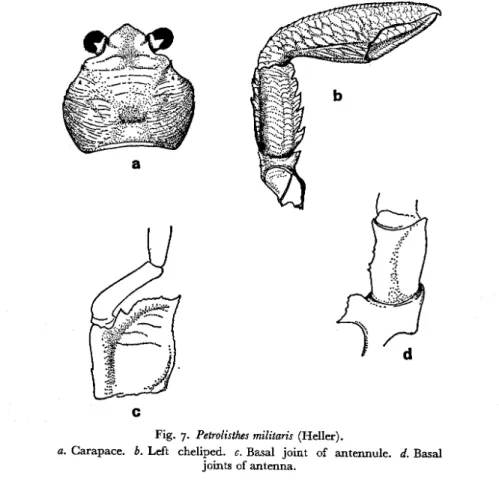
Petrolisthes militaris (Heller, 1862) Fig. 7 a-d
Petrolisthes militaris (Heller), Miyake, 1943: 56. Haig, 1964: 357.
Description: Carapace length (including rostrum) equal to breadth. Frontal margin broadly triangular, apically rounded, base (between supra-orbital teeth) just less than twice length, margin finely crenulated. Prominent supra-
Fig. 7.Petrolisthes militaris (Heller).
a.Carapace. b.Left cheliped. c.Basal joint of antennule. d.Basal joints of antenna.
orbital spine present. Epibranchial spine present. Just posterior to latter, small spine in antero-branchial region. Lateral branchial margin with 2 or 3 largish spines, anterior to which, 2 or 3 minute spines. Gastric and branchial regions covered with transverse rugae. Basal joint of antennule with distal toothed keel.
1st free peduncular joint of antenna with distal slightly flattened denticulate lobe. Chela longer than carapace. Merus, carpus, propodus, and dactylus of cheliped covered with flattened rugae. Merus with large crenulated tooth on inner distal angle. Carpus with 5 crenulate flattened teeth on anterior margin, distal 2 apically blunt. Posterior margin of carpus with 3 small distal spines.
Proximal posterior margin of chela slightly denticulate, denticles decreasing in size distally. Meri of ambulatory pereiopods with flattened rugae. Propodi cylindrical, about twice length of carpus. Dactylus with 3 sharp spines on lower margin, ending in acute curved talon.
Distribution: Widespread throughout Indo-Pacific region.
Material:
4'0
4'0 4.6 5'0 6'0 3'5~ carapace
length Station Depth (m)
4'5 BRU372G 55
5'0 6·0 rJ carapace
length
Remarks: These specimens would appear to constitute the most south-westerly record for the species.
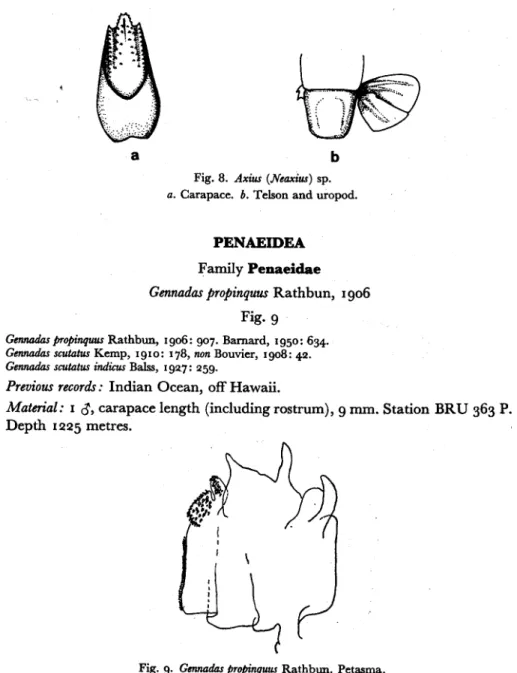
Family Axiidae Axius (Neaxius) sp.
Fig. 8 a-b
Description: Rostrum triangular, breadth equal to length, apically notched, margin with 4 spines. Prominent exorbital spine, region between latter and base of rostrum smooth. Lateral margin of anterior carapace region with 13 to 14 spines. Very prominent cervical groove. Anterior two-thirds of flattened part of carapace with scattered spines. Telson slightly broader than long, without transverse carinae.
Material: I
rJ,
carapace length 4 mm, overall length 9' 5 mm. Station BR U 357 B. Depth 70 metres. I ovigerous ~, dimensions as rJ. Station BRU 256 B.Depth 18 metres.
Remarks: As many of the appendages are missing, it is difficult to be definite
about the specific position of these specimens.
Axius acanthus
var.mauritianus
Bouvier, 1914, has been recorded from Mauritius. This species has a telson with 2 transverse carinae, poorly developed lateral carapace spines, and no scattered carapace spines. The present specimens lack the telson carinae, while possessing scattered spines on the carapace, and well-developed antero-lateral carapace spines.Fig. 8. Axius (Neaxius) sp.
a.Carapace. b.Telson and uropod.
Family Penaeiclae
Gennadas propinquus
Rathbun, 1906 Fig. 9Gennadas propinquus Rathbun, 1906: 907. Barnard, 1950: 634.
Gennadas scutatusKemp, 1910: 178,nonBouvier, 1908: 42.
Gennadas scutatus indicusBaiss, 1927: 259.
Previous records:
Indian Ocean, off Hawaii.Material:
10',
carapace length (including rostrum), 9 mm. Station BRU 363 P.Depth 1225 metres.
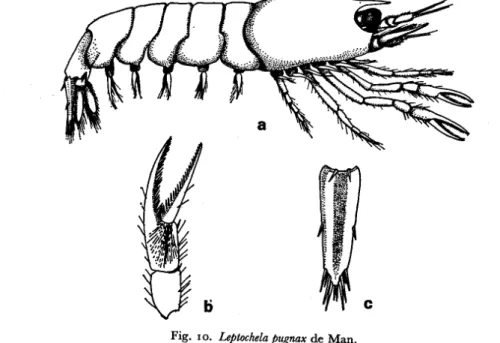
Family Pasiphaeidae Leptochela pugnax de Man, 1920
Fig. IO a-c
Leptochelapugnax de Man, 1920: 26. Kemp, 1925: 255. Barnard, 1958: 6 (InL. robusta).
Description: Rostrum slender, reaching beyond eyes to 2nd antennular peduncle segment. Small antennal spine present. Rostral carina not continued posteriorly along carapace. Dactylus of 2nd pereiopod with about 19 spines, finger of propodus with about 21 spines. 5th abdomimal segment not dorsally- carinate, unarmed. Pleurae of 3rd, 4th, 5th abdominal segments ventrally rounded, each with small tooth in anterior region. 6th abdominal segment with long ventro- lateral spine about two-thirds from anterior end, followed by several setae.
Posterior margin of 6th segment with prominent lateral spine. Anterior part of telson with 1 pair of dorsal spines, 1 pair of lateral spines at about the mid- point. Telson with 5 pairs of apical spines.
Previous records: Maldives, Andamans, Nicobars, Mergui Archipelago.
Material: 1 ~, carapace length 4 mm, overall length 13 mm. Station BRU 392 F. Depth 35 metres.
Remarks: The present species closely resembles L. robusta Stimpson, which has
Fig.10. Leptochela pugnax de Man.
a.Lateral view. b.First chela. c.Telson.
been recorded from Inhambane, but differs in the possession of an antennal spine, and one pair oflateral telson spines and not two as inrobusta.
Family Oplophoridae
Oplophorus spinicauda Milne-Edwards, 1883 Fig. I I
Oplophorus spinicauda Milne-Edwards, 1883: plate 29. de Man, 1920: 48. Chace, 1940: 184.
Description: Postero-Iateral angle of carapace lacking tooth. 2nd, 3rd, 4th abdominal segments ending in long spines. Telson terminating in end piece, latter armed laterally with spines.
Previous records: East coast of U.S.A., West Indies, off Morocco, north of Malagasy Republic, off Indian coast, Philippines, Hawaii.
Material: I ? ~, carapace length (excluding rostrum) 5'5 mm. Station BRU 363 P. Depth 1225 metres.
Fig. I I. Oplophorus spinicauda M.-Ed.
Telson.
Family Pandalidae
Heterocarpus woodmasoni Alcock, 190I Fig. 12
Heterocarpus woodmasoniAlcock,190I: 108.de Man, 1920: 156.
Description: Rostrum one and a half times longer than carapace, 10 dorsal, 7 ventral teeth. Rostral carina produced almost to posterior margin of cara- pace, posterior portion indistinct. Carapace with prominent post-antennular and post-antennal carinae, starting with prominent antennal and branchio- stegal spines respectively. Antennal scale two-thirds carapace length. 1st pereiopods equal in length to 3rd maxillipeds, ending in minute dactyl. 2nd pereiopods both chelate, right shorter than left. Right chela slightly larger than left, carpus offormer with 12.segments, carpus oflatter with about 20 segments.
3rd, 4th, sth pereiopods similar, with slender dactyls. Abdominal segments
I and 2 dorsally smooth, 3rd with flattened hook-like tooth, 4th, Sth, 6th dor- sally smooth. Telson elongate, tapering, equal in length to outer branch of uropod, apically pointed, with 2 pairs of subapical spines.
Previous records: Bali Sea, Makassar, Kei Islands, Madura Straits, Andaman Sea.
Material: I ~,carapace length (excluding rostrum) 9 mm, overall length 43 mm. Station 370 G. Depth 347 metres.
Remarks: This appears to be the most southerly record of this very distinctive Indian Ocean species.
Fig. 12.Heterocarpus woodmasoni Alcock.
Lateral view.
Plesionika acanthonotus (Smith, 1882) Fig. 13 a-b
Pandalus acanthonotus Smith, 1882: 6 I, plate 13,figs10, I I.
Plesionika acanthonotus (Smith), de Man, 1920: 105.Holthuis, 1951: 62, fig.13bot.
Description: Rostrum two-thirds carapace length, compressed, spines variable (II/S, 12/4, 12/S). Prominent antennal and branchiostegal spines. Basal joint
of antenna with prominent spine on lower distal angle. Antennal scale seven- eighths carapace length, rostrum two-thirds antennal scale length. Carapace and abdomen with minute scales. 1st pereiopod with microscopic dactyl, very slender, propodus half length of carpus, 2nd pereiopods equal in length, reaching beyond antennal scale. Chela about one-eighth length of carpus. Latter con- sisting of about 2Ijointlets. Merus and ischium equal in length, each slightly more than half length of carpus. Dactyl of 3rd pereiopod one-third length of propodus, merus reaching to end of antennal scale. Posterior margin of merus with I I spines. 4th pereiopod similar to 3rd. 5th pereiopod longest, midpoint of carpus reaching to end of antennal scale. Merus armed with 8 spines. Pleuron of 5th abdominal segment with tooth on postero-ventral angle. Telson with 3 pairs lateral spines, slightly shorter than inner branch of uropod, latter slightly shorter than outer branch. Outer margin of outer branch with tooth some way behind apex.
Previous records: East coast of U.S.A., off Portugal, Spain, Brazil, Angola.
Material: I
c3',
carapace length (excluding rostrum) 6 mm, I ~,carapace length 5 mm. Station BRU 390 H. Depth 175-200 metres. 2c3'c3',
carapace lengths 8 mm, 7' 5 mm. Station BRU 390 P. Depth 118 metres.Remarks: From de Man's 1920 key to the genus Plesionika, this specimen falls into the group characterised by a rostrum shorter than the carapace, 2nd pereiopods equal in length. The species in this group, viz. hypanodon Doflein,
Fig. 13. Plesionika acanthonotus (Smith).
a.lateral view. b.Endopod of pleopod one.
and brevis (Rathbun) bear little resemblance to the present species, which more closely resembles the ortmanni Doftein, longipes (Milne-Edwards), sindoi (Rath- bun) group, in spite of the short rostrum. This species most closely resembles P. acanthonotus (Smith). The rostra of the 2 species are very similar, being shorter than either the carapace or the antennal scale. The variation in number of the rostral teeth in this species is similar to that ofacanthonotus. The shape of the telson, abdomen, and antennular peduncle also agree closely. The pereio- pods are similar in both species, including the number of jointlets of the carpus of the 2nd pereiopods. The mouthparts are identical. The antennal scale of this species appears proportionally more slender than acanthonotus, while the endopod of the 1st pleopod in the male differs in shape. It seems unusual that such a typically Atlantic species should occur in the Indian Ocean. Without further material it is not possible to be more definite regarding the status of this species, but ifnot acanthonotus, it is certainly very closely related.
Family Processidae Processa sp.
Fig. 14
Description: Rostrum apically bidentate, reaching to posterior part of orbit.
Lateral process of basal joint of antennule smoothly rounded, with a slightly elongate inner rounded angle. Antennal scale apically rounded, spine on outer margin slightly longer than apex. Palm of chela of right 1st pereiopod almost twice length of finger and thumb. Dactylus of left 1st pereiopod about one- third length of propodus. Postero-inferior angle of pleuron of 5th abdominal segment with a small tooth.
Material: I ovigerous ~, carapace length (including rostrum) 4' 5 mm, overall length 16 mm. Station BRU 372 G. Depth 55 metres.
Remarks: This specimen closely resembles P. australiensis Baker, 1907, in the shape of the carapace, rostrum, telson and 5th abdominal pleuron, but differs in possessing a smoothly rounded process on the basal antennular joint. P.
australiensis has this process with a spine on the outer angle. The 2nd-5th pereiopods appear to be more slender than in australiensis. Without more material it is difficult to give this specimen definite status.
Family AIpheidae Alpheus nonalter n.sp.
Fig. 15 a-d
Description: No supra-orbital spines. Rostrum reaching about two-thirds along basal antennular peduncle joint. Latter with swollen base, spine on external distal angle reaching just beyond end of joint. 2nd antennal peduncle segment 3 times length of 3rd. Antenna! scale reaching beyond antennular peduncle.
Larger chela with palm about 4 times longer than broad. No notch at base of
Fig. 14.Processa sp.
a.Peduncle of antennule. b.Tip of antennal scale.c.Chela of first right pereiopod.d.Dactyl and propodus of left first pereiopod.e.Antero-Iateral portion of carapace.f Pleuron,
5th abdominal segment.g.Telson.
dactyl, but shallow notch at base of fixed finger. Latter longer than movable finger. Both chelae granulous. Smaller chela with fingers half to two-thirds length of palm. Latter cylindrical, six times longer than wide. Movable finger slightly balaeniceps-like. Meri and ischia of both chelae with inner margin denticulate, former with spine on inner distal angle. Carpus of 2nd pereiopod of 5 jointlets, 2nd joint two-thirds length of 1st, equal in length to jointlets 3, 4, 5 together. Pereiopods 3, 4, 5 with simple flattened dactyls. Propodi, carpi, and meri equal in length. Ischia with single ventral spine. Telson length twice basal width.
Material: 3 ovigerous ~~, carapace lengths (including rostrum) 8· 0, (holotype, S.A.M. AI2650), 8'0, g'o mm. 7
0'0',
carapace lengths, 6'0, 7'0, 7'4, 7'5(paratype, S.A.M. AI2651), 8'0, 8'0, 8'0 mm. 18 damaged specimens.
Station BRU 390 P. I 18 metres. I ~, carapace length 7' 5 rom. I damaged.
Station BRU 391.c. 86 metres. 4 ~~, carapace length 7'5, 8'0, 8'0, 8'0 rom.
4
d'd',
6'0, 6'0,7'0,8'0,15 damaged, 4juveniles. Station BRU 390 H. 175-200 metres.Remarks:
The unarmed meri of the third pereiopods, the balaeniceps-like smaller chela of the male, the simple lanceolate-like dactyls of the last 3 pairs of pereiopods and the lack of supra-orbital spines place this species in theBrevirostris
group of de Man (19II). This species is most closely related toA. acutocarinatus
de Man, andA. macrosceles
Alcock & Anderson. It differs from~
~--d-)
Fig. 15. Alpheus nonaltern.sp.
a.Lateral view.b.Anterior carapace and appendages, dorsal view.c.Large chela.d.Small chela.
A. acutocarinatus in that it lacks a prominent post-rostral carina and the tubercle or tooth just behind the orbital hood. It differs fromA. macrosceles (which has a subcylindrical chela) in having a slightly flattened large!' chela. The smaller chela ofA. macrosceles is not balaeniceps-like, as in this species; both fingers meet when shut.
Alpheus waltervadi n.sp.
Fig. 16 a-c
Description: Rostrum reaching to middle of 1st antennular peduncle segment, supra-orbital spines slightly shorter. 2nd antennular peduncle segment twice length of 1st, Ii length of 3rd. 1st antennular peduncle s~gment basally broad, with external spine reaching to end of segment. Apical spine of antennal scale reaching beyond 3rd antennular peduncle segment. Larger chela of 1st pereiopods with distinct deep notch in upper margin of palm behind dactyl.
Notch followed distally by raised flattened lobe, distal end of which armed with forwardly directed tooth. Latter overhangs dactyl. Carpus one quarter length of merus, latter triangular in cross section, distally ending in 3 lobes at the angles, margins unarmed. Smaller chela only slightly shorter than other, fingers equal in length to palm. Spine at distal end of palm overhangs dactyl.
Latter with concave inner edge. Carpus of 2nd pereiopods consisting of 5 jointlets, 1st largest. Ischium only slightly longer than merus. Dactyls ofpereio-
pods 3, 4, 5, biunguiculate. Carpi two-thirds length of propodi, latter armed ventrally with 8 spines. Carpus with distal lobe overlapping propodus, other- wise unarmed, merus with flattened spine on ventral distal margin. Telson It times longer than basal width, with 2 pairs lateral spines dividing the appendage into thirds.
Material: 2 ovigerous ~~, carapace lengths 5'5 (paratype, S.A.M. AI2647), 4' I mm (holotype, S.A.M. AI2646). 4
d'd',
carapace lengths 3'4, 4'0, 4' I, 4' I mm. 6juveniles, 5 damaged, station BRU 381 A-C, 38-46 metres (Walter's Shoal).Remarks: According to de Man's 191I classification of the genus Alpheus (taken from Coutiere, 1899), this species belongs to theMegacheles group, characterized by the presence of supra-orbital spines, a grooved and notched first chela, unarmed meri of the 3rd pereiopods and biunguiculate dactyls for the last three pairs of pereiopods. This species is very closely related to the following:
A. hailstonei Coutiere, and its varieties assimulans de Man, laetabilis de Man, and to A. paradentipes Coutiere. It differs from hailstonei in that the larger chela is proportionally more robust and shorter and differently shaped. The supra- orbital spines are not as pronounced as in hailstonei.
It differs from hailstonei var. assimulans in the detailed shape of the larger chela, the stockier meri of the third pereiopods and in the 4th joint of the carpus of the 2nd pereiopods being only half as long as the 2nd. (These are equal in assimulans.) It differs from hailstonei var. laetabilis in lacking the spinous merus
of the larger chela characteristic of this variety. It differs from
paradentipes,
which it most closely resembles, in the shape of the larger chela, in having much less prominent supra-orbital spines, and no spines on the carpi of the last three pairs of pereiopods. Further investigation may well prove this species to be synonymous with an already established one. This is, however, a preferable situation to incorrectly assigning them to an already established species.\:l V
Fig. 16.Alpheus waltervadi n.sp.
a.Lateral view. b.Anterior carapace and appendages, dorsal view.
c.Large chela.d.Small chela.e.TeIson.
In the following table the geographical distribution of all the species in this collection is given. All are automatically included in the Indo-Pacific region. The South Mrican region includes the area from Cape Point east to
about Durban. The Atlantic region includes the area west from Cape Point.
It can be seen from this table that the majority of animals have Indo-Pacific affinities, while only about 2 I species occur in all three regions.
Species Indo-Pacific South Mrican Atlantic
BRACHYURA
Achaeopsis spinulosus
XAchaeopsis thomsoni
X X XAchaeus lacertosus
XAchaeus
cf.affinis
X XActaea rueppellii
XCalappa lophos
XCarcinoplax longimanus
X XCharybdis
cf.annulata
XCharybdis variegata
XConchoecetesartificiosus
XDorippe lanata
X X XEbalia bamardi
X XEbalia tuberculata
X X XEbalia tuberculosa
f.postulans
X XEbalia tuberculosa
f.scandens
X XEthusa sinespina
XEumedonus granulosus
XEurynome aspera
X X XConeplax angulata
X X XConioneptunus africanus
X XHomola barbata
X X XHyastenus spinosus
XInachus
ef.dorsettensis
Xlnachus guentheri
X XLeucosia marmorea
XLophozozymus dodone
X XLupocyclustugelae
X XMacropodia formosa
X XNursilia dentata
XPalicus sexlobatus
XParatergatis longimanus
XPhilyra globosa
X XPhilyra globulosa
X XPilumnus hirsutus
X XPilumnus longicomis
XPlatylambrus quemvis
X178 ANNALS OF THE SOUTH AFRICAN MUSEUM
Species Indo-Pacific South Mrican ~ Atlantic
Platypodia granulosa X
Portumnus mcleayi X X
Ranina ranina X
Retropluma planiform X
Thalamita woodmasoni X
Xanthias tuberculidens X X
ANOMURA PAGURIDEA
Anapagurus hendersoni X X
Dardanus arrosor X X X
Dardanus euopsis X
Dardanus setifer X
Diogenes brevirostris X X X
Diogenes costatus X X
Nematopagurus gardineri X
Nematopagurus squamichelis X
Pagurus spinulentus X X
Para-pagurus pilosimanus X X X
GALATHEIDEA
Galathea dispersa X X X
Galathea intermedia X X X
Munida sanctipauli X X X
Munida semoni X
Porcellana dehaanii X
Porcellana streptocheles X X
MACRURA PENAEIDEA
Acetes erythraeus X
Gennadas propinquus X
Macropetasma africana X X X
Metapenaeopsis adamanensis X
Metapenaeopsis stebbingi X
Parapenaeus fissurus X
Penaeopsis rectacuta X
Penaeus japonicus X X
Sergestes prehensilis X X
Solenocera ajricanum X X X
Solenocera pectinata X
DECAPODCRUSTACEAFROMTHESOUTH-WESTINDIANOCEAN 179
Species Indo-Pacific South African Atlantic
CARIDEA
Alpheus nonalter
XAlpheus waltervadi
XAlpheus frontalis
XChlorotocus crassicornis
X X XEualus ctenifera
X XHeterocarpus woodmasoni
XHippolysmata vittata
XLatreutes mucronatus
XLeptochela pugnax
XLeptochela robusta
XNikoides
cf.danae
XOplophoTUSspinicauda
X XPlesionika
cr.acanthonotus
XPlesionika martia
X X XPontocaris cataphracta
X X XPontocaris lacazei
X X XProcessa austroaJricana
X XStylodactylus bimaxillaris
X X XSynalpheus anisocheir
X X XSynalpheus jedanensis
XTozeuma armata
XSUMMARY
A collection of brachyuran, anomuran and macruran decapod Crustacea is described. The material is from the south-west Indian Ocean, i.e. off the coasts of Portuguese East Mrica, Natal and Malagasy Republic, and includes approximately 110 species, of which 15 are new records, and 5 previously undescribed.
Thanks are due to the Zoology Department of the University of Cape Town, and particularly to Mr. J. Field, for making the material available.
Thanks are also due to Mr. C. Berrisford and Miss L. Joubert for preliminary identifications of some of the material and to Dr. M.-L. Penrith for helpful comments and criticisms.
The Trustees of the South Mrican Museum are grateful to the Council for Scientific and Industrial Research for a grant towards the publication of this paper.
ALCOCK, A. 18g6. Materials for a carcinological f~una of India. 2. The Brachyura Oxystoma.
J.
Asiat. Soc. Beng. 65: 134-296.ALCOCK, A. 190 I .A descriptive catalogue of the Indian deep-sea Crustacea, Decapoda Maerura and Anomala, in the Indian Museum, being a revised accountif the deep-sea species collected by the Royal Indian Marine Survey ship 'Investigator'. Calcutta: Indian Museum. .
ALCOCK, A. 1905. Catalogue if the Indian decapod Crustacea in the collectionifthe Indian Museum. 2.
Anomura. Calcutta; Indian Museum.
ALCOCK, A. & ANDERSON, A. R. 1894. Natural history notes from H.M. Indian Marine Survey steamer 'Investigator', Commander C. F. Oldham, R.N., commanding. Series 2, no. 14.
An account of a recent collection of deep-sea Crustacea from the Bay of Bengal and Lac- cadive Sea. J.Asiat. Soc. Beng. 63: 141-185.
BAKER, W. H. 1907. Notes on South Australian decapod Crustacea. Part 5. Trans. R. Soc. S.
Aust. 3:1: 173-191.
BALSS, G. 1927. Macrura der Deutschen Tiefsee-Expedition. 3. Natantia, Teil B. Wiss. Ergebn.
dt. Tiifsee-Exped. 'Valdivia' ll3:245-275.
BARNARD, K. H. 1950. Descriptive catalogue of South Mrican decapod Crustacea. Ann. S. Afr.
Mus. 38: 1-824.
BARNARD, K. H. 1954. Notes sur une collection de crustaces decapodes de la region Malgache.
Mem. Inst. scient. Madagascar (A) 9: 95-104.
BARNARD, K. H. 1958. Further additions to the crustacean fauna-list of Portuguese East Mrica.
Mem. Mus. Dr. Alvaro de Castro4: 3-27.
BELL, T. 1855. Horae carcinologicae, or notices of Crustacea. A monograph of the Leucosiadae, with observations on the relations, structures, habits and distribution of the family; a revision of the generic characters; and descriptions of new genera and species. Trans. Linn.
Soc. Lond. llJ:: 277-314.
BOUVIER, E. L. 1908. Crustaces decapodes, provenant de campagnes de I"Hirondelle' et de la 'Princesse Alice' 1886-19°7. Result. Camp. scient. Prince Albert 1. 33: 1-122.
BOUVIER, E. L. 1914. Sur la faune carcinologique de l'ile Maurice. C. r. hebd. Seanc. Acad. Sci.
Paris :159: 6g8-704·
CHACE, F. A. 1940. Plankton of the Bermuda Oceanographic Expeditions. 9. The bathypelagic caridean Crustacea. <:,oologica,N.
r.
ll5: II 7-2 I 0.CoUTIERE, H. 1899. Les Alpheidae. AnnIs Sci. nat. 9: I-56o.
DoFLEIN, F. 1904. Brachyura. Wiss. Ergebn. dt. Tiefsee-Exped. 'Valdivia' 6: 1-314.
FUPSE, H.J. 1930. Oxyrrhyncha. Parthenopidae. Siboga Exped. monogr. 39C"; 1-g6.
GILL, T. 1894. A new bassalian type of crab. A~. Nat.ll8: 1043-1°45.
HAIG, J. 1964. Papers from Dr. Th. Mortensen's Pacific Expedition 1914-16. 81. Porcellanid crabs from the Indo-West Pacific, Part 1. Vidensk. Meddr dansk naturh. Foren. :lll6: 355-386.
HELLER, C. 1862. Neue Crustaceen, gesammelt wahrend der Weltumseglung der k.k. Fregatte Novara. Zweiter vorlaufiger Bericht. Verh. zool.-bot. Ges. Wien :Ill:519-528.
HOLTHUIS, L. B. 195 I. The caridean Crustacea of tropical west Mrica. Atiantide Rep. ll:7- I 87.
HOLTHUIS, L. B. &GoTTLIEB, E. 1958. An annotated list of the decapod Crustacea of the Medi- terranean coast of Israel, with an appendix listing the Decapoda of the eastern Mediter- ranean. Bull. Res. Coun. Israel7B: 1-126.
KEMP, S. 1910. Notes on the Decapoda in the Indian Museum. 1.Rec. Indian Mus. 5: 173-18r.
KEMP, S. 1925. On various Caridea. Notes on Crustacea Decapoda in the Indian Museum. 17.
Rec. Indian Mus. ll7:249-343.
MACGILCHRIST, A. C. 1905. Natural history notes from the R.I.M.S. 'Investigator' Capt. T. H.
Heming, R.N. (retired) commanding. Series 3, no. 6. An account of some of the new and some of the rarer decapod Crustacea obtained during the surveYing season 1901-1904.
Ann. Mag. nat. Hist. (7) :15: 233-268.
MAN,J. G. de. IBg3. Report on the podophthalmous Crustacea collected in the yearIBgl by Dr. H. Ten Kate in some islands of the Malay Archipelago.Notes Leydm Mus. 15: 284-31 I.
MAN,J. G. de. 191I. The Decapoda of the Siboga Expedition. Part 2. Family Alpheidae.Siboga Exped. monogr. 39a1: 1-465.
MAN,J. G. de. 1920. The Decapoda of the Siboga Expedition. Part 4. Families Pasiphaeidae, Stylodactylidae, Hoplophoridae, Nematocarcinidae, Thalassocaridae, Pandalidae, Psali- dopodidae, Gnathophyllidae, Processidae, Gylphocrangonidae and Crangonidae. Siboga Exped. monogr. 39a3: 1-318.
MILNE-EDWARDS,A. 1883.Recueil dejigures de crustaees nouveaux oupeu connus. Paris.
MIYAKE,S. 1943. Studies on the crab-shaped Anomura of Nippon and adjacent waters.
J.
Dep.Agric. Kyushu imp. Univ. 7: 49-158.
ORTMANN,A. E. 1894. Crustaceen.In Semon, R. Zoologische Forschungsreise in Australien und den malayischen Archipel. 5: 1-80. J ena: Fischer.Denkschr. med.-natuTW. Ges. Jena 8: 1-80.
RATHBUN,M. 1906. The Brachyura and Macrura of the Hawaiian Islands. Bull. U.S. Fish Commn 113:827-930.
RATHBUN,M. 1911. Marine Brachyura. Trans. Linn. Soc. Lond. (2, Zool.) 14: 191-261.
RATHBUN,M. 1918. The grapsoid crabs of America.Bull. U.S. natn. Mus. 97: i-xxii, 1-461.
RATHBUN,M. 1932. Preliminary descriptions of new species of Japanese crabs.Proc. bioi. Soc.
Wash. 45: 29-38.
SAKAI,T. 1939.Studies on the crabs of Japan 4. Brachygnatha, Brachyrhyncha. Tokyo: Yokendo.
SAKAI,T. 1965a. On two new genera and five new species ofxanthoid crabs from the collection of His Majesty the Emperor ofJapan, made in Sagami Bay.Crustaeeana8: 97-106.
SAKAI,T. 1965b. The crabs of Sagami Bay. Honolulu: East West Centre Press.
SMITH,S. I. 1882. Reports on the results of dredging ... on the east coast of the United States ...
by the U.S. Coast Survey Steamer 'Blake' . . . 17. Report on the Crustacea. Part I. Deca- poda. Bull. Mus. compo Zool. Harv. 10: 1-108.
TESCH,J. J. 1918. The Decapoda Brachyura of the Siboga Expedition. 1. Hymenosomidae, Retroplumidae, Ocypodidae, Grapsidae and Gecarcinidae. Siboga Exped. monogr. 39c1:
1-148·