
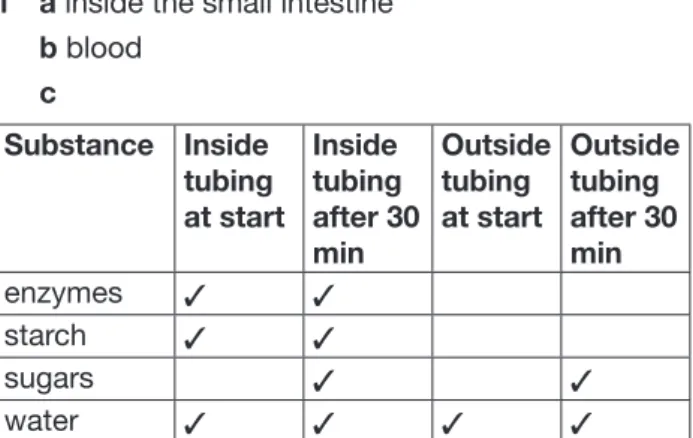
After food is broken down, it enters the body in the small intestine. 4 Credit must be given to: the enzyme in the diagram labeled amylase, the diagram showing the lines between the hexagons that are cut by the enzyme, the enzyme looks the same after it has done its job.
8C Breathing and respiration
2 a Arrows with appropriate color for oxygen going from the alveolus to the inside of the blood vessel. 2 X – the cells respire and therefore use up glucose, and then the concentration of glucose decreases; The Y – cells use anaerobic respiration (they have no mitochondria for aerobic respiration) and produce lactic acid, so the concentration increases gradually; The Z – cells do not use aerobic respiration (they have no mitochondria for aerobic respiration) and therefore the level of carbon dioxide does not increase.
8D Unicellular organisms
Aerobic respiration releases more carbon dioxide and thus will cause the bread to rise further/faster. 8 list of organic compounds (eg carbohydrates, proteins, fats, glucose, starch); carbon dioxide does not contain a chain of carbons and is thus not organic.
8E Combustion
The oxygen theory suggests that the loss of mass is due to the production of carbon dioxide gas. 3 Carbon dioxide is a greenhouse gas that absorbs some of the energy emitted by the Earth and transfers it back to the Earth's surface. More carbon dioxide in the air will increase this effect, so the Earth will warm.
1 A company's "carbon footprint" is a measure of the amount of carbon dioxide released into the atmosphere as a result of all its activities. 2 a There is a positive correlation between the amount of carbon dioxide in the atmosphere and the global temperature. 2 a An increase in the earth's temperature as a result of extra greenhouse gases/carbon dioxide in the atmosphere.
If the amount of greenhouse gases/carbon dioxide increases in the atmosphere, then this effect will increase, causing global warming.
8F The periodic table
2 Aristotle thought that there were four elements and that different substances contained different amounts of the four elements. 5 No atoms are lost or gained during a reaction, so the mass of the products is the same as the mass of the reactants (since they contain the same atoms). 1 a because they are very different from the pattern of the other results in the graph and table.
1 is the atomic number, which is the number of protons in the nucleus of the element. Make sure students can see how the bottom two rows of the table on page 206 of the Student's Book fit into the bottom two periods of the main table above them). 4 a One of: makes it less cramped/words would take up too much space/makes it easier to see the colors and layout of the table.
1 Diagram showing: two circles (symbols for atoms), arrows pointing towards each other (symbols for the movement of the atoms towards each other), crash symbol (to represent the impact of the two atoms), central circle that is larger than both of the outer two circles (symbol for the newly created atom, which is larger than the starting atoms).

8G Metals and their uses
Carbon monoxide, nitrogen oxides and hydrocarbons. they become carbon dioxide, water and nitrogen. copper electrical wiring, as it is a good conductor of electricity; steel in radiators, as it is a good conductor of heat;. aluminum for doors and windows, as it is light and strong; lead for roofing, as it is willing;. copper for water pipes as it is strong and malleable or non-reactive or malleable. 1 order is: potassium, sodium, calcium, magnesium, aluminum, iron, tin, copper, silver, gold 2 potassium + hydrochloric acid → potassium chloride + hydrogen. 7 The second experiment for sulfuric acid is anomalous as it differs greatly from the other results.
9 Group 5 used sulfuric acid that was twice as concentrated as it took half the time to react compared to the other groups. 2 shiny, hard, strong, high melting point, high boiling point, malleable, flexible, stretchable, good conductor of heat, good conductor of electricity 3 a stainless steel. b connects pipes or wires in electrical circuits c It is strong but light which makes flying easier/. 4 a a metal with another element added/an impure metal. In the alloy, the different-sized atoms disrupt the structure like this. the rows of atoms cannot easily slide over each other and are therefore more difficult to bend.
In bronze, the tin atoms of different sizes disrupt the structure, making it difficult for the rows of copper atoms to slide over each other easily, making it more difficult.
8H Rocks
So it does not cool as much as the lava that escapes to the surface of the Earth. Compaction is when layers above the sediment flatten and squeeze out most of the water between the grains. Sediments are compacted, forcing out the water between the grains, and cementation occurs when minerals dissolved in the water solidify and 'glue' the sediments together.
4 The oldest rocks are in the Outer Hebrides and north-west of the Scottish mainland. 1 a Water flows slower on the inside of the bend (near X) and faster on the outside of the bend (near Y). The larger grains that are carried will be deposited where the water slows down, which is on the inside of the bend.
2 The water in the stream runs over the rocks that protrude from the riverbed.
8I Fluids
The volume of water pushed into the cup is the same as the volume of the modeling clay. Air is compressible, so the air at the bottom of the atmosphere is compressed more than the air higher up, adding to pressure. 7 The ship contains air spaces, so the total density of the ship and the air in it is less than the density of seawater.
4 Students should find that the buoyancy depends only on the submerged volume of the solid. 4 size – the Navy submarine is much larger than Alvin, which will give it a higher drag for a given speed; shape – the Navy submarine is much smoother than Alvin, which will reduce drag at the same speed; speed – the naval submarine is much faster than Alvin, and will therefore have a higher drag when traveling at its top speed. 3 On a hot day, the density of the air decreases, and so the lift decreases for a given speed.
With ice the opposite happens: the solid has a lower density than the liquid and so the ice floats on water.
8J Light
2 It must be good at reflecting light, so that as much as possible of the light from the projector reaches the audience. This means that the light from the source is only completely blocked in part of the shadow. Draw a normal at the point where the light entered the block and measure the angles of the light beam from the normal.
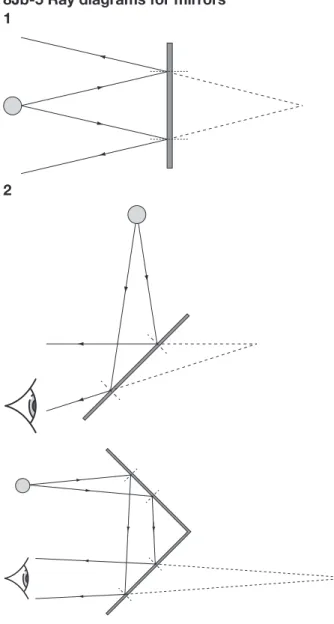
1 A: Another ray drawn from the top of the flame passing through the hole to the screen. 2 Second set of rays drawn from the bottom of the flame, passing through the lens and converging on one point on the screen. 3 a light rays from the top of the flame cross light rays from the bottom as they pass through the hole (or similar explanation).
In a camera, the shape of the lens does not change, but the distance from the lens to the sensor is adjusted.
8K Energy transfers
3 The light from the sun must travel through more atmosphere to reach person B than person A. The sun appears low in the sky. So there is a greater chance of the blue light being scattered and less of it reaching our eyes. 4 If blue light is scattered more than colors with longer wavelengths, you might expect violet (with an even shorter wavelength than blue) to also be scattered more. The reason the sky doesn't look violet is partly due to the fact that some of the violet light is absorbed by the atmosphere, and partly to do with the relative sensitivities of the different cones in the human eye - but this is beyond the scope of this worksheet. ). 1 joules (J) – the units for measuring energy degrees Celsius – the units for measuring temperature temperature – how hot or cold something is.
2 30% – the air has a lower relative humidity, so sweat will evaporate more easily and you will be cooler. 4 The air heated by the element will rise because it is less dense than the rest of the air in the oven. Black Chimneys - Black absorbs radiation and heats the chimney, creating a convection current that pulls air through the building.
They must therefore be colder than the air inside the house at the beginning of the day.
8L Earth and space
9 similar to Figure E, showing that the sun's heat is more concentrated at the equator than in Britain. This is summer, so the sun will also be higher in the sky and so the rays will be more concentrated. The sun was high in the sky and felt very warm, so she enjoyed being outside.
5 The sun is highest in the sky in June, which is midsummer in the northern hemisphere. The Earth is closer to the Sun when it is winter in the UK, but it is colder in winter when the North Pole is tilted away from the Sun. 2 In summer, the days are longer, the sun is higher in the sky, so the sun's rays are more concentrated.
2 The thread should be shorter, since Mercury is closer to the Sun than to the Earth.

