
This part answers these questions and outlines the history of anthropology, the study of humanity as a whole. These are biological differences, and the goal of physical anthropology—the study of humanity as a biological species—is to understand the hows and whys of these variations in man.
Looking Into Humanity’s Mirror: Anthropology’s History In This Chapter
At the same time, most of them are working – in one way or another – to answer some of the fundamental questions I outline in the section “To the core of anthropology.” In the 1930s, anthropology was a distinctive academic field worldwide, with anthropologists seeking – in various ways – to explore some of the fundamental questions outlined earlier in this chapter in the section 'Getting to the heart of anthropology'.
Actually, Four Mirrors: How Anthropology Is Studied In This Chapter
The answers to these and many other questions about our species can be found in the study of evolution, the change over time in the properties of a living species. Explaining how cultures changed over time is one of the most controversial issues in the field of anthropology.
Physical Anthropology and Archaeology
The Wildest Family Reunion: Meet the Primates In This Chapter
Most of the characteristics of early primates have been studied from fossils of their teeth and skulls (and some limb bones). One of the main divisions in the order Primates is that between the Anthropoidea (human-like monkeys and apes) and the Prosimii (or prosimians, which are quite different from humans even though they are clearly primates). The New World (South America) is home to primates as well; they are members of the order Platyrrhini, meaning "broad-nosed," as opposed to their Old World counterparts discussed in the last section.
In general, the New World monkeys are somewhat smaller than those of the Old World, with most species averaging about 7 kilograms (about 15 pounds). Thus, modern human origins can be traced by fossil evidence to Africa, 6 to 30 million years ago, in the evolution of the Hominoidea. Molars are the heavy, flat teeth in the back of the mouth that do the heavy pushing.
VCLs include tarsiers and lemurs, both members of the prosimian group discussed earlier in the chapter. A parallel big toe aligned with the rest of the toes (instead of the divergent big toe used by other primates to grip tree limbs).
My Career Is in Ruins: How Anthropologists Learn about the Past
- Ar dating
Archaeologists must dig carefully if they want to get a good idea of what people did in the ancient world. In the same way, today's archaeologists carefully examine how ancient cultures' artifacts changed over time. By keeping careful track of where artifacts and features are found at archaeological sites, archaeologists can identify patterns of life in the ancient world.
Uniformitarianism suggests that the geological phenomena that litter the landscape today (such as landslides or ash layers) worked in the same way in the past. If you are interested in the evolution of projectile size over time, focus on size measurements rather than other possible variables such as the color of the stone used to make the arrowheads. They include objects made from the three most common materials used in the ancient world: stone, bone and/or antler, and ceramics.
These basic methods shaped stone into a wide variety of artifacts; the most common artifacts of the ancient world included. Billions of pottery vessels were used in the ancient world; in Roman times, amphorae (storage jars varying in size from bottles to barrels) were as common as jars and bottles are today.
Traces preserved in volcanic ash in Laetoli, Tanzania, date back just under 4 million years. The Pliocene geological epoch from about 5 to 1.8 million years ago is particularly important for early hominid studies because it is the period in which bipedalism really took off as a hominid adaptation. The Pleistocene begins about 1.8 million years ago and is a period marked by ice ages (which ended about 10,000 years ago).
The earliest robust species (Australopithecus aethiopicus) are known from about 2.5 million years ago, and the most recent from about 1 million years ago. The Peninj mandible, the lower jawbone of a robust animal dating to about 1.5 million years ago, is one of the last known robusts. The earliest gracilies are known from about 4 million years ago, and the most recent from about 2 million years ago.
The earliest specimens of Homo are known from about 2.5 million years ago and the latest from about 1.5 million years ago. Not so long ago, the general consensus was that hominids first left Africa about 1 million years ago in the form of Homo erectus, the hominid into which early Homo evolved 1.8 million years ago.
First, you must consider each of the two ways of being a modern man separately. These features include features of the skull (head) and postcranium (skeleton below the head). The archeology of the origins of modern human consciousness (cognitive archaeology) is at the forefront of much archeology today.
Earlier in this chapter I mentioned that AMHss was the only hominid in the world after 30,000 years ago, excluding Neanderthals. Today, the most convincing theory of the origins of language is based on an evolutionary model, and I think it is the best there is; To tell the truth, I'm not even going to mention the others because I don't think they carry the weight of this one. Humans aren't the only animals that can evolve language; one primate species (Homo) has done it, so why not others.
Psychologist Merlin Donald produced the first truly evolutionary model for the origins of modern consciousness in his 1991 book, Origins of the Modern Mind. Archaeologist Steven Mithen produced the second truly evolutionary model for the origins of modern consciousness in his 1996 book, The Prehistory of the Mind.
Hunting, Fishing, Sailing, and Sledding: The Spread of Humanity Worldwide
When humanity first came to the continent of Australia is one of the great mysteries of archaeology. Whatever the ambiguities with some of the data from these sites, they all point in the same direction: to the occupation of Australia at least 40,000 years ago, and perhaps much earlier. Yet another wild, chilling and unlikely story of prehistoric migration and colonization is that of the colonization of the New World (North and South America).
Together, this region opened more than 40 million square kilometers (more than 15 million square kilometers) to humanity, which quickly spread to inhabit every imaginable ecological niche—the grassy Great Plains, the icy Arctic, the windswept coast of Peru, the steamy jungles of Central America, the hardwood forests of Appalachia, the Mississippi Basin, the windy Pacific Northwest, the dry Great Basin, and almost everywhere in between. The real mysteries of the colonization of the Americas lie in the timing and circumstances of the earliest inhabitants. If the dates pan out and the research holds up to the rigorous scrutiny that is the hallmark of good science, this will be the oldest well-accepted date for human occupation in North or South America.
Between 3000 and 1500 years ago, the ancient Polynesians traveled the Pacific Ocean and acquired a habit of exploration, illustrated by the legend of the explorer siblings Ru and Hini (who, after discovering every piece of land in the Pacific, looked at the moon, saw a new city, where they would step, and build a magical ship to take them there). Shell hooks used to catch fish on the trail. Association of researchers.
Old, Old McDonald: The Origins of Farming In This Chapter
An important concept in this definition is control; at some point in the evolution of some plants and animals (such as corn, sheep, cattle or sweet potatoes), these species came under complete human control. It takes advantage of the fact that some species can't do anything about whether people want to corral an animal or control which seeds are used in the next planting. For more information on the origins of some common domesticated plants, see Table 9-2 later in the chapter.
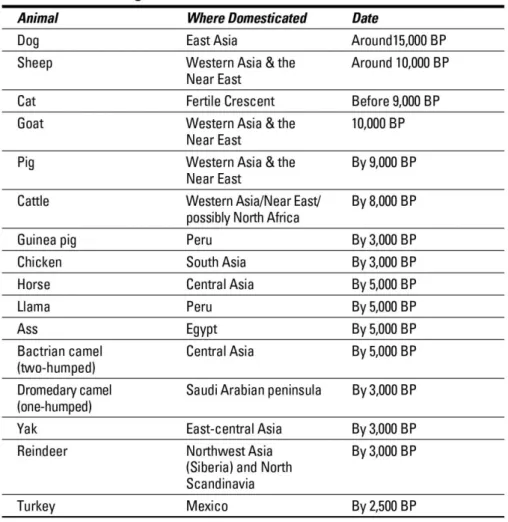
Fortunately, most of the animal species we eat reproduce quickly, producing lots of offspring at the same time. See Table 9-1 later in the chapter for a list of some common domestic animals and their origins. For these reasons, I will call the type of agriculture that I describe in the sections that follow state farming.
The Domestication of Llamas and Turkeys: Interestingly, no animal that could be ridden on a large scale was domesticated in the Americas. Potato Cultivation: The potato first appeared in South America and, like many other New World crops, was brought back to the Old World after conquistadors "discovered" it in the 16th century.
The Development of Civilization In This Chapter
Lack of emphasis on social ranking, meaning that people in the foraging culture have equal access to all resources (an arrangement known as egalitarianism). Lack of emphasis on possession, meaning that most (but not necessarily all) objects are communally owned and symbolic units of value (such as money) are absent. Strong emphasis on social ranking, meaning that some people have greater access to resources than others; these citizens are often heads of families.
A strong emphasis on possessions, meaning that gardeners (compared to foragers and herders) place a high value on their goods and personal property (farmland, food processing and storage facilities, paddocks, etc.) because they invest so much time in that property . A very strong emphasis on symbolic material culture, which means that a lot of effort goes into beautifying artefacts mainly because of no. A strong emphasis on social ranking, meaning that some people have greater access to resources than others; these people are and often were the heads of families owning large numbers of livestock and vast and unusually productive patches of agricultural land.
Strong emphasis on possessions, meaning that (compared to foragers, pastoralists and horticulturists) farmers place the most value on their goods and personal possessions (farmland, food processing and storage facilities, enclosures, and so on) because they invest so much time in it property. Strong emphasis on social ranking, meaning that some people have greater access to resources than others; these people are and often were leaders of.