We thank members of the Publication Manual Revision Task Force for their vision for the manual and for ensuring that our guidance reflects current best practice. The Publication Manual of the American Psychological Association is the authoritative resource for APA Style, and we are proud to present its seventh edition.
Why Use APA Style?
APA Style for Students
Utility and Accessibility
What’s New in the Seventh Edition?
- Scholarly Writing and Publishing Principles Chapter 1 addresses types of papers and ethical compliance
- Paper Elements and Format
- Journal Article Reporting Standards
- Writing Style and Grammar
- Bias-Free Language Guidelines
- Mechanics of Style
- Tables and Figures
- Works Credited in the Text
- Reference List
- Reference Examples
- Legal References
- Publication Process
Extensive guidance is provided on the capitalization of proper names, job titles, diseases and disorders, and more. New guidance is provided on how to cite recorded or unrecorded traditional knowledge and oral traditions of indigenous peoples.
APA Style Online
Notes to Users
Scientific journals contain our primary research literature and thus serve as a repository of accumulated knowledge in the field. We begin with reviews of various types of articles and papers written by professional and student authors.
Types of Articles and Papers
- Quantitative Articles
- Qualitative Articles
- Mixed Methods Articles
- Replication Articles
- Quantitative and Qualitative Meta-Analyses
- Literature Review Articles
- Theoretical Articles
- Methodological Articles
- Other Types of Articles
- Student Papers, Dissertations, and Theses
These forms of replication are useful in establishing that the findings of the original study are reliable. Literature reviews reflect trends in the literature; they do not engage in a systematic quantitative or qualitative meta-analysis of the findings from the initial studies.
Ethical, Legal, and Professional Standards in Publishing
Ensuring the Accuracy of Scientific Findings
- Planning for Ethical Compliance
- Ethical and Accurate Reporting of Research Results
- Errors, Corrections, and Retractions After Publication
- Data Retention and Sharing
- Additional Data-Sharing Considerations for Qualitative Research
- Duplicate and Piecemeal Publication of Data
- Implications of Plagiarism and Self-Plagiarism
Segments of data (eg, quotes from interviews) are presented to exemplify the analysis process and to demonstrate the basis of the findings in the data. Duplicate publication is the publication of the same data or ideas in two separate works.
Protecting the Rights and Welfare of Research Participants and Subjects
Rights and Welfare of Research Participants and Subjects The APA Ethics Code (Sections 3 and 8) specifies the standards
For example, if research participants agreed to have their identifying information disclosed (eg, their name), authors should indicate in the Methods section of the article that consent was given.
Protecting Confidentiality
For example, changing a person's gender in a case that illustrates a promising therapy for sexual assault trauma may compromise its educational value if the person's gender plays a significant role in the treatment. Researchers have also developed methods for identifying different types of data; see, for example, the work of the Data Privacy Lab (https://dataprivacylab.org/projects/index.html).
Conflict of Interest
For editors and reviewers, the conflict of interest may be economic, as described earlier for authors. Conflicts of interest for editors and reviewers can also take the form of personal connections.
Protecting Intellectual Property Rights
- Publication Credit
- Order of Authors
- Authors’ Intellectual Property Rights During Manuscript Review
- Authors’ Copyright on Unpublished Manuscripts
- Ethical Compliance Checklist
Authors are responsible for determining authorship and for specifying the order in which two or more authors' names appear in the byline. Have you reported institutional review of your study or studies in the methods section of your manuscript.
Required Elements
Professional Paper Required Elements
Student Paper Required Elements
Paper Elements
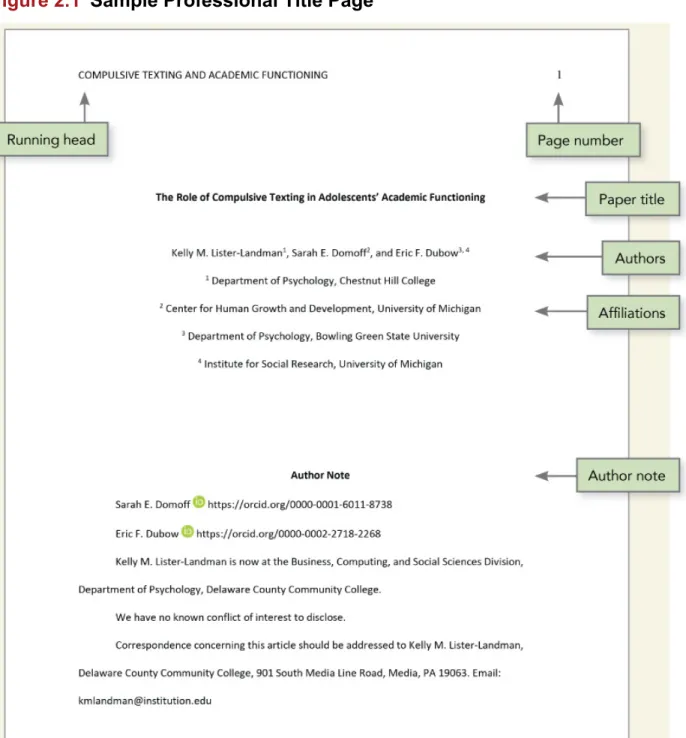
Title Page
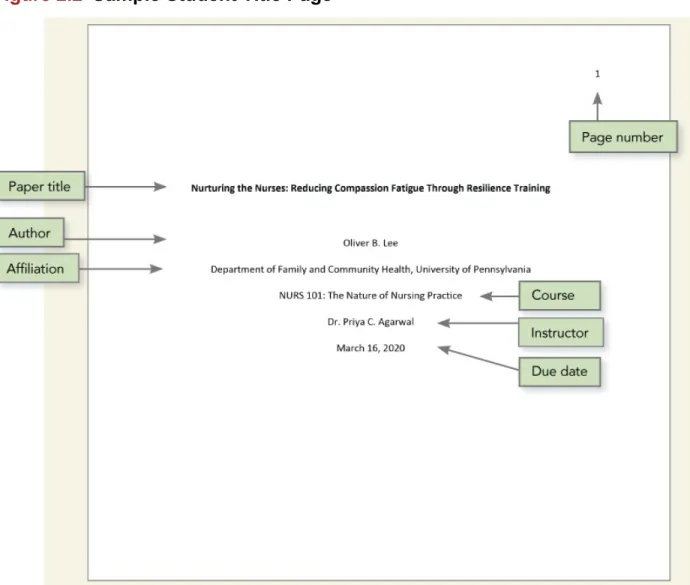
Students should follow the guidelines of their instructor or institution when determining which title page format is most appropriate. Place the course number and name, the instructor's name, and the assignment due date on separate lines, centered and in that order, below the association (see section 2.21 for more on line spacing).
Title
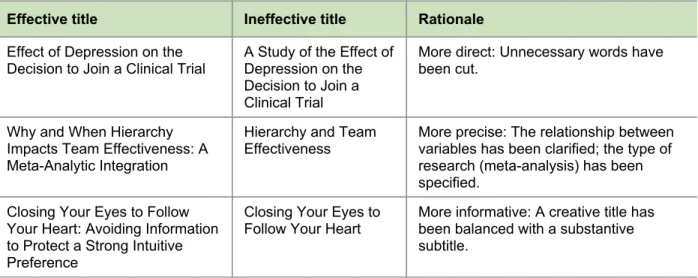
The paper title should be in capital letters (see Section 6.17), bold, centered and placed in the top half of the title page (eg three or four . lines down from the top margin of the page). Note that the paper title also appears at the top of the first page of text (see Sections 2.11 and 2.28).
Author Name (Byline)
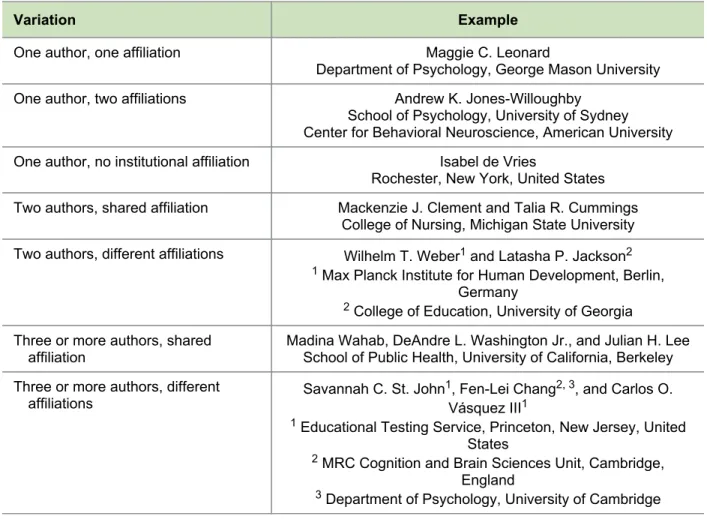
If the title is longer than one line, the main title and the subtitle can be separated on double-spaced lines if desired. School of Psychology, University of Sydney Center for Behavioral Neuroscience, American University One author, no institutional affiliation Isabel de Vries.
Author Affiliation
If the paper has one author with one affiliation, or if all the authors of a multi-authored paper share one affiliation, include the affiliation centered and in standard font on its own line, beginning one line below the byline. If the paper has one author with two affiliations, or if all the authors of a multi-author paper share the same two affiliations, include each affiliation centered and in standard font on its own line, beginning one line below the byline.
Author Note
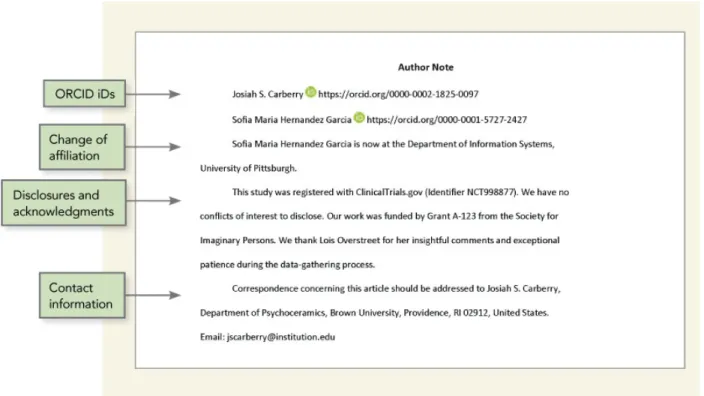
If the study is registered, provide the register name and document entry number in the author note. Place the author's note in the bottom half of the title page, below the title, byline, and affiliation.
Running Head
If the title is already 50 characters or less, the full title can be used as a running header. Running head" to identify the running head on any page (see the sample papers at the end of this chapter).
Abstract
Avoid using abbreviations in the running head; however, the ampersand symbol (&) can be used instead of "and" if desired. Use the same running header on every page, including the title page; do not include the label.
Keywords
Paragraph summaries are written as a single paragraph, without first line indentation. Structured summaries are also written as a single paragraph without indentation, and labels are inserted to identify different sections (e.g. Objective, Method, Results, Conclusions); use the labels and formatting prescribed by the journal to which you are submitting your manuscript (for example, APA journals use bold and italics for the labels).
Text (Body)
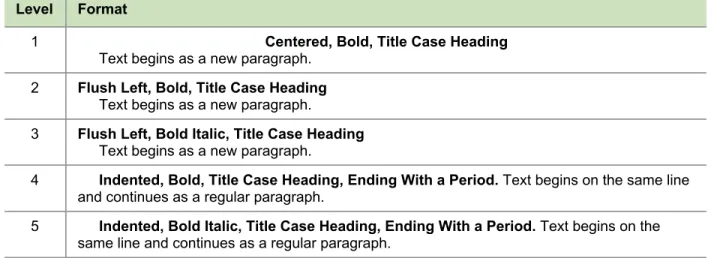
On the first line of the first page of the text, write the title of the paper in title letters, in bold and centered. Use headings as necessary and appropriate within the text to separate sections and reflect the organizational structure of the content (see sections 2.26–2.27).
The text or body of the paper contains the authors' main contribution to the literature. In addition to the introduction, the paper should contain paragraphs or sections that explain the main premises of the paper.
Footnotes
For detailed instructions on citing sources in the text and preparing a reference list, consult Chapters 8 and 9, respectively. To refer back to a footnote after it has been cited, identify it in the text with the footnote number (eg. eg, write "see Footnote 3"); do not repeat the footnote or the entire footnote.
Appendices
Place the plugin tag and title in bold and centered on separate lines at the top of the page on which the plugin begins. If an appendix consists of only one table or only one figure, then the appendix label takes the place of the table or figure number and the appendix title takes the place of the table or figure title.
Supplemental Materials
As such, materials for inclusion in supplemental materials should be submitted in formats that are widely accessible. Briefly describe any additional material in the text or a footnote as appropriate (see section 2.13).
Importance of Format
Order of Pages
Page Header
Font
When presenting computer code, use a monospace font such as 10-point Lucida Console or 10-point Courier New. When presenting a footnote in a footer, the default footnote settings for your word processor are acceptable (eg, 10-point single-spaced font).
Special Characters
Line Spacing
Endnotes that appear on their own page after the references should be formatted like regular paragraphs of text—that is, indented and double-spaced. There is no need to add blank lines before or after headings, even if the heading is at the end of the page.
Margins
Paragraph Alignment
Paragraph Indentation
For professional articles, the title (bold), byline, and affiliations should be centered on the title page (see Figure 2.1). For student papers, the title (bold), byline, affiliations, course number and name, instructor, and assignment date should be centered (see Figure 2.2).
Paper Length
If the block quote spans more than one paragraph, the first line of the second and any subsequent paragraphs of the block quote must be indented another 0.5 inches, so that those first lines are indented a total of 1 inch. If the journal you are submitting to has different specifications for determining page count or word count, follow the journal's instructions.
Organization
Principles of Organization
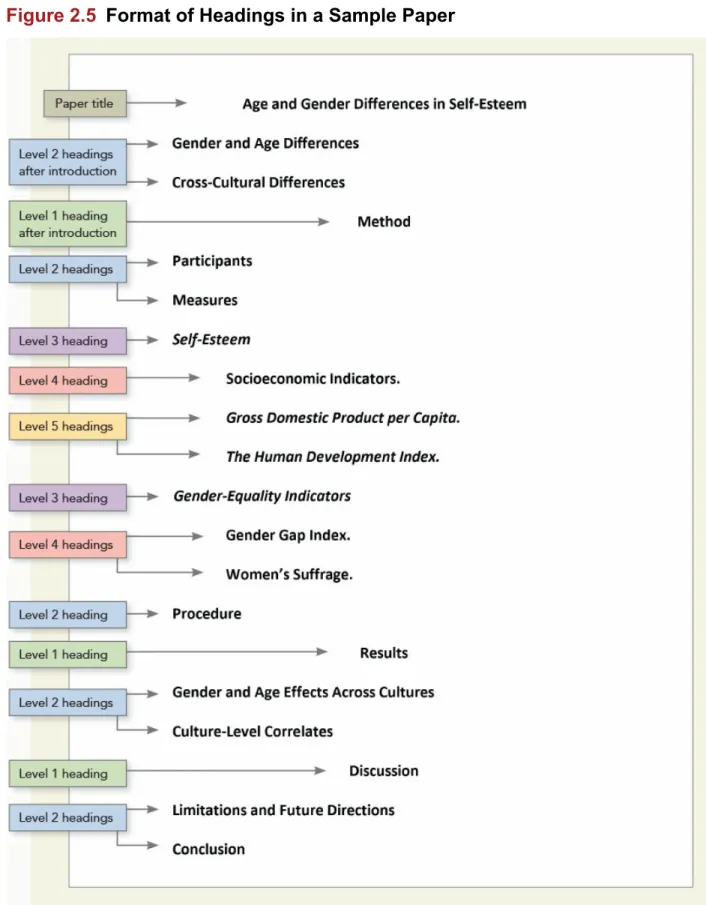
Heading Levels
The number of levels of heading required for a paper depends on its length and complexity; three is average. The sample papers at the end of this chapter also demonstrate the use of headings in context.

Section Labels
Sample Papers
Undergraduate students writing less complicated research papers may also find the standards on the abstract and introduction useful (see sections 3.3–3.4). JARS may also be revised and expanded in the future as new standards are developed; any such changes will be reflected on the website.
Overview of Reporting Standards
Application of the Principles of JARS
JARS, released in 2018 (see Appelbaum et al., 2018; Levitt et al., 2018), expands the types of quantitative research (JARS–Quant) addressed and now includes standards for reporting qualitative (JARS–Qual) and mixed methods (JARS–Mixed) research. As research approaches continue to evolve, authors should use these standards to support the publication of research; they should not allow these standards to limit the development of new methods.
Terminology Used in JARS
Common Reporting Standards Across Research Designs
Abstract Standards
Use verbs instead of their noun equivalents and actives instead of passives (eg “investigated” instead of “investigation”; “we present results” instead of “results are presented”; see Section 4.13). Use specific words in your summary that you think your audience will use when searching.
Introduction Standards
Review the literature succinctly to convey to the reader the scope of the problem, its context, and its theoretical or practical implications. Including these descriptions will show how your work usefully builds on what has already been achieved in the field.
Reporting Standards for Quantitative Research
Basic Expectations for Quantitative Research Reporting
Describe the subjects (non-human animal research) or participants (human research), specifying their characteristics relevant to the study; in animal research, include genus and species. In the case of animal research, report the genus, species and type number or other specific identification, such as supplier's name and location and stock designation.
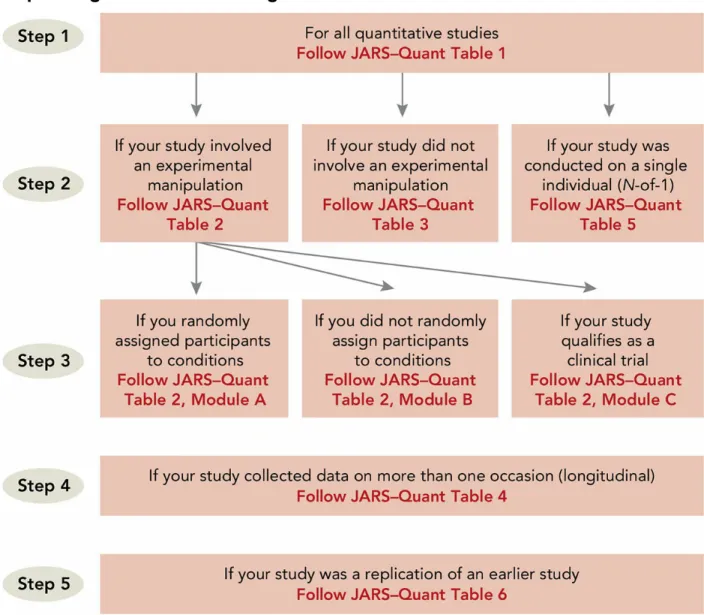
Quantitative Method Standards
Provide the intended sample size and number of individuals intended to be in each condition if separate conditions were used. Describe the instrumentation used in the study, including standardized assessments, physical equipment, and imaging protocols, in sufficient detail to allow exact replication of the study.
Quantitative Results Standards
Analyzing data and reporting the results of those analyzes are fundamental aspects of conducting research. Researchers are always responsible for the accurate and responsible reporting of the results of their research study.
Quantitative Discussion Standards
Your interpretation of the results should consider (a) sources of potential bias and other threats to internal validity, (b) the imprecision of measures, (c) the overall number of tests and/or overlap between tests, (d) the adequacy of sample sizes and sample validity, and (e) other limitations or weaknesses of the study. What is the theoretical, clinical or practical significance of the outcomes, and what is the basis for these interpretations.
Additional Reporting Standards for Typical Experimental and Nonexperimental Studies
If there was a follow-up, give the rationale for the length of the follow-up period. In general, describe the study design, participant selection and sampling methods (eg, prospective, retrospective, case-control, cohort, cohort-sequential), and data sources.
Reporting Standards for Special Designs
Describe any contextual changes that occurred during the course of the study (eg, Great Economic Recession). Report the results of the same analytical methods (statistical or other quantitative manipulations) used in the original study, as well as any results of additional or different analyses.
Standards for Analytic Approaches
Provide comparisons between the original study and the replication you are reporting so that readers can assess the degree to which factors may be present that would contribute to any differences between the findings of the original study and the findings of the replication you are reporting. Bayesian techniques are inferential statistical procedures in which researchers estimate the parameters of the underlying distribution based on the observed distribution.
Quantitative Meta-Analysis Standards
These standards are complex and address the needs of this analytical approach, including how to specify the model, describe and plot the distributions, describe the computation of the model, report any Bayes factors, and report Bayes model averages .
Reporting Standards for Qualitative Research
- Basic Expectations for Qualitative Research Reporting
- Qualitative Method Standards
- Qualitative Findings or Results Standards
- Qualitative Discussion Standards
- Qualitative Meta-Analysis Standards
Describe research results (e.g. themes, categories, stories) and the meaning and insights that the researchers derived from the data analysis in relation to the purpose of the research. The purpose of a qualitative discussion section is to communicate the contributions of the study in relation to the previous literature and the research objectives.
Reporting Standards for Mixed Methods Research
Basic Expectations for Mixed Methods Research Reporting Whereas standards for reporting information in the abstract and introduction
Match the order of the sections to the procedures used in the mixed methods design type. The mixed methods guidelines help authors describe the combination of qualitative and quantitative methods.
Effective Scholarly Writing
Continuity and Flow
Importance of Continuity and Flow
Transitions
Noun Strings
Conciseness and Clarity
- Importance of Conciseness and Clarity
- Wordiness and Redundancy
- Sentence and Paragraph Length
- Tone
- Contractions and Colloquialisms
- Jargon
- Logical Comparisons
- Anthropomorphism
When describing the content of different sections of a paper, for example you can write "this section addresses" or "the chapter focuses on". Similarly, when describing the results of a study, you can write "the results suggest," "the data provided," "the research contributes," "the study found," and so on.
Grammar and Usage
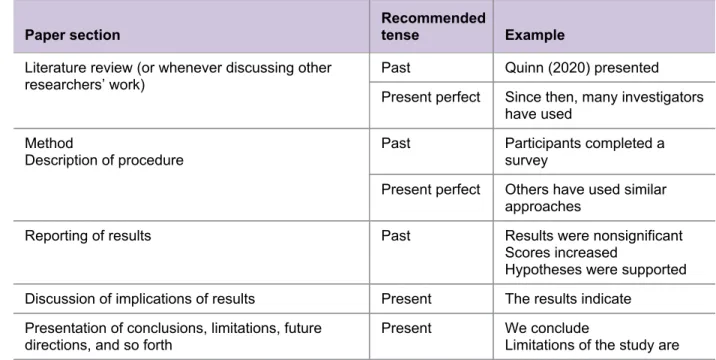
Verbs
- Verb Tense
- Active and Passive Voice
- Mood
- Subject and Verb Agreement
If the action of the verb applies to the group as a whole, treat the noun as singular and use a singular verb. If the action of the verb applies to members of the group as individuals, treat the noun as plural and use a plural verb.
Pronouns
First- Versus Third-Person Pronouns
Editorial “We”