Facilitate conservation partnership in or near conservation areas, which will include support for sustainable livelihoods – component 2, subcomponent 2.1 and 2.2;. Provide community training in four conservation areas (forest protection and sustainable utilization of areas around conservation areas) – component 2, subcomponent 2.1 and 2.2.;. The agency is mandated to manage conservation areas (national parks, game reserves, wildlife sanctuaries and nature tourism parks), including potential associated O&S risks.
Facilitate RIL-C policy and legislative development (policy review, gap analysis, FGDs, consultations, etc.) – component 2, sub-. Empowerment of Badan Layanan Umum Daerah (Business Unit Service), currently in the education and health sector – component 3, sub-component 3.1. Support for the signing and approval of a Declaration of Commitment to Sustainable Estate Crops, including the Protection of Remaining HCV Forest Areas – Component 2, Sub-Component 2.1.
Collaborate/liaise with SEKDA in FGRM. integration of sustainable practices in village planning, small oil palm cultivation, NTFP, etc.) – component 2, subcomponent 2.2;. Main empowerment of village institutions (village forest management agencies) and capacity building of community businesses – component 2, subcomponent 2.2. Facilitating community and village program and training formulation and facilitation - – component 2, subcomponent 2.2.
Provide coaching and mentoring for the implementation of work plans and business plans - component 2, sub-component 2.2.
Facilitate partnerships between large estate crop companies and local communities in the control of forest and land fires - component 3, subcomponent 3.2;. The agency has a convening power and credibility to engage with mining companies/concessionaires to manage the identified E&S risks. Cross-sectoral coordination to guide policy review processes to strengthen information management and documentation related to land use licensing process – Component 1, subcomponent 1.1.
Provide facilitation and technical support, including capacity building for sustainable livelihood initiatives, including integration of sustainable practices in village planning (i.e. sustainable agriculture, smallholder oil palm cultivation, NTFP, community-based forest fire prevention and management / MPA, etc.) – component 2, subcomponent 2.3 . to combat unauthorized activities). Lead empowerment of village institutions (village forest management agencies) and capacity building of community businesses (up to 102 sub-districts within the WPK) – component 2, sub-component 2.1. Provide coaching and mentoring for the implementation of work plans and business plans – component 2, subcomponent 2.1.
Cross-Sector Coordination to Facilitate Regulatory Development and Dispute Resolution Policy Procedures - Component 1, Sub-Component 1.1. The agency has the federal strength and credibility to work with key stakeholders to manage identified E&S risks that are significant to the provincial economy. Cross-sectoral coordination of all activities carried out by OPDs (provincial agencies) in relation to the ER program – Component 1.
Support for the signing and adoption of a declaration of commitment to sustainable crops, including the protection of remaining HCV forest areas – component 3, subcomponent 3.1. The Bupat's office has the convening power and credibility to engage with key stakeholders to manage identified E&S risks. Provide facilitation and technical support, including capacity building for sustainable livelihood initiatives, including the integration of sustainable practices and social forestry in village planning, sustainable agriculture, smallholder oil palm cultivation, NTFPs, etc. .) – component 2, sub-component 2.2.
Facilitating the establishment of fire prevention and management team in the village and fire-free community (masyarakat Perduli Api) – Component 2, sub-component 2.1. Facilitating partnerships between large agricultural companies and local communities in forest and land fire control - component 2, sub-component 2.1;. Facilitating the assessment and registration of adat claims within the State Forest Area – Component 1, sub-component 1.2 and 1.3.
Lead the integration of emission reduction activities into village development plans. which will support .. communities in integrating REDD+ activities into village spatial and development plans - component 2, sub-component 2.2 and 2.3. Allocate village funds as benefit sharing for REDD+ implementation. activities – component 3, subcomponent 3.1.
- Law and Regulation related to BioCF operation mentioned by stakeholders
- Trainings and workshops followed up to now;
- Capacity/tract record/experiences in dealing with environmental and social issues;
- Training needs
- Coordination and institutional needs
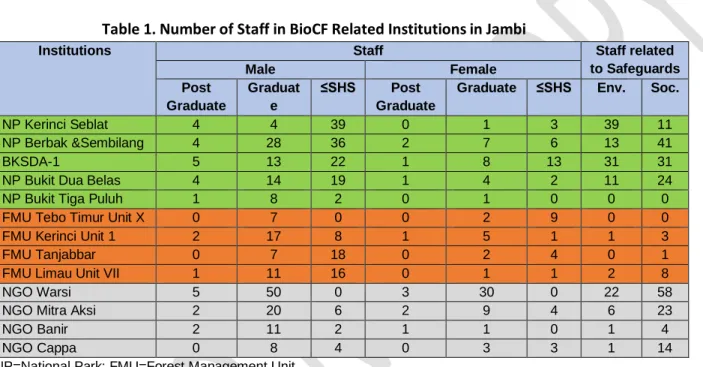
Companies (forestry, plantation and mining) are obliged to comply with the environmental regulations stipulated by the environmental permit. The existing SESA document provided a capacity assessment for most of the institutions involved in the J-SLMP, except for the National Park, FMU (limited) and local NGOs in Jambi. Since these institutions are located in the field and will be the main institutions for the implementation of activities in the pre-investment phase, it is also crucial to assess their capacity for ERP purposes.
This result shows that social issues are the main issues most of the institutions deal with in the field. It is a multi-stakeholder entity consisting of Provincial Government offices in Jambi, National Park Authorities, FMUs, NGOs and the private sector in Jambi. On the other hand, FMU's main responsibility is to manage the production and protection of forest in Jambi.
As social forestry became national priorities under the Ministry of Environment and Forestry's Strategic Plan for social forestry, most FMUs in Jambi were supported. It is interesting to see that most NGOs in Jambi focus their activities related to forest management issues, conservation and community development and empowerment. WARSI is particularly extensive in conflict resolution involvement as will be discussed in the next section.
At the national level at least 8 institutions have mandates and related interests in the REDD+ project in Jambi. All the national parks in Jambi have experiences of conflict resolution with mixed results, some with positive results but others with no result. Most FIUs in Jambi have experience in conflict resolution and mediation either directly with communities or indirectly by mediating conflict between private sectors operating within FIU areas with local communities.
In addition to this, most FMUs have provided meaningful support for the implementation of Social Forestry activities either in the form of Village Forest (HD), Community Forestry (HKM), Community Plantation Forest (HTR) and Customary Forest (HA). Most of the experiences are in the areas of conflict resolution and mediation as well as community strengthening. The above accumulated experience from either the national park authorities, FMUs and NGOs will be a positive contribution to the implementation of the safety measures in the fields.
Therefore, it is not surprising to find that most FMUs in Jamba have very limited operational budget support in 2019, about Rp. However, there is a common requirement for training in carbon stock and emissions calculation.