Applications of a Concise and General Strategy for the Syntheses of Transtaganolide and Basiliolide Natural Products
Thesis by Jonny Robert Gordon
In Partial Fulfillment of the Requirements for the Degree of
Doctor of Philosophy
CALIFORNIA INSTITUTE OF TECHNOLOGY Pasadena, California
2015
(Defended November 10, 2014)
© 2015 Jonny Robert Gordon
All Rights Reserved
To my Grandfather, Jerome Schwarzbach
ACKNOWLEDGEMENTS
First, I must thank my parents David Gordon and Donna Schwarzbach, my sister Courtney, and my girlfriend/unofficial life partner Lily for their continued support and belief in me as I pursued a PhD in organic chemistry. This has been the most challenging experience of my life and without these people in my corner I wouldn’t have come this far.
However, without the unending support from Professor Brian Stoltz I wouldn’t have survived. Brian has inspired, supported, and challenged me in ways I never thought possible. He has always encouraged me to pursue my intellectual interests and has tackled my adversities with openness and support. Under his guidance, I have managed to achieve academic success with my syntheses of the transtaganolide and basiliolide natural products. Brian has taught me that a strong chemist is both a scientist within and outside lab walls, providing resassurance that my never-sleeping brain is above all a gift.
I also praise my thesis committee members, Professsors Bob Grubbs, Peter Dervan, Sarah Reisman, and Scott Virgil. During our meetings and throughout my graduate education they have been an invaluable resource guiding me and encouraging my success.
I thank my undergraduate academic supervisor, Professor Jason Sello. I was his first student as he began his academic career at Brown University. In our first meeting, I, a wide-eyed student of chemistry, and him, a seasoned scientist itching to educate, had realized we had been discussing chemistry for close to four hours, resulting in a missed evening class and a missed dinner with his wife. This passion for chemistry we both shared only grew and I hold Jason solely responsible for my deep love of experimental chemistry and the reason why I chose to pursue a PhD in chemistry.
As for my co-workers, I must first and foremost thank Hosea Nelson. He has been my primary collaborator on the transtaganolide and basiliolide research project as well as a dear friend. He is an excellent scientist and a person I hope to have the pleasure of working closely with once again.
I would also like to thank Chris Henry, a former post doc in the laboratory. He began his post doc around the time I joined Brian’s group and was a treasured mentor, and I believe made me a better bench chemist.
I thank Alex (Rookie) Goldberg for the hours we have spent together discussing our chemistry and challenging one another to become better scientists. I must also acknowledge the rest of the Stoltz and Reisman group past and present. I have had the pleasure to work alongside a group of talented comrades who have contributed to my success and I couldn’t have achieved this degree without them. In particular, I must thank Robert Craig and Beau Pritchett for taking the time to proofread my thesis.
Lastly, I must thank the technical and support staff of the chemistry department, including Dr. Scott Virgil, Dr. Dave VanderVelde, Lynne Martinez, Rick Gerhart, Joe Drew, Agnes Tong, and Anne Penney.
Without them none of this could be possible.
Jonny
ABSTRACT
Herein are described the total syntheses of all members of the transtaganolide and basiliolide natural product family. Utilitzation of an Ireland–Claisen rearrangement/Diels–Alder cycloaddition cascade (ICR/DA) allowed for rapid assembly of the transtaganolide and basiliolide oxabicyclo[2.2.2]octane core.
This methodology is general and was applicable to all members of the natural product family.
A brief introduction outlines all the synthetic progress previously disclosed by Lee, Dudley, and Johansson. This also includes the initial syntheses of transtaganolides C and D, as well as basiliolide B and epi-basiliolide B accomplished by Stoltz in 2011. Lastly, we discuss our racemic synthesis of basililide C and epi-basiliolide C, which utilized an ICR/DA cascade to constuct the oxabicyclo[2.2.2]octane core and formal [5+2] annulation to form the ketene-acetal containing 7-membered C-ring.
Next, we describe a strategy for an asymmetric ICR/DA cascade, by incorporation of a chiral silane directing group. This allowed for enantioselective construction of the C8 all-carbon quaternary center formed in the Ireland–Claisen rearrangement. Furthermore, a single hydride reduction and subsequent translactonization of a C4 methylester bearing oxabicyclo[2.2.2]octane core demonstrated a viable strategy for the desired skeletal rearrangement to obtain pentacyclic transtaganolides A and B. Application of the asymmetric strategy culminated in the total syntheses of (–)-transtaganolide A, (+)-transtaganolide B, (+)- transtaganolide C, and (–)-transtaganolide D. Comparison of the optical rotation data of the synthetically derived transtaganolides to that from the isolated counterparts has overarching biosynthetic implications which are discussed.
Lastly, improvement to the formal [5+2] annulation strategy is described. Negishi cross-coupling of methoxyethynyl zinc chloride using a palladium Xantphos catalyst is optimized for iodo-cyclohexene.
Application of this technology to an iodo-pyrone geranyl ester allowed for formation and isolation of the eneyne product. Hydration of the enenye product forms natural metabolite basiliopyrone. Furthermore, the eneyne product can undergo an ICR/DA cascade and form transtaganolides C and D in a single step from an achiral monocyclic precursor.
TABLE OF CONTENTS
Acknowledgements ... iv
Abstract ... vi
Table of Contents ... vii
List of Figures ... xi
List of Schemes ... xvii
List of Tables ... xx
List of Abbreviations ... xxii
CHAPTER 1 ... 1
Transtaganolide and Basiliolide Natural Products and Early Efforts Toward their Total Synthesis 1.1 Introduction ... 1
1.1.1 Isolation and Biological Activity ... 1
1.1.2 Biosynthetic Proposals ... 3
1.2 Synthetic Strategies for the Transtaganolide and Basiliolide ABD Tricyclic Core ... 6
1.3 Progress Toward the Synthesis of Transtaganolides C and D and Basiliolides B and C ... 9
1.3.1 Retrosynthetic Analysis ... 9
1.3.2 Progress for the Forward Synthesis ... 11
1.4 Total Syntheses of Transtaganolides C and D ... 12
1.5 Total Syntheses of Basiliolide B and epi-Basiliolide B ... 14
1.5.1 Stoltz and Coworkers’ Approach ... 14
1.5.2 Lee and Coworkers’ Approach ... 15
1.6 Total Syntheses of Basiliolide C and epi-Basiliolide C ... 18
1.7 Conclusion ... 20
1.8 Experimental Section ... 22
1.8.1 Materials and Methods ... 22
1.8.2 Preparative Procedures ... 23
1.9 Notes and References ... 33
APPENDIX 1 ... 37
Synthetic Summary for Basiliolide C and epi-Basiliolide C: Relevant to Chapter 1 A1.1 Synthetic Summary for Basiliolide C and epi-Basiliolide C ... 38
APPENDIX 2 ... 40
Comparison of Spectral Data for Synthetic and Reported Basiliolide C, as well as Biological Assays for Synthetic Transtaganolide C: Relevant to Chapter 1 A2.1 Comparison of 1H NMR and 13C NMR for Synthetic and Reported Basiliolide C ... 41
A2.2 Bioactivity of Synthetic Transtaganolide C ... 43
A2.3 Notes and References ... 46
APPENDIX 3 ... 47
Spectra Relevant to Chapter 1 CHAPTER 2 ... 66
Total Syntheses of (–)-Transtaganolide A, (+)-Transtaganolide B, (+)- Transtaganolide C, and (–)-Transtaganolide D and Biosynthetic Implications 2.1 Introduction ... 66
2.2 Retrosynthetic Analysis ... 68
2.3 Enantioselective Total Syntheses of Transtaganolides C and D ... 69
2.4 Synthetic Strategies for the Total Syntheses of Transtaganolides A and B ... 71
2.5 Enantioselective Total Syntheses of Transtaganolides A and B ... 76
2.6 Biosynthetic Implications and Stereochemical Analysis of the Enantioselective Total Syntheses of Transtaganolides C and D ... 80
2.7 Conclusion ... 85
2.8 Experimental Section ... 86
2.8.1 Materials and Methods ... 86
2.8.2 Preparative Procedures ... 88
2.9 Notes and References ... 131
APPENDIX 4 ... 134
Synthetic Summary for (–)-Transtaganolide A, (+)-Transtaganolide B, (+)- Transtaganolide C, and (–)-Transtaganolide D: Relevant to Chapter 2 A4.1 Synthetic Summary for (+)-Transtaganolide C and (–)-Transtaganolide D ... 135
A4.2 Synthetic Summary for (–)-Transtaganolide A and (+)-Transtaganolide B ... 137
APPENDIX 5 ... 143
Comparison of Spectral Data for Synthetic and Reported Transtaganolides A–D, as well as CD Spectra: Relevant to Chapter 2 A5.1 Comparison of 1H NMR and 13C NMR for Synthetic and Reported Transtaganolide A .. 144
A5.2 Comparison of 1H NMR and 13C NMR for Synthetic and Reported Transtaganolide B .. 146
A5.3 Comparison of 1H NMR and 13C NMR for Synthetic and Reported Transtaganolide C .. 148
A5.4 Comparison of 1H NMR and 13C NMR for Synthetic and Reported Transtaganolide D .. 150
A5.5 CD Spectra of Diffracted Crystal 133 ... 152
A5.6 Notes and References ... 153
APPENDIX 6 ... 154
Spectra Relevant to Chapter 2 APPENDIX 7 ... 216
X-ray Crystallography Reports: Relevant to Chapter 2 A7.1 Crystal Structure Analysis for Compound 133 ... 216
CHAPTER 3 ... 235
Negishi Cross-Coupling of Zinc Methoxyacetylides and Protecting-Group-Free Total Syntheses of Basiliopyrone and Transtaganolides C and D 3.1 Introduction ... 235
3.2 Model Cross-Coupling Reactions of Zinc Methoxyacetylides ... 238
3.3 Ligand Bite Angles and the Relationship to Organozinc Cross-Coupling of Methoxyethynyl Zinc Chloride ... 240
3.4 Applications of Organozinc Cross-Couplings to the Syntheses of Transtaganolide Natural Products ... 242
3.5 Protecting-Group-Free Syntheses of Basiliopyrone and Transtaganolides C and D ... 247
3.6 Conclusion ... 249
3.7 Experimental Section ... 250
3.7.1 Materials and Methods ... 250
3.7.2 Preparative Procedures ... 252
3.8 Notes and References ... 258
APPENDIX 8 ... 260
Synthetic Summary for Protecting-Group-Free Total Syntheses of Basiliopyrone and Transtaganolides C and D: Relevant to Chapter 3 A8.1 Synthetic Summary for Basiliopyrone and Transtaganolides C and D ... 261
APPENDIX 9 ... 263
Gas Chromatography and Supercritical Fluid Chromatography Data: Relevant to Chapter 3 A9.1 Gas Chromatography Data for Organozinc Cross-Coupling Optimization ... 264
A9.2 Supercritical Fluid Chromatography Data for Organozinc Cross-Coupling Optimization ... 265
A9.3 Notes and References ... 267
APPENDIX 10 ... 268 Spectra Relevant to Chapter 3
Comprehensive Bibliography ... 273 Index ... 278 About the Author ... 285
LIST OF FIGURES
CHAPTER 1
Transtaganolide and Basiliolide Natural Products and Early Efforts Toward their Total Synthesis
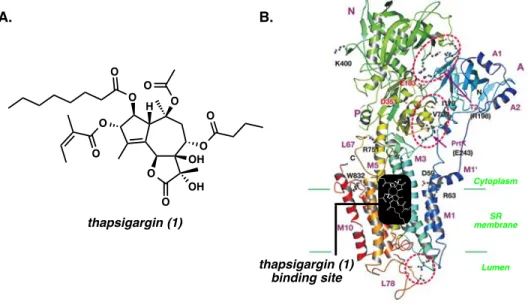
Figure 1.1.1. A) Thapsigargin (1). B) Crystal structure of thapsigargin (1) bound SERCA-ATPase. ... 2
Figure 1.1.2. Natural products isolated from Thapsia. ... 3
Figure 1.2.1. The transtaganolide and basiliolide structural features. ... 7
APPENDIX 2 Comparison of Spectral Data for Synthetic and Reported Basiliolide C, as well as Biological Assays for Synthetic Transtaganolide C: Relevant to Chapter 1 Figure A2.2.1. A) Thapsigargin (1) and transtaganolide C (9). B) The effect of synthetic transtaganolide C (9) or naturally isolated thapsigargin (1) on calcium mobilization as a function of time (arrows indicate the time at which a reagent was added).3 ... 43
Figure A2.2.2. Percentage of cells still viable after 24 hours of exposure to either synthetic transtaganolide C (9) or thapsigargin (1).3 ... 44
APPENDIX 3 Spectra Relevant to Chapter 1 Figure A3.1.1 1H NMR (300 MHz, CDCl3) of compound 84 ... 48
Figure A3.1.2 Infrared spectrum (thin film/NaCl) of compound 84 ... 49
Figure A3.1.3 13C NMR (75 MHz, CDCl3) of compound 84 ... 49
Figure A3.2.1 1H NMR (300 MHz, CDCl3) of compound 85 ... 50
Figure A3.2.2 Infrared spectrum (thin film/NaCl) of compound 85 ... 51
Figure A3.2.3 13C NMR (75 MHz, CDCl3) of compound 85 ... 51
Figure A3.3.1 1H NMR (300 MHz, CDCl3) of compound 85.5 ... 52
Figure A3.3.2 Infrared spectrum (thin film/NaCl) of compound 85.5 ... 53
Figure A3.3.3 13C NMR (75 MHz, CDCl3) of compound 85.5 ... 53
Figure A3.4.1 1H NMR (300 MHz, CDCl3) of compound 86 ... 54
Figure A3.4.2 Infrared spectrum (thin film/NaCl) of compound 86 ... 55
Figure A3.4.3 13C NMR (75 MHz, CDCl3) of compound 86 ... 55
Figure A3.5.1 1H NMR (300 MHz, CDCl3) of compound 87 ... 56
Figure A3.5.2 Infrared spectrum (thin film/NaCl) of compound 87 ... 57
Figure A3.5.3 13C NMR (75 MHz, CDCl3) of compound 87 ... 57
Figure A3.6.1 1H NMR (300 MHz, CDCl3) of compounds 88a and 88b ... 58
Figure A3.6.2 Infrared spectrum (thin film/NaCl) of compounds 88a and 88b ... 59
Figure A3.6.3 13C NMR (75 MHz, CDCl3) of compounds 88a and 88b ... 59
Figure A3.7.1 1H NMR (300 MHz, CDCl3) of compounds 89a and 89b ... 60
Figure A3.7.2 Infrared spectrum (thin film/NaCl) of compounds 89a and 89b ... 61
Figure A3.7.3 13C NMR (75 MHz, CDCl3) of compounds 89a and 89b ... 61
Figure A3.8.1 1H NMR (500 MHz, CDCl3) of basiliolide C (12) ... 62
Figure A3.8.2 Infrared spectrum (thin film/NaCl) of basiliolide C (12) ... 63
Figure A3.8.3 13C NMR (125 MHz, CDCl3) of basiliolide C (12) ... 63
Figure A3.9.1 1H NMR (500 MHz, CDCl3) of epi-basiliolide C (43) ... 64
Figure A3.9.2 Infrared spectrum (thin film/NaCl) of epi-basiliolide C (43) ... 65
Figure A3.9.3 13C NMR (125 MHz, CDCl3) of epi-basiliolide C (43) ... 65
CHAPTER 2 Total Syntheses of (–)-Transtaganolide A, (+)-Transtaganolide B, (+)- Transtaganolide C, and (–)-Transtaganolide D and Biosynthetic Implications Figure 2.1.1. Transtaganolide and basiliolide natural products (7–11 and 42). ... 67
Figure 2.8.1. Racemic SFC trace of compound 97. ... 90
Figure 2.8.2. Enantioenriched SFC trace of compound 97. ... 90
Figure 2.8.3. Racemic SFC trace of compounds 100a and 100b. ... 92
Figure 2.8.4. Enantioenriched SFC trace of compounds 100a and 100b. ... 93
Figure 2.8.5. Racemic SFC trace of transtaganolide C (9). ... 96
Figure 2.8.6. Enantioenriched SFC trace of transtaganolide C (9). ... 96
Figure 2.8.7. Racemic SFC trace of transtaganolide D (10). ... 97
Figure 2.8.8. Enantioenriched SFC trace of transtaganolide D (10). ... 97
Figure 2.8.9. Reaction schematic for the single hydride reduction of tricyclic acids 120a and 120b using a glass cannula. ... 113
Figure 2.8.10. Racemic SFC trace of transtaganolide B (8). ... 127
Figure 2.8.11. Enantioenriched SFC trace of transtaganolide B (8). ... 127
Figure 2.8.12. Racemic SFC trace of transtaganolide A (7). ... 128
Figure 2.8.13. Enantioenriched SFC trace of transtaganolide A (7). ... 128
APPENDIX 5 Comparison of Spectral Data for Synthetic and Reported Transtaganolides A–D, as well as CD Spectra: Relevant to Chapter 2 Figure A5.5.1. CD spectral comparison of diffracted crystal 133 to 90% enantioenriched bulk sample of 133 and 135. ... 152
APPENDIX 6
Spectra Relevant to Chapter 2
Figure A6.1.1 1H NMR (500 MHz, CDCl3) of compound 97 ... 155
Figure A6.1.2 Infrared spectrum (thin film/NaCl) of compound 97 ... 156
Figure A6.1.3 13C NMR (125 MHz, CDCl3) of compound 97 ... 156
Figure A6.2.1 1H NMR (500 MHz, CDCl3) of compounds 100a and 100b ... 157
Figure A6.2.2 Infrared spectrum (thin film/NaCl) of compounds 100a and 100b ... 158
Figure A6.2.3 13C NMR (125 MHz, CDCl3) of compounds 100a and 100b ... 158
Figure A6.3.1 1H NMR (500 MHz, CDCl3) of transtaganolide C (9) ... 159
Figure A6.3.2 Infrared spectrum (thin film/NaCl) of transtaganolide C (9) ... 160
Figure A6.3.3 13C NMR (125 MHz, CDCl3) of transtaganolide C (9) ... 160
Figure A6.4.1 1H NMR (500 MHz, CDCl3) of transtaganolide D (10) ... 161
Figure A6.4.2 Infrared spectrum (thin film/NaCl) of transtaganolide D (10) ... 162
Figure A6.4.3 13C NMR (125 MHz, CDCl3) of transtaganolide D (10) ... 162
Figure A6.5.1 1H NMR (500 MHz, CDCl3) of compound 105 ... 163
Figure A6.5.2 Infrared spectrum (thin film/NaCl) of compound 105 ... 164
Figure A6.5.3 13C NMR (125 MHz, CDCl3) of compound 105 ... 164
Figure A6.6.1 1H NMR (300 MHz, CDCl3) of compound 106 ... 165
Figure A6.6.2 Infrared spectrum (thin film/NaCl) of compound 106 ... 166
Figure A6.6.3 13C NMR (75 MHz, CDCl3) of compound 106 ... 166
Figure A6.7.1 1H NMR (300 MHz, CDCl3) of compound 107 ... 167
Figure A6.7.2 Infrared spectrum (thin film/NaCl) of compound 107 ... 168
Figure A6.7.3 13C NMR (125 MHz, CDCl3) of compound 107 ... 168
Figure A6.8.1 1H NMR (300 MHz, CDCl3) of compound 108 ... 169
Figure A6.8.2 Infrared spectrum (thin film/NaCl) of compound 108 ... 170
Figure A6.8.3 13C NMR (75 MHz, CDCl3) of compound 108 ... 170
Figure A6.9.1 1H NMR (300 MHz, CDCl3) of compound 109 ... 171
Figure A6.9.2 Infrared spectrum (thin film/NaCl) of compound 109 ... 172
Figure A6.9.3 13C NMR (75 MHz, CDCl3) of compound 109 ... 172
Figure A6.10.1 1H NMR (300 MHz, CDCl3) of compounds 110a and 110b ... 173
Figure A6.10.2 Infrared spectrum (thin film/NaCl) of compounds 110a and 110b ... 174
Figure A6.10.3 13C NMR (125 MHz, CDCl3) of compounds 110a and 110b ... 174
Figure A6.11.1 1H NMR (300 MHz, CDCl3) of compounds 112a and 112b ... 175
Figure A6.11.2 Infrared spectrum (thin film/NaCl) of compounds 112a and 112b ... 176
Figure A6.11.3 13C NMR (125 MHz, CDCl3) of compounds 112a and 112b ... 176
Figure A6.12.1 1H NMR (500 MHz, CDCl3) of compound 113 ... 177
Figure A6.12.2 Infrared spectrum (thin film/NaCl) of compound 113 ... 178
Figure A6.12.3 13C NMR (125 MHz, CDCl3) of compound 113 ... 178
Figure A6.13.1 1H NMR (300 MHz, CDCl3) of compound 114 ... 179
Figure A6.13.2 Infrared spectrum (thin film/NaCl) of compound 114 ... 180
Figure A6.13.3 13C NMR (125 MHz, CDCl3) of compound 114 ... 180
Figure A6.14.1 1H NMR (300 MHz, CDCl3) of compound 115 ... 181
Figure A6.14.2 Infrared spectrum (thin film/NaCl) of compound 115 ... 182
Figure A6.14.3 13C NMR (125 MHz, CDCl3) of compound 115 ... 182
Figure A6.15.1 1H NMR (500 MHz, CDCl3) of a crude mixture of compounds 116a and 116b ... 183
Figure A6.16.1 1H NMR (300 MHz, CDCl3) of compound 118 ... 184
Figure A6.16.2 Infrared spectrum (thin film/NaCl) of compound 118 ... 185
Figure A6.16.3 13C NMR (125 MHz, CDCl3) of compound 118 ... 185
Figure A6.17.1 1H NMR (300 MHz, CDCl3) of compound 119 ... 186
Figure A6.17.2 Infrared spectrum (thin film/NaCl) of compound 119 ... 187
Figure A6.17.3 13C NMR (75 MHz, CDCl3) of compound 119 ... 187
Figure A6.18.1 1H NMR (500 MHz, CDCl3) of compounds 120a and 120b ... 188
Figure A6.18.2 Infrared spectrum (thin film/NaCl) of compounds 120a and 120b ... 189
Figure A6.18.3 13C NMR (125 MHz, CDCl3) of compounds 120a and 120b ... 189
Figure A6.19.1 1H NMR (300 MHz, CDCl3) of compound 122 ... 190
Figure A6.19.2 Infrared spectrum (thin film/NaCl) of compound 122 ... 191
Figure A6.19.3 13C NMR (75 MHz, CDCl3) of compound 122 ... 191
Figure A6.20.1 1H NMR (500 MHz, CDCl3) of compound 123 ... 192
Figure A6.20.2 Infrared spectrum (thin film/NaCl) of compound 123 ... 193
Figure A6.20.3 13C NMR (125 MHz, CDCl3) of compound 123 ... 193
Figure A6.21.1 1H NMR (300 MHz, CDCl3) of compound 124 ... 194
Figure A6.21.2 Infrared spectrum (thin film/NaCl) of compound 124 ... 195
Figure A6.21.3 13C NMR (75 MHz, CDCl3) of compound 124 ... 195
Figure A6.22.1 1H NMR (300 MHz, CDCl3) of compound 125 ... 196
Figure A6.22.2 Infrared spectrum (thin film/NaCl) of compound 125 ... 197
Figure A6.22.3 13C NMR (75 MHz, CDCl3) of compound 125 ... 197
Figure A6.23.1 1H NMR (300 MHz, CDCl3) of compound 126 ... 198
Figure A6.23.2 Infrared spectrum (thin film/NaCl) of compound 126 ... 199
Figure A6.23.3 13C NMR (75 MHz, CDCl3) of compound 126 ... 199
Figure A6.24.1 1H NMR (300 MHz, CDCl3) of compound 127 ... 200
Figure A6.24.2 Infrared spectrum (thin film/NaCl) of compound 127 ... 201
Figure A6.24.3 13C NMR (125 MHz, CDCl3) of compound 127 ... 201
Figure A6.25.1 1H NMR (500 MHz, CDCl3) of compounds 128a and 128b ... 202
Figure A6.25.2 Infrared spectrum (thin film/NaCl) of compounds 128a and 128b ... 203
Figure A6.25.3 13C NMR (125 MHz, CDCl3) of compounds 128a and 128b ... 203
Figure A6.26.1 1H NMR (500 MHz, CDCl3) of compounds 121a and 121b ... 204
Figure A6.26.2 Infrared spectrum (thin film/NaCl) of compounds 121a and 121b ... 205
Figure A6.26.3 13C NMR (125 MHz, CDCl3) of compounds 121a and 121b ... 205
Figure A6.27.1 1H NMR (500 MHz, CDCl3) of compounds 130a and 130b ... 206
Figure A6.27.2 Infrared spectrum (thin film/NaCl) of compounds 130a and 130b ... 207
Figure A6.27.3 13C NMR (125 MHz, CDCl3) of compounds 130a and 130b ... 207
Figure A6.28.1 1H NMR (500 MHz, CDCl3) of transtaganolide B (8) ... 208
Figure A6.28.2 Infrared spectrum (thin film/NaCl) of transtaganolide B (8) ... 209
Figure A6.28.3 13C NMR (125 MHz, CDCl3) of transtaganolide B (8) ... 209
Figure A6.29.1 1H NMR (500 MHz, CDCl3) of transtaganolide A (7) ... 210
Figure A6.29.2 Infrared spectrum (thin film/NaCl) of transtaganolide A (7) ... 211
Figure A6.29.3 13C NMR (125 MHz, CDCl3) of transtaganolide A (7) ... 211
Figure A6.30.1 1H NMR (500 MHz, CDCl3) of compound 133 ... 212
Figure A6.30.2 Infrared spectrum (thin film/NaCl) of compound 133 ... 213
Figure A6.30.3 13C NMR (125 MHz, CDCl3) of compound 133 ... 213
Figure A6.31.1 1H NMR (500 MHz, CDCl3) of compound 135 ... 214
Figure A6.31.2 Infrared spectrum (thin film/NaCl) of compound 135 ... 215
Figure A6.31.3 13C NMR (125 MHz, CDCl3) of compound 135 ... 215
APPENDIX 7 X-ray Crystallography Reports: Relevant to Chapter 2 Figure A7.1.1. Ortep diagram of 133. The crystallographic data have been deposited in the Cambridge Database (CCDC) and has been placed on hold pending further instructions. . 217
CHAPTER 3 Negishi Cross-Coupling of Zinc Methoxyacetylides and Protecting-Group-Free Total Syntheses of Basiliopyrone and Transtaganolides C and D Figure 3.1.1. Transtaganolides and basiliolides (7–12, 42, and 43). ... 236
APPENDIX 9
Gas Chromatography and Supercritical Fluid Chromatography Data: Relevant to Chapter 3
Figure A9.1.1. A) Calibration curve used to determine cross-coupling yields comparing methyl ester 139 and tridecane internal standard. B) Calibration curve used to determine cross-coupling
substrate consumption by comparing vinyl iodide 137 and tridecane internal standard. ... 264
Figure A9.2.1. Calibration curve used to determine cross-coupling yields comparing eneyne 141 and diphenylether internal standard. ... 266
APPENDIX 10 Spectra Relevant to Chapter 3 Figure A10.1.1 1H NMR (500 MHz, CDCl3) of compound 141 ... 269
Figure A10.1.2 Infrared spectrum (thin film/NaCl) of compound 141 ... 270
Figure A10.1.3 13C NMR (125 MHz, CDCl3) of compound 141 ... 270
Figure A10.2.1 1H NMR (300 MHz, CDCl3) of basiliopyrone (3) ... 271
Figure A10.2.2 Infrared spectrum (thin film/NaCl) of basiliopyrone C (3) ... 272
Figure A10.2.3 13C NMR (125 MHz, CDCl3) of basiliopyrone (3) ... 272
LIST OF SCHEMES
CHAPTER 1
Transtaganolide and Basiliolide Natural Products and Early Efforts Toward their Total Synthesis
Scheme 1.1.1. Appendino’s biosynthetic proposal. ... 4
Scheme 1.1.2. Massanet’s biosynthetic proposal. ... 5
Scheme 1.1.3. Johansson’s biosynthetic proposal. ... 6
Scheme 1.2.1. Stoltz’s synthesis of ABD tricyclic core of the transtaganolides and basiliolides. ... 8
Scheme 1.2.2. A) Dudley’s synthesis of ABD tricyclic core of the transtaganolides and basiliolides. B). Lee’s synthesis of ABD tricyclic core of the transtaganolides and basiliolides. ... 9
Scheme 1.3.1. Retrosynthetic analysis of transtaganolides C and D (9 and 10) and basiliolides B and C (11 and 12). ... 10
Scheme 1.3.2. Stoltz’s progress toward the synthesis of transtaganolides C and D (9 and 10). ... 11
Scheme 1.3.3. Johansson’s progress toward the synthesis of transtaganolides C and D (9 and 10). ... 12
Scheme 1.4.1. Ireland–Claisen/Diels–Alder cycloaddition cascade (ICR/DA). ... 13
Scheme 1.4.2. Synthesis of stannyl methoxyacetylide 62. ... 13
Scheme 1.4.3. Total syntheses of transtaganolides C and D (9 and 10). ... 14
Scheme 1.5.1. Stoltz’s total syntheses of basiliolide B and epi-basiliolide B (11 and 42). ... 15
Scheme 1.5.2. Lee’s synthesis of basiliolide B (11) ... 16
Scheme 1.5.3. Lee’s continued synthesis of basiliolide B (11). ... 18
Scheme 1.6.1. Total syntheses of basiliolide C (12) and epi-basiliolide C (43). ... 20
APPENDIX 1 Synthetic Summary for Basiliolide C and epi-Basiliolide C: Relevant to Chapter 1 Scheme A1.1.1. Retrosynthetic analysis for basiliolide C (12) and epi-basiliolide C (43). ... 38
Scheme A1.1.2. Syntheses of basiliolide C (12) and epi-basiliolide C (43). ... 39
CHAPTER 2 Total Syntheses of (–)-Transtaganolide A, (+)-Transtaganolide B, (+)- Transtaganolide C, and (–)-Transtaganolide D and Biosynthetic Implications Scheme 2.1.1. General synthetic strategy. ... 67
Scheme 2.2.1. Retrosynthetic analysis for the asymmetric construction of transtaganolides A (7) and B (8). ... 68
Scheme 2.2.2. Retrosynthetic analysis for the asymmetric construction of transtaganolides C (9) and D (10). ... 69
Scheme 2.3.1. Enantioselective total syntheses of transtaganolides C and D (9 and 10). ... 70
Scheme 2.4.1. Initial attempts at preparing the tricyclic cores of transtaganolides A and B (103a and 103b). ... 71
Scheme 2.4.2. Studies for the transtaganolide A and B (7 and 8) tetracyclic core via protected alcohol 109. ... 73
Scheme 2.4.3. Studies for the transtaganolide A and B (7 and 8) tetracyclic core via Weinreb amide 115. ... 74
Scheme 2.4.4. Studies for the transtaganolide A and B (7 and 8) tetracyclic core via methylester 119.76 Scheme 2.5.1. Syntheses of enantioenriched tricyclic cores of transtaganolides A and B (128a and 128b). ... 77
Scheme 2.5.2. Enantioselective total syntheses of transtaganolides A and B (7 and 8). ... 79
Scheme 2.6.1. Johansson’s biosynthetic proposal. ... 81
Scheme 2.6.2. Analysis of chiral silane directed ICR/DA cascade (where pyr = iodo pyrone). ... 82
Scheme 2.6.3. Determination of the absolute stereochemistry of intermediate 100a. ... 83
Scheme 2.6.4. Proposed biosynthesis of basiliopyrone (3). ... 85
APPENDIX 4 Synthetic Summary for (–)-Transtaganolide A, (+)-Transtaganolide B, (+)- Transtaganolide C, and (–)-Transtaganolide D: Relevant to Chapter 2 Scheme A4.1.1. Retrosynthetic analysis for (+)-transtaganolide C (9) and (–)-transtaganolide D (10).135 Scheme A4.1.2. Syntheses of (+)-transtaganolide C (9) and (–)-transtaganolide D (10). ... 136
Scheme A4.2.1. Retrosynthetic analysis for (–)-transtaganolide A (7) and (+)-transtaganolide B (8).137 Scheme A4.2.2. First attempt to synthesize (±)-transtaganolide A and B (7–8) tetracyclic core via protected alcohol 109. ... 138
Scheme A4.2.3. Second attempt to synthesize (±)-transtaganolide A and B (7–8) tetracyclic core via Weinreb amide 115. ... 139
Scheme A4.2.4. Third attempt to synthesize (±)-transtaganolide A and B (7–8) tetracyclic core via methylester 119. ... 140
Scheme A4.2.5. Forward syntheses of (–)-transtaganolide A (7) and (+)-transtaganolide B (8). ... 141
Scheme A4.2.6. Continued forward syntheses of (–)-transtaganolide A (7) and (+)-transtaganolide B (8). ... 142
CHAPTER 3
Negishi Cross-Coupling of Zinc Methoxyacetylides and Protecting-Group-Free Total Syntheses of Basiliopyrone and Transtaganolides C and D
Scheme 3.1.1. A) Cross-coupling to form transtaganolides A and B (7 and 8). B) Cross-coupling to form transtaganolides C and D (9 and 10). C) Cross-coupling to form basiliolide B (11) and epi-basiliolide B (42). D) Cross-coupling to form basiliolide C (12) and epi-basiliolide C (43).237
Scheme 3.2.1. Synthesis of methoxyethynyl zinc chloride (136). ... 238
Scheme 3.4.1. A) Cross-coupling of tricycles 63a and 63b using the palladium Xantphos catalytic conditions developed on model cross-couplings to iodo-cyclohexene (137). B) Cross- coupling of tricycles 63a and 63b facilitated by microwave irradiation. ... 243
Scheme 3.4.2. Retrosynthetic Analysis illuminates a viable cross-coupling substrate pyrone ester 57.244
Scheme 3.4.3. Cross-coupling of pyrone 57 and methoxyethynyl zinc chloride (136) using our optimized reaction conditions. ... 247
Scheme 3.5.1. Acid catalyzed hydration of 141 allows for the formation of basiliopyrone (3). ... 248
Scheme 3.5.2. A one-pot synthesis of transtaganolides C and D (9 and 10) from alkynyl pyrone 141.249
APPENDIX 8
Synthetic Summary for Protecting-Group-Free Total Syntheses of Basiliopyrone and Transtaganolides C and D: Relevant to Chapter 3
Scheme A8.1.1. Protecting-group-free synthesis of basiliopyrone (3). ... 261
Scheme A8.1.2. Protecting-group-free syntheses of transtaganolides C and D (9–10). ... 262
LIST OF TABLES
APPENDIX 2
Comparison of Spectral Data for Synthetic and Reported Basiliolide C, as well as Biological Assays for Synthetic Transtaganolide C: Relevant to Chapter 1
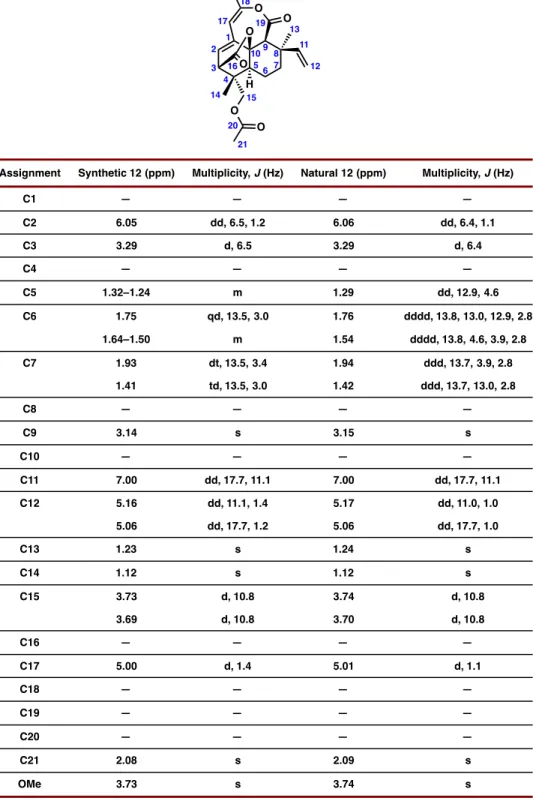
Table A2.1.1. Comparison of 1H NMR data for synthetic and reported natural basiliolide C (12). ... 41
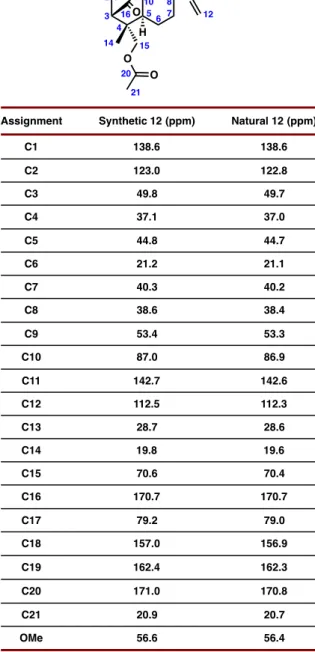
Table A2.1.2. Comparison of 13C NMR data for synthetic and reported natural1 basiliolide C (12). .... 42
CHAPTER 2
Total Syntheses of (–)-Transtaganolide A, (+)-Transtaganolide B, (+)- Transtaganolide C, and (–)-Transtaganolide D and Biosynthetic Implications
Table 2.6.1. Comparison of the optical rotations of synthetic and natural transtaganolides A–D (7–10).83
APPENDIX 5
Comparison of Spectral Data for Synthetic and Reported Transtaganolides A–D, as well as CD Spectra: Relevant to Chapter 2
Table A5.1.1. Comparison of 1H NMR data for synthetic and reported natural transtaganolide A (7).144
Table A5.1.2. Comparison of 13C NMR data for synthetic and reported natural1 transtaganolide A (7).145
Table A5.2.1. Comparison of 1H NMR data for synthetic and reported natural1 transtaganolide B (8).146
Table A5.2.2. Comparison of 13C NMR data for synthetic and reported natural1 transtaganolide B (8).147
Table A5.3.1. Comparison of 1H NMR data for synthetic and reported natural1 transtaganolide C (9).148
Table A5.3.2. Comparison of 13C NMR data for synthetic and reported natural1 transtaganolide C (9).149
Table A5.4.1. Comparison of 1H NMR data for synthetic and reported natural1 transtaganolide D (10).150
Table A5.4.2. Comparison of 13C NMR data for synthetic and reported natural1 transtaganolide D (10).151
APPENDIX 7
X-ray Crystallography Reports: Relevant to Chapter 2
Table A7.1.1. Crystal data and structure analysis details for 133. ... 218
Table A7.1.2. Atomic coordinates ( x 104) and equivalent isotropic displacement parameter (Å2 x 10³) for 133. U(eq) is defined as one third of the trace of the orthogonalized Uij tensor .... 221
Table A7.1.3. Bond lengths [Å] and angles [°] for 133. ... 223
Table A7.1.4. Anisotropic displacement parameters (Å2x 10⁴) for 133. The anisotropic displacement factor exponent takes the form: –2π2 [h2 a*2 U11 + ... + 2 h k a* b* U12] ... 231
Table A7.1.5. Hydrogen coordinates ( x 103) and isotropic displacement parameters (Å2 x 10³) for 133. ... 233
CHAPTER 3
Negishi Cross-Coupling of Zinc Methoxyacetylides and Protecting-Group-Free Total Syntheses of Basiliopyrone and Transtaganolides C and D
Table 3.2.1. Ligand screen for the cross-coupling of methoxyethynyl zinc chloride (136) and iodo- cyclohexene (137). ... 240
Table 3.3.1. Comparing dppb, dppf, and Xantphos as ligands for catalyzing the cross-coupling of methoxyethynyl zinc chloride (136) and iodo-cyclohexene (137) as a function of time. ... 242
Table 3.4.1. Comparing methoxyethynyl zinc chloride (136) equivalents, catalyst loading, and concentration as they effect the cross-coupling reaction at 50 °C of organozinc 136 and pyrone 57 as a function of time. ... 245
Table 3.4.2. Comparing methoxyethynyl zinc chloride (136) equivalents and catalyst loading as they effect the cross-coupling reaction at 40 °C of organozinc 136 and pyrone 57 as a function of time. ... 246
APPENDIX 9
Gas Chromatography and Supercritical Fluid Chromatography Data: Relevant to Chapter 3
Table A9.1.1. A) The molar ratio of product 139 and tridecane with the associated peak area ratio obtained from GC analysis. B) The molar ratio of substrate 137 and tridecane with the associated peak area ratio obtained from GC analysis. ... 265
Table A9.2.1. The molar ratio of product 141 and diphenylether internal standard with the associated peak area ratio obtained from SFC analysis. ... 266
LIST OF ABBREVIATIONS
Å Ångstrom
[α]D specific rotation at wavelength of sodium D line
Ac acetyl
Anal. Combustion elemental analysis
APCI atmospheric pressure chemical ionization
app apparent
aq aqueous
AIBN 2,2’-azobisisobutyronitrile
Ar aryl
atm atmosphere
BBN borabicyclononane
Bn benzyl
Boc tert-butyloxycarbonyl
bp boiling point
br broad
Bu butyl
i-Bu iso-butyl
n-Bu butyl
t-Bu tert-Butyl
Bz benzoyl
c concentration for specific rotation measurements
°C degrees Celsius
ca. about (Latin circa)
calc’d calculated
CAN ceric ammonium nitrate
cat catalytic
Cbz carbobenzyloxy
CCDC Cambridge Crystallographic Data Centre
CDI 1,1’-carbonyldiimidazole
cf. compare (Latin confer)
CI chemical ionization
CID collision-induced dissociation
cm–1 wavenumber(s)
comp complex
Cy cyclohexyl
d doublet
D deuterium
dba dibenzylideneacetone
DBU 1,8-diazabicyclo[5.4.0]undec-7-ene
DCE dichloroethane
dec decomposition
DIAD diisopropyl azodicarboxylate
DMA N,N-dimethylacetamide
DMAP 4-dimethylaminopyridine
dmdba bis(3,5-dimethoxybenzylidene)acetone
DMF N,N-dimethylformamide
DMSO dimethyl sulfoxide
DNA (deoxy)ribonucleic acid
dppb 1,4-bis(diphenylphosphino)butane dppf 1,1’-bis(diphenylphosphino)ferrocene
dr diastereomeric ratio
EA activation energy
EC50 median effective concentration (50%)
EDC N-(3-dimethylaminopropyl)-N’-ethylcarbodiimide
ee enantiomeric excess
EI electron impact
e.g. for example (Latin exempli gratia)
equiv equivalent
ESI electrospray ionization
Et ethyl
FAB fast atom bombardment
FID flame ionization detector
g gram(s)
GC gas chromatography
gCOSY gradient-selected correlation spectroscopy GlyPHOX 2-(2-(diphenylphosphino)phenyl)oxazoline
h hour(s)
HMDS 1,1,1,3,3,3-hexamethyldisilazane
HMPA hexamethylphosphoramide
HOBt 1-hydroxybenzotriazole
HPLC high-performance liquid chromatography HRMS high-resolution mass spectroscopy
HSV herpes simplex virus
hν light
Hz hertz
IC50 median inhibition concentration (50%)
ICR/DA Ireland–Claisen rearrangement/Diels–Alder cycloaddition cascade i.e. that is (Latin id est)
IR infrared (spectroscopy)
J coupling constant
kcal kilocalorie
KDA potassium diisopropylamide
KHMDS potassium hexamethyldisilazide
λ wavelength
L liter
LDA lithium diisopropylamide
lit. literature value
LTQ linear trap quadrupole
m multiplet; milli
m meta
m/z mass to charge ratio
M metal; molar; molecular ion
Me methyl
MHz megahertz
µ micro
µwaves microwave irradiation
min minute(s)
MM mixed method
mol mole(s)
MOM methoxymethyl
mp melting point
Ms methanesulfonyl (mesyl)
MS molecular sieves
n nano
N normal
nbd norbornadiene
NBS N-bromosuccinimide
NIST National Institute of Standards and Technology
NMO N-methylmorpholine N-oxide
NMR nuclear magnetic resonance
NOE nuclear Overhauser effect
NOESY nuclear Overhauser enhancement spectroscopy
Nu nucleophile
[O] oxidation
o ortho
p para
PA proton affinity
PCC pyridinium chlorochromate
PDC pyridinium dichromate
Ph phenyl
pH hydrogen ion concentration in aqueous solution
PhH benzene
PhMe toluene
PHOX phosphinooxazoline
Piv pivaloyl
pKa pK for association of an acid
PMB p-methoxybenzyl
pmdba bis(4-methoxybenzylidene)acetone
ppm parts per million
PPTS pyridinium p-toluenesulfonate
Pr propyl
i-Pr isopropyl
Py pyridine
q quartet
ref reference
R generic for any atom or functional group
Rf retention factor
rt room temperature
s singlet or strong or selectivity factor
sat. saturated
SET single electron transfer
SN2 second-order nucleophilic substitution
sp. species
t triplet
TBAF tetrabutylammonium fluoride
TBHP tert-butyl hydroperoxide
TBS tert-butyldimethylsilyl
TCDI 1,1’-thiocarbonyldiimidazole
TCNE tetracyanoethylene
Tf trifluoromethanesulfonyl (trifyl)
TFA trifluoroacetic acid
TFE 2,2,2-trifluoroethanol
THF tetrahydrofuran
TIPS triisopropylsilyl
TLC thin-layer chromatography
TMEDA N,N,N’,N’-tetramethylethylenediamine
TMS trimethylsilyl
TOF time-of-flight
Tol tolyl
TON turnover number
tR retention time
Ts p-toluenesulfonyl (tosyl)
UV ultraviolet
v/v volume to volume
w weak
w/v weight to volume
X anionic ligand or halide
CHAPTER 1
Transtaganolide and Basiliolide Natural Products and Early Efforts Toward their Total Synthesis
1.1 INTRODUCTION
1.1.1 ISOLATION AND BIOLOGICAL ACTIVITY
Indigenous to the Mediterranean, plants of the genus Thapsia have been recognized to possess valuable therapeutic properties since the birth of western medicine.1 In modern times, their bioactivity has been attributed to major metabolite thapsigargin (1), a potent histamine releaser2 and non-tetradecanoylphorbol acetate (TPA) type tumor promoter3 (Figure 1.1.1A). More importantly, thapsigargin (1) is a powerful, irreversible, sacroplasmatic-endoplasmatic reticulum Ca2+-ATPase (SERCA-ATPase) inhibitor, which allows for the net transfer of endoplasmic reticular Ca2+ to the cytosol and eventual apoptosis resulting from the endoplasmic reticular stress.4 Furthermore, thapsigargin’s (1) potent SERCA-ATPases inhibitory activity has been exploited and widely utilized as an invaluable biochemical tool5 (Figure 1.1.1B)6.
Figure 1.1.1. A) Thapsigargin (1). B) Crystal structure of thapsigargin (1) bound SERCA-ATPase.
Further investigations of the chemical components of Thapsia have elucidated the existence of several additional novel metabolites (Figure 1.1.2). These include 7-O- geranylscopoletin (2),7 basiliopyrone (3),8 haplolonide (4),9 lactonic meroterpenoid 5,8a thapsitranstagin (6),10 transtaganolides A–D (7–10),11 and basiliolides B and C (11 and 12).12 In particular, the transtaganolides and basiliolides (7–12), like thapsigargin (1), demonstrated SERCA-ATPase inhibitory activity, despite bearing characteristically different structural cores than that of thapsigargin (1), suggesting a mechanistically different mode of action. Appendino, Muñoz, and coworkers found that unlike thapsigargin (1), Ca2+ mobilization resulting from transtaganolide C (9) and basiliolides B and C (11 and 12) was reversible and did not induce apoptosis.13 Furthermore, the possibility of trace thapsigargin (1) contamination of the transtaganolide and basiliolide (9, 11, and 12) samples was later ruled out when synthetically derived transtaganolide C was assayed and gave similar results to those of the original study.14
O OH O
OH O O O
O H O O O
O
thapsigargin (1)
Cytoplasm
SR membrane
Lumen
A. B.
thapsigargin (1) binding site
O OH O HO O O
O O O
H O O
O