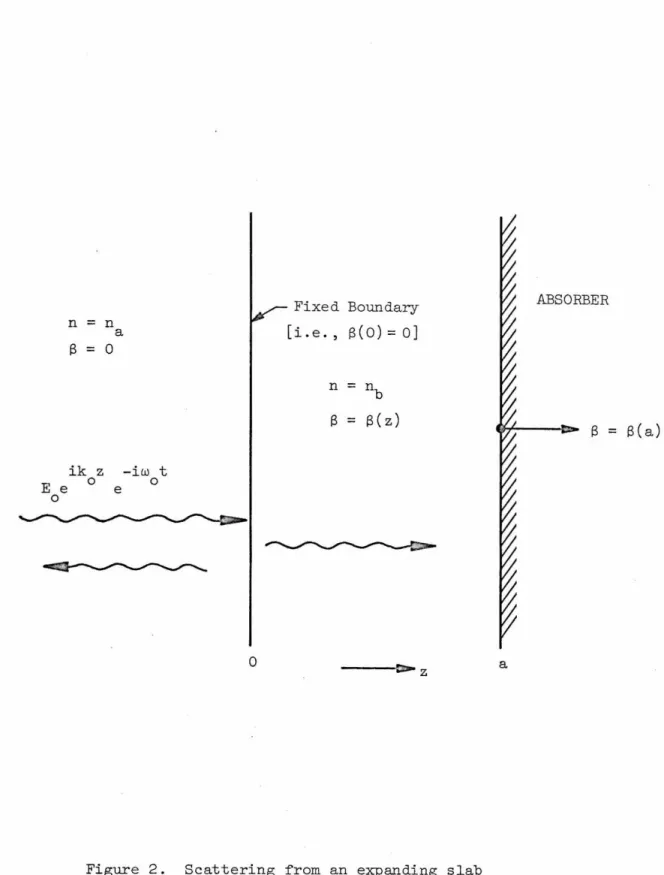
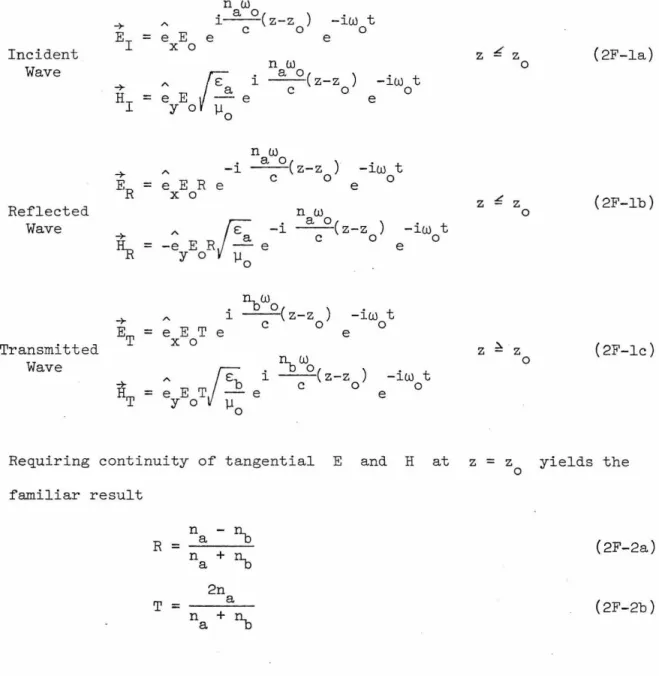
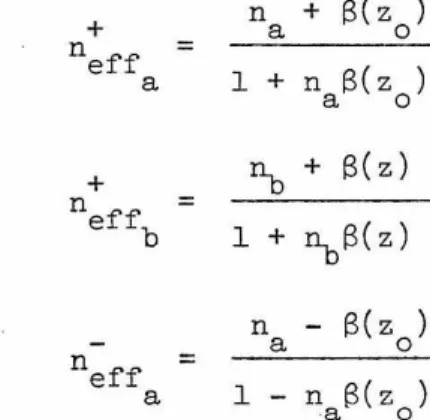
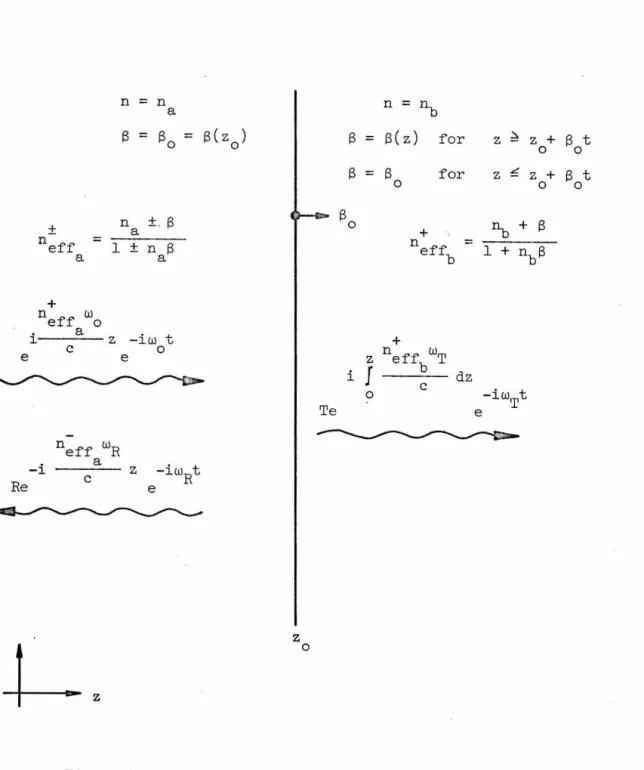
The formulation is ~uasistatic and is carried out to first order in the velocity of the medium. In addition, it will be assumed that the refractive index can be specified independently of the density of the medium. In the rest frame of the medium the wave impedance is Z and in a frame moving with velocity v + i t.
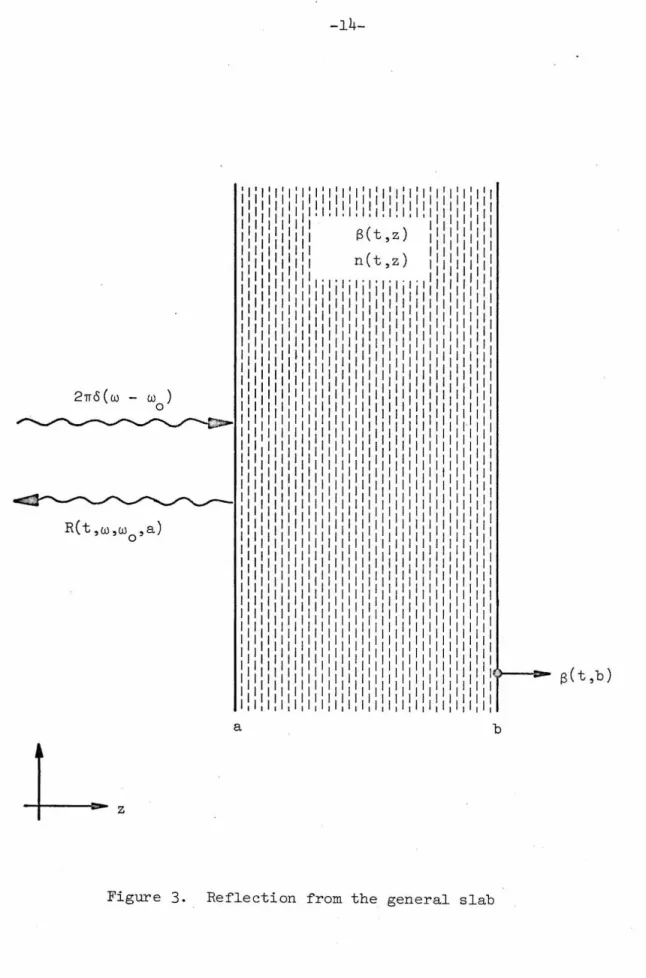
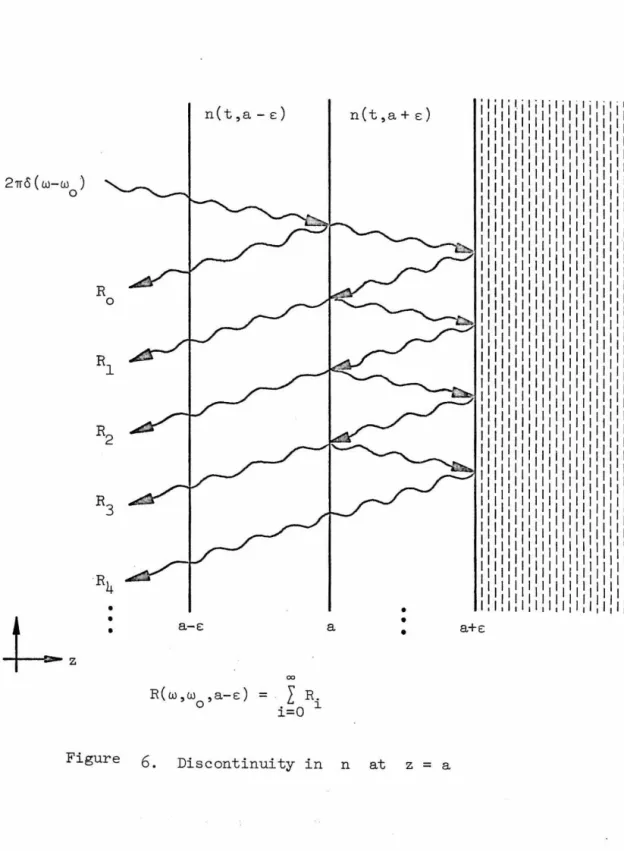
The plate is stratified so that the velocity of the fluid and its refractive index of rest are functions of time t and position z only. Therefore, we define the reflection function R as the spectral density function that gives the frequency spectrum of the reflected wave. With this assumption, we can use the concept of a time-varying spectrum.
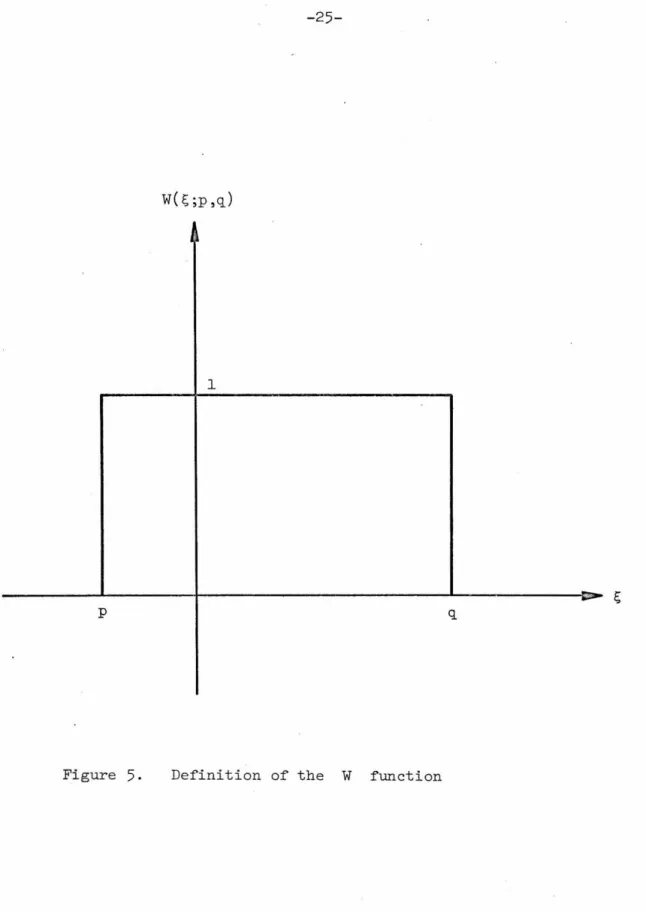
The W function is defined in Figure 5 and indicates that the first term of the solution (2D-9) is band limited. The contribution of the interior of the plate to the spectrum of the reflected wave is given by the first term in. The reflection of an index gradient at a given position within the plate has an amplitude proportional to the gradient of the plate.
A plane electromagnetic wave is normally incident on the plate and we want to study the properties of the reflected electromagnetic wave.
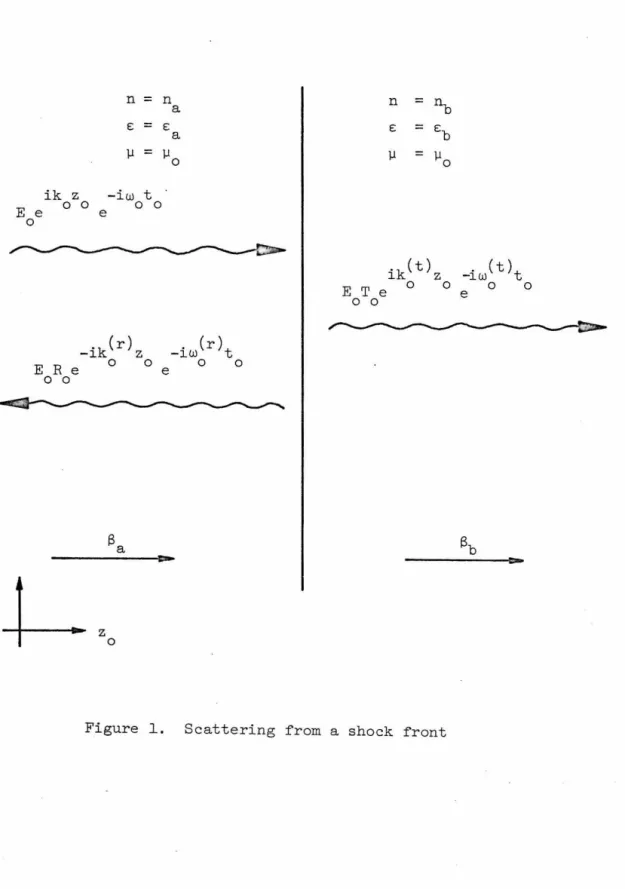
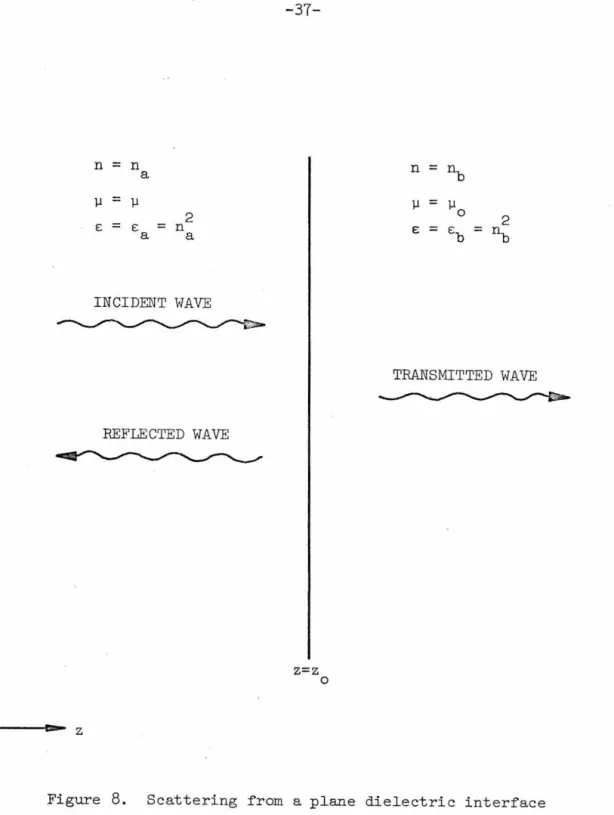
INCIDENT WAVE
REFLECTED WAVE
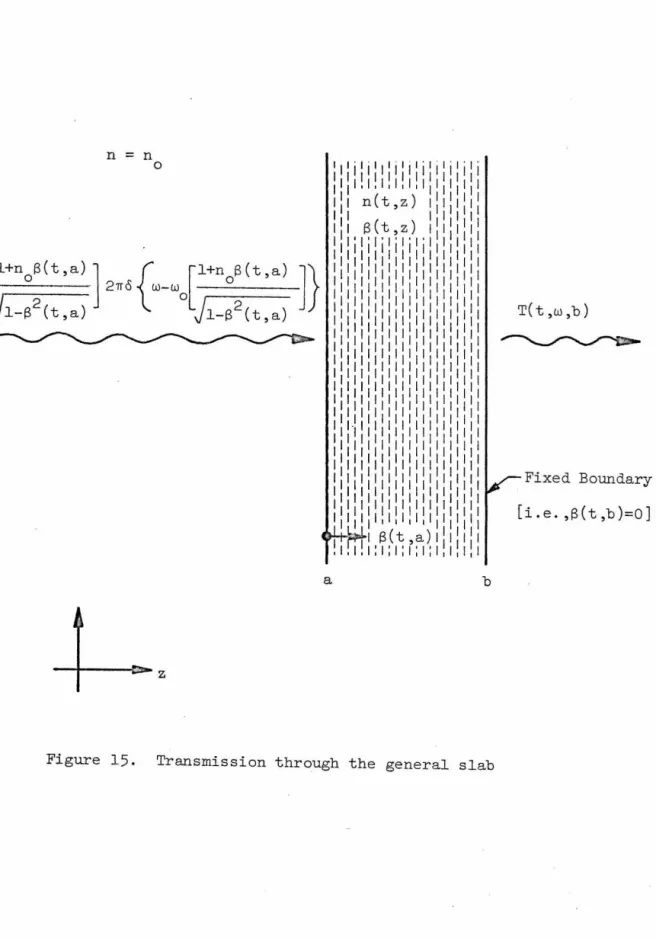
TRANSMITTED WAVE
EXPAJIIDING SPHERES
This form is then used to ascertain information about the nature of the scattered wave. Seen in the framework of the laboratory. the frame of the expansion center) the constitutive relations to first order in the velocity of the medium are. The relevant Maxwell's equations are the divergence equations are automatically satisfied since the region is source-free. c 2 Using the vector identities.
We now assume that the radial dependence of each component in the solution of this equation is of the form .. 3A-7). We now proceed to determine the oscillation frequency of R and T; that is, we determine the frequencies of the reflected and transmitted waves. We now have sufficient information to obtain the differential operator and the form of the invariant embedding equation.
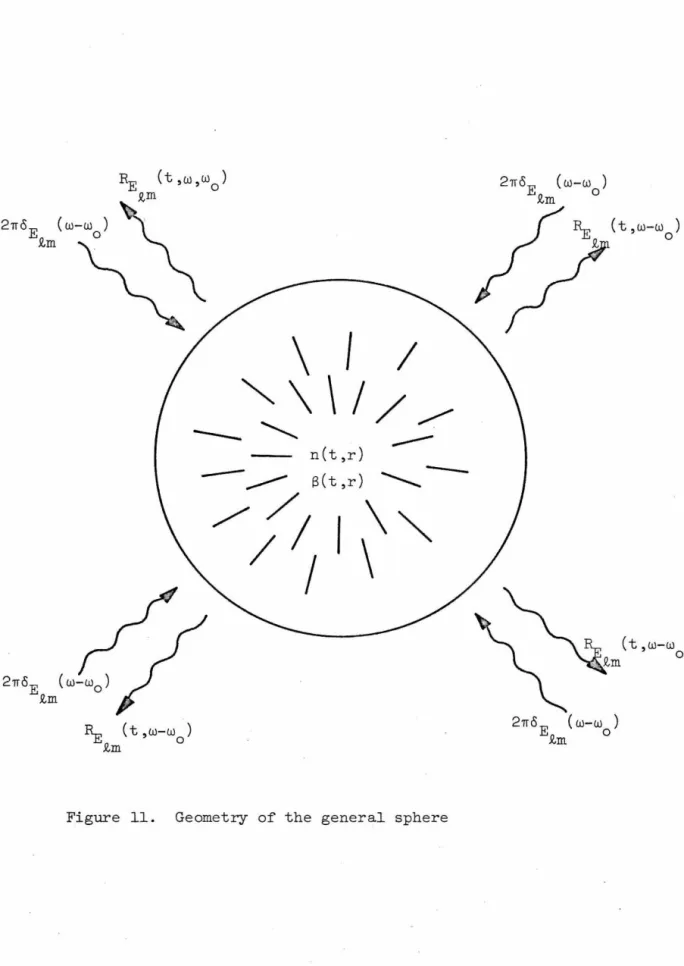
This equation must be integrated from the center of the sphere where Ri(t,w .. 1) out to the surface of the sphere where R£. Let us then study the properties of some of these components and the dependence of the properties on the character of the spreader. 2 are the appropriate Jacobians of the variable transformations defined by the corresponding delta functions in the integrand of (3C-7) and.
It immediately determines the position and width of the spectrum of the reflected wave; in other words. We are particularly interested in determining the frequencies of the delta functions and the spectral width and position of the term corresponding to R. The third term accounts for the shift on reflection from the inside of the surface at r=r.
The spectral width and position of the spectrum corresponding to R 1 is also easily found using (3C-10) together with the appropriate boundary effect terms; i.e. The reflection spectrum resulting from a typical incident spherical mode is shown in Fig. 13. 1 depends in a complex way on the detailed variation of velocity and index with radius.
We wish to extend this incident wave to spherical waves of the form given by (3B-l) and (3B-2). It is identical to (3C-12a) except for a change in the sign of the second term and the substitution of n(r).
CONCLUDING REMARKS
The frequencies of two of these components were calculated quasi-statically and to first order in the surface velocity for a large homogeneous expanding sphere, and the frequencies were shown to have a physical interpretation consistent with results from geometrical optics. It is expected that the techniques presented here will be of value in the analysis of the data obtained in radar studies of the ionosphere and disturbances in the atmosphere. The spherical analysis can be of particular value in studying the dynamics of explosions through.
76- APPENDIX A
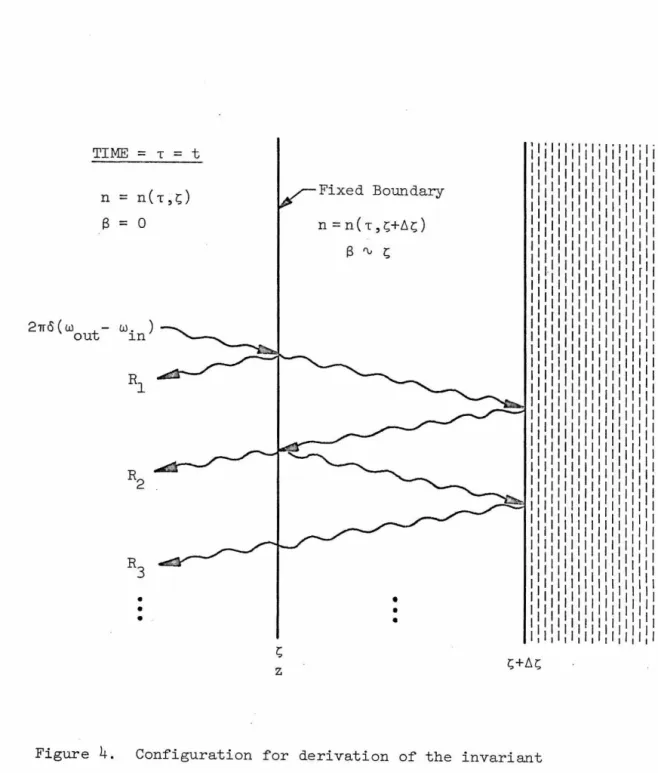
In this presentation, the problem was solved for each fixed value of the sprinkler parameters, and each solution thus obtained was called the solution at the time the sprinkler parameters assumed the values used to obtain it (necessary conditions (2C -lb)). This is a simplified invariant embedding equation for the first-order reflection function in S. For simplicity in this discussion, we consider a plate where the transformation is one-to-one across its thickness.
Thus, the condition under which this approach is applicable is that accuracy up to the first order in S is not necessary in the solution phase. In this appendix, the invariant embedding equation for the transmission function of an expanding plate is derived. The laboratory frame here is associated with the right boundary of the plate instead of the left boundary, as in the derivation of the equation for the reflection function.
It is assumed that the transmission through the part of the plate to the left of s-~s is known in a Lorentzian frame moving with the fluid at s-~s when the space to the right of s-~s in this frame is filled with a homogeneous stationary liquid of. That is, for this calculation a Lorentzian frame moving with the fluid at position z at time t (or equivalent position .s and time T in the upcoming frame) will be used. Again, our intention is to take the limit as ~s approaches zero, so again calculations will only be performed to first order in ~s.
It is transmitted through the plate to the left of s-6s and when it appears at s-6s it is described in the local moving frame by the spectral density function T(t,w t's-6d. Tj for j > 2 is of second order or highest at 6s and is therefore negligible in this calculation This is the imbed.ding invariant equation for the first-order transfer function on S • Assuming that + R is a known function, this equation is a variation of first-order partial linear - differential equation.
It must be integrated from the left boundary of the plate where the transmission is known to the right boundary where it will be found. 12 with the argument r + Set • Now the van der Pol and Bremmer expressions involve only the logarithmic derivatives of the Hankel functions. The radial dependence of the logarithmic derivatives for v I r + Sc6t can be ascertained using the asymptotic expressions for the Hankel functions [15] which are.