Critical Review
New Approach Methodologies for the Endocrine Activity Toolbox: Environmental Assessment for Fish and Amphibians
Constance A. Mitchell,a,* Natalie Burden,bMark Bonnell,cMarkus Hecker,dThomas H. Hutchinson,eMagdalena Jagla,c Carlie A. LaLone,fLaurent Lagadic,gScott G. Lynn,hBryon Shore,cYou Song,iSara M. Vliet,jJames R. Wheeler,k and Michelle R. Embrya
aThe Health and Environmental Sciences Institute, Washington, DC, USA
bNational Centre for the 3Rs (NC3Rs), London, United Kingdom
cEnvironment and Climate Change Canada, Ottawa, Canada
dToxicology Centre and School of the Environment & Sustainability, University of Saskatchewan, Saskatoon, Canada
eReckitt R&D, Hull, United Kingdom
fOffice of Research and Development, Great Lakes Toxicology & Ecology Division, US Environmental Protection Agency, Duluth, Minnesota
gResearch and Development, Crop Science, Environmental Safety, Bayer, Monheim am Rhein, Germany
hOffice of Pesticide Programs, US Environmental Protection Agency, Washington, DC
iNorwegian Institute for Water Research, Oslo, Norway
jOffice of Research and Development, Scientific Computing and Data Curation Division, US Environmental Protection Agency, Duluth, Minnesota
kCorteva Agriscience, Bergen op Zoom, The Netherlands
Abstract:Multiple in vivo test guidelines focusing on the estrogen, androgen, thyroid, and steroidogenesis pathways have been developed and validated for mammals, amphibians, orfish. However, these tests are resource‐intensive and often use a large number of laboratory animals. Developing alternatives for in vivo tests is consistent with the replacement, reduction, and refinement principles for animal welfare considerations, which are supported by increasing mandates to move toward an
“animal‐free”testing paradigm worldwide. New approach methodologies (NAMs) hold great promise to identify molecular, cellular, and tissue changes that can be used to predict effects reliably and more efficiently at the individual level (and potentially on populations) while reducing the number of animals used in (eco)toxicological testing for endocrine disruption.
In a collaborative effort, experts from government, academia, and industry met in 2020 to discuss the current challenges of testing for endocrine activity assessment forfish and amphibians. Continuing this cross‐sector initiative, our review focuses on the current state of the science regarding the use of NAMs to identify chemical‐induced endocrine effects. The present study highlights the challenges of using NAMs for safety assessment and what work is needed to reduce their uncertainties and increase their acceptance in regulatory processes. We have reviewed the current NAMs available for endocrine activity assessment including in silico, in vitro, and eleutheroembryo models. New approach methodologies can be integrated as part of a weight‐of‐evidence approach for hazard or risk assessment using the adverse outcome pathway framework. The development and utilization of NAMs not only allows for replacement, reduction, and refinement of animal testing but can also provide robust and fit‐for‐purpose methods to identify chemicals acting via endocrine mechanisms.Environ Toxicol Chem2023;42:757–777. © 2023 The Authors.Environmental Toxicology and Chemistrypublished by Wiley Periodicals LLC on behalf of SETAC.
Keywords:Adverse outcome pathway; Endocrine‐disrupting compounds; In vitro toxicology
INTRODUCTION
Endocrine pathways regulate growth, development, re- production, metabolism, and tissue function in vertebrates (US Environmental Protection Agency [USEPA], 2022b). Examples of endocrine pathways important for the functions listed are estrogen, androgen, thyroid, and steroidogenesis modalities,
This article includes online‐only Supporting Information.
This is an open access article under the terms of the Creative Commons Attribution License, which permits use, distribution and reproduction in any medium, provided the original work is properly cited.
Published online 15 February 2023 in Wiley Online Library (wileyonlinelibrary.com).
DOI: 10.1002/etc.5584
* Address correspondence to [email protected]
which are the focus of regulatory programs such as the USEPA's Office of Pesticide Programs (OPP). A chemical that alters the function of an endocrine system and causes sub- sequent adverse effects in an intact organism, its progeny, or (sub)populations is referred to as an endocrine‐disrupting chemical (EDC; International Programme on Chemical Safety, 2002). Endocrine activity, by contrast, describes an in- teraction with the endocrine system observed during a tox- icological study that may or may not lead to an adverse effect.
There is also scientific consensus that the World Health Or- ganization (WHO)/International Programme on Chemical Safety definition does not necessarily mean that the adverse effect has to be demonstrated in an intact test animal but may be shown in adequately validated alternative test systems predictive of adverse effects in humans and/or wildlife (Solecki et al., 2017).
Endocrine‐disrupting chemicals may alter the endocrine system by mimicking endogenous hormones (e.g., binding to re- ceptors) or altering the synthesis, metabolism, and transport of hormones (Schneider et al., 2019) and are of concern for both human and ecological health. Testing requirements related to identification of EDCs are developing worldwide but vary in approaches. These range from test requirements for all sub- stances being registered or marketed for a particular use to exposure‐and production volume–based scenarios to specific testing triggered by emerging concerns (Table 1).
Initial testing for endocrine activity typically involves short‐ term in vivo and in vitro assays used to evaluate the potential for interactions of a chemical with select endocrine pathways.
Where activity is identified to be of concern, higher‐tier in vivo testing is subsequently required to confirm the activity and establish adversity. Multiple in vivo test guidelines have been validated for mammals, amphibians, and fish by the Organ- isation for Economic Co‐operation and Development (OECD) and the USEPA (OPPTS 890 test guidelines; Burden et al., 2022; OECD, 2021a). These guidelines often require the use of a large number of laboratory animals (Russell &
Burch, 1959). Because of these animal welfare and economic concerns, there are mandates to move toward an“animal‐free” testing paradigm worldwide (Frank R. Lautenberg Chemical Safety for the 21st Century Act, 2016; Oziel, 2017;
Wheeler, 2019).
The potential for expanding the use of new approach methodologies (NAMs) in endocrine activity testing and assessment
New approach methodologies refer to “any technology, methodology, approach, or combination thereof that can be used to provide information on chemical hazard and risk as- sessment that avoids the use of [intact] animals”(OECD, 2005).
However, the term NAM can also include whole‐organism assays using some invertebrates or the nonprotected eleu- theroembryonic life stages of vertebrates (e.g., fish and am- phibians, typically prior to independent feeding; Embry et al., 2010; von Hellfeld et al., 2020). For the purposes of the present study, we refer to NAMs as all (eco)toxicological tools
other than traditional in vivo toxicity tests. The USEPA (2021) similarly defines NAMs as“any technology, methodology, ap- proach, or combination that can provide information on chemical hazard and risk assessment to avoid the use of animal testing.”Generally, NAMs can provide information on molec- ular changes, molecular/cellular perturbations, toxicokinetics, toxicodynamics, and toxicity mechanisms rather than meas- uring apical endpoints that are assessed in vivo. New approach methodologies hold great promise to increase the efficiency of screening testing to inform regulatory decisions, while having the added benefit of reducing the need for more resource‐ intensive studies which are reliant on large numbers of animals (OECD, 2005). Currently, however, there is limited confidence in using these tools broadly for hazard and risk assessment (Burden et al., 2022); and to date NAMs have been primarily used for chemical screening, classification, or prioritization or to assist in providing a mechanistic understanding of effects ob- served in in vivo studies. This is partly because many NAMs lack the complex biological processes that in vivo systems possess, such as absorption, distribution, metabolism, and excretion (ADME) processes or cross talk among multiple tissues or or- gans. Furthermore, insufficient mechanistic knowledge of the biochemical pathways of interest may pose issues concerning the use and interpretation of NAM data. This collaborative ef- fort strives to summarize the current state of the science re- garding the use of NAMs to identify and predict chemical‐ induced endocrine effects and aims to identify steps needed to increase acceptance of NAMs in regulatory processes.
Adverse outcome pathways as a framework to support NAM development and application
The adverse outcome pathway (AOP) framework has been developed to support a more mechanistically focused ap- proach to toxicity testing and drive the development and in- tegration of toxicodynamic NAMs in safety assessment.
Adverse outcome pathways are constructed using available information to define the sequence of molecular and cellular events required to produce an adverse effect on individuals, with potential consequences at the population level when or- ganisms are exposed to a substance. Adverse outcome path- ways entail linking a molecular initiating event, which describes the initial interaction of a chemical with a biomolecule, through a cascade of downstream key events (KEs) occurring at multiple levels of biological organization (i.e., cellular, tissue, organ), to an adverse outcome of regulatory concern (Ankley et al., 2010).
The strength of the causal relationships between KEs (termed KE relationships) can be evaluated by weight‐of‐evidence (WoE) considerations (Collier et al., 2016), integrating evi- dence streams along the AOP. Changes to an organism in- duced by perturbations of the pathway can then be mapped along the AOP. With sufficient understanding and develop- ment of quantitative endocrine AOPs, NAMs can be developed and used in place of animal toxicity tests to determine whether a substance induces early KEs within the AOP and ultimately help to predict if an adverse outcome is likely. The estrogen,
TABLE1:Currentregulatoryrequirementsandopportunitiesfornewapproachmethodologiesrelatedtoendocrine‐disruptingchemicals RegionSubstancetypeLegalbasisRequirementsforendocrinetestingusingfish oramphibianmodelsOpportunitiesforNAMs EuropePlantprotectionproducts— activesubstancesCommissionregulation(EU)2018/605 amendingAnnexIItoRegulation(EC) No.1107/2009bysettingout scientificcriteriaforthedetermination ofEDproperties
OECDConceptualFramework(OECD,2018a) toolboxadopted.Accordingtothe CommissionDelegatedRegulation(EU)No. 2017/21003andCommissionRegulation(EU) No.2018/605,theconclusionsastowhether theEDcriteriaaremetneedtobedrawn separatelywithrespecttohumansand nontargetorganisms.Theassessment strategyaimsatmakingthemostefficient useoftheavailabledatasettoreacha conclusion.Itisrecommendedtostrivefora conclusionontheEDpropertiesregarding humansand,inparallel,usingthesame database,tostriveforaconclusionon mammalsasnontargetorganisms.Only where,basedonthisassessment,thecriteria arenotmetformammalsasnontarget organismswouldtheassessmentneedto proceedbyconsideringfishandamphibians becausethesearethetaxawhere standardizedtestmethodsandknowledge onhowtointerprettheresultsareavailable. Informationonothertaxa(e.g.,birdsand reptiles)shouldbeconsideredifavailable (ECHA&EFSA,2018).
Assessmentofthemammaliandataset includesthefollowinginvitroassays: estrogen:OECDTG455(OECD,2021c), OPPTS890.1300(USEPA,2009d),and ToxCastERBioactivityModelData; androgen:OECDTG458(OECD,2020); steroidogenesis:OECDTG456 (OECD,2011a),OPPTS890.1550 (USEPA,2009e);EUB.57,OPPTS890.1200 (USEPA,2009c). InECHA&EFSA(2018),eleutheroembryo assays(XETA,EASZY,RADARassay) mentionedasLevel‐3assaysrelevantfor theevaluationofendocrineactivity. Biocidalproducts—active substancesCommissionDelegatedRegulation(EU) 2017/2100settingoutscientific criteriaforthedeterminationofED propertiespursuanttoRegulation (EU)No.528/2012
SpecificstudiesinfishmayincludeaMEOGRT (OECD,2015a)orafishlife‐cyclestudy coveringallthe“estrogen,androgenor steroidogenesis‐mediated”parameters foreseentobemeasuredinOECDTG240. Specificstudiesinamphibiansmayincludea LAGDA(OECD,2015b).Thesestudiesdo notneedtobeperformedifendocrine activityissufficientlyinvestigated(i.e.,atest accordingtoOECDTG229[OECD,2012a], 230[OECD,2009a],and231[OECD,2009b] isavailable)andthereisnoindicationthat thesubstancehasendocrineactivityor effectspotentiallyrelatedtoendocrine activity. IndustrialchemicalsRegulation(EC)No.1907/2006 concerningREACHEDsidentifiedassubstancesofveryhigh concernorequivalentlevelofconcernare includedinthecandidatelistandaresubject toauthorization/restrictionprocesses. Currently(2022),proposalsforstandard informationrequirementsarebeing discussed. (Continued)
TABLE1:(Continued) RegionSubstancetypeLegalbasisRequirementsforendocrinetestingusingfish oramphibianmodelsOpportunitiesforNAMs HumanpharmaceuticalsRegulation(EC)No.726/2004Currently(2022),theEuropeanMedicines Agency'sCommitteeforMedicinalProducts forHumanUseguideline(EMEA/CHMP, 2006)specifiesthatenvironmentalriskof certaincompounds,includingendocrine‐ activeones,needstobeaddressed irrespectiveofexposure.Someoutlined guidanceontestingapproachesisalso availableintheaccompanyingQ&A document.Adraftrevisionoftheguidance releasedin2018retainstherequirementsfor tailoredriskassessmentforendocrine‐active substancesandmakesmorespecific recommendationsformechanismof action–specifictesting,includingOECDTG 229(OECD,2012a),230(OECD,2009a),234 (OECD,2011b),240(OECD,2015a),and241 (OECD,2015b). VeterinarypharmaceuticalsRegulation(EC)No.2001/82/ECRequiredstudiesdonotcurrentlyinclude studiesspecificallydesignedtoidentify endocrine‐mediatedeffects.
Informationfrommechanismofaction, mammaliantoxicology,oropenliterature studiescaninformrequestsforadditional studies. United StatesPesticides,pesticidal formulationinert chemicals,and environmental contaminantsfoundin drinkingwatertowhich asubstantialpopulation isexposed
FoodQualityProtectionAct1996.EDSP 1998FederalRegisterNoticesEDSPusesatwo‐tieredapproach:TheUSEPAiscurrentlyfocusingonthepivot strategyofdevelopingandimplementing NAMsasalternatives.Thegoalisto developasetof“nonanimal”high‐ throughputassaysandcomputational bioactivitymodelsasalternativesforallthe assaysinthecurrentTier1screening battery.Invitroconsensusapproacheshave beenproposedbytheUSEPAforER (USEPA,2015a)andARactivity(USEPA, 2017;“ER/ARpathwaymodels”).
TierI •August11,1998:EDSP •December28,1998:EDSP StatementofPolicy
•OPPTS890.1100:Amphibian metamorphosisassay(USEPA,2009f) •OPPTS890.1350—Fishshort‐term reproductionassay(USEPA,2009g) TierII •OPPTS890.2200:MEOGRT (USEPA,2015b) •OPPTS890.2300:LAGDA(USEPA,2015c) The52pesticidesonList1haveundergone TierIscreening,andnotestordersforTierII testinghaveyetbeenissued.List1includes chemicalsthattheUSEPAselectedbasedon exposurepotential. HumanpharmaceuticalsUS:NationalEnvironmentalPolicyActof 1969CodeofFederalRegulations Part25—EnvironmentalImpact Considerations
TheUSFDAhasissuedbothageneral guidanceforenvironmentalriskassessment (FDA,1998)andaQ&Aforendocrine‐active substances(FDA,2016).Neitherofthese requestspecificstudies,butapplicantsare encouragedtorequesttoconsulttheagency priortosubmission. (Continued)
TABLE1:(Continued) RegionSubstancetypeLegalbasisRequirementsforendocrinetestingusingfish oramphibianmodelsOpportunitiesforNAMs JapanChemicalsubstancesJapanChemicalSubstanceControl Law(2011)TheJapanesestrategyemploysatwo‐tiered approach*:•MedakaERaandbreportergeneassays •Xenopustropicalisthyroidreceptorb reportergeneassayTierI Currentstrategicprogram EXTEND2017•MedakaERαreportergeneassay •MedakaARβreportergeneassay •OECDTG231(OECD,2009b) •Fishscreen(i.e.,OECDTG229 [OECD,2012a]or230[OECD,2009a]) •Juvenilemedakaanti‐androgenscreening assay(underdevelopment) TierII •OECDTG241(OECD,2015b) •OECDTG240(OECD,2015a) CanadaPesticidesThePestManagementRegulatoryAgency considerstoxicologicalstudiesthat investigatetheEDpotentialofpesticidesas partofpesticideevaluations.Forchemicals thatexhibitEDpropertiesorthatinduce adversebiochemicaland/orcellularchanges, theagencyconsiderseffect(s)resultingina measurableholisticendpoint(e.g.,mortality, reproduction,growthdevelopment, behavioral)toassessrisktonontarget organismsatenvironmentallyrelevant concentrations.Itdoesnotcurrentlyrequire studiesevaluatingspecificEDeffectsforthe premarketregistrationofnewchemicals underthePestControlProductsAct,but availableendocrinedataareconsideredin riskassessments.
ThePestManagementRegulatoryAgencyis opentoconsideringanyapplicantrationale incorporatingNAMresultsasahazardflag forpesticides.Itdoesnotroutinelyuseor receiveNAMdataforregulatorypurposes. IfNAMresultsweretoflaganEDconcern andexposureisexpected,thesubstance couldbeconsideredasacandidatefor additionaldatagathering.Newapproach methodologystudiescanimpartvaluable insightintothemechanistictoxicityofa chemicalatthemolecularandcellular levels;however,theseeffectsmaynot necessarilytranslateintoobservable adverseeffectsattheorganismlevel. Toxicityresultsofamechanisticnature, therefore,aretypicallyusedqualitativelyin theagency'sriskassessments. ChemicalsubstancesEndocrinetestsarenotpresentlyaregulatory requirementundertheCanadian EnvironmentalProtectionAct,1999;but availableendocrinedataareconsideredand canbeadrivingfactorinriskassessments.
Modesandmechanismsofaction considerations,includingendocrine‐active substances,havebeenappliedto ecologicalassessments(Okonski etal.,2021).Thespecificroleforagiven NAMwilldictateboththetypesofdataand thelevelofconfidenceneededtosupport itsintegration.Forexample,as replacementsforapical,invivoendpoints, NAMswouldneedtogeneratereliable, quantitativevaluestoallowtheestimation
HumanpharmaceuticalsSafety,quality,andefficacyofpharmaceuticals areevaluatedundertheFoodandDrugsAct. (Continued)
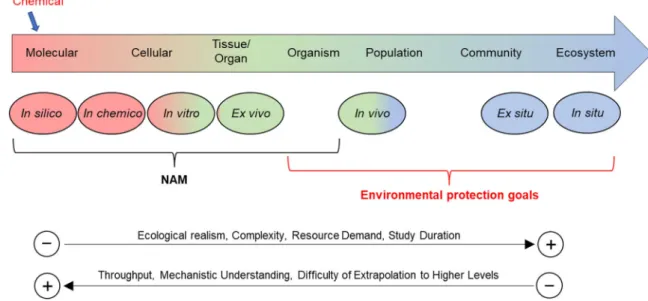
androgen, thyroid, and steroidogenesis modalities are of in- terest in the current regulatory paradigms. These pathways tend to be conserved across species, are relatively well studied, and in some cases have a robust set of in vivo adverse outcome data. Figure 1 maps the different methods and approach types that are available to support general chemical assessment for ecological endpoints along an AOP. Such organizational thinking can be applied for chemicals acting on endocrine pathways. However, the extrapolation from individual‐based adverse outcomes to a population‐relevant apical effect, in line with the protection goals of most environmental assessments, remains a significant challenge (Crane et al., 2019; Lagadic et al., 2020; Perkins et al., 2019).
It is worth noting that while NAMs hold promise for high‐throughput screening and assessment with the added benefit of reducing dependence on traditional animal tests, they are not necessarily a one‐to‐one replacement. However, their data should be considered a key component in an in- tegrated WoE approach for decision‐making. A WoE approach uses a combination of information from several sources, with weight given to the available evidence based on expert judg- ment or reliability factors (e.g., quality of the data, consistency of results, and relevance of the information; European Chem- icals Agency, 2016). Despite their limitations, NAMs provide the possibility to incorporate mechanistic information into the chemical assessment process, to increase the efficiency of such assessments, and to ultimately reduce the overall numbers of animals used in ecotoxicology testing and assessment. In par- ticular, in silico, in vitro, and eleutheroembryo models are more rapid and higher‐throughput than traditional in vivo ap- proaches, allowing more chemicals to be screened with fewer resources and in less time.
Aims of our review
In a collaborative effort led by the Health and Environmental Sciences Institute (HESI) and the United Kingdom's National Centre for the 3Rs, experts from government, academia, and industry met in early 2020 to discuss the current challenges of endocrine testing forfish and amphibians (Burden et al., 2022).
In continuing the cross‐sector initiative, the present study out- lines the current state of the science for evaluating the endocrine‐disrupting potential of chemicals in amphibians and fish using NAMs across the estrogen, androgen, thyroid, and steroidogenesis pathways. In the present study, we discuss the use of NAMs, their current and potential roles for ecotox- icology testing, and their potential to be used in paradigms like AOPs and integrated approaches to testing and assessments (IATAs). We also discuss the challenges of using NAMs for endocrine assessments and what is needed to reduce the un- certainties with such approaches. Movement toward the de- velopment, validation, and utilization of NAMs will lead to the replacement, reduction, and refinement of animal use needed for endocrine activity assessments while increasing the robustness and fitness for purpose of regulatory EDC assessments.
TABLE1:(Continued) RegionSubstancetypeLegalbasisRequirementsforendocrinetestingusingfish oramphibianmodelsOpportunitiesforNAMs ofpredicted‐no‐effectconcentrations,while NAMsintendedtoflagspecificmodesof actioncanbeintegratedthroughthe applicationofadditionalassessmentfactors duringpredicted‐no‐effectconcentration derivation.Canada'sEcologicalRisk Classificationoforganicsubstances approachundertheChemicals ManagementPlanutilizesWoEapproaches whichincorporateinsilicoflags. NAM=newapproachmethodology;EC=EuropeanCommission;ED=endocrinedisruption/disruptor;OECD=OrganisationforEconomicCo‐operationandDevelopment;ECHA=EuropeanChemicalsAgency; EFSA=EuropeanFoodSafetyAuthority;XETA=Xenopuseleutheroembryonicthyroidassay;EASZY=endocrineactivesubstances,actingthroughestrogenreceptors,usingtransgenictg(cyp19a1b:GFP)zebrafish embryos;RADAR=rapidandrogendisruptionadverse‐outcomereporter;MEOGRT=medakaextendedone‐generationreproductiontest;TG=testguideline;LAGDA=larvalamphibiangrowthanddevelopmentassay; REACH=Registration,Evaluation,AuthorisationandRestrictionofChemicals;Q&A=questionandanswer;EDSP=EndocrineDisruptorScreeningProgram;OPPTS=OfficeofPrevention,PesticidesandToxic Substances;USEPA=USEnvironmentalProtectionAgency;ER=estrogenreceptor;AR=androgenreceptor;FDA=USFoodandDrugAdministration;EXTEND=ExtendedTasksonEndocrineDisruption;WoE,weight ofevidence. Source:ModifiedfromBurdenetal.(2022).
USING PROBLEM FORMULATION TO ENSURE THAT NAMs ARE FIT FOR PURPOSE
Problem formulation is defined as a systematic approach that identifies the factors critical to a specific assessment and con- siders the purpose, scope, and depth of the necessary analysis, analytical approach, available resources and outcomes, and overall management goal (Solomon et al., 2016). Because management goals may vary by sector, legislation, and geo- graphic region, the specific regulatory context must be taken into account. One example of this is the difference between approaches to the regulation of EDCs in Canada, the United States, and Japan, where a risk‐based approach is used, and in the European Union, where a hazard‐based approach is em- ployed (i.e., a lack of consideration of exposure in the assess- ment; Burden et al., 2022). Therefore, data and assessment methodology will vary significantly depending on the stated purpose, making it crucial that NAMs are evaluated to ensure that they arefit for purpose for the assessment type (e.g., pri- oritization, classification, hazard assessment, risk assessment).
Regional regulations and current acceptance of NAMs under those regulations are listed in Table 1. The OECD Guidance Document 150 provides information on standardized test guidelines for evaluating chemicals for endocrine disruption (ED) and describes what tests are available to evaluate endocrine activity and ED (OECD, 2018a). While it has been used as a basis for some regulatory guidance, it does not in itself define a testing strategy. It should be recognized that although regu- latory testing requirements may vary globally, many chemicals are intended for use worldwide, and the relevance of any test across geographies (NAM or otherwise) should be a key con- sideration. Streamlined data packages and harmonized data templates that satisfy multiple global requirements will ensure that collected data can be broadly utilized for regulatory pur- poses, thereby reducing duplicative testing and resource costs,
while still enabling marketing internationally (Sewell et al., 2017) and potentially reducing the need for animal testing.
BUILDING CONFIDENCE IN NAM DEVELOPMENT, EVALUATION, AND APPLICATION
Although NAMs can be used to reduce the number of ani- mals and resources used in toxicity testing (Parish et al., 2020), in vivo data have been typically thought to provide more re- alistic information on chemical hazard, especially with respect to complex biological processes and systems within the assays (like ADME). Therefore, there are still several issues to over- come before there is sufficient confidence in NAM data for these tools to be incorporated more widely in safety assess- ment. There is a concern for high false‐negative or false‐
positive outcomes with NAMs, leading to a reluctance to make decisions solely based on results from these assays. However, in vivo tests may also produce false negatives because their sensitivities and specificities for detecting endocrine activity have been shown to be not as high as those of some NAMs. A separate project from this collaboration will critically review the robustness of currently available in vivo tests. Building con- fidence in negative outcomes from NAMs is essential to avoid unnecessary animal studies. Confidence can be increased by using multiple NAMs covering multiple pathways to ensure that there are no“gaps”in coverage. Some degree of redundancy (i.e., several NAMs covering the same molecular initiating event) may also help in consolidating a positive or negative outcome. Next, to gain regulatory acceptance, NAMs must be
“validated” (appropriate definitions of validated include “the process by which the reliability and relevance of a particular approach, method, process or assessment is established for a defined purpose” [OECD, 2005]; “the process by which the reliability and relevance of a procedure are established for a
FIGURE 1: Current overview: levels of biological organization and tools in support of chemical ecological assessment. NAM=new approach methodology.
specific purpose”[Balls et al., 1995]; and“the process by which the reliability and relevance of a procedure for a specific pur- pose are established” [National Toxicology Program Inter- agency Center for the Evaluation of Alternative Toxicological Methods & Interagency Coordinating Committee on the Vali- dation of Alternative Methods, 2003]), which has its own set of challenges. For example, validation studies are usually con- ducted using reference test substances, which typically elicit strong negative or positive responses. However, most “real‐ world chemicals”tested for regulatory purposes will typically not elicit such clear effects. This has been recognized, with some OECD validation studies now including weakly acting reference chemicals to ensure that assays can cover a realistic spectrum of effect magnitudes. The USEPA is also developing and utilizing reference chemical sets with a broad spectrum of potency for validation purposes.
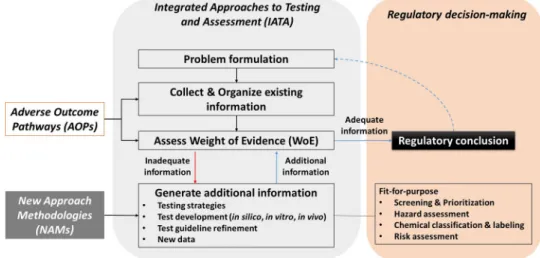
Combining data from multiple sources, such as via IATAs which use new and existing data in aflexible manner to address regulatory needs, will build confidence in NAMs. Integrated approaches to testing and assessments are widely recognized as the best regulatory practice for the application of NAMs.
However, the current OECD process for IATA adoption is rigid, conservative, and lengthy (5–10 years). It typically requires that data are generated using official test guideline methods, which can take many years to obtain. Although some performance‐ based test guidelines are considered, there need to be faster ways to enable adoption of NAMs more broadly within regulatory agencies. Figure 2 provides a conceptual diagram regarding the integration of NAMs into IATAs.
CURRENTLY AVAILABLE NAMs TO ELUCIDATE ED PATHWAYS AND MECHANISMS
This section highlights the currently available NAM tools (Figure 3): in silico approaches, in vitro assays, and eleutheroembryo‐based assays. Details on each assay are
available in the Supporting tables. Table 1 also demonstrates the regulatory contexts where NAMs are already being applied.
In silico tools
In silico (i.e., computational) tools represent a growing body of NAMs with the potential to accelerate the toxicological screening process. Advantages of these methods are that they often have high speed and throughput, are low‐cost, and can assess a large number of molecules with relative ease. Cur- rently, these tools can be used as an alternative or as a sup- plement to in vitro and in vivo testing. Most of the available in silico models can be described as ligand‐based methods or target structure‐based approaches. Quantitative structure‐
activity relationship (QSARs) models are ligand‐based methods that estimate activity based onfingerprints and molecular de- scriptors (Schneider et al., 2019). These tools look for structural alerts in either a particular portion of the molecule or the molecule as a whole. Examples include the OECD QSAR toolbox (qsartoolbox.org), VEGA HUB (www.vegahub.eu), or CAESAR (www.caesar-project.eu). There are QSARs for specific modalities for the endocrine system. Specifically, estrogen re- ceptor (ER), AR, and aromatase inhibition for steroidogenesis have been well established because of interest and regulatory requirements; but models for other pathways, such as thyroid, still require significant development.
Two such QSAR models were developed by consortia of scientists from 35 international organizations led by the USEPA. The Collaborative Estrogen Receptor Activity Pre- diction Project evaluates chemicals for potential ER activity (Mansouri et al., 2016), and the Collaborative Modeling Project for Androgen Receptor activity (Mansouri et al., 2020) evaluates potential AR activities. Expert modelers and com- putational toxicology scientists used the data for approximately 1800 chemicals from the ER (Judson et al., 2015) and AR (Kleinstreuer et al., 2017) pathway models (see below,In Vitro Tools) to train QSAR models to predict ER and AR activity, respectively. Both of these QSARs are available through the
FIGURE 2: An illustration of how new approach methodologies can be integrated to support integrated approaches to testing and assessments.
Modified from Organisation for Economic Co‐operation and Development (2016). AOP=adverse outcome pathway; NAMs=new approach methodologies; IATAs=integrated approaches to testing and assessments; WoE=weight of evidence.
Open Structure–activity/property Relationship App (National Toxicology Program, 2021). In addition, the USEPA's CompTox Dashboard (Williams et al., 2017) has a “Predictions” tool (USEPA, 2022a) which allows input of a chemical structure to predict a number of toxicological endpoints including ER relative‐binding affinity and ER binding.
There are also target structure‐based approaches for EDCs.
These investigate EDC targets using docking or more compu- tationally intensive approaches such as molecular dynamics.
Docking tools are commonly used for virtual screens for thou- sands of chemicals, as employed in drug discovery. There are many programs available to understand molecular docking and dynamics: A full review of these is beyond the scope of the present study (see Schneider et al., 2019, for a comprehensive summary).
While the above‐described computational tools have great utility for screening and prioritization of testing efforts, most have some common limitations. Typically, the chemical space eval- uated by these tools is dependent on the amount of high‐quality data that are available to train the models, which is often limited.
Many models are also dependent on experimental data which, in itself, can contain error and bias, in some cases leading the
models to inaccurate predictions. Currently, many types of chemistries are incompatible for these models, including halo- gens, metals, and polymers. Chemical mixtures also prove chal- lenging, with models overlooking potential additive or synergistic effects. From an ecotoxicological perspective, many of the ex- isting tools are based on human data, with unknown specificity forfish or amphibians. The ADME properties are also not always incorporated into models and need to be considered (though physiologically based pharmacokinetic modeling could aid with this; Schneckener et al., 2020). Further, most computational models can only ever provide mechanistic information on the lower levels of organization in an AOP; therefore, more data will be needed to link activity detected in silico with an adverse outcome at higher levels.
The tools described above use toxicity data and/or chemical structures as their inputs. Other tools evaluate conservation where there is knowledge of targets, such as the USEPA's Sequence Alignment to Predict Across Species Susceptibility (SeqAPASS; https://seqapass.epa.gov/seqapass/) tool. This tool provides a screening approach that allows for extrapolation of toxicity information across hundreds of species. For some model species (e.g., humans, mice, rats, and zebrafish) the FIGURE 3: New approach methodologies and in vivo assays available to evaluate endocrine modalities. Italics indicate in development. Test guidelines: 248 (OECD, 2019), 250 (OECD, 2021b), 251 (OECD, 2022), 407 (OECD, 2008), 408 (OECD, 2018b), 440 (OECD, 2007), 441 (OECD, 2009c), 455 (OECD, 2021c), 456 (OECD, 2011a), 457 (OECD, 2012b), 458 (OECD, 2020), 407 (OECD, 2008), 493 (OECD, 2015c). *Rep- resentative assays. **Note that, under the current Endocrine Disruptor Screening Program, the LAGDA is considered primarily for identifying interactions with the hypothalamic–pituitary–thyroid axis. ***Hershberger assay specifically measures 5α‐reductase inhibition as well. NPLS= nonprotected life stage; QSAR=quantitative structure–activity relationship; ER=estrogen receptor; AR=androgen receptor; TR=thyroid hormone receptor; TG=test guideline; OPPTS=Office of Prevention, Pesticides and Toxic Substances; DIO1, DIO2, and DIO3=iodothyronine deiodinases 1, 2, and 3; AUR=Amplex UltraRed; EASZY=endocrine active substances, acting through estrogen receptors, using transgenic tg(cyp19a1b:GFP) zebrafish embryos; RADAR=rapid androgen disruption activity reporter; XETA=Xenopuseleutheroembryonic thyroid assay; REACTIV=rapid estrogen activity tests in vivo; OECD=Organisation for Economic Co‐operation and Development; LAGDA=larval amphibian growth and de- velopment assay; FS[TR]A=fish short‐term reproduction assay; FSDT=fish sexual development test; AMA=amphibian metamorphosis assay;
MEOGRT=medaka extended one generation reproduction test.
USEPA has large amounts of data regarding their toxicological susceptibility to various chemicals. However, the existing tox- icity data for the whole diversity of species are limited. The SeqAPASS tool extrapolates from these data‐rich organisms to other unassessed species to predict their specific potential chemical susceptibility. Some chemical classes have relatively well‐defined protein targets (e.g., pesticides), and those pro- teins are curated in the National Center for Biotechnology In- formation's protein database (www.ncbi.nlm.nih.gov/protein).
The SeqAPASS tool evaluates the similarities of protein struc- ture to identify whether a protein target is present for a chemical interaction in other nontarget species. This tool has been applied to endocrine‐specific targets, like the ER, the AR, and proteins in the thyroid axis and involved in steroidogenesis (Ankley et al., 2016; LaLone et al., 2018). There are advantages to tools such as SeqAPASS compared with other computational methods. For example, mixtures could be evaluated if their contents are known. Limitations relevant to SeqAPASS are re- lated to the growing sequence information that may have poor annotation or curation and the limitations of sequence data for certain groups of species, particularly invertebrates. In addi- tion, because the chemical's molecular (protein) target is used to query the tool, there needs to be a better understanding (or sharing of knowledge generated in the development of chemicals) as to the chemical–protein interaction that leads to the effectiveness of the chemical.
Overall, computational methods can be used in fit‐for‐ purpose ways as a part of a WoE assessment.
In vitro tools
In vitro tools can provide mechanistic information and evi- dence on chemical perturbations via molecular initiating events
and KEs in an AOP. In vitro tools can be cell‐free or cell‐based and, as with other NAMs, are typically used in a WoE approach.
Cell‐free assays are available to measure potential endocrine interactions. While there are countless models and targets, in this review we will highlight a few assays that are currently being used or considered for screening associated with chemical safety or risk assessment (Table 1 and Figure 4). When possible, a description of the assay and the associated parameters and performance was generated and is included in the Supporting Information. There are a number of cell‐free assays that have been adopted as test guidelines by either the USEPA or the OECD. The USEPA's Endocrine Disruptor Screening Program (EDSP) Tier 1 battery of assays (USEPA, 2022a, 2022b) includes three test guidelines for cell‐free assays: an AR‐binding assay (rat ventral prostate cytosol, OPPTS 890.1150; USEPA, 2009b), an ER‐binding assay (using rat uterine cytosol, OPPTS 890.1250;
USEPA, 2009a), and an aromatase inhibition assay (human recombinant, OPPTS 1200; USEPA, 2009c).
There are also several cell‐based assays adopted as test guidelines. The USEPA's EDSP Tier 1 battery of assays includes cell‐based test guidelines for ER transcriptional activation (OPPTS 890.1300; USEPA, 2009d) and steroidogenesis (OPPTS 890.1550; USEPA, 2009e). The OECD test guidelines include androgen (458, 455, 493; OECD 2020, 2021c, 2015c, re- spectively) and steroidogenesis (456; OECD, 2011a). There is also a yeast ER assay from the International Organization for Standardization (2018a, 2018b). The above test guidelines that are a part of the USEPA Tier 1 EDSP (see Table 1) are intended to be reviewed as a battery, which includesfive in vitro tests and six in vivo tests, to determine potential estrogen, androgen, and thyroid bioactivity.
The Toxicity Forecaster (“ToxCast”) program and the Tox21 (“Toxicity Testing for the 21st Century”) federal consortium
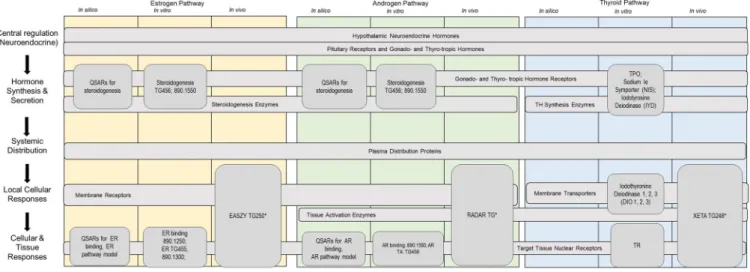
FIGURE 4: Generalized nodes with potential molecular initiating event targets across the estrogen, androgen, and thyroid pathway axes and cross‐ referenced with available new approach methodologies by type for measuring molecular endpoints. *Ongoing research is clarifying the potential of the embryo assays to detect effects on hormone synthesis, secretion, and systemic distribution. QSAR=quantitative structure–activity relationship;
TG=test guideline; TH=thyroid hormone; TPO=thyroperoxidase; NIS=sodium iodide symporter; IYD=iodotyrosine deiodinase; ER=estrogen receptor; EASZY=endocrine active substances, acting through estrogen receptors, using transgenic tg(cyp19a1b:GFP) zebrafish embryos; AR= androgen receptor; RADAR=rapid androgen disruption activity reporter; DIO1, DIO2, and DIO3=iodothyronine deiodinases 1, 2, and 3; TR, thyroid hormone receptor; XETA=Xenopuseleutheroembryonic thyroid assay.
prioritize the public release of bioactivity screening data. The USEPA has developed the ToxCast program to make in vitro medium‐ and high‐throughput screening assay data publicly available for the prioritization and hazard characterization of thousands of chemicals. ToxCast contains a variety of assay technologies to evaluate the effects of chemical exposure on diverse biological targets from distinct proteins to more complex cellular processes, including all Tox21 assays. The USEPA's CompTox Chemicals Dashboard (https://comptox.
epa.gov/dashboard) integrates physicochemical, environ- mental fate and transport, exposure, usage, in vivo toxicity, and in vitro bioassay data (i.e., ToxCast) for over 870 000 chemicals (Williams et al., 2017). A subset of ToxCast methods and data from this effort is directly relevant to screening for endocrine activity. For example, ToxCast has 18 high‐throughput assays based on the molecular events associated with ER activation (e.g., binding, dimerization, transcription, and translation), and the data from these assays were assessed for 1800 chemicals to build a statistical model called theER pathway model(Judson et al., 2015). Similarly, ToxCast has 14 high‐throughput assays based on the molecular events associated with AR activation, and the data from 11 assays were assessed for the same set of 1800 chemicals to build the AR pathway model (Judson et al., 2020; Kleinstreuer et al., 2017). These models can also provide a measure of potency based on consensus models, where relative potency is scored against the bioactivity of known potent substances (e.g., 17β‐estradiol). The data for each of the ER and AR high‐throughput assays and scores for both the ER and AR pathway models are available on the Chemicals Dashboard. In 2015, the USEPA published aFederal Register notice seeking comment on using the ER pathway model as a validated alternative for multiple Tier 1 assays (USEPA, 2015a). Very recently, the USEPA published a white paper supporting the validation of these models as alternatives for EDSP Tier 1 screening (USEPA, 2023). The ToxCast ER and AR high‐throughput assay data were reassessed to demon- strate that subsets of assays can provide close to the same level of predictivity as the full assay sets listed above for ER agonism (Judson et al., 2017), AR agonism, and AR antagonism (Judson et al., 2020).
The Chemicals Dashboard also contains ToxCast data from assays targeting multiple thyroid hormone receptors (TRs;
Paul‐Friedman et al., 2019), thyroperoxidase activity (Paul Friedman et al., 2016), and steroidogenesis (HT‐H295R;
Haggard et al., 2017). New ToxCast assays for a variety of thyroid pathways are in development. These include the io- dothyronine deiodinase 1 (DIO1) inhibition assay (Hornung et al., 2017), the DIO2 inhibition assay (Olker et al., 2018), the DIO3 inhibition assay (Olker et al., 2018), the iodotyrosine deiodinase inhibition assay (Olker et al., 2021), and the sodium iodide symporter inhibition assay (J. Wang et al., 2019).
The currently available in vitro tools have common strengths in that they are quick to perform, many have been adapted to be high‐throughput, and they provide specific mechanistic in- formation on potential endocrine activity. The cell‐based in vitro assays also share some common strengths, utilizing im- mortalized and commercially available cell lines, which are
easier to acquire and handle than primary cells and do not need to be sourced from animals. They also can give some idea of potency based on response or binding (Asnake et al., 2019).
However, the immortalized cell lines used in the above assays are almost exclusively derived from tumors and are prone to theWarburg effect(increase in the rate of glucose uptake and preferential production of lactate, even in the presence of oxygen; Oliveira et al., 2015), which could be a complication for predicting responses to endogenous cells, receptors, and en- zymes. Not all modalities and mechanisms are fully covered by existing assays, and there are few that are specific forfish or amphibians. Some cell‐free assays require isolation of bio- logical material from animal organs (e.g., the AR‐binding assay uses rat ventral prostate cytosol). Using biological material derived from animals increases cost and effort; however, those organs have endogenous expression of a mix of receptors (e.g., uterus expresses ERα and ERβ) that may not be found in im- mortalized cell lines. In addition, receptor‐binding assays cannot distinguish if a chemical is an agonist or antagonist, and most in vitro assays would likely not be able to capture re- sponses from life stages when an organism would be more susceptible to the effects of an EDC.
Eleutheroembryo assays
Eleutheroembryo assays have been developed in amphib- ians andfish with the specific purpose of detecting endocrine activity. The amphibianXenopus laevisis used in theXenopus eleutheroembryonic thyroid assay (XETA; OECD test guideline 248; OECD, 2019). Medaka (Oryzias latipes) and zebrafish (Danio rerio) arefish species for which eleutheroembryo assays have been developed to investigate estrogenic (endocrine active substances, acting through estrogen receptors, using transgenic tg[cyp19a1b:GFP] zebrafish embryos; OECD test guideline 250 zebrafish eleutheroembryos; OECD, 2021b;
rapid estrogen activity tests in vivo [REACTIV] assay, medaka eleutheroembryos) and androgenic (rapid androgen disruption activity reporter [RADAR] assay; OECD test guideline 251 medaka eleutheroembryos; OECD, 2022) activities. Both the REACTIV and RADAR assays also cover downstream steps (5α‐
reductase and aromatase) of steroidogenesis. These assays use organisms in the eleutheroembryonic stage that are not ca- pable of independent feeding. At this stage the eleuther- oembryos are not considered capable of experiencing pain, distress, suffering, or lasting harm (European Food Safety Au- thority [EFSA], 2005). However, it is important to note that these eleutheroembryo assays do not necessarily use fewer individuals compared with other OECD Level 3 mechanistic assays (e.g., test guidelines 231, 229; OECD, 2009b, 2012a, respectively).
Currently, the available eleutheroembryo assays do not allow for the identification of specific endocrine targets be- cause they are whole organisms which may include multiple mechanisms by which an endocrine active substance can act.
By design, the assays are based on the use of genetic con- structs that combine the promoter of an endocrine receptor