An Examination of Mississippi Teachers' Likelihood to Report Child Sexual Abuse and the Potential Effect on the Rates of Victim Disclosure. Darkness to Light estimates that 400,000 babies born in the United States will become victims of child sexual abuse. While school personnel identify 52% of all cases of child sexual abuse (Darkness to Light, 2006), less than 30% of suspicions are officially reported (Kenny, 2001).
There are many barriers to teachers being reluctant to report suspected child sexual abuse. A review of the existing literature shows that today's teachers lack the necessary knowledge to detect and intervene in cases of child sexual abuse.
Literature Review
Katerndahl, Burge, Kellogg, and Parra (2005) found more of a correlation between level of acculturation and reporting of child sexual abuse than with ethnicity and reporting itself. All of these are factors that exacerbate the difficulty of reporting child sexual abuse (Sudderth, 2003). Many victims of child sexual abuse report emotional or psychological distress or inappropriate behavior as a result of their victimization.
Darkness to Light (2006) reports that victims of child sexual abuse are more likely to be involved in prostitution. Female victims of sexual abuse are 2.2 times more likely to become teenage mothers, with 45% reporting a history of child sexual abuse. Child sexual abuse has an indirect relationship with rates of teen suicide, teen runaways, and teen births (Finkelhor & Jones, 2012).
McGuire and London (2017) found that 70% of physicians believe that decreased academic performance is linked to child sexual abuse. Darkness to Light (2006) estimates that 400,000 babies born in the United States will be victims of child sexual abuse. While Finkelhor and Jones' research focuses on substantiated reports of sexual abuse, Darkness to Light (2006) found that only about 4 to 8% of reports of child sexual abuse are fabricated.
Triggered disclosure induced by the recall of previously forgotten or repressed memories of the sexual abuse. Studies consistently show that teachers lack the knowledge and confidence to be effective reporters of child abuse and neglect, particularly child and youth sexual abuse” (Goldman & Grimbeek, 2014, p. 3). CAPTA's description of child sexual abuse is considered the federal definition from which individual states drew their own definitions.
In a self-report survey distributed by McIntyre (1999), teachers assessed their own awareness of the signs of child sexual abuse. Only a third of child sexual abuse cases are identified; school personnel report only 52% of these cases (Darkness to Light, 2006).
Methodology
After reading an article published in the Journal of Child Sexual Abuse by Walsh et al. 2010), the researcher chose to use the newly designed 21-item Likert-type survey to measure teachers' attitudes and beliefs about reporting child sexual abuse, the "Twenty-One Item Self-Report Teachers' Reporting Attitude Scale for Child Sexual Abuse I In relation to reporting child sexual abuse, to what extent do you agree or disagree with the following statements?" that was created by Walsh et al. Despite these limitations, the researcher chose to proceed with the study because it was the most recently developed scale of its kind that was found. Initial tests from Walsh et al. 2010) proved successful enough for the researcher to believe it would be effective in smaller research.
Once the survey was selected and edited, the researcher submitted it, along with recruitment letters and a consent to participate form (Appendix B), to the University of Mississippi Institutional Review Board for approval, which was granted after review by the committee. Schools were eliminated either because the principal did not give the researcher permission to contact his or her employees or because the principal refused to respond to both the initial email and subsequent phone call. Two teachers – one from a middle school and the other from a high school – approached the researcher.
After the researcher received approval from the school principal, teachers of all content areas for grades 7–9 were given class sent email about employment. If teachers who received a recruitment email from the researcher were willing to participate in the study, they followed a link in the email to a Qualtrics survey uploaded by the researcher. The survey was also distributed to 250 undergraduate and graduate education majors at the University of Mississippi.
Susan McClelland, Chair of the Department of Teacher Education, who gave consent and referred the researcher to the Office of Student Advising and Field Experience (SAFE Office), which acts as a liaison between College of Education faculty and education majors when mass e-mail is required. to be dispersed. While the survey was not sent to elementary school teachers, it was sent to undergraduate elementary students. The rationale for sending the survey to undergraduate students seeking a degree in education was to determine whether preservice teachers were exposed to the necessary information about detecting and reporting child sexual abuse among their prospective students.
Survey Analysis
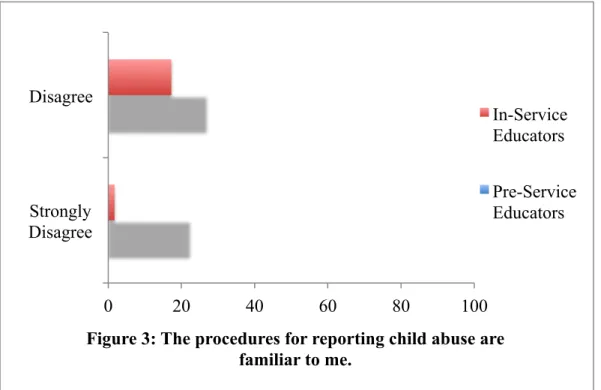
- The procedures for reporting child abuse are familiar to me
- Reporting child sexual abuse can enable services to be made available to children and families. (Figure 4)
- Teachers who report child sexual abuse that is unsubstantiated can get into trouble. (Figure 6)
- I would be apprehensive to report child sexual abuse for fear of family/community retaliation. (Figure 7)
- I would be reluctant to report a case of child sexual abuse because of what parents will do to the child if he or she is reported. (Figure 8)
- I would like to fulfill my professional responsibility by reporting suspected cases of child sexual abuse. (Figure 9)
- I would still report child sexual abuse even if my administration disagreed with me. (Figure 10)
- I lack confidence in the authorities to respond effectively to reports of child sexual abuse. (Figure 11)
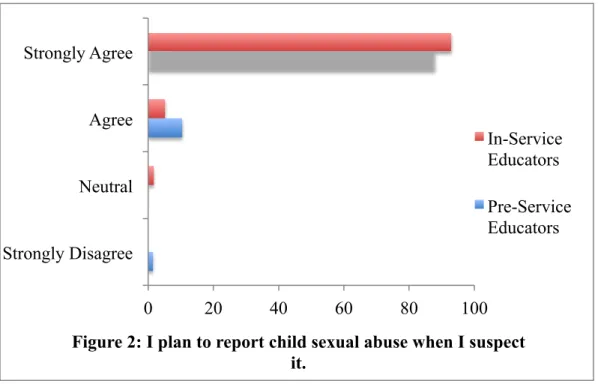
This section will assess and compare pre-service and in-service teachers' beliefs about and knowledge of mandatory reporting laws and the protections they provide. If the pre-service and in-service teachers who participated in the survey were truly aware of the laws of the state in which they teach, they would have no problem answering either "Strongly Agree" or "Agree" to Statements 1- 3 listed above. According to the results received, the responses to Statement 1 and 3 correspond to the researcher's expectations, with 88.06% of pre-service and 93.10% of in-service teachers "Strongly agree" to Statement 1, "I plan to report child sexual abuse when I suspect it.” Similarly, 41.79% of pre-service and 39.66% of in-service teachers.
The researcher expected the response of student teachers regarding statement 2: “I am aware of the procedures for reporting child abuse.” According to the existing literature, little is being done to prepare undergraduate students to prevent, detect, or intervene in cases of child sexual abuse. This gap can most likely be attributed to the amount of experience between in-service and pre-service teachers; Those currently working in education are more likely to have encountered a case of child sexual abuse, participated in a professional development course that addressed child abuse and neglect, or both.
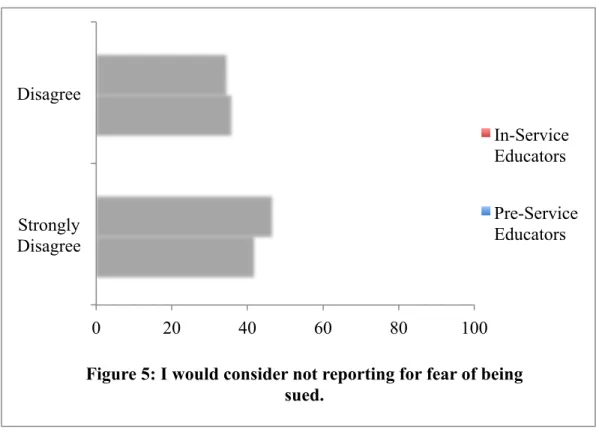
Disagree” for statement 4, “I would consider not reporting because I'm afraid of being sued,” as well as for statement 5, “Teachers who report unsubstantiated child sexual abuse can get into trouble. " This law gives whistleblowers legal immunity if the whistleblower is presumed to be acting in good faith. According to Hinkelman and Bruno (2008), “professionals respond to child sexual abuse based on their education and experience with child sexual abuse cases, the age and gender of the child, and their relationship to the victim and the perpetrator” (p. 381). ; two researchers also found that approximately 59% of mental health professionals, law enforcement agencies, and schools place some of the responsibility for abuse on child victims. Child sexual abuse affects victims not only physically, but also emotionally, and for some the scars never truly heal; Whether they exhibit delinquent behavior or develop addiction to harmful substances, victims' mannerisms are often found to be self-destructive.
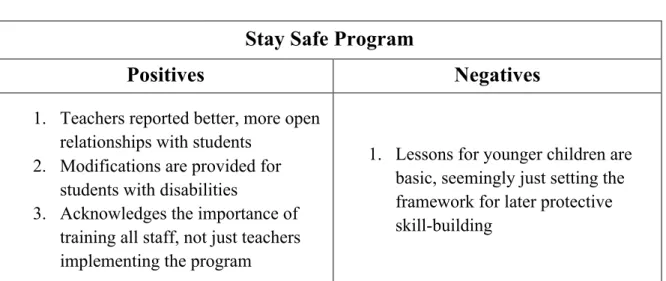
According to the results of the survey distributed by the researcher, many pre-service teachers – and some in-service teachers – have no practical knowledge of how to apply the laws regarding child abuse and neglect, such as the duty to inform and the immunity afforded granted to a reporter acting in good faith, for the prevention and detection of child sexual abuse. For in-service teachers: the introduction of child sexual abuse prevention programs in mainstream education. These relationships have likely effectively enabled educators, especially those in education, to successfully report their suspicions of child sexual abuse among their students.
An anonymous questionnaire distributed to all students, regardless of their experience with child sexual abuse, would allow further anonymity for victims who have not yet come forward and are unsure about doing so. A third difficulty for further study is the school, which may be reluctant to allow researchers to conduct a study involving the competence - or lack thereof - of their teachers to report child sexual abuse.
Conclusion
A Preliminary Mapping of Individual, Relational, and Social Factors Impeding Disclosure of Childhood Sexual Abuse." Child Abuse and Neglect. Disclosures of Sexual Abuse by Puerto Rican Children: Suppression and Cultural Barriers." Journal of Child Sexual Abuse, 2, 21-35. Differences in experience of childhood sexual abuse between adult Hispanic and English women in a primary care setting." Journal of Child Sexual Abuse.
The Impact of Childhood Sexual Abuse on Adolescent Outcomes: The Roles of Gender, Poverty, and Revictimization." Journal of Child Sexual Abuse. Educators Have a Unique Role in Reporting Suspected Abuse." attitudes toward reporting child sexual abuse: Issues with existing research leading to new scale development. Exploratory factor analysis and psychometric evaluation of the Child Sexual Abuse Teacher Reporting Attitude Scale.”.
One item: self-report of teacher attitudes scale for child sexual abuse regarding reporting child sexual abuse, to what extent do you agree or. It is important that teachers are involved in reporting child sexual abuse to prevent long-term consequences for children. N). I believe that the current system for reporting child sexual abuse is effective in tackling the problem. o) Teachers who report unsubstantiated sexual abuse of children may receive.
Agree Neutral Disagree Strongly disagree p) It is a waste of time for . report child sexual abuse because no one will take action after reporting it. Child sexual abuse would be difficult to report because it is difficult to gather enough evidence. u). I am currently conducting a study on teachers' beliefs and attitudes towards reporting child sexual abuse.
The purpose of this study is to determine the attitudes and beliefs of Mississippi teachers and teacher educators at Mississippi universities regarding reporting child sexual abuse. All calls are confidential and will be answered by knowledgeable child sexual abuse prevention professionals.