At the time it was just him and a postdoc, Hackjin Kim, in the basement corner of the Broad Building. These have been a wonderful group of people to work with, and I feel extremely fortunate to have been a part of the O'Doherty lab at Caltech. Twice blessed, I also became a member of the Shimojo lab, which definitely served to broaden my horizons.
Many thanks to friends in the Shimojo lab: Neil Halelamien, Daw An Wu, Virginie van Wassenove, Junghyun Paryk, Yasuki Noguchi, Iris and family, Michael Campos, Lindsay Lewis, and Zoltan Nadasdy. We show that reward prediction errors in the nucleus accumbens occur when subjects learn associations between neutral cues and attractive faces, as has been shown with other reinforcers such as juice and money. We find that activity in the ventral striatum discriminates between decisions to act in a manner compatible or incompatible with a simultaneously presented Pavlovian signal.
In the next section, we apply associative learning techniques to direct instrumental conditioning of neural activity using reward feedback obtained from fMRI images, processed and analyzed in real time. Collectively, these studies advance our understanding of the functional contributions of the ventral striatum and orbitofrontal cortex in influencing decision-making and evaluation, and illustrate the utility of using associative learning techniques in combination with real-time fMRI to assess the causal contribution of specific brain regions toward specific cognitive functions.
Introduction
They found significantly greater activity in the ventral striatum/nucleus accumbens during the block of temporally unpredictable rewards. This occurs despite no formal learning of the effect of performing the action in the presence of the cue. 86] showed that general motivational enhancement was correlated with activity in the nucleus accumbens and amygdala.
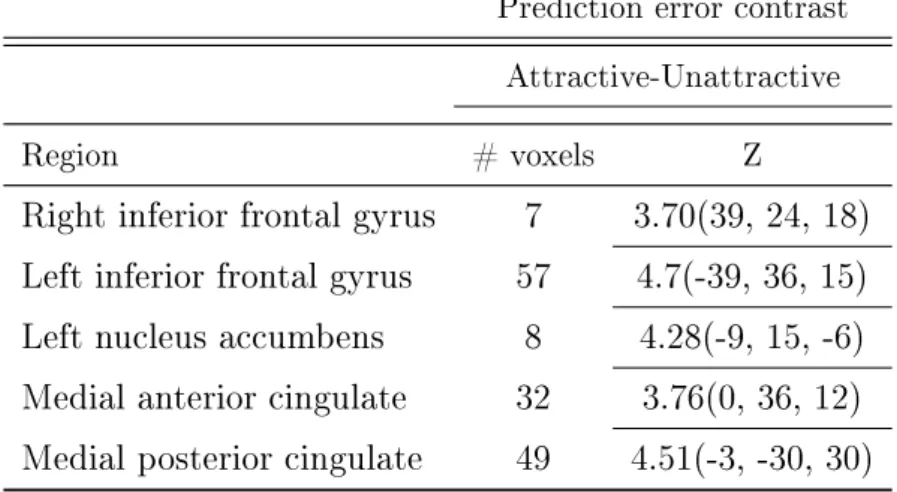
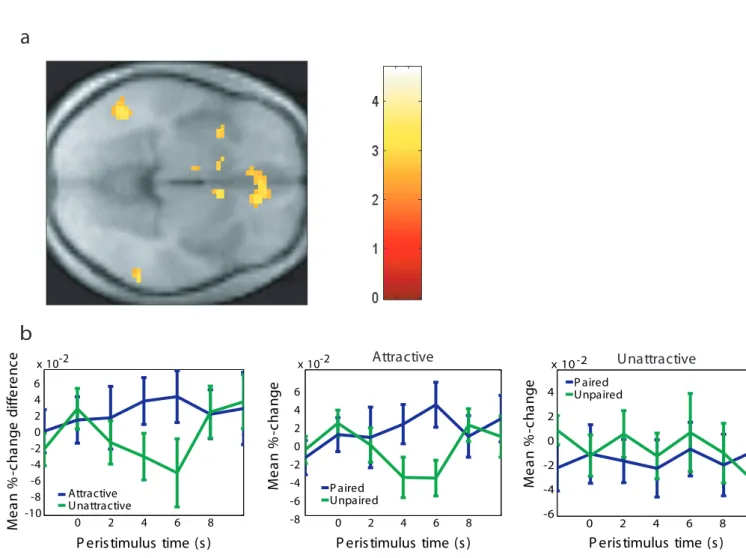
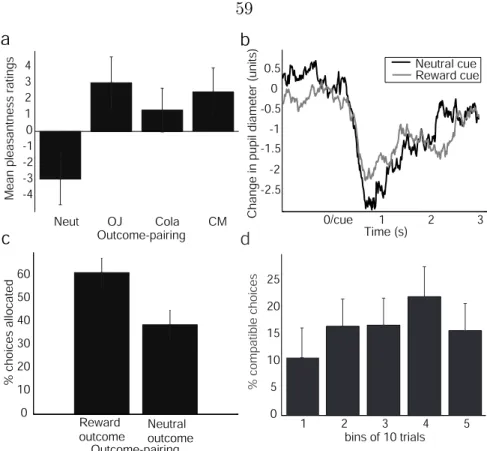
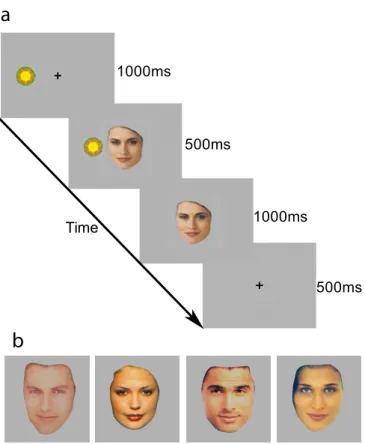
100], in which subjects were trained to elevate and suppress activity in the rACC, a region involved in pain processing. We found significant prediction-error-related activity in the ventral striatum during conditioning with attractive faces compared to unattractive faces. On reinforced CS+ trials, after 1 s a picture of a face appeared in the middle of the screen, next to the fractal.
NAcc activity is in the same region that we found to be responsive to prediction error. Differences in the nature of unconditioned responses produced by different reinforcers could potentially account for differential activity in the striatum. This transfer occurs despite no explicit training of instrumental actions in the presence of Pavlovian cues.
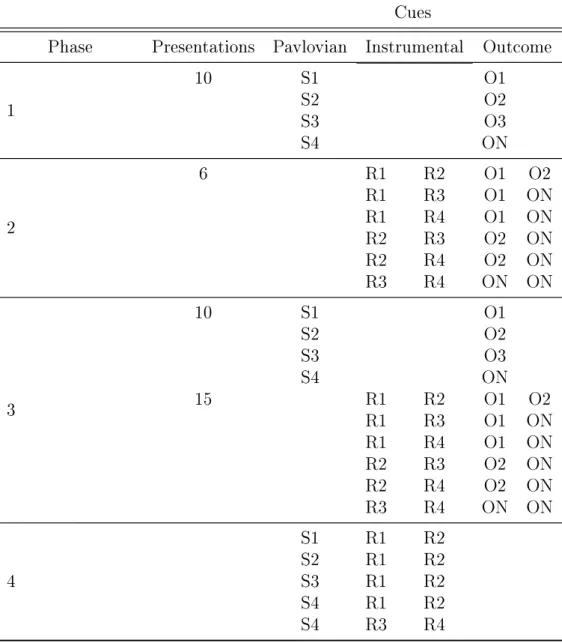
In the first two sessions, Pavlovian and instrumental trials were presented separately to enhance learning of the respective associations. In the present study we explore an alternative approach to modulating neural activity in the standard biofeedback paradigm. The purpose of this study was to determine whether it is possible to use instrumental conditioning techniques to modulate neural activity in the human brain.
Some subjects reported being tired towards the end of the experiment, which could confound learning-related eects in the reaction time analysis. This can be seen from the slopes and divergence of the curves in the upper one. During the last two sessions of the foot-cue condition, neural activity in the foot ROI was also significantly greater in the feedback group than in the control group (t p<0.005).
It is unclear which mental strategy is most effective for increasing activity in the OFC. Missed attempts were indicated with a red X in the center of the screen and there was no change to the running total. In the first two blocks, the points moved outward or inward toward the center of the circle at a rate of 66 pixels/sec.
Post-hoc plots of the animal mOFC-V5 signal showed a sharp decrease in the 4th session.
Summary
Baylis, Gustatory, olfactory, and visual convergence within primate orbitofrontal cortex, Journal of Neuroscience, vol. Yaxley, Hunger modulates responses to gustatory stimuli of single neurons in the caudolateral orbitofrontal cortex of the macaque monkey, European Journal of Neuroscience, vol. McGlone, Representation of pleasant and aversive taste in the human brain, Journal of Neuro-physiology, vol.
Deakin, Diercial response patterns in the striatum and orbitofrontal cortex to financial reward in humans: A parametric functional magnetic resonance imaging study, Journal of Neuroscience, vol. Rangel, The orbitofrontal cortex encodes willingness to pay in everyday economic transactions, Journal of Neuroscience, vol. Bohbot, Impaired preference conditioning after anterior temporal lobe resection in humans, Journal of Neuroscience, vol.
Dolan, Animal coding of losses and gains in the human striatum, Journal of Neuroscience, vol. Schultz, Human neural learning depends on reward prediction errors in the blocking paradigm, Journal of Neurophysiology, vol. Fiez, Monitoring the hemodynamic responses to reward and punishment in the striatum, Journal of Neurophysiology, vol.
Balleine, The role of the nucleus accumbens in instrumental conditioning: Evidence for a functional dissociation between the nucleus accumbens and the shell, Journal of Neuroscience, vol. Johnsrude, Learning to like: a role for the human orbitofrontal cortex in conditioned reward, Journal of Neuroscience, vol. O'Doherty, Direct instrumental conditioning of neural activity using reward feedback derived from functional magnetic resonance imaging, Journal of Neuroscience, vol.
Klein, An experimental study of the mental processes of the rat, American Journal of Psychology, vol. Buchel, Dissociable systems for gain-loss related value predictions and prediction errors in the human brain, Journal of Neuroscience, vol. Frackowiak, Functional anatomy of the mental representation of upper limb movements in healthy subjects, Journal of Neurophysiology, vol.