ATTITUDES TOWARDS PLASTIC SURGERY IN COLLEGE MEN AND WOMEN
by
Margaret Rose Hovan
A thesis submitted to the faculty of The University of Mississippi in partial fulfillment of the requirements of the Sally McDonnell Barksdale Honors College.
Oxford May 2018
Approved by
___________________________________
Advisor: Dr. Elise Lake
___________________________________
Reader: Dr. John Sonnett
___________________________________
Reader: Dr. Kirsten Dellinger
© 2018
Margaret Rose Hovan ALL RIGHTS RESERVED
ii
ACKNOWLEDGMENTS
I would like to thank all of the people who helped and supported me with completing this research project. Firstly, I would like to thank my research advisor Dr.
Elise Lake for guiding me through this stressful process and sticking with me during this unconventional journey. Without you, this thesis would not be in existence and I would not have finished my time with the Sally McDonnell Barksdale Honors College
successfully. I would also like to thank my readers, Dr. Kirsten Dellinger and Dr. John Sonnett, for being part of this project. Thank you all for giving your time and providing advice and suggestions to make this research the best it can possibly be.
I would also like to thank my family for the constant support and motivation that they have given me throughout this stressful experience. Thank you mom for
emphasizing the importance of perseverance in your words and actions. Your support has been an integral part of this project reaching completion.
iii
ABSTRACT
MARGARET ROSE HOVAN: Attitudes towards Plastic Surgery in College Men and Women
(Under the direction of Elise Lake)
The aim of this study is to determine whether exposure to extreme makeover based reality television programs is related to the attitudes of college-aged individuals towards the acceptability of obtaining plastic surgery procedures and how students view plastic surgery itself. Interviews consisting of closed- and open-ended questions
measured the possible influence that exposure to plastic surgery reality television programs, familial experience with plastic surgery and parental attitudes towards plastic surgery, among other factors, have on one’s attitudes towards plastic surgery. The data collected were then entered into Qualtrics and analyzed using Statistical Package for the Social Sciences (SPSS) or coded for common themes to determine significance. This study found that college women have more exposure to plastic surgery reality television programs than college men. Qualitative responses suggest that many college individuals consider having cosmetic surgery private or personal and worry about being judged for having such procedures. The small sample size of the study was limiting in determining the significance of the findings, but analysis revealed many possibilities for future research.
iv
TABLE OF CONTENTS
LIST OF TABLES...v
INTRODUCTION...1
HISTORY OF PLASTIC SURGERY...3
MEDIA EXPOSURE AND BODY IMAGE...6
BODY MODIFICATION AND SOCIETY...9
ATTITDUDES TOWARDS COSMETIC SURGERY IN COLLEGE STUDENTS...13
DATA COLLECTION METHODS...15
METHODS OF ANALYSIS…...22
RESULTS……...23
CONCLUSIONS...48
LIST OF REFERENCES...53
APPENDIX A…………...58
v
LIST OF TABLES
Table 1 Perceived Parental Support for having Plastic Surgery……….19 Table 2 Responses to Questions 16, 17, 18, 19, 20 and 21……….…27 Table 3 Surgical Procedure Consideration of each Gender ………...29 Table 4 Gender and Exposure to Plastic Surgery Reality Television Cross
Tabulation………..33 Table 5 Exposure to Plastic Surgery Reality Television Programs and Attitudes
towards others having Plastic Surgery Cross Tabulation………..35 Table 6 Number of Plastic Surgery Reality Television Shows Viewed. ……...36 Table 7 Cosmetic Surgery can be Beneficial to One's Self-Image………….……38 Table 8 Reasons for Reluctance in telling Family about having Cosmetic
Surgery………...………...…...43 Table 9 Reasons for Reluctance in telling Friends about having Cosmetic
Surgery………...………...43 Table 10 Reasons for Reluctance in telling Strangers about having Cosmetic
Surgery………...………...44 Table 11 Reasons for Eagerness in telling Family about having Cosmetic
Surgery………...………...44 Table 12 Reasons for Eagerness in telling Friends about having Cosmetic
Surgery………...………...45 Table 13 Reasons for Eagerness in telling Strangers about having Cosmetic
Surgery………...
………...45
vi
I. Introduction
In the past few years, there has been an increase in the amount of plastic surgery related content on television. Exposure to programs where individuals alter their appearance by surgical means could possibly have an effect on the attitudes of viewers.
The rise in numbers of this type of television programs suggests that younger generations are the primary viewers (Wegenstein 2012) and that adolescents are particularly
susceptible to body modification because of risk taking tendencies (Rodriguez Cano and Sams 2010). Extreme makeover-based reality television programs present plastic surgery in a format that can potentially desensitize viewers and normalize taboos associated with body modification. In this study, I examine the relationship between exposure to extreme makeover reality television programs and the attitudes of college-aged individuals regarding the acceptability of obtaining plastic surgery procedures and how students view plastic surgery itself. I will investigate the attitudes of male and female college students towards plastic surgery to examine the possibility of positive experiences or reactions as they may be related to exposure to extreme makeover-based reality television programs.
Many studies have attempted to discover the relationship between media exposure and body image and have found that unrealistic images of women in media are associated with body dissatisfaction and body anxieties. Identifying the relationship between
exposure to plastic surgery reality television programs and attitudes about obtaining plastic surgery and plastic surgery as a practice could determine if altered perceptions of plastic surgery lead to individuals pursuing body modification or transformative
procedures. Studies gauging attitudes towards plastic surgery in middle-aged females
have found that media have a primarily direct effect on attitudes towards cosmetic surgery (Slevec and Tiggemann 2010). Other studies examine the attitudes towards cosmetic surgery of college-aged females in relation to objectification theory (Calogero et al. 2010) and societal appearance ideals (Menzel et al. 2011).
Frequent exposure to plastic surgery content in one’s life may desensitize individuals to the risks and taboos associated with having plastic surgery. In the past, plastic surgery was done secretly and rarely every spoken about (Adams 2009). The change in the presentation of plastic surgery in today’s society reveals the transition in cultural norms and may be predictive of accepting attitudes towards plastic surgery. Exposure to plastic surgery, from both the media and other outlets, could possibly influence one’s attitudes towards plastic surgery, so this study will also relate familial experience with plastic surgery and attitudes.
Parental attitudes can be deterministic of attitudes of their children (Henderson-King and Brooks 2009). College students who are between the ages of 18 and 22 are newly out of their parents’ homes and may still be influenced by their parents in decision- making processes and attitude formation, but they are also in the risk-taking stage of their lives (Adams 2009). In this study, I wanted to see if parental attitudes towards plastic surgery are related to their college-aged children’s attitudes because adolescence is a highly variable time in one’s life and may be affected by influences of closely-related individuals.
Many external factors may influence attitudes and I have decided to explore the relationship between the attitudes of college-age men and women and exposure to plastic surgery reality television shows, exposure to plastic surgery from familial experience and
parental attitudes towards plastic surgery. I use both men and women students as respondents because little prior research shows strong relationships between external variables and men’s attitudes towards plastic surgery. Data were collected by conducting interviews that consisted of 35 open- and closed-ended questions from 51 undergraduate students at the University of Mississippi.
II. History of Plastic Surgery
The word plastic as it is used in the phrase plastic surgery is derived from the Greek word “plastikos” meaning to create, shape or form (Cock, 2014). In ancient times, plastic surgery was done for those who received punishment in the form of having their nose cut off. This disfiguration is referred to as a “dishonoring wound” because it commonly occurred to individuals who were sexually promiscuous (Cock, 2014).
Rhinoplasties became more well known when Gaspar Tagliacozzi performed the procedure for individuals in the sixteenth century. Although various reports may say differently, Tagliacozzi stated that he did this procedure for purely reconstructive means (Cock, 2014). Tagliacozzi’s goal was to dignify individuals who had received the shame of this physical sentence.
The erosion of the nose that occurred because of the pox, now referred to as syphilis, is the most well-known example of plastic surgery done for health reasons in the seventeenth century (Cock, 2014). Although the cultural stigmas associated with diseases vary, the need for rhinoplasties to be done for these reasons shows the significance of disease in association with plastic surgery (Cock, 2014). The reputation of individuals who had contracted syphilis was very obvious and physicians who associated with these individuals were morally suspect. Many other surgeons were reluctant to openly do this
procedure for debauched individuals, so that is why advancements in plastic surgery did not occur until wartime injuries sparked a need for such procedures (Cock, 2014).
In “Plastic Surgery History (2005)” Karol Gutowski reviews the short film A Plastic Story: A Short History of Plastic Surgery (2003) directed by Antoine Hurtado Huyssen. In this work, the earliest beginnings of plastic surgery are noted and renowned plastic surgeons provide commentary on important times for this specialty. The first book about plastic surgery was published by Gaspar Tagliacozzi in 1597. The nasal
reconstructions mentioned in this book were done for individuals who lost their nose to trauma or disease. Further work was published in the 1800s and the word rhinoplasty became commonplace. The facial defects that occurred during World War I because of trench warfare gave rise to a new era of plastic surgery. After these surgical procedures were created to reconstruct the faces of soldiers with tragic defects, the first aesthetic procedures emerged. In the 1920s, plastic surgery began to flourish in North America and the first breast reduction and mini-facelift were recorded. The controversies associated with plastic surgery surrounding silicone implants and liposuction for cosmetic means arose in the 1990s and may have contributed to the common beliefs that cosmetic surgery and plastic surgery are the same.
The injuries that resulted from trench warfare gave rise to a new discipline in medicine, reconstructive plastic surgery. Soldiers who fought in trenches had protection from the neck down, but their faces were exposed to the enemy’s fire. Readjusting into society was difficult for these soldiers because of facial disfigurations, so surgeries were created by Sir Harold Gilles and Hippolyte Morestin to reduce the mutilations. Both of these physicians worked primarily with dental surgeons to improve techniques for bone
and skin grafting that were used to repair deformities in the faces and jaws of wounded soldiers. This work happened at the Queen’s Hospital in Sidcup, England, a district of London (Sykes and Bamji, 2010). Work done on soldiers created the field of plastic surgery that was more acceptable to the medical community. Cosmetic or beautification procedures had been attempted before this time, but they were looked down upon because of their frivolous nature.
In the United States, beauty and cosmetic surgery advertisements began in the late twentieth century (Denkler and Hudson, 2015). John H. Woodbury was the first pioneer of cosmetic surgery in the United States and developed many surgical operations in this field (Denkler and Hudson, 2015). Woodbury dedicated his career to fixing and treating facial disfigurements after he had a facial deformity fixed by physicians during his childhood (Denkler and Hudson, 2015). The procedures that Woodbury created and offered at his surgical institutes were those that improved facial imperfections in minor ways. His efforts made the field of plastic surgery innovative and lucrative. Americans’
desires to have these procedures done by Americans made the United States the leader in this field compared to other major countries.
In “A Brief History of Plastic Surgery: A Mural’s Perspective” (2015) by Jose Guerrerosantos, Oscar F. Fernandez-Diaz, and Hiram Fernandez-Diaz, the first mural depicting the history of plastic surgery at the Jalisco Reconstructive Surgery Institute is examined. The plastic surgeon’s hand in the center of the mural is "holding a scalpel, ready to improve and correct wounds or deformities through modeling, creating, or reconstructing” (1018). Reconstructive surgery was the first to emerge in the discipline of plastic surgery, but people now associate cosmetic surgery more commonly with
plastic surgery. Plastic surgery began as a reconstructive field and has transformed into an industry in which frivolousness thrives and individuals can transform themselves if they have the resources to do so (Denkler and Hudson, 2018).
III. Media Exposure and Body Image
Body dissatisfaction has become increasingly common in American girls and young women. A meta-analysis done by Shelley Grabe, L. Monique Ward and Janet Shibey Hyde entitled “The Role of the Media in Body Image Concerns Among Women: A Meta- Analysis of Experimental and Correlational Studies” (2008) examined the relationship between body image concerns and exposure to media that contain images of thin characters and celebrities. The type of media exposure analyzed in this meta-analysis consisted of fashion magazines, television commercials and television programs that were appearance-focused. Repeated exposure to this media content leads individuals to accept these images of women as representations of reality. Normalization of these images leads women to become more dissatisfied with their own bodies due to constant comparison. Analysis of research done shows that women feel worse when exposed to images of thin women as opposed to neutral ones. The number of hours a week
individuals are exposed to newspapers, radio and other media that may contain messages or images related to the thin ideal can be used as an assessment of alternative media exposure. The results of this study found that overall, media exposure is associated with increased levels of body dissatisfaction in women and increased investment in
appearance.
Media-induced body dissatisfaction was examined by Julie Slevec and Marika Tiggemann in “Media Exposure, Body Dissatisfaction and Disordered Eating in Middle-
aged Women” (2011). In this study, one hundred and one women between the ages of thirty-five and fifty-five answered questionnaires that measured media exposure, thin- ideal internalization, social comparison, appearance investment, aging anxiety, body dissatisfaction, and disordered eating. The results showed that television exposure was positively related to body dissatisfaction. Although much of the research done on this topic shows a relationship between media exposure and body dissatisfaction in young women, this study successfully shows that there is a relationship between media exposure and body dissatisfaction in other age groups.
Body image concerns have become normative in Western society. In
“Psychological Functioning, Media Pressure and Body Dissatisfaction among College Women” (2011) by Rodger, Sales and Chabrol, the relationship between media exposure and body dissatisfaction was examined. This article is relevant to my study because it focuses on perceived media pressure to conform to idealized images presented in mass media. Social phobia in combination with media pressure was a significant predictor of body dissatisfaction. This suggests that appearance comparison plays an important role in body dissatisfaction. Individuals who experience social phobias see themselves as lacking in certain areas and are more vulnerable to experience negative feelings and be
influenced by social desirability. This study furthered previous research conducted on media exposure in college-aged females and body image by emphasizing the role that social phobias play into individual dissatisfaction.
In “Body Dissatisfaction and Body Comparison with Media Images in Males and Females” (2007) by Patricia van den Berg et al., body comparison was examined using media images. The authors of this study investigated whether media body comparison
contributed to thin ideal pressures and body dissatisfaction. Participants in this research were males and females who responded to Eating Among Teens, a large epidemiological study that collected information about dietary intake, weight and body image of
adolescents of diverse ethnic backgrounds. Assessment of media body comparison was done by using the Sociocultural Attitudes toward Appearance Questionnaire to see if young individuals compare themselves to celebrities or images of individuals in magazines. Participants were also asked to indicate the frequency with which they watched television or videos weekly. The study concluded that media body comparison is significantly associated with body dissatisfaction in women, but that there is not a
significant relationship between media body comparison and body dissatisfaction in men.
Although men have received less research attention, Nikkelen et al. focused on media influence on body image of males in “Influence of Visual Attention on Male Body Dissatisfaction After Idealized Media Exposure” (2007). Studies have found that men are somewhat dissatisfied with their bodies and prefer bodies that are leaner and
muscular. Negative contrast theory suggests that individuals tend to compare themselves to images in the media and develop negative feeling about their bodies. Contemporary images of men in media show a more muscular body than the bodies of average men and exposure to these images may foster a negative effect on male body dissatisfaction. This study consisted of fifty-seven participants among a student population that ranged from nineteen to thirty-three years of age. The results revealed that media images do not affect all men equally. Some men may be more susceptible to developing body dissatisfaction than others due to media exposure, but overall, body dissatisfaction did not differ between men who had been exposed to neutral media or idealized media content.
An extensive review of 15 studies by Anna Blond entitled “Impacts of Exposure to Images of Ideal Bodies on Male Dissatisfaction: A Review” (2008) explored the effects that advertisements and commercials containing idealized images of men have on male body dissatisfaction. Social comparison theory is used to explain the connection between individual body satisfaction and images shown in media. Overall, the studies had a small positive effect size that suggests that exposure to media showing ideal male bodies has a small significant effect on body dissatisfaction. The accounts of
dissatisfaction all resulted from images presenting athletic male bodies. These images in combination with those containing attractive faces have the greatest influence on male body dissatisfaction. This study suggested that some men think this ideal is attainable and may view these images as a source of inspiration instead of discouragement.
IV. Body Modification and Society
In “Bodies of Change: A Comparative Analysis of Media Representations of Body Modification Practices” (2009), Josh Adams compares representations of cosmetic surgery, tattoos and body piercings in mass media accounts. Media outlets frame issues so that they reinforce normative standards. An increasingly popular subject in the media are topics regarding self-betterment. Content about cosmetic surgery, exercise and diets emphasize cultural beauty ideals and the importance of attractiveness and personal appearance. This practice has led to the assimilation of cosmetic surgery into mainstream culture. The frame in which cosmetic surgery is currently presented in the media suggest that it is accessible for everyone, but in the past these procedures were luxuries reserved for the rich. Newspaper analysis revealed that cosmetic surgery has a higher degree of social legitimacy in comparison to other body modification practices.
The current way that cosmetic surgery is presented in the media omits many of the real issues associated with surgery and the postsurgical recovery process. This analysis also showed that media coverage of cosmetic surgery is highly gendered and is directed primarily towards female viewers and readers. The presence of men and women in newspaper articles regarding cosmetic surgery differs in the rationales that individuals must give for having such procedures. Men having cosmetic procedures must have rational justification for doing so unless they want to be seen as feminine or vain.
Cosmetic surgery is a way for men to adapt in workplaces that are full of young individuals so that they do not fall behind or get forgotten. The justification of
maintaining a specific appearance to stay relevant in the workplace makes getting plastic surgery acceptable for men. Regardless of gender, cosmetic surgery is presented in the media as a way to maintain a youthful appearance and stay relevant in a society where energy often trumps experience.
The current presentation of race in cosmetic surgery media content is focused on the idea that certain procedures are associated with certain ethnic groups. Individuals of certain races may not necessarily be trying to look “white” when they have certain procedures done. Goals of individuals are related to social or cultural acceptance and identification with a dominant racial or ethnic group or white-centered aesthetic standard.
Prevalence of the words beauty, youth and ideal show that individuals of any race or gender obtain plastic surgery to look better and thrive in a society obsessed with physical appearance. The aesthetic expectations of our culture are framed by mass media and the attitudes that individuals have about cosmetic surgery play an important part in the increasing popularity of certain body modification practices in today’s society. The
positive transformative experiences shown in some mass media regarding cosmetic surgery have attempted to de-gender these practices, legitimize them socially and popularize them in our culture (Adams 2009).
“Body Modifications and Young Adults: Predictors of Intentions to Engage in Future Body Modification” (2010) by Cynthia Rodriguez Cano and Doreen Sams examined the likelihood that college students who have already engaged in body modification will do so again. Body modification is a way for young adults to express control over their bodies and identities. Individual’s identities are created and change as the world changes around them. Those who alter their bodies through modification nonverbally communicate their identity to others and express their group affiliations and other relationships. Cultural experiences can be influenced by the generational status and age of individuals and the decisions that those individuals make at different stages in life. This study consisted of a sample size of 454 college students and seventy-seven percent of the participants had engaged in some kind of body modification and intend to continue plastic surgery and tattoos in large numbers in the future. This study showed a strong positive relationship between previous and future likelihood to pursue body modifications and suggests that attitudes and perceptions change as self-expression does. College students are more likely to engage in body modification because younger individuals tend to be vain and
impulsive (Rodriguez Cano and Sams 2010).
The emergence of plastic surgery reality television and television reality makeover shows has created a culture that focuses on the cosmetic gaze, “the search for the younger more productive sexual self “(Wegenstein 2012), and targets assumptions, desires and images of audiences who want to have transformative experiences themselves. In The
Cosmetic Gaze, Bernadette Wegenstein talks about the normalization techniques that are used to make body modification and self-adjustment part of popular culture. Wegestein argues that watching these transformative experiences on television makes body and body image one. Determining beauty and understanding beauty standards in our society has contributed to this wave of presenting body modification on a public stage.
Individuals who begin their transformative experience as average or beautiful can become beautiful or really beautiful with plastic surgery. Current statistics show that the age of individuals who are undergo cosmetic procedures has gotten younger. “In the United States in 2006, 16,477 rhinoplasties, 7,915 Botox injections, and 5,423
Hylaform/Restylane injections were performed on adolescents who were eighteen years and younger” (113). Wegestein attributes this to the quick fix mentality of younger generations and the celebrity culture that is prominent in everyday life.
Part of celebrity culture includes the new wave of reality television celebrities who arose with the reality TV revolution of the early two-thousands. Viewers watch these programs and see “real people” with whom they can identify. People in cosmetic surgery reality television programs show others that real bodies can be media bodies and present plastic surgery as accessible to all. The increase of these programs since their inception has contributed to the increase in cosmetic surgery done in the United States. The increased media coverage of this topic has exposed individuals to a culture that could alter one’s perception of physical attractiveness, body image and the practice of plastic surgery. Wegestein conducted an in-study in Buffalo, New York and Los Angeles, California (2004, 2005, 2006) of college-aged females and males about viewing patterns of The Swan (Fox) and I Want a Famous Face (MTV). The results showed that Buffalo
students watch these shows more and exhibit more beauty anxiety than students in Los Angeles. Women were generally more likely to watch the shows than men and to feel increased body anxiety. The reality television market has created a vicious cycle where individuals who watch feel anxious and those who feel anxious watch. Body modification has become normalized in today’s society because of the media exposure and the way that plastic surgery procedures are presented.
V. Attitudes towards Cosmetic Surgery in College Students
Studies have examined college women’s attitudes towards cosmetic surgery because cosmetic surgery is culturally and socially viewed as a gendered activity (Henderson- King and Brooks 2009). The experiences that women have with their bodies are subject to objectification and lead to participation in activities that enhance physical appearance.
Some of the pressures women feel to monitor and alter their bodies come from media conglomerates, corporations, celebrities and techniques that support unrealistic beauty standards of today’s society. In “Materialism, Sociocultural Appearance Messages, and Paternal Attitudes Predict College Women’s Attitudes about Cosmetic Surgery” (2009) by Henderson-King and Brooks, a positive relationship between internalization of social standards and acceptance of cosmetic surgery procedures was identified. Women who accept sociocultural messages about beauty and attractiveness are more likely to consider cosmetic surgery procedures and desire a larger number of such procedures. This study also found that familial attitudes towards plastic surgery are deterministic for one’s acceptance of cosmetic surgery, but that friends’ attitudes were not predictive of individual attitudes. This study used the Acceptance of Cosmetic Surgery scale
(Henderson-King and Henderson King 2005) and the results further validated this test.
Investigation of attitudes towards cosmetic surgery using objectification theory was done by Calogero et al. in “Objectification Theory Predicts College Women’s Attitudes Toward Cosmetic Surgery” (2010). Experiencing sexual objectification and body shaming by others is predictive of one having plastic surgery and suggests that women reflect on sociocultural expectations of attractiveness and beauty heavily. Objectification theory is demonstrated in interpersonal and social encounters and in media content that focuses on women’s bodies. This study found that the frequencies of experiences with sexual objectification and body shame were predictors of giving social reasons for accepting cosmetic surgery. This suggests that social evaluations of women are a driving force in the increased number of cosmetic procedures done and the greater acceptability of plastic surgery for this gender. Interpersonal and intrapersonal variables like negative body image, appearance-based self-esteem and body anxiety are linked to people’s attitudes towards cosmetic surgery and reveal deeper reasoning for acceptance of this once-controversial practice.
A study done in Florida on college men and women by Menzel et al. entitled
“Internalization of Appearance Ideals and Cosmetic Surgery Attitudes: A Test of the Tripartite Influence Model of Body Image” (2011) examined the role of body
satisfaction, pressure to have cosmetic surgery and social appearance ideals
internalization in relation to cosmetic surgery attitudes. The distribution of males and females was not equal in this study and had a 20 percent male to 80 percent female ratio.
This study attempted to detect the level of body image concerns in men and to further understand formative influences of attitudes towards cosmetic surgery by using the Tripartite Influence Model of Body Image. This model examines the relationship between
eating disorders and body dissatisfaction by focusing on social comparison,
internalization of appearance ideals and sociocultural influences. This study found an interesting difference between how social pressures operate on each gender and relate to male and female cosmetic surgery attitudes. Body dissatisfaction has a strong association with accepting attitudes towards cosmetic surgery in males. Females, however,
experience social pressures that cause internalization of beauty ideals and that internalization is associated with positive cosmetic surgery attitudes. This work still claims that there are many paths for future research to be done in exploring college male attitudes towards cosmetic surgery and supports other findings regarding the attitudes towards cosmetic surgery in college females.
VI. Data Collection Methods
For my study, I conducted interviews of college students over the course of one week at the University of Mississippi, using the second floor study room of Burns Hall.
Participants of this study had to be currently enrolled undergraduates at the University of Mississippi between the ages of eighteen and twenty-two. This study population was selected because previous research done on this topic suggests that college students are more likely to consider body modification procedures like plastic surgery (Rodriguez Cano and Sams 2010) and are the main audience of extreme makeover or plastic surgery reality television shows (Wegenstein 2012).
The data collected consists of responses from fifty-one participants. Questions at the end of the interview collected demographic information about age, gender and race and ethnicity of the participants. Participants were primarily from the United States, but four of the participants were international students who are currently enrolled at the University
of Mississippi. Ten of the participants were 18 years of age, eighteen participants were 19 years of age, seven were 20 years of age, nine were 21 years of age and seven were 22 years of age. Of the fifty-one participants, twenty-five identified as female, twenty-five identified as male and one identified as transgender female. In my analyses I included only data from respondents who identified as male or female, as I was uncertain whether the responses of the transgender woman might have been affected by her unique status as a transgender individual in a heteronormative society. Even numbers of interviews from male and females were conducted so that the collective responses of each gender could be compared equally. Twenty-seven of the participants identified as white, seventeen
identified as black or African American, five identified as Asian or Pacific Islander, one identified as Biracial and one identified as other.
The non-random convenience sample consisted of participants that were recruited by word-of-mouth. Initial participants were individuals whom I contacted because of common classes or other regular interactions. Those individuals then told friends and others whom they thought may enjoy participating. To ensure that the desired age category was maintained, I specifically requested that participants encourage current undergraduate students to volunteer. I was the sole interviewer.
The 35 question interview used for data collection consisted of both closed- and open-ended questions. The interview and procedures for this study were approved by IRB as Exempt under 45 CF 46.101(b) (#2). I started the interviews by telling participants about my interest in this topic and giving a brief overview of the differences between reconstructive plastic surgery. Most interviews lasted about fifteen minutes, but some participants took additional time. No interview lasted more than thirty minutes. The
majority of the questions used were modified or directly drawn from the Acceptance of Cosmetic Surgery Scale (ACSS) (Henderson-King and Henderson-King 2005) and the Cosmetic Surgery Attitudes Questionnaire (CSAQ) (Sarwer et al. 2005), and used five- point response scales beginning with strongly agree and ending in strongly disagree.
Questions that were not drawn from these instruments were created by me with the assistance of my research advisor. All interview questions can be found can be found in Appendix A.
The interview instrument assessed three key independent variables among other variables. Research participants were first asked about family history regarding plastic surgery (“As far as you know, has anyone in your family gotten plastic surgery?”). This variable was measured because previous exposure to plastic surgery that is not media content may be a predictor of certain attitudes towards plastic surgery. Individuals with family members who have had positive experiences with plastic surgery might have the tendency to have positive attitudes towards plastic surgery. Those who have family members who have had negative plastic surgery procedures might have negative feelings towards the plastic surgery practice and have anxieties when considering such procedures themselves. Responses to this question showed that half of the participants did know a family member that had plastic surgery and the other half did not.
The second and third key questions in the interview are related to how likely
individuals are to give advice to others about getting plastic surgery. Speaking to others about a topic may reveal one’s opinions and attitudes about that topic. Questions sixteen through twenty-one are associated with talking about having cosmetic procedures to family, friends and strangers and were followed up with “why?” to obtain qualitative
data. Reluctance and eagerness were used in these questions because they represent extremes and can provide information that reveals a dramatic difference in behavior that is related to one’s attitudes towards plastic surgery. Differentiating between family, friends, and strangers may reveal privacy concerns regarding plastic surgery.
To determine exposure to plastic surgery reality television programs, individuals were asked about their familiarity with these programs (“How familiar are you with plastic surgery reality television shows?”) and had response options that gauged the exposure (“not familiar, never heard of them,” “not very familiar, may have heard of them,” “have heard of it, never seen them,” “familiar, occasionally watch them” or “very familiar, regularly watch them”). This independent variable is of interest because of the possible relationship between repeated exposure to content and desensitization of taboo body modification practices. Twenty-five participants answered with “familiar, occasionally watch them” response. The distribution of participant responses can be viewed in Figure 1. A follow up question identifying what reality shows this age category watched was used to see if individuals who watch this content favor similar programs or have seen some of the original shows of this genre.
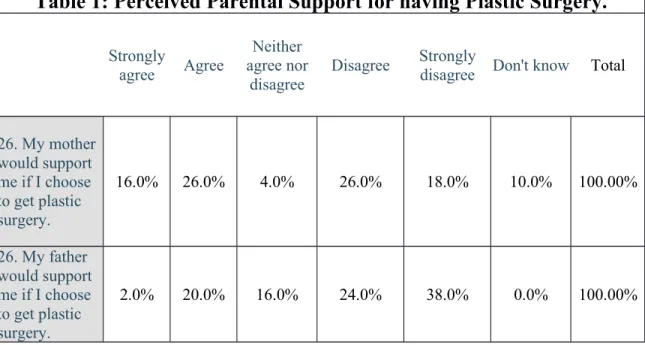
Parental attitudes towards plastic surgery were measured in questions twenty-five and twenty-six by asking participants how supportive their mother or father would be if they decided to have plastic surgery. These questions were asked towards the end of the interview and are present to explore the relationship that familial expectations and attitudes towards plastic surgery have with each participant’s attitudes. The responses to these questions were varied and can be viewed in Table 1. This independent variable is an important measure because pressures or influence of close individuals could relate to one’s attitudes towards plastic surgery. Question twenty-seven is also associated with influence but is focused on how participants think their friends’ attitudes are influenced by plastic surgery related media content. One cannot assume that individuals who are close to one another share common attitudes, but this question was included to determine the prevalence of surgery acceptance and rejection within the respondents’ friend groups.
Table 1: Perceived Parental Support for having Plastic Surgery.
Strongly
agree Agree
Neither agree nor
disagree
Disagree Strongly
disagree Don't know Total
26. My mother would support me if I choose to get plastic surgery.
16.0% 26.0% 4.0% 26.0% 18.0% 10.0% 100.00%
26. My father would support me if I choose to get plastic surgery.
2.0% 20.0% 16.0% 24.0% 38.0% 0.0% 100.00%
Questions seven, eight and nine are related to acceptability of having plastic surgery among closely-related individuals to the participant. Cosmetic surgery is something that may be acceptable for some and not others. Acceptability of plastic surgery practices is related to many outside influences and investigating how acceptable one sees plastic surgery for their peers, family and group members may indicate individual attitudes towards plastic surgery. Gauging acceptance of approval in obtaining plastic surgery among family, friends and other community members may reveal one’s own attitudes towards plastic surgery and may also indicate the perceptions regarding plastic surgery in one’s common environments.
Questions ten, eleven and twelve were used to relate financial predicaments or expectations to one’s attitudes towards plastic surgery. Attitudes may be affected by one’s financial situation or whether respondents see plastic surgery as frivolous or unnecessary. These questions were drawn from the CSAQ (Sarwer et al. 2005) and the ACSS (Henderson-King and Henderson-King 2005) and were used because previous studies showed that financial considerations have little impact on women’s interest in cosmetic surgery (Sarwer et al. 2005). The relationship of finances and plastic surgery is of interest because money is required to have these procedures and accessibility may be predictive of one’s attitudes towards this practice.
Level of medical risk of reconstructive and cosmetic surgical procedures was identified through questions fourteen and fifteen. These questions were created to see if individuals differentiate the level of medical risk associated with procedures done in the same field but for different reasons. Responses in this category also relate to possible fears that individuals have regarding hospitals, physicians and other medical practices
that could affect their attitudes towards plastic surgery. Cosmetic surgery is what is typically associated with plastic surgery, although reconstructive procedures were what initiated this field of medicine. Question four was also measured to determine if
individuals view plastic surgery only as an enhancing practice. This mentality may be predictive of one’s attitudes towards plastic surgery.
Question thirteen was used to determine what cosmetic procedures participants would consider getting. The responses from this question and questions twenty-nine, thirty and thirty-one which are from the ACSS (Henderson-King and Henderson-King 2005) and CASQ (Sarwer et al. 2005) are related to the seriousness with which participants have considered getting cosmetic surgery procedures. Communication of plans with others may reveal body dissatisfaction and indicate how societal appearance ideals put thoughts into action. Question twenty-eight identifies how often individuals speak to others about their plans of having cosmetic work done and relates to the how increased acceptability of plastic surgery has made it a normative practice and topic of conversation.
Desirability in relation to attitudes towards plastic surgery was measured using questions twenty-two, twenty-three and twenty-four. Partner acceptance and support is examined by asking individuals if they would modify themselves if their partner wanted them to get plastic surgery or thought it was a good idea and if they would support a partner who wanted to get plastic surgery. Responses in this category are related to the pressures that individuals face regarding physical attractiveness and the desire to please others. Accepting attitudes towards cosmetic surgery is measured in this set of questions by relating the likelihood to change oneself for love and altering personal attitudes for
love. Desires to be attractive and have success in relationships relate to large social pressures that may predict attitudes towards plastic surgery.
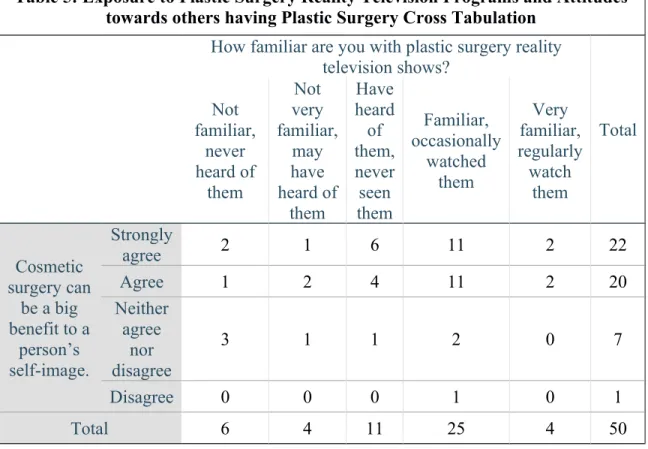
Question thirty-two was used from the ACSS (Henderson-King and Henderson-King 2005) and assesses the transformative experience that may occur to individuals who pursue cosmetic surgery. The idea of cosmetic surgery being beneficial to a person’s self- image, not necessarily one’s own self-image, examines the attitudes that one has towards others getting cosmetic surgery. Responses to this question reveal broader social attitudes towards plastic surgery and could be related to how extreme makeover or plastic surgery reality television programs present cosmetic surgery as a positive transformation.
The final three questions of the interview assessed the age, gender, and race or
ethnicity of each participant. Obtaining this information is important because comparison of attitudes towards plastic surgery between genders, age groups and racial or ethnic groups is indicative of how social pressures manifest differently for diverse individuals.
VII. Methods of Analysis
Information collected from interviews was originally recorded on paper.
Quantitative data were entered into Qualitrics, a web-based survey tool that can be used for data collection, and qualitative responses from questions sixteen through twenty-one were entered into a Word document. Initial analysis of quantitative data was done by using the Results and Reports tabs on Qualtrics. These data were then exported in to Statistical Package for the Social Sciences (SPSS) software to conduct more detailed analysis. The data from the three independent variables, exposure, previous experience and parental influence, were cross-tabulated with other factors to determine the
relationships, if any, between these factors and attitudes towards plastic surgery.
A grounded coding scheme was used to analyze the qualitative data collected.
After data were entered into a single document, I looked for common themes, code words, and phrases. The words “privacy” and “judgment” as well as the phrases
“personal matter” and “it’s none of their business” were used to gauge attitudes towards plastic surgery that are related to social acceptance. Words and phrases that indicated embracing having cosmetic surgery were common, but for varying reasons.
VIII. Results
Half of the participants knew of a family member that had plastic surgery and half did not. When asked if they would advise a family member who was unsure about getting plastic surgery, 26 percent of participants responded with “it depends,” 42 percent of participants responded with yes and 32 percent of participants responded with no. Table 2 contains the advice that respondents that said yes would give and Table 3 contains the advice that the “it depends” respondents would give to a family member who was unsure about having plastic surgery. The advice from the individuals that said yes was
encouraging and cautionary. Three participants responded with questions they would ask to the unsure family member, “why are you doing this?”, “what are the benefits?,” “will you go against your wishes later?,” “why do you feel like you need it?,” “do you feel like it would make you feel better?,” and “will you regret it later?.”. Other advice was “do what will make you happy,” “do what you want,” and “get it if you want it.”. The advice from the “it depends” respondents consisted of support for reconstructive means and health issues. Participants responded with “For reconstructive means, I would support them.,” “If it is associated with a health risk, then I would support them.,” “If it is for
health reasons, yes I would endorse it, but otherwise, I would not.,” and “If it was for reconstructive means, I would say do it. Otherwise, I don’t feel like it is my place.”
In response to the statement “People who get plastic surgery only do so for cosmetic reasons,” 4 percent of participants selected agree, 10 percent selected neither agree nor disagree, 48 percent selected disagree and 38 percent selected strongly disagree. This suggests that participants are aware of the two types of plastic surgery and do not see plastic surgery through a purely cosmetic lens. Six participants (12%) were not familiar, 4 participants (8%) were not very familiar, 11 participants (22%) were somewhat
familiar, 25 participants (50%) were familiar and 4 participants (8%) were very familiar with plastic surgery reality television programs. Over half of the participants occasionally or regularly watch plastic surgery reality television programs. This reveals a high level of exposure in this sample population.
Regarding social acceptability of their friends obtaining plastic surgery, 14 percent of participants selected strongly agree, 52 percent selected agree, 18 percent selected neither agree nor disagree and 16 percent selected disagree. Over half of participants believe that having plastic surgery is socially acceptable for their friends. Regarding social
acceptability of their family obtaining plastic surgery, 14 percent of participants selected strongly agree, 36 percent selected agree, 26 percent selected neither agree nor disagree, 20 percent selected disagree and 4 percent selected strongly disagree. The responses to this question showed that half of participants think it is socially acceptable for their family members to have plastic surgery, but the other half were unsure or disagree.
Regarding social acceptability of members of their community obtaining plastic surgery, 6 participants (12%) selected strongly agree, 23 participants (46%) selected agree, 16
participants (32%) selected neither agree nor disagree, 4 participants (8%) selected disagree and 1 participant (2%) selected strongly disagree in response to getting plastic surgery being socially acceptable for members of their community. These responses show that individuals think that have the smallest number of negative attitudes towards
members of their community having plastic surgery.
Fifty-four percent of participants disagreed and 46% agreed when asked “If I could have a surgical procedure done for free, I would consider trying cosmetic surgery.” This suggests that if money were not an option when considering having plastic surgery, individuals would still not choose to try plastic surgery. Twenty-seven participants disagreed, 19 agreed and 4 didn’t know if they could have cosmetic surgery if they had an unlimited amount of money. These responses also show that the majority of
participants would not have cosmetic surgery if money were not a problem. Figure 2 shows the distribution of responses for “I think plastic surgery is a waste of money.”
Although more than half of participants would not consider having cosmetic surgery if they could get a cosmetic procedure done for free or if they had an unlimited amount of money, over half of participants do not think that plastic surgery is a waste of money.
28 14
8
Figure 2: I think cosmetic surgery is a waste of money.
Agree
Disagree
Twenty-eight percent of participant associate a high level of medical risk with cosmetic plastic surgery, 58 percent associate a moderate level, 12 percent associate a low level and 2 percent did not know what level of medical risk. Forty-six percent of participants associate a high level of medical risk with reconstructive plastic surgery, 36 percent associate a moderate level of risk, 16 percent associate a low level of risk and 2 percent of participants did not know what level of medical risk to associate with having reconstructive plastic surgery. The responses to these questions show that most
participants associate a high or moderate level of risk with both reconstructive and cosmetic plastic surgery.
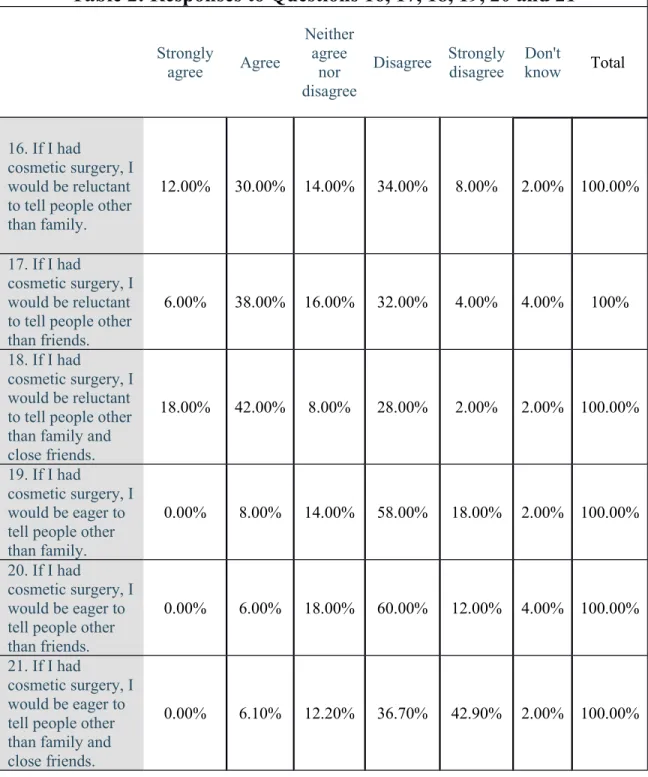
Responses to questions 16 through 21 can be viewed in Table 2. The results
regarding reluctance in talking to others about having cosmetic surgery were varied and almost the same when considering family and friends, but respondents were somewhat more reluctant to discuss such surgery with people who were not close friends. This suggests that many individuals would be reluctant telling strangers about having cosmetic work done, but not all are reluctant about telling their family and friends. Individuals that are closely to participants may understand the person’s reasoning for having cosmetic work done or be accepting of the participant’s decisions in general. The results reveal that very few individuals are eager about talking to family, friends and others about having cosmetic surgery which suggests that getting cosmetic surgery may not be widely socially accepted. Participants would not want to talk about having cosmetic work eagerly with any individuals they may interact with in their life.
Table 2: Responses to Questions 16, 17, 18, 19, 20 and 21
Strongly
agree Agree
Neither agree
nor disagree
Disagree Strongly disagree
Don't
know Total
16. If I had cosmetic surgery, I would be reluctant to tell people other than family.
12.00% 30.00% 14.00% 34.00% 8.00% 2.00% 100.00%
17. If I had cosmetic surgery, I would be reluctant to tell people other than friends.
6.00% 38.00% 16.00% 32.00% 4.00% 4.00% 100%
18. If I had cosmetic surgery, I would be reluctant to tell people other than family and close friends.
18.00% 42.00% 8.00% 28.00% 2.00% 2.00% 100.00%
19. If I had cosmetic surgery, I would be eager to tell people other than family.
0.00% 8.00% 14.00% 58.00% 18.00% 2.00% 100.00%
20. If I had cosmetic surgery, I would be eager to tell people other than friends.
0.00% 6.00% 18.00% 60.00% 12.00% 4.00% 100.00%
21. If I had cosmetic surgery, I would be eager to tell people other than family and close friends.
0.00% 6.10% 12.20% 36.70% 42.90% 2.00% 100.00%
Six percent of participants strongly agree, 8 percent agree, 4 percent neither agree nor disagree, 32 percent disagree and 50 percent strongly disagree about seriously
considering plastic surgery if they thought their partner would find them more attractive.
This shows that individuals are strongly opposed to changing their appearance or having plastic surgery to please others. When asked if they would consider having cosmetic surgery if their partner though it was a good idea, 4 percent of participants responded strongly agree, 18 percent responded agree, 12 percent responded neither agree nor disagree, 30 percent responded disagree, 32 percent responded strongly disagree and 4 percent responded don’t know. The responses to this question show that over sixty percent of participants would not get cosmetic surgery if their partner thought it was a good idea. When asked if they would support a partner’s decision to get plastic surgery, 26 percent of participants selected strongly agree, 44 percent selected agree, 20 percent selected neither agree nor disagree, 6 percent selected disagree, 2 percent selected strongly disagree and 2 percent selected don’t know. Overall, participants would be supportive of a partner’s decision to get plastic surgery. The breakdown of men’s and women’s consideration of getting specific procedures is in Table 3.
Table 3: Surgical Procedure Consideration of each Gender.
Total
Men Women
"What cosmetic procedures would
you consider getting?"
None 75% 25% 100%
Rhinoplasty 0% 100% 100%
Breast augmentation 0% 100% 100%
Breast reduction 13% 88% 100%
Face lift 0% 100% 100%
Abdominoplasty
(tummy tuck) 27% 73% 100%
Liposuction 29% 71% 100%
Other 25% 75% 100%
Total 100% 100% 100%
When asked how much influence cosmetic surgery related content in the media has on friends’ attitudes towards towards plastic surgery, 18 percent said high influence, 46 percent said moderate influence, 20 percent said low influence, 14 percent said no influence and 2 percent said didn’t know. This suggests that most participants think that their friends’ attitudes towards plastic surgery are highly and moderately influenced by cosmetic surgery related content in the media. Regarding how often they do talk to others about having cosmetic work done, 2 percent of participants said very often, 10 percent said often, 36 percent said sometimes and 52 percent said never. This distribution shows that may individuals would not talk to others about having cosmetic work done, but does not reveal if they think about it.
When asked about their future possibility of having cosmetic surgery, 7
participants responded strongly agree, 8 responded agree, 18 responded neither agree nor disagree, 14 responded disagree and 4 responded strongly disagree. The majority of participants are unsure about their future possibility of having plastic surgery. When asked if they have thought about having cosmetic surgery, 14 percent of participants said strongly agree, 24 percent said agree, 2 percent said neither agree nor disagree, 22 percent said disagree and 38 percent said strongly disagree. Over 50 percent of
participants have not thought about having cosmetic surgery, but around 40 percent have.
This suggests that individuals of a younger age are considering having cosmetic surgery;
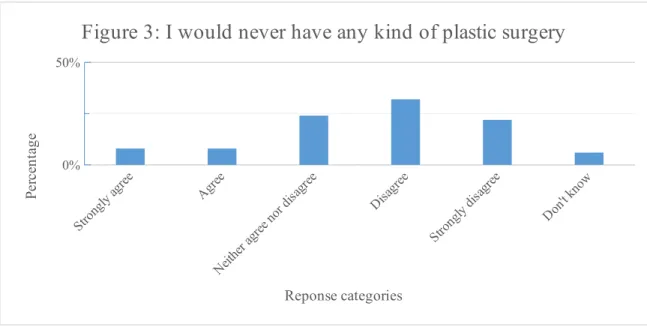
it is not a practice limited to a different age group. Response distribution for “I would never have any kind of plastic surgery” is in Figure 3. The majority of participants in this study disagreed or strongly disagreed about never having plastic surgery. The
clarification made before the interview explaining the differences between reconstructive and plastic surgery could have affected the responses to this question. Several
participants commented that plastic surgery included reconstructive surgery before answering this question and remarked that they could not know if they would need reconstructive surgery in the future. Those responses suggest that this question could be heavily influenced by future possibilities of experiencing disease and trauma.
Strongly agree
Agree
Neither agree nor disagree
Disagree
Strongly disagree
Don't know 0%
50%
Figure 3: I would never have any kind of plastic surgery
Reponse categories
Percentage
I used chi-square tests to examine differences between women’s and men’s responses to questions regarding social understanding, social acceptability, financial
considerations, risk associated with reconstructive and cosmetic surgery, eagerness or reluctance in talking to others about having cosmetic surgery, social desirability, parental attitudes, media influence towards friends’ attitudes, consideration about having cosmetic or plastic surgery. The relationship between gender and social acceptability of friends getting plastic surgery was significantly significant (p=0.02) and can be attributed to younger individuals thinking plastic surgery is acceptable for individuals of their generation. Understanding of friends’ reasoning and desires for getting plastic surgery could also contribute to the relatedness of these variables. Several chi square values calculated regarding consideration of having plastic surgery and gender had statistically significant relatedness. Frequency with which one talks to others about their plans for having plastic surgery (p=0.007), consideration of having plastic surgery in the future (p=0.003) and never having plastic surgery (p=0.012) were significantly related to gender
and possibly reveal how often each gender talks about and thinks about having plastic surgery. Women feel more pressure from society to maintain body ideals and are more likely to pursue plastic surgery in the future (Wegenstein 2012). Although the results of this tests do not show the nature of the relationship, more research could be done to see if consideration about getting plastic surgery differs between genders.
The relationship between gender and exposure to plastic surgery reality television programs was analyzed first using the cross-tabulation and chi-square tests in SPSS.
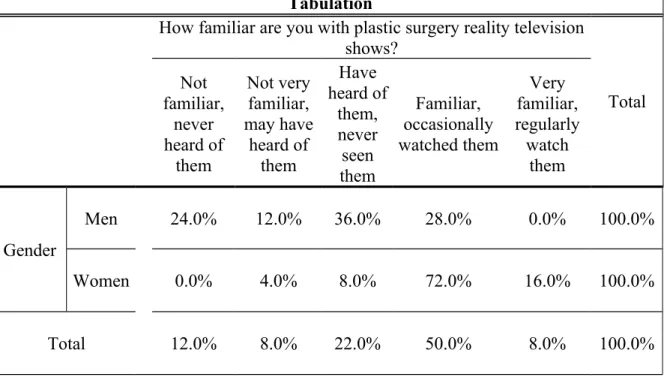
Cross tabulations are used to compare the relationship between two variables. Results of cross tabulation between gender and familiarity or exposure to plastic surgery reality television programs are shown in Table 7. The chi square test determined that there was a statistically significant p value (p=0.01) and that one gender is more likely to be familiar, or have greater exposure to plastic surgery reality television programs than the other. This information supports the findings of the study done in The Cosmetic Gaze that found that women are more likely to watch plastic surgery reality television programs than men. A Cramer’s V test was also used to determine the strength of the relationship between gender and exposure. The value calculated was 0.637 which reveals a strong relationship between the two variables.
The results from the cross tabulation done relating gender and exposure were expected. College-aged women have higher levels of exposure to plastic surgery reality television programs that college-aged men do (Table 3). This suggests that once college- aged women see commercials or advertisements for and watch this television programs, they continue to do so. Familiarity with programs identifies continuous and repeated exposure that could have a desensitizing effect regarding plastic surgery as a practice and create desires of getting plastic surgery in college-aged women. Thirty-six percent, the largest response group, of men said that they had heard of plastic surgery reality television shows but have never watched them. This suggests that men have had opportunities to watch these programs and become exposed to this content, but have chosen not to.
Table 4: Gender and Exposure to Plastic Surgery Reality Television Cross Tabulation
How familiar are you with plastic surgery reality television shows?
Total Not
familiar, never heard of
them
Not very familiar, may have
heard of them
Have heard of
them, never seen them
Familiar, occasionally watched them
Very familiar, regularly watch
them
Gender
Men 24.0% 12.0% 36.0% 28.0% 0.0% 100.0%
Women 0.0% 4.0% 8.0% 72.0% 16.0% 100.0%
Total 12.0% 8.0% 22.0% 50.0% 8.0% 100.0%
Results of chi square testing show statistically significant relatedness between exposure to plastic surgery reality television programs and never getting plastic surgery (p=0.046). Although statistically significant results were not found after completing the chi square tests regarding exposure, a statistically significant relationship was found between exposure to plastic surgery reality television programs and attitudes about never getting plastic surgery. The chi square value does not determine anything about the relationship, other than its presence, but one could suggest that exposure to reality surgery plastic television programs presents plastic surgery in a way that makes viewers open-minded about getting plastic surgery in the future.
Table 5 presents a cross tabulation between the exposure to plastic surgery reality television programs and attitudes towards others have cosmetic surgery. Chi-square test did not show a relationship between these two variables, but the presentation of this table shows that the individuals who are most exposed to plastic surgery reality television programs have positive attitudes towards others having plastic surgery. Individuals who are not frequently exposed to plastic surgery reality television programs selected strongly agree or agree in response to “Cosmetic surgery can be a big benefit to a person’s self- image,.” but did so in smaller numbers. This suggests that exposure may have an influence on the attitudes towards plastic surgery in college-aged men and women.
Table 5: Exposure to Plastic Surgery Reality Television Programs and Attitudes towards others having Plastic Surgery Cross Tabulation
How familiar are you with plastic surgery reality television shows?
Total Not
familiar, never heard of
them
Not very familiar,
may have heard of
them
Have heard of them, never seen them
Familiar, occasionally
watched them
Very familiar, regularly
watch them
Cosmetic surgery can
be a big benefit to a
person’s self-image.
Strongly
agree 2 1 6 11 2 22
Agree 1 2 4 11 2 20
Neither agree
nor disagree
3 1 1 2 0 7
Disagree 0 0 0 1 0 1
Total 6 4 11 25 4 50
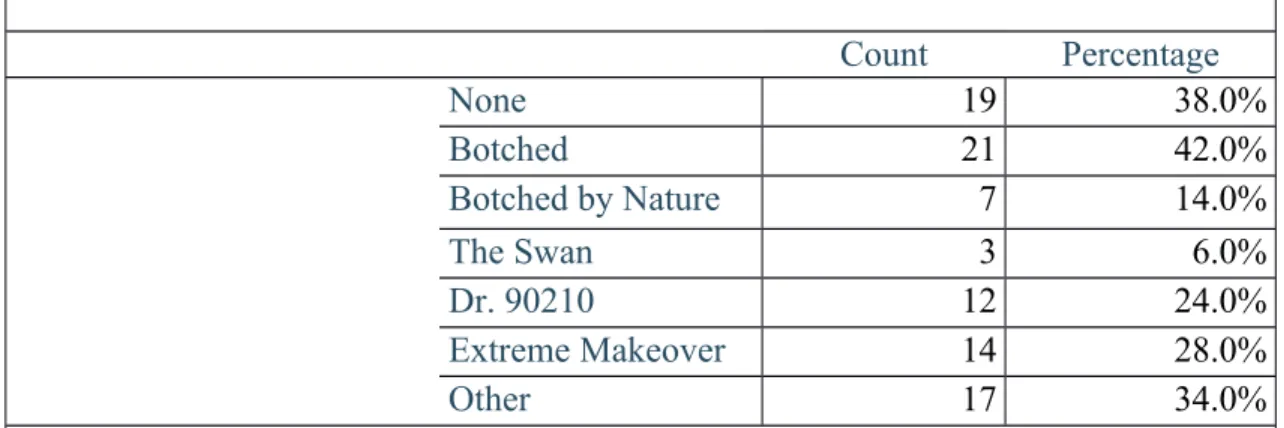
The number of plastic surgery reality television shows viewed by participants is presented in Table 6. Nineteen participants had never seen a plastic surgery reality television shows. Botched (Entertainment Television (E!)) was the most viewed plastic surgery reality television show out of the possible responses. Other was the second highest response option. Individuals that selected this said that they had seen videos of plastic surgery shows on Instagram and Facebook and had watched the shows Nip/Tuck (FX), Dr. Miami (Women’s Entertainment Television (WE)) and Atlanta Plastic (Lifetime). Several participants asked if Keeping Up with the Kardashians and Real Housewives were considered plastic surgery reality television shows, but for this research these programs were not included because the focus of these shows is not primarily plastic surgery transformations.
Chi square identified statistically significant relatedness between familial experience with plastic surgery and the acceptability of family members having plastic surgery (p=0.039). Although the strength and direction of this relationship cannot be deduced from this finding, a relationship between these two variables is expected.
Individuals who know of a family member who has had plastic surgery have been exposed to plastic surgery and may think other family members having plastic surgery is acceptable. Knowledge of a family member’s experience having plastic surgery may reduce one’s fear of the unknown or increase one’s apprehensions regarding plastic surgery and affect attitudes. Chi square testing identified relatedness between familial experience with plastic surgery and reluctance towards telling people other than family (p=0.049). Although the frequency distributions for question 16 (Table 2) were not obviously leading towards one attitude or another (30 percent agree; 34 percent disagree), knowledge of previous family members having plastic surgery can be predictive of one’s attitudes towards telling family. If an individual knows that one of their family members
Table 6: Number of Plastic Surgery Reality Television Shows Viewed
Count Percentage
None 19 38.0%
Botched 21 42.0%
Botched by Nature 7 14.0%
The Swan 3 6.0%
Dr. 90210 12 24.0%
Extreme Makeover 14 28.0%
Other 17 34.0%
The counts do not add up to total number of participants and the percentages to not add up to 100% because this was a multiple response question.
were accepted by other family for having plastic surgery, one can assume that their family will give a similar reaction; however, if one knows of a family member who experienced a negative response from family members after having cosmetic surgery, that individual might be more reluctant to tell their family.
Never having plastic surgery and familial experience with plastic surgery showed relatedness after chi square testing (p=0.049). Individuals who have family members who have had plastic surgery may have knowledge of the unexpectedness of trauma or
disease. The rigidity of the word never implies that one cannot do something under any circumstances, but if one knows of a family member who had to get reconstructive surgery after an accident, they may be better prepared for the uncertainties of life.
Individuals that have family members who have had positive experiences may consider getting cosmetic work done after seeing the transformation of an individual closely related to them. The statistically significant relationships found regarding familial
experience are predictive of individual’s attitudes towards having plastic surgery, but it is important to remember that the strength of and the direction between the variables was not determined.
Analysis of the relationship between parental attitudes towards plastic surgery and the acknowledgment of cosmetic procedures as beneficial to one’s self-esteem was done to see if perceived parental attitudes are associated with attitudes towards others getting cosmetic surgery. Two additional chi square tests were conducted to compare one’s support from their mother and father regarding getting plastic surgery and attitudes towards others getting plastic surgery, but neither relationship was statistically significant. The p values for the mother’s support and father’s support (p=0.544;