Volume 45 Issue 2 Article 3
2020
Fun and Friendly or Wild and Offensive? Preservice Teachers’ Use Fun and Friendly or Wild and Offensive? Preservice Teachers’ Use of and Image Conveyed by Social Media
of and Image Conveyed by Social Media
Marlynn M. Griffin
Georgia Southern University, [email protected] Cordelia Zinskie
Georgia Southern University, [email protected]
Follow this and additional works at: https://ro.ecu.edu.au/ajte
Part of the Teacher Education and Professional Development Commons Recommended Citation
Recommended Citation
Griffin, M. M., & Zinskie, C. (2020). Fun and Friendly or Wild and Offensive? Preservice Teachers’ Use of and Image Conveyed by Social Media. Australian Journal of Teacher Education, 45(2).
http://dx.doi.org/10.14221/ajte.2020v45n2.3 This Journal Article is posted at Research Online.
https://ro.ecu.edu.au/ajte/vol45/iss2/3
Fun and Friendly or Wild and Offensive? Preservice Teachers’ Use of and Image Conveyed by Social Media
Marlynn M. Griffin Cordelia D. Zinskie
Georgia Southern University, United States of America
Abstract: The study presents survey results from 515 preservice teachers at a regional United States institution on their social media use, specifically, their self-reported personal image conveyed on their social media sites, likelihood of posting problematic content on their social media sites, and preference for various others viewing their social media sites. While many preservice teachers reported appropriate social media use, some participants conveyed
inappropriate personal images; had reservations about supervisors, employers, and university faculty viewing their sites; and were likely to post problematic content. Thus, it is incumbent for teacher
preparation programs to develop clear policies as preservice teachers must be made aware of the professional consequences of
inappropriate social media usage and behaviours.
Introduction
Use of social media sites (e.g., Facebook, Twitter, Instagram) continues to grow rapidly concomitant with the global rise in internet use (Kemp, 2018). This has led to increased research on social media use and behaviours, especially in areas such as privacy (Ross, Lai, Walton, Kirwan, & White, 2013), professional boundaries (Crompton, Rippard, & Sommerfeldt, 2016;
Hillman, Hillman, Neustadter, & Pang, 2019), e-professionalism (Duke, Anstey, Carter, Gosse, Hutchens, & Marsh, 2017), and disconnect in personal and professional online personas
(Peluchette & Karl, 2010). These topics are especially important in professional fields such as education and healthcare due to the higher expectations and standards for both students and practicing professionals in these areas (Barnable, Cunning, & Parcon, 2018; Cain, 2008; Foss &
Olson, 2013; Jain, Petty, Jaber, Tackett, Purkiss, Fitzgerald, & White, 2014; Kang, Marbini, Patel, Fawcett, & Leaver, 2015; Nason, Byrne, & O’Connell, 2018; Pham, 2014; Poth,
McCallum, & Tang, 2016; Westrick, 2016). And, as noted by Boon and Maxwell (2016), there are “…long held societal and academic beliefs that because of its human focus teaching is, like medicine, grounded in ethical deliberations” (p. 1). In particular teachers, both preservice and inservice, are considered role models (e.g., New South Wales [NSW] Department of Education and Training, 2009) with a reputation of public trust (Queensland College of Teachers [QCT], 2017) for “expectation of high standards of ethical behaviour” (QCT, n.d., para. 1) and are subject to intense ethical and moral standards (Bock, 2008; Carpenter & Harvey, 2019). Not surprisingly, then, inappropriate use of social media by preservice and inservice teachers can
have negative consequences for potential and current employment (Booth, 2015; Drouin, O’Connor, Schmidt, & Miller, 2015).
News media in the United States (U.S.) and internationally is rife with stories of teachers who have been suspended or fired from their professional positions due to social media content that includes intolerant comments (Alfonso, 2018), derogatory remarks (CBC News, 2015), or racist language (Cerullo, 2017); images of lewd behaviour (Kindelan, 2013); or is deemed inappropriate by those in power or the community, such as a photo showing a teacher smiling and holding an alcoholic beverage (CBS News, 2011). In addition, preservice teachers have been removed from their field experiences at the authors’ institution and elsewhere due to their
inappropriate social media behaviour (Krebs, 2008). Russo, Squelch and Varnham (2010) noted that, given the heightened awareness for teacher professionalism, preservice teachers are more likely to be treated like employees rather than students in the face of inappropriate social media postings.
According to Henderson (2019), screening the social media sites of potential new hires is quite commonplace with the most common construct searched for being professionalism. While some students disagree with employers reviewing social media sites as part of a hiring decision (Drouin et al., 2015; Duke et al., 2017; Foss & Olson, 2013), Barnable et al. (2018) found that students became concerned about the impact of their social media sites on their professional status as they neared degree completion. Research has shown a lack of understanding and awareness among students preparing for a variety of professions, including teaching, as to what is considered acceptable/professional social media use (e.g., Barnable et al., 2018; Booth, 2015;
Crompton et al., 2016; Olson, Clough, & Penning, 2009; Poth et al., 2016). Given the lack of understanding about what constitutes professional social media use and the potential impact of social media postings on future employment (Barnble et al., 2018; Booth, 2015; Carpenter &
Harvey, 2019), it is important to examine the image that preservice teachers convey on social media, their likelihood of posting problematic information on their social media sites, and their preference for others viewing their social media sites. This study examined the self-reported (a) images preservice teachers convey on their social media sites; (b) likelihood of preservice teachers posting problematic content on their social media sites; (c) preferences of preservice teachers for various others viewing their social media sites; (d) relationships among types of images conveyed on preservice teachers’ social media sites; and (e) relationship between images conveyed by preservice teachers on social media sites and both the likelihood of posting
problematic content on these sites and preference for others viewing these sites.
Review of Literature
Teacher Ethics and Professionalism
Bock (2008), Carpenter and Harvey (2019), and Vacca (2005) suggested that the personal lives of teachers are subject to greater scrutiny than are the lives of those in other professions, and a brief history of U.S. legal rulings related to teaching suggests this is so. For example, a 1939 Pennsylvania Supreme Court ruling found that the School District of Mount Pleasant Township was not within its rights for firing a teacher, as she was not deemed incompetent.
However, the argument did note that the teacher was no longer in possession of the “respect nor the good will of the community” (Horosko v. School District of Mt. Pleasant Tp., 1939, p. 5) because, while working as a waitress in the presence of some of her students, she shook dice for patrons while serving beer, took an occasional drink of beer, and taught patrons to use a pinball
machine. The ruling indicated that a teacher’s conduct must command the good will and esteem of the community, even possibly resulting in restricted activities for teachers, as teachers are expected to set a strong example for children. Similarly, the U.S. Supreme Court, in Ambach v.
Norwick, 441 U.S. 68 (1979) stated that teachers are expected to embody civic values and to serve as role models to their students. Comparably, the NSW Public Instruction Act of 1880 (Department of Public Instruction, NSW, 1886) specified that teachers were to be evaluated on the “moral improvement of their pupils” (p. 37) and teachers themselves were to be persons of
“unblemished reputation” (p. 27) with the inclusion of a provision for even itinerant teachers to be “of good moral character” (p. 16). These provisions support the notion of teachers as role models, responsible for influencing the inner character of their young charges. The recent move toward nationalisation of ethical standards in Australia (Australian Institute for Teaching and School Leadership [AITSL], 2011) suggests that teachers are still valued as moral agents.
Similarly, Grunder (2016), Kramer (2003), and Sockett (1993) posited that teachers are held to intense ethical and moral standards as they serve as role models for their students and maintain codes of ethical behaviour. Teachers are bound by ethical codes and standards such as the Code of Ethics and Standard Practice for Texas Educators (Texas Administrative Code, n.d.), Code of Ethics for Educators (Georgia Professional Standards Commission [GAPSC], 2019), Code of Ethics for Teachers in Queensland (Queensland College of Teachers, n.d.), Code of Ethics for the Teaching Profession in South Australia (Teachers Registration Board of South Australia, n.d.), and the Minnesota Administrative Rules: Code of Ethics for Minnesota Teachers (Revisor of Statutes, State of Minnesota, 2017). In an attempt to lend national consistency to state codes, the U.S. National Association of State Directors of Teacher Education and
Certification (NASDTEC) created a Model Code of Ethics for Educators (MCEE) designed to help “ensure that educators are equipped with a framework for ethical decision-making”
(NASDTEC, 2017, p. 8). Similarly, in Australia there has been a move toward a national set of ethical standards (Forster, 2012).
The U.S. National Education Association (NEA, n.d.) in the preamble to its Code of Ethics indicated “The desire for the respect and confidence of one's colleagues, of students, of parents, and of the members of the community provides the incentive to attain and maintain the highest possible degree of ethical conduct” (para. 3). Similarly, AITSL (2011) requires that certified teachers, and by implication preservice teachers, “possess ethical attributes and qualities which they must demonstrate in the classroom and in their general behaviour within their
community” (Boon & Maxwell, 2016, p. 2). While the States and Territories of Australia created their own ethical standards separate from the national professional standards, curriculum and strategic goals, there are similarities among these ethical standards that indicate ethical
responsibilities are valued in Australian teachers (Forster, 2012) as well as teachers in the U.S.
(NEA, n.d.). Yet it is evident that these strict ethical values are violated by teachers on social media, at least as judged by some school administrators and members of the public (e.g., Alfonso, 2018; CBS News, 2011; Cerullo, 2017; Krebs, 2008).
Teacher Professionalism and Employment
Use of social media by professionals in education is increasing and investigations of the benefits and uses of social media are emerging (Fenwick, 2016). Those responsible for education in professional disciplines such as teacher preparation (Ashley, 2014; Griffin & Lake, 2012) have noted that social media use can be a professional stumbling block and there must be a
continued awareness that social media is not always used responsibly nor ethically (Forbes, 2017).
In fact, the media has much to share about teachers who have faced suspension and job loss for failing to maintain the moral and ethical standards of the profession. The premier case of a teacher in trouble with social media is Stacy Snyder of Millersville University who, in 2006, was not awarded a teaching degree, in part because of unprofessional behaviour that included a photo of herself posted on MySpace wearing a pirate hat, holding an opaque plastic cup and with the caption “drunken pirate” (Krebs, 2008). While Ms. Snyder’s may have been one of the first publicised cases of teacher misfortune with social media, it was certainly not the last. From the Georgia high school teacher forced to resign after parents complained of a Facebook post of her holding a glass of beer and a glass of wine (CBS News, 2011), to a teacher at an all-boys
grammar school in England, suspended after nude photos of him were found online (Daily Mail Reporter, 2009), to a British teacher suspended after posting a photo of herself in a white dress, showing “a bit of leg” (Meyjes, 2017, para. 4), to a Western Australia teacher fired for social media use that “…fell below the standards of teachers in a Catholic school” (Henebery, 2019, para. 11), teachers’ online personas are under increasing scrutiny.
A sampling of the online history of teachers in trouble with social media shows that a variety of social media faux pas can become professional obstacles. Teachers in the U.S.
(Associated Press, 2006; CBS News, 2011; Kindelan, 2013), Australia (Victorian Institute of Teaching, 2017a; Victorian Institute of Teaching, 2017b), and Canada (CBC News, 2015), among others, have received censure for images of online nudity, such as the Texas art teacher with nude photos on her Flick’r site (Associated Press, 2006), alcohol use (CBS News, 2011), and sexual conduct including a high school coach fired for posting on Facebook a photo with her fiancé’s hand on her breast (Kindelan, 2013). Similarly, questionable written posts can be
problematic, such as one from an Ohio middle school teacher placed on paid leave after a Snapchat rant about students traveling to prom in a horse and carriage, yet not having enough money for school supplies (Waller, 2017) or a comment from a teacher in Winnipeg, Manitoba suspended without pay for making online derogatory remarks about indigenous aboriginal people (CBC News, 2015). Teachers have also resigned or been fired after publicly mocking the
instructional needs of students with disabilities (e.g., Alfonso, 2018; Downey, 2016). While the above history is largely reflective of incidents in the U.S. and Canada, teachers in Australia have also received sanctions for online behaviour. A Perth primary school teacher was reported to the Department of Education and faced possible disciplinary action after posting online a comment mocking a trans woman (Staff Writers, 2018), Victorian teachers were censured for unethical conduct including flirtatious comments with students via social media (Victorian Institute of Teaching, 2017a; Victorian Institute of Teaching, 2017b), and a teacher from a Perth Catholic school lost her job after a photo appeared online of her holding a bong at a music festival, though school officials denied the photo was the cause of the job loss (Holland, 2015). In Queensland, a teacher was suspended after sending inappropriate Snapchats to a 15-year-old student (Miko, 2015), a Northern Territory (NT) teacher was removed from the classroom after posting a social media rant mocking a student who had recently committed suicide (Brown, 2014), and “more than a dozen” (Vonow, 2015, para. 2) Queensland teachers were disciplined between 2009 and 2015 for inappropriate social media usage.
Legal decisions in the U.S. support the rights of employers to terminate teachers for cause (Pickering, 1968) and this is relevant to social media postings, while Australian law includes restrictions on dismissals related to process and prohibited grounds (Black, n.d.). As far back as
1968 in the U.S., Pickering v. Board of Education of Township High School District found in favour of a ruling that permits employees of public agencies to be disciplined for speech that is disruptive to the work environment by distracting workers, damaging workplace relationships, or showing disloyalty or incompetence or is in any other way “detrimental to the best interests of the schools” (Pickering, 1968, para. 1). Similarly, the doctrine of employment-at-will holds that employers can terminate an employee at will, without cause, unless their speech is protected by concerted activity, activity which is designed to collectively improve working conditions (Magaldi, Sales, & Cameron, 2018). In slight contrast to these U.S. practices, Australian law includes unfair dismissal laws, and regulations require reasonable notice of termination in the absence of misconduct (Black, n.d.). If, however, an employee violates a contractual social media clause, that employee may be subject to dismissal (McDonald Murholme Employment Lawyers, n.d.), as in the case of the Perth teacher fired for inappropriate social media posts involving images of a bong and of herself topless (Henebery, 2019) or other discipline (Victorian Institute of Teaching, n.d.) as in the case of two teachers whose registration was suspended after inappropriate social media conversations with students (Victorian Institute of Teaching, 2017a, 2017b). The fine grain analysis of law and statutes across U.S. states and Australian states and territories is beyond the scope of this paper, but the aforementioned examples indicate, clearly, that questionable social media use can cause legal and other hurdles for teachers.
While it has been shown that social media presence and image conveyed can lead to teachers losing their jobs (e.g., CBS News, 2011; Henebery, 2019), one’s social media presence and image may also influence whether or not one is hired for a position. The 2018
Careerbuilder.com annual social media recruitment surveys, the most recently published, showed a dramatic increase in employers who use social media to screen job applicants in the 12 years from 2006 (11%) to 2018 (70%). Furthermore, search engines are used by 66% of hiring managers to research candidates (Careerbuilder.com, 2018). Of those who use social media to screen potential employees, 57% (Careerbuilder.com, 2018) reported that they have made a decision not to hire on the basis of what they found online – from drinking and drug use to evidence of poor communication skills (Careerbuilder.com, 2018). Forty-eight percent of employers check their employees’ social media presence, and 34% reported firing or reprimanding employees for what was posted on social media. Similarly, Griffin and Lake (2012) surveyed P–12 principals to learn what, if anything, posted on teachers’ social media sites would prevent principals from hiring prospective teacher employees. Twenty-two of 51
statements reflecting provocative, drug and alcohol-related, and discriminatory images and comments, along with swearing and violent language, were rated as likely to have a minor to moderate impact on a hiring decision, and 28 statements a moderate to significant likelihood of impact on a hiring decision.
Preservice Teachers’ Use of Social Media
In one study of ethical social media use by preservice teachers (Crompton et al., 2016), a survey administered to 121 teacher candidates showed that while most candidates knew they should not post images involving alcohol, they were less certain whether it was appropriate to post pictures of parties or silly behaviour. Candidates also indicated that they knew not to post comments considered to be controversial or offensive if the comment was the focus of the post.
However, if the comment was part of a larger set of non-offensive or non-controversial comments, candidates were unsure whether or not the post was appropriate. At a large
Midwestern university, an investigation by Olson et al. (2009) of elementary preservice teachers’
Facebook pages showed that 32% of 471 preservice teachers had fully accessible Facebook pages (i.e., anyone was able to view the content of these pages) and that of this 32%, 56% (n = 86) of the preservice teachers’ pages included inappropriate information (e.g., curse words, references to alcohol consumption) and another 22% (n = 34) included marginally inappropriate information (e.g., political views, personal information such as students kissing). A third study focused on 68 undergraduate secondary education majors at a large Midwestern university who participated in an intervention intended to change their views on the use of Facebook by
inservice teachers (Mikulec, 2012). These teacher candidates read a series of articles detailing problems encountered by professional educators who posted inappropriate information on Facebook. Mikulec (2012) noted that preservice teachers became more aware of the need to be careful with what they posted and the ethical concerns associated with teacher use of Facebook.
Furthermore, these participants “began to understand the moral standard to which teachers are held by the public” (p. 9).
The current study of education majors replicates a study among undergraduate business majors conducted by Peluchette and Karl (2010), who found a relationship between image conveyed and likelihood of posting problematic information on social media sites. Business students who conveyed an image considered wild, offensive, or sexually appealing were more likely to post problematic content whereas business students who conveyed an image of hard- working were less likely to post problematic content. Most students also indicated they were okay with family viewing their social media sites but were somewhat neutral when it came to employers or strangers viewing these sites. Business students who were okay with others viewing their social media sites were less likely to post problematic information.
Method
Participants
This descriptive, correlational study includes survey data from preservice teachers in the College of Education at a rural regional university in the southeastern U.S. Voluntary
participants in this Institutional Review Board approved study included undergraduates enrolled in the initial practicum, pre-professional block (PPB) of a teacher education program. The PPB consists of three courses and a 51-hour practicum (field experience) that must be completed prior to admission to an upper division teacher education program. A convenience sample of
participants completed a survey regarding their social media use during PPB orientation.
Surveys were returned from 515 preservice teachers in PPB who participated in social media. Preservice teachers completed surveys in fall, 2012 (n = 112), spring, 2013 (n = 110), spring, 2016 (n = 164), and fall, 2018 (n = 129). The sample was 84.3% female, and ages of participants ranged from 18 to 49 (M = 20.37, SD = 2.89). The most common major reported by participants was Early Childhood/Elementary Education (58.2%).
Instrument
The first author obtained permission from Peluchette and Karl (2010) to modify their existing instrument that examines student postings on social media sites. Modifications focused on incorporating language that is reflective of teacher education (e.g., field experience
supervisor, future students). The instrument addressed self-perception of image conveyed on social media sites (“Assuming someone viewed your social media site, how likely would the person be to believe you had each of the traits indicated?”), likelihood that respondent would include problematic information on his/her social media sites, and respondent’s preference for others (e.g., friends, family, faculty, current or potential employers) viewing his/her social media sites.
Image Conveyed on Social Media Sites
This section of the instrument contains 23 traits or characteristics which preservice teachers rated on a 5-point scale (5 = Very Likely to 1 = Very Unlikely). Six scales were developed from these items by Peluchette and Karl (2010): Appealing (sexy, popular, facially attractive); Wild (outrageous, bold, risk taker, partier); Fun and Friendly (fun, friendly, likeable, good-natured, humorous); Offensive (offensive, emotionally unstable, irresponsible, arrogant, immature); Intelligent (intelligent, high academic ability); and Hard-working (hard-working, trustworthy, conscientious, reliable). The mean response to items associated with each scale was calculated to create a scale score for each student.
Problematic Information Scale
In their original study, Peluchette and Karl (2010) created a problematic information scale using items from the section of their instrument that addressed likelihood of respondents including selected information on their social media sites. These same items were used in the current study. Items included on the problematic information scale were as follows: comments regarding personal sexual activities; self-photos considered revealing, e.g., sexy, semi-nude, or nude; self-photos posing with sexual props or firearms; self-photos of alcohol consumption;
comments regarding use of alcohol or illegal drugs; or comments regarding participation in activities that violated the Student Conduct Code. Preservice teachers used a 5-point scale (5 = Very Likely to 1 = Very Unlikely) to indicate likelihood of including this type of information on their social media sites. Responses to these 10 items were averaged for each participant to create their problematic information scale score.
Preference for Others Viewing Social Media Sites
This section consists of nine items focused on preservice teachers’ preference for others viewing their social media sites. Respondents were asked whether they would be okay with friends, family, classmates, university faculty, classroom teachers who supervise their field experience, current or possible employers, strangers, and future students viewing their social media sites. Preservice teachers used a 5-point Likert scale (5 = Strongly Agree to 1 = Strongly Disagree) to respond to items in this section.
Results
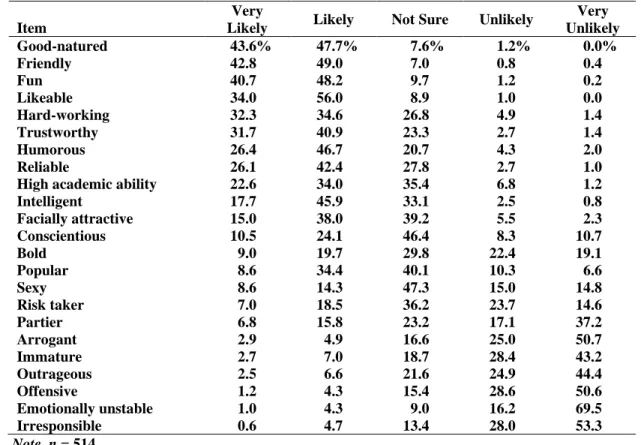
Preservice teachers rated the likelihood that a particular trait or characteristic would be conveyed to those viewing their social media sites, as shown in Table 1. Images rated as very
Item
Very
Likely Likely Not Sure Unlikely Very Unlikely
Good-natured 43.6% 47.7% 7.6% 1.2% 0.0%
Friendly 42.8 49.0 7.0 0.8 0.4
Fun 40.7 48.2 9.7 1.2 0.2
Likeable 34.0 56.0 8.9 1.0 0.0
Hard-working 32.3 34.6 26.8 4.9 1.4
Trustworthy 31.7 40.9 23.3 2.7 1.4
Humorous 26.4 46.7 20.7 4.3 2.0
Reliable 26.1 42.4 27.8 2.7 1.0
High academic ability 22.6 34.0 35.4 6.8 1.2
Intelligent 17.7 45.9 33.1 2.5 0.8
Facially attractive 15.0 38.0 39.2 5.5 2.3
Conscientious 10.5 24.1 46.4 8.3 10.7
Bold 9.0 19.7 29.8 22.4 19.1
Popular 8.6 34.4 40.1 10.3 6.6
Sexy 8.6 14.3 47.3 15.0 14.8
Risk taker 7.0 18.5 36.2 23.7 14.6
Partier 6.8 15.8 23.2 17.1 37.2
Arrogant 2.9 4.9 16.6 25.0 50.7
Immature 2.7 7.0 18.7 28.4 43.2
Outrageous 2.5 6.6 21.6 24.9 44.4
Offensive 1.2 4.3 15.4 28.6 50.6
Emotionally unstable 1.0 4.3 9.0 16.2 69.5
Irresponsible 0.6 4.7 13.4 28.0 53.3
Note. n = 514.
Table 1: Self-Perception of Image Conveyed on Social Media Sites by Item
likely or likely to be conveyed included friendly (91.8%), good-natured (91.3%), likeable (90.0%), fun (88.9%), humorous (73.1%), trustworthy (72.6%), reliable (68.5%), and hard- working (66.9%); images rated as very unlikely or unlikely to be conveyed included emotionally unstable (85.7%), irresponsible (81.3%), offensive (79.2%), arrogant (75.7%), immature
(71.6%), and outrageous (69.3%). There was greater variability regarding the likelihood of preservice teachers conveying the remaining nine images (high academic ability, intelligent, facially attractive, conscientious, bold, popular, sexy, risk taker, and partier) on their social media sites with many participants selecting “not sure” as their response.
Cronbach’s alpha was calculated for the six scales developed from these 23 traits; these values ranged from .67 to .79, as shown in Table 2, indicating good internal consistency
reliability for all scales. Scale means organised from highest to lowest likelihood of being conveyed on preservice teachers’ social media sites were as follows: Fun and Friendly (M = 4.22, SD = .53); Intelligent (M = 3.74, SD = .79); Hard-working (M = 3.74, SD = .69); Appealing (M = 3.24, SD = .81); Wild (M = 2.48, SD = .84); and Offensive (M = 1.76, SD = .68).
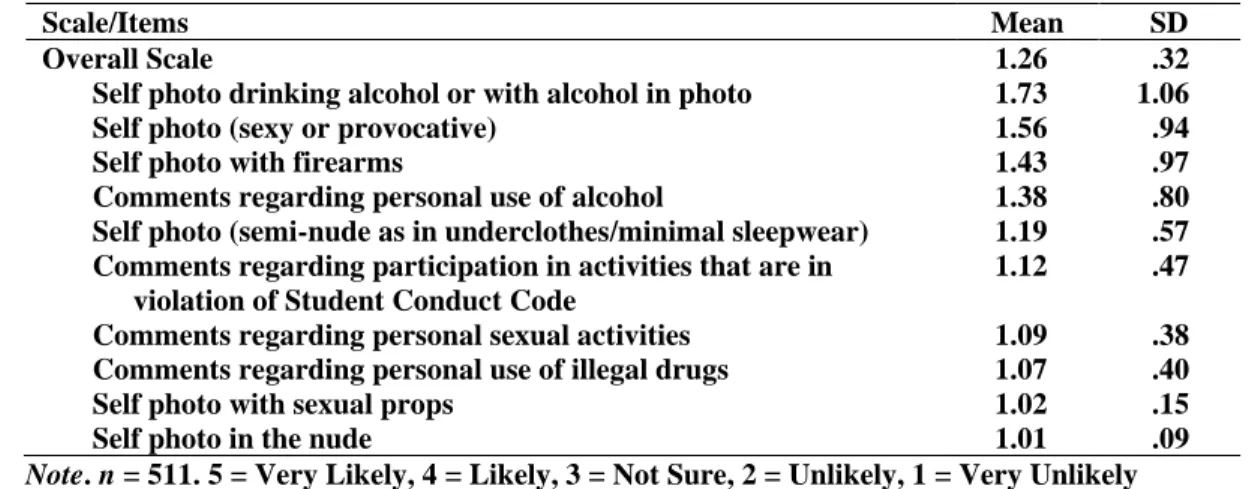
Preservice teachers reported that they were very unlikely to post problematic content on their social media sites as evidenced by an overall problematic content scale score mean of 1.26 (SD = .32), as shown in Table 3. Analysis of the individual items that comprise the problematic
content scale showed lowest mean values for self-photo in the nude (M = 1.01, SD = .09) and self-photo with sexual props (M = 1.02, SD = .15). The highest mean value was seen for self- photo drinking alcohol or with alcohol in photo (M = 1.73, SD = 1.06); this item also had the greatest variability. While most preservice teachers noted they were unlikely to include problematic content on their social media sites, these results nevertheless revealed that some
Scale Items Mean SD
Fun and Friendly (.78) 4.22 .53
Good-natured 4.34 .67
Friendly 4.33 .68
Fun 4.28 .70
Likeable 4.23 .65
Humorous 3.91 .90
Intelligent (.79) 3.74 .79
Intelligent 3.77 .79
High academic ability 3.70 .93
Hard-working (.70) 3.74 .69
Trustworthy 3.99 .89
Hard-working 3.92 .95
Reliable 3.90 .85
Conscientious 3.15 1.07
Appealing (.73) 3.24 .81
Facially attractive 3.58 .89
Popular 3.28 .99
Sexy 2.87 1.10
Wild (.67) 2.48 .84
Risk taker 2.80 1.12
Bold 2.77 1.22
Partier 2.38 1.31
Outrageous 1.98 1.07
Offensive (.73) 1.76 .68
Immature 1.98 1.07
Arrogant 1.84 1.05
Offensive 1.77 .94
Irresponsible 1.71 .91
Emotionally unstable 1.51 .90
Note. n = 514. 5 = Very Likely, 4 = Likely, 3 = Not Sure, 2 = Unlikely, 1 = Very Unlikely. Coefficient alpha reported in parentheses next to each scale.
Table 2: Descriptive Statistics for Image Conveyed on One’s Social Media Sites
Scale/Items Mean SD
Overall Scale 1.26 .32
Self photo drinking alcohol or with alcohol in photo 1.73 1.06
Self photo (sexy or provocative) 1.56 .94
Self photo with firearms 1.43 .97
Comments regarding personal use of alcohol 1.38 .80
Self photo (semi-nude as in underclothes/minimal sleepwear) 1.19 .57 Comments regarding participation in activities that are in
violation of Student Conduct Code
1.12 .47
Comments regarding personal sexual activities 1.09 .38 Comments regarding personal use of illegal drugs 1.07 .40
Self photo with sexual props 1.02 .15
Self photo in the nude 1.01 .09
Note. n = 511. 5 = Very Likely, 4 = Likely, 3 = Not Sure, 2 = Unlikely, 1 = Very Unlikely Table 3: Descriptive Statistics for Problematic Information Scale and Scale Items
preservice teachers were likely to post content that may be detrimental to their desired career as a P–12 teacher.
As reported in Table 4, preservice teachers also indicated their preference for others viewing their social media sites. Most preservice teachers agreed or strongly agreed that they were okay with family (M = 4.48, SD = .86), classmates (M = 4.63, SD = .71), and friends (M = 4.85, SD = .43) viewing their social media sites. There was more moderate agreement regarding preference for classroom teachers who supervise their field experience (M = 3.81, SD = 1.24), employers (M = 3.90, SD = 1.18), and university faculty (M = 3.94, SD = 1.15) viewing their social media sites. The preference for strangers (M = 2.79, SD = 1.46) or future students (M = 3.00, SD = 1.40) viewing their social media sites was even lower. When asked about the
likelihood that anyone other than their close personal friends would view their social media sites, the participants’ mean response (M = 2.94, SD = 1.28) reflected uncertainty about the potential audience for these sites.
Items Mean SD
Okay with friends viewing my SMS 4.85 .43
Okay with classmates viewing my SMS 4.63 .71
Okay with family viewing my SMS 4.48 .86
Okay with university faculty viewing my SMS 3.94 1.15
Okay with current or possible employers viewing my SMS 3.90 1.18 Okay with classroom teachers who supervise my field experience
viewing my SMS
3.81 1.24
Okay with my future students viewing my SMS 3.00 1.40
Very unlikely that anyone other than my close personal friends will read my SMS
2.94 1.28
Okay with strangers viewing my SMS 2.79 1.46
Note. n = 515. 5 = Strongly Agree, 4 = Agree, 3 = Neither Agree nor Disagree, 2 = Disagree, 1 = Strongly Disagree
Table 4: Descriptive Statistics for Preference for Others Viewing Social Media Sites (SMS)
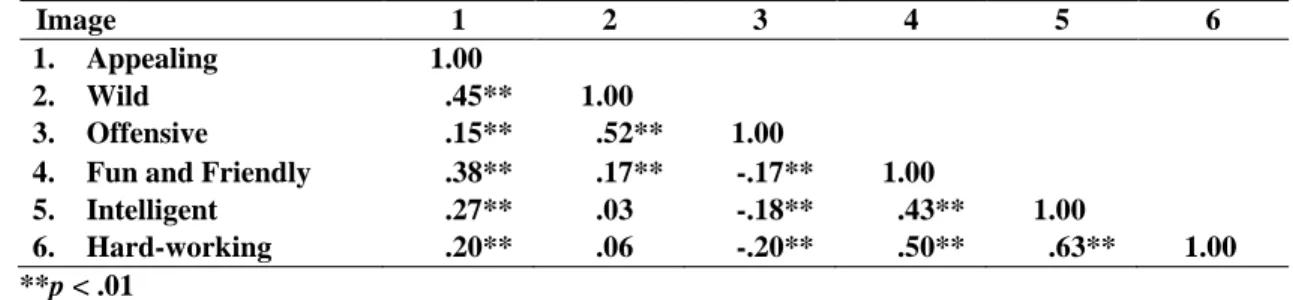
Intercorrelations were determined for scales describing type of image conveyed on preservice teachers’ social media sites, as shown in Table 5.The strongest, albeit moderate, relationship was seen between Hard-working and Intelligent (r = .63, p < .01) indicating that those who believed they would be viewed as hard-working on social media sites also believed
that they would be viewed as intelligent. Moderate positive relationships were also found for Fun and Friendly with both Intelligent (r = .43, p < .01) and Hard-working (r = .50, p < .01)
reflecting a mild trend that preservice teachers who were more likely to be viewed as fun and friendly on their social media sites would also have a higher likelihood of being seen as
intelligent and hard-working. A moderate positive relationship was noted between Offensive and Wild (r = .52, p < .01); this denotes a pattern that some preservice teachers who conveyed an offensive personal image via social media sites were also likely to be viewed as wild by those viewing these sites.
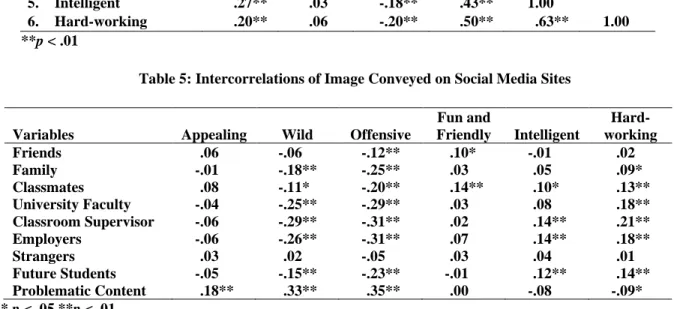
The type of image conveyed on social media sites was correlated with likelihood of posting problematic content on social media sites and preference for others viewing social media sites, as shown in Table 6. The strongest relationships with posting problematic content were seen for Wild (r = .33, p < .01) and Offensive (r = .35, p < .01); while significant, these correlations were weak to moderate in strength. These results reflect a slight trend that some participants who conveyed a wild or offensive personal image on social media sites were also
Image 1 2 3 4 5 6
1. Appealing 1.00
2. Wild .45** 1.00
3. Offensive .15** .52** 1.00
4. Fun and Friendly .38** .17** -.17** 1.00
5. Intelligent .27** .03 -.18** .43** 1.00
6. Hard-working .20** .06 -.20** .50** .63** 1.00
**p < .01
Table 5: Intercorrelations of Image Conveyed on Social Media Sites
Variables Appealing Wild Offensive
Fun and
Friendly Intelligent
Hard- working
Friends .06 -.06 -.12** .10* -.01 .02
Family -.01 -.18** -.25** .03 .05 .09*
Classmates .08 -.11* -.20** .14** .10* .13**
University Faculty -.04 -.25** -.29** .03 .08 .18**
Classroom Supervisor -.06 -.29** -.31** .02 .14** .21**
Employers -.06 -.26** -.31** .07 .14** .18**
Strangers .03 .02 -.05 .03 .04 .01
Future Students -.05 -.15** -.23** -.01 .12** .14**
Problematic Content .18** .33** .35** .00 -.08 -.09*
* p < .05 **p < .01
Table 6: Image Conveyed on Social Media Sites Correlated with Preference for Others Viewing Social Media Sites and Likelihood of Posting Problematic Content
more likely to post problematic content on these sites. There was a very slight positive trend that those who conveyed a personal image of Hard-working (significant r-values ranging from .18 to .21) on their social media sites would be okay with those associated with the teaching profession (university faculty and classroom supervisors) and current or future employers viewing their social media sites. Conversely, there was a slight negative trend for those who conveyed their personal image as Wild (significant r-values ranging from -.25 to -.29) or Offensive (significant r-values ranging from -.29 to -.31) on their social media sites would be less accepting of those in professional education settings or employers viewing their social media sites.
Discussion
The findings of the current study were consistent with those of Peluchette and Karl (2010) and have implications for professions concerned with an ethical, professional identity (Carpenter & Harvey, 2019; Duke et al., 2017; Henderson, 2019; Nason et al., 2018; Westrick, 2016). Though the findings of the current study indicate that preservice teachers have some reservations about future employers viewing their social media, some are still posting content that validates these reservations. These preservice teachers may not truly comprehend that some of their personal social media content may impact their future career and that social media
content may be considered grounds for disciplinary action, including termination in both the U.S.
(Ashley, 2014; Foss & Olson, 2013) and Australia (“From Twitter to Twired”, 2018; Karp, 2019;
McDonald Murholme Employment Lawyers, n.d.).
Self-reported information from preservice teachers in the current study noted that the most common image conveyed on their social media sites was fun and friendly followed by intelligent and hard-working; however, some participants did report their social media sites would convey to others personal images characterised as wild or offensive. This finding
corroborates the survey results of Poth et al. (2016) who found that while most of the Canadian preservice teachers in their study regulated the information they posted, a few participants did post images of partying and excessive drinking and profane comments that could be detrimental to them professionally. The results of the current study reflect the ongoing trend of uncertainty among preservice teachers regarding what is appropriate content, and thus appropriateness of image conveyed, for their social media sites (Crompton et al., 2016; Foss & Olson, 2013; Olson et al., 2009).
Preservice teachers in the current study were generally comfortable with family, friends and classmates viewing their social media sites, but had some reservations about supervisors, employers, and university faculty viewing their sites. This finding is consistent with that of Foss and Olson (2013) who worked with preservice and early service teachers who had reservations about future employers viewing their social media sites. This finding also implies that some preservice teachers are in fact cognizant that their social media postings may influence others’
opinions of them personally and professionally. This may be why some preservice teachers and students in other fields of study are not in favour of using social media data for hiring and firing decisions (Barnable et al., 2018; Drouin et al., 2015). It should be noted that in the current study preservice teachers conveying an image of intelligent or hard-working were more likely to be comfortable with supervisors, employers, and university faculty viewing their social media sites.
The current study showed that while most preservice teachers were very unlikely to post problematic content on their social media sites, some preservice teachers do still post content that may cause them trouble. The types of problematic content most likely to be posted included images of preservice teachers drinking alcohol or photos containing alcohol; this is consistent with results from Poth et al. (2016) who noted that one-third of participants posted pictures of partying and Nason et al. (2018) who discovered that 25% of photos posted on Facebook by their participants were unprofessional (i.e., photos showing alcohol use or varying levels of nudity). It was found that those whose social media sites conveyed an image of wild or offensive also were somewhat more likely to post problematic content. This is similar to findings of Drouin et al.
(2015) who examined students from over 40 majors and found that undergraduates evaluated as having less self-control, more likely to endorse the hookup culture, and more psychologically
open were less likely to support the use of social media as part of employers’ employment decisions, suggesting that these students may have more to hide.
It should be noted that a possible limitation of the current study is response bias due to the use of self-reported data collection and the focus on some social media traits and behaviours that are considered unflattering and unfavourable, i.e., some respondents may have wanted to be viewed in a more positive light. However, given that most of the study participants were
sophomores at the beginning of their teacher education program, thus having no formal training in teacher professionalism, the authors believe that results reflect social media use and
behaviours commonly considered as representative of early college years. The current results indicate that many preservice teachers may not yet be looking ahead to their future employment as teachers nor considering any unintended consequences of their social media actions.
As some previous research (e.g., Jain et al., 2014; Kang et al., 2015) found significant differences in what students and professionals consider appropriate on social media, one might wonder whether a generational gap is at work when considering that most of the participants in these previous studies as well as the current study grew up with social media. Cortino (2019) suggests that today’s Gen Z preservice teachers learn and communicate differently, a function of being true digital natives. Nonetheless, Henderson (2019) noted that members of this “digital age” generation need to shape their social media image to align with the expectations of their intended profession and potential employers. For preservice teachers, this guidance in e- professionalism must come from faculty within their teacher education programs.
Implications for Policy and Practice
Those involved with the education and preparation of professional educators must be prepared to also coach them in the ethical expectations of their professions and help them avoid questionable social media use (Fenwick, 2016). Furthermore, it is evident that teachers need some guidance for using social networking sites wisely (Downey, 2016; Heussner & Fahmy, 2010; Kindelan, 2013; Waller, 2017). For example, the National Education Association Office of General Counsel Mike Simpson (n.d.) reminded readers that First Amendment rights do not apply to social media sites, while a blogpost on Issues in Ontario Education (lml01, 2015) suggests that teachers are role models and public figures who must take care when revealing their personal lives. Similarly, the High Court of Australia recently ruled that public servants, which includes teachers, can be disciplined and even fired for political social media posts (Karp, 2019). Generally, teacher candidates do not feel well-prepared when it comes to professionalism or ethics education, as indicated in an investigation of teacher candidates in a birth through grade two program (Brown, Cheddie, Horry, & Monk, 2017). Early childhood education candidates felt well-prepared in their programs for certain aspects of professionalism, as identified by the National Association for the Education of Young Children (NAEYC) Standards (2010), such as integrating theory and research on early education to support teaching and collaborative learning relevant to professional role and practice. However, the data did not clearly indicate that
candidates were well-versed in the NAEYC Code of Ethical Conduct and other ethical standards pertinent to their professional role (Brown et al., 2017). A five-country (Australia, Canada, England, Netherlands and U.S.) survey of ethics education, which included topics such as ethical issues, teacher professionalism, and professional qualities, showed that teacher candidates in only 16% of initial certification teacher education programs surveyed in both the U.S. and Australia completed a standalone ethics course, though 76% of the programs in all five countries
combined reported that ethics is integrated into coursework or completed as a standalone course (Maxwell, Tremblay-Laprise, Filion, Boon, Daly, van den Hoven, Heilbronn, Lenselink, &
Walters, 2016). Though there is evidence that some training on teacher professionalism exists in teacher preparation programs, studies specifically focused on preparation to use social media are scant. As Rodesiler (2017) noted, teacher educators can have an impact in helping budding teachers understand the importance of professional social media use. In fact, several studies (Crompton et al., 2016; Mikulec, 2012; Olson et al., 2009) showed that teacher educators can make a difference in student awareness of what is and is not appropriate to post on social media.
While the ethical standards of several Australian States and Territories (e.g., NSW Government, 2020; Teachers Registration Board, Tasmania, 2019) specifically address social media use by teachers, there is not consistency across Australian States and Territories nor among U.S. states as to what constitutes professional social media use among teachers. At the very least, Colleges of Education should establish social media policies or guidelines for preservice teachers
(Carpenter & Harvey, 2019); however, merely establishing such policies is not enough.
Teachers, both preservice and inservice, need professional development for the wise use of social media and other forms of technology (Carpenter & Harvey, 2019; Rodesiler, 2017).
While professionals may be aware of the need for e-professionalism, improvements in identifying policies and e-professionalism education are called for in educating future teachers (Foss & Olson, 2013; Poth et al., 2016). Those in teacher education should be concerned with preparing future professional educators for the ethical standards of the workplace, as part of their understanding of teacher roles and responsibilities (Poth et al., 2016; Westrick, 2016), and Foss and Olson (2013) argued that this preparation should occur frequently and early in their training.
Furthermore, Westrick (2016) pointed out that identifying e-professionalism policies in writing is crucial for legal support of disciplinary action.
A recent analysis of school board social media policies (Rodesiler, 2017) suggested that professionally oriented online participation has a number of benefits for inservice teachers, including helping teachers feel less isolated, improving ability to support students, and increasing professional opportunities. This same study concluded that teacher educators should play a pivotal role in helping preservice teachers become conversant about social media use policies (Rodesiler, 2017). Furthermore, Colleges of Education may want to consider establishing social media policies. For example, the Queensland College of Teachers (2017) states clearly that
“there needs to be a clear distinction between the professional and the private when using
Facebook as Facebook exposes both teachers and students to fairly significant risk when it comes to respecting the boundaries between teacher and student” (p. 8). The social media policy (PPB Information Packet, 2020) at the authors’ institution states, in part,
As a future professional educator, you are expected to maintain high standards of personal and professional ethics at all times and in all settings. Social networking sites, such as Twitter, Facebook, Instagram, Snapchat, etc., should represent your high personal and professional standards. If you have postings on any of these sites, you must remember that they are public and may be viewed by school personnel and students. If school personnel find your postings to be unprofessional, they can request your removal from their school. This request will be honoured immediately and a new student teaching placement will not be identified until the following semester. (p. 32)
This policy and the Code of Ethics for Educators (GAPSC, 2019) are introduced to teacher candidates prior to admission to the teacher education program as part of the orientation
to the initial PPB field experience. Candidates are told tales about some of the teachers who have lost jobs due to social media blunders, and typically a lively discussion ensues about “privacy”, what to delete, what to keep, and general “what ifs.” It is also made clear to candidates that social media accounts are not monitored by university personnel, but as per the social network policy, candidates may be dismissed from their practicum if school personnel find information on their sites objectionable.
Conclusion
Researchers have suggested that while professionalism and ethics are addressed in teacher education programs, limited attention has been given to e-professionalism in these programs (Carpenter & Harvey, 2019; Foss & Olson, 2013; Krutka, Nowell, & Whitlock, 2017;
Poth et al., 2016; Rodesiler, 2017). The discussion of e-professionalism must be incorporated into the overall discussion of teacher professionalism; in addition, explicit policies and consequences for inappropriate/unprofessional social media actions must be established (Rodesiler, 2017). Preservice teachers must be made aware that professionalism for teachers extends beyond the classroom to their personal social media usage and behaviours.
It is unlikely that preservice and inservice teachers will discontinue social media use anytime in the near future. In fact, as more social media platforms are developed and those considered to be digital natives make up a larger portion of the teacher workforce, it is likely that social media use will become ubiquitous. Teacher educators and those responsible for teacher professional development are well-advised to be sure teachers understand the risks of taking their private lives online. Furthermore, local education agencies should develop clear policies for social media use, such as those developed by the NSW Government (2020) and by the Teachers Registration Board Tasmania (2019). This study has demonstrated that while preservice teachers may have some understanding that who views their social media is of import, some still post information that is problematic, and this could hinder their chance of employment.
References
Alfonso, F. (2018, May 10). Texas teacher fired after sending profane text to mother of autistic student. Chron. Retrieved from https://www.chron.com/news/houston-
texas/texas/article/texas-teacher-fired-text-message-autistic-student-12904188.php Ambach v. Norwick, 441 U.S. 68. (1979). Retrieved from
https://supreme.justia.com/cases/federal/us/441/68/ https://doi.org/10.1007/BF01164528 Ashley, H. (2014). Don’t get trapped by social media. The Education Digest, 79(9), 32–36.
Associated Press. (2006, August 18). Teacher resigns after nude photos found online. NBC News. Retrieved from http://www.nbcnews.com/id/14411399/ns/us_news-life/t/teacher- resigns-after-nude-photos-found-online/#.W8ZQpfYnaUl
Australian Institute for Teaching and School Leadership. (2011). Australian Professional Standards for Teachers. Retrieved from https://www.aitsl.edu.au/teach/standards Barnable, A., Cunning, G., & Parcon, M. (2018). Nursing students’ perceptions of
confidentiality, accountability, and e-professionalism in relation to Facebook. Nurse Educator, 43(1), 28–31. https://doi.org/10.1097/NNE.0000000000000441
Black, S. (n.d.) An overview of Australian employment practices. Primerus. Retrieved from https://www.primerus.com/business-law-articles/an-overview-of-australian-employment- practices-111414.htm
Bock, J. (2008, June 25). It’s not just yourspace. STLtoday.com. Retrieved from
http://www.stltoday.com/stltoday/news/stories.nsf/stcharles/story/0F914BBEE1BF25A08 625747300124F6A?OpenDocument
Boon, H. J., & Maxwell, B. (2016). Ethics education in Australian preservice teacher programs:
A hidden imperative? Australian Journal of Teacher Education, 41(5). Retrieved from https://doi.org/10.14221/ajte.2016v41n5.1
Booth, R. G. (2015). Happiness, stress, a bit of vulgarity and lots of discursive conversation: A pilot study examining nursing students’ tweets about nursing education posted to Twitter.
Nurse Education Today, 35(2), 322–327. https://doi.org/10.1016/j.nedt.2014.10.012 Brown, C. S., Cheddie, T. N., Horry, L. F. & Monk, J. E. (2017). Training to be an early
childhood professional: Teacher candidates’ perceptions about their education and training. Journal of Education and Training Studies, 5(6), 177–186.
https://doi.org/10.11114/jets.v5i6.2308
Brown, S. R. (2014, March 26). Australian teacher rants on Facebook about student who had just committed suicide. New York Daily News. Retrieved from
https://www.nydailynews.com/news/world/australian-teacher-rants-facebook-student- committed-suicide-article-1.1735589
Cain, J. (2008). Online social networking issues with academia and pharmacy education.
American Journal of Pharmaceutical Education, 72(1), 1–7. Retrieved from https://www.ncbi.nlm.nih.gov/pmc/articles/PMC2254235/
https://doi.org/10.5688/aj720110
CareerBuilder, LLC. (2018, August 9). More than half of employers have found content on social media that caused them NOT to hire a candidate, according to recent CareerBuilder survey. Retrieved from http://press.careerbuilder.com/2018-08-09-More-Than-Half-of- Employers-Have-Found-Content-on-Social-Media-That-Caused-Them-NOT-to-Hire-a- Candidate-According-to-Recent-CareerBuilder-Survey
Carpenter, J. P., & Harvey, S. (2019). Obstacles, travails, and barriers, oh my! Educators’
perspectives on challenges in professional social media use. In D. C. Gibson, & M. N.
Ochoa (Eds.), Research highlights in technology and teacher education 2019 (pp. 159–
267). Waynesville, NC: Association for the Advancement of Computing in Education.
CBC News. (2015, January 22). Teacher Brad Badiuk suspended without pay: Case called groundbreaking. CBC News. Retrieved from
https://www.cbc.ca/news/canada/manitoba/teacher-brad-badiuk-suspended-without-pay- case-called-ground-breaking-1.2928147
CBS News. (2011, February 6). Did the Internet kill privacy? CBS News. Retrieved from https://www.cbsnews.com/news/did-the-internet-kill-privacy/
Cerullo, M. (2017, September 22). School teacher fired over racist Facebook rant claims account was hacked. Daily News. Retrieved from
http://www.nydailynews.com/news/national/school-teacher-fired-racist-facebook-rant- article-1.3509411
Cortino, R. (2019). General self-efficacy and teacher sense of efficacy of Generation Z teacher candidates: An explanatory sequential mixed methods inquiry (Publication No.
13900096) [Doctoral dissertation, Texas A & M University – Corpus Christi]. ProQuest Dissertations and Theses Global.
Crompton, H., Rippard, K., & Sommerfeldt, J. (2016). To post, or not to post, that is the
question: Teachers candidates’ social networking decisions and professional development needs. Journal of Technology and Teacher Education, 24(3), 257–279.
Daily Mail Reporter. (2009, September 25). Teacher suspended after pupils find naked pictures of him on gay porn website. Daily Mail. Retrieved from
https://www.dailymail.co.uk/news/article-1216004/Teacher-suspended-naked-pictures- posing-gay-porn-website-circulated-grammar-school.html
Department of Public Instruction, New South Wales. (1886). The Public Instruction Act of 1880, and Regulations Framed Thereunder; together with Instructions to Teachers. Sydney:
Thomas Richards, Government Printer.
Downey, M. (2016, January 6). Fulton teacher resigns over Facebook rant. Is social media a minefield for educators? AJC. Retrieved from https://www.myajc.com/blog/get- schooled/fulton-teacher-resigns-over-facebook-rant-social-media-minefield-for- educators/wqZtnOdTu0FRDowNeb4GOP/
Drouin, M., O’Connor, K. W., Schmidt, G. B., & Miller, D. A. (2015). Facebook fired: Legal perspectives and young adults’ opinions on the use of social media in hiring and firing decisions. Computers in Human Behavior, 46, 123–128.
https://doi.org/10.1016/j.chb.2015.01.011
Duke, V. J. A., Anstey, A., Carter, S., Gosse, N., Hutchens, K. M., & Marsh, J. A. (2017). Social media in nurse education: Utilization and e-professionalism. Nurse Education Today, 57, 8–13. https://doi.org/10.1016/j.nedt.2017.06.009
Fenwick, T. (2016). Social media, professionalism, and higher education: A sociomaterial consideration. Studies in Higher Education, 41, 664–677.
https://doi.org/10.1080/03075079.2014.942275
Forbes, D. (2017). Professional online presence and learning networks: Educating for the ethical use of social media. International Review of Research in Open and Distributed Learning, 18(7), 175–190. https://doi.org/10.19173/irrodl.v18i7.2826
Forster, D. J. (2012). Codes of ethics in Australian education: Towards a national perspective.
Australian Journal of Teacher Education, 37(9).
https://doi.org/10.14221/ajte.2012v37n9.4
Foss, N., & Olson, M. (2013). The beliefs and perceived experiences of pre-service and early service teachers using Facebook. National Forum of Teacher Education, 23(3), 1–16.
From twitter to twired – Social media posts that got people fired. (2018, August 22). Busy at work. Retrieved from https://www.busyatwork.com.au/news/twitter-twired-social-media- posts-got-people-fired/
Georgia Professional Standards Commission. (2019). The code of ethics for educators. Retrieved from https://www.gapsc.com/Rules/Current/Ethics/505-6-.01.pdf
Griffin, M. M., & Lake, R. (2012). Social networking posting: Views from school principals.
Education Policy Analysis Archives, 20(11). https://doi.org/10.14507/epaa.v20n11.2012 Grunder, H. (2016). The image of teachers: The perceptions of others as impulses for the
professionalisation of teaching. British Journal of Religious Education, 38(2), 152–162.
https://doi.org/10.1080/01416200.2016.1139890
Henderson, K. E. (2019). They posted what? Recruiter use of social media for selection.
Organizational Dynamics, 48(4). Article 100663. Retrieved from https://doi.org/10.1016/j.orgdyn.2018.05.005
Henebery, B. (2019, January 14). Can a teacher be fired over a social media post? The Educator. Retrieved from https://www.theeducatoronline.com/k12/news/can-a-teacher- be-fired-over-a-social-media-post/259188.
Heussner, K. M., & Fahmy, D. (2010, August 19). Teacher loses job after commenting about students, parents on Facebook. ABC News. Retrieved from
https://abcnews.go.com/Technology/facebook-firing-teacher-loses-job-commenting- students-parents/story?id=11437248
Hillman, S., Hillman, A., Neustaedter, C., & Pang, C. (2019). “I have a life”: Teacher
communication & management outside the classroom. CHI ’19 Extended Abstracts, 1-6.
https://doi.org/10.1145/3290607.3312943
Holland, S. (2015, May 10). Bunbury bong photo claims teacher’s job: You’ve got to be toking?
Illawarra Mercury News. Retrieved from
https://www.illawarramercury.com.au/story/3067476/bunbury-bong-photo-claims- teachers-job-youve-got-to-be-toking/?cs=2452
Horosko v. Mt. Pleasant Schl. Dist., 135 Pa. Super. 102. (1939).
Jain, A., Petty, E. M., Jaber, R. M., Tackett, S., Purkiss, J., Fitzgerald, J., & White, C. (2014).
What is appropriate to post on social media? Ratings from students, faculty members and the public. Medical Education, 48, 157–169. https://doi.org/10.1111/medu.12282
Kang, J., Marbini, H. D., Patel, P., Fawcett, N., & Leaver, L. (2015). Survey of medical students’
use of social media. The Clinical Teacher, 12, 373–377. https://doi.org/10.1111/tct.12320 Karp, P. (2019, August 6). High court rules public servants can be sacked for political social
media posts. The Guardian. Retrieved from https://www.theguardian.com/australia- news/2019/aug/07/high-court-rules-public-servants-can-be-sacked-for-political-social- media-posts
Kemp, S. (2018, January 30). Digital in 2018: World’s internet users pass the 4 billion mark. we are social. Retrieved from https://wearesocial.com/blog/2018/01/global-digital-report- 2018
Kindelan, K. (2013, November 7). Idaho high school coach fired for ‘immoral’ Facebook photo.
ABC News. Retrieved from https://abcnews.go.com/blogs/headlines/2013/11/idaho-high- school-coach-fired-for-immoral-facebook-photo/
Kramer, P. A. (2003). The ABC’s of professionalism. Kappa Delta Pi Record, 40(1), 22–25.
https://doi.org/10.1080/00228958.2003.10516409
Krebs, B. (2008, December 3). Court rules against teacher in MySpace drunken pirate case. The Washington Post. Retrieved from
http://voices.washingtonpost.com/securityfix/2008/12/court_rules_against_teacher_in.ht ml
Krutka, D. G., Nowell, S., & Whitlock, A. M. (2017). Towards a social media pedagogy:
Successes and shortcomings in educative uses of Twitter with teacher candidates. Journal of Technology and Teacher Education, 25(2), 215–240. lml01. (2015, January 4). Why teachers shouldn’t use Facebook. [Blog Post]. Retrieved October 16, 2018 from
https://ontarioeducation.wordpress.com/2015/01/14/why-teachers-shouldnt-use-facebook/