Australian Journal of Teacher Education Australian Journal of Teacher Education
Volume 43 Issue 1 Article 3
2018
A Stealth Intervention: The GLAMA (Girls! Lead! Achieve! Mentor!
A Stealth Intervention: The GLAMA (Girls! Lead! Achieve! Mentor!
Activate!) and BLAST (Boys! Lead! Activate! Succeed Together!) Activate!) and BLAST (Boys! Lead! Activate! Succeed Together!) School Connectedness, Peer Leadership and Physical Activity School Connectedness, Peer Leadership and Physical Activity Transition Program
Transition Program
Kate A. Jenkinson
RMIT University, [email protected] Geraldine Naughton
Australian Catholic University, [email protected] Amanda C. Benson
Swinburne University of Technology, [email protected]
Follow this and additional works at: https://ro.ecu.edu.au/ajte
Part of the Curriculum and Instruction Commons, Junior High, Intermediate, Middle School Education and Teaching Commons, Other Education Commons, Other Teacher Education and Professional
Development Commons, and the Secondary Education and Teaching Commons Recommended Citation
Recommended Citation
Jenkinson, K. A., Naughton, G., & Benson, A. C. (2018). A Stealth Intervention: The GLAMA (Girls! Lead!
Achieve! Mentor! Activate!) and BLAST (Boys! Lead! Activate! Succeed Together!) School Connectedness, Peer Leadership and Physical Activity Transition Program. Australian Journal of Teacher Education, 43(1).
http://dx.doi.org/10.14221/ajte.2018v43n1.3 This Journal Article is posted at Research Online.
https://ro.ecu.edu.au/ajte/vol43/iss1/3
A Stealth Intervention: The GLAMA (Girls! Lead! Achieve! Mentor!
Activate!) and BLAST (Boys! Lead! Activate! Succeed Together!) School Connectedness, Peer Leadership and Physical Activity Transition Program
Kate A Jenkinson RMIT University Geraldine Naughton Australian Catholic University
Amanda C Benson
Swinburne University of Technology RMIT University
Abstract: This study investigated the effects of the GLAMA (Girls!
Lead! Achieve! Mentor! Activate!) and BLAST (Boys! Lead! Activate!
Succeed Together!) controlled 8-week peer-led stealth intervention on school connectedness and physical activity self-efficacy(PASE). The GLAMA and BLAST sessions were conducted during curriculum time in an Australian state secondary school by 49 Year 10 student leaders and 206 Year 7 students. Year 7 school connectedness decreased in both the control and intervention schools (p<.001). Baseline social self-efficacy was the largest single predictor of change in Year 7 school connectedness (p<.001). PASE increased in both schools over the 8-weeks (p=.054), with the intervention school improving more.
School connectedness may require greater time to elicit positive changes and integrated curriculum approaches that include ongoing peer mentoring are warranted. As school connectedness is a
protective factor for many public health outcomes, a stealth approach requires further investigation particularly exploring the role of process motivators.
Background
The transition of students from primary to secondary school, a time of change in an adolescents’ personal, social and cognitive development is often supported in Australia by programs such as the Peer Support Program (PSP) (Coffey, 2013; Ellis, Marsh, & Craven, 2009; Peer Support Australia, 2001). Schools usually modify and adapt the program to suit school contexts and needs. Developed by Peer Support Australia (2001), the program content covers issues relevant to adolescents during their transition to secondary school such as group decision making, problem solving, and the development of support networks in the new school environment (Peer Support Australia, 2001). The secondary school program usually consists of one module of eight sessions, 40 minutes in duration, and takes place once per week over the first term of the school year (Ellis et al., 2009; Peer Support Australia, 2001).
Commonly called a transition program, as the new students transition from Year 6 in primary school to Year 7 in secondary school, the aim of such programs is to provide a
Simmons, 1997), including those involving physical activity and physical education (Jenkinson, Naughton, & Benson, 2014; Ward & Lee, 2005), with positive outcomes
including changes to mentee and mentor self-efficacy also reported in the general classroom and community-based mentoring programs (Dworkin, Larson, & Hansen, 2003; Galbraith &
Winterbottom, 2010).
The intention of many school transition programs is to promote a sense of school connectedness. The construct of school connectedness is best described as multifaceted (Libbey, 2004). The Centre for Disease Control and Prevention (Centres for Disease Control and Prevention, 2008) expanded on the Wingspread Declaration on School Connections ("Wingspread Declaration on School Connections," 2004) definition, adding a peer
component to define school connectedness as “the belief by students that adults and peers in the school care about their learning as well as about them as individuals” (pg.3). Research reveals that school connectedness is considered a protective factor that may help children and adolescents avoid behaviours that place them at risk of adverse health and educational
outcomes. A US longitudinal study of more than 36,000 adolescents in 7-12th grade found school connectedness to be the strongest protective factor for both boys and girls to decrease substance abuse, violence, unintentional injury, absenteeism and early sexual initiation; and after family connectedness, it was the second most important protective factor against mental health issues, emotional distress, eating disorders and suicidal ideation and attempts (Blum, McNeely, & Rinehart, 2002; Nonnemaker, McNeely, & Blum, 2003; Resnick et al., 1997;
Resnick, Harris, & Blum, 1993).
Research has also shown school connectedness influences and improves school attendance, educational outcomes, school completion and results in higher grades (Barber &
Olsen, 1997; Battin-Pearson et al., 2000; Klem & Connell, 2004; McNeely, 2003; Rosenfeld, Richman, & Bowen, 1998). This consequently may result in those who achieve well
academically being less likely to engage in those aforementioned risk-taking behaviours (Centres for Disease Control and Prevention, 2008; Hawkins, 1997). Students who experience school connectedness believe discipline is fair, teachers care about them,
education matters, and that they belong at the school and have opportunities to participate in extra-curricular activities (Blum, 2005). Those with higher school connectedness are often younger, predominately female, participate in extra-curricular activities, and have more friends (Bonny, Britto, Klostermann, Hornung, & Slap, 2000; Chapman, Buckley, Sheehan, Shochet, & Romaniuk, 2011; Frydenberg, Care, Freeman, & Chan, 2009). Threats to school connectedness include a teacher’s poor classroom management skills, social isolation, and lack of safety within the school (Blum, 2005). Social isolation which can result from students being teased or bullied tends to flourish in environments where students form social cliques (Bishop et al., 2004). Therefore, for teachers working with students during this transition it highlights the importance of understanding the relationships, interactions and the specific roles they can play during this dynamic transition period.
Students’ connectedness to school has consistently been reported to decline throughout adolescence (Monahan, Oesterle, & Hawkins, 2010; Whitlock, 2006). A
systematic review of school-based interventions designed to simultaneously improve school connectedness and reduce risk-taking behaviour found seven studies; of which included all or some components of classroom/curriculum level changes, school-wide environment changes or broader social changes to include parent and family involvement (Chapman, Buckley, Sheehan, & Shochet, 2013). Intervention duration was between 1½-3 years, conducted mainly with primary-aged students, and four of the seven programs demonstrated significant increases in school connectedness (Battistich, Schaps, & Wilson; Catalano et al., 2003;
Hawkins et al., 1992; Wenzel, Weichold, & Silbereisen, 2009). Two studies were unable to demonstrate any positive program effects on school connectedness (Bond, Butler, et al., 2007; Simons-Morton, Haynie, Saylor, Crump, & Chen, 2005). The review concluded that
although some interventions included school-wide strategies (including curriculum) and social interactions with parents for example, other programs only used curriculum-based approaches and still impacted on connectedness. Therefore, there appears to be many ways to impact on connectedness.
Not one of the aforementioned school connectedness interventions were conducted over the primary (Year 6) into secondary school (Year 7) transition period, reflecting the scarcity of research and development of interventions during this dynamic time. As stated above, many school connectedness interventions have previously been conducted between 1½ -3 years, only in primary school cohorts and usually specifically target prevention of risk taking behaviours (Chapman et al., 2013). In contrast, transition programs have been reported to last only one term and research has focused on the changes in student academic
performance, behavioural changes relevant to declines in levels of motivation, interest, self- efficacy, self-esteem and potential increases in problem or risk-taking behaviours (Anderman
& Midgley, 1997; Bouffard, Boileau, & Vezeau, 2001; Harter, Whitesell, & Kowalski, 1992;
Nottelmann, 1987; Parker, 2009) during the transition period between primary and secondary school rather than as a result of an intervention program. Results of most relevance to this study come from one Peer Support Program that was conducted in three high schools, once a week for 45 minutes, over 12 weeks. It identified a significant impact on students’ school self-concept, perceptions of bullying, honesty self-concept, opposite-sex relationships, self- concept, open-thinking, and stress management scores. Positive changes to student
connectedness were qualitatively recorded via an open-ended questionnaire and focus groups (Ellis et al., 2009).
Based on previous research about the duration of most transition programs in schools, the structure of the PSP model and both the success and failure of many school
connectedness programs, researchers in this study decided to use a stealth approach to develop a school connectedness intervention using physical activity as the delivery mode with the potential to additionally influence physical activity self-efficacy. Stealth
interventions that promote one outcome but are enacted for other reasons have gained popularity, particularly with obesity interventions aligned to public health policy (Robinson, 2010; Robinson & Sirard, 2005). The primary emphasis of stealth interventions is
maximising the intrinsic value of the intervention activities themselves rather than their resulting health-related outcomes (Robinson, 2010). Stealth interventions focus on ‘process motivators’ such as challenge, curiosity, choice, cooperation, competition, social interaction and anticipated peer and adult approval, in contrast to ‘outcome motivators’ such as weight loss, diabetes, cardiovascular risk and appearance (Robinson, 2010; Robinson & Sirard, 2005). Support for and success of stealth approaches has been evident in studies focusing on decreasing screen-time for children and families (Robinson & Borzekowski, 2006) and using dance and team sports to promote physical activity (Flores, 1995; Weintraub et al., 2008).
These studies found process motivators such as belonging to a team, receiving feedback from coaches, rewards of participation and enjoyment contributed to increases in physical activity or even sufficient levels of physical activity being undertaken to decrease weight gain. The effectiveness of stealth interventions in a school context is relatively unknown and disguising the aim of physical activity promotion or other health outcomes within a school intervention has been under researched.
Purpose
Therefore, the aim of the GLAMA (Girls! Lead! Achieve! Mentor! Activate!) and BLAST (Boys! Lead! Activate! Succeed Together!) project was to investigate the
effectiveness of an 8-week peer-led stealth intervention to understand the impact a transition program can have on school connectedness. More specifically, this study assessed changes to the primary outcome of school connectedness in Year 7 students who were aged 12-13 years old and secondary outcomes including their experiences of bullying, social connectedness, social self-efficacy, and physical activity self-efficacy (PASE) during this transition program.
Method
Participants
Year 7 students in two metropolitan state secondary schools from Victoria, Australia were invited to participate in the study. Schools were matched using the Schools and Family Occupation (SFO) indices (as determined by the state education department) of low-medium (Victorian Department of Education and Early Childhood Development, 2010). A total of 67% of state secondary schools within the state had this rating, indicating that they are not particularly in need of resources or funding. One school acted as the intervention school (Year 7 students n=170; Year 10 students n=49), whilst the other was the control school (Year 7 students n=143; Year 10 students n=69) and did not receive the GLAMA or BLAST intervention (Figure 1). Schools were not randomly allocated due to the difficulty in working within a school environment. Both the intervention and control school required that if the program was to be administered it needed to include all Year 7 students as it was timetabled during regular class time. The intervention school requested that Year 10 peer leaders and Year 7 students were gender matched where possible. This intervention was registered with the Australia and New Zealand Clinical Trials registry (ACTRN12611000105943). Ethical approval was obtained from the University Human Ethics Committee and the state education authority. Participants and their parents provided written informed consent.
Intervention Development
Bandura’s Social Cognitive Theory (SCT) (Bandura, 1986) underpinned the
theoretical framework of the intervention. Emphasising the interaction between people, their behaviour and the environment, Bandura’s SCT construct of observational learning asserts that people can witness and observe behaviours conducted by others and reproduce those behaviours. Additionally, the constructs of self- and collective efficacy are important in interventions where individuals can prosper in some activities individually, however, they may also be given opportunities to experience success collectively with others as they solve problems and challenges in group tasks (Bandura, 1986). These behavioural constructs were operationalised in this study through the use of peer leaders’ (Year 10 students) role-
modelling behaviours, building team relationships, being rewarded through points systems to encourage sustained efforts and reinforcement of positive behaviours in each session to optimise internalisation of new behaviours in a new environment.
As the school has previously used the Peer Support Program (Peer Support Australia, 2001) as a model for its transition program, which is allocated one school term to transition students into their new school, the intervention was designed to work within those parameters and was therefore shorter than previously reported school connectedness interventions
(Chapman et al., 2013). The challenge was then to see if we could elicit positive school
connectedness changes over a shorter time period despite previous evidence suggesting that school connectedness often declines over this transition period for students of this age.
The specific activities used in the program were guided by an ‘Adventure Racing’ concept (DeJager & Himberg, 2008) and have been previously reported in the pilot study (Jenkinson, Naughton, & Benson, 2012). Briefly, an example of a challenge session, which ran for approximately 48 minutes, included a gathering of Year 7 students in each team
(approximately 4-6 students per team) with their peer leader (Figure 1). The topic of the day was discussed as required by the school, led by the peer leader. These topics were considered important issues and had been used in previous peer mentoring programs at the school guided by the PSP manual (Ellis et al., 2009; Peer Support Australia, 2001). Leaders with their teams then proceeded to the starting point of the days ‘challenge’ to conduct activities for
approximately 20 minutes. The venue for each ‘challenge’, which consisted of between 5-8 activities set up in stations, was either the school gymnasium, outside court space or on the school oval. Activities were completed in teams with each student responsible for success and each station had a task that must be completed before moving forward to the next activity.
Each challenge included process motivators such as challenge, choice, cooperation, competition, social interaction and anticipated peer approval in line with a stealth
intervention approach. No ‘challenges’ required a high level of pre-existing motor skills or particular sporting attributes. Primarily, ‘challenges’ focused on team work, cognitive strategies, and opportunities to develop positive physical activity experiences. A ‘racetrack’, consisting of a lap of a defined area (the section of the gymnasium court, or between a set of markers), had to be completed before moving onto the next activity; this enabled the leader to move to the next station to prepare to present the next activity to participants in their team.
Team points were
Figure 1: Participant Recruitment, Intervention Format and Data Collection
awarded for completion of challenges within time limits, scoring a certain number of points, completing tasks cooperatively, and staff were also involved in providing bonus points. Points were accumulated throughout the
program and winning teams announced at the school assembly after completion of the program.
Intervention School YEAR 7 (n=170 of 206)
• 36 did not return consent forms
YEAR 10 (n=49 of 54)
• 3 withdrew
• 2 absent for pre-test
Control School YEAR 7 (n=143)
• 80 did not return consent forms
YEAR 10 (n=69)
• 141 did not return consent form
Complete intervention WEEK1-8 YEAR 7 (n=170)
YEAR 10 (n=49)
No intervention received. Year 10 participate in normal school programs
& curriculum. Usual transition program for Year 7 students includes NO physical activity.
Intervention School YEAR 7 (n=160)
• 10 absent
• n=90 males; 70 females YEAR 10 (n=43)
• 1 withdrew from study
• 5 absent
• n=17 males; 26 females
Control School YEAR 7 (n=136)
• 7 absent
• n=60 males; 76 females YEAR 10 (n=63)
• 6 absent
• n=38 males; 25 females INTERVENTION FORMAT
(Duration=48minutes)
Seated Introduction- key issues (eg.
bullying, peer pressure,
communication, friends, where to find help within the school).
12 minutes
Girls groups/Boys groups move to separate venues to conduct challenges
Leaders Set Up Activities 10 minutes
Conduct activities Pack up Debrief with team Return to Meeting Place 26 minutes
BASELINE TESTING Week 1
INTERVENTION Week 1-at School Camp Week 2- N/A*
Week 3-at School Week 4-at School Week 5-at School Week 6-at School Week 7- N/A*
School holidays (2 weeks) Week 8-at School Week 9- at School Week 10- at School
*N/A- program not available to run due to school events or issues arising
POST TESTING Week 11
Apply for and complete Leadership Training (2-days)
YEAR 10 (n= 54)
INTERVENTION CONTROL
Available for recruitment YEAR 7 (n=223) YEAR 10 (n=210) Available for recruitment
YEAR 7 (n=206) YEAR 10 (n=199) Recruitment & Training
2 schools invited to participate Matched on School Family
Occupation Index (SFO)
Implementation
Phase 1: Leadership Training
The GLAMA and BLAST school-based intervention included two days of leadership training for peer leaders (Figure 1). Recruitment included potential leaders completing written applications, with suitable leaders then selected by two teachers at the school (n=54).
A two-day training course was conducted using the ‘train the trainer’ model (Pancucci, 2007). Training focused on the development of leadership skills to enable Year 10 peer leaders to lead a team of four to six Year 7 students in a series of challenges. They also participated in the challenges in which the role-modelling of both leader and participants took place.
Phase 2: Introduction between Leaders and Year 7 Students
Following training, same gender (where possible) peer leaders were allocated to a Year 7 group consisting of four to six members. These groups were arbitrarily compiled by the school at the start of the year by the staff member who coordinated Year 7 students. The introduction of leaders to Year 7 students occurred at the Year 7 school camp held at a different venue to the school over a 2-day period in week 4 of Term 1. The school camp had traditionally been used as a peer mentoring opportunity and the school considered it a positive environment to introduce leaders and Year 7 students. The first session included an extended introduction of 20 minutes focusing on ‘getting to know you’ activities as well as a GLAMA and BLAST challenge session.
Phase 3: Implementation
The introduction at camp was followed by the school-based implementation of seven GLAMA and BLAST peer led sessions during class time throughout Term 1 and into Term 2 (Figure 1). The length of the program was dictated by the school and timetable constraints and the school term duration including the rescheduling of two sessions as the school had events arise on scheduled days of the program. All Year 7 students at the intervention school (n=206) participated in the program. Data were only collected from Year 7 students who returned consent forms (n=170). Recruitment flow and the structure of the program
implementation are outlined in Figure 1. The Year 7 students at the control school received their regular curriculum and school transition program that did not include physical activity components or adventure based activities.
Outcome Measures
The previously validated questionnaires were distributed by the researcher and teachers involved with the project, using a standardised protocol at similar time points (baseline and post-intervention). A summary of questionnaires, including reliability from previous research and the current intervention are included in Table 1. The primary outcome measured was school connectedness (Bond, Butler, et al., 2007). The secondary outcome measures included: social self-efficacy, social connectedness, bullying (Bond, Butler, et al., 2007; Bond, Wolfe, Tollit, Butler, & Patton, 2007), physical activity self-efficacy (PASE) (Motl et al., 2000), and physical activity participation levels (Hagler, Calfas, Norman, Sallis,
& Patrick, 2006; Pate et al., 2005).
Note: 1Bond, Wolfe, Tollit, Butler, & Patton, 2007; 2Motl, Dishman, Trost, Saunders, Dowda, Felton, Ward & Pate, 2000; q= number of questions included in questionnaire Table 1: Measurement Tools used at Baseline and Post Intervention for Year 7 Participants
YEAR 7 Outcome measured Previously reported Cronbach alpha (α)
Specific Constructs Measurement Tools Intervention Cronbach alpha (α) Primary
Outcome
School connectedness1 .871 Relationships Participation Commitment Belonging
Questionnaire (q=27) 4-point scale
.90
Secondary Outcomes
Physical activity self efficacy2
.782 Physical activity behaviours in and out of school Questionnaire (q=8) 5-point scale
.86
Social self-efficacy1 .871 Rating of Good or Bad on self -perceived ability to interact with peers in and outside the school environment
Questionnaire (q=15) .85
Social connectedness1 .691 Assessment of contact with friends, availability of others to share feelings and trust
Questionnaire (q=3) .90
Bullying1 N/A
Bullying measured across 4 different areas including:
being teased, rumours being spread, being deliberately left out, physical or threatened physical harm.
Questionnaire (q=4) N/A
Data Analysis
Data were analysed using PASW Statistics, Version 19 (IBM SPSS, Chicago, IL).
Preliminary analyses were performed to ensure there were no violation of assumptions and data were visually and statistically inspected for normality and summarised as means (SD).
Reliability was measured by Cronbach alpha as appropriate. Independent t-tests were used to compare differences between intervention and control groups at baseline. The group means were compared at baseline and change scores were calculated (post-pre) for all outcome variables and presented using 95% confidence intervals. The study was a controlled
(intervention school vs control school) before and after design with the group-by-time, time and group effects for the primary and secondary outcomes investigated with general linear model (GLM) repeated measures analysis. The magnitude of the differences between groups for each outcome were calculated as partial eta squared. Effect sizes were interpreted as:
small (ηp2=.01), medium (ηp2=.06) and large (ηp2=.138) respectively (Cohen, 1988;
Tabachnick & Fidell, 2007). Sample size was calculated for the primary outcome Year 7 School connectedness as a total of 130 participants per school to permit detection of a mean between-participant change from baseline of .35 standard deviation, significant at the .05 level with a power of 80% (Peat, 2001).
All variables significantly related to explaining variance in the primary outcomes during univariate regression analysis were considered for inclusion in independent and stepwise multiple regression models. Regression models were used to investigate the overall (multiple regression) and independent (stepwise) contributions to the variance of change in school connectedness (Year 7) from among the potential predictive variables identified.
Change (post minus baseline) in school connectedness was the dependent variable. Gender and school were investigated as covariates for regression analysis. Colinearity was defined as having a correlation of >.7 and <.1 coefficient tolerance (1-R2). Colinearity was checked to assess which variables could be included together in the same multiple regression models. A two-tailed p-value of <.05 was accepted as statistically significant.
Results
The Year 7 outcome measures had moderate and high internal reliability (Table 1).
Data collection timeframes and participant flow are presented in Figure 1.
Year 7 Primary Outcome: School Connectedness
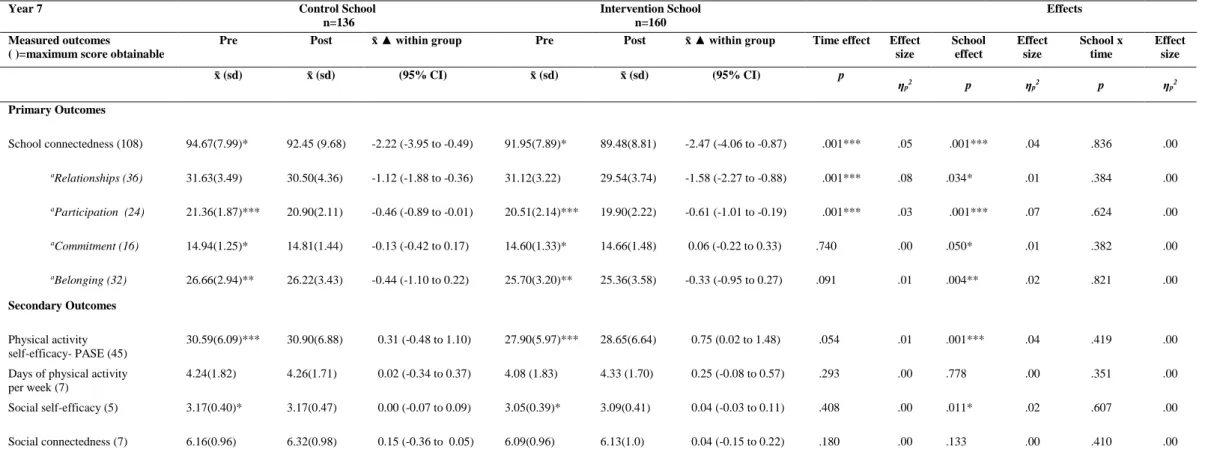
Although matched on the Schools and Family Occupation (SFO) indices, differences were evident at baseline in school connectedness scores between the intervention and the control school (t=(311)=-2.80, p=.05). Differences were also apparent at baseline in the school connectedness sub-categories of participation, commitment and belonging (Table 2).
Despite the absence of school-by-time interactions, the school connectedness of both the intervention and control schools decreased significantly from baseline to post intervention (F(1,294)=15.37, p<.001, ηp2=.05; Table 2). Students at both schools had relatively high school connectedness scores at both baseline and post intervention with scores higher than 89 of a possible 108.
Baseline Predictors of Change in School Connectedness
We tested baseline characteristics for their ability to predict which Year 7 participants would improve school connectedness over the intervention period. Univariate analysis
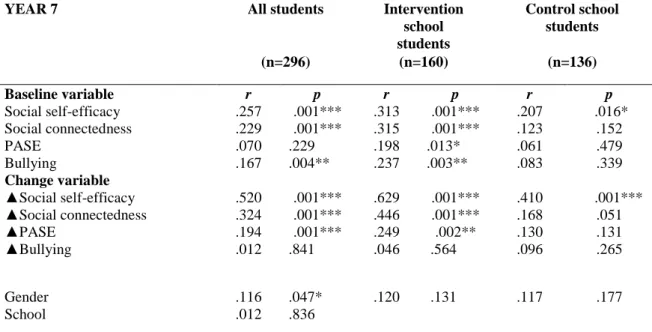
identified a high baseline social self-efficacy score was the largest single predictor of the change in Year 7 school connectedness for all Year 7 students (r=.257, p<.001) and the control school students (r=.207, p=.016; Table 3). Social self-efficacywas defined as an individuals’self -perceived ability to interact with peers in and outside the school environment.
In contrast, social connectedness was the largest single predictor for the intervention school (r=.315, p<.001), with social self-efficacy a similar predictor (r=.313, p<.001; Table 3).Social connectedness was defined as how individuals assessed their contact with friends, and the perceived availability of others to share feelings and trust.
The multiple regression model for all Year 7 students found baseline social self- efficacy, social connectedness, and bullying experiences accounted for only 7.0% of the variance in changes to school connectedness following the intervention (r=.303, p<.001).
Gender was controlled for and explained only 1.0% of variance despite being a significant univariate predictor (r=.116, p=.047). In the stepwise multiple regression model that included gender as a covariate; 6.4% of variance in changes to school connectedness was attributable to baseline social self-efficacy and bullying experiences (r=.289, p<.001).
In the intervention school, the multiple regression model found 12.8% of the variance in changes to school connectedness was determined by social self-efficacy, social
connectedness, bullying and PASE (r=.394; p=.001), with gender accounting for only 0.08%
of this variance (r=.120, p=.133). However, in the stepwise regression model, when gender was controlled for, baseline social self-efficacy and social connectedness remained the only predictors of change in school connectedness for those in the intervention school (r=.365;
p=.001), explaining 11.6% of the variance.
Changes over Time: Predictors of Change in School Connectedness
Potential predictors of change in school connectedness over time were investigated across all Year 7 students (Table 3). The change in school connectedness was greatest in students who improved social self-efficacy, social connectedness, and PASE (Table 3). For all Year 7 students, the multiple and stepwise regression models found the change in social self-efficacy, change in social connectedness, and change in PASE were the significant predictors of change in school connectedness (r=.550, p<.001), accounting for 29.3% of the variance, including only 1% explained by gender (r=.116, p=.047).
In the intervention school, the multiple and stepwise regression model found a total of 43.7% of change in school connectedness could also be predicted by change in social self- efficacy, social connectedness, and PASE (r=.671, p<.001).
In the control school, change in social self-efficacy was the only significant predictor of change in school connectedness (Table 3).
Year 7 Secondary Outcomes
Physical Activity Self-Efficacy (PASE)
There were significant school effects supported by a small effect size for PASE (F(1,294)=12.76, p<.001, ηp2=.04). The intervention school improved more than the control school. However, these were not significant school-by-time changes and there were
significant differences identified at baseline between schools (t=(311)=-3.813, p<.001; Table 2).
Days per Week of Physical Activity
No significant school effects for the self-reported number of days of completing 60 minutes of physical activity were observed (Table 2). Overall, 60% of all Year 7 students reported their participation in days per week of physical activity increased or remained the same over the 8-week period; 40% reported decreases in days per week of physical activity.
Bullying Experiences
A total of 248 of 302 (82%) Year 7 students did not report experiencing any form of bullying at the commencement of the intervention period, one month into the school year.
After the intervention
Note: a =subcategory of school connectedness; xˉ ▲=mean change; measured outcome (108)=maximum score possible; statistically significant differences = *p<.05; **p<.01;
***p<.001; ηp2=partial eta squared effect sizes, small=.01, medium =.06, large=.138 (Cohen, 1988; Tabachnick & Fidell, 2007).
Table 2: Year 7 Primary and Secondary School Outcomes over the 8-Week School-based GLAMA & BLAST Stealth Intervention
Year 7 Control School
n=136
Intervention School n=160
Effects Measured outcomes
( )=maximum score obtainable
Pre Post xˉ ▲ within group Pre Post xˉ ▲ within group Time effect Effect
size
School effect
Effect size
School x time
Effect size
xˉ (sd) xˉ (sd) (95% CI) xˉ (sd) xˉ (sd) (95% CI) p
ηp2 p ηp2 p ηp2
Primary Outcomes
School connectedness (108) 94.67(7.99)* 92.45 (9.68) -2.22 (-3.95 to -0.49) 91.95(7.89)* 89.48(8.81) -2.47 (-4.06 to -0.87) .001*** .05 .001*** .04 .836 .00
aRelationships (36) 31.63(3.49) 30.50(4.36) -1.12 (-1.88 to -0.36) 31.12(3.22) 29.54(3.74) -1.58 (-2.27 to -0.88) .001*** .08 .034* .01 .384 .00
aParticipation (24) 21.36(1.87)*** 20.90(2.11) -0.46 (-0.89 to -0.01) 20.51(2.14)*** 19.90(2.22) -0.61 (-1.01 to -0.19) .001*** .03 .001*** .07 .624 .00
aCommitment (16) 14.94(1.25)* 14.81(1.44) -0.13 (-0.42 to 0.17) 14.60(1.33)* 14.66(1.48) 0.06 (-0.22 to 0.33) .740 .00 .050* .01 .382 .00
aBelonging (32) 26.66(2.94)** 26.22(3.43) -0.44 (-1.10 to 0.22) 25.70(3.20)** 25.36(3.58) -0.33 (-0.95 to 0.27) .091 .01 .004** .02 .821 .00 Secondary Outcomes
Physical activity self-efficacy- PASE (45)
30.59(6.09)*** 30.90(6.88) 0.31 (-0.48 to 1.10) 27.90(5.97)*** 28.65(6.64) 0.75 (0.02 to 1.48) .054 .01 .001*** .04 .419 .00 Days of physical activity
per week (7)
4.24(1.82) 4.26(1.71) 0.02 (-0.34 to 0.37) 4.08 (1.83) 4.33 (1.70) 0.25 (-0.08 to 0.57) .293 .00 .778 .00 .351 .00
Social self-efficacy (5) 3.17(0.40)* 3.17(0.47) 0.00 (-0.07 to 0.09) 3.05(0.39)* 3.09(0.41) 0.04 (-0.03 to 0.11) .408 .00 .011* .02 .607 .00
Social connectedness (7) 6.16(0.96) 6.32(0.98) 0.15 (-0.36 to 0.05) 6.09(0.96) 6.13(1.0) 0.04 (-0.15 to 0.22) .180 .00 .133 .00 .410 .00
Note: ▲Change variable= change over time (post-pre); PASE= physical activity self-efficacy; Dependent variable= change in school connectedness score; significant univariate predictor=*p<.05; **p<.01; ***p<.001
Table 3: Baseline and change factors associated with Year 7 change in school connectedness
period, direct or indirect bullying increased from 18 to 23% of students who reported
experiencing bullying. There were no significant school-by-time interactions, with negligible change in the intervention school showing self-reported male incidences increasing 1% to give a total of 28% and female incidences decreasing 1% to give a total of 22%. In contrast, in the control school bullying increased 9% to give a total of 30% in males and in females there was a 9.3% increase from baseline to give a total of 19.3% reporting being bullied.
Discussion
This study reports the effects of a novel 8-week school-based peer-led school connectedness stealth intervention. This is the first time to our knowledge that a stealth intervention aiming to provide additional physical activity opportunities and potentially impact on physical activity self-efficacy (PASE), in addition to the primary outcome of school connectedness has been conducted during a primary to secondary school transition program.
Year 7 Primary Outcome: School Connectedness
The significant decline in school connectedness for all Year 7 students in both the control and intervention schools in this study was reinforced by the 2015 audit of the Victorian Department of Education and Training (DET) and government schools. The audit investigated the effectiveness of the support provided for children transitioning from primary to secondary school, finding school connectedness declined significantly following the transition to Year 7 (Auditor General, 2015).
YEAR 7 All students Intervention
school students
Control school students
(n=296) (n=160) (n=136)
Baseline variable r p r p r p
Social self-efficacy .257 .001*** .313 .001*** .207 .016*
Social connectedness .229 .001*** .315 .001*** .123 .152
PASE .070 .229 .198 .013* .061 .479
Bullying .167 .004** .237 .003** .083 .339
Change variable
▲Social self-efficacy .520 .001*** .629 .001*** .410 .001***
▲Social connectedness .324 .001*** .446 .001*** .168 .051
▲PASE .194 .001*** .249 .002** .130 .131
▲Bullying .012 .841 .046 .564 .096 .265
Gender .116 .047* .120 .131 .117 .177
School .012 .836
al., 1993), understanding what actually makes an effective transition program in both content and duration becomes increasingly important for teachers and schools alike. The students within both schools had very high levels of school connectedness at baseline
(control=94.67/108; intervention=91.95/108), which provided limited scope to actually increase school connectedness. This may indicate that programs conducted in primary school to support and prepare for this transition may be integral to the success of the initial
transition. It has been found attendance at local primary schools increased the likelihood of smoother transitions into a local high school (Hanewald, 2013). Both the intervention and control school were involved in ‘clusters’ with local primary schools; that is they are linked together through the provision and use of facilities, leadership programs (secondary students work with primary students in sport, literacy and numeracy programs), staff professional development and other educational opportunities. They also work closely to align pre- secondary school orientation programs to ease transition pressures.
The key concern then is maintaining school connectedness after the transition is made and declines occur as they did after just over one term within the secondary school
environment despite a transition program being in place. Research has reported that for school connectedness to be maximised, developmental and social needs of students must be met, including opportunities for autonomy, to demonstrate competence, caring and support from adults, appropriate supervision and acceptance by peers (McNeely, Nonnemaker, &
Blum, 2002)
Additional understanding of the four subcategories used in this study to assess school connectedness (relationships, participation, commitment and belonging) may provide some further insight into connectedness. Relationships may be a key indicator of school
connectedness, with previous findings highlighting that students who come to a school with friendship groups already established, or who are quick to develop positive teacher-student relationships and participate in extra-curricular activities (usually with peers) have greater school connectedness (Blum, 2005; McNeely et al., 2002; Rowe, Stewart, & Patterson, 2007;
Thompson, Iachan, Overpeck, Ross, & Gross, 2006). The development of relationships with peers and teachers when entering school is imperative to the successful adaptation to a new school environment, and provides opportunity for greater school connectedness (Blum, 2005;
Eccles et al., 1989; Libbey, 2004; Monahan et al., 2010).
The opportunity to develop relationships through group activities was one of the fundamental principles underpinning the GLAMA and BLAST intervention which required team work, problem solving and provided a range of social interaction opportunities.
However, as the GLAMA and BLAST program was conducted only once a week over the first terms of the school year, similar to other previously reported transition programs
(Coffey, 2013; Peer Support Australia, 2001), the opportunity for actual development of new and even existing relationships was very limited. Relationships were building on multiple levels, including between Year 7 peers, Year 7 peers and Year 10 leaders, and students and staff. Based on the negative change in school connectedness in this study and previous research that has reported positive changes in school connectedness after interventions that have been conducted over longer periods extending beyond a year, peer mentoring based transition programs such as GLAMA and BLAST may need to be implemented over a longer period of time than a typical transition program. Alternatively, they may require more
intensive contact within each week to maximise opportunities for positive change and the development of each construct of school connectedness, in particular the ability to form and maintain relationships. However, this would require a significant change by schools in how transition programs are typically developed and implemented.
Understanding and manipulating the mentoring component of the GLAMA and BLAST intervention could also provide opportunities to develop school connectedness and
warrants further consideration. Especially given that peer activities both pre-transition and during the first year of secondary school have been previously recognised as important (Lester & Cross, 2015). Peer mentoring has many reported benefits for both mentors and mentees in a range of contexts (Dworkin et al., 2003; Fuchs et al., 1997; Galbraith &
Winterbottom, 2010). Mentoring could be encouraged in schools not only in cross-age contexts such as this intervention but potentially in same-age contexts to build relationships.
Therefore, opportunities may exist to continue the peer-led component of the GLAMA and BLAST program as a whole school approach, or using an integrated curriculum approach rather than just peer mentoring as part of a transition program. This could enable the development of opportunities for school connectedness and building relationships within a wider context. Furthermore, ‘social architecture’ (Lester & Cross, 2015) can be encouraged by schools through camps, extra-curricular activities, meetings of students who share similar interests, as well as recess and lunch-time activities to provide opportunities for both peer mentoring and school connectedness. The impact of such programs on social self-efficacy and social connectedness, baseline predictors of change in school connectedness in this study, would also be encouraged given the increased and diverse interactions between students who choose to be involved in these types of extra-curricular activities.
Social isolation can result from students being teased or bullied within the school and can be a major threat to school connectedness (Blum, 2005). The evidence of a small increase in bullying occurring in both schools during the intervention period was not unexpected and has previously been found to occur in the immediate transition from primary to secondary school (Cross et al., 2009). Students usually endeavour to start their first secondary school experience enthusiastically, wanting to do well and please others; including peers and teachers and establish relationships (Eccles, 1999; Jacobs, Lanza, Osgood, Eccles, &
Wigfield, 2002). As this jostling for peer group approval and position within the hierarchical order is established in a new school, it is possible that over time students become more willing to test boundaries, change relationships and take opportunities to disconnect via increasing adolescent peer pressure and possibly bullying (Pellegrini & Long, 2002).
Therefore, the increased disconnection observed in the Year 7 students in the present study may be part of their acculturation to the new environment.
The consequences of starting to bully another or being bullied is the enhancement of behaviours such as misbehaviour, aggression or social anxiety which can then impact on health outcomes, including school connectedness and mental health (Centre for Disease Control and Prevention, 2009; Pellegrini & Long, 2002). In schools that have formal transition programs, less frequent bullying has been reported than in schools with no
transition programs as the social dynamics are less supportive of such behaviours (Hanewald, 2013). Therefore, schools must consider developing transition programs that draw attention to and limit opportunities for bullying to occur, as well as provide a sustained period of engagement to increase opportunities for school connectedness
Changes in social self-efficacy, social connectedness and PASE over the duration of the intervention were the strongest predictors of change in school connectedness. Therefore, having friends, being able to interact confidently, trusting and having others to share feelings with all may have influenced school connectedness. There were significant differences between schools for social self-efficacy, with improvements recorded in the intervention school and no change in the control school. Although not an interaction effect, the school difference may be attributable to all schools running their own unique transition programs at the start of the school year and the type of transition program being implemented. The
complete challenges and also with other groups and peer leaders in older year levels. This type of interaction may explain why students within the intervention school perceived a higher ability to socially adapt to a range of different contexts in and outside the school, with different people including their peers, possibly peer-leaders and teachers. However, this is an area requiring further investigation.
Year 7 Secondary ‘Stealth’ Outcome- Physical Activity
The majority of all Year 7 students (60%) maintained or increased their reported days of physical activity. Further analysis revealed 40% of females and 30% of males decreased the days of the week on which they were physically active. These findings are in support of previous research reporting that physical activity participation declines during adolescence, especially in girls (Camacho-Miñano, LaVoi, & Barr-Anderson, 2011; Craggs, Corder, van Sluijs, & Griffin, 2011; Dishman, Saunders, Motl, Dowda, & Pate, 2009) and across the school transition period (Garcia, Pender, Antonakos, & Ronis, 1998).
However, in contrast to research which noted declining trends, there were positive trends towards significant time-effects for all Year 7 students’ PASE scores. The increases could be attributed to a greater access to experiences and physical activity opportunities in the secondary school curriculum differing markedly to their primary school experiences.
Additionally, being more socially connected and having associations with a diverse range of people within the school community becomes extremely important to adolescents (Bond, Butler, et al., 2007; Rowe et al., 2007). A potential friendship group expansion during the transition period may facilitate opportunities to engage in more physical activity in organised group activities or sports due to the changing social dynamics synonymous with early
adolescence. Social and peer support are key determinants of physical activity participation and PASE (de la Haye, Robins, Mohr, & Wilson, 2011; Salvy et al., 2009) and potentially, if peer and social support were provided over a longer period of time, it may have elicited higher and sustained PASE.
The significant difference between schools for PASE scores is harder to explain. The control group had higher overall PASE at the commencement and end of the transition period. However, during the 8-week intervention, PASE in the intervention school positively changed twice that of the control school. With almost identical curriculum opportunities available in both sport and physical education classes in each of the schools, the physical activity component of the GLAMA and BLAST program may have had some influence on the school differences and warrants further investigation over a longer timeframe as no school-by-time changes were identified. The ‘process motivators’ involved in the
intervention could have been somewhat influential as the GLAMA and BLAST program included motivators such as challenge, curiosity, choice, cooperation, competition, and social interaction, the intrinsic value of the activities themselves and this possible influence on PASE requires further research.
Limitations
Matching the control and intervention schools on the School and Family Occupation (SFO) index and similar size student populations was a viable option to enable a comparison between schools. Placing a randomised controlled trial (RCT) within the same school would have ensured some homogeneity of participants but disadvantages would have also occurred.
For example, within-school randomisation could possibly lend itself to high levels of
contamination; and the feasibility of engaging a school to implement this type of curriculum based program for only a few students at a specific year level is very low. Unexpectedly, despite the schools being matched for socio-demographics, there were significant baseline differences between schools on several measures. This draws attention to the difficulty in comparing a year level of students across like-schools. The unique characteristics of students and the distinctiveness of each school environment and the programs and curricula they provide make it difficult to generalise these results across all Year 7 school populations.
As the intervention was implemented within curriculum time, Year 7 participation with a leader was consistent each week. There was no weekly preparation required by Year 7 students, just attendance and participation. The greater effectiveness of physical activity interventions implemented within school curriculum time has been previously reported (Lubans, Morgan, Aguiar, & Callister, 2011) and should be given consideration for all future school-based interventions. However, the crowded curriculum makes implementation and continuity difficult (Hardman, 2008) and despite planning for consecutive weeks of the programs, there needs to still be a degree of flexibility to work within the school environment.
The implementation of such an intervention once a week with Year 10 peer leaders was insufficient to elicit a sustainable school connectedness response from Year 7 students.
However, working within the school environment requires adaptability to fit within the school structure and requirements and transition programs are frequently restricted only to the first term of the school year.
The issue that school connectedness has been measured by a variety of constructs has been raised previously (Libbey, 2004). There was only one previous study that validated and used the same questionnaire as the present study to measure school connectedness in a similar adolescent (Year 8 and Year 10 students) cohort (Bond, Butler, et al., 2007) which was found to be unable to demonstrate positive program effects on school connectedness. However, the intervention was specifically focused on decreasing risk-taking behaviours.
Finally, the use of a self-report questionnaire by adolescents, in addition to
completing the questionnaire in a classroom or peer group setting, may affect validity (Fan et al., 2006). However, reliable and previously validated questionnaires were administered using a standardised protocol to minimise these potential influences.
Implications for Schools and Teacher Education
This study supports previous research that school connectedness declines during adolescence. Teachers have a role to play in the success of school transition and along with schools should consider the following:
Schools and Practicing Teachers
• Schools must develop and support an embedded transition program to give students the best opportunity to engage in a new school environment. This starts with building strong relationships with cluster primary schools where familiarisation with staff, resources and curriculum can start to develop and ease the transition process.
• Having a 'program champion' to direct the transition program from within the school has shown to be influential in the success of many school-based interventions
become embedded within the school community. The program champion needs skills to be able to tailor the transition program to the environment, build interest and enthusiasm from both staff and students. The ability to understand that ‘social architecture’ needs to be implicitly planned for within a school and the potential for physical activity to foster school connectedness is essential.
• Schools must decide what is important to include in a transition program. Planning clear and constructive aims beyond wanting to welcome students and make them aware of services available are essential. The aims should enhance connectedness through promoting key behaviours such as building relationships, belonging, commitment and participation for both the student in transition and those already within the school environment (teachers and students). By integrating and requiring outcomes across multiple stakeholders there is potential for greater reach.
• A decline in Year 7 school connectedness was apparent following a total of 14 weeks of schooling. Therefore, schools need to consider how to provide ongoing
opportunities to address the inability of short-term programs to enhance school connectedness. On-going mentoring in same-age, cross-age and importantly cross- curricular context warrants further investigation as it has the potential to achieve more than just a supported transition and development of school connectedness, with benefit for mentees, mentors and staff. Should schools embark on such a non- traditional transition program, it may enable staff to be more receptive to such programs as potentially it may be viewed as having less impact on teaching time if it delivered curriculum learning outcomes as well as building greater connectedness.
Professional Development and Pre-Service Teacher Education
• Professional development for program champions and teachers should include opportunities to understand the need for and how to incorporate process motivators into transition programs that will encourage school connectedness. This will also enable teachers to provide opportunities within their own curriculum areas to promote a school environment that reduces opportunities for bullying, increases engagement between and across year levels, and encourages positive teacher-student relationships.
• Recognising the developmental needs of adolescents (physically, emotionally and cognitively) is essential to implementing effective curriculum, behavioural strategies and programs during not only the transition period but into the classroom over subsequent years. Pre-service teaching programs need to further address this with greater emphasis on providing opportunities to practice embedding all domains of learning into their planning and teaching with diverse groups of adolescents from Year 7-12.
• Ensuring that pre-service teacher education programs consider the pastoral care role that teachers have, with the provision of opportunities to develop an understanding of factors influencing school connectedness is important. This includes the capacity to build and maintain teacher-student relationships that are effective, positive and professional.
• Teachers and pre-service teachers need to select and implement teaching models and strategies that foster connectedness. In learning how to teach, pre-service teachers must be encouraged to try a range of pedagogical approaches and consider how they can promote process motivators such as challenge, curiosity, choice, cooperation, competition, social interaction and intrinsic rewards from participation. Importantly, a range of teaching models such as Peer Teaching, Cooperative Learning, Inquiry-based
Learning, and the Teaching for Personal and Social Responsibility can facilitate the development of intrinsically relevant and rewarding learning opportunities that can promote school connectedness.
Conclusion
To our knowledge there are no interventions that specifically measure school connectedness in a primary to secondary school transition program. Therefore, the unique findings in this study, where we have attempted to develop opportunities for adolescent school connectedness using peer mentoring, physical activity and the adaptation of a
traditional Peer Support Program (PSP), necessitate further consideration as a potential way to enhance the transition experience.
Implementation of transition programs is the responsibility of key staff and the entire school community. Therefore, considerations to enhance school connectedness during the transition period should include: making links between primary and secondary schools to ensure continuity, understanding relevant process motivators, and considering an increased duration of the formal transition program to include embedded cross-curricular integrated approaches that include peer mentoring.
Despite including physical activity opportunities in a modified Peer Support Program, declines in school connectedness were found in this study, thus supporting previous research and the suggestion that a longer time period is needed to influence this outcome. However, the positive PASE trends underline the potential value of stealth interventions in a school environment that fosters physical activity opportunities as well as other health, educational and transition outcomes. Given that school connectedness is a protective factor for many health outcomes, this study certainly affirms the need for further research over a longer period of time.
Acknowledgements
The authors would like to thank both the control and intervention school communities, physical education teachers, Year 10 leaders and Year 7 students who participated in the intervention.
References
Anderman, E. M., & Midgley, C. (1997). Changes in achievement goal orientations, perceived academic competence, and grades across the transition to middle-level schools. Contemporary Educational Psychology, 22(3), 269-298.
https://doi.org/10.1006/ceps.1996.0926
Auditor General. (2015). Education Transitions. Melbourne: Victorian Government Printers.
Bandura, A. (1986). Social Foundations of Thought and Action: A Social Cognitive Theory.
Englewood Cliffs, NJ: Prentice Hall.
Barber, B. K., & Olsen, J. A. (1997). Socialization in context: Connection, regulation, and autonomy in the family, school, and neighborhood, and with peers. Journal of Adolescent Research, 12(2), 287-315. https://doi.org/10.1177/0743554897122008
Battin-Pearson, S., Newcomb, M. D., Abbott, R. D., Hill, K. G., Catalano, R. F., & Hawkins, J. D. (2000). Predictors of early high school dropout: A test of five theories. Journal of Educational Psychology, 92(3), 568-582. https://doi.org/10.1037/0022-
0663.92.3.568
Battistich, V., Schaps, E., & Wilson, N. Effects of an elementary school intervention on students' “connectedness” to school and social adjustment during middle school.
Journal of Primary Prevention, 24(3), 243-262.
https://doi.org/10.1023/B:JOPP.0000018048.38517.cd
Bishop, J. H., Bishop, M., Bishop, M., Gelbwasser, L., Green, S., Peterson, E., . . .
Zuckerman, A. (2004). Why we harass nerds and freaks: A formal theory of student culture and norms. Journal of School Health, 74(7), 235-251.
https://doi.org/10.1111/j.1746-1561.2004.tb08280.x
Blum, R. W. (2005). A case for school connectedness. Educational Leadership, 62(7), 16-20.
Blum, R. W., McNeely, C. A., & Rinehart, P. M. (2002). Improving the odds: The untapped power of schools to improve the health of teens. Minneapolis, MN: University of Minnesota.
Bond, L., Butler, H., Thomas, L., Carlin, J., Glover, S., Bowes, G., & Patton, G. (2007).
Social and school connectedness in early secondary school as predictors of late teenage substance use, mental health, and academic outcomes. Journal of Adolescent Health, 40(4), e9- e18. https://doi.org/10.1016/j.jadohealth.2006.10.013
Bond, L., Wolfe, S., Tollit, M., Butler, H., & Patton, G. (2007). A comparison of the Gatehouse bullying scale and the peer relations questionnaire for students in secondary school. Journal of School Health, 77(2), 75-79.
https://doi.org/10.1111/j.1746-1561.2007.00170.x
Bonny, A. E., Britto, M. T., Klostermann, B. K., Hornung, R. W., & Slap, G. B. (2000).
School disconnectedness: Identifying adolescents at risk. Pediatrics, 106(5), 1017- 1021. https://doi.org/10.1542/peds.106.5.1017
Bouffard, T., Boileau, L., & Vezeau, C. (2001). Students' transition from elementary to high school and changes of the relationship between motivation and academic
performance. European Journal of Psychology of Education, 16(4), 589-604.
https://doi.org/10.1007/BF03173199
Camacho-Miñano, M. J., LaVoi, N. M., & Barr-Anderson, D. J. (2011). Interventions to promote physical activity among young and adolescent girls: a systematic review.
Health Education Research, 40(1), 76-93. doi:10.1093/her/cyr040
Catalano, R. F., Mazza, J. J., Harachi, T. W., Abbott, R. D., Haggerty, K. P., & Fleming, C.
B. (2003). Raising healthy children through enhancing social development in elementary school: results after 1.5 years. Journal of School Psychology, 41(2), 143- 164.
Centre for Disease Control and Prevention. (2009). School Connectedness: Strategies for Increasing Protective Factors Among Youth. Atlanta, GA: US Department of Health and Human Services.
Centres for Disease Control and Prevention. (2008). Fact sheet: Health risk behaviours and academic achievement. Atlanta, GA: US Department of Health and Human Services.
Chapman, R. L., Buckley, L., Sheehan, M., & Shochet, I. (2013). School-based programs for increasing connectedness and reducing risk behavior: A systematic review.
Educational Psychology Review, 25(1), 95-114. https://doi.org/10.1007/s10648-013- 9216-4
Chapman, R. L., Buckley, L., Sheehan, M. C., Shochet, I. M., & Romaniuk, M. (2011). The impact of school connectedness on violent behavior, transport risk-taking behavior, and associated injuries in adolescence. Journal of School Psychology, 49(4), 399-410.