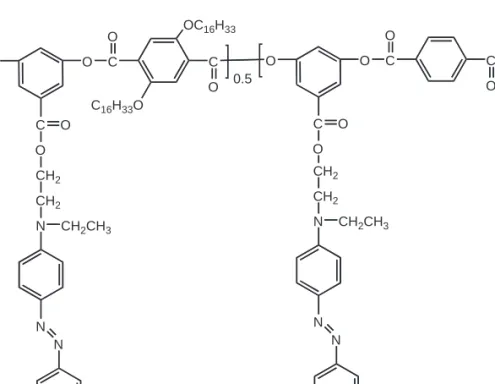
Smart light-responsive materials: Azobenzene-containing polymers and liquid crystals / Yue Zhao and Tomiki Ikeda. Indeed, reversible photoisomerization in azobenzene-containing polymers and liquid crystals allows the use of light as a powerful external stimulus to control or trigger a change in the properties of these two important classes of soft materials.
CONTRIBUTORS
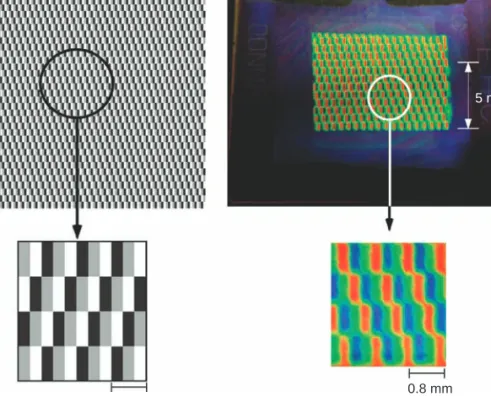
See pages 348–350 for text discussion of this figure. a) Gray mask and (b) color pattern of the Ch LC containing E44, m-azo-8 and chiral obtained by UV irradiation for 10 s through the gray mask at 251C.
AZOBENZENE POLYMERS FOR PHOTONIC APPLICATIONS
INTRODUCTION TO AZOBENZENE
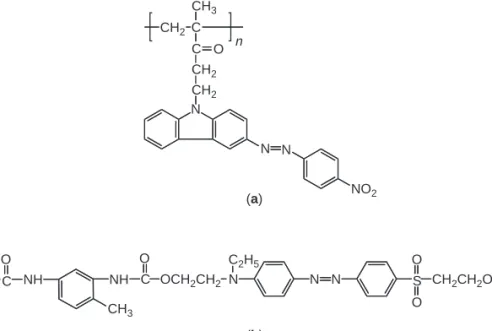
Side and main chain azobenzene polymers have been prepared (Viswanathan et al., 1999) (Fig. 1.5). These polyelectrolyte multilayers (PEMs) are easy to prepare, use benign (all aqueous) chemistry, and are inherently tunable (Decher et al., 1998; Hammond, 1999; . Knoll, 1996).

PHOTOINDUCED MOTIONS AND MODULATIONS
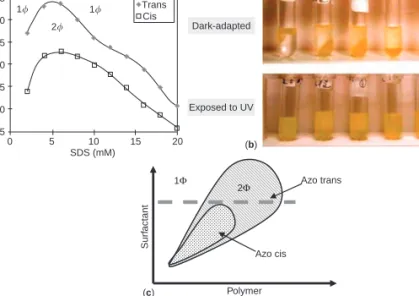
As expected, pulsed (nanosecond) experiments lead to thermal effects, which enhance the motion of the chromophore and thus induce greater birefringence at the same net dose compared to continuous wave (cw) experiments (Cimrova´ et al., 2002; Hildebrandt et al., 1998). Critical micelle concentration (cmc) and surface activity can also be modified (Yang et al., 1995).
INTRODUCTION
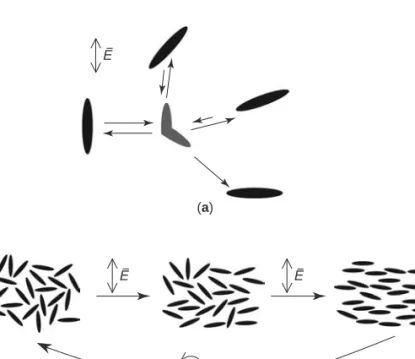
The question of the interplay of molecular orientation and their translational motion also remains unclear. Moreover, the glass transition of the materials is quite low, which leads to low stability of the photoinduced structures. To the authors' knowledge, not many results have been published that are up to date.
Where possible, they have commented on different mechanisms for the relief formation in these materials. They have particularly emphasized the role of the matrix for the light-driven mass transport. In summary, the authors derive the advantages and disadvantages of the new supramolecular materials for photoinduced orientation and SRG formation.

PHOTOORIENTATION
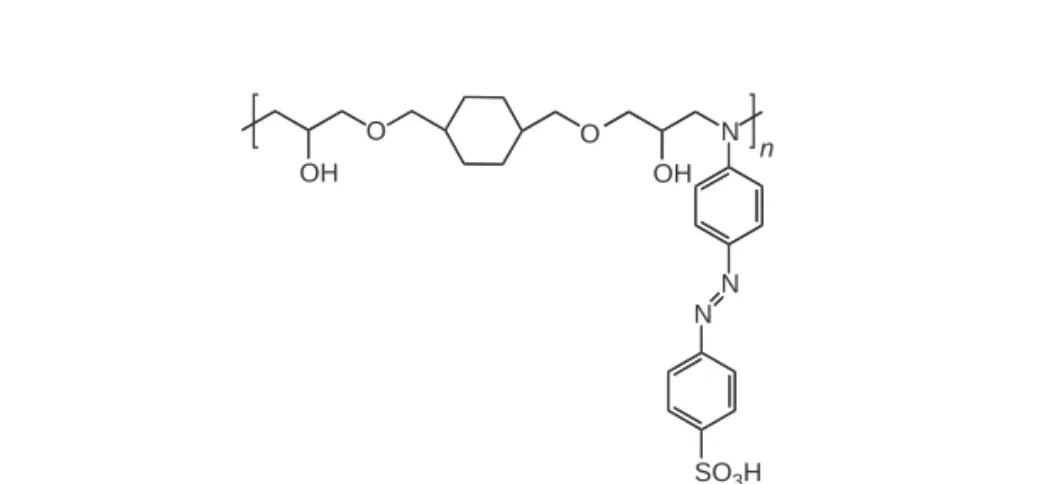
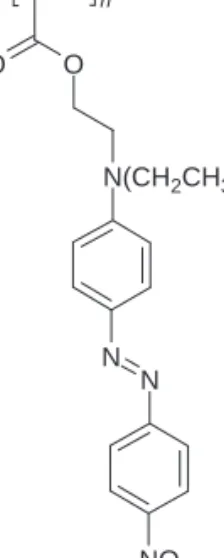
A relatively high dichroic ratio of up to 2.3 has been achieved due to the geometry of the molecule (high aspect ratio of Direct Red 80) (Advincula et al., 2003). Some indications of the influence of the ionic azobenzene derivative structure (Fig. 2.7) and polyelectrolyte can be derived from a number of investigated azobenzene derivatives (Ziegler et al., 2002). Other examples of the photosensitive complexes can be found in a study by Zakrevskyy et al.
Induction of optical anisotropy in spin-coated films by the ISA complexes under irradiation with polarized light from an Ar + laser was very efficient (Zakrevskyy et al., 2007). To the authors' knowledge, this is the highest value of photoinduced anisotropy. Induction of optical phase gratings in films by the azobenzene-containing ISA complexes was also observed.
SURFACE RELIEF GRATINGS
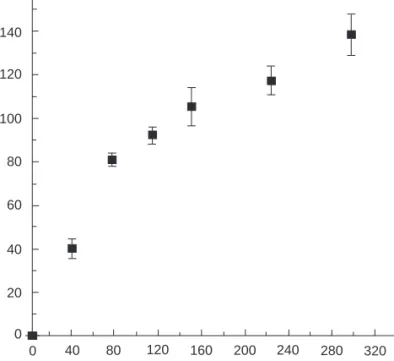
The dependence of the achieved relief height on the number of double layers is shown in the figure. In contrast to the results with Congo Red (He et al., 2000), we observed a strong dependence on the polarization configuration of the writing beams for the layers with Brilliant. Yellow (Zucolotto et al., 2003). At the same time, SRGs could be easily inscribed on spin-coated layers of the same polymer (Lee et al., 2000).
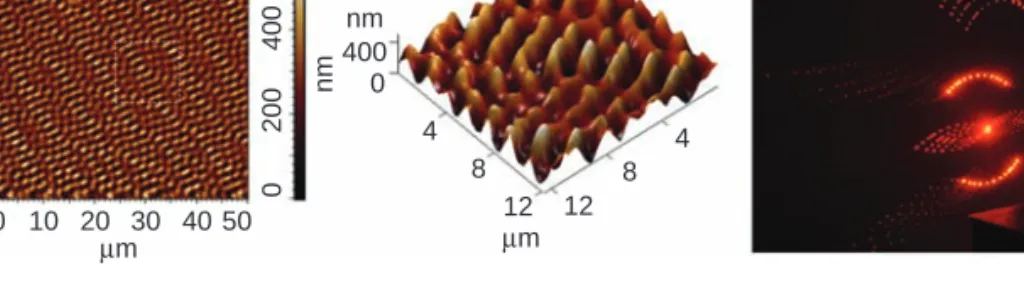
For example, the LbL stacking structure of PDADMAC/(Congo Red) films has been suggested to produce a constrained geometry to improve the stability of the Congo Red Z-isomer (He et al., 2000). Intermolecular interactions have been shown to be a convenient means of reducing the tendency of molecules to aggregate (Priimagi et al. The topology of the lattice is presented on the left, a cutout of the lattice in a 3-D view in the middle, and a photograph of diffraction with the lattice on the right. Source: Kulikovska et al. , 2008b.
CONCLUSION AND OUTLOOK
Surface relief frits and photoinduced birefringence in layer-by-layer films of chitosan and an azopolymer. The role of azopolymer/dendrimer layer-by-layer film architecture in photoinduced birefringence and the formation of surface relief friezes. Thermally stable holographic surface relief gratings and switchable optical anisotropy in films of an azobenzene-containing polyelectrolyte.
Photo-induced fabrication of surface relief gratings in alternative self-assembled films containing azo dye and alignments of LC molecules. Nanofabrication of surface relief gratings on azo dye films using prism-based evanescent wave interference. Molecular engineering strategies for layer-by-layer control of photo-induced birefringence and surface-relief gratings in azopolymer films.
INTRODUCTION
In order for polymers to be responsive to light, they must be equipped with photosensitive functional groups or fillers. Incorporation of such photosensitive groups or molecules into a tailored polymer environment combined with a functionalization process is a well-established strategy to transfer effects from the molecular level to those that are macroscopically visible. A modest change in shape of just a few angstroms, however, quickly magnifies and triggers a cascade of larger and larger shape changes and chemical changes that ultimately culminate in an electrical signal to the brain of a vision event.
Here, the energy of the input photon is amplified thousands of times in the process. Therefore, this chapter describes various photodeformable polymer systems containing azobenzenes, such as polymer gels, solid films, and liquid crystals (LCs), focusing on light-sensitive LC elastomers (LCEs), which are recently developed photomechanical systems. Other photodeformable polymer systems such as colloidal particles and monolayers, for which good reviews are included in the following chapters, are skipped here.
PHOTODEFORMABLE MATERIALS BASED ON AZOBENZENE- CONTAINING POLYMER GELS
In the past 30 years, there have been few reports on photoinduced shape or volume changes in polymer gels, except for Irie and Suzuki et al. During unloading, irradiation of the gels with UV light was found to increase the release of water from the swollen gels and reduce the water content of the gels by as much as 20%–30%. Irradiation of laser light with a wavelength of 405 nm caused a local change in the volume of the gels due to the deformation of the network structure, and the volume change was reversible by irradiation with visible light or heat.
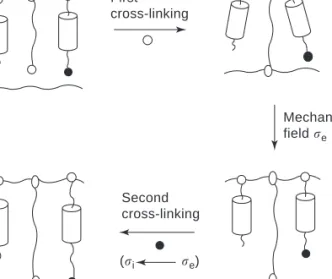
The viscoelastic properties of the gels before and after light irradiation were also investigated, and a twofold increase in the storage modulus of the gels was observed upon irradiation with 405 nm laser light (Hosono et al., 2007). For all three systems, irradiation with UV light induced expansion of the gels, and visible light the opposite. It is inferred that such efficient molecule-to-material transformation can be attributed to the dynamic nature of the cross-linkers (Sakai et al., 2007).
PHOTODEFORMABLE MATERIALS BASED ON AZOBENZENE-CONTAINING SOLID FILMS
This effect is attributed to the photochemical structural change of the azobenzene group absorbed by the nylon fibers. Eisenbach (1980) investigated the photomechanical effect of poly(ethyl acrylate) networks (3) cross-linked with azobenzene groups and noted that the polymer network contracted when exposed to UV light (caused by the trans–..cis isomerization of the azobenzene cross). -left) and expanded upon visible light irradiation (caused by cis-trans back isomerization; Figure 3.5). This photomechanical effect is mainly due to the conformational change of the azobenzene crosslinks by the trans-cis isomerization of the azobenzene chromophore.
The initial expansion of azobenzene polymer films with a thickness of 25 to 140 nm was irreversible and was 1.5%–4%. Subsequent irradiation with lmax=356 nm light causes the release of the polymer and conversion to the all-cis conformation. The photomechanical effect is attributed to the reversible change between the highly aggregated and dissociated state of the azobenzene groups (Figure 3.8) (Kim et al., 2005a,b,c).

PHOTODEFORMABLE MATERIALS BASED ON AZOBENZENE-CONTAINING LCs
Fibers were drawn from a melt of the polymer and a cross-linking agent, 4,4u-methylenebis(phenylisocyanate) (MDI). A polarization change induced at the irradiated sites can lead to a change in the alignment of the ferroelectric LCs. The azobenzene with a cyclic carbonate is quite effective in inducing the photochemical polarization change of the ferroelectric LC mixture (Negishi et al., 1996a).
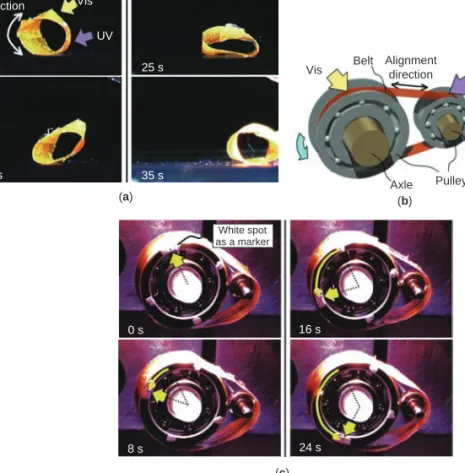
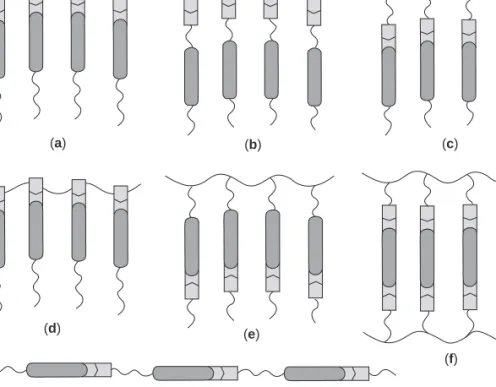
The film deflected towards the irradiation source in a direction parallel to the polarization of the light. Photographs of the monodomain LCE films with different cross-linking densities exhibiting photoinduced bending and unbending behavior. Most recently, Ikeda and colleagues prepared a continuous ring of the LCE film by connecting both ends of the film (Yamada et al., 2008).
SUMMARY AND OUTLOOK
Effect of carbochain length on the phase behavior of side chain cholesteric liquid crystalline elastomers. How the initial alignment of mesogens affects the photoinduced bending behavior of liquid crystalline elastomers. Photoinduced deformation behavior of cross-linked liquid crystalline polymer films of azobenzene with unimorph and bimorph structure.
Effect of non-mesogenic cross-linking units on the mesogenic properties of cholesteric liquid crystalline elastomers with side chains. Effect of crosslink density on photoinduced bending behavior of oriented liquid crystalline network films containing azobenzene. Influence of molecular parameters on the elastic and viscoelastic properties of liquid crystalline elastomers with side chains.
AMORPHOUS AZOBENZENE POLYMERS FOR LIGHT-INDUCED
SURFACE MASS TRANSPORT
Observations of a double-frequency orientation grid under a normal SRG have also been reported (Schaller et al., 2003). An optical field vector component in the direction of light modulation (hence mass transport) seems necessary (Bian et al., 1998). The thermal erasure of the SRG, with the associated growth of the DG, has been measured (Geue et al., 2003) and modeled (Pietsch, 2002).
In fact, the molecular version formed lattices faster than its corresponding polymer (Ando et al., 2003). In dendrimer systems, the quality of SRG depends on the number of generations (Archut et al., 1998). For example, it was found that illumination with red light (outside the azo absorption band) made DGs (formed under SRG) stable against thermal erasure (Geue et al., 2002a).
MECHANISM
The assumption of an anisotropic deformation is very consistent with experimental observations (Bublitz et al., 2000). One of the first mechanisms to be introduced was the suggestion of Barrett et al. However, a system can be used where cross-linking enables permanent fixation of surface patterns (Zettsu et al., 2001).
The process, of course, has been suggested as an optical mechanism of data storage (Egami et al., 2000). This formed a large number of very long (several millimeters) but extremely thin (200 nm) parallel metal wires (Noel et al., 1996). This process appears to be enhanced by the presence of gold nanoislands (Hasegawa et al., 2002).
CONCLUSIONS
Comparative studies of the formation of surface relief lattices of amorphous molecular material versus vinyl polymer. Photoinduced formation of the surface relief lattice on azobenzene polymers: analysis based on fluid mechanics. Atomic force microscopy inspection of the early formation state of polymer surface relief lattices.
Investigation of the orientation of azobenzene side groups in polymer surface relief lattices by photoelectron spectroscopy. Analyzes of refractive efficiency, birefringence and surface relief gratings on polymer films containing azobenzene. A detailed investigation of the polarization-dependent process of forming a relief grating on azo polymer films.