2
© AP Images/PRNewsFoto/Marshall & Ilsley Corporation
What you will be able to do once you complete this chapter:
Learning Objectives
1
Understand what is meant by business ethics.2
Identify the types of ethical concerns that arise in the business world.3
Discuss the factors that affect the level of ethical behavior in organizations.4
Explain how ethical decision making can be encouraged.5
Describe how our current views on the social responsibility of business have evolved.6
Explain the two views on the social responsibility of business and understand the arguments for and against increased social responsibility.7
Discuss the factors that led to the consumer movement and list some of its results.8
Analyze how present employment practices are being used to counteract past abuses.9
Describe the major types of pollution, their causes, and their cures.10
Identify the steps a business must take to implement a program of social responsibility.Being Ethical and
Socially Responsible
Did You Know?
Divine Chocolate, which makes premium chocolate bars, is partly owned by 45,000 Fairtrade cocoa growers in Ghana.
FYI
Divine Chocolate’s Recipe for Sales and Social Responsibility
Divine Chocolate has cooked up an unusual yet highly effective recipe for sales success and social responsibility. Competing against global giants such as Nestlé and Mars, Divine Chocolate has not only made a name for itself in the world of premium chocolate but has also improved the lives of thousands of cocoa farmers throughout Ghana.
The company’s roots go back to the mid-1990s, when Ghana’s government began allowing local companies to buy locally produced cocoa for resale in world markets. Seeing this as an opportunity to improve profits by banding together, several hundred small producers united in a cooperative association they named Kuapa Kokoo (good cocoa growers). Soon Kuapa Kokoo was certified to supply Fairtrade cocoa, meaning the growers were meeting high standards for cocoa quality, using earth-friendly production methods, and complying with requirements for safe and healthy working conditions.
Once Kuapa Kokoo’s growers had achieved Fairtrade certification, they were guaranteed above-market prices for their cocoa beans. Members voted to use the extra money for dig- ging new wells, opening day-care facilities, and funding other projects in their villages. The group also reinvested to build the business by expanding warehousing and conducting agri- cultural education programs for members. As word of Kuapa Kokoo’s accomplishments spread, thousands of new members joined, which in turn brought the financial and social benefits to additional villages.
By 1998, Kuapa Kokoo was ready to embark on an even more ambitious business venture.
With investments from several sources—including a trading company and the socially respon- sible Body Shop retail chain—the group formed Day Chocolate, based in London, to manufacture and market premium Divine Chocolate bars using the growers’ finest Fairtrade cocoa. Because Kuapa Kokoo was part-owner, its members received a share of the profits from each Divine Chocolate bar sold.
In 2007, the U.K. company changed its name to Divine Chocolate and secured investments to start a new business in the United States. Like its U.K. counterpart, the U.S. Divine Chocolate began selling its Fairtrade chocolate bars through specialty food stores and upscale supermar- kets. Today Kuapa Kokoo’s 45,000 members produce 10 percent of Ghana’s cocoa exports, and the profits from sales of Divine Chocolate are making a real difference to members in more than 1,200 villages.1
inside business
O
bviously, organizations like Divine Chocolate want to be recognized as responsible corporate citizens. Such companies recognize the need to harmonize their operations with environmental demands and other vital social concerns. Not all firms, however, have taken steps to encourage a consideration of social responsibility and ethics in their decisions and day-to-day activities.Some managers still regard such business practices as a poor investment, in which the cost is not worth the return. Other managers—indeed, most managers—
view the cost of these practices as a necessary business expense, similar to wages or rent.
Most managers today, like those at Divine Chocolate, are finding ways to balance a growing agenda of socially responsible activities with the drive to gener- ate profits. This also happens to be a good way for a company to demonstrate its values and to attract like-minded employees, customers, and stockholders. In a highly competitive business environment, an increasing number of companies are,
like Divine Chocolate, seeking to set themselves apart by developing a reputation for ethical and socially responsible behavior.
We begin this chapter by defining business ethics and examining ethical issues.
Next, we look at the standards of behavior in organizations and how ethical behav- ior can be encouraged. We then turn to the topic of social responsibility. We compare and contrast two present-day models of social responsibility and present arguments for and against increasing the social responsibility of business. We then examine the major elements of the consumer movement. We discuss how social responsibility in business has affected employment practices and environmental concerns. Finally, we consider the commitment, planning, and funding that go into a firm’s program of social responsibility.
Business Ethics Defined
Ethics is the study of right and wrong and of the morality of the choices individuals make. An ethical decision or action is one that is “right” according to some stan- dard of behavior. Business ethics is the application of moral standards to business situations. Recent court cases involving unethical behavior have helped to make business ethics a matter of public concern. In one such case, Copley Pharmaceutical, Inc., pled guilty to federal criminal charges (and paid a $10.65 million fine) for falsifying drug manufacturers’ reports to the Food and Drug Administration.
In another much-publicized case, lawsuits against tobacco companies have led to $246 billion in settlements, although there has been only one class-action lawsuit filed on behalf of all smokers. The case, Engle v. R. J. Reynolds, could cost tobacco companies an estimated $500 billion. In yet another case, Adelphia Communications Corp., the nation’s fifth-largest cable television company, agreed to pay $715 million to settle federal investigations stemming from rampant earn- ings manipulation by its founder John J. Rigas, and his son, Timothy J. Rigas.
Prosecutors and government regulators charged that both father and son had misap- propriated Adelphia funds for their own use and had failed to pay the corporation for securities they controlled. John Rigas and Timothy Rigas are serving 12 years and 17 years in prison, respectively. John Rigas applied for a presidential pardon in January 2009, but George W. Bush left office without making a decision on Rigas’ request.2
Ethical Issues
Ethical issues often arise out of a business’s relationship with investors, customers, employees, creditors, or competitors. Each of these groups has specific concerns and usually exerts pressure on the organization’s managers. For example, inves- tors want management to make sensible financial decisions that will boost sales, profits, and returns on their investments. Customers expect a firm’s products to be safe, reliable, and reasonably priced. Employees demand to be treated fairly in hiring, promotion, and compensation decisions. Creditors require accounts to be paid on time and the accounting information furnished by the firm to be accurate.
Competitors expect the firm’s competitive practices to be fair and honest. Consider TAP Pharmaceutical Products, Inc., whose sales representatives offered every urolo- gist in the United States a big-screen TV, computers, fax machines, and golf vaca- tions if the doctors prescribed TAP’s new prostate cancer drug Lupron. Moreover, the sales representatives sold Lupron at cut-rate prices or gratis while defrauding Medicare. Recently, the federal government won an $875 million judgment against TAP when a former TAP vice president of sales, Douglas Durand, and Dr. Joseph Gerstein blew the whistle.3
In late 2006, Hewlett-Packard Co.’s chairman, Patricia Dunn, and general coun- sel, Ann Baskins, resigned amid allegations that the company used intrusive tactics in observing the personal lives of journalists and the company’s directors, thus tarnishing Hewlett-Packard’s reputation for integrity. According to Congressman
ethics the study of right and wrong and of the morality of the choices individuals make business ethics the application of moral standards to business situations
Understand what is meant by business ethics.
1
Identify the types of ethical concerns that arise in the business world.
2
© AP Images /Mary Altaff er
John Dingell of Michigan, “We have before us witnesses from Hewlett-Packard to discuss a plunderers’ operation that would make (former president) Richard Nixon blush were he still alive.” Alternatively, consider Bernard Madoff, former stockbroker, financial advisor, and chairman of the NASDAQ stock exchange. In 2009, he was convicted of securities and other frauds including a Ponzi scheme that defrauded clients of $65 billion.
Businesspeople face ethical issues every day, and some of these issues can be difficult to assess. Although some types of issues arise infrequently, others occur regularly. Let’s take a closer look at several ethical issues.
Fairness and Honesty
Fairness and honesty in business are two important ethical concerns. Besides obeying all laws and regulations, businesspeople are expected to refrain from knowingly deceiving, misrepresenting, or intimidating others. The consequences of failing to do so can be expensive. Recently, for example, Keith E. Anderson and Wayne Anderson, the leaders of an international tax shelter scheme known as Anderson’s Ark and Associates, were sentenced to as many as 20 years in prison.
The Andersons; Richard Marks, their chief accounting officer; and Karolyn Grosnickle, the chief administrative officer, were ordered to pay more than
$200 million in fines and restitution.4 In yet another case, the accounting firm PricewaterhouseCoopers LLP agreed to pay the U.S. government $42 million to resolve allegations that it made false claims in connection with travel reimburse- ments it collected for several federal agencies.5
Deere & Company requires each employee to deal fairly with its customers, suppliers, competitors, and employees. “No employee should take unfair advantage of anyone through manipulation, concealment, abuse of privileged information, misrepresentation of material facts or any other unfair dealing practice.” Employees are encouraged to report possible violations of company ethics policies using a 24-hour hotline or anonymous e-mails.6
Personal data security breaches have become a major threat to personal privacy in the new millennium. Can businesses keep your personal data secure?
Organizational Relationships
A businessperson may be tempted to place his or her personal welfare above the welfare of others or the welfare of the organization. For example, in late 2002, former CEO of Tyco International, Ltd, Leo Dennis Kozlowski, was indicted for misappropriating
$43 million in corporate funds to make philanthropic contributions in his own name, including $5 million to Seton Hall University, which named its new business-school building Kozlowski Hall. Furthermore, according to Tyco, the former CEO took $61.7 million in interest-free relocation loans without the board’s permission. He allegedly used the money to finance many personal luxuries, including a $15 million yacht and a $3.9 million Renoir painting, and to throw a
$2 million party for his wife’s birthday. Mr. Kozlowski, currently serving up to 25 years in prison, paid
$134 million in restitution to Tyco and criminal fines of $70 million. In 2009, the U.S. Supreme Court denied his petition for a judicial review.7
Relationships with customers and co-workers often create ethical problems. Unethical behavior in these areas includes taking credit for others’ ideas or work, not meeting one’s commitments in a mutual agreement, and pressuring others to behave unethically.
Meet New York Governor, David Paterson, arriving at his office on March 5, 2010. A state ethics panel accused him of seeking and accepting World Series tickets from the New York Yankees in 2009 despite a gift ban, then lying to the panel about it.
Conflict of Interest
Conflict of interest results when a businessperson takes advantage of a situation for his or her own personal interest rather than for the employer’s interest. Such conflict may occur when payments and gifts make their way into business deals. A wise rule to remember is that anything given to a person that might unfairly influence that person’s business decision is a bribe, and all bribes are unethical.
For example, Nortel Networks Corporation does not permit its employees, officers, and directors to accept any gifts or to serve as directors or officers of any organization that might supply goods or services to Nortel Networks. However, Nortel employees may work part-time with firms that are not competitors, suppli- ers, or customers. At AT&T, employees are instructed to discuss with their supervi- sors any investments that may seem improper. Verizon Communications forbids its employees and executives from holding a “significant” financial stake in vendors, suppliers, or customers.
At Procter & Gamble Company (P&G), all employees are obligated to act at all times solely in the best interests of the company. A conflict of interest arises when an employee has a personal relationship or financial or other interest that could interfere with this obligation, or when an employee uses his or her position with the company for personal gain. P&G requires employees to disclose all potential conflicts of interest and to take prompt actions to eliminate a conflict when the company asks them to do so. Generally, it is not acceptable to receive gifts, enter- tainment, or other gratuities from people with whom P&G does business because doing so could imply an obligation on the part of the company and potentially pose a conflict of interest.
Communications
Business communications, especially advertising, can present ethical questions. False and misleading advertising is illegal and unethical, and it can infuriate customers.
Sponsors of advertisements aimed at children must be especially careful to avoid misleading messages. Advertisers of health-related products also must take precau- tions to guard against deception when using such descriptive terms as low fat, fat free, and light. In fact, the Federal Trade Commission has issued guidelines on the use of these labels.
Factors Affecting Ethical Behavior
Is it possible for an individual with strong moral values to make ethically ques- tionable decisions in a business setting? What factors affect a person’s inclina- tion to make either ethical or unethical decisions in a business organization?
Although the answers to these questions are not entirely clear, three general sets of factors do appear to influence the standards of behavior in an organization.
As shown in Figure 2.1, the sets consist of individual factors, social factors, and opportunities.
Individual factors
Social factors
LEVEL OF ETHICAL BEHAVIOR
Opportunity Figure 2.1 Factors that Affect the Level of Ethical Behavior in an Organization
Source: Based on O. C. Ferrell and Larry Gresham, “A Contingency Framework for Understanding Ethical Decision Making in Marketing,” Journal of Marketing (Summer 1985), 89.
Discuss the factors that affect the level of ethical behavior in organizations.
3
Individual Factors Affecting Ethics
Several individual factors influence the level of ethical behavior in an organization.
• Individual knowledge of an issue. How much an individual knows about an issue is one factor. A decision maker with a greater amount of knowledge regarding a situation may take steps to avoid ethical problems, whereas a less-informed person may take action unknowingly that leads to an ethical quagmire.
• Personal values. An individual’s moral values and central, value-related attitudes also clearly influence his or her business behavior. Most people join organiza- tions to accomplish personal goals.
• Personal goals. The types of personal goals an individual aspires to and the manner in which these goals are pursued have a significant impact on that individual’s behavior in an organization. The actions of specific individuals in scandal-plagued companies, such as Adelphia, Arthur Anderson, Enron, Halliburton, Qwest, and WorldCom, often raise questions about individuals’
personal character and integrity.
Social Factors Affecting Ethics
• Cultural norms. A person’s behavior in the workplace, to some degree, is deter- mined by cultural norms, and these social factors vary from one culture to another. For example, in some countries it is acceptable and ethical for customs agents to receive gratuities for performing ordinary, legal tasks that are a part of their jobs, whereas in other countries these practices would be viewed as unethi- cal and perhaps illegal.
• Co-workers. The actions and decisions of co-workers constitute another social factor believed to shape a person’s sense of business ethics. For example, if your co-workers make long-distance telephone calls on company time and at com- pany expense, you might view that behavior as acceptable and ethical because everyone does it.
• Significant others. The moral values and attitudes of “significant others”—
spouses, friends, and relatives, for instance—also can affect an employee’s perception of what is ethical and unethical behavior in the workplace.
Green or Greenwashing?
Is it ethical for a company to say its product is “green” if even the tini- est aspect is not eco-friendly? Many customers seek out goods and services that are considered green because they are made in sus- tainable ways, for example, or are recyclable. But is a product truly green if it is delivered by a jet that burns fossil fuel? What if one or more parts are not biodegradable or the manufacturing operation consumes lots of energy?
The Federal Trade Commission enforces advertising guidelines to ensure that firms do not make misleading environmental claims.
Yet, consumers may believe a company is not doing enough to make its products green or, at the other extreme, is in some way exaggerating—greenwashing—its environmental claims.
To earn and retain the trust of their customers, companies must therefore be as transparent as possible about how green their prod- ucts and processes really are. The outdoor clothing company Pata- gonia is a leader here, disclosing the carbon footprint of many of its products and labeling items that contain non-ecofriendly materi- als. Apple, once a Greenpeace target because some products con- tained environmentally questionable chemicals, is forcing suppliers to replace those materials. The company is polishing its green cre- dentials by publicly reporting its total annual company-wide carbon footprint.
Sources: “Facts Should Match ‘Green’ Image,” MMR, November 16, 2009, 8; Weston Kosova, “It Ain’t Easy Being Green,” Newsweek, September 21, 2009, http://www.newsweek.com/id/215886;
“FTC Cites Kmart, Tender, Dyna-E for False Green Claims,” Environmental Leader, June 10, 2009, http://www.environmentalleader.com; Peter Burrows, “Finally, a Big Green Apple?” BusinessWeek, October 5, 2009, 68–69.
Ethical Challenges &
SUCCESSFUL SOLUTIONS
• Use of the Internet. Even the Internet presents new challenges for firms whose employees enjoy easy access to sites through convenient high-speed connections at work. An employee’s behavior online can be viewed as offensive to co-workers and possibly lead to lawsuits against the firm if employees engage in unethical behavior on controversial Web sites not related to their job. Interestingly, one recent survey of employees found that most workers assume that their use of technology at work will be monitored. A large majority of employees approved of most monitoring methods such as monitoring faxes and e-mail, tracking Web use, and even recording telephone calls.
“Opportunity” as a Factor Affecting Ethics
• Presence of opportunity. Opportunity refers to the amount of freedom an orga- nization gives an employee to behave unethically if he or she makes that choice.
In some organizations, certain company policies and procedures reduce the opportunity to be unethical. For example, at some fast-food restaurants, one employee takes your order and receives your payment, and another fills the order. This procedure reduces the opportunity to be unethical because the per- son handling the money is not dispensing the product, and the person giving out the product is not handling the money.
• Ethical codes. The existence of an ethical code and the importance management places on this code are other determinants of opportunity (codes of ethics are discussed in more detail in the next section).
• Enforcement. The degree of enforcement of company policies, procedures, and ethical codes is a major force affecting opportunity. When violations are dealt with consistently and firmly, the opportunity to be unethical is reduced.
Do you make personal telephone calls on company time? Many individuals do.
Although most employees limit personal calls to a few minutes, some make personal calls in excess of 30 minutes. Whether you use company time and equipment to make personal calls is an example of a personal ethical decision.
Now that we have considered some of the factors believed to influence the level of ethical behavior in the workplace, let us explore what can be done to encourage ethical behavior and to discourage unethical behavior.
Encouraging Ethical Behavior
Most authorities agree that there is room for improvement in business ethics.
A more problematic question is: Can business be made more ethical in the real world? The majority opinion on this issue suggests that government, trade associa- tions, and individual firms indeed can establish acceptable levels of ethical behavior.
Government’s Role in Encouraging Ethics
The government can encourage ethical behavior by legislating more stringent regu- lations. For example, the landmark Sarbanes-Oxley Act of 2002 provides sweeping new legal protection for those who report corporate misconduct. At the signing ceremony, President George W. Bush stated, “The act adopts tough new provisions to deter and punish corporate and accounting fraud and corruption, ensure justice for wrongdoers, and protect the interests of workers and shareholders.” Among other things, the law deals with corporate responsibility, conflicts of interest, and corporate accountability. However, rules require enforcement, and the unethical businessperson frequently seems to “slip something by” without getting caught.
Increased regulation may help, but it surely cannot solve the entire ethics problem.
Trade Associations’ Role in Encouraging Ethics
Trade associations can and often do provide ethical guidelines for their members.
These organizations, which operate within particular industries, are in an excel- lent position to exert pressure on members who stoop to questionable business
Sarbanes-Oxley Act of 2002 provides sweeping new legal protection for employees who report corporate misconduct
Explain how ethical decision making can be encouraged.
4
practices. For example, recently, a pharmaceutical trade group adopted a new set of guidelines to halt the extrava- gant dinners and other gifts sales representatives often give to physicians. However, enforcement and authority vary from association to association. Because trade associations exist for the benefit of their members, harsh measures may be self-defeating.
Individual Companies’ Role in Encouraging Ethics
Codes of ethics that companies provide to their employ- ees are perhaps the most effective way to encourage ethical behavior. A code of ethics is a written guide to acceptable and ethical behavior as defined by an orga- nization; it outlines uniform policies, standards, and punishments for violations. Because employees know what is expected of them and what will happen if they violate the rules, a code of ethics goes a long way toward encouraging ethical behavior. However, codes cannot possibly cover every situation. Companies also must create an environment in which employees recog- nize the importance of complying with the written code.
Managers must provide direction by fostering communication, actively model- ing and encouraging ethical decision making, and training employees to make ethical decisions.
During the 1980s, an increasing number of organizations created and imple- mented ethics codes. In a recent survey of Fortune 1,000 firms, 93 percent of the companies that responded reported having a formal code of ethics. Some companies are now even taking steps to strengthen their codes. For example, to strengthen its accountability, the Healthcare Financial Management Association recently revised its code to designate contact persons who handle reports of ethics violations, to clarify how its board of directors should deal with viola- tions of business ethics, and to guarantee a fair hearing process. S. C. Johnson &
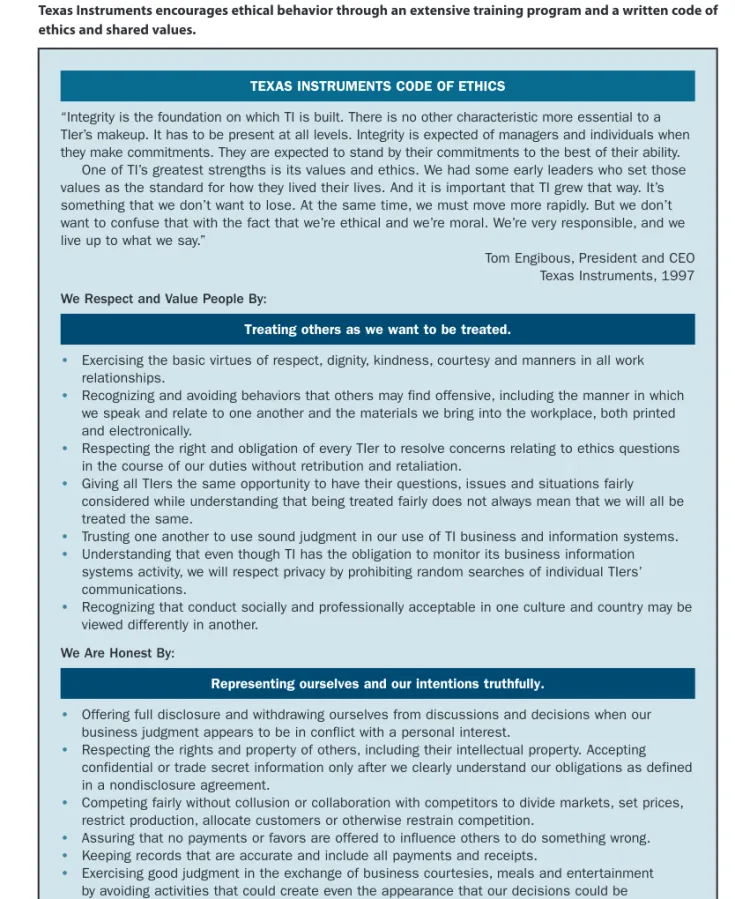
Son, makers of Pledge, Drano, Windex, and many other household products, is another firm that recognizes that it must behave in ways the public perceives as ethical; its code includes expectations for employees and its commitment to consumers, the community, and society in general. As shown in Figure 2.2, the ethics code of electronics giant Texas Instruments (TI) includes issues relating to policies and procedures; laws and regulations; relationships with customers, suppliers, and competitors; conflicts of interest; handling of proprietary informa- tion; and code enforcement.
Assigning an ethics officer who coordinates ethical conduct gives employees someone to consult if they are not sure of the right thing to do. An ethics officer meets with employees and top management to provide ethical advice, establishes and maintains an anonymous confidential service to answer questions about ethical issues, and takes action on ethics code violations.
Sometimes even employees who want to act ethically may find it difficult to do so. Unethical practices can become ingrained in an organization. Employees with high personal ethics may then take a controversial step called whistle-blowing.
Whistle-blowing is informing the press or government officials about unethical practices within one’s organization.
The year 2002 was labeled as the “Year of the Whistle-blower.” Consider Joe Speaker, a 40-year-old acting chief financial officer (CFO) at Rite Aid Corp.
in 1999. He discovered that inventories at Rite Aid had been overvalued and that millions in expenses had not been reported properly. Further digging into Rite Aid’s books revealed that $541 million in earnings over the previous two years was really $1.6 billion in losses. Mr. Speaker was a main government witness
code of ethics a guide to acceptable and ethical behavior as defi ned by the organization whistle-blowing informing the press or government offi cials about unethical practices within one’s organization
Meet Senators Sarbanes and Oxley. The Sarbanes-Oxley Act of 2002 adopted tough new provisions to deter and punish corporate and accounting fraud and corruption. Here, Senator Paul S. Sarbanes and John LaFalce congratulate each other as Senator Michael J. Oxley (middle) looks on. The legislation passed with near unanimous support.
© CONGRESSIONAL QUARTERLY PHOTO BY SCOTT J. FERRELL/Newscom
TEXAS INSTRUMENTS CODE OF ETHICS
“Integrity is the foundation on which TI is built. There is no other characteristic more essential to a TIer’s makeup. It has to be present at all levels. Integrity is expected of managers and individuals when they make commitments. They are expected to stand by their commitments to the best of their ability.
One of TI’s greatest strengths is its values and ethics. We had some early leaders who set those values as the standard for how they lived their lives. And it is important that TI grew that way. It’s something that we don’t want to lose. At the same time, we must move more rapidly. But we don’t want to confuse that with the fact that we’re ethical and we’re moral. We’re very responsible, and we live up to what we say.”
Tom Engibous, President and CEO Texas Instruments, 1997 We Respect and Value People By:
Treating others as we want to be treated.
• Exercising the basic virtues of respect, dignity, kindness, courtesy and manners in all work relationships.
• Recognizing and avoiding behaviors that others may find offensive, including the manner in which we speak and relate to one another and the materials we bring into the workplace, both printed and electronically.
• Respecting the right and obligation of every TIer to resolve concerns relating to ethics questions in the course of our duties without retribution and retaliation.
• Giving all TIers the same opportunity to have their questions, issues and situations fairly considered while understanding that being treated fairly does not always mean that we will all be treated the same.
• Trusting one another to use sound judgment in our use of TI business and information systems.
• Understanding that even though TI has the obligation to monitor its business information systems activity, we will respect privacy by prohibiting random searches of individual TIers’
communications.
• Recognizing that conduct socially and professionally acceptable in one culture and country may be viewed differently in another.
We Are Honest By:
Representing ourselves and our intentions truthfully.
• Offering full disclosure and withdrawing ourselves from discussions and decisions when our business judgment appears to be in conflict with a personal interest.
• Respecting the rights and property of others, including their intellectual property. Accepting confidential or trade secret information only after we clearly understand our obligations as defined in a nondisclosure agreement.
• Competing fairly without collusion or collaboration with competitors to divide markets, set prices, restrict production, allocate customers or otherwise restrain competition.
• Assuring that no payments or favors are offered to influence others to do something wrong.
• Keeping records that are accurate and include all payments and receipts.
• Exercising good judgment in the exchange of business courtesies, meals and entertainment by avoiding activities that could create even the appearance that our decisions could be compromised.
• Refusing to speculate in TI stock through frequent buying and selling or through other forms of speculative trading.
Texas Instruments encourages ethical behavior through an extensive training program and a written code of ethics and shared values.
Source: Courtesy of Texas Instruments, http://www.ti.com/corp/docs/csr/corpgov/conduct.shtml (accessed April 5, 2010).
Figure 2.2 Defining Acceptable Behavior: Texas Instruments’ Code of Ethics
when former Rite Aid Corp. Chairman and CEO Martin L. Grass went on trial.
Mr. Speaker is among dozens of corporate managers who have blown the whistle.
Enron’s Sherron S. Watkins and WorldCom’s Cynthia Cooper are now well-known whistle-blowers and Time magazine’s persons of the year 2002. According to Linda Chatman Thomsen, deputy director for enforcement at the Securities and Exchange
Commission, “Whistle-blowers give us an insider’s perspective and have advanced our investigation immeasurably.”
Whistle-blowing could have averted disaster and prevented needless deaths in the Challenger space shuttle disaster, for example. How could employees have known about life-threatening problems and let them pass? Whistle-blowing, however, can have serious repercussions for employees: Those who “blow whis- tles” sometimes lose their jobs. However, the Sarbanes-Oxley Act of 2002 protects whistle-blowers who report corporate misconduct. Any executive who retaliates against a whistle-blower can be held criminally liable and imprisoned for up to ten years.
Retaliations do occur, however. For example, in 2005, the U.S. Court of Appeals for the 8th Circuit unanimously upheld the right of Jane Turner, a 25-year veteran FBI agent, to obtain monetary damages and a jury trial against the FBI. The court held that Ms. Turner presented sufficient facts to justify a trial by jury based on the FBI’s retaliatory transfer of Ms. Turner from her investigatory position in Minot, North Dakota, to a demeaning desk job in Minneapolis. Kris Kolesnik, executive director of the National Whistle Blower Center, said, “Jane Turner is an American hero. She refused to be silent when her co-agents committed misconduct in a child rape case. She refused to be silent when her co-agents stole property from Ground Zero. She paid the price and lost her job. The 8th Circuit Court did the right thing and insured that justice will take place in her case.” In 2008, the U.S. government was ordered to pay $1 million in legal fees to Turner’s lawyers. In 2010, the Obama administration was attempting to pass a law that would further protect the govern- ment whistle-blowers.8
When firms set up anonymous hotlines to handle ethically questionable situa- tions, employees actually may be more likely to engage in whistle-blowing. When firms instead create an environment that educates employees and nurtures ethical behavior, fewer ethical problems arise. Ultimately, the need for whistle-blowing is greatly reduced.
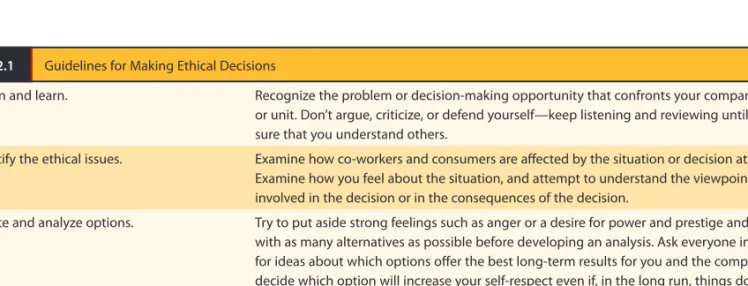
It is difficult for an organization to develop ethics codes, policies, and proce- dures to deal with all relationships and every situation. When no company policies or procedures exist or apply, a quick test to determine if a behavior is ethical is to see if others—co-workers, customers, and suppliers—approve of it. Ethical deci- sions will always withstand scrutiny. Openness and communication about choices will often build trust and strengthen business relationships. Table 2.1 provides some general guidelines for making ethical decisions.
1. Listen and learn. Recognize the problem or decision-making opportunity that confronts your company, team, or unit. Don’t argue, criticize, or defend yourself—keep listening and reviewing until you are sure that you understand others.
2. Identify the ethical issues. Examine how co-workers and consumers are affected by the situation or decision at hand.
Examine how you feel about the situation, and attempt to understand the viewpoint of those involved in the decision or in the consequences of the decision.
3. Create and analyze options. Try to put aside strong feelings such as anger or a desire for power and prestige and come up with as many alternatives as possible before developing an analysis. Ask everyone involved for ideas about which options offer the best long-term results for you and the company. Then decide which option will increase your self-respect even if, in the long run, things don’t work out the way you hope.
4. Identify the best option from your point of view.
Consider it and test it against some established criteria, such as respect, understanding, caring, fairness, honesty, and openness.
5. Explain your decision and resolve any differences that arise.
This may require neutral arbitration from a trusted manager or taking “time out” to reconsider, consult, or exchange written proposals before a decision is reached.
Table 2.1 Guidelines for Making Ethical Decisions
Source: Tom Rusk with D. Patrick Miller, “Doing the Right Thing,” Sky (Delta Airlines), August 1993, 18–22.
Social Responsibility
Social responsibility is the recognition that business activities have an impact on society and the consideration of that impact in business decision making. In the first few days after Hurricane Katrina hit New Orleans, Walmart delivered $20 million in cash (including $4 million to employees displaced by the storm), 100 truckloads of free merchandise, and food for 100,000 meals. The company also promised a job elsewhere for every one of its workers affected by the catastrophe. Obviously, social responsibility costs money. It is perhaps not so obvious—except in isolated cases—that social responsibility is also good business. Customers eventually find out which firms act responsibly and which do not. Just as easily as they can purchase a product made by a company that is socially responsible, they can choose against buying from the firm that is not.
Consider the following examples of organizations that are attempting to be socially responsible:
• Social responsibility can take many forms—including flying lessons. Through Young Eagles, underwritten by S. C. Johnson, Phillips Petroleum, Lockheed Martin, Jaguar, and other corporations, 22,000 volunteer pilots have taken a half million youngsters on free flights designed to teach flying basics and inspire excitement about flying careers. Young Eagles is just one of the growing number of education projects undertaken by businesses building solid records as good corporate citizens.
• The General Mills Foundation, created in 1954, is one of the nation’s larg- est company-sponsored foundations. Since the General Mills Foundation was created, it has awarded more than $420 million to its communities.
In the Twin Cities, the General Mills Foundation provides grants for youth nutrition and fitness, education, arts and culture, social services, and the United Way. Beyond financial resources, the General Mills Foundation also supports organizations with volunteers and mentors who share their expertise and talents. For example, General Mills plays a leadership role in supporting education, arts, and cultural organizations by matching employee and retiree contributions dollar for dollar. General Mills Foundation institutions matched contributions of nearly $1.9 million to eligible accredited educational and employee-supported arts and cultural organizations in 2009. In 2009, the General Mills
Foundation contributed nearly $21 million in grants in its communities.9
• As part of Dell’s commitment to the community, the Dell Foundation contributes significantly to the quality of life in communities where Dell employees live and work. The Dell Foundation supports innova- tive and effective programs that provide fundamen- tal prerequisites to equip youth to learn and excel in a world driven by the digital economy. The Dell Foundation supports a wide range of programs that benefit children from newborn to 17 years of age in Dell’s principal U.S. locations and welcomes proposals from non-profit organizations that address health and human services, education, and technology access for youth.
Dell’s global outreach programs include projects that bring technology to underserved communities around the world. For example, Dell Brazil launched the Digital Citizen Project in 2002 in conjunction with the State Government of Rio Grande do Sul to provide
social responsibility the recognition that business activities have an impact on society and the consideration of that impact in business decision making
Triple Canopy helping the victims of the earthquake in Haiti.
These waterproof tents were donated by Triple Canopy to the GHESKIO Center in Port-au-Prince, Haiti. Here, homeless victims replace hundreds of makeshift shelters with waterproof tents.
© AP Images/PRNewsFoto/Triple Canopy, Inc.
technical education to youth from low-income brackets through the creation of technology computing schools. In 2004, Dell partnered with Weyerhaeuser to deliver computers, keyboards, monitors, printers, and mouse pads to more than 100 schools in Uruguay, where the technology is estimated to benefit more than 32,700 students. In addition, employees in Dell’s Asia–Pacific Customer Center volunteered to create The Smart Village Project, a program to educate students in villages located near Penang, Malaysia. Dell is currently working with the Malaysian government to expand the program to more villages. Globally, the Michael and Susan Dell Foundation has contributed more than $250 million to improve student performance and increase access to education so that all children have the opportunity to achieve their dreams.10
• Improving public schools around the world continues to be IBM’s top social priority. Its efforts are focused on preparing the next generation of leaders and workers. Through Reinventing Education and other strategic efforts, IBM is solving education’s toughest problems with solutions that draw on advanced information technologies and the best minds IBM can apply. Its programs are paving the way for reforms in school systems around the world.
IBM launched the World Community Grid in November 2004. It combines excess processing power from thousands of computers into a virtual supercom- puter. This grid enables researchers to gather and analyze unprecedented quan- tities of data aimed at advancing research on genomics, diseases, and natural disasters. The first project, the Human Proteome Folding Project, assists in iden- tifying cures for diseases such as malaria and tuberculosis and has registered 85,000 devices around the world to date.
In 2009, IBM hosted the first-ever Smarter Planet University Jam. More than 150 IBMers and approximately 2,000 faculty, students, and administrators—from more than 200 universities and research centers world- wide—brainstormed ideas on how technology and business can build a smarter planet. The 72-hour online dialogue centered on five themes: Smart Cities, Smarter Healthcare, Smart Grid, Smart Water Management & Green Planet, and Smarter Planet Skills and Education.11
• General Electric Company (GE) has a long history of supporting the communi- ties where its employees work and live through GE’s unique combination of resources, equipment, and employees’ and retirees’ hearts and souls. Today GE’s responsibility extends to communities around the world.
GE applies its long-standing spirit of innovation and unique set of capa- bilities to take on tough challenges in its communities. The company devotes its efforts in philanthropy to making communities around the world stronger. For example, the GE Foundation reallocated more than $20 million in 2009 to give greater support for organizations providing basic needs, such as food, cloth- ing, and shelter. GE’s Developing Health Globally™ program is working with local communities, health workers, and government ministries in Africa, Latin America, and Asia. It does not just provide usable equipment in rural hospitals and clinics—it also backs this up with capacity building for the equipment’s long-term use, maintenance, and management. Through these efforts, GE can be confident that its donations are not only making a difference, but also that they as a company can learn more about how to develop technologies that meet the demand for health care in challenging environments.12
• With the help of dedicated Schwab volunteers, the Charles Schwab Foundation provides programs and funding to help individuals fill the information gap.
For example, Schwab MoneyWise helps adults teach—and children learn—
the basics of financial literacy. Interactive tools are available at http://
schwabmoneywise.com, and local workshops cover topics such as getting kids started on a budget. In addition to these efforts, widely distributed publications and news columns by foundation President Carrie Schwab Pomerantz promote financial literacy on a wide range of topics—from saving for a child’s education to bridging the health insurance gap for retirees.
The Charles Schwab Foundation matches employee gifts of $25 or more, up to $1,000 per employee during the calendar year. Recently, more than a one-third of Schwab employees participated in this program. In 2009, the Charles Schwab Foundation matched employee donations to 1,838 charitable organizations, for a combined total of $1.87 million.
More than half the employee gifts and matching funds go to educa- tion-related and health and human service charities. Over one-third of total contributions are given to community-service organizations.13
• Improving basic literacy skills in the United States is among the Verizon Foundation’s major priorities because of its enormous impact on education, health, and economic development. Here in the United States, more than 30 million American adults have basic or below average literacy skills.
Thinkfinity.org is designed to improve education and literacy achievement.
This comprehensive free Web site delivers online resources to advance student achievement. Thinkfinity delivers top-quality K-12 lesson plans, student materials, interactive tools, and connections to educational Web sites. It gives teachers, instructors, and parents the tools they need to increase student performance.
Recently, Verizon employees and retirees donated more than 608,000 hours of service and, with the Verizon Foundation, contributed more than $25 million in combined matching gift funds, making Verizon Volunteers one of the largest corporate volunteer incentive programs in the United States.
• ExxonMobil’s commitment to education spans all levels of achievement. One of its corporate primary goals is to support basic education and literacy programs in the developing world. In areas of the world where basic education levels have been met, ExxonMobil supports education programs in science, technology, engineering, and mathematics.
ExxonMobil recognizes the essential role that proficiency in math and science plays not only in the energy business but also in fostering innovation and facilitating human progress. The company encourages new generations to pursue studies and careers in fields involving mathematics and science.
Toward this goal, it supports programs focused on laying the foundation for long-term educational improvements, such as the National Math and Science Initiative and the Mickelson ExxonMobil Teachers Academy.
Recently, more than 24,900 ExxonMobil employees, retirees, and their families worldwide donated more than 690,000 volunteer hours to 5,350 charitable organizations in 30 countries through company-sponsored vol- unteer programs. Of the total volunteers, 14,300 participants donated more than 87,200 hours to more than 1,000 organizations in countries outside the United States. ExxonMobil employees and retirees donated $36 million through ExxonMobil’s matching gift, disaster relief, and employee-giving programs.
When combined with corporate donations, ExxonMobil—together with its employees and retirees —contributed $225 million to community investments around the world.14
• AT&T has built a tradition of supporting education, health and human ser- vices, the environment, public policy, and the arts in the communities it serves since Alexander Graham Bell founded the company over a century ago. Since 1984, AT&T has invested more than $600 million in support of education. Currently, more than half the company’s contribution dol- lars, employee volunteer time, and community-service activities are directed toward education. Since 1911, AT&T has been a sponsor to the Telephone Pioneers of America, the world’s largest industry-based volunteer organiza- tion consisting of nearly 750,000 employees and retirees from the telecom- munications industry. Each year, the Pioneers volunteer millions of hours and raise millions of dollars for health and human services and the environment.
In schools and neighborhoods, the Pioneers strengthen connections and build communities.
In 2009, responding to President Barack Obama’s call to action for all Americans to participate in the annual national day of service, Share Our Strength, AT&T Inc., the Communications Workers of America, and the AT&T Pioneers announced two new programs in the fight against childhood hunger. The text- donation program encourages wireless phone users, including AT&T custom- ers, to donate to Share Our Strength via their mobile phones. In addition, the groups sponsored a nationwide AT&T employee food drive. Share Our Strength, a national organization dedicated to ending childhood hunger, provides support for hundreds of hunger-relief organizations. Donations are used to help provide food for 12.4 million children at risk of hunger in America.15
• At Merck & Co., Inc., the Patient Assistance Program makes the company’s medicines available to low-income Americans and their families at no cost.
When patients do not have health insurance or a prescription drug plan and are unable to afford the Merck medicines their doctors prescribe, they can work with their physicians to contact the Merck Patient Assistance Program. For more than 50 years, Merck has provided its medicines completely free of charge to people in need through this program. Patients can get information through http://www.merck.com; by calling a toll-free number, 1-800-727-5400; or from their physician’s office. For eligible patients, the medicines are shipped directly to their home or the prescribing physician’s office. Each applicant may receive up to one year of medicines, and patients may reapply to the program if their need continues.
Established in 1957, the Merck Company Foundation has contributed more than $560 million to develop and initiate programs that help improve the health and well-being of people around the world. According to Richard T. Clark, chair- man, president, and CEO, “Merck established the Foundation more than 50 years ago because we knew that along with corporate success comes social responsibility.”
Education programs often link social responsibility with corporate self- interest. For example, Bayer and Merck, two major pharmaceuticals firms, promote science education as a way to enlarge the pool of future employees.
Students who visit the Bayer Science Forum in Elkhart, Indiana, work alongside scientists conducting a variety of experiments. Workshops created by the Merck Institute for Science Education show teachers how to put scientific principles into action through hands-on experiments.
These are just a few illustrations from the long list of companies, big and small, that attempt to behave in socially responsible ways. In general, people are more likely to want to work for and buy from such organizations.
The Evolution of Social Responsibility in Business
Business is far from perfect in many respects, but its record of social responsibility today is much better than that in past decades. In fact, present demands for social responsibility have their roots in outraged reactions to the abusive business practices of the early 1900s.
Historical Evolution of Business Social Responsibility
During the first quarter of the 20th century, businesses were free to operate pretty much as they chose. Government protection of workers and consumers was minimal.
As a result, people either accepted what business had to offer or they did without.
Working conditions often were deplorable by today’s standards. The average workweek in most industries exceeded 60 hours, no minimum-wage law existed, and employee benefits were almost nonexistent. Work areas were crowded and unsafe, and industrial accidents were the rule rather than the exception. To improve working conditions, employees organized and joined labor unions. During the early 1900s, however, businesses—with the help of government—were able to use court
5
Describe how our current views on the social responsibility of business have evolved.
orders, brute force, and even the few existing antitrust laws to defeat union attempts to improve working conditions.
During this period, consumers generally were subject to the doctrine of caveat emptor, a Latin phrase meaning
“let the buyer beware.” In other words, “what you see is what you get,” and if it is not what you expected, too bad. Although victims of unscrupulous business practices could take legal action, going to court was very expen- sive, and consumers rarely won their cases. Moreover, no consumer groups or government agencies existed to publicize their consumers’ grievances or to hold sellers accountable for their actions.
Before the 1930s, most people believed that compe- tition and the action of the marketplace would, in time, correct abuses. Government, therefore, became involved in day-to-day business activities only in cases of obvious abuse of the free-market system. Six of the more impor- tant business-related federal laws passed between 1887 and 1914 are described in Table 2.2. As you can see, these laws were aimed more at encouraging competition than at correcting abuses, although two of them did deal with the purity of food and drug products.
The collapse of the stock market on October 29, 1929,
triggered the Great Depression and years of dire economic problems for the United States. Factory production fell by almost half, and up to 25 percent of the nation’s workforce was unemployed. Before long, public pressure mounted for the government to “do something” about the economy and about worsening social conditions.
Soon after Franklin D. Roosevelt became president in 1933, he instituted programs to restore the economy and improve social conditions. The government passed laws to correct what many viewed as the monopolistic abuses of big busi- ness, and provided various social services for individuals. These massive federal programs became the foundation for increased government involvement in the deal- ings between business and society.
As government involvement has increased, so has everyone’s awareness of the social responsibility of business. Today’s business owners are concerned about the return on their investment, but at the same time most of them demand ethical behavior from employees. In addition, employees demand better working condi- tions, and consumers want safe, reliable products. Various advocacy groups echo
Breaking away from fossil fuels. Today’s consumers are more open to transportation alternatives, such as the electric car, because they are concerned about the negative impact of gasoline-run vehicles.
caveat emptor a Latin phrase meaning “let the buyer beware”
© AP Images/PRNewsFoto/ZAP
Interstate Commerce Act (1887) First federal act to regulate business practices; provided regulation of railroads and shipping rates
Sherman Antitrust Act (1890) Prevented monopolies or mergers where competition was endangered
Pure Food and Drug Act (1906) Established limited supervision of interstate sales of food and drugs Meat Inspection Act (1906) Provided for limited supervision of interstate sales of meat and
meat products Federal Trade Commission Act
(1914)
Created the Federal Trade Commission to investigate illegal trade practices
Clayton Antitrust Act (1914) Eliminated many forms of price discrimination that gave large businesses a competitive advantage over smaller firms Table 2.2 Early Government Regulations that Affected American Business
Government Regulation Major Provisions
Six of the important business-related federal laws passed between 1887 and 1914 were aimed more at encouraging competition than at correcting abuses.
these concerns and also call for careful consideration of Earth’s delicate ecological balance. Therefore, managers must operate in a complex business environment—
one in which they are just as responsible for their managerial actions as for their actions as individual citizens. Interestingly, today’s high-tech and Internet-based firms fare relatively well when it comes to environmental issues, worker conditions, the representation of minorities and women in upper management, animal testing, and charitable donations.
Two Views of Social Responsibility
Government regulation and public awareness are external forces that have increased the social responsibility of business. However, business decisions are made within the firm—there, social responsibility begins with the attitude of management. Two contrasting philosophies, or models, define the range of management attitudes toward social responsibility.
The Economic Model
According to the traditional concept of business, a firm exists to produce quality goods and services, earn a reasonable profit, and provide jobs. In line with this concept, the economic model of social responsibility holds that society will benefit most when business is left alone to produce and market profitable products that society needs. The economic model has its origins in the 18th century, when busi- nesses were owned primarily by entrepreneurs or owner-managers. Competition was vigorous among small firms, and short-run profits and survival were the primary concerns.
To the manager who adopts this traditional attitude, social responsibility is someone else’s job. After all, stockholders invest in a corporation to earn a return on their investment, not because the firm is socially responsible, and the firm is legally obligated to act in the economic interest of its stockholders.
Moreover, profitable firms pay federal, state, and local taxes that are used to meet the needs of society. Thus, managers who concentrate on profit believe that they fulfill their social responsibility indirectly through the taxes paid by their firms. As a result, social responsibility becomes the problem of the government, various environmental groups, charitable foundations, and similar organizations.
The Socioeconomic Model
In contrast, some managers believe that they have a responsibility not only to stock- holders but also to customers, employees, suppliers, and the general public. This broader view is referred to as the socioeconomic model of social responsibility, which places emphasis not only on profits but also on the impact of business deci- sions on society.
Recently, increasing numbers of managers and firms have adopted the socio- economic model, and they have done so for at least three reasons. First, business is dominated by the corporate form of ownership, and the corporation is a creation of society. If a corporation does not perform as a good citizen, society can and will demand changes. Second, many firms have begun to take pride in their social respon- sibility records, among them Starbucks Coffee, Hewlett-Packard, Colgate-Palmolive, and Coca-Cola. Each of these companies is a winner of a Corporate Conscience Award in the areas of environmental concern, responsiveness to employees, equal opportunity, and community involvement. Of course, many other corporations are much more socially responsible today than they were ten years ago. Third, many businesspeople believe that it is in their best interest to take the initiative in this area.
The alternative may be legal action brought against the firm by some special-interest group; in such a situation, the firm may lose control of its activities.
6
Explain the two views on the social responsibility of business and understand the arguments for and against increased social responsibility.
economic model of social responsibility the view that society will benefi t most when business is left alone to produce and market profi table products that society needs
socioeconomic model of social responsibility the concept that business should emphasize not only profi ts but also the impact of its decisions on society
The Pros and Cons of Social Responsibility
Business owners, managers, customers, and govern- ment officials have debated the pros and cons of the economic and socioeconomic models for years.
Each side seems to have four major arguments to reinforce its viewpoint.
Arguments for Increased Social Respon- sibility
Proponents of the socioeconomic model maintain that a business must do more than simply seek profi ts. To support their position, they offer the following arguments:1. Because business is a part of our society, it can- not ignore social issues.
2. Business has the technical, financial, and mana- gerial resources needed to tackle today’s com- plex social issues.
3. By helping resolve social issues, business can create a more stable environment for long-term profitability.
4. Socially responsible decision making by firms can prevent increased government intervention, which would force businesses to do what they fail to do voluntarily.
These arguments are based on the assumption that a business has a responsibility not only to its stockholders but also to its customers, employees, suppliers, and the general public.
Arguments Against Increased Social
Responsibility
Opponents of the socioeconomic model argue that business should do what it does best: earn a profi t by manufacturing and marketing products that people want. Those who support this position argue as follows:1. Business managers are responsible primarily to stockholders, so management must be concerned with providing a return on owners’ investments.
2. Corporate time, money, and talent should be used to maximize profits, not to solve society’s problems.
3. Social problems affect society in general, so individual businesses should not be expected to solve these problems.
4. Social issues are the responsibility of government officials who are elected for that purpose and who are accountable to the voters for their decisions.
These arguments obviously are based on the assumption that the primary objec- tive of business is to earn profits and that government and social institutions should deal with social problems.
Table 2.3 compares the economic and socioeconomic viewpoints in terms of business emphasis. Today, few firms are either purely economic or purely socioeco- nomic in outlook; most have chosen some middle ground between the two extremes.
However, our society generally seems to want—and even to expect—some degree of social responsibility from business. Thus, within this middle ground, businesses are leaning toward the socioeconomic view. In the next several sections, we look at some results of this movement in four specific areas: consumerism, employment practices, concern for the environment, and implementation of social responsibility programs.
Sustaining the Planet
Sustainability
What are major companies and non-profit groups doing to pre- serve the environment? Hundreds of organizations, including AT&T, Burt’s Bees, General Mills, Hitachi America, Microsoft, PepsiCo, Union Bank, Vivendi, and Yahoo!, post the latest news about their sustainability initiatives and accomplishments on Corporate Social Responsibility Newswire. Take a look: http://www.csrwire.com/.
© 2010 CSRwire, LLC. All Rights Reserved.
Consumerism
Consumerism consists of all activities undertaken to protect the rights of consumers.
The fundamental issues pursued by the consumer movement fall into three catego- ries: environmental protection, product performance and safety, and information disclosure. Although consumerism has been with us to some extent since the early 19th century, the consumer movement became stronger in the 1960s. It was then that President John F. Kennedy declared that the consumer was entitled to a new
“Bill of Rights.”
The Six Basic Rights of Consumers
President Kennedy’s Consumer Bill of Rights asserted that consum- ers have a right to safety, to be informed, to choose, and to be heard.
Two additional rights added since 1975 are the right to consumer education and the right to courteous service. These six rights are the basis of much of the consumer-oriented legislation passed during the last 45 years. These rights also provide an effective outline of the objectives and accomplishments of the consumer movement.
The Right to Safety
The consumers’ right to safety means that the products they purchase must be safe for their intended use, must include thorough and explicit directions for proper use, and must be tested by the manufacturer to ensure product quality and reliability. There are several reasons why American business fi rms must be concerned about product safety.Corrective Actions Can Be Expensive. Federal agencies, such as the Food and Drug Administration and the Consumer Product Safety Commission, have the power to force businesses that make or sell defective products to take corrective actions. Such actions include offering refunds, recalling defective products, issuing public warnings, and reimbursing consumers—all of which can be expensive.
Increasing Number of Lawsuits. Business firms also should be aware that consumers and the government have been winning an increasing number of product-liability lawsuits against sellers of defective products. Moreover, the amount of the awards in these suits has been increasing steadily. Fearing the outcome of numerous lawsuits filed around the nation, tobacco giants Philip Morris and R. J. Reynolds, which for decades had denied that cigarettes
7
Discuss the factors that led to the consumer movement and list some of its results.
Table 2.3 A Comparison of the Economic and Socioeconomic Models of Social Responsibility as Implemented in Business
Economic Model Primary Emphasis Socioeconomic Model Primary Emphasis
1. Production 1. Quality of life
2. Exploitation of natural resources 2. Conservation of natural resources 3. Internal, market-based decisions Middle
ground
3. Market-based decisions, with some community controls
4. Economic return (profit) 4. Balance of economic return and social return 5. Firm’s or manager’s interest 5. Firm’s and community’s interests 6. Minor role for government 6. Active government
Source: Adapted from Keith Davis, William C. Frederick, and Robert L. Blomstron, Business and Society: Concepts and Policy Issues (New York: McGraw-Hill, 1980), 9. Used by permission of McGraw-Hill Book Company.
consumerism all activities undertaken to protect the rights of consumers
©Monkey Business Images/Shutterstock.com
The right to be informed. The Consumer Bill of Rights asserts consumers’ basic rights. The right to be informed and the right to choose means that consumers must have complete information about a product and a choice of products.
冧 冧
cause illness, began negotiating in 1997 with state attorneys general, plaintiffs’
lawyers, and antismoking activists. The tobacco giants proposed sweeping curbs on their sales and advertising practices and the payment of hundreds of billions of dollars in compensation.
Consumer Demand. Yet another major reason for improving product safety is con- sumers’ demand for safe products. People simply will stop buying a product they believe is unsafe or unreliable.
The Right to Be Informed
The right to be informed means that consumers must have access to complete information about a product before they buy it. Detailed information about ingredients and nutrition must be provided on food containers, information about fabrics and laundering methods must be attached to clothing, and lenders must disclose the true cost of borrowing the money they make available to customers who purchase merchandise on credit.