DOT/FAA/TC-07/24
Federal Aviation Administration William J. Hughes Technical Center Atlantic City International Airport, NJ 08405
Benefits Analysis for the National Traffic Management Log
Tanya Yuditsky, Human Factors Team – Atlantic City Bart Brickman, Northrop Grumman Information Technology
July 2007
Technical Report
This document is available to the public through the National Technical Information Service (NTIS), Springfield, VA 22161. A copy is retained for reference at the William J. Hughes Technical Center Library.
U.S. Department of Transportation Federal Aviation Administration
NOTICE
This document is disseminated under the sponsorship of the U.S. Department of Transportation in the interest of information exchange. The United States Government assumes no liability for the contents or use thereof. The United States Government does not endorse products or manufacturers. Trade or manufacturers' names appear herein solely because they are considered essential to the objective of this report. This document does not constitute Federal Aviation Administration (FAA) certification policy. Consult your local FAA aircraft certification office as to its use.
This report is available at the FAA William J. Hughes Technical Center’s full- text Technical Reports Web site: http://actlibrary.tc.faa.gov in Adobe® Acrobat® portable document format (PDF).
Technical Report Documentation Page 1. Report No.
DOT/FAA/TC-07/24
2. Government Accession No. 3. Recipient’s Catalog No.
4. Title and Subtitle
Benefits Analysis for the National Traffic Management Log
5. Report Date July 2007
6. Performing Organization Code AJP-6110
7. Author(s)
Tanya Yuditsky, Human Factors Team – Atlantic City, ATO-P Bart Brickman, Northrop Grumman Information Technology
8. Performing Organization Report No.
DOT/FAA/TC-07/24 10. Work Unit No. (TRAIS) 9. Performing Organization Name and Address
Federal Aviation Administration
Human Factors Team – Atlantic City, ATO-P William J. Hughes Technical Center
Atlantic City International Airport, NJ 08405
11. Contract or Grant No.
13. Type of Report and Period Covered Technical Report
12. Sponsoring Agency Name and Address Federal Aviation Administration System Operations Services, ATO-R 800 Independence Avenue, S.W.
Washington, DC 20591
14. Sponsoring Agency Code ATO-R
15. Supplementary Notes
16. Abstract
Traffic Management Specialists within the Air Traffic Control (ATC) system strategically manage the flow of air traffic to minimize delays and congestion due to system stressors such as heavy volume, weather, and equipment outages. ATC facilities are required to log all Traffic Management Initiatives (TMIs), coordinate the implementation of some initiatives with the Air Traffic Control System Command Center, and communicate TMIs to Traffic Management Specialists at all affected facilities and to the controllers within their facility. The Federal Aviation Administration developed the National Traffic Management Log (NTML) to provide a single system for automated coordination, logging, and communication of TMIs throughout the National Airspace System. This report describes the results of an empirical comparison of TMI processing with and without the NTML. Researchers observed benefits in completion times, potential for user error, and workload. Furthermore, the completion time and potential for error remained relatively unaffected by TMI complexity. These results suggest that the NTML will continue to provide benefits as ATC complexity increases in the future.
17. Key Words Automation Benefits Analysis Traffic Management
18. Distribution Statement
This document is available to the public through the National Technical Information Service, Springfield, Virginia, 22161. A copy is retained for reference at the William J. Hughes Technical Center Library.
19. Security Classification (of this report) Unclassified
20. Security Classification (of this page) Unclassified
21. No. of Pages 31
22. Price Form DOT F 1700.7 (8-72) Reproduction of completed page authorized
Table of Contents
Page
Executive Summary ...v
1. INTRODUCTION ...1
1.1 Background ...1
1.2 Purpose...1
2. METHODS ...2
2.1 Participants...2
2.2 Materials ...2
2.2.1 Scenarios ...2
2.2.2 Design ...3
2.2.3 Measures ...3
2.3 Procedures...4
3. RESULTS ...5
3.1 Flight Restrictions...5
3.1.1 Time to Complete ...6
3.1.2 Potential for Error ...8
3.1.3 Workload ...11
3.2 Ground Delay Program/Ground Stop ...12
3.2.1 Time to Complete ...13
3.2.2 Potential for Error ...14
3.2.3 Workload ...14
3.3 Delays ...15
3.3.1 Time to Complete ...15
3.3.2 Potential for Error ...15
3.3.3 Workload ...15
4. DISCUSSION ...16
4.1 Flight Restriction Scenarios...16
4.2 Ground Delay Program/Ground Stop Scenarios...17
4.3 Delays Scenarios...17
5. SUMMARY...17
6. CONCLUSIONS...18
Reference ...20
Acronyms ...21 Appendix: NASA-TLX Rating Forms
List of Illustrations
Figures Page
Figure 1. Time required to complete each Flight Restriction scenario... 7
Figure 2. Time savings by subtask for each scenario. ... 8
Figure 3. Number of errors as a function of scenario complexity and use of the NTML... 10
Figure 4. NASA-TLX workload ratings by scenario... 11
Figure 5. Workload subscale ratings for the Flight Restriction scenarios. ... 12
Figure 6. Average workload ratings by subscale for the GDP/Ground Stop scenario. ... 14
Figure 7. Average workload ratings by subscale for the Delays scenario. ... 16
Tables Page Table 1. Complexity Ratings for the Flight Restriction Scenarios ... 6
Table 2. Median, Minimum, and Maximum Completion Times by Subtask ... 7
Table 3. Analysis of Potential Errors for Scenario 1: Pre-NTML Condition ... 9
Table 4. Analysis of Potential Errors for Scenario 1: NTML Condition... 9
Executive Summary
Traffic Management Specialists within the Air Traffic Control (ATC) system strategically manage the flow of air traffic to minimize delays and congestion due to system stressors such as heavy volume, weather, and equipment outages. ATC facilities are required to record, or log, all Traffic Management Initiatives (TMIs). They are also required to coordinate the implementation of some initiatives with the Air Traffic Control System Command Center (ATCSCC) and to communicate the initiatives to Traffic Management Specialists at all affected facilities as well as to controllers within their facility. Every affected facility is then also required to log the
information and communicate it to the controllers.
Until recently, the methods for accomplishing the three tasks of coordination, logging, and communication were highly inefficient, with work duplicated in a number of areas. Logging of TMIs varied from facility to facility. Some facilities relied on paper and pencil, whereas others developed local automation. Coordination was accomplished through verbal communications within the facility and through numerous telephone calls between the ATCSCC and other facilities.
The Federal Aviation Administration developed the National Traffic Management Log (NTML) to provide a single system for automated coordination, logging, and communication of TMIs throughout the National Airspace System. This paper describes an analysis of the savings that the NTML provides in completing these three tasks in terms of time, potential for user error, and workload.
We used structured scenarios of varied complexity to reenact the coordination, logging, and communication of TMIs prior to the NTML and with the NTML. Experienced Traffic Management Specialists served as participants. The results indicate that the NTML provides savings in the time it takes to implement the TMIs, the potential for user error, and workload.
Furthermore, time to completion and potential for user error increase only slightly with increases in complexity.
1. INTRODUCTION
Traffic Management Specialists within the Air Traffic Control (ATC) system strategically manage the flow of air traffic to minimize delays and congestion due to system stressors such as heavy volume, weather, and equipment outages. ATC facilities are required to record, or log, all traffic management initiatives (TMIs). They are also required to coordinate the implementation of some initiatives with the Air Traffic Control System Command Center (ATCSCC) and to communicate the initiatives to Traffic Management Specialists at all affected facilities and to controllers within their facility. Every other facility affected by the TMI is, in turn, also required to log the information and communicate it to the controllers.
Until recently, the methods for accomplishing the three tasks of coordination, logging, and communication were highly inefficient with work duplicated in a number of areas. Logging of TMIs varied from facility to facility. Some facilities relied on paper and pencil, whereas others developed local automation. Coordination was accomplished through verbal communications within the facility and through numerous telephone calls between the ATCSCC and other facilities.
The Federal Aviation Administration (FAA) developed the National Traffic Management Log (NTML) to provide a single system for automated coordination, logging, and communication of TMIs throughout the National Airspace System (NAS). The Human Factors Team – Atlantic City (ATO-P) conducted an analysis of the savings that the NTML provides in completing these three tasks in terms of time, potential for user error, and workload.
1.1 Background
The NTML is an automated system that Traffic Management Specialists use to initiate TMIs, coordinate TMIs with other facilities, log TMIs that they initiated as well as TMIs initiated by other facilities, and communicate the TMI information to other positions in their facility. The system provides savings and advantages in many areas. Previously, a facility initiated a TMI and coordinated it with the ATCSCC through a series of telephone calls, during which each participant verbally communicated and manually recorded detailed information about the initiative. This process was often time consuming, required each participant to make multiple entries of the same TMI information, and created several opportunities for human error. Once coordinated, the TMI information was disseminated within each facility verbally, on paper, electronically, or on a whiteboard. Each method required retyping or rewriting the information.
With NTML, the Specialists use specially designed templates to enter and submit the TMI. It is automatically shared with all affected facilities and can be logged by any facility with a single click. For TMIs that occur frequently, the Specialists can save the entries and recall them as needed. Once coordinated, the TMI information can be easily sent to other positions within the facility and made available to the controllers.
1.2 Purpose
This report describes the results of an empirical comparison of TMI processing with and without the NTML. Participants from the field recreated realistic scenarios during which simple and complex initiatives were processed. They repeated each scenario twice, once using verbal
communication and manual recording methods, and again using the NTML. We measured time to complete, potential for user error, and workload to evaluate the benefits that the NTML provides in completing the tasks of coordination, logging, and communication.
2. METHODS
We used structured scenarios to reenact the coordination, logging, and communication of various types of TMIs prior to NTML and with NTML. We made several assumptions to simplify the procedure: (a) all facilities used a text file for logging TMIs prior to NTML, (b) advanced automation for communicating TMI information within the facilities did not exist, and (c) telephone calls were answered on the first ring. Furthermore, because we were particularly interested in measuring savings, processes and procedures that have remained unchanged were not reenacted. For example, General Information (GI) messages were used to send TMI information to the specialty areas at the Air Route Traffic Control Centers (ARTCCs) before NTML and are still used in exactly the same way today. Therefore, we did not have the participants reenact the task of sending a GI message nor did it contribute to any of our measures.
2.1 Participants
This was a small sample feasibility study. Three experienced Traffic Management Specialists participated in the study. The participants reported having operational experience at a number of FAA ATC facilities including the ATCSCC, ARTCCs, Terminal Radar Approach Control (TRACONs), and Airport Traffic Control Towers (ATCTs). They were all experienced users of the NTML.
2.2 Materials
We conducted the study in a training laboratory at the ATCSCC. Each participant used a personal computer workstation configured with NTML and Enhanced Traffic Management System (ETMS) software. The positions that represented ARTCCs were also configured with the En Route Status Information System (ESIS) software that works with NTML.
2.2.1 Scenarios
A Traffic Management Specialist served as a subject matter expert to develop the scenarios used in the study. The Specialist designed 10 scenarios to represent operationally relevant tasks that Traffic Management Specialists routinely perform in the field. In summary, the scenarios required the participants to initiate and process several TMIs. The scenarios varied in
complexity and required different amounts of interaction among the participants. To obtain data across a wide variety of Traffic Management operations, the scenarios included several TMI types including Flight Restrictions (e.g., mile-in-trail), Ground Delay Programs (GDPs), Ground Stops, and Airport Delays. There were eight Flight Restriction scenarios:
Scenario 1: ARTCC to ARTCC: Four mile-in-trail flight restrictions Scenario 2: ARTCC to TRACON: Two aircraft speed restrictions
Scenario 3: ARTCC to TRACON: One call for release on departures to an airport and one minutes-in-trail flight restriction on traffic arriving at an airport via a fix.
TRACON to ARTCC: One call for release on departures heading to an airport and one time-based metering restriction for arrivals at an airport.
Scenario 4: ARTCC1 to ARTCC2: One mile-in-trail flight restriction ARTCC2 to ARTCC1: Two mile-in-trail flight restrictions Scenario 5: ARTCC1 to ARTCC2: One mile-in-trail flight restriction
ARTCC1 to ARTCC3: Two mile-in-trail flight restrictions ARTCC1 to ARTCC4: One mile-in-trail flight restriction ARTCC2 to ARTCC1: One mile-in-trail flight restriction
Scenario 6: ARTCC1 to ARTCC2 & ARTCC3: Two mile-in-trail flight restrictions ARTCC1 to ARTCC3: One mile-in-trail flight restriction
Scenario 7: ARTCC1 to ARTCC2 & ARTCC3: One route restriction Scenario 8: ARTCC1 to ARTCC2: Two mile-in-trail flight restrictions
ARTCC1 to ARTCC3: Three mile-in-trail flight restrictions There was one GDP and Ground Stop scenario:
Scenario 9: Two GDPs followed by one Ground Stop, and then followed by one more GDP, were issued at 2-min intervals. This scenario included participants at the
ATCSCC, 1 ARTCC, 1 TRACON, and three ATCTs.
There was one Delay scenario:
Scenario 10: Three ATCTs reported delays at 15-min intervals for 75 min. For the purpose of the study, we did not wait 15 min between reports of delays; instead, the
participants continuously provided updates as if time had passed. This scenario included participants at the ATCSCC, one ARTCC, one TRACON, and three ATCTs.
2.2.2 Design
There were two conditions in the study, Pre-NTML and NTML. All participants experienced all scenarios in each of these conditions.
2.2.3 Measures
We collected three types of data to assess the benefits of the NTML: Time to Complete, Potential for Error, and Workload.
Time to Complete
We recorded the total amount of time to complete each of the scenarios in each condition. For the Flight Restriction scenarios, we also recorded the amount of time it took the participants to complete each of the three subtasks: coordination, logging, and communication.
Potential for Error
The error analysis was an estimate of the potential for human error when issuing TMIs. We considered a number of common human errors associated with verbal and text-based
communications for this analysis including speaking mistakes, hearing mistakes, and writing/typographical mistakes. Multiple errors of each type may potentially occur along the way from the initiation of a TMI through the receipt of that information by the controllers. The error analysis did not include an exhaustive list of all possible human errors. Indeed, one of the most common human errors, forgetting, was not included because (a) the potential to forget was present in both conditions and (b) it would be difficult to estimate when forgetting is likely to occur.
Workload
We used the National Aeronautics and Space Administration (NASA)-Task Load Index (TLX) (Hart & Staveland, 1988) to assess how hard the participants were working during each scenario.
The NASA-TLX is a self-report technique that provides an assessment of the overall workload associated with performing a given task. In addition, the NASA-TLX includes six subscales that measure six dimensions thought to contribute to overall workload including mental demand, physical demand, temporal demand, effort, performance, and frustration (see Appendix). The scale for performance ranges from 0 (good performance) to 100 (poor performance). The other five subscales range from 0 (low workload/demand) to 100 (high workload/demand). In all cases, a high score is indicative of undesirable conditions.
2.3 Procedures
Prior to beginning the study, the experimenters briefed the participants on the general procedure, the measures that they were going to collect, and the NASA-TLX questionnaires. They also reviewed participants’ rights and obtained their verbal consent to participate. Following the introductory briefing, the participants completed each of the traffic management scenarios, once with NTML and once without NTML, in the following order.
Scenarios 1-8: Flight Restrictions Pre-NTML Scenarios 1-8: Flight Restrictions with NTML Scenario 9: GDPs and Ground Stop with NTML Scenario 9: GDPs and Ground Stop Pre-NTML Scenario 10: Delays Pre-NTML
Scenario 10: Delays with NTML
All of the Traffic Management Specialists participated simultaneously, and they reenacted the role of various facilities as dictated by the requirements of each scenario. Where possible, we maintained the participants in the roles that they were working in the field. Experimenter staff members performed non-critical roles as needed. Each participant completed the NASA-TLX workload assessment immediately following each scenario.
During scenario execution, the experimenters recorded start and end times, process flows, and anomalies or deviations from the scripted scenarios. For the Flight Restriction scenarios, they also recorded completion times for the three subtasks of coordination, logging, and
communication.
3. RESULTS
3.1 Flight Restrictions
The scenarios included two types of ARTCC-to-ARTCC and ARTCC-to-TRACON flight restrictions. We first describe the observed process flow for each type of TMI.
ARTCC-to-ARTCC
Pre-NTML Condition. The scenario began with a Specialist at an ARTCC writing down notes regarding the needed restriction; the Specialist then telephoned the ATCSCC with a TMI request.
The ATCSCC Specialist initiated a conference call with all other affected ARTCCs. While on the telephone, Specialists at the ATCSCC and the affected ARTCC recorded hand-written notes on the requested TMI. Each of the Specialists entered the TMI information into their respective facility logs. At each of the ARTCCs, the Specialists posted the restriction information on a whiteboard and phoned the affected specialty areas. The Area Supervisors then typed and posted the restriction information on the area’s ESIS display.
NTML Condition. The scenario began when a Specialist at an ARTCC entered and submitted a Flight Restriction TMI request using the NTML. The Specialist telephoned the ATCSCC with the request, and the ATCSCC Specialist initiated a conference call with all other affected ARTCCs. Each of the Specialists logged the restriction entry using NTML. The ARTCC Specialists also used NTML to send the restriction information to the ESIS Display Manager in the affected specialty areas. The area supervisors then used their ESIS Display Manager to post the information on the display.
ARTCC-to-TRACON
Pre-NTML Condition. The scenario began when a Specialist at an ARTCC recorded hand- written notes and telephoned a TRACON with a restriction request. While on the telephone, the affected TRACON Specialist recorded hand-written notes on the restriction requirements. Each of the Specialists entered the TMI information into their respective facility logs. At the ARTCC, the Specialist posted the TMI information on a whiteboard and called the affected specialty areas. The area supervisors then typed and posted the TMI information on the area’s ESIS display.
NTML Condition. The scenario began when a Specialist at an ARTCC entered and submitted a restriction TMI using the NTML. The ARTCC Specialist telephoned the TRACON with the restriction information. Each of the Specialists logged the restriction entry using NTML. In addition, the ARTCC Specialist used the NTML to send the TMI information to the ESIS Display Manager in their affected specialty areas. The area supervisor then used the ESIS Display Manager to post the information on the display.
Scenario Complexity
The Flight Restriction scenarios varied in complexity in terms of the number of interactions, the number of participating facilities in each interaction, and the number of TMIs initiated. We calculated a complexity score for each interaction in a scenario as the product of the number of facilities participating and the number of TMIs initiated. We then added the scores for each interaction to yield an overall complexity rating for the scenario. For example, Scenario 8 consisted of two interactions, ARTCC 1 to ARTCC 2 and ARTCC 1 to ARTCC 3. Each interaction also required the participation of the ATCSCC. The first interaction included three participants (the two ARTCCs and the ATCSCC) and was used to initiate two restrictions for a complexity score of 6. The second interaction involved three facilities and three restrictions for a complexity score of 9. The total complexity score for Scenario 8 is 15. Table 1 presents the complexity ratings for each of the Flight Restriction scenarios.
Table 1. Complexity Ratings for the Flight Restriction Scenarios Scenario Complexity Rating
1 12
2 4
3 8
4 9
5 16
6 11
7 3
8 15
3.1.1 Time to Complete
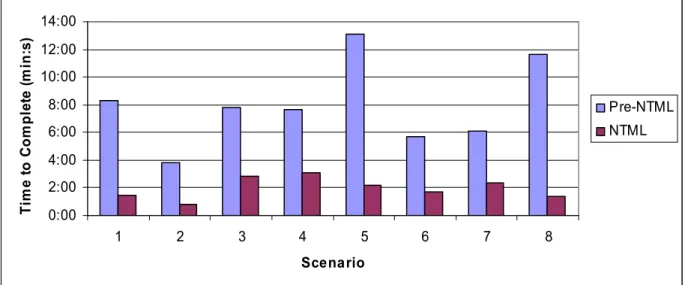
The amount of time required to complete the Flight Restriction scenarios was significantly shorter in the NTML condition (Median = 1 min 58 s, Min = 47 s, and Max = 3 min 4 s) than in the Pre-NTML condition (Median = 7 min 44 s, Min = 3 min 49 s, and Max = 13 min 8 s);
Wilcoxon Signed Rank Test, p < .05, two-tailed.
To provide further detail on scenario completion times, Figure 1 presents the amount of time required to perform each of the eight Flight Restriction scenarios. Time to completion was shorter in the NTML than in the Pre-NTML condition for each scenario. The average amount of time saved across Flight Restriction scenarios was 5 min 56 s. An examination of the Pre-NTML data reveals a noticeable increase in the amount of time required to complete Scenarios 5 and 8.
These scenarios had the greatest complexity with multiple ARTCCs involved. The completion times for these scenarios in the NTML condition, however, were similar to the completion times of all of the other scenarios.
0:00 2:00 4:00 6:00 8:00 10:00 12:00 14:00
1 2 3 4 5 6 7 8
Scenario
Time to Complete (min:s)
Pre-NTML NTML
Figure 1. Time required to complete each Flight Restriction scenario.
To further investigate how the NTML affects the restriction process, we examined the times to complete each of the three subtasks of coordination, logging, and communication. We defined coordination time as the amount of time from initiation of a Flight Restriction request to the end of telephone coordination. We defined logging time as the average amount of time required to enter the Flight Restriction TMI into the facility log, and we defined communication time as the amount of time required to share the TMI information with the Specialty Area Supervisor and to post the information on ESIS for the controllers. Table 2 presents the completion times for each subtask across scenarios.
Table 2. Median, Minimum, and Maximum Completion Times by Subtask Completion Times
Subtasks Pre-NTML (min:s) NTML (min:s)
Median 2:35 1:11
Min 0:31 0:40
Coordination
Max 8:39 2:17
Median 1:39 0:05
Min 0:55 0:02
Logging
Max 2:08 0:11
Median 3:17 0:35
Min 1:58 0:10
Communication
Max 3:34 1:03
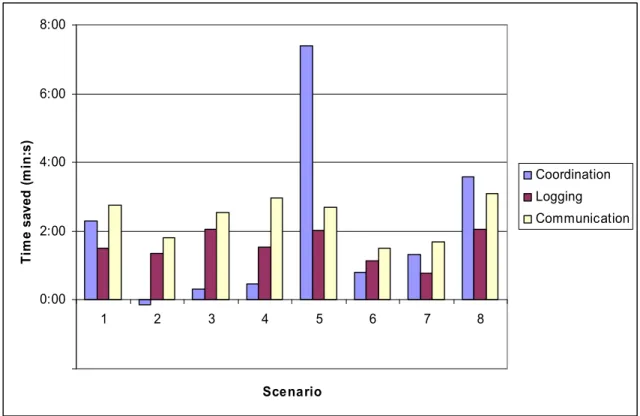
Figure 2 presents the time difference between the Pre-NTML and the NTML conditions (i.e., time saved) for each scenario by subtask.
0:00 2:00 4:00 6:00 8:00
1 2 3 4 5 6 7 8
Scenario
Time saved (min:s)
Coordination Logging Communication
Figure 2. Time savings by subtask for each scenario.
The scenarios were reenactments of realistic situations and did not always proceed with one subtask beginning only after the previous subtask was completed. In some scenarios, there was overlap in the execution of the subtasks and variability in the time to complete each subtask between facilities. For example, in the Pre-NTML condition for Scenario 5, one facility was still taking notes on the restriction they were going to request, whereas another facility had already initiated a call to the ATCSCC. For this reason, adding up the savings for the subtasks will not always equal the savings based solely on clock time.
The Wilcoxon Signed Rank Tests for each subtask were significant at the p < .05 level, two- tailed. The complex scenarios (Scenarios 5 and 8) that showed the largest differences in completion times in Figure 1 also showed the biggest savings in coordination times.
3.1.2 Potential for Error
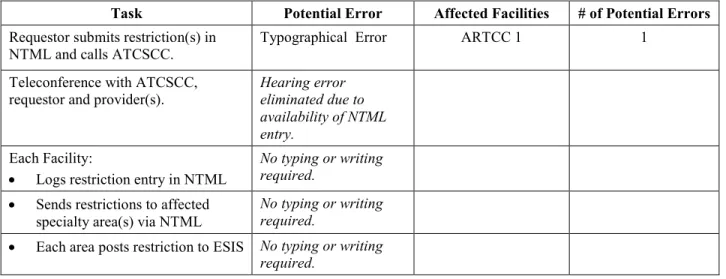
The analysis began by identifying each event in the scenario, during which one or more types of errors (i.e., speaking mistakes, hearing mistakes, and writing/typographical mistakes) may potentially occur. Tables 3 and 4 provide examples of the error analyses conducted for the Pre- NTML condition and the NTML condition for one interaction in Scenario 1. To calculate the total number of potential errors, we repeated this analysis for each additional interaction in the scenario. Scenario 1 consisted of ARTCC-to-ARTCC Flight Restriction TMIs.
Table 3. Analysis of Potential Errors for Scenario 1: Pre-NTML Condition
Task Potential Error Affected Facilities # of Potential Errors Requestor jots down needed
restriction(s) and calls ATCSCC.
Speaking Error ARTCC 1 1
Teleconference with ATCSCC, requestor and provider(s).
Hearing Error ARTCC 2, ATCSCC 2
Each Facility
• Writes down restriction information while on the telephone
Writing Error ARTCC 2, ATCSCC 2
• Types restriction information Typographical Error ARTCC 1, ARTCC 2, ATCSCC
3
• Posts restriction information on whiteboard (ARTCCs only)
Writing Error ARTCC 1, ARTCC 2 2
• Calls affected specialty areas and Supervisor takes notes
(ARTCCs only)
Typographical Error ARTCC 1, ARTCC 2 2
• Each area types the restriction information to post to ESIS (ARTCCs only)
Typographical Error Area at ARTCC 1, Area at ARTCC 2
2
Table 4. Analysis of Potential Errors for Scenario 1: NTML Condition
Task Potential Error Affected Facilities # of Potential Errors Requestor submits restriction(s) in
NTML and calls ATCSCC.
Typographical Error ARTCC 1 1
Teleconference with ATCSCC, requestor and provider(s).
Hearing error eliminated due to availability of NTML entry.
Each Facility:
• Logs restriction entry in NTML
No typing or writing required.
• Sends restrictions to affected specialty area(s) via NTML
No typing or writing required.
• Each area posts restriction to ESIS No typing or writing required.
It is immediately apparent that many of the cells in the NTML condition table are empty. The NTML provides the TMI information entered by the requesting facility electronically; therefore, all other opportunities for the common hearing, speaking, or typographical mistakes are
eliminated.
The Pre-NTML condition yielded 346 potential opportunities for human error to process the eight Flight Restriction scenarios. The use of NTML reduced this number to 26 potential opportunities for human error. Across the Flight Restriction scenarios, there were significantly more opportunities for error in the Pre-NTML condition (Median = 38, Min = 16, and Max = 76) than in the NTML condition (Median = 3.5, Min = 1, and Max = 5); Wilcoxon Signed Rank Test, p < .05, two-tailed. Each of the four categories of common human error could potentially occur in the Pre-NTML condition. Conversely, only one potential error type (e.g., an initial opportunity to make a typographical error when inputting the TMI entry into NTML) was associated with the NTML condition. Due to the electronic nature of NTML, once the initial entry was successfully entered into the system, the potential for the remaining error types was eliminated.
As Figure 3 shows, the rate of growth of potential errors as a function of scenario complexity is much greater in the Pre-NTML than in the NTML condition.
0 10 20 30 40 50 60 70 80
0 2 4 6 8 10 12 14 16 18
Complexity
Number of Errors
Pre-NTML NTML
Figure 3. Number of errors as a function of scenario complexity and use of the NTML.
3.1.3 Workload
Subjective workload ratings measured with the NASA-TLX assessment scale were significantly higher in the Pre-NTML condition (Median = 33.6, Min = 17.3, and Max = 42.0) than in the NTML condition (Median = 5.9, Min = 2.5, and Max = 11.2; Wilcoxon Signed Rank Test, p < .05, two-tailed) across subscales. Figure 4 presents the median workload ratings for each Flight Restriction scenario. As Figure 4 shows, the subjective workload scores were lower in the NTML than in the Pre-NTML condition for every Flight Restriction scenario. The Pre-NTML condition generally yielded moderate workload ratings, whereas the use of NTML consistently yielded very low ratings.
0 10 20 30 40 50 60 70 80 90 100
1 2 3 4 5 6 7 8
Scenario
Workload
Pre-NTML NTML
Figure 4. NASA-TLX workload ratings by scenario.
The NASA-TLX subscales assess the relative contribution of six elements to the workload associated with the performance of a task. For each scenario, we calculated weighted subscale ratings for the Pre-NTML and the NTML conditions. As Figure 5 shows, these data indicate a consistent pattern of moderate to high workload ratings on each dimension for the Pre-NTML condition as opposed to very low ratings in the NTML condition. The Wilcoxon Signed Rank Tests revealed significant differences for every subscale (p < .05, two-tailed) except the Physical Demand.
0 20 40 60 80 100 120
Mental Demand
Physical Dem and
Temporal Demand
Effort
Performance
Frustration
W orkload Subscale
Median Weighted Rating
Pre-NTML NTML
Figure 5. Workload subscale ratings for the Flight Restriction scenarios.
3.2 Ground Delay Program/Ground Stop
Although the GDP and Ground Stop TMIs were performed in the same trial, there were some differences in the operational steps required to complete each of these tasks.
Ground Delay Program
Pre-NTML Condition. The scenario began when the ATCSCC initiated a GDP. The Specialist entered the GDP TMI information into an electronic system and distributed it to affected facilities. The ATCSCC Specialist then initiated a conference call with the affected ARTCC.
While on the telephone, the ARTCC Specialist recorded the GDP information using hand-written notes. The ARTCC Specialist then contacted the affected TRACON and, while on the
telephone, the TRACON Specialist recorded the GDP information using hand-written notes.
Finally, the TRACON Specialist telephoned the ATCTs at affected airports and, while on the telephone, the tower controllers recorded the GDP information using hand-written notes. All of the affected facilities then recorded the TMI information in their respective facility logs. At the ARTCC, the Specialists posted the TMI information on a whiteboard and telephoned the affected specialty areas. The area supervisors then typed and posted the TMI information on their ESIS displays.
NTML Condition. The scenario began when the ATCSCC Specialist entered and submitted GDP information using the NTML. The ATCSCC Specialist initiated a telephone call with the affected ARTCC. The ARTCC Specialist then contacted the affected TRACON. Finally, the TRACON Specialist telephoned the ATCTs at the affected airports. Each of the Specialists logged the GDP entry using the NTML. In addition, the ARTCC Specialist used NTML to send the GDP information to the ESIS Display Manager in the affected specialty areas. The area supervisor then used the ESIS Display Manager to post the information on the display.
Ground Stop
Pre-NTML Condition. The Ground Stop portion of the scenario began when the ATCSCC Specialist initiated a phone call with the affected ARTCC. While on the telephone, the ARTCC Specialist recorded hand-written notes on the TMI requirements. The ARTCC Specialist then contacted the TRACON. While on the telephone, the TRACON Specialist recorded hand- written notes. The TRACON Specialist then contacted the ATCTs at the affected airports.
While on the telephone, the tower controllers also recorded the Ground Stop information using hand-written notes. Each of the Specialists entered the TMI information into their respective facility logs. At the ARTCC, the Specialist posted the TMI information on the facility
whiteboard and sent it with a phone call to the affected specialty areas. The area supervisor then typed and posted the Ground Stop information on the area’s ESIS display.
NTML Condition. The Ground Stop portion of the scenario began when the ATCSCC Specialist entered and submitted the Ground Stop information using the NTML. The ATCSCC Specialist then initiated a telephone call with the affected ARTCC. The ARTCC Specialist then contacted the affected TRACON. Finally, the TRACON Specialist telephoned the ATCTs at the affected airports. Each of the facilities logged the Ground Stop entry using NTML. In addition, the ARTCC Specialist also used NTML to send the TMI information to the ESIS Display Manager in the affected specialty areas. The area supervisor then used the ESIS Display Manager to post the information on the display.
3.2.1 Time to Complete
The participants required 6 min 2 s to complete the scenario in the Pre-NTML condition as opposed to 4 min 37 s in the NTML condition. This corresponds to a 1 min 25 s overall savings when using NTML. Because this scenario consisted of three events spaced 2 min apart, it is also important to consider what the participants were doing between events. In the Pre-NTML condition, they spent all of the time between events logging the GDPs and Ground Stop. The participants were typically still working on logging one event when the telephone call came in for the next one. In the NTML condition, the participants were unencumbered most of the time between events so they could perform other tasks.
We were not able to collect precise measures of the time required to log the events, but perhaps an analysis of total time spent on telephone calls gives a better estimate of savings than the overall value. The participants spent an average of 4 min 20 s on the telephone to complete the GDP/Ground Stop scenario in the Pre-NTML condition as opposed to 1 min 31 s in the NTML condition, a savings of 2 min 49 s for telephone communications alone.
3.2.2 Potential for Error
In the Pre-NTML condition, there were 52 potential opportunities for human errors in processing the GDP/Ground Stop scenario. The use of NTML reduced the potential errors to 4.
3.2.3 Workload
We analyzed subjective workload ratings for the two participants representing the ARTCC and TRACON.1 Workload scores were higher in the Pre-NTML condition (M = 47.00, SD = 4.24) than in the NTML condition (M = 5.50, SD = 7.78). As Figure 6 shows, the subjective workload scores were lower in the NTML than in the Pre-NTML condition for every subscale. The Pre- NTML condition generally yielded moderate workload ratings, whereas the use of NTML consistently yielded very low ratings.
0 10 20 30 40 50 60 70 80 90 100
Mental Demand
Physical Dem and
Temporal Demand
Effort
Performance
Frustration
W orkload Subscale
Mean Workload Rating
Pre-NTML NTML
Figure 6. Average workload ratings by subscale for the GDP/Ground Stop scenario.
1Only 2 of 3 participants completed the workload questionnaires for this scenario.
3.3 Delays
Pre-NTML Condition. The Delays scenario began when a tower controller telephoned the ATCSCC to report current delays. The ATCSCC Specialist initiated a conference call with the overlying ARTCC and TRACON affected by the delay. The ATCSCC Specialist and the affected facilities’ Specialists recorded hand-written notes on the delay, and each of the Specialists entered the TMI information into their respective facility logs. These steps were repeated every 15 min, until the airport was no longer experiencing delays.
NTML Condition. The NTML scenario began when a tower controller entered and submitted their delay status using the NTML. The controller then called the ATCSCC to follow up on the NTML entry of delay status. The ATCSCC Specialist initiated a conference call with the affected ARTCC and TRACON. Each of the Specialists logged the delay entry using NTML.
The Specialists were required to complete each of these steps only when they entered a delay condition and again when they exited the delay condition. No further telephone calls were required for each intermediate change in delay status at the airport. However, the Specialists were still required to log each of the intermediate delay changes.
3.3.1 Time to Complete
The participants required an average of 13 min 16 s to complete the Delays scenario in the Pre- NTML condition compared to 8 min 18 s in the NTML condition for a savings of 4 min 58 s.
Number of Calls Required
In the Pre-NTML condition, the participants initiated 15 telephone calls (one call was accidentally used to report two intervals of delay changes) compared to only 5 telephone calls in the NTML condition. This is due to procedural differences with the use of NTML. Because delay
information is shared electronically, facilities are only required to make a telephone call to report when they are first entering delays and then again when they are out of delays. Without NTML, each change in delay status must be reported via telephone.
3.3.2 Potential for Error
In the Pre-NTML condition, there were 176 potential opportunities for human errors in
processing the Delays scenario. The use of NTML reduced the potential errors to 16, with only one potential typographical error per reporting interval.
3.3.3 Workload
Subjective workload ratings were analyzed for the two participants representing two of the ATCTs.2 Workload scores were higher in the Pre-NTML condition (M = 53.33, SD = 10.37) than in the NTML condition (M = 7.44, SD = 0.71). As Figure 7 shows, the subjective workload scores were lower in the NTML than in the Pre-NTML condition for every subscale. The Pre- NTML condition generally yielded moderate workload ratings, whereas the use of NTML consistently yielded very low ratings. The Physical Demand subscale revealed low workload ratings in both conditions.
0 10 20 30 40 50 60 70 80 90 100
Mental Demand
Physical Dem and
Temporal Demand
Effort
Performance
Frustration
W orkload Subscales
Mean Workload Rating
Pre-NTML NTML
Figure 7. Average workload ratings by subscale for the Delays scenario.
4. DISCUSSION
A consistent pattern of results emerged from the current study. In every scenario tested, across each of the four categories of TMIs used in the study, the NTML condition resulted in faster task completion times, fewer opportunities for human error, and lower subjective ratings of operator workload compared to the Pre-NTML condition.
4.1 Flight Restriction Scenarios
Completion times were greatly reduced in the NTML condition for every Flight Restriction scenario. The pattern of completion times revealed greater variability in the Pre-NTML
condition than the NTML condition. As complexity increased, completion times with the NTML did not increase as rapidly as they did without the NTML. The benefit appears to be primarily in the time to coordinate the TMIs. In the Pre-NTML condition, having multiple facilities initiating multiple TMIs created the need for lengthy telephone discussions of the TMI details, with
enough time needed during the call for all participants to record the information. As the number of affected facilities and TMIs increased, the time to complete the coordination process
increased. However, in the NTML condition, when every participant received the TMI information electronically, the gist of the telephone call was simply to confirm that the TMIs were received and that all were in agreement. This process did not take much longer for multiple TMIs than for a single one.
A similar pattern of findings emerged in the error data. As complexity increased, the number of potential errors increased more quickly in the Pre-NTML condition than in the NTML.
Together, these findings suggest that with the use of the NTML, as complexity in Traffic Management operations increases, the time to initiate Flight Restriction TMIs and the potential for user error in that process should not be significantly impacted.
4.2 Ground Delay Program/Ground Stop Scenarios
The results of the GDP/Ground Stop scenarios revealed completion times that differed by only 1 min 25 s. The overall savings seem small, however, the observed behavior of the participants in the two conditions is particularly compelling. As described previously, this scenario consisted of an initial TMI comprising two GDPs, followed by a second TMI having one Ground Stop, and then a third TMI comprising an additional GDP. We presented the three TMIs to the
participants in 2-min intervals. Constant activity marked the scenario in the Pre-NTML condition. The participants were very busy throughout the scenario; they had barely finished one TMI before, and in some cases after, they were confronted with the next TMI. Conversely, task performance in the NTML condition was marked by periods of inactivity between the TMIs.
Therefore, the savings of 1 min 25 s is really an underestimate of the actual savings obtained with the NTML.
4.3 Delays Scenarios
There were procedural differences associated with processing Delays between the two experimental conditions. In the Pre-NTML condition, the ATCTs were required to make a telephone call to the ATCSCC upon entering a delay condition. In addition, the ATCTs were required to place subsequent phone calls every time the delay condition changed (e.g., a delay of +15 changed to a delay of +30). When they used NTML, the tower controllers were only required to make an initial phone call to the ATCSCC when they entered delay conditions and a second phone call when they exited the delay condition. They were not required to place any additional phone calls for intermediate changes in delays (e.g., change in delay from +30 to delay of +45). This difference yielded a 200% decrease in the number of calls required for any one ATCT.
5. SUMMARY
The time to completion results of the current study are likely conservative when compared to what one might expect in an operational environment. Several factors inherent to typical operational environments that were not present in the current study may have moderated the results. First, we simulated telephone communication systems. We did not account for events such as dialing the telephone and waiting for the other party to pick up. In the Delays scenario, where the number of telephone calls was reduced, these events are likely to create longer
completion times in the Pre-NTML condition and even greater savings with the NTML. Another factor that would have contributed to all of the scenarios in this study is that there were no
outside distractions interrupting the processing of the TMIs. The Specialists’ full attention was given to completing the simulated TMI events as they were introduced. In summary, the current results are certainly representative of what we might expect to see in an operational setting;
however, the observed data are probably more conservative than we would see at an operational facility.
At first glance, the time saved per TMI seems small. One might wonder how much strategic planning can be done in the few minutes saved. To put the findings in the proper context, one must consider how many TMIs are processed hourly, daily, or monthly. In the first quarter of 2006, for example, there were 30,491 ARTCC-to-ARTCC restrictions requiring ATCSCC approval. That adds up to approximately 54 hours of time saved per day. This estimate is based on the conservative assumption that only two ARTCCs were involved in each of these
restrictions. Increasing the participation to three ARTCCs raises the time saved by an additional 21 hours per day.
The error analysis results also represent a conservative estimate of potential human errors. We limited the error analysis to the four error types commonly associated with telephone-based communication systems that we described earlier. The analysis did not consider other potentially more common sources of error, such as forgetting. One could argue, however, that due to the interactive nature of NTML and the presence of a warning display that indicated when new TMIs were received, the potential to forget would be lower for the NTML condition than for the Pre- NTML condition.
In addition, the error analyses counted errors per task step. For example, in Table 3, for the Task Teleconference with ATCSCC, requestor and provider(s), we only counted one potential error per participant under the category of Hearing Errors for that task step. Obviously, people are not limited to only one misspoken word on any given task. We counted the presence of the opportunity for error, not the actual number of times a particular error might be made. Indeed, the latter represents an empirical question not suited for the current analytical study. The current results represent the types of errors that might occur and where those errors might be found. The pattern of results holds true across the TMI types used in the study with reductions in potential errors in the NTML condition.
6. CONCLUSIONS
Based on the results of this study, it is clear that the NTML provides savings in time, user error, and workload. The time saved is a particularly important finding. The time saved when using NTML can be effectively used to support one of the fundamental goals of Traffic Management Unit (TMU) operations: strategic planning to minimize delays and congestion in the NAS. TMU operations have become increasingly busy, especially during severe weather. Without the time needed for analysis and strategic planning, the Specialists have been forced to take a more tactical approach to traffic management. We observed time savings in every scenario in the study. This suggests that with the use of the NTML, the TMU Specialists will have more time to evaluate options or plan better responses for dealing with traffic management events.
The introduction of automation sometimes provides benefits in one area at a cost in another. For example, a system that automates a manual process may reduce the number of steps in that process, but may be extremely complex and frustrating to the user. The findings reported here do not suggest any such cost with the use of the NTML. We did not observe any increases in overall workload ratings or the ratings by subscale. In fact, for the Flight Restriction scenarios, we found significant reductions in workload for every subscale except Physical Demand, which is a dimension that we would not expect to differ between the two conditions.
Finally, it is important to project into the future of Traffic Management operations and the role of the NTML. As traffic levels increase, the complexity of the NAS is likely to increase as well.
The findings are promising, that is, the time to complete the processing of TMIs and the potential for user error increase only slightly with increases in complexity. Furthermore, the NTML continues to evolve. With further improvements in usability and enhanced capabilities, the benefits of using the tool will likely continue to grow. For example, the scenarios exercised in this study required coordination for many telephone calls in both conditions. Further
development of NTML capabilities may eliminate the need for many of the telephone calls. This should further reduce the amount of time needed to process TMIs, potential for user error, and workload.
Reference
Hart, S. G., & Staveland, L. E. (1988). Development of the NASA-TLX (Task Load Index):
Results of empirical and theoretical research. In P. A. Hancock & N. Meshkati (Eds.), Human mental workload (pp. 139-183). Amsterdam: Elsevier.
Acronyms
ARTCC Air Route Traffic Control Center
ATC Air Traffic Control
ATCSCC Air Traffic Control System Command Center
ATCT Airport Traffic Control Towers
ESIS En Route Status Information System
FAA Federal Aviation Administration
GDP Ground Delay Program
GI General Information
NAS National Airspace System
NASA National Aeronautics and Space Administration
NTML National Traffic Management Log
TLX Task Load Index
TMI Traffic Management Initiative
TMU Traffic Management Unit
TRACON Terminal Radar Approach Control
Appendix
NASA-TLX Rating Forms
NASA-TLX Rating Forms Workload Dimension Ratings
Mental Demand
Time Pressure
Performance
Physical Demand
Effort
Frustration
Low High Low High
Low High Low High
Good Poor Low High
0 25 50 75 100 0 25 50 75 100
0 25 50 75 100 0 25 50 75 100
0 25 50 75 100 0 25 50 75 100
NASA-TLX Rating Forms Paired Comparisons
__Effort __Time Pressure
__Time Pressure __Performance __Physical Demand __Effort
__Physical Demand __Mental Demand
__Effort __Performance
__Mental Demand __Frustration __Physical Demand __Performance __Frustration __Performance __Mental Demand __Physical Demand
__Effort __Mental Demand
__Mental Demand __Time Pressure __Time Pressure __Frustration
__Time Pressure __Physical Demand
__Frustration __Effort
__Performance __Frustration
NASA-TLX Index Rating Scale Dimension Definitions
Title Endpoints Definition_________________________________
Mental Demand Low/High How much mental and perceptual activity was required (e.g., thinking, deciding, calculating, remembering, looking, searching, etc.)? Was the task easy or demanding, simple or complex, exacting or forgiving?
Physical Demand Low/High How much physical activity was required (e.g., pushing, pulling, turning, controlling, activating, etc.)? Was the task easy or demanding, slow or brisk, slack or strenuous, restful or laborious?
Temporal Demand Low/High How much time pressure did you feel due to the rate or pace at which the tasks or task elements occurred? Was the pace slow and leisurely or rapid and frantic?
Performance Good/Poor How successful do you think you were in accomplishing the goals of the task set by the experimenter (or yourself)? How satisfied were you with your performance in accomplishing these goals?
Effort Low/High How hard did you have to work (mentally and physically) to accomplish your level of performance?
Frustration Low/High How insecure, discouraged, irritated, stressed, and annoyed versus secure, gratified, content, relaxed, and complacent did you feel during the task?