Trends in Biodiesel Production: Present Status and Future Directions
Chapter · April 2014
DOI: 10.1007/978-3-319-05020-1_13
CITATIONS
19
READS
6,200
8 authors, including:
Victor Haber Perez
Universidade Estadual do Norte Fluminense 67PUBLICATIONS 1,580CITATIONS
SEE PROFILE
Euripedes Garcia Silveira Junior Universidade Estadual do Norte Fluminense 18PUBLICATIONS 285CITATIONS
SEE PROFILE
Geraldo Ferreira
66PUBLICATIONS 555CITATIONS SEE PROFILE
Oselys R. Justo Universidade Estácio de Sá 5PUBLICATIONS 53CITATIONS
SEE PROFILE
All content following this page was uploaded by Marcelo Sthel on 06 July 2016.
The user has requested enhancement of the downloaded file.
Trends in Biodiesel Production: Present Status and Future Directions
Victor H. Perez, Euripedes G. Silveira Junior, Diana C. Cubides, Geraldo F. David, Oselys R. Justo, Maria P. P. Castro,
Marcelo S. Sthel and Heizir F. de Castro
Abstract The use of renewable fuels, an alternative that reduces the generation of greenhouse gases, is one proposal to mitigate the effects that contribute to global warming. Brazil is the fourth largest producer of biodiesel in the world, and growth expectations of the productive capacities have generated huge technological and environmental challenges. In this context, this chapter discusses some of the rel- evant aspects of biodiesel production in Brazil, including sustainability of raw materials, conventional technology limitations, and further presents technological alternatives as strategies that will guide the future directions which can result in processes with greater environmental and economic returns.
13.1 Introduction
Global warming is a serious environmental problem these days (Kerr 2013).
Consequently, substantial climate changes have been observed, causing major socioeconomic and environmental impacts to society and biodiversity. The emission V. H. Perez (&)
UENF/CCTA/LTA, Av. Alberto Lamego 2000. Pq California, Campos dos Goytacazes-RJ 28013-602, Brazil
e-mail: [email protected]
V. H. PerezE. G. Silveira JuniorD. C. CubidesG. F. David Food Technology Department, State University of the North Fluminense, Campos dos Goytacazes-RJ, Brazil
O. R. Justo
Estácio de Sá University, Campos dos Goytacazes-RJ, Brazil M. P. P. CastroM. S. Sthel
Physical Sciences Department, State University of the North Fluminense, Campos dos Goytacazes-RJ, Brazil
H. F. de Castro
Engineering School of Lorena, University of São Paulo, São Paulo-SP, Brazil
S. S. da Silva and A. K. Chandel (eds.),Biofuels in Brazil,
DOI: 10.1007/978-3-319-05020-1_13,Springer International Publishing Switzerland 2014 281
of greenhouse gases from the use of fossil fuels on a large scale after the industrial revolution is seen as the main cause of this phenomenon (Beck2013).
Most of the energy consumed in the world comes from fossil oil, natural gas, and coal. Fossil fuels are widely used as a transportation and machinery energy source due to their high heating power, availability, and quality combustion characteristics (Hassan and Kalam 2013). However, as foreseen, fossil fuel resources will inevitably be depleted, while demand for energy is increasing due to population growth, technological progress, and urbanization. Thus, estimates for 2100 suggest that worldwide energy demand will be five times greater than today (Hossain and Davies2013). At the same time, a report of the Intergovernmental Panel on Climate Change (IPCC) pointed out the use of renewable fuels as an alternative to mitigate the emission of greenhouse gases (IPCC2007).
Several countries have investigated, developed, or are considering the intro- duction of biofuels in their national energy programs. Particularly, Brazil has developed programs that use biofuels and other renewable energy sources, for both transport and power generation. In 2002, the Incentive Program for Alternative Sources of Energy (PROINFA) was implemented with the purpose of developing alternative and renewable sources of energy for electricity production, taking into account the characteristics and potential region, aimed at reducing emissions of greenhouse gases. More recently, the National Program for Production and Use of Biodiesel (PNPB) was launched in 2004 to regulate the production and distribution of Brazilian biodiesel from various sources of raw materials, in a sustainable way, both technically and economically, with a focus on social inclusion and regional development. Thus, small farms can cultivate oilseeds according to regional characteristics in order to produce biodiesel. However, although soybean is the main raw material marketed by the program, other crops such as sunflower, peanut, sesame, castor, and soybean oil itself have a higher market value.
Therefore, some of the oil can be sold to the program, but can also be used for manufacturing products with higher commercial value.
Biodiesel production in Brazil is an overcoming history when compared with the ethanol production, since ethanol has a consolidated technology in relation to biodiesel, which is still incipient (Sallet and Alvim2011). The methods for bio- diesel production are well known (Basha et al. 2009). However, the chemical transesterification using methyl alcohol or ethyl alcohol, in some cases by one or two reaction steps, has been adopted as a conventional route for its production at an industrial scale. In general, biodiesel production can be considered as a simple process. However, production on a large scale presents challenging technological and production cost problems. In addition, as the raw materials used in the pro- duction of biodiesel fuel are sometimes the source of food for humans and/or animal consumption, controversy, and competition between biofuels and food, sustainability and limited land for use, and deforestation have been generated (Elbehri et al.2013).
This chapter discusses some of the aspects of biodiesel production in Brazil, including feedstock used, technological routes established, and alternative
processes such as unconventional methods of characterization as well as the challenges that must be met to make this process more competitive and attractive in terms of industrial and environmental concerns.
13.2 Raw Materials for Biodiesel Production
For biodiesel production, the raw materials frequently used around the world, according Pahl (2008), are rapeseed oil (59 %), soybean oil (25 %), palm oil (10 %), sunflower oil (5 %), and other sources (1 %) which include: coconut, jatropha sp, camelina, peanut, safflower, mustard, hemp, corn (maize), waste frying oil, animal fat, and algae. For Brazil, Fig.13.1shows the profile of use of raw materials in the production of biodiesel based on the average values of the first half of 2013, according to data reported by the National Agency of Petroleum, Natural Gas and Biofuels (ANP). Brazil is the second largest soybean producer in world, and as can be seen, soybean biodiesel represents more than 72 % compared to other raw materials, followed by beef tallow and cotton which are approxi- mately 20 and 3 %, respectively. The explanation for this national scene is due to investments in the production chain over decades, which has resulted in the development of new varieties of species, genetic improvement, and plague control and, consequently, a higher rate of productivity compared to other oilseeds, resulting in a relatively lower cost of soybean production.
However, other crops have been gaining ground as sources of raw materials (Fig.13.2). Furthermore, it is predicted that over the years, this growth will become more significant insofar as technological advances in agriculture are reached, especially for those oilseeds with higher energy density than soybeans (Table13.1), i.e., the higher oil content of seeds. In fact, this may be possible because of the geographic characteristics of Brazil, which is basically a tropical country that has a large territory, important water resources, regular rainfall, high biodiversity, and well-developed agricultural technologies, therefore, having great potential for bioenergy production (Sthel et al.2009).
Many studies have demonstrated the potential of some of these oilseeds in biodiesel production. Macedo et al. (Macedo et al. 2011a) studied the thermal properties of biodiesel obtained from oiticica oil, while Andrade et al. (2012a) produced biodiesel through moriche palm oil (Buriti oil) to evaluate thermal behavior in blends with diesel. Other studies investigated the potential of using different raw materials such as macaw palm oil (Ferrari and de Azevedo Filho 2012), babassu oil (Freitas et al.2009; Nascimento et al.2009), Pequi oil (Macedo et al.2011b), in the production of biodiesel.
Although there is still much to be done for its implementation on an industrial scale, microalgae has been identified as third-generation biodiesel and presents several benefits over other raw material resources, such as land use, potential cultivation in nonfertile locations, and especially its faster growth and high lipid-to- biodiesel yield (Torres et al. 2013). According to Demirbas and Demirbas
(Demirbas and Demirbas 2011), high oil species of microalgae cultured in optimized growth conditions in photobioreactors have the potential to yield 19.000–57.000 L of microalgal oil per acre per year; consequently, the yield of oil from algae is over 200 times the yield from the best-performing plant vegetable oils. More than three thousand species of algae have been identified;thus the choice of highly producing strains of oils for industrial application will probably depend on genetic improvement. The oil content of some microalgae is very attractive for biodiesel production, since it can be higher than 70 %. For example, the oil content ofSchizochytrium sp. andBotryococcus brauniiare 50–77 and 25–75 %, respec- tively (Chisti2007). Similarly, single cell oils (SCOs) accumulated by oleaginous microorganisms have recently emerged as a potential feedstock for production of biodiesel. This is a very interesting raw material because the biomass can be pro- duced in conventional fermenters using low-cost substrates as carbon sources, such as sugar cane bagasse (Kamat et al. 2013), glycerol generated from biodiesel
Soybean oil Tallow
Cotton oil Frying oil Pork fat Palm oil Chicken fat
Forage turnipOthers fat 0
10 20 30 40 50 60 70 80
Raw material for Biodiesel production (%)
Fig. 13.1 Raw materials used for Brazilian biodiesel production during the first 6 month of 2013 (ANP2013)
0 30 60 90
Raw material for biodiesel production (%)
2009 2010 2011 2012 2013
Soybean oil Tallow
Fatty acids Cotton oil Frying oil Pork fat
Chicken fat Fig. 13.2 Profile of the use
of raw materials used in biodiesel production in Brazil between 2008 and 2013 (ANP 2013)
Table13.1SeveraloilseedswithpotentialtoproducebiodieselfromvegetableoilinBrazil OilseedtypeOil content (%)
OilyieldBrazilianregiona Refs. (ton/ha) Babassupalm(Orbignya phalerata)60–680.12bLargestproduceristheStateofMaranhão(Freitasetal.2009) Canudo-de-pito(Mabeafistulifera)40–MinasGerais,RiodeJaneiro,andSãoPaulo(CENBIO2013) Crambe(Crambeabyssinica Hochst)350.45–2.5b Plantationsextendthroughcentralwarmerregions ofBrazil(Vargas-Lopezetal.1999) Creamnutormonkeypot (LecythispisonisCamb.)54.80–CearátoRiodeJaneiro,SouthBahia,andNorth EspíritoSanto(CENBIO2013) Linseed(LinumusitatissimunL.)33–430.4–1.45BrazilSouthRegion,especiallyRioGrandedoSul(CENBIO2013) Macawpalm(Acronomia aculeata)20–251.5–5.0MidwestandNorth,MinasandSãoPaulo(doAmaraletal.2011) Maraja(BactristomentosaMart.)28–MaranhãoandPará(CENBIO2013) Monguba(PachiraaquáticaAubl)56–58–EntireAmazonregiontoMaranhão(CENBIO2013) Morichepalm(Mauritiaflexuosa)29–Acre,Amazonas,Bahia,Ceará,Goiás,Tocantins, Maranhão,Pará,Piauí,SãoPaulo(CENBIO2013) Palm(Opuntiacochenillifera)222.0–8.0b AmazonasandNorthRegion(Queirozetal.2012) Jatropha(JatrophacurcasL)501.2–1.5bGoiás,MinasGeraisandintheNortheast.(CENBIO2013) Rapeseed(BrassicanapusL.var. oleifera)34–400.8Goiás,MatoGrossodoSul,Paraná,RioGrandedo Sul(CENBIO2013) Safflower(Carthamustinctorius)30–450.7Averypromisingplantinginthesemiaridregionin Brazil(CENBIO2013) Sessame(SesamumindicumL.)50–600.24Goiás,MatoGrossoandSoutheast(mainlyinSão Paulo)(CENBIO2013) Sunflower(HelianthusannusL.)40–470.774b Alagoas,Ceará,Goiás,MatoGrosso,MatoGrosso doSul,Paraná,RioGrandedoNorte,RioGrande doSul,Sergipe
(Bergmannetal.2013) (continued)
Table13.1(continued) OilseedtypeOil content (%)
OilyieldBrazilianregiona Refs. (ton/ha) Tucumapalm(Astrocaryum aculeatum)30–50–Acre,Amapá,Amazonas,Pará,andRondônia(CENBIO2013) Tung-oiltree(Aleurites moluccanus)35–400.790RioGrandedoSul(CENBIO2013) Turnipforage(Raphanussativus L.)302.2MatoGrosso,MatoGrossodoSul,MinasGerais, andSãoPaulo(CENBIO2013) Ucuúba(Virolasurinamensis)58–60–AmazonregiontoMaranhãoandPernambuco(CENBIO2013) Westernsoapberry(Sapindus saponariaL.)30–AmazonregiontoGoiásandMatoGrosso(CENBIO2013) aIBGE-BrazilianInstituteofGeographyandStatistic(http://www.ibge.gov.br/english/) b Yieldoil(Bergmannetal.2013)
production (Xu et al.2012), biomass pyrolytic sugars (levoglucosan) (Lian et al.
2013), and aqueous fractions rich in organic short chain (C1–C4) obtained in thermochemical conversion processes of biomass (Lian et al.2012).
The choice of suitable feedstocks must also answer technical questions. Thus, parameters such as flash point, viscosity, density, acid value, cetane number, and oxidative stability, among others, must be observed for both biodiesel and diesel/
biodiesel blends. Depending on the chemical composition of the raw material, some properties of the produced biodiesel may be undesirable. In these cases, the use of additives may be required to attenuate these effects (Focke et al.2012; Ali et al.2013). Thus, the production of biodiesel from oils with high iodine value, for example, can result in a product susceptible to oxidation. Similarly, raw materials with high content of saturated fatty acids result in biodiesel which tends to have solidification problems with temperature variations (Knothe et al.2005).
13.3 Process of Biodiesel Production: Trends and Alternatives
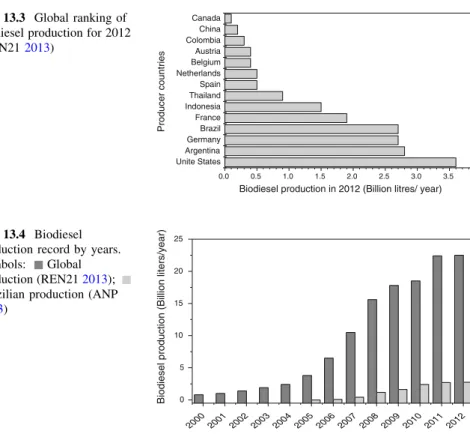
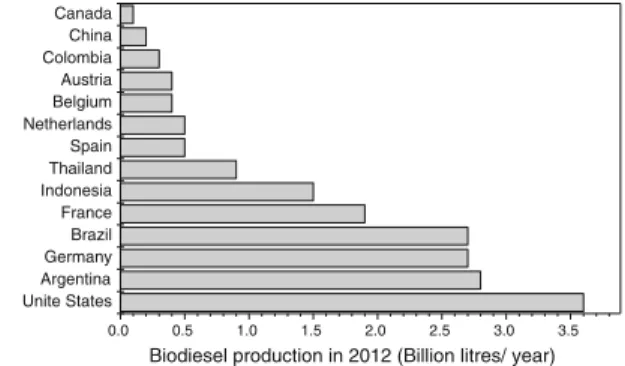
In 2010, Brazil became the second world producer of biodiesel with a production of 2.4 billion of liters, approximately, second only to Germany. However, in 2011, both the United States and Argentina increased production, and now Brazil is the fourth world producer of biodiesel, as shown in Fig.13.3.
At present, 69 Brazilian plants are authorized for biodiesel production, corre- sponding to a total capacity of 22,334.06 m3/day. Among these, 11 plants are allowed to expand their production capacity, while 3 other new plants should be built, providing an increase of 9 % in the current production capacity of biodiesel in Brazil (ANP2013).
Figure13.4shows the values of biodiesel production in Brazil in relation to the overall production. The global average annual growth rate over the period from the end of 2005 through 2011 was approximately 37 %. Compared with global pro- duction, the Brazilian profiles were similar; biodiesel production increased from 70 million liters in 2006 to 2.7 billion liters in 2011. Thus, the Brazilian average annual growth rate over the period from 2008 to 2011 was 33 %. In 2012, bio- diesel production continued to expand, but at much lower rate, nearly 1.7 %, while the global production was just 0.4 %. However, the Brazilian biodiesel market is not open, and the ANP itself, which currently regulates sales through public auctions, gives preference to companies with the ‘‘Social Fuel Label.’’
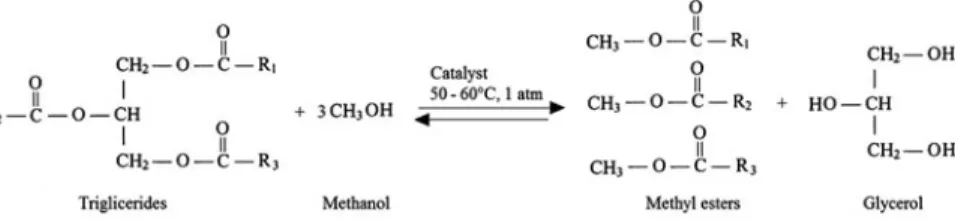
Industrially, biodiesel production is achieved by chemical transesterification of oils/fats using methanol or ethanol in some cases, by one or two reaction steps in the presence of a homogeneous alkaline catalyst such as KOH or NaOH or its corresponding alkoxide (Na+CH3O-or K+CH3O-). These alkoxides can be pro- duced in a very simple way, dissolving sodium hydroxide in alcohol, before its addition to the reaction medium. Basically, in this process one mole of oil reacts with three moles of alcohol, but in industrial practice alcohol is used in excess to
displace the equilibrium of the reaction and promote the formation of the product.
As a result, a mixture of alkyl esters of fatty acids of a long chain and glycerin as byproduct is obtained (Fig.13.5).
From a technological point of view, this is a relatively simple process which can be conducted at atmospheric pressure and under moderate conditions of temperature (50–60C), resulting in high conversion rates at relatively low reaction times (Meher et al.2006). When low-cost oils and fats (waste frying oil, etc.) are used as raw material, they cannot be converted to biodiesel using alkaline catalyst because of their large amounts of free fatty acids. Therefore, two-step processes are required. First, the free fatty acids are converted to fatty acid methyl esters by an acid catalyst; in the second step, transesterification is completed using an alkaline catalyst.
A general description for a conventional process is synthesized in Fig.13.6, in which a mixture of oil, methanol, and catalyst is fed to a system of two stirred tanks reactors; after reaction in the first reactor, the glycerol is removed from the first reactor before being fed into the second reactor. The subsequent sections allow separation of biodiesel as the light phase from glycerol, and it is purified by washing, neutralization, and then vacuum dried. Meanwhile, the glycerol is sep- arated from the residual fraction, neutralized and the excess of methanol is removed by evaporation and recycled in the process (Knothe et al.2005).
Unite States Argentina Germany Brazil France Indonesia Thailand Spain Netherlands Belgium Austria Colombia China Canada
0.0 0.5 1.0 1.5 2.0 2.5 3.0 3.5
Biodiesel production in 2012 (Billion litres/ year)
Producer countries
Fig. 13.3 Global ranking of biodiesel production for 2012 (REN212013)
2000 2001 2002 2003 2004 2005 2006 2007 2008 2009 2010 2011 2012 0
5 10 15 20 25
Biodiesel production (Billion liters/year)
Fig. 13.4 Biodiesel production record by years.
Symbols: Global production (REN212013);
Brazilian production (ANP 2013)
The presence of free fatty acids and water in the reaction facilitates soap for- mation; the need to neutralize the catalyst after the reaction; the impossibility of catalyst retrieval; as well as requirements for treatment of effluents generated during the washing steps are some drawbacks that currently require attention in the process. Furthermore, when free fatty acid content is very high, this process can also be carried out using homogeneous acid catalysts despite the alkali, but reaction times are longer, requiring much higher oil molar ratio oil: alcohol and reaction temperatures.
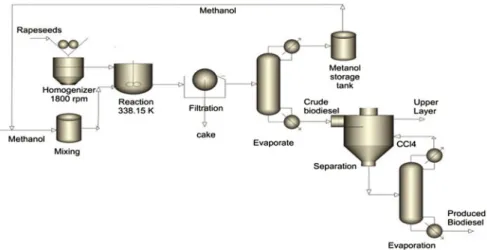
On the other hand, transesterification processes in situ have been reported for a diversity of oils using methanol (Abo El-Enin et al.2013). In these processes, the ground oilseed is mixed directly, instead of purified oils, with alcohol and catalyst, to produce alkyl fatty acid esters, as shown in the generic scheme (Fig.13.7). The molar ratio oil: alcohol higher than the value calculated according to stoichiometry has been tested alkaline and acid catalyst. The simplicity of the process will pave Fig. 13.6 Flow sheet for conventional biodiesel production
Fig. 13.5 Simplified scheme for biodiesel production by chemical transesterification
the way for oil seed growers to move away from overdependence on crushing and solvent extraction plants.
Emphasis can be also placed on the technology developed by PETROBRAS (Brazil) for the biodiesel production known as Grain route. In the process, biodiesel is obtained directly from oilseed plant grain using ethanol, which works not only as an acyl acceptor, but also as a solvent in the oil extraction. This process eliminates steps such as oil extraction and refining; its feasibility on an industrial scale was assessed in a small plant in Rio Grande do Norte (Brazil) (Sauer et al.2006).
The production of biodiesel from algae is also a process that is under discussion.
A variety of high value-added byproducts can be produced from algae; therefore, it is likely that in the future production of biodiesel from algae will be the least important application. Basically, bioreactors for algal culture consist of open ponds, photobioreactors, and closed systems. Open pond systems are shallow ponds in which algae are cultivated, while photobioreactors include different types of tanks or closed systems. The biodiesel from algal oil is similar to biodiesel produced from vegetable oils. The biggest challenges of this process are the choice or development of bioreactors, the definition of the best choice to formulate nutrients, and methods for biomass processing to extract the oil, which involves costly steps such as concentration, separation, drying, and oil extraction. After obtaining the oil, the following steps involve transesterification and purification of biodiesel, alcohol recovery and separation of glycerin, as in the conventional process. Economic evaluation studies have been reported comparing different alternatives (Gallagher 2011; Nagarajan et al.2012). Closed systems are relatively expensive compared to open ponds due to the required infrastructure costs. However, open systems are more vulnerable to bacterial contamination. Thus, the tubular photo bioreactor seems to be the most satisfactory choice for producing algal biomass on the scale needed for biodiesel production (Demirbas and Demirbas2011).
Fig. 13.7 Pilot scale for in situ transesterification from rapeseeds (Modified from Abo El-Enin et al.2013)
Another common issue in this process that must be addressed relates to the use of methanol for biodiesel production. Ethyl esters proved to be a viable alternative to diesel fuel being more sustainable than methyl esters (Brunschwig et al.2012).
Methanol is a product known to be toxic and although it can be obtained from synthesis gas (syngas) of biomass, it is usually produced from fossil materials, such as natural gas. In anyway, in Brazil lacks self-sufficiency in the CH3OH production. In this sense, the use of ethanol instead of methanol fossil is a very attractive alternative. A technological condition in Brazil that is quite atypical with respect to most countries engaged in biofuels production, especially for being the second largest ethanol producer in the world, reaching in 2012 a production of 21.6 million liters of ethanol. But either way it would be necessary to increase the production levels to meet demand for biodiesel in the next years.
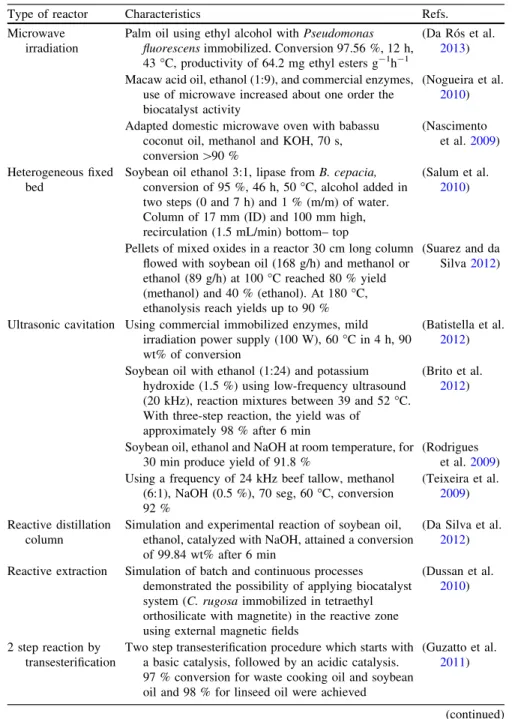
Technological advances have made possible the construction of industries which are able to process raw materials from various sources, using both methylic and/or ethylic routes, in batch or continuous processes (Table13.2). Stand out Barralcool plant, designed with Dedini-Balestra technology and built-in integrated way with a sugarcane industry. In addition, processes that use centrifuges instead of decanters to separate biodiesel from glycerol, such as Westfalia technology, improve the separation phases, but production cost can be increased as a conse- quence of high energy consumption. On the other hand, some Brazilian research technologies that can modify the conventional reaction step are summarized in Table13.3. Several of these emerging technologies seem to be cost-effective and environmentally friendly operations in comparison with conventional biodiesel production technologies. In some cases, the conventional processes without great modification can be adapted, e.g., ultrasound reactors when the mechanical stirrer is replaced with ultrasound equipment. Furthermore, the use of packed-bead reactors, which are well known in other industrial processes, are limited by the lack of optimization studies applied to biodiesel production.
On the other hand, extensive research activity has been observed to use het- erogeneous catalysts as alternative to the use of conventional homogeneous cat- alysts (Table13.4). In these systems are required typical reaction temperatures and molar ratios of oil: alcohol more higher, however, probably one of the most important advantages is that these catalysts do not produce soap, can be recovered and consequently, their use results in processes with lower environmental impact.
Heterogeneous catalysts may be chemical or enzymatic, the latter consisting of enzymes and cells (whole cells), either free or immobilized. Particularly, in the case of chemical heterogeneous catalysts, many studies have focused on both alkaline and acid catalysts, as well as the reaction mechanisms and their physi- cochemical properties that influence biodiesel yields (Islam et al.2013; Semwal et al. 2011; Endalew et al. 2011). There is still no consensus, however, as to whether alkaline catalysts are a better choice than acid in terms of reaction rate and biodiesel productivity. One disadvantage of the use of a solid catalyst is the formation multiphasic system, which leads to diffusion limitations that decrease the reaction rate (Semwal et al.2011).
Table13.2SomeexamplesofBrazilianindustriesdesignedtoproducebiodieselproductionbymethylicand/orethylicroutes(BiodieselBR2013) IndustryFeedstockProcessTechnological routeProduction capacity (106 L/year) AraguassuSoybeans(80%),sunflower,cotton,castorbeansOwntechnology/continuousMethylic/ethylic36 BarralcoolSoybeansDedini-Balestrabatch/ continuousMethylic/ethylic60 Owntechnology/batchBigfrangoAnimalfat,recycledoilMethylic/ethylic2 BioPetroSoybeansOwntechnology/continuousMethylic/ethylic70 BioparParecisAnimalfatMethylic/ethylic36 BioverdeSoybeans(40%),cotton(50%),recycledoil(10%)Owntechnology/batchMethylic/ethylic181 CooperbioSoybeans,sunflower,cotton,animalfat,recycledoilOwntechnology/continuousMethylic/ethylic166 DeltaBiocombustíveisSoybeans,cotton,crambe,andbeeftallowMethylic/ethylic108 FertibomSoy,Sunflower,jatropha,animalfat,recycledoil,peanutOwntechnology/batchEthylic120 Granol(Anapoliscity, GO)Soybeans(90%),cotton(90%)Dedini-BalestraMethylic/ethylic372 continuousForageturnip,animalfat,recycledoil GranolSoybeans(90%),cotton,forageturnip,animalfat, recycledoilWestfalia/continuousMethylic/ethylic336 SPBioSoybeans(80%),animalfat,recycledoilOwntechnology/batchMethylic/ethylic25
Table 13.3 Unconventional technologies for biodiesel production
Type of reactor Characteristics Refs.
Microwave irradiation
Palm oil using ethyl alcohol withPseudomonas fluorescensimmobilized. Conversion 97.56 %, 12 h, 43C, productivity of 64.2 mg ethyl esters g-1h-1
(Da Rós et al.
2013) Macaw acid oil, ethanol (1:9), and commercial enzymes,
use of microwave increased about one order the biocatalyst activity
(Nogueira et al.
2010) Adapted domestic microwave oven with babassu
coconut oil, methanol and KOH, 70 s, conversion[90 %
(Nascimento et al.2009) Heterogeneous fixed
bed
Soybean oil ethanol 3:1, lipase fromB. cepacia, conversion of 95 %, 46 h, 50C, alcohol added in two steps (0 and 7 h) and 1 % (m/m) of water.
Column of 17 mm (ID) and 100 mm high, recirculation (1.5 mL/min) bottom– top
(Salum et al.
2010)
Pellets of mixed oxides in a reactor 30 cm long column flowed with soybean oil (168 g/h) and methanol or ethanol (89 g/h) at 100C reached 80 % yield (methanol) and 40 % (ethanol). At 180C, ethanolysis reach yields up to 90 %
(Suarez and da Silva2012)
Ultrasonic cavitation Using commercial immobilized enzymes, mild irradiation power supply (100 W), 60C in 4 h, 90 wt% of conversion
(Batistella et al.
2012) Soybean oil with ethanol (1:24) and potassium
hydroxide (1.5 %) using low-frequency ultrasound (20 kHz), reaction mixtures between 39 and 52C.
With three-step reaction, the yield was of approximately 98 % after 6 min
(Brito et al.
2012)
Soybean oil, ethanol and NaOH at room temperature, for 30 min produce yield of 91.8 %
(Rodrigues et al.2009) Using a frequency of 24 kHz beef tallow, methanol
(6:1), NaOH (0.5 %), 70 seg, 60C, conversion 92 %
(Teixeira et al.
2009) Reactive distillation
column
Simulation and experimental reaction of soybean oil, ethanol, catalyzed with NaOH, attained a conversion of 99.84 wt% after 6 min
(Da Silva et al.
2012) Reactive extraction Simulation of batch and continuous processes
demonstrated the possibility of applying biocatalyst system (C. rugosaimmobilized in tetraethyl orthosilicate with magnetite) in the reactive zone using external magnetic fields
(Dussan et al.
2010)
2 step reaction by transesterification
Two step transesterification procedure which starts with a basic catalysis, followed by an acidic catalysis.
97 % conversion for waste cooking oil and soybean oil and 98 % for linseed oil were achieved
(Guzatto et al.
2011)
(continued)
The use of a co-solvent can help to solve this problem, but in industrial practice this method should not be used to avoid increasing cost production. In addition, another important aspect that must be observed concerns the particle size of these catalyst systems, which are usually synthesized as very small particles or fine powder. Conceptually, high reaction rates should be expected when catalysts with high surface area are used (Levenspiel 1999). However, this may result in the formation of clusters due to the physiochemical properties of the reaction medium oil: alcohol. Consequently, on one hand it affects the performance of the catalysts and on the other side, more complex and expensive downstream steps are required.
Bifunctional heterogeneous catalysts have also been studied as a potential alternative means to simultaneously develop biodiesel production by esterification and transesterification reactions (Borges and Díaz2012; Farooq et al.2013), but to attain a catalyst bifunctional with adequate surface area, size, and porous volume and high activity, as well as being inexpensive, more investigations are required.
However, Axens has commercialized a process for the production of biodiesel via heterogeneous catalysis at elevated temperatures (180–220C) and consequently higher pressures, known as Esterfip-H process. The transesterification reaction makes use of rapeseed oil and methanol and as catalyst a spinel, e.g., one co-mixes the alumina support material with zinc (Bournay et al.2005).
In addition, Albemarle Corporation (www.albermarle.com), a leader in the market of heterogeneous catalysts, has a pilot plant demonstration (BECON Pilot Plant) in Iowa (USA) with a capacity of 300,000.00 gal/year for the production of biodiesel via heterogeneous catalysis, using the catalyst known as GoBio T300.
This process uses vegetable and algae oils and operates at pressures and temper- atures similar to conventional homogeneous catalysis process.
In a similar way, large efforts have been made to investigate enzymatic transesterification (Tan et al.2011; Gog et al.2012). Lipases are the most studied enzymes and they show great potential for enzyme immobilized on organic or inorganic supports. Basically, the high biochemical specificity of lipases, which allows conducting the reactions under mild conditions of temperature, as well as the ease of biocatalyst reuse in several reaction cycles, are some of the major Table 13.3 (continued)
Type of reactor Characteristics Refs.
Supercritical microtube reactor
Soybean oil, supercritical ethanol (1:20), catalyst-free, carbon dioxide as co-solvent (0.2:1 mass). 598 K, 20 MPa, oil to ethanol molar ratio of 1:20 and using a CO2to substrate mass ratio of 0.2:1
(Trentin et al.
2011)
Soybean oil and macaw oil with supercritical methyl acetate (1:5), without catalyst, at 20 MPa, with 45 min at 350C obtain yield of 44 % for soybean oil and with macaw oil 83 % of yield
(Doná et al.
2013)
Ultra-shear reactor Equipment with rotor–stator mixing with high speed and intense shear frequency. Soybean, ethanol, NaOH, 1:6:1.35, conversion of 99.26 wt%, with 12 min, 78C and constant agitation of 7900 rpm
(Da Silva de et al.2011)
Table13.4SomestudycasesofBiodieselproductionusingheterogeneouscatalysts CatalystsOil,alcohol(molarratio%cat)/Temperature/Reactiontime/ ConversionRefs. HUSYandCe/HUSYzeolitesSoybeanoil,ethanol(30:1:0.001mol)/200Cunderconstant stirring(1000rpm)andautogenouspressure(20bar)/ 24h/[97%forbarium (Borgesetal.2013) Alkalinecompoundsofstrontium SrCO3?SrO?Sr(OH)2
Babassu,methanol(1:6:1.0%)/65C/1h/[95%/reusability 6times(deCarvalhoetal.2013) Ni0.5Zn0.5Fe2O4ferritesdopedwithCuSoybeanoil,methanol(1:20:4%)/160C/2h/[42%(Dantasetal.2013) Sn(IV)complexes:Butylstannoicacid,di-n-butyl- oxo-stannaneanddibutyltindilaurateSoybeanFFAs,methanol(simultaneoustransesterification/ esterification)(4:1:0.01)/160C/1h/[90%(Britoetal.2012) AluminaimpregnatedwithpotassiumiodideBranoil,methanol(15:1:5%)/–/92h/95.2%(Evangelistaetal.2012) Iodidepotassiumincorporatedonmesoporous molecularsieves(SBA-15andMCM-41)Sunfloweroil,methanol(1:15:1e2%)/60C/4h/*85%(deGalvãoetal.2012) Lewisacid/surfactantrareearthtrisdodecylsulfateWastecookingsoybeanoilwith8.8wt.%offreefattyacids, ethanol(1:6:10%)/100C/1h/76–86%(deMattosetal.2012) Mesoporoussilicaactivephase(La50SBA-15)Soybeanoil,ethanol(20:1:1%),atinertatmosphere(N2)/ 343K/6h/[80%(Quintellaetal.2012) Preparedfromthewastematerial,Amazonflint kaolinandactivatedwith4MsulfuricacidEsterificationofdistillateproducedbydeodorizationofpalm oilandmethanol(1:60)/160C/4-h/92.8%(doNascimentoetal.2011) H3PW12O40(HPA)Oleicacid,methanol(esterification)(1:1:0,1g)/25C/10h/ 80%(Sepulvedaetal.2011) Mixedoxides(Al2O3)0.8(SnO)0.2-x(ZnO)x (0.2\x\0)Soybeanoil,methanol/100C/3h/[80%/200h(SuarezanddaSilva2012)
attractions of this alternative. Novozym 435 has been reported to be an effective biocatalyst for biodiesel production (Da Rós et al.2012a). Also, some successful strategies combine the use of enzymes with unconventional reactors, resulting in considerable improvements in the productivity of biodiesel production, as in the case of a microwave reactor used for the transesterification of beef tallow by Burkholderia cepacia lipase immobilized on silica-PVA, where full conversion was achieved only at 8 h reaction (Da Rós et al.2012b,2013). More recently, the preparation of biocatalysts with magnetic properties has motivated the scientific community, and some work has been applied to the production of biodiesel (Wang et al.2011; Ngo et al.2013; Liu et al.2012). These systems allow the separation of the magnetic biocatalyst by applying an external magnetic field at the end of the reaction. However, the main obstacles to the use of immobilized enzymes are the high cost and low conversion rates as a function of the reaction time (Jang et al.
2012). Thus, whole cells are an attractive alternative because they can be obtained at much lower cost than purified enzymes (Gog et al.2012; Andrade et al.2012b), but the long reaction times required and low conversion rate are still undesirable.
In these cases, diffusional limitations imposed by cellular walls certainly con- tribute to lower conversion rates. Therefore, to further reduce the cost of bio- catalysts in biodiesel production, new immobilization procedures with higher activity and stability still need to be explored.
13.4 Characterization of Biodiesel Through Unconventional Techniques
The growth of biodiesel production simultaneously demands research for the development and implementation of analytical techniques to evaluate the quality of biodiesel, as well as of diesel/biodiesel blends. Basically, biodiesel quality is determined through the analysis of chemical composition and several physical properties, which have been extensively reviewed (Knothe et al. 2005; Knothe 2006; Monteiro et al.2008).
Nevertheless, there is demand for new procedures and, in this scenario, photothermal techniques arise as alternatives and unconventional methodologies for the characterization of biodiesel. Photothermal methods include various techniques and phenomena based on the absorbed optical energy into heat con- version. Basically, these techniques consist of detecting very small variations in temperature resulting from the absorption of the given modulated radiation, and therefore it is possible to determine physical properties such as conductivity and thermal diffusivity of the raw material, biodiesel, and blends with diesel. Among the different types of phothermical techniques, two have been shown to be sen- sitive to the study and characterization of the thermal biodiesel properties:
(a) photopyroelectric, and (b) thermal lens. Lima et al. (2009) conducted a study with soybean samples to show the influence of waste and antioxidants in the thermal properties of the samples. Castro et al. (2011) reported a study which
observed a correlation between the iodine number and the thermal diffusivity for biodiesel samples attained from oils of several sources and consequently with different fatty acid composition. Another study developed by Guimarães et al.
(2009) also presents measures of diffusivity, conductivity and effusivity for mix- tures of diesel/biodiesel. Furthermore, Ventura et al. (2012) conducted a study in which the thermal lens technique was applied to biofuel samples to test their potential to distinguish diesel from biodiesel in binary mixtures. More recently, Crespo (2013) presented a study on the correlation between the NOx emissions of biodiesel with the thermal and rheological properties. This study may serve as a new methodology for the characterization of NOx emissions from the combustion of this type of biofuel.
13.5 Application of Glycerin
Since the beginning of the program of biodiesel production in Brazil there has always been concern with respect to the glycerol accumulation. Over the years, increase in biodiesel production has created a scenario that is indeed alarming.
Glycerol, a by-product of the transesterification, represents about 10 % of the total biodiesel, e.g., just in 2012 approximately 274 million liters were produced in Brazil. Research focusing on new applications for glycerol is being developed to improve the economic viability of biodiesel production and its environmental impact (Quispe et al.2013). Some of the main uses of refined glycerin include food, personal care products, and oral hygiene products, which make up approx- imately 64 % of total consumption (Stelmachowski 2011). Other applications include its use in the manufacture of pharmaceuticals and cosmetics (Tan et al.
2013). But the range of applications is now much broader, including its use in the production of chemicals, fuel additives, production of hydrogen, development of fuel cells, ethanol production, animal feed, co-digestion, and co-gasification (Leoneti et al. 2012) as well as single cell oil (Xu et al. 2012). In addition, an economic evaluation study found that attaining acrolein, hydrogen, and 1,2-pro- panediol from glycerol was feasible from a technological standpoint, with good profitability. At the same time, the conversion of glycerol into value-added products such as 1,3-propanediol, PHB, and ethanol (da Silva et al. 2009) also proved cost-effective and a high margin of difference between the cost of pro- duction and sale using glycerol was observed (Cardona et al.2010). As can be observed, there are many applications, but the current panorama of glycerol accumulation will be changed only if the technologies to transform it in chemical products of high value are used on a large scale. A strategy that seems particularly promising would be to look for applications inside the biodiesel process, as addictive or as raw material for methanol production, eliminating the need of acquisition from methanol from natural gas, transforming the biodiesel completely in a renewable process. However, in some way, glycerin will probably be available in the market, at low cost, in the next few decades.
13.6 Concluding Remarks
Brazil has a large potential for bioenergy production derived from plants and several biomass, as well as other residual sources. The question in debate between energy versus food may be increasingly attenuated as new raw materials not competing with the food chain begin to gain more attention in biodiesel produc- tion. Thus, the expectation of using algae continues to be of great relevance, although more research is required to reduce processing costs. In general, further efforts should be made to reduce the cost of biodiesel production. Intense research activity is occurring with the search for new chemical and biological catalysts, proposing improvements and alternative processes, but on the industrial scale, development of new technologies including the imminent use of glycerol to add value to the process, such that they become more efficient and friendly with the environment, is imperative. Other aspects no less important that were not addressed here, but which should be observed, include problems in the stock, stability, and formation of sediments after the manufacturing process of biodiesel and even increasing the level of NOx emission with increasing future demands of blends of diesel/biodiesel B10, B20, etc. Hence, major challenges in scientific and technological development in this branch of biofuels, and particularly biodiesel, will be specifically required to achieve these goals in a sustainable way.
Acknowledgments We are grateful to the Rio de Janeiro Research Foundation (FAPERJ) and The National Council for Scientific and Technological Development (CNPq) for the financial support.
References
Abo El-Enin SA, Attia NK, El-Ibiari NN et al (2013) In-situ transesterification of rapeseed and cost indicators for biodiesel production. Renew Sustain Energy Rev 18:471–477
Ali OM, Mamat R, Faizal CKM (2013) Review of the effects of additives on biodiesel properties, performance, and emission features. J Renew Sustain Energy 5:012701. doi.org/10.1063/1.
4792846
Andrade GSS, Freitas L, Oliveira PC et al (2012a) Screening, immobilization and utilization of whole cell biocatalysts to mediate the ethanolysis of babassu oil. J Mol Catal B-Enzym 84:183–188
Andrade RDA, Pozzebom E, Faria EA et al (2012b) Thermal behavior of diesel/biodiesel blends of biodiesel obtained from buriti oil. Acta Sci Technol 34(2):243–248
ANP—National Agency of Petroleum, Natural Gas and Biofuels (2013)http://www.anp.gov.br/?pg=
67205&m=anuario&t1=&t2=anuario&t3=&t4=&ar=0&ps=1&cachebust=1376640163560.
Accessed in 16 Aug 2013
Basha SA, Gopal KR, Jebaraj S (2009) A review on biodiesel production, combustion, emissions and performance. Renew Sustain Energy Rev 13:1628–1634
Batistella L, Lerin LA, Brugnerotto P et al (2012) Ultrasound-assisted lipase-catalyzed transesterification of soybean oil in organic solvent system. Ultrason Sonochem 19(3):
452–458
Beck J (2013) Predicting climate change effects on agriculture from ecological niche modeling:
who profits, who loses? Clim Chan 116:177–189
Bergmann JC, Tupinambá DD, Costa OYA et al (2013) Biodiesel production in Brazil and alternative biomass feedstocks. Renew Sustain Energy Review 21:411–420
BiodieselBR (2013)http://www.biodieselbr.com. Accessed in 16 Aug 2013
Borges ME, Díaz L (2012) Recent developments on heterogeneous catalysts for biodiesel production by oil esterification and transesterification reactions: A review. Renew Sust Renew Energ Rev 16(5):2839–2849
Borges LD, Moura NN, Costa AA et al (2013) Investigation of biodiesel production by HUSY and Ce/HUSY zeolites: Influence of structural and acidity parameters. Appl Catal A 450:114–119
Bournay L, Casanave D, Delfort B et al (2005) New heterogeneous process for biodiesel production: A way to improve the quality and the value of the crude glycerin produced by biodiesel plants. Catal Today 106(1–4):190–192
Brito YC, Ferreira DAC, de Fragoso DMA et al (2012) Simultaneous conversion of triacylglycerides and fatty acids into fatty acid methyl esters using organometallic tin(IV) compounds as catalysts. Appl Catal A Gen 443–444:202–206
Brunschwig C, Moussavou W, Blin J (2012) Use of bioethanol for biodiesel production. Prog Energy Combust Sci 38:283–301
Cardona CA, Posada J, Quintero JA (2010) Aprovechamiento de subproductos y residuos agroindustriales: glicerina y lignocelulósicos. Universidad Nacional de Colombia, Sede Manizales. ISBN 978-95-44-7611-1
Castro M, Machado F, Rocha A, Perez VH et al (2011) Characterization of biodiesel by unconventional methods: phothermal techniques, biodiesel- quality, emissions and by products—Intech. ISBN 978-953-307-784-0
CENBIO (2013) Brazilian center of biomass reference.http://www.cenbio.iee.usp.br. Accessed in 16 Aug 2013
Chisti Y (2007) Biodiesel from microalgae. Biotechnol Adv 25(3):294–306
Crespo AMR (2013) Detecção de Gases Poluentes e Avaliação das Propriedades Térmicas e Reológicas das Misturas Binárias (Diesel e Biodiesel) Tese-Universidade Estadual do Norte Fluminense Darcy Ribeiro
Da Rós PCM, Silva CSP, Silva-Stenico ME et al (2012a) Microcystis aeruginosa lipids as feedstock for biodiesel synthesis by enzymatic route. J Mol Catal B Enzym 84:177–182 Da Rós PC, de Castro HF, Carvalho AKF et al (2012b) Microwave-assisted enzymatic synthesis
of beef tallow biodiesel. J Ind Microbiol Biotechnol 39(4):529–536
Da Rós PCM, Freitas L, Perez VH et al (2013) Enzymatic synthesis of biodiesel from palm oil assisted by microwave irradiation. Bioprocess Biosyst Eng 36:443–451
Da Silva de NL, Garnica JAG, Batistella CB et al (2011) Use of experimental design to investigate biodiesel production by multiple-stage Ultra-Shear reactor. Bioresour Technol 102 (3):2672–2677
da Silva G, Mack M, Contiero J (2009) Glycerol: A promising and abundant carbon source for industrial microbiology. Biotechn Adv 27(1):30–39
Da Silva NL, Martinez EL, Rios LF et al (2012) Comparative study of simulations and experimental results of biodiesel production using two types of reactive distillation columns.
In: Bogle IDL, Fairweather M (eds) Computer Aided Chemical Engineering, vol 30. Elsevier, Amsterdam, pp 107–111
Dantas J, Santos JRD, Cunha RB et al (2013) Use of Ni–Zn ferrites doped with Cu as catalyst in the transesterification of soybean oil to methyl esters. Mater Res 16(3):625–627
de Carvalho LMG, de Abreu WC, e Silva MGO et al (2013) Heterogeneous catalysis afford biodiesel of babassu, castor oil and blends. J Braz Chem Soc 24(4):550–557
de Galvão LPFC, Barbosa MN, Araujo AS et al (2012) Iodeto de potássio suportado em peneiras moleculares mesoporosas (sba-15 e mcm-41) como catalisador básico para síntese de biodiesel. Quim Nova 35(1):41–44
de Mattos FCG, de Souza JA da S, do Cotrim ABA et al (2012) Lewis acid/surfactant rare earth trisdodecylsulfate catalysts for biodiesel production from waste cooking oil. Appl Catal A Gen 423–424:1–6
Demirbas A, Demirbas MF (2011) Importance of algae oil as a source of biodiesel. Energ Convers Manag 52(1):163–170
do Amaral FB, Broetto F, Batistella CB et al (2011) Extração e Caracterização Qualitativa do Óleo de Polpa e Amêndoas. Rev Energ Agric 26 (1):12–20
do Nascimento LAS, Angélica RS, da Costa CEF et al (2011) Conversion of waste produced by the deodorization of palm oil as feedstock for the production of biodiesel using a catalyst prepared from waste material. Bioresour Technol 102(17):8314–8317
Doná G, Cardozo-Filho L, Silva C et al (2013) Biodiesel production using supercritical methyl acetate in a tubular packed bed reactor. Fuel Process Technol 106:605–610
Dussan KJ, Cardona CA, Giraldo OH et al (2010) Analysis of a reactive extraction process for biodiesel production using a lipase immobilized on magnetic nanostructures. Bioresour Technol 101(24):9542–9549
Elbehri A; Segerstedt A, Liu P (2013) Biofuels and the sustainability challenges: A global assessment of sustainability issues, trends and policies for biofuels and related feedstocks.
Food and Agriculture Organization of The United Nations (FAO), ROME
Endalew AK, Kiros Y, Zani R (2011) Inorganic heterogeneous catalysts for biodiesel production from vegetable oils. Biomass Bioenerg 35(9):3787–3809
Evangelista JPC, Chellappa T, Coriolano ACF et al (2012) Synthesis of alumina impregnated with potassium iodide catalyst for biodiesel production from rice bran oil. Fuel Process Technol 104:90–95
Farooq M, Ramli A, Subbarao D (2013) Biodiesel production from waste cooking oil using bifunctional heterogeneous solid catalysts. J Clean Prod 59:131–140. doi:10.1016/j.jclepro.
2013.06.015
Ferrari RA, de Azevedo Filho JA (2012) Macauba as Promising substrate for crude oil and biodiesel production. J Agri Sci Technol B 2:1119–1126
Focke WW, van der Westhuizen ISBE, Grobler ABL et al (2012) The effect of synthetic antioxidants on the oxidative stability of biodiesel. Fuel 94:227–233
Freitas L, Da Rós PCM, Santos JC et al (2009) An integrated approach to produce biodiesel and monoglycerides by enzymatic interestification of babassu oil (Orbinya sp). Process Biochem 44(10):1068–1074
Gallagher BJ (2011) The economics of producing biodiesel from algae. Renew Energy 36(1):158–162
Gog A, Roman M, Tosa M et al (2012) Biodiesel production using enzymatic transesterifica- tion—current state and perspectives. Renew Energ 39(1):10–16
Guimarães AO, Machado FAL, Zanelato EB et al (2009) Photopyroelectric methodology applied to thermal characterization of biodiesel. Inter Rev Chem Eng 1(6):623–663
Guzatto G, de Martini TL, Samios D (2011) The use of a modified TDSP for biodiesel production from soybean, linseed and waste cooking oil. Fuel Process Technol 92(10):2083–2088 Hassan MHJ, Kalam MDA (2013) An overview of biofuel as a renewable energy source:
development and challenges. Procedia Eng 56:39–53
Hossain AK, Davies PA (2013) Pyrolysis liquids and gases as alternative fuels in internal combustion engines—a review. Renew Sustain Energy Rev 21:165–189
IPCC—Intergovernmental Panel on Climate Change (2007) Report of working group III, climate change: mitigation of climate change, Bangkok
Islam A, Taufiq-Yap HY, Chu CH et al (2013) Studies on design of heterogeneous catalysts for biodiesel production. Process Saf Environ Prot 91(1–2):131–144
Jang MG, Kim DK, Park SC et al (2012) Biodiesel production from crude canola oil by two-step enzymatic processes. Renew Energy 42:99–104
Kamat S, Khot M, Zinjarde S et al (2013) Coupled production of single cell oil as biodiesel feedstock, xylitol and xylanase from sugarcane bagasse in a biorefinery concept using fungi from the tropical mangrove wetlands. Bioresour Technol 135:246–253