The adjacent dendogram (Saitou and Nei 1987) represents the phylogenetic relationships of the 16S rRNA gene of S. Loeta Lapoe Moekoe - the director of Lende Moripa Hospital and all doctors of Karitas Hospital for their help during the study.

Pulsed Field Gel Electrophoresis (PFGE): a DNA finger printing technique to study the genetic diversity of blood disease bacterium of banana
Whereas, based on the position of the fragments within 14 isolates of BDB, PFGE could generate 21 fragments. Pulse-field gel electrophoresis (PFGE) analysis was a discriminating tool to study the genetic diversity of blood disease bacteria (BDB).

Diversity and phosphate solubilization by bacteria isolated from Laki Island coastal ecosystem
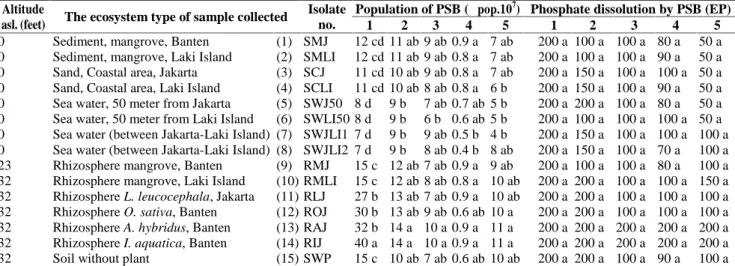
Glucose was the carbon source used in a test of PSB isolated from the sea to solubilize bound phosphorus labeled with halozones (De Souza et al. reported that PSB isolated from coastal, marine, mangrove, and seawater was able to solubilize P from zinc phosphate (30%), from calcium triphosphate (19%) and from calcium triphosphate (18%). The results can be seen in Table 1 and were supported by the research conducted by Kucey et al.1989) which shows that that the population of PSB in rhizosphere areas is more than in non-vegetated areas. This is due to the fact that organic phosphate is rare in offshore areas, so the population of PSB is small.
The lowest concentration was found in isolates from sea water, namely isolates number 7 and 8 (Table 3). All isolates were grown in media using 3 different phosphate sources (Ca3(PO4)2.), Al3(PO4)2.and rock phosphate). The highest activities of both acidic enzyme and basic enzyme were found in PSB isolated from soil growing Amaranthus hybridus and Ipomoea aquatica.
This may be due to the fact that the amount of P in culture growth was limited, proving that P is in high demand (Savine et al. 2000). Phosphate solubilizing bacteria (PSB) were found in coastal, offshore, coastal and mangrove ecosystems, indicating their wide distribution.
Epiphytic orchids and host trees diversity at Gunung Manyutan Forest Reserve, Wilis Mountain, Ponorogo, East Java
Epiphytic orchids and host tree diversity in Gunung Manyutan Forest Reserve, Wilis Mountain, Ponorogo, East Java. We used targeted sampling at locations with the richest orchid diversity, based on information from forest rangers. Various data were also collected, including the species name of the host tree and the area on the tree where the orchid was holding.
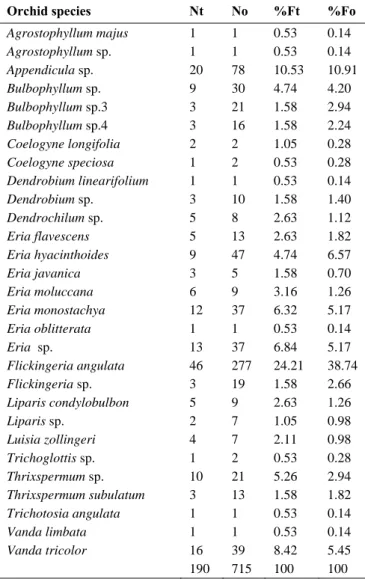
All data were recorded in a spreadsheet, and the following parameters were calculated: Nt is the number of trees in the plot that host a specific orchid species; No is the number of individuals of a particular orchid species within the plot. Orchids were identified to the species level if possible, and the genus level otherwise using the books by Comber as references. Location of study site at Gunung Manyutan Forest Reserve, in Wilis Mountain (dashed circle), and some of orchid species in this area: (A) Eria flavescens, (B) Coelogyne longifolia, (C) Coelogyne speciosa, (D) Dendrobium linearifolium and Flickingeria angulata.
BMadiun
Dressler (1990) divides the part of the host tree where the epiphytic orchid grows into five zones. Of course, most orchids grow on a specific part of the host tree that optimizes their resource acquisition. YULIA & BUDIHARTA - The diversity of orchids and their host tree on Mount Wilis 25 showed that epiphytic orchids were mostly in zone 3.
Number of epiphytic orchids in each zone of the host tree (Zone 1: the lower part (1/3) of the main stem; Zone 2: the upper part (2/3) of the main stem; Zone 3: the lower part of the main stem branches; Zone 4: the middle part of the branches; Zone 5: the outer part of the branches). However, the individual condition of the host tree also influences the occurrence of epiphytic orchids in terms of creating suitable conditions such as light intensity, aeration and humidity (Zotz and Hietz 2001). A study on the relationship between epiphytic orchids and host trees in subtropical forest in Taiwan also showed that generalist orchid species tend to grow on different host trees without specific association with a particular tree species (Martin et al. 2007).
List of registered host tree species and number of individuals on each plot. Species of host tree SP. Martin CE, Lin TC, Hsu CC, Lin SH (2007) No effect of host tree species on the physiology of the epiphytic orchid Bulbophyllum japonicum in subtropical rainforest of northeastern Taiwan.
Inventory and habitat study of orchids species in Lamedai Nature Reserve, Kolaka, Southeast Sulawesi
By growth type we know 18 species of sympodial orchids and 9 species of monopodial orchids in the Lamedai nature reserve, such as Grosourdya appendiculata (Blume) Reichb.f., Phalaenopsis sp., Pteroceras emarginatum (Blume) Hollt, Schoenorchis juncifolia Blume ex. This result was supported by Tirta et al. 2010), that epiphytic orchid in the Senturan forest mainly grows on Syzygium racemosum, Syzygium sp., Glochidion rubrum, Artocarpus sp., Baccaurea sp., Trema Orientalis and Shorea sp. The same applies to research by Yulia (2007) in which more Bulbophyllum sp. 15 species) in the natural forest in Petarikan village, West Kotawaringin District, Central Kalimantan.
Based on the number of individual orchids on host tree, showed that many orchid species in Lamedai prefer to grow on Pouteria sp., then on Syzygium and Sapotaceae family. Metrosideros vera Cratoxyllum formosum Vitex sp. the frequency of host tree ∑ orchid species ∑ individual of orchid orchid species/host tree individual of orchid/host tree. Dendrobium sp.1 grows on every zone and almost all the orchid species in Lamedai Nature Reserve grow on zone 1, except Agrostophyllum sp., Dendrobium platygastrum Reichb.f., Grammatophyllum scriptum Blume, Grosourdya appendiculata (Blume) Reichb.f., Luisia sp. ., Phalaenopsis sp.
In the Lamedai Nature Reserve, humidity was around 60-80% and temperature 22-32°C, this condition created thick humus deposits. There were 51 orchid species growing in thick humus and 7 species in thin humus, such as Bulbophyllum sp., Cymbidium finlaysonianum Lindl., Dendrobium sp.1, Dendrobium. This condition indicates that epiphytic orchids in Lamedai usually grow in high humidity, often in zone 1.

Infection of Anisakis sp. larvae in some marine fishes from the southern coast of Kulon Progo, Yogyakarta
Many commercially important fish species were caught in the Indian Ocean, southern coast of Kulon Progo district. Species, total number of individuals and size of fish samples and the infection of Anisakis sp. The high average intensity was achieved in Evynnis cardinalis and Nemipterus virgatus, 80.3 and 76.2 larvae/infected host, respectively.
Fish from the Gempylidae family (Gempylus serpens, Thyrsitoides marleyi) showed high prevalence and medium intensity of Anisakis sp. Indonesia has thousands of fish species, but few have been studied for Anisakis sp. Jacob E, Palm HW (2006) Parasites of commercially important fish species from the southern coast of Java, Indonesia, including the distribution pattern of trypanorhine cestodes.
Manfredi MT, Crosa G, Galli P, Ganduglia S (2000) Distribution of Anisakis simplex in fish caught in the Ligurian Sea. Palm HW, Damriyasa IM, Linda and Oka IBM (2008) Molecular genotyping of Anisakis Dujardin, 1845 (Nematoda: Ascaridoidea: . Anisakidae) larvae from marine fishes of Balinese and Javanese waters, Indonesia.
Herpetofaunal community structure and habitat associations in Gunung Ciremai National Park, West Java, Indonesia
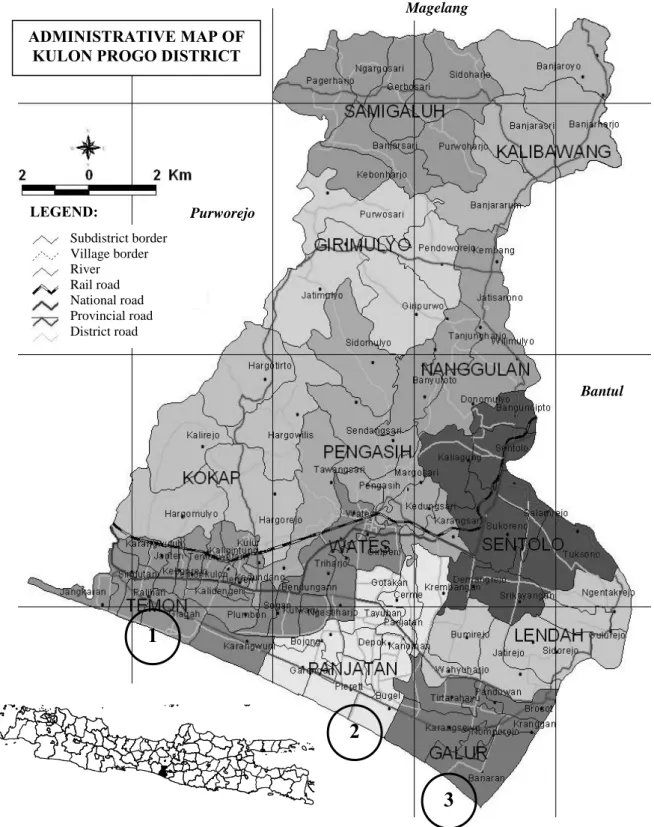
The higher the value of H', the greater the diversity and supposedly the cleaner the environment (Ludwig and Reynolds 1988; Metcalfe 1989). This index indicates the number of species in a sample or the abundance of the species per unit area (Ludwig and Reynolds 1988; Metcalfe 1989). Map showing the location of the study sites for (1) Palutungan, (2) Linggarjati and (iii) Seda at and around Gunung Ciremai National Park.
These values showed that between the rainy and dry seasons, changes in the species' distribution did not have much influence on species richness. Dendrogram of herpetofaunal community similarity between habitat types based on Sorensen coefficient during dry (A) and rainy (B) seasons. This finding can be used as baseline data for further research and management of the fauna of Gunung Ciremai National Park.
The distribution change of the herpetofauna is the consequence of the climate change between the rainy season and the dry season. This distributional change was reflected in differences in clustering patterns of community similarity between habitat types.

A model of relationship between climate and soil factors related to oxalate content in porang (Amorphophallus muelleri Blume) corm
A model of relationship between climate and soil factors related to oxalate content in porang (Amorphophallus muelleri Blume) tuber. Based on this argument, research was carried out using model simulation with smartPLS software to obtain a model of relationship between climate and soil factors related to corm oxalate content in porang. A model of relationship between climate and soil factors related to oxalate content in leek tuber.
The significance was higher petiole diameter condition affects higher tuber total oxalate, soluble oxalate, insoluble oxalate, and density of calcium oxalate crystal condition. The tuber total oxalate, soluble oxalate, insoluble oxalate and density of calcium oxalate crystal were not directly affected on the garlic diameter. INDRIYANI et al.–Relation between climate and soil to oxalate content of porang 51. always followed by the decrease in corm oxalate content and vice versa.
The model developed to determine the relationship between climate and soil factors related to oxalate content in porangi corm revealed that soil temperature and CEC had an indirect effect on total oxalate, soluble oxalate, insoluble oxalate and crystal density of calcium oxalate. There was an indirect effect between total corm oxalate, soluble oxalate, insoluble oxalate and calcium oxalate crystal density and corm diameter.

Species identification and selection to develop agroforestry at Lake Toba Catchment Area (LTCA)
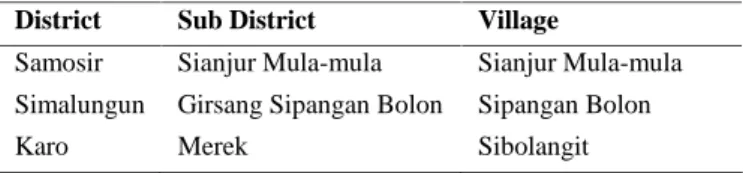
Based on the results of the interview with the participants (Vas Sipangan Bolon) at the meeting and the results. The community often does not know the types of crops that can be planted, nor does it know the production techniques of growing forest culture seedlings (trees). Based on the condition of the village as mentioned above, the plant varieties that were suitable for planting in the demo plot are as follows: (i) For Sianjur Mula-mula village: C.
The diversity of the existing crop species showed the number of choices to be developed by the farmer. The wider implication of the study is that biophysical as well as social variables must be considered together in the design of suitable agroforestry systems in various parts of the world (Sood and Mitchell 2009). Based on the data and information collected, as well as the available literature references, the combination of the crop species that could potentially be developed was, among others: (i) The agricultural crop: Z.
In: Sabarnurdin MS (ed.) The role of agro-forestry education in the revitalization of the agriculture, fisheries and forestry program; continuation of the international seminar. Sabarnurdin MS (ed.) The role of agroforestry education in the revitalization of the agriculture, fisheries and forestry program; continuation of the international seminar.