THE ROLE OF CULTURE IN DIPLOMACY:
BOLLYWOOD AS INDIAN CULTURAL DIPLOMACY TOWARDS INDONESIA (1998-2013)
By
MEYDITYA YUSWANDARI ID no. 016201000040
A thesis presented to the
Faculty of International Relations, Communications and Law President University
In partial fulfillment of the requirements for Bachelor Degree in International Relations
Concentration of Diplomacy Studies
2014
ii
THESIS ADVISER
RECOMMENDATION LETTER
This thesis entitled “The Role of Culture in Diplomacy: Bollywood as Indian Cultural Diplomacy towards Indonesia (1998-2013)” prepared and submitted by Meyditya Yuswandari in partial fulfillment of the requirement for the degree of Bachelor Degree in International Relations in the Faculty of International Relations, Communications and Law has been reviewed and found to have satisfied the requirements for a thesis fit to be examined. I therefore recommend this thesis for Oral Defense.
Cikarang, Indonesia, January 21
st, 2014
________________________________
Prof. Anak Agung Banyu Perwita, Ph.D
iii
DECLARATION OF ORIGINALITY
I declare that this thesis, entitled “The Role of Culture in Diplomacy:
Bollywood as Indian Cultural Diplomacy towards Indonesia (1998- 2013)” is, to the best of my knowledge and belief, an original piece of work that has not been submitted, either in whole or in part, to another university to obtain a degree.
Cikarang, Indonesia, January 21
st, 2014
__________________
Meyditya Yuswandari
iv
PANEL OF EXAMINER APPROVAL SHEET
The Panel of Examiners declare that the thesis entitled “The Role of Diplomacy in Culture: Bollywood as Indian Cultural Diplomacy towards Indonesia (1998-2013)” that was submitted by Meyditya Yuswandari majoring in International Relations from the Faculty of International Relations, Communications and Law was assessed and approved to have passed the Oral Examinations on February 18
th,
2014.
Hendra Manurung, MA Chair – Panel of Examiners
Teuku Rezasyah, Ph.D Examiner
Prof. Anak Agung Banyu Perwita, Ph.D
Thesis Adviser
v
ABSTRACT
Title: The Role of Culture in Diplomacy: Bollywood as Indian Cultural Diplomacy towards Indonesia (1998-2013)
This research aims to discuss the influence of Bollywood movies, as Indian Cultural Diplomacy, in the bilateral relations between Indonesia and India that limited in the period of 1998-2005. This research used the qualitative research method which is explained descriptively the effort of Indian government in maximizing Bollywood as Indian cultural diplomacy through cultural activities and cultural agreements with other country. Besides that, Bollywood is also used to encourage the deployment of Indian culture throughout the world. The researcher also found out that private sectors and Indian artists contribute in developing Bollywood and spread Indian culture to be known by other countries.
Especially in Indonesia, the researcher found that Bollywood movies have affected Indonesia and strengthen relations between India and Indonesia. It's supported by several findings such as the number of Indonesia people who want to learn Indian culture in Indian cultural center in Jakarta, Indonesian people‟s interest to buy Indian products, Indonesian people‟s interest to participate Indian cultural activities and the interest of the Indonesian people to study and visit India. The use of Bollywood as Indian cultural diplomacy will strengthen the bilateral relations between Indonesia and India.
vi
ABSTRAK
Title: The Role of Culture in Diplomacy: Bollywood as Indian Cultural Diplomacy towards Indonesia (1998-2013)
Penelitian ini bertujuan untuk membahas pengaruh film Bollywood, sebagai alat diplomasi budaya India, dalam hubungan bilateral antara Indonesia dan India yang dibatasi dalam periode tahun 1998-2005. Penelitian ini menggunakan metode penelitian kualitatif yang dijelaskan secara deskriptif upaya pemerintah India dalam memaksimalkan Bollywood sebagai alat diplomasi budaya India dan untuk medorong penyebaran budaya India melalui kegiatan buadaya dan perjanjian budaya dengan Negara lain. Selain itu, Bollywood digunakan untuk mendorong penyebaran budaya India di dunia. Peneliti memenukan bahwa perusahaan swasta dan beberapa seniman India juga turut berkontribusi dalam mengembangkan Bollywood dan budaya India agar diketahui oleh Negara lain. Terutama di Indonesia, peneliti menemukan bahwa film Bollywood telah mempengaruhi Indonesia dan hal itu memperkuat hubungan bilateral antara Indonesia dan India. Hal ini di dukung oleh beberapa penemuan terkait seperti banyaknya orang Indonesia yang ingin belajar budaya India di Indian cultural center di Jakarta, minat orang Indonesia untuk membeli barang- barang India, minat orang Indonesia untukberpartisipasi dalam acara budaya India dan minat orang Indonesia untuk belajar dan berkunjung ke India. Penggunaan Bollywood sebagai alat diplomasi budaya India akan memperkuat hubungan bilateral antara Indonesia dan India.
vii
ACKNOWLEDGEMENT
Alhamdulillahirabbilalamin. I already finished my thesis. This thesis would not have been possible without the help and guidance from many people around me who always support and contribute in the preparation and completion of my thesis.
First of all, I would like to send my gratitude to Allah SWT for giving me strength and ease my way to complete my thesis. I could not have completed my thesis without your permission, thank you Lord.
Secondly, the full support and contribution of my beloved parents, Rudy Jusdian and Septi Dwi Kurniawati, my younger sister and whole family also encourage me to fight and complete my thesis.
Third of all, I would like to acknowledge my gratitude to Prof. Anak Agung Banyu Perwita and Isyana Adriani Arslan, as my thesis advisor, for giving me advice and guided me patiently.
Fourthly, I would like to thank to Astari and Ardhisa Harmanita, my internship‟s friends, and the admin of Komunitas Fans Bollywood Indonesia (KFBI) for being my interviewees and partners to share the stories, experiences and knowledge about Bollywood that will support the completion of my thesis.
Fifthly, I would like to address my gratitude to my beloved friends and roommates Rahayu Shofa, Patricia Olivia, Anissa Syifa, Puspa Anggraeni, Raiza Indi, Siti Muthia, Sheyla Laveyla, Salim, Achmad Faizal, Akbar Wibi and Randi Fauzan for their warm support so that I can finish my thesis.
The last but not least, I would like to thank to all my beloved IR friends who always give big support and share many important information which help me to complete my study.
Bekasi, January 21, 2014
Meyditya Yuswandari
viii
TABLE OF CONTENTS
THESIS ADVISER RECOMMENDATION LETTER ... ii
DECLARATION OF ORIGINALITY ... iii
PANEL OF EXAMINER APPROVAL SHEET………...iv
ABSTRACT ... v
ABSTRAK……….vi
ACKNOWLEDGEMENT ... vii
TABLE OF CONTENTS……….viii
LIST OF ACRONYMS ... xi
CHAPTERS CHAPTER I: INTRODUCTION………...1-18 I.1 Background of the studies………..1
I.2 Problem Identification………4
I.3 Statement of problem……….7
I.4 Research Objectives………...7
I.5 Significance of the study………8
I.6 Theoretical Framework………..8
I.7 Research Method………..14
I.7.1 Research Time and Place………..14
I.7.2 Research Instruments...15
I.8 Scope and limitations of the study………...16
I.9 Definitions of terms………..16
I.9.1 Soft Power……….16
I.9.2 Cultural Diplomacy………...17
I.10 Thesis structure………..17
ix CHAPTER II: INDIA‟S CULTURAL INTEREST………19-35 II.1 National Interest of India………...19 II.1.1 National Interest of India in Culture………...22 II.2 The Overview of Indian Cultural Diplomacy as a Tool to Promote Indian Cultural Interest………..24 CHAPTER III: DEVELOPMENT OF BOLLYWOOD AS INDIAN CULTURAL DIPLOMACY TO THE WORLD……….36-55 III.1 Development of Bollywood in the World……….36 III.1.1 Brief History of Bollywood………...36 III.1.2 Bollywood as Indian Cultural Diplomacy……….40 III.1.2.1 Indian Government‟s Support for Bollywood as Indian Cultural Diplomacy………42 III.1.2.2 Private Sector and NGO‟s Support for Bollywood as Indian Cultural Diplomacy…...44 III.2 The Promotion of Bollywood as Indian Cultural Diplomacy to the World……….46 III.2.1 Promotion of Bollywood as Indian Cultural Diplomacy by Ministry of Information and Broadcasting………47 III.2.2 Promotion of Bollywood as Indian Cultural Diplomacy by India Ministry of External Affairs……….49 III.2.3 Promotion of Bollywood as Indian Cultural Diplomacy by Indian Artists and Private Sector………...53 CHAPTER IV: DEVELOPMENT OF BOLLYWOOD MOVIES AS INDIAN CULTURAL DIPLOMACY TOWARDS INDONESIA (1998- 2013)……….56-75 IV.1. India-Indonesia Bilateral Relations………56
IV.1.1 Indian-Indonesia Cultural Relations……….61 IV.2 The Development of Bollywood Movies in Indonesia as Indian Cultural Diplomacy (1998-2013)………..66
x IV.3 The Promotion of Bollywood in Indonesia as Indian Cultural Diplomacy Tool……….71 IV.3.1 Promotion of Bollywood by Indian Government………..71 IV.3.2 Promotion of Bollywood by Indian Actor and Actress….74 CHAPTER V: CONCLUSION………76-79 BIBLIOGRAPHY………80-90 APPENDICES………...91
xi List of Acronyms
ASEAN Association of Southeast Asian Nations BRICS Brazil, Russia, India, China and South Africa CEP Cultural Exchange Programs
CFSI Children‟s Film Society of India ESG Entertainment Society of Goa
ICCR Indian Council for Cultural Relations IFFI International Film Festival of India IIFA Indonesia-India Friendship Association IIFA International Indian Film Academy IIFFT International Indian Film Festival Toronto IPSC Institute of Peace and Conflict Studies ITEC Indian Technical and Economic Cooperation JCM Joint Commission Meeting
JNICC Jawaharlal Nehru Indian Cultural Center KFBI Komunitas Fans Bollywood Indonesia MEA Ministry of External Affairs
MIB Ministry of Information and Broadcasting MIFF Mumbai International Film Festival MoU Memorandum of Understanding NGO Non-Governmental Organization RCTI Rajawali Citra Televisi Indonesia SCTV Surya Citra Televisi
SICC Sentul International Convention Center
xii TPI Televisi Pendidikan Indonesia
UI University of Indonesia
UKIERI United Kingdom – India Education and Research Initiative WEF World Economic Forum
WFP World Food Program
1
CHAPTER I INTRODUCTION
I.1. Background of studies
Diplomacy is a term that is often used if we talk about International Relations. There are several definitions of diplomacy used by many different scholars. One of them is written by Jean Robert Leguey Feilleux in his book The Dynamic of Diplomacy, “Diplomacy as a method of political interaction at the international level and the techniques used to carry out political relations across international boundaries1. According to S.M Tariqul Islam, Assistant Professor of Department of Government and Politics, Jahangirnagar University, Savar, Bangladesh, there are four points in changing the nature and agenda of diplomacy. The four points are an evolution of organized diplomacy, new diplomacy, cold war diplomacy, and post-cold war or modern diplomacy2. The modern diplomacy started in the beginning of the twentieth century. According to S.M Tariqqul Islam, diplomacy on the level of the political world is consists of two ways. First, diplomacy is now global in scope and second is the contemporary diplomacy can be characterized as complex and fragmented. In the modern diplomacy, the continued expansion of the international society has been a major factor. The increasing interest of each country also gives impact to the modern diplomacy.
Talking about the increase of interests in each country, the modern diplomacy leads us to the soft power era. The trend of soft power is influential both in terms of national interests and the strategy in pursuing them through diplomacy3. Soft power diplomacy, as a way to get others to desire what you
1 Jean Robert Leguey Feilleux, The Dynamic of Diplomacy: The Meaning of Diplomacy as an Issue (United States of America: Lynne Rienner Publisher, 2009), 1.
2 S.M.Tariqul Islam, “Changing Nature and Agenda of Diplomacy: A Critical Analysis.” Asian Affairs 27:1 (January-March 2005). Centre for Development Research Bangladesh Publication.
http://www.cdrb.org/journal/2005/1/asian-4.pdf (23 September 2013).
3 Savitri, Rina. Popular Culture in Cultural Diplomacy: Korean Wave as Republic of Korea‟s Cultural Diplomacy in Indonesia (2002-2012). (President University, Cikarang, Bekasi: 2013)
2 desire, persuades people rather than coerces them4. Therefore, soft power becomes the new strategy to do diplomacy in order to achieve a country‟s national interest.
Soft power diplomacy has to be transparent to get public support, and this is known as public diplomacy. The actors of public diplomacy are not the government, but the non-state actors, such as Non-Governmental Organization (NGO) and civil society. Public diplomacy refers to programs sponsored by government with the purpose of influencing the public opinion about a country through publication, film, culture exchange, radio and television5. A nation can implement soft power diplomacy through culture, known as cultural diplomacy.
Culture is an asset of each country to help them to get recognition in the world politics. Culture itself has several meanings. According to Welsh academic, novelist, critic and influential figure in culture, Raymond Williams (1990):
“First culture can be used to refer to „a general process of intellectual, spiritual and aesthetic development‟. Second, culture might be to suggest „particular way of life, whether of a people, a period or a group‟. Third, culture can be used to refer to „the works and practices of intellectual and especially artistic activity6.”
Culture serves as the identity of a particular nation. Each country has a different culture. Culture can be a way for a nation to spread their influence in the world.
4 Cited in Joseph S. Nye, Jr , Soft Power: The Means to Success in World Politics. (United States:
United Stated by Public Affairs, 2004)
https://webfiles.uci.edu/schofer/classes/2010soc2/readings/8%20Nye%20Soft%20Power%20Ch%
201.pdf (23 September 2013)
5 U.S Department of State, Dictionary of International Relations Terms. (Department of State,
1987), 85; quoted in Rahman, Bajora. Diplomasi Hip Hop Sebagai Diplomasi Budaya Amerika Serikat. (Universitas Indonesia, Depok: 2012)
6 Raymond Williams, Keywords: A Vocabulary of Culture and Society. 2nd ed. (New York: Oxford University Press, 1985), 90; quoted in John Storey, Cultural Theory and Popular Culture: An Introduction. 5th ed. (Harlow: Pearson Education, 2010), 1-2.
http://www.scribd.com/doc/36058283/Cultural-Theory-and-Popular-Culture (23 September 2013)
3 Culture is capable to foster understanding of a person which affects diplomatic relations through changing times7.
We cannot separate cultural diplomacy from public diplomacy, although they are different. Public diplomacy expert Jian Wang suggests three levels of public diplomacy that involve a different configuration of actors: promoting a country‟s national goals (primarily national actors); communicating a nation‟s ideas and ideals, beliefs and values (national and sub-national actors); and building common understanding and relationships (primarily sub-national actors)8. Culture has its role in those three levels of public diplomacy.
Cultural exchange instills tolerance and understanding between people of different cultures. Culture has no boundaries, and using it as the medium to interact with the masses has been the most effective and proven way to win hearts in this era of globalization, said Dr. Karan Singh as the President of Indian Council for Cultural Relations in India. Fashion, music, and dance are part of popular culture. Showing dance, music, and fashion of one country to another country is part of cultural diplomacy. If a culture is accepted by many people around the world, it means that nation is successful in introducing their culture to the world. Indeed, the most important contribution of a culture to public diplomacy is its ability to showcase a diversity of views, perspectives and opinions. Breaking down persistent national stereotypes and instilling a perception that a country‟s interests are similar to another country9.
Every nation has its own popular culture that serves as a diplomatic tool, for instance Korea with Korean Wave. If we mention India, the first thing which comes to mind is Bollywood. Bollywood is known all over the world for its dance and songs. It was showing the culture of India who love to dance and sing. Indian films were first imported to Indonesia in 1945. At that time, Bollywood films
7 Bound, K., Briggs, R., Holden, J., & Jones, S., Cultural Diplomacy: Culture is a central
component of international relations. It's time to unlock its full potential. (London: Demos, 2007);
quoted in Rina Savitri, Popular Culture in Cultural Diplomacy: Korean Wave as Republic of Korea‟s Cultural Diplomacy in Indonesia (2002-2012). (President University, Cikarang, Bekasi:
2013), 2.
8 Ibid
9 Bound, K., Briggs, R., Holden, J., & Jones, S. (2007). Cultural Diplomacy: Culture is a central
component of international relations. It's time to unlock its full potential. London: Demos.
http://www.scribd.com/doc/1037288/Demos-Cultural-Diplomacy (24 September 2013)
4 were used to entertain the Indian army who was part of the British army. In the 1970s and 1980s, many Indian movies were screened at the cinemas in Indonesia.
The target of Bollywood film has been the lower middle class. In 1991 and 1992, Indian movies were aired on Televisi Pendidikan Indonesia (TPI), a national television station. In 1996, another Indonesian national channel, Indosiar, started to air Indian movies every weekend. However, after the successful of „Kuch Kuch Hota Hai‟ in 1998, the middle-upper class started to pay attention to Bollywood movies. „Kuch Kuch Hota Hai‟ marks a turning point in the Indian film market in Indonesia, both middle-upper class and lower middle class10. Now, there are many Indian films imported to Indonesia every year, according to Indonesian Censorship Institution or Lembaga Sensor Indonesia (LSI).
There are three categories of cultural diplomacy in India, which have done by different sectors: public sector, private sector and civil society11. An example of cultural diplomacy in the private sector is the annual Indian Film Festival of Los Angeles, which shows 20 Bollywood movies both classic and temporary.
There is also a question and answer session about films and seminars. This shows that Bollywood is a successful cultural diplomacy tool, to an extent.
I.2. Problem Identification
Bollywood movies are often heard by Indonesian people in 1991 and attracted the lower middle class. At that time, Bollywood movies aired in Televisi Pendidikan Indonesia (TPI) and followed by another Indonesian national television, Indosiar, in 1996. In 1998, „Kuch Kuch Hota Hai‟ aired in cinema and made the middle-upper class attracted by Bollywood movies. After that, Bollywood produced other films with the same genre with „Kuch Kuch Hota Hai‟, which is a love story and family movies. It is a world in which traditional
10 “Bollywood in Indonesia: The Kuch Kuch Hota Hai Effect.” One World South Asia. 23rd December 2012. http://southasia.oneworld.net/features/bollywood-in-indonesia-the-kuch-kuch- hota-hai-effect#.UkKCkIanpu4 (25 September 2013).
11 Institute for Cultural Diplomacy (ICD). “Country profiles: India.” 2011.
http://www.culturaldiplomacy.org/culturaldiplomacynews/content/pdf/Cultural_Diplomacy_Outlo ok_Report_2011_-_03-09.pdf (24 September 2013).
5 values such as honesty, respect for elders and hard work still count12. Bollywood films reflect the generational conflict in modern India.
Bollywood cinema has shown tremendous influence in Indonesia. First, one of Indonesian song adopted Indian instrument. The title of its song is „Kau‟, sung by Glenn Fredly in 1999. In the video clip of „Kau‟, Glenn Fredly and the female artist used Indian outfit complete with Indian accessories in their body.
The rhythm of „Kau‟ song was involving Indian rhythm. The other example is the emergence of Norman Kamaru, Indonesian police officer, in social media, YouTube. Suddenly, he became famous because he uploaded his video dancing and sings „Chaiyya Chaiyya‟ in 2011. „Chaiyya Chaiyya‟ is a soundtrack of „Dil Se‟, one of Bollywood movies, sung by Sukhwinder Singh and Sapna Awasthi in 1998.
The fans of Bollywood movies in Indonesia are huge and they made many fan bases in social networks, such as Facebook and Twitter. They often talked about the most update news of Indian artist, movies, and song. To enhance Bollywood in Indonesia, the Indian Embassy in Jakarta organized a weeklong festival named “Indian Film Festival: 100 Years Indian Cinema”. The embassy is sponsoring free screenings of 15 films from 23rd September 2013 to 27th September 2013 at the Cinema XXI Plaza Senayan in Senayan, South Jakarta, capped by a special screening of Unni Vijayan‟s 2012 film titled „Lessons in Forgetting‟ at the Embassy on 28th September 201313. This event got a great response from Indonesian people. It proved by the full quota of ticket reservation for three Bollywood movies, „Lagaan‟, „Sholay‟ and „Kuch Kuch Hota Hai‟.
Indian government realizes that expanding Indian culture in the world is important in order to compete with other nation to boost economic growth. At the beginning of 2012, Public Diplomacy Division of Ministry of External Affairs of
12 Ministry of External Affairs: Government of India. “Bollywood: The Journey from 1913 to
2013.” 9th May 2013. http://www.mea.gov.in/articles-in-foreign-media.htm?dtl/ (24 September 2013).
13 The Jakarta Post. “In Jakarta: Indian Film Festival Aims at Bollywood and Beyond.” 23rd
September 2013. http://www.thejakartapost.com/news/2013/09/23/in-jakarta-indian-film-festival- aims-bollywood-and-beyond.html (4 October 2013).
6 India invited proposals for documentaries featuring varied aspects of Indian art and culture which will show the soft power of India to the world outside14.
Besides that, Prof. Anjali Gera Roy of Indian Institute of Technology, Kharagpur has come out with a collection of article aptly titled The Magic of Bollywood: At Home and Abroad15. This book explores the wide range of dimensions of Bollywood as an effective element of India‟s soft power, the presence and influence of Bollywood in different parts of the world and its constitution as a cultural and commercial branding16. Bollywood has influenced many countries, including Indonesia. The Indian government is fully aware that Bollywood has an important role in supporting the cultural diplomacy towards Indonesia.
Indonesia and India diplomatic relations have been established for 6 decades. Indian Prime Minister, Jawaharlal Nehru and Indonesian President, Soekarno collaborated in supporting the cause of Asian and African independence. They made a foundation of the Afro-Asian and Non-Aligned Movements at Bandung Conference in 1955. Since the adoption of India‟s „Look East Policy‟ in 1991, there has been a rapid development of bilateral relations in political, security and defense, commercial and cultural fields17.
India and Indonesia have an active cultural exchange. President Indonesia signed the Cultural Exchange Programs (CEP) for the period 2011-2014 in January 2011 during his visit to India. Several events have been organized in Indonesian provinces to introduce Indian culture in these regions and facilitating business contacts. To enhance people-to-people contact, India Cultural Forum was inaugurated on 15th August 2012 bringing together all India focused socio- cultural groups in Indonesia on one platform18.
India also wants to reach the younger generation of Indonesia people, so that the Embassy of India has been created a Facebook page to connect with
14 The New Indian Express. “When Bollywood Becomes a Powerful Seductress.” 23rd December
2012. http://newindianexpress.com/lifestyle/books/article1388591.ece (24 September 2013).
15 Ibid.
16 Ibid.
17 Ministry of External Affairs: Government of India. “India-Indonesia Relations.” (July 2013).
http://www.mea.gov.in/Portal/ForeignRelation/India-Indonesia_Relations.pdf (4 October 2013).
18 Ibid
7 them. India Tourism Board and Embassy of India in Jakarta made a seminar on Indian Tourism –„Know India Series‟ on the theme of Incredible India- which held in Jakarta on 7th March 2013. There were many important people attended the seminar, such as travel agents based in Indonesia, representatives of the airline industry, hotels, diplomatic community, the media and other stakeholders in the tourism industry. The Embassy also organized „Culinary Connection- India and Indonesia‟ at Four Seasons Hotel in March 2013 in order to explore the links between the culinary traditions of the two countries19. It shows that India has beneficial diplomatic relation with Indonesia. India uses the similarities of Indian culture and Indonesian culture to build a relation with Indonesia.
This research aims to analyze the role of Bollywood, as a tool of Indian cultural diplomacy, spreading the culture of India to Indonesian people and helping the bilateral relations of the two countries.
I.3. Statement of Problem
This research is about determining the role of culture in diplomacy. In this research, Bollywood is a tool of India in doing cultural diplomacy. How does Bollywood, as Indian cultural diplomacy, contribute in improving India- Indonesia relations?
I.4. Research Objectives
According to the statement of the problem, the research objective of this thesis is to prove the extent of improvement in the bilateral relations between India and Indonesia, brought by the influence of Bollywood.
19 Ministry of External Affairs: Government of India. “India-Indonesia Relations.” (July 2013).
http://www.mea.gov.in/Portal/ForeignRelation/India-Indonesia_Relations.pdf (4 October 2013).
8 I.5. Significance of the Study
This research is significant because first of all it aims to explore the advantages of cultural diplomacy. Secondly, this research will increase our knowledge about the other side of Bollywood, which is used as the tool of Indian cultural diplomacy.
I.6. Theoretical Framework
This research uses two theories of International Relations that may be the most appropriate to give a clear picture of Bollywood in Indian cultural diplomacy towards Indonesia. They are Soft Power theory and Cosmopolitan Constructivism theory.
First is the soft power theory. Soft power first introduced by Joseph S.
Nye in his article „Soft Power‟ in 1990. In general, power is the ability to influence the perspectives of others to get the outcomes that you want. According to Joseph S. Nye, there are three ways to influence others; coerce them with threats, induce them with payments and attract or co-opt them20.
There are two powers in diplomacy introduced by Joseph S. Nye, which are hard power and soft power. Hard power is already known by International Relations actors because of its role in solving problems which is using military forces and economic. Meanwhile, soft power is use an attractive way that can build the preferences of others so that people will follow what you want without any forces. The ability to establish preferences tends to be associated with intangible assets, such as an attractive personality, culture, political values and institutions and policies that are seen as legitimate or having moral authority21.
Although soft power seems useful in the globalization era and use less cost rather than hard power but soft power also has limitations. Joseph S. Nye said that the crucial resources of soft power are outside the control of
20 Nye, Jr, Joseph Samuel. “The Benefits of Soft Power.” Working Knowledge for Business
Leaders. (2 August 2004). Harvard Business School.
http://hbswk.hbs.edu/archive/4290.html (5 October 2013).
21 Ibid.
9 governments, and their effect depends heavily on acceptance by the receiving audiences and soft power sometimes take years to produce the desired outcomes.
Culture is one of attractive way in building the preferences of others. The Indian government is currently using culture as their soft power. Minister of State for Human Resource Development of India, Sashi Tharoor, argued that India is now having several resources that can be used as its soft power:
“If India is now perceived as a superpower, it was not just through trade and politics, but also through its ability to share its culture with the world through food, music, technology and Bollywood.
However, it is difficult to determine India‟s actual soft power resources, or which of these resources have actually helped strengthen India‟s global status22.”
India has a long history of civilization and cultural links with countries in Central Asia, South-East Asia and the Middle-East because of that Indian diplomats used religious and cultural ties to improve the relations in South-East Asia. Indian government realizes that soft power has become an active element in Indian diplomacy in parallel with the development of its hard power resources23.
Nicolas Blarel, Graduate Research Assistant of Center on American and Global Security, Indiana University, stated in his book „India‟s Soft Power: From Potential to Reality?‟ that India has progressively understood that these two powers cannot be separated. India‟s hard power, which is use economic and military forces, has an important role in developing India‟s soft power strategy to give legitimacy and credibility to India‟s leadership in the world.
Soft power is very important for India in order to change the stereotypical image of underdeveloped into new and modern image of India. For the last 7 years, India has tried to exploit its soft power resources by adding a new division in India‟s Ministry of External Affairs which is Public Diplomacy Division in
22 Nicolas Blarel. “India‟s Soft Power: From Potential to Reality?” The London School of Economics and Political Science.
http://www.lse.ac.uk/IDEAS/publications/reports/pdf/SR010/blarel.pdf (5 October 2013).
23 Ibid.
10 2006. Indian soft power has been perceived as complementing rather than challenging the existing Asia and international orders24. Now, Indian government is very concern about the use of soft power in improving India relation with other countries.
The second theory is cosmopolitan constructivism theory. The normative view of cultural diplomacy in terms of promoting mutual understanding and cultural-cooperation through intercultural dialogue and cultural exchange is propagated within the framework of cosmopolitan constructivism25. Cesar Villanueva wrote in his article titled Cosmopolitan Constructivism: Mapping a Road to the Future Cultural and Public Diplomacy that:
“Cosmopolitan Constructivism is a theory which based on multilateral diplomacy, formulated by people who interested in peace, understanding and friendly relations among nations26. The bottom line of this theory is about people, cultures and state matters, and cultural and public diplomacies collaborate in the inter-subjective construction of ideas, norms and identities towards cooperation, welfare and understanding27. The theory celebrates cultural differences, cultural exchanges and face-to-face encounters in the struggle to foster common understanding28.”
The cosmopolitan constructivism theory explained that cultural diplomacy will imply the long-term foreign policy objectives, where every country needs process
24 Blarel, Nicolas. “India‟s Soft Power: From Potential to Reality?” The London School of Economics and Political Science.
http://www.lse.ac.uk/IDEAS/publications/reports/pdf/SR010/blarel.pdf (5 October 2013).
25 Cesar Villanueva (2010), Cosmopolitan Constructivism: Mapping a Road to the Future of
Cultural and Public Diplomacy; quoted in Hyungseok Kang, Reframing Cultural Diplomacy:
International Cultural Politics of Soft Power and The Creative Economy (King‟s College London, 2013) www.culturaldiplomacy.org/academy/content/pdf/participant-papers/2011-08-
loam/Reframing-Cultural-Diplomacy-International-Cultural-Politics-of-Soft-Power-and-the- Creative-Economy-Hyungseok-Kang.pdf (8 October 2013)
26 Ibid.
27 Cesar Villanueva. “Cosmopolitan Constructivism: Mapping a Road to the Future of Cultural and Public Diplomacy.” Public Diplomacy Magazine, University of Southern California.
http://publicdiplomacymagazine.com/cosmopolitan-constructivism-mapping-a-road-to-the-future- of-cultural-and-public-diplomacy/ (10 October 2013)
28 Ibid.
11 to make common understanding and cultural exchanges with other societies and trying to encourage other societies to join the process. Paul Sharp, Professor and Head of Political Science at the University of Minnesota Duluth (US), stated that under the cosmopolitan constructivism theory, the mission of cultural diplomacy has evolved to the point where states are authentic expressions of popular sovereignty and the nation are authentic expressions of popular culture identity29. There are six programs that cultural diplomacy can do under the cosmopolitan constructivism framework30:
- Making the creation of peace and friendly relations with other nations - Investing in international educational exchanges targeting groups in
foreign societies which have talent but may not have the resources to study abroad.
- Creating a solid infrastructure for international cooperation, in which money and human resources can flow together and address important and urgent common topics with other nations.
- Establishing institutions abroad as a platform for sharing knowledge and engaging foreign publics, also discuss domestic issues that may be relevant for the two parties such as human rights, life conditions of children, or popular culture.
- Building the necessary channels to communicate with foreign publics, to listen to their concerns and to create mutual ways involvement.
- Educating young people in school programs related to international solidarity, mutual understanding and sensitivity to diversity and multiculturalism.
29 Paul Sharp, For Diplomacy: Representation and the Study of International Relations.
(International Studies review, 1999); quoted in Cesar Villanueva, Cosmopolitan Constructivism:
Mapping a Road to the Future of Cultural and Public Diplomacy. (University of Southern California: Public Diplomacy Magazine, 2010)
http://publicdiplomacymagazine.com/cosmopolitan-constructivism-mapping-a-road-to-the-future- of-cultural-and-public-diplomacy/ (10 October 2013)
30 Villanueva, Cesar. “Cosmopolitan Constructivism: Mapping a Road to the Future of Cultural and Public Diplomacy.” Public Diplomacy Magazine. 13th January 2010.
http://publicdiplomacymagazine.com/cosmopolitan-constructivism-mapping-a-road-to-the-future- of-cultural-and-public-diplomacy/ (10 October 2013)
12 Globalization helped nations to increase its relations with foreign publics, especially in term of cultural exchange. The role of culture as the important aspects of international relations is increasing because of the globalization and advancements of communication technologies that reconfigure the power dynamics between different social actors31. Kang argued that cultural diplomacy serves as an important aspect of successful bilateral and multilateral diplomacy and consequently requires a holistic conceptual framework for sound pragmatic implications.
Cultural diplomacy is a part of soft power. Dr. Emil Constantinescu, President of the Academy for Cultural Diplomacy, described the definition of cultural diplomacy as a course of actions, which are based on and utilize the exchange of ideas, values, traditions and other aspects of culture or identity, whether to strengthen relationships, enhance socio-cultural cooperation or promote national interest; Cultural diplomacy can be practiced by either the public sector, private sector or civil society32.
Now, India‟s soft power is increasing and cultural diplomacy becomes the tools of India‟s soft power. Sashi Tharoor, Minister of State for Human Resource Development of India, believed India‟s soft power had emerged until now independently of the government‟s policies and India has now to enhance its co- optive power33. India has a high level of cultural diplomacy. Indian cultural diplomacy has been done by three sectors; public, private and civil society. Every sector is helping their country to promote Indian culture and introduce a new image of India to the world.
The Indian government was deeply involved in promoting cultural diplomacy, not only to safeguard the nation‟s interests, but also to engage with
31 Hyungseok Kang. “Reframing Cultural Diplomacy: International Cultural Politics of Soft
Power and The Creative Economy.” (King‟s College London, 2013)
www.culturaldiplomacy.org/academy/content/pdf/participant-papers/2011-08-loam/Reframing- Cultural-Diplomacy-International-Cultural-Politics-of-Soft-Power-and-the-Creative-Economy- Hyungseok-Kang.pdf (10 October 2013)
32 Institute for Cultural Diplomacy. “What is Cultural Diplomacy? What is Soft Power?”
http://www.culturaldiplomacy.org/index.php?en_culturaldiplomacy (8 October 2013)
33 Blarel, Nicolas. “India‟s Soft Power: From Potential to Reality?” The London School of
Economics and Political Science.
http://www.lse.ac.uk/IDEAS/publications/reports/pdf/SR010/blarel.pdf (10 October 2013)
13 other countries on a cultural level34. Indian government established many cultural centers abroad along with its embassies, including in Indonesia. For Instance, Jawaharlal Nehru Indian Cultural Center (JNICC) located in Kuningan, Jakarta.
JNCC often showcases Indian culture free screening Bollywood movies and gave a course about Indian language. The Indian Council for Cultural Relations (ICCR) has set up 22 cultural centers in 19 countries whose activities ranging from film festivals to book fairs and art exhibitions, aim to present an image of India as a plural multicultural society35. The private sector also has a deep role in Indian cultural diplomacy. The private sector has engaged in sponsoring international events and many international schools are run by some private groups36. Private sectors also made some events, such as an Indian film festival, Indian Art Fair and The World Culture Festival 2011. Each event is used to show the cultural heritages of India and to build the appreciation of Indian cinema.
India has many resources that can be soft power assets, one of them is Bollywood. The successful export of cultural products such as Bollywood across the world has helped raise awareness of Indian culture and modified existing stereotypes37. Indian government is always developing Bollywood as their cultural diplomacy with other countries. The development of Bollywood showed when India celebrated hundred years of Indian cinema in Indonesia last month.
Bollywood, as Indian cultural diplomacy, has played a great role in introducing Indian society and culture. Bollywood is probably the largest and farthest reaching medium for Indian culture38. With the help from satellite television and internet, Bollywood movies and Indian soap operas have reached growing global
34 Institute for Cultural Diplomacy (ICD). “Country profiles: India.” 2011.
http://www.culturaldiplomacy.org/culturaldiplomacynews/content/pdf/Cultural_Diplomacy_Outlo ok_Report_2011_-_03-09.pdf (10 October 2013)
35 Blarel, Nicolas. “India‟s Soft Power: From Potential to Reality?” The London School of
Economics and Political Science.
http://www.lse.ac.uk/IDEAS/publications/reports/pdf/SR010/blarel.pdf (10 October 2013)
36 Institute for Cultural Diplomacy (ICD). “Country profiles: India.” 2011.
http://www.culturaldiplomacy.org/culturaldiplomacynews/content/pdf/Cultural_Diplomacy_Outlo ok_Report_2011_-_03-09.pdf (10 October 2013)
37 Blarel, Nicolas. “India‟s Soft Power: From Potential to Reality?” The London School of
Economics and Political Science.
http://www.lse.ac.uk/IDEAS/publications/reports/pdf/SR010/blarel.pdf (10 October 2013)
38 Ibid.
14 audiences that have become increasingly familiar with Indian society and culture39. In short, India is trying to expand the relations with other countries through its culture and Bollywood.
I.7. Research Method
The research method that will help the writer to develop her thesis is Qualitative research. Qualitative research is aim at discovering the underlying motives and desires, using in depth interviews for the purpose40. Through such research, we can analyze the various factors which motivate people to behave in a particular manner or which make people like or dislike a particular thing41. Qualitative research will support the purpose of this thesis, which is to find the influence of Bollywood in Indonesia – India relations.
The writer also uses Field research to support the thesis, which is done by interviewing people who are fans of Bollywood. Through interviews the writer will know about the attitude and opinion of people towards the phenomenon. It is used to find out how people feel and what they think about Bollywood as Indian cultural diplomacy in Indonesia. Library research will also support to strengthen this thesis. The writer will analyze journals, books and reports from Indian government, which are related to the development of Bollywood as Indian cultural diplomacy.
I.7.1. Research Time and Place
Place of research:
- Adam Kurniawan Library, President University - Perpustakaan Pusat Universitas Indonesia
- Jawaharlal Nehru Indian Cultural Center, Jakarta
39 Blarel, Nicolas. “India‟s Soft Power: From Potential to Reality?” The London School of
Economics and Political Science.
http://www.lse.ac.uk/IDEAS/publications/reports/pdf/SR010/blarel.pdf (10 October 2013)
40 C.R. Kothari, Research Methodology: Methods and Techniques (Second Edition) (New Delhi:
New Age International Limited Publisher, 2004), p3.
41 Ibid
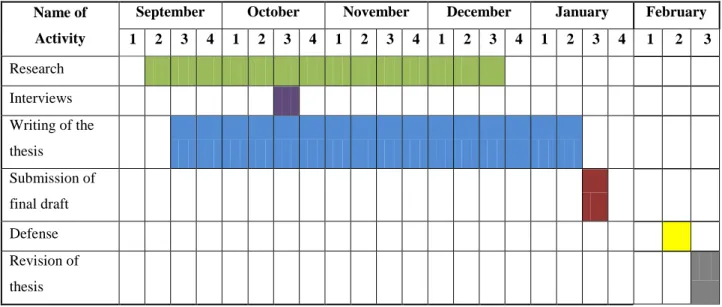
15 Name of
Activity
September October November December January February 1 2 3 4 1 2 3 4 1 2 3 4 1 2 3 4 1 2 3 4 1 2 3 Research
Interviews Writing of the
thesis Submission of
final draft Defense Revision of
thesis
Table I.1. Research Time Frame
I.7.2. Research Instrument
Internet: Internet has an amazing role in providing any information that can be used in making thesis. We can access it everywhere and at any time. The internet can make the making of thesis is more effective and efficient.
Books and journals: Books and journals also the most important instrument in making thesis. It helps the writer to find the theories that are written by the expert which relate to the thesis topic.
Report publications: The Indian Government, especially the Ministry of External Affairs of India, always published every report about the bilateral relations between India and Indonesia. It also published every event that India held in Indonesia. Besides that, the Embassy of India in Indonesia always informed Indonesian people about every event that India held in Jakarta. Most of them are related to the cultural events, such as the Bollywood movie screening and Indian art festival.
16 Interviews: The subjects of the interview are the people who involved or interested in the object of the research, in this case are Bollywood fans or Bollywood communities in Indonesia.
I.8. Scope and Limitations of the Study
The scope and limitations of this research are in line with the problem that will be analyzed. The first is about the time frame, which is a period of 1998- 2013. The reason is that during the time Indonesian people, in both lower middle class and middle-upper class, have been very aware of the existence of Bollywood films, and a significant change occurred within that period.
I.9. Definition of Terms
I.9.1. Soft Power
The term of soft power was explained by the American political scientist, Joseph Samuel Nye, Jr, in his book titled Soft Power: The Means to Success in The World Politics.
“Soft power is more than just persuasion or the ability to move people by argument. It is also the ability to attract, and attraction often leads to acquiescence. Soft power resources are the assets that produce such attraction. Soft power uses a different type of currency (not force, not money) to engender cooperation – an attraction to shared values and the justness and duty of contributing to the achievement of those values42.”
42 Nye, Jr, Joseph Samuel. “The Changing Nature of Power.” Introduction. Soft Power: The Means to Success in the World Politics. 1st ed. United States of America: Public Affairs, 2004. p6, p7. Print
17 The resources of soft power can come from many things around us. It needs to be attractive so that people will be aware of its resources easily. Culture could be the resources of soft power. Soft power can be done by every actor in international relations, such as government, organization, even the individual.
I.9.2. Cultural Diplomacy
The definition of cultural diplomacy, according to a dictionary of diplomacy is:
“The promotion abroad of a state‟s cultural achievement, for example is the case of France and Britain notably their languages.
The special importance of cultural diplomacy is to promote links between parallel institutions at home and abroad, for example between domestic and foreign universities43.”
Cultural diplomacy is the extent of soft power. Films, music, dances, art, fashion and food can be the assets of a nation to do cultural diplomacy. Culture, cultural diplomacy and particular institutional cultures can therefore form important parts of national strategy44.
I.10. Thesis Structure
This thesis consists of five chapters. It starts from introduction, followed by India‟s Cultural Interest in the World, Development of Bollywood as Indian Cultural Diplomacy in the World, Development of Bollywood Movies as Indian Cultural Diplomacy towards Indonesia (1998-2013) and Conclusion. The detail of every chapter will be discussed below.
Chapter I: Introduction
This chapter will further discuss the background of culture‟s role in diplomacy. Then, the problem identification will discuss the general information
43 Berridge, G.R. and James, Alan (2001). A Dictionary of Diplomacy. New York: Palgrave Macmillan.
44 The (Controversial) Role of Culture in International Relations
18 about Bollywood in the world. This chapter also provides the theoretical framework that can be the foundation for this thesis. The other essential information such as a research question, research objectives, significance of study, research methodology, scope and limitations of the study and definition of terms are written in chapter 1. The purpose of this chapter is to introduce the basic writing of the thesis and become the hook that may provoke the reader to have further reading in this thesis.
Chapter II: India’s Cultural Interest
This chapter will discuss about the national interest of India to the world in terms of culture. It will also explain the Indian cultural diplomacy and its instruments to achieve the cultural interest.
Chapter III: Development of Bollywood as Indian Cultural Diplomacy to the World
This chapter will explain the brief history of Bollywood movies.
Moreover, it will explore the effort of Indian government, Indian artist and private companies to develop and promote Bollywood as Indian cultural diplomacy to the world.
Chapter IV: Development of Bollywood Movies as Indian Cultural Diplomacy towards Indonesia (1998 – 2013)
This chapter will explain the cultural relations between Indonesia and India. It followed by the development of Bollywood movies in Indonesia. Then, it will discuss about the role of Bollywood as Indian cultural diplomacy in improving India – Indonesia relations.
Chapter V: Conclusion
The last chapter will be discussed about the conclusion of Bollywood, as Indian cultural diplomacy, contribute in improving India – Indonesia relations especially in the cultural relations.
19
CHAPTER II
INDIA’S CULTURAL INTEREST
II.1. National Interest of India
India is a developing country which is also as the poorest country, yet it is one of the largest and fastest growing economies in the world. India has a very large population, which is still engaged in traditional small scale farming. In the early nineties, the Indian government decided that liberalizing the economy would be the best way to encourage growth45. The growth of Indian economy is unusual because India has very little exports. Indian economy grows because of the consumer demands in the country and many travelers that come to India for health tourism46. Religious reason and tourism are also have the role in the increasing the Indian economic growth. Therefore, India has slower growth compared to China, but the cultural exports have helped keep the economy stable.
India came through the recent global financial crisis virtually unscathed because India does not depend on foreign trade47. There are a few issues that influence Indian economic growth, such as a lack of resources, especially in the energy sector.
One of India‟s great strength‟s is its education system. India has become a major player in the high technology field because of its highly educated workforce48. India‟s economic growth is now increasing and it can compete with the world‟s economic situation and because of it India is now a member of BRICS (Brazil, Russia, India, China and South Africa). Minister of External Affairs, Salman Khurshid, mentioned several instruments that made India as one of emerging power countries.
45 Third World Economies Introduced. “The Indian Economy.”
http://www.thirdworldplanet.com/indian-economy.php (29 October 2013)
46 Ibid.
47 Ibid.
48 Ibid.
20
“India with its good legal structure, corporate governance, banking system, the financial system and skilled manpower has become the new economic icon of emerging powers. Our development model has managed to deliver long term economic pay offs at many levels of investment.”49
The government of India has shown a strong growth in recent years in order to improve the economic condition of the nation. However, it has fixed only a little part of India and the majority of the Indian is still poor. Therefore, one of India‟s national interests is economic prosperity. Rajiv Kumar and Santosh Kumar state in their book titled “In the National Interest: A Strategic Foreign Policy for India”, that the most vital component of India‟s national interest is to achieve economic prosperity for its people by ensuring rapid, sustainable and inclusive growth50. The government of India is trying to make India a global economic power by 2020 under US and China51.
The Indian government is also concerned with the state security.
Therefore, security is one of Indian national interest. Again, Rajiv Kumar and Santosh Kumar are written in their book that India would secure the country against external and internal threats to its territory, population and vital economic interest52. Diplomatic relations between India and other countries have been established to protect Indian people from threats. In the 1990s, India established relations with Pakistan, which included every possible development - from a limited conventional war to a total military confrontation to many summits that struggled to define a new peace framework between the two neighbors53. India is now addressing its two of the most important sources of insecurity – unresolved
49 “India New Economic Icon of Emerging Powers: Salman Khursid.” (10 March 2013) http://articles.economictimes.indiatimes.com/2013-03-10/news/37598246_1_salman-khurshid- corporate-governance-strengths (29 October 2013)
50 Kumar, Santosh., & Kumar, Rajiv (2010). In the National Interest: A Strategic Foreign Policy for India. New Delhi: Business Standard Books. P27
51 Ibid.
52 Ibid.
53 Mohan, C. Raja. “India‟s New Foreign Policy Strategy.” Strategic Affairs Editor, the Indian Express, New Delhi. http://carnegieendowment.org/files/Mohan.pdf (31 October 2013)
21 territorial questions with Pakistan and China54. However, Indian political leaders believe that if India can solve those problems it can improve India‟s security.
India‟s third national interest is to expand global public goods to improve country‟s overall welfare55. To achieve this national interest, India has been playing an active role in international forums and global governance structures to secure a fair and equitable share of global public goods, ensuring their compatibility with India‟s national interest and contributing to their development56. India‟s contribution in global public goods is not only the government‟s responsibility, Indian non-governmental organization (NGO‟s) and private sectors also play important roles. According to the Chatham House Report about India‟s role in the global public goods in 2011, the private sector is making a significant contribution through the provision of low-cost medicines and irrigation equipment and also Indian NGOs are increasingly active internationally57. India is also expanding its aid program of grants and assistance.
However, policy makers understand that both aids and increased economic interaction with other countries can help reposition India as an emerging power with recipient nations58. India has offered assistance to other countries through training and capacity-building in the form of The Indian Technical and Economic Cooperation (ITEC), especially in Africa.
India became the 15th largest donor to the World Food Program (WFP) in 2005. India plays an increasingly important role in providing food security in South Asia, notably in Afghanistan and Iraq59. While India provides food aid to other countries, India is facing the challenges in its domestic food security. Many
54 Ibid.
55 According to World Health Organization, public goods are defined as goods and services that are “non-rival” and “non-excludable”. In other words, no one can be excluded from their benefits and their consumption by one person does not diminish consumption by another. Public goods become global in nature when the benefits flow to more than one country and no country can effectively be denied access to those benefits.
56 Kumar, Santosh., & Kumar, Rajiv (2010). In the National Interest: A Strategic Foreign Policy
for India. New Delhi: Business Standard Books. P28
57 Price, Gareth. “For the Global Good: India‟s Developing International Role.” A Chatham House Report (May 2011). The Royal Institute of International Affairs.
http://www.chathamhouse.org/sites/default/files/public/Research/Asia/r_indiarole0511.pdf (31 October 2013)
58 Ibid.
59 Ibid., p5
22 Indians are malnourished. It stems from a range of issues, such as poor distribution systems, gender discrimination and a range of health, sanitation and feeding caring practices60. At the end, India‟s development assistance program reflects a conscious effort to reposition the country as an emerging power. The Indian program helped other developing countries to build their capacity and it reflects India‟s non-aligned movement heritage.
II.1.1. National Interest of India in Culture
India as the world‟s largest democracy can bring certain credibility to the projection of democratic ideals, because of the multilingual, multiethnic and multi religious character of its society61. It also has a global cultural impact through its cultural assets, such as arts, crafts, films and educational institutions. Cultural resources that India has can increase its soft power over the ensuing decades. A country with a lot of cultural diversity is an appropriate sentence to picture India.
Indian government understands very well about the strength that India has, which is culture. Therefore, Indian government is very concern about the promotion of Indian culture in the world.
The cultural diplomacy of India serves to advance India‟s interest62. The promotion of India to the world can help India achieve its national interests.
World Health Organization stated on its website that the promotion and protection of cultural diversity, core labor rights, and environment through global cooperation are also regarded as global public goods63. Besides that, in order to
60 Price, Gareth. “For the Global Good: India‟s Developing International Role.” A Chatham House
Report (May 2011). The Royal Institute of International Affairs.
http://www.chathamhouse.org/sites/default/files/public/Research/Asia/r_indiarole0511.pdf (31 October 2013)
61 Kumar, Santosh., & Kumar, Rajiv (2010). In the National Interest: A Strategic Foreign Policy
for India. New Delhi: Business Standard Books. P46
62 Mark, Simon. “A Greater Role for Cultural Diplomacy.” (2009) Netherlands Institute of International Relations „Clingendael‟.
http://www.clingendael.nl/sites/default/files/20090616_cdsp_discussion_paper_114_mark.pdf (5 November 2013)
63 “Trade, foreign policy, diplomacy and health: Global Public Goods.” World Health Organization http://www.who.int/trade/glossary/story041/en/ (31 October 2013)