‘This book makes a useful contribution to the rapidly expanding literature on value chains by clarifying the myriad methods, some old, some new, used to finance actors in agricultural value chains.’
Richard L. Meyer, Professor Emeritus, Ohio State University
‘I recommend the publication to be read by all stakeholders in the agriculture sector.’
N.V. Ramana, former CEO, BASIX, India and Chairman, Indian Society of Agribusiness Professionals, India
‘This is a “must read” for anyone interested in value chain finance. The authors have moved forward our understanding by presenting a conceptual framework, supported by an extensive use of case studies, which makes this book indispensible for those involved in financing as well as policy makers.’
Kenneth Shwedel, agricultural economist
‘An insightful and complete analysis of agricultural value chain financing. An essential reference for anyone interested in improving access to agricultural credit in developing countries.’
Mark D. Wenner, Inter-American Development Bank
Agricultural Value Chain Finance
Tools and Lessons
Calvin Miller and Linda Jones
Published by
Food and Agriculture Organization of the United Nations and
Practical Action Publishing 2010
Schumacher Centre for Technology and Development Bourton on Dunsmore, Rugby,
Warwickshire, CV23 9QZ, UK www.practicalactionpublishing.org
© FAO, 2010 ISBN 978 1 85339 702 8 FAO ISBN 978 925 106277 7
All rights reserved. FAO encourages reproduction and dissemination of material in this information product. Non-commercial uses will be authorized free of charge upon
request. Reproduction for resale or other commercial purposes, including educational purposes, may incur fees. Applications for permission to reproduce or disseminate FAO
copyright materials and all other queries on rights and licences, should be addressed by e-mail to [email protected] or to the Chief, Publishing Policy and Support Branch,
Office of Knowledge Exchange, Research and Extension, FAO, Viale delle Terme di Caracalla, 00153 Rome, Italy.
A catalogue record for this book is available from the British Library.
The authors have asserted their rights under the Copyright Designs and Patents Act 1988 to be identified as authors of this work.
Since 1974, Practical Action Publishing (formerly Intermediate Technology Publications and ITDG Publishing) has published and disseminated books and information in support of international development work throughout the world.
Practical Action Publishing is a trading name of Practical Action Publishing Ltd (Company Reg. No. 1159018), the wholly owned publishing company of Practical
Action. Practical Action Publishing trades only in support of its parent charity objectives and any profits are covenanted back to Practical Action (Charity Reg. No.
247257, Group VAT Registration No. 880 9924 76).
The designations employed and the presentation of material in this publication do not imply the expression of any opinion whatsoever on the part of the Food and Agriculture Organization of the United Nations concerning the legal status of any country, territory, city or area of its authorities, or concerning the delimitation
of its frontiers or boundaries. The mention of specific companies or products of manufacturers, whether or not these have been patented, does not imply that these
have been endorsed or recommended by FAO in preference to others of a similar nature that are not mentioned. The views expressed herein are those of the authors
and do not necessarily represent those of FAO.
Cover photo: Potato conveyor belt © FAO/Olivier Thuillier, and authors’ own photos Cover design by Practical Action Publishing
Indexed by Andrea Palmer Typeset by S.J.I. Services, New Delhi Printed by Hobbs the Printers Ltd, Totton, Hampshire
Contents
Boxes vii
Figures ix
Tables x
About the authors xi
Acknowledgments xiii
Preface xv
1. Introduction 1
Defining value chain finance 2
Why is there interest in value chain finance in agriculture? 3
Overview of content 3
2. Understanding agricultural value chain finance 5
Context 5
The concept of agricultural value chain finance 8 Agricultural value chain finance as an approach 14
Enabling environment 17
Standards and certification 19
Regulation and enforcement 20
Macro-economic and social context 21
Value chains and diversified livelihoods 23
3. Value chain business models 27
Producer-driven value chain models 29
Buyer-driven value chain models 30
Facilitated value chain models 36
Integrated value chain models 40
Case Study 1. Farm Concern International:
commercial village approach 45
4. Agricultural value chain finance instruments 55
Product overview 55
Product financing 55
Trader credit 58
Input supplier credit 60
Marketing company credit 62
Lead firm financing 64
Receivables financing 67
Trade receivables finance 67
Factoring and forfaiting 69
Physical asset collateralization 72
Warehouse receipts 72
Repurchase agreements (repos) 82
Financial lease 83
Risk mitigation products 84
Crop/weather insurance 84
Forward contracting 85
Futures 87
Financial enhancements 89
Securitization 89
Loan guarantees 90
Joint ventures 93
Bringing it together 95
Case Study 2. Producer-driven financing of farm inputs: Niger
informal inventory credit 100
Case Study 3. LAFISE Group: integrated financial instruments
and value chain services 108
5. Innovations 115
Value chain innovations 115
Financial innovations 117
Technological innovations 120
Management systems 120
Networks and exchanges 121
Mobile phones and mobile banking 122
Infrastructural innovations 123
Policy and public sector innovations 124
Case Study 4. DrumNet and technological innovations 126 Case Study 5. Integrated agro food parks: avenues for
sustainable agricultural development in India 137 6. Lessons learned and summary recommendations 147
Lessons learned 147
Summary of recommendations 153
Recommendations regarding financial institutions 154 Recommendations regarding value chain stakeholders 155
Recommendations regarding policymakers 157
List of conferences 159
References 161
Index 167
Boxes
2.1 Value chain definitions 11
2.2 Flower chain financing, Mexico 14
2.3 Five C’s of lending applied to value chain financing 17
2.4 Financial flows within the rice industry 23
3.1 Cacao producer association, Peru 29
3.2 Buyer relationship credit-worthiness, Costa Rica 31
3.3 Formal contract agriculture, Philippines 34
3.4 Failure of contract farming in tomato production in Brazil 35
3.5 Success factors for contract farming 36
3.6 Facilitating chain development in Malawi and Tanzania 38 3.7 Facilitating artichoke chain development and finance in Peru 40 3.8 BRAC integrated services model for agriculture, Bangladesh 42 3.9 National Agricultural Cooperative Federation, Korea 44 4.1 Small-scale farmer capacity and competitiveness, Kenya 58
4.2 Trader finance in Latin America 59
4.3 Input supply credit, Myanmar 61
4.4 Input supplier credit, Bangladesh 62
4.5 Processor finance for agave farmers, Mexico 63
4.6 Marketing company finance, Costa Rica 64
4.7 Lead firm finance and assistance in Central America 65
4.8 Factoring in Serbia 70
4.9 Formal agri-fishery warehouse receipts, Philippines 75
4.10 Informal warehouse receipts, Tanzania 76
4.11 Field warehousing, India 77
4.12 Publicly controlled warehouses, Philippines 78 4.13 Agricultural warehouse receipts in the wider system, India 78
4.14 ACE and global risk mitigation 80
4.15 Warehouse receipt challenges and solutions, India 82
4.16 Warehousing livestock, Mexico 82
4.17 Using futures in price risk management, MCX, India 88
4.18 Livestock securitization, BNA, Colombia 90
4.19 Public-private contract farming, Thailand 93
5.1 Kisan credit cards, India 120
5.2 Integrated information management, BASIX, India 121 5.3 Electronic network for fruit and vegetable trade, India 121
5.4 E-choupal information centres, India 122
5.5 Transportation innovation in the Philippines 123 5.6 Value chain approach to agricultural services, Costa Rica 124
5.7 Agri-export zones in India 125
5.8 Warehousing of nomadic farmers’ honey in northern India 140
Figures
2.1 Product and financial flows within the value chain 10
2.2 Interlinked cereal lending 12
2.3 BASIX livelihood services model 24
3.1 Different ways to coordinate and structure the value chain 27
3.2 Artichoke value chain 41
3.3 Rabobank integrated agriculture finance structure 43 3.4 Commercial village approach for African traditional vegetables 47
3.5 Market access financial service flowchart 50
4.1 Pre-export receivables finance basic scheme 68
4.2 Pre-export receivables finance scheme 69
4.3 HDFC Bank warehouse system 73
4.4 SACCO Cooperative warehouse storage 76
4.5 Brazil rural finance note finance 86
4.6 Para-finance guarantees in Mexico 91
4.7 Financing with future receivables 92
4.8 Value chain financing: shrimp industry model 94
4.9 Capturing the agri-food value chain 95
4.10 Poverty production cycle 101
4.11 Inventory credit flow chart 106
4.12 Traditional cost structure in Nicaragua 109
4.13 LAFISE Group partner model of intervention 110
4.14 LAFISE Group integrated service model 111
5.1 A stylized value chain 116
5.2 Inter-connected value chains in a subsector 116
5.3 The DrumNet actors 129
5.4 Process flow 132
5.5 A holistic perspective: agricultural value chain approach 140
5.6 Integrated agricultural food park model and activities 142 5.7 Customized financial products for edible oil processing value
chain stakeholders 143
5.8 Non-financial services favouring credit recovery 143 5.9 Integrated dairy at IAFP: information, product and financial flow 144
6.1 Farmer-centric ecosystem services 149
Tables
2.1 Kenyan Government Interlinked Cereal programme 13 3.1 Typical organizational models of smallholder production 28
3.2 Hortifruti financing models 32
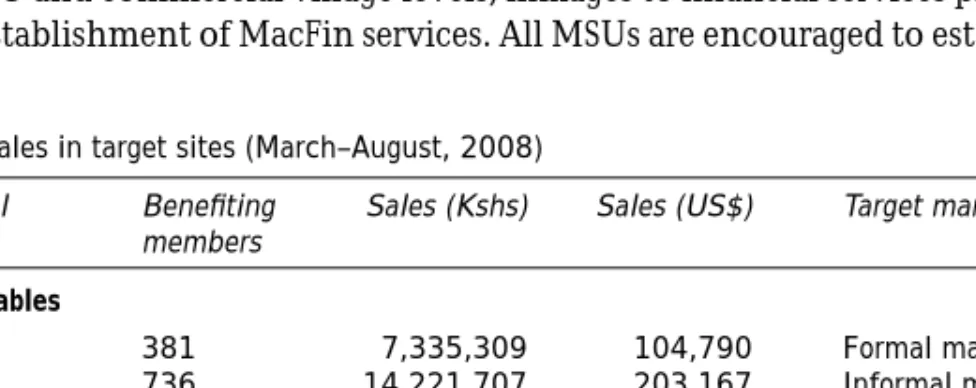
3.3 Sales in target sites (March–August 2008) 51
4.1 Description of agricultural value chain finance instruments 56 4.2 Benefits and limitations of product financing 66 4.3 Benefits and disadvantages of receivables financing 72 4.4 Benefits and challenges of inventory finance and warehouse
receipts 81
4.5 Financial lease considerations 83
4.6 Summary analysis of agricultural value chain finance products 96 4.7 Price increase gained from inventory credit 103
5.1 Performance indicators 135
About the authors
Calvin Miller is an agricultural economist, with a specialization in rural finance. He is Senior Officer and leader of the Agribusiness and Finance Group of Rural Infrastructure and Agro-Industries Division, FAO (Food and Agriculture Organization of the United Nations).
During his career he has worked in agriculture and financial development in more than 50 countries, with 15 years of global experience in technical assistance, project management and research in rural and agricultural development finance and marketing. He gained direct field experience working for 16 years in Latin America in agricultural and rural finance, agricultural value chain development and agro-enterprise development.
He is also the founder of MicroVest, a private sector social investment fund for microfinance, and a co-founder of the Rural Finance Learning Centre, a multi-institutional resource centre managed by FAO. He has published manuals and other documents on agricultural finance and value chain finance.
Linda Jones is an international consultant specializing in inclusive market development and a technical adviser for sub-sector/value chain development programmes, particularly in agriculture. She has hands-on project management and consulting experience in Eastern Europe, Middle East, Africa and Asia.
Linda is a recognized contributor to best practice and advancement of the field of enterprise development, and is a member of the Editorial Committee of Enterprise Development and Microfinance journal.
Linda was formerly Chair of the SEEP Board of Directors, the founding Chair of WAM (Women Advancing Microfinance) Canada, and Technical Director of MEDA . She has been a trainer for the Microenterprise Development Institute and ILO for many years, and has published widely on enterprise development, value chain analysis and development, and agricultural value chains.
Acknowledgments
The concept of Value Chain Finance is broad, and the term is used to describe varying aspects of the approach and its supporting tools. Therefore, a nuanced understanding of value chain finance is best derived from the learning of many who are experts in one or multiple aspects of financing the value chain.
This volume brings together the experience of many such experts.
This collection is built upon the expertise and contributions of a multitude of persons and their institutions and businesses. It is not always feasible to provide footnotes and references to all these people and their presentations, papers, discussions and other contributions. The presentations and papers can be accessed on the Rural Finance Learning Centre (RFLC) at www.ruralfinance.
org/id/48273 and publications at www.ruralfinance.org/id/1813. The authors appreciate this valuable information and the rich insights, which can now be shared with a wider audience. The volume also draws from two articles by one of the authors published in the Enterprise Development and Microfinance journal, Vol. 13, Nos. 2 and 3 and Vol. 19, No. 4.
The authors are extremely grateful for the input of nearly 90 papers and/
or presentations made by experts and practitioners in this field from around the world. In particular, the authors would like to acknowledge the persons who made valuable written contributions through publications or summary documents from international conferences organized by FAO on this topic.
These include: Rodolfo Quirós and Claudio Gonzalez-Vega in Latin America, Yogesh Ghore in Asia, Mumbi Kimathi and Jonathan Campaigne in Africa, Larry Digal in Southeast Asia and Michael Winn in Eastern Europe. The case studies in the text have been graciously drafted by Grace Ruto, Farm Concern;
Jonathan Campaign, DrumNet; Kalyan Chakravarthy and Raju Poosapati, YES Bank; Enrique Zamorra, LAFISE; and Emmanuelle LeCourtois and Äke Olofsson, Rural Infrastructure and Agro-Industries Division, FAO.
In addition the authors would like to note the insightful contributions made by Richard Meyer, Anita Campion and Mark Wenner in providing their expert review comments.
Finally, strong recognition is given to FAO, and in particular the Rural Infrastructure and Agro-industries Division, for its support for the international conferences on the topic and allocation of the time and resources needed for developing this volume. Special thanks also go to FAO colleagues who contributed research and review to the publication, including Doyle Baker, Prasun Das, Eva Gálvez-Nogales, Ivana Gegenbauer, Martin Hilmi, Maria Pagura, Carlos da Silva, Andrew Shepherd, and Tigist Woldetsadik.
Preface
This volume provides a global review of experiences and learning on the broad subject of value chain finance for agriculture in developing countries. Value chains in agriculture comprise a set of actors who conduct a linked sequence of value-adding activities involved in bringing a product from its raw material stage to the final consumer. Value chain finance, as described in this volume, refers to the financial flows to those actors from both within the value chain and financial flows to those actors from the outside as a result of their being linked within a value chain.
The purpose of this book is to provide an understanding of the emerging field of agricultural value chain finance. Key questions include:
• What is value chain finance, how is it applied and what can it offer to strengthen agricultural development?
• How can financial systems, governments and services be prepared for the demands of financing modern agri-food chains?
• How does agricultural value chain financing affect inclusion, especially for small producers and what can be done to make these systems more inclusive?
• What can governmental and non-governmental (NGO) agencies do to support increased and more effective agricultural financing through value chains?
These issues are addressed through examination of a wide array of experiences and illustrations of large and small organizations from around the world that are participating in or linked to agricultural value chain financing. The central concern of the volume is not to take a stand on the virtues and weaknesses of value chain finance, but rather to describe how the various types of value chains are being used to strengthen and extend financial products and services to the agricultural sector. Many of the value chain finance instruments and processes are not new; however, what is new and noteworthy is the extent to which value chain finance is being utilized by financial institutions, agribusinesses and farmers. Noteworthy are the variations across applications, the range of organizations that are facilitating value chain finance in innovative ways, the emergence of integrated value chains as a widespread global model, and the increasing diversification, intensification and combination of financial mechanisms. Quite often, tools and models of value chain finance that were first developed by larger agribusinesses are now being adapted to include small farmers and small-to-medium scale agribusinesses. Therefore, the cases and learning collected here do not have a specific small-farmer emphasis although
there is increasing application of value chain finance mechanisms for the benefit of smallholders, as illustrated in many of the examples.
The volume represents the extensive experience of many organizations, with the learning presented through case studies and descriptive analysis, followed by lessons learned and recommendations. The information is primarily drawn from a rich collection of documents, presentations and discussions that took place at international conferences on the subject that were organized by FAO in Latin America, Africa, South Asia and Southeast Asia during 2006 and 2007, and research work in Eastern Europe and Central Asia in 2008. These conferences were organized in partnership with regional organizations on each continent. The information is augmented by learning from the research and case examples of multiple organizations who are working in this field.
The objective of the conferences was to learn more about practical experiences and approaches to value chain finance across countries. The conferences enabled a diverse set of participants to share and obtain information on best practices with the goal of increasing the supply and efficiency of financial services for rural producers, marketers and processors. Businesses active in the agricultural sector (including producers, processors, marketers and exporters) met together with leaders from financial institutions, technical assistance providers and policymakers to discuss this subject. Each region and country brought forth specific issues related to agricultural value chain finance, and these are noted in this volume. Overall, however, the concept and application of agricultural value chain finance has been shown to be consistent across regions.
An important part of each of the conference discussions was to analyse relevant policy issues: policy constraints, ways to improve policies, how to best perform in environments which lack desired policies for financing in the sector, and so on. These policy issues were reviewed from the distinctive perspectives of the many and varied types of stakeholders within a value chain, including those who provide the financing, investment and regulation.
We hope that this volume will serve as a practical primer on value chain finance for business and financial leaders, policymakers and practitioners, extension agents, universities and training institutes. We have strived to offer a rich learning opportunity by collecting, consolidating and presenting an array of relevant experiences from around the world.
Introduction
‘Agriculture continues to be a fundamental instrument for sustainable de- velopment and poverty reduction’ (World Bank, 2008: 1–2); yet, ‘fi nancial constraints in agriculture remain pervasive, and they are costly and inequita- bly distributed, severely limiting smallholders’ ability to compete’ (ibid.: 13).
Sudden and dramatic changes in food prices have exposed the vulnerability of agricultural production in meeting global demand and call for increased investment in agriculture at all levels. The question is how the right amount of investment can be acquired, particularly in a challenging milieu where fi nancial uncertainty causes a reduction in available resources along with in- creased fear and scrutiny of risk. An answer to addressing these constraints goes beyond conventional measures since agriculture has always been diffi cult to fi nance through formal fi nancial institutions and approaches.
The environment for agricultural fi nance is further infl uenced by the grow- ing concentration of control in the agricultural sector. Driven by gains from economies of scale and globalization of the food chain along with access to re- sources, multinational and other interconnected agribusinesses have a greater impact in a sector that is characterized by increasing vertical and horizontal integration. The consequences of tightening integration are profound, espe- cially for smallholders and others who are outside of the interlinked chains.
In short, agriculture is evolving towards a modern, extremely competitive sys- tem driven by consumer demand for higher value, more processed products, and consistent quality and safety standards. Hence, enhancing smallholders’
productivity, competitiveness and their participation in these global value chains have been noted as priorities of the agriculture-for-development agenda (World Bank, 2008).
Agricultural value chain fi nance offers an opportunity to reduce cost and risk in fi nancing, and reach out to smallholder farmers. For fi nancial insti- tutions, value chain fi nance creates the impetus to look beyond the direct recipient of fi nance to better understand the competitiveness and risks in the sector as a whole and to craft products that best fi t the needs of the businesses in the chain. Naturally, this more comprehensive approach to agricultural fi nancing is not unique to value chain fi nance; some leading fi nancial orga- nizations in the sector employ such a focus in their loan assessment processes but this is more often not the case. In fact, much of the fi nance available to value chains is not from fi nancial institutions but rather from others within the chain. At the same time, value chain fi nance can help the chains become more inclusive, by making resources available for smallholders to integrate into higher value markets. Finance that is linked with value chains is not
new and some types of trader fi nance, for example, have been around for millennia; what is new is the way it is being applied more systematically to agriculture, using innovative or adapted approaches, tools and technologies.
Examples of their application and innovation from around the world are shared and discussed in the following chapters.
Defi ning value chain fi nance
In our fast-paced development context, value chain fi nance is an evolving term that has taken on a range of meanings and connotations. The fl ows of funds to and among the various links within a value chain comprise what is known as value chain fi nance. Stated another way, it is any or all of the fi nan- cial services, products and support services fl owing to and/or through a value chain to address the needs and constraints of those involved in that chain, be it a need to access fi nance, secure sales, procure products, reduce risk and/
or improve effi ciency within the chain. The comprehensive nature of value chain fi nance, therefore, makes it essential to analyse and fully understand the value chain in all aspects. The authors use the term here in reference to both internal and external forms of fi nance that are developing along with the agricultural value chains that they serve:
1. Internal value chain fi nance is that which takes place within the value chain such as when an input supplier provides credit to a farmer, or when a lead fi rm advances funds to a market intermediary.
2. External value chain fi nance is that which is made possible by value chain relationships and mechanisms: for example, a bank issues a loan to farmers based on a contract with a trusted buyer or a warehouse re- ceipt from a recognized storage facility.
This discussion of value chain fi nance does not include conventional agri- cultural fi nancing from fi nancial institutions, such as banks and credit unions, unless there is a direct correlation to the value chain as noted above. Inevita- bly, there will be some grey areas in any such defi nition, and we recognize that fi nancing approaches are often continuums through which an arbitrary line must be drawn for practical reasons of analysis and discussion.
An example of internal value chain fi nance is the case of input supplier credit in Myanmar where agro-input retailers offer deferred payment sales to smallholder farmers (Myint, 2007). A typical case of external value chain fi nance is exemplifi ed in Kenya where small fruit and vegetable growers are able to access bank fi nance for agro-chemicals thanks to their export contract.
The exporter pays the farmers through the bank, which deducts the sched- uled loan payments before releasing the net proceeds to the farmer group (Marangu, 2007).
Value chain fi nance in agriculture must be seen in the light of the larger context, not only of the value chains proper but also the business environ- ment of each country as this impacts value chains and the fi nancial systems.
For this reason, the following two chapters provide background on the ap- proach and the business models which have been developed around value chain fi nance. These chapters are followed by descriptions of fi nancial instru- ments and innovations in value chain fi nance.
What is the interest around value chain fi nance in agriculture?
Value chain fi nance offers an opportunity to expand the fi nancing opportu- nities for agriculture, improve effi ciency and repayments in fi nancing, and consolidate value chain linkages among participants in the chain. The specifi c opportunities that fi nancing can create within a chain are driven by the con- text and business model and the relative roles of each participant in the chain.
As stated by Campion (2006), fi nance often looks different when provided within a value chain than from a fi nancial institution. Not only is the nature of the fi nance often different, but so are the motives. Nyoro (2007) notes that in Africa ‘value chain actors are driven more by desire to expand markets than by the profi tability of the fi nance’. Traders, for example, commonly use fi nance as a procurement facility while input suppliers often employ it as part of a sales incentive strategy. For fi nancial institutions, it offers an approach to lower risk and cost in providing fi nancial services. For the recipients of value chain fi nance, such as smallholder farmers or those purchasing their products, value chain fi nance offers a mechanism to obtain fi nancing that may other- wise not be available due to a lack of collateral or transaction costs of securing a loan, and it can be a way to guarantee a market for products.
Understanding value chain fi nance can improve the overall effectiveness of those providing and requiring agricultural fi nancing. It can improve the qual- ity and effi ciency of fi nancing agricultural chains by: 1) identifying fi nancing needs for strengthening the chain; 2) tailoring fi nancial products to fi t the needs of the participants in the chain; 3) reducing fi nancial transaction costs through direct discount repayments and delivery of fi nancial services; and 4) using value chain linkages and knowledge of the chain to mitigate risks of the chain and its partners. As agriculture and agribusiness modernize with increased integration and interdependent relationships, the opportunity and the need for value chain fi nance becomes increasingly relevant.
Overview of content
This book is built around actual case studies that were presented at a series of FAO conferences, which took place in Asia, Africa and Latin America in 2006 and 2007, as well as additional work in Eastern Europe and Central Asia in 2008. As a result of using real world examples, descriptions of specifi c fi nan- cial models and instruments are often teased out of a complex system that exhibits a range of fi nancial, agricultural, institutional, regulatory and socio- cultural variables. As much as possible, illustrative cases have been stream- lined to focus on a particular aspect of the system, and elaborate the topic
under discussion. In some instances, a project or case may be used in more than one section to exemplify a relevant point.
The second chapter of this volume attempts to convey the current under- standing of value chain fi nance as presented by practitioners and theorists in the fi eld. The chapter begins with a section describing the contemporary agricultural context that is rapidly changing from fragmented and informal relationships to integrated and structured agribusiness systems. Based on an understanding of this context, agricultural value chain fi nance receives deeper analysis and defi nition in the next section. This leads to a discussion of value chain fi nance as an approach, not just a series of fi nancial instruments, and ends with an examination of enabling environment issues including regula- tion and business and socio-economic contexts.
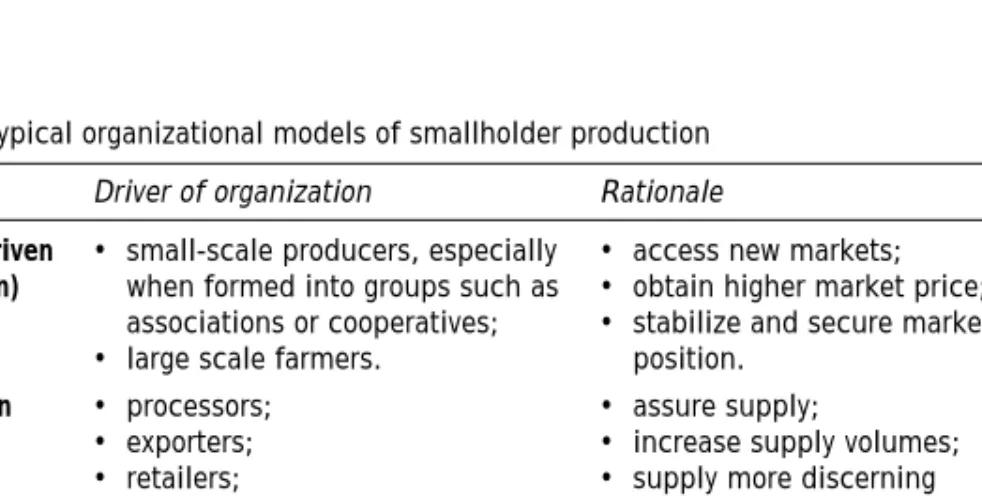
The third chapter elaborates four broad value chain business models – pro- ducer-driven, buyer-driven, facilitator-driven, and integrated – that provide a framework for understanding and analysing the structures and processes of agricultural value chains, and therefore the various applications of fi nancing mechanisms that apply in different situations. Within these models specifi c mechanisms, such as contract farming which is growing rapidly in the de- veloping world, are explained as they provide supportive structures through which value chain fi nancing is often applied.
The next chapter, the fourth, provides a classifi cation, defi nitions and ex- amples of value chain fi nance mechanisms and tools from traditional prod- ucts such as trader credit, to more complex instruments such as factoring. This core chapter of the volume explains the range of value chain fi nance tools and mechanisms, and illustrates them with a cross-section of mini-cases from highly differentiated agricultural systems around the globe.
Chapter fi ve highlights and illustrates successful innovations in the appli- cation of models and fi nancial tools. These include technological innovations as well as organizational and policy sector ones.
The fi nal chapter looks at both general lessons and those for key applications and settings. Then it presents a set of recommendations, organized according to those for fi nancial institutions, agribusiness fi rms and policymakers.
Understanding agricultural value chain fi nance
Context
After many years of declining investment, there is renewed interest in agricul- tural fi nancing. The rapid rise in food prices and a shortage of basic commodi- ties experienced in 2008 has motivated increased attention from the public sector; the higher prices and consequently increased opportunity for profi ts is generating interest from the private sector. Investment decisions require plac- ing much more emphasis on assessing the future trends and market potential.
In addition, in an era of global markets, local supply and demand has less ef- fect on prices as products more readily fl ow across borders, thus changing the nature of price risk within those markets.
The agro-food sector has undergone changes that have infl uenced new models of production and marketing involving a focus on demand rather than on producer-defi ned agricultural goods; a global, liberalized and fragmented marketplace with little seasonality and high product diversity; food safety and traceability requirements; and higher quality standards in conjunction with the enforcement of basic environmental regulations. This evolution requires a better understanding of the whole set of transactions within each value chain and that of the agricultural sector within which it operates. Integrated chains are able to do this most effectively. This information is important for making fi nancial decisions.
Despite the changes in agriculture and agribusiness, the typical offer for fi nancial products and services for agricultural and rural production has been defi cient and not particularly innovative; fi nancial intermediaries still lack much depth in rural areas, and producers, especially smallholders, are still underserved. Conventional thinking is that the agricultural sector is too costly and risky for lending. Yet, major banks in the sector such as Rabobank and Banorte, large fi nancial institutions in the Netherlands and Mexico respec- tively, both express the view that agricultural credit is profi table if producers are well integrated into a viable value chain (Shwedel, 2007; Martínez, 2006).
It is recognized that increases in fi nance and investment are needed at all levels of the food chain, with special interest in increasing the access to fi nance by those agricultural households and communities who are most vulnerable to food insecurity and poverty. As such, although this book deals with agribusi- nesses of all sizes and types, signifi cant consideration is given to the effects on small farmers and small agribusinesses that have the most to gain or lose in today’s rapidly changing agricultural and economic environment.
Increasing fi nance and investment in a sustainable manner is not easy.
Financing agriculture continues to be perceived as having high costs of op- eration, high risks and low returns on investment. Despite good intentions for directing credit to agriculture, the results of the agricultural lending pro- grammes in developing countries commonly have unsatisfactory results with low rates of repayment in spite of (or often partly because of) high subsidies.
Agricultural development banks have been slow to innovate, often due in part to governmental directives given to them. Commercial banks have tradition- ally shied away from this sector because of uncontrollable and systemic risks, higher costs and fear of the unknown for bankers not familiar with the sector and setting. The cost of directly lending to farmers, especially smaller ones, in hard-to-reach rural areas with less-educated and low-income populations is in fact generally prohibitive to most formal fi nancial institutions. Microfi nance institutions do reach some of these low-income households but at a high cost, with short-term loan products that are generally not able to address the full range of agricultural needs.
Even more important than the operational costs for transacting a loan or securing investments is the systemic or correlated risk in agriculture. This risk stems from both price volatility as well as from changeable weather patterns that can affect whole regions at a time, making repayment uncertain. In con- ventional lending, collateral is used to mitigate risks to the lender but the typi- cal mortgage type of collateral commonly required by the banks is often not available or feasible in rural areas. This is due largely to land tenure restrictions and/or other requirements that are often designed to protect the livelihood as- sets of the community, but in doing so effectively limit their use as collateral.
Hence, collateral is a major constraint to access to fi nance in agriculture not only from banks, but also from credit unions and other fi nancing institutions.
Central Bank policies can often exacerbate this constraint by requiring high reserves or imposing other restrictions which in effect penalize uncollateral- ized lending. Furthermore, the collapse of the global fi nancial markets in 2008 and ensuing caution for fi nancing activities with unknown and/or uncon- trollable risk has led to fi nanciers and investors requiring more assurance of markets, prices and controls.
Agriculture has been changing rapidly from one of fragmented production and marketing relationships toward integrated market systems, or chains.
Driven by gains from economies of scale and globalization of the food chain, multinational agri-enterprises increasingly dominate the sector with more and more vertical and horizontal linkages or integration. The changes are also being driven by the marketplace and responsiveness to consumer interests, including stricter compliance, timeliness and quality standards. Agriculture, as with many other sectors, is now a global marketplace driven by competitive- ness, which demands certain levels of effi ciency and productivity. The future of farmers, traders and agribusinesses in the food or agro-industrial chain – and therefore the quality of their loan or investment – depends upon both their ability to compete in the marketplace and/or to adapt to markets in which
they can compete. Further, success depends upon the collective competitive- ness of everyone involved in the particular chain. In Kenya, Mrema (2007) notes that adoption of a value chain approach to agriculture begins with an attitude change by thinking in terms of ‘we’ instead of ‘me’ and focusing on harmonization of use of resources and interventions. Hence, the linkages, structure and overall health of the whole chain become much more important than ever before. Non-integrated, independent farmers, traders and businesses in a food system will likely become broken links in fragmented chains, unable to survive competition in the future.
Meeting the challenges of consumer trends and the demand for more pro- cessed or value added products requires increased investment in equipment, working capital, and skills and knowledge. Such investment is not only costly for individual value chain businesses, but can only be undertaken if there is an assurance from elsewhere in the chain for supplies, produce or markets.
This creates the need to strengthen the links and commitment amongst value chain players, often through contracts. Agricultural transformation in the glo- balizing marketplace therefore not only creates new challenges but also new opportunities for using that integration to increase competitiveness and ac- cess to fi nance. Since more fi nance for agriculture is critical in meeting this challenge, it is hoped that fi nancial institutions and policymakers can learn from and engage more with value chain actors in order to develop new prod- ucts and to reach new markets.
Gonzalez-Vega (2007) raises a series of questions that a transformation and consolidation of agriculture would pose for fi nance:
1. Are fi nancial systems in the countries prepared to meet the new demands for fi nancial services arising from the growth of modern agro-food value chains? Will fi nancial intermediaries be equipped to meet these demands and support the rapid growth of production and productivity triggered by the opportunities of globalization? To what extent will the success of the chains depend on progress toward widen- ing the choice and access of rural fi nancial services in these countries?
2. How much will the transformation of agriculture and the development of modern value chains shape the processes of fi nancial access and deliv- ery and the ability of fi nancial intermediaries to meet resulting demands?
Does the development of agricultural chains contribute new means of support for modernizing the fi nancial system and how much does the emergence of contractual relationships among stakeholders benefi t a country’s fi nancial development and outreach?
3. Will the supply of fi nancial services that develops in response to these processes benefi t all kinds of farmers? Which will be included, and which may not? How much will conventional fi nancial systems be able to ease the incorporation of small- and medium-scale farmers into mod- ern agricultural chains? Will the lack of access to fi nancial services be- come an insurmountable barrier to entry for many traditional farmers?
What fi nancial service options will be available to producers who are not served by formal fi nancial service providers?
This second set of questions in particular highlights the interplay between agricultural development and the outreach of a country’s fi nancial systems.
In rural areas, there is a correlation between the number and development of agribusinesses and fi nancial institutions and vice versa. As agricultural value chains become more sophisticated with responsive production to guaranteed markets, fi nancial institutions are able to act with reduced risk to increase their services and further support the expansion and upgrading of agricultural activities.
The effects of the growing integration of value chains also have impor- tant social implications as well as fi nancial ones. It is therefore important to analyse the effect of the vertical integration and market driven demand on low-income producers, traders and processors. Enhancing their level of com- petitiveness and their participation in dynamic and profi table value chains are two priorities of the agriculture-for-development agenda. With the fact that the majority of the world’s poor are in the agricultural and rural sectors, this is an important development factor. Finance is important to value chains but by itself is of little value. Even the most well-intentioned fi nancial services directed to agriculture will not be successful in the long run unless the pro- ducers and agribusinesses are competitive, not only today, but as the markets evolve.
The concept of agricultural value chain fi nance
The value chain concept allows integration of the various players in agri- culture production, processing and marketing. It defi nes the various roles of players while at the same time, scope and purpose of partnerships that can be established.
Equity Bank, Kenya (Muiruri, 2007)
The introduction of this book offered a defi nition of agricultural value chain fi nance that takes into consideration the two broad aspects of its fi nancing. It is defi ned as both internal fi nance that takes place within the value chain and external fi nance that is made possible by value chain relationships and mecha- nisms. This defi nition is enlarged in the following section, providing a detailed examination of the term and its applications. It is also useful to note here that the terms value chain and supply chain are often used interchangeably with supply chain being used most frequently in industrial chains. For agriculture, the term value chain is most appropriate for highlighting the value addition, i.e. transformation of the inputs and products as they pass through the chain.
However fi rst, we begin with an explanation of value chains proper.
The concept of ‘agricultural value chain’ includes the full range of activities and participants involved in moving agricultural products from input suppli- ers to farmers’ fi elds, and ultimately, to consumers’ tables. Each stakeholder or
process in the chain has a link to the next in order for the processes to form a viable chain. At each stage, some additional transformation or enhancement is made to the product – ranging from simply moving the product from point
‘a’ to point ‘b’ (a common value addition of traders for example) to complex processing and packaging. Hence, a value chain is often defi ned as the se- quence of value-adding activities, from production to consumption, through processing and commercialization. Each segment of a chain has one or more backward and forward linkages. A chain is only as strong as its weakest link and hence the stronger the links, the more secure the fl ow of products and services within the chain.
The ‘farm to table’ integration of a chain can increase effi ciency and val- ue through reduction of wastage, ensuring food safety, preserving freshness, decreasing consumer prices, and improving farmer prices and incomes. Ef- fi cient value chains normally reduce the use of intermediaries in the chain, and strengthen value-added activities because of better technology and in- puts, farm gate procurement, upgraded infrastructure (such as cold chains), improved price opportunities through demand-driven production, and facili- tation of more secure procurement for food processing and exports.
The fl ows of funds and internal and external fi nancial arrangements among the various links in the chain comprise what is known as value chain fi nance.
Stated another way, it is any or all of the fi nancial services, products and sup- port services fl owing to and/or through a value chain. This can be internal fi - nancing directly from one value chain actor to another or external from a fi nancial institution or investor based upon the borrower’s value chain rela- tions and activities.
The role of value chain fi nance is to address the needs and constraints of those involved in that chain. This is often a need for fi nance but it is also com- monly used as a way to secure sales, procure products, reduce risk and/or im- prove effi ciency within the chain. The comprehensive nature of value chain fi nance, therefore, makes it important to understand the nature of each chain, its actors and their interests. Some successful fi nancial institutions have done this in their lending operations but many have not. Even fewer have multi- party fi nancing arrangements in agriculture which is common in value chain fi nance among producers, suppliers, wholesalers and others.
A conceptual framework is useful for understanding value chain fi nance.
This is important because value chain fi nance is both an approach to fi nanc- ing as well as a set of fi nancial instruments which are utilized to expand and improve fi nancial services to meet the needs of those involved in the value chain. Many of the instruments are not new but are often applied more broad- ly and frequently in combination with others. Most importantly, value chain fi nance is as an approach to fi nancing that recognizes the entirety of the chain and the forces which drive it and responds accordingly to the specifi c require- ments for fi nancing them – the producers, traders, processors and others in the chain. It is a tailor-made approach which is designed to most effi ciently meet the needs of the businesses and particular nature of the chain. These
mechanisms and tools can be applied to: 1) fi nance production or harvest; 2) purchase inputs or products, or fi nance labour; 3) provide overdrafts or lines of credit; 4) fund investments; and 5) reduce risk and uncertainty. Therefore, value chain fi nance as an approach takes a systemic viewpoint, looking at the collective set of actors, processes and markets of the chain as opposed to an individual lender-borrower within the system. This is described in more detail in the next section.
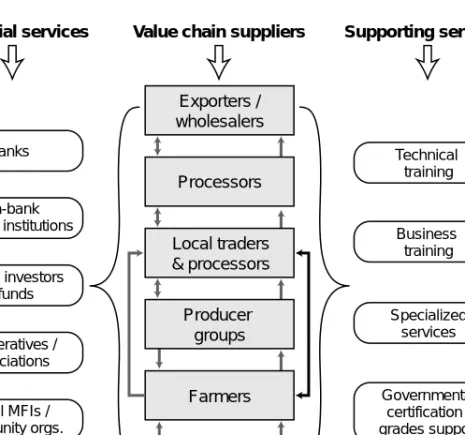
Figure 2.1 presents a simplifi ed framework for understanding value chain fi nance. As described above, it illustrates that fi nance is provided by those within the value chain itself, as well as by various types of institutional fi nanc- ing entities who provide fi nancing to the chain. Products fl ow in one direc- tion through the chain with varying levels of value addition at each level.
Within the chain the fi nance fl ows in two directions, depending upon the particular value chain and/or region and the dynamics of the companies and participants involved. For example, in the rice industry, large wholesalers of- ten fi nance traders who advance fi nancing to the producers. At the same time, many processors receive unprocessed rice from farmers and producer groups
Figure 2.1 Product and fi nancial fl ows within the value chain Source: Adapted from Fries (2007) and Miller (2007a)
Banks
Non-bank financial institutions
Private investors
& funds
Cooperatives / associations
Local MFIs / community orgs.
Exporters / wholesalers
Specialized services Business training Financial services Value chain suppliers Supporting services
Governmental certification / grades support
Technical training Processors
Local traders
& processors
Producer groups
Farmers
Input suppliers
Product flows Financial flows
with only a partial payment with the understanding that fi nal payment will be made after the rice is processed and sold. In this case the farmers are fi nan- ciers to their rice millers.
It is noted in the fi gure that those within the chain can be both recipient users of fi nance as well as suppliers of fi nance. For example, an input supplier often receives fi nancing to purchase inventory and sells the inputs on credit.
Farmers may receive inputs on credit, they may receive advances from proces- sors (directly or through their associations) and they may also provide in-kind fi nance, such as through delayed payments for their produce from millers, supermarkets or even governmental warehouses.
Box 2.1 highlights brief defi nitions of three interrelated value chain con- cepts. While the concept and approach of value chain fi nance may be quite new, the key components are not. The concept and practice of value chains or supply chains have been present for millennia, but in today’s world of height- ened market requirements and just-in-time delivery, the chains become ever more important. Similarly value chain analysis is a successor to the term sub- sector analysis and remains an important way of diagnosing a chain for de- termination of areas of weakness and intervention. It can also be noted that value chain fi nance and its increasing importance builds from the combina- tion of value chain analysis, tailor designed fi nancing, increased market inte- gration in agriculture and the application of improved fi nancial instruments and information technologies. It commonly involves multiple parties, each of which have a vested interest in the success of the others in the chain – the more each have to gain or lose from the partnership, the stronger the value chain. These relationships can be formal or informal. They can involve simple fi nancing agreements such as with the traditional ‘farming on shares’ where
Box 2.1 Value chain defi nitions
A useful starting point for understanding value chain fi nancing in agriculture is with three general defi nitions:
1. Value chain – the set of actors (private, public, and including service providers) and the sequence of value-adding activities involved in bringing a product from production to the fi nal consumer. In agriculture they can be thought of as a ‘farm to fork’ set of processes and fl ows (Miller and da Silva, 2007).
2. Value chain analysis – assessment of the actors and factors infl uencing the perfor- mance of an industry, and relationships among participants to identify the driving constraints to increased effi ciency, productivity and competitiveness of an industry and how these constraints can be overcome (Fries, 2007).
3. Value chain fi nance – fi nancial services and products fl owing to and/or through value chain participants to address and alleviate driving constraints to growth (Fries, 2007).
To summarize, the key aspects of the value chain defi nitions for agriculture are:
o Value chains – multiple, linked actors and sequential, value-adding activities.
o Value chain analysis – assessment of actors, relationships, constraints and opportunities.
o Value chain fi nance – fi nance to address the constraints and opportunities, both through the value chain, and to and/or because of the value chain.
costs, inputs and returns are shared. In this case, through informal or contrac- tual arrangements, a farmer typically receives inputs such as seeds, fertilizer and technical guidance, in exchange for a share in the product with a business part- ner – who may be a neighbour or an agribusiness wanting to secure produce for their mill or business.
A study by the Temeo Institute demonstrated that in Kenya, as in many parts of Africa, the use of value chain fi nance has been a common part of the production and marketing systems of major commodities, both in the tea plantations that were set up centuries ago and in more recent structures.
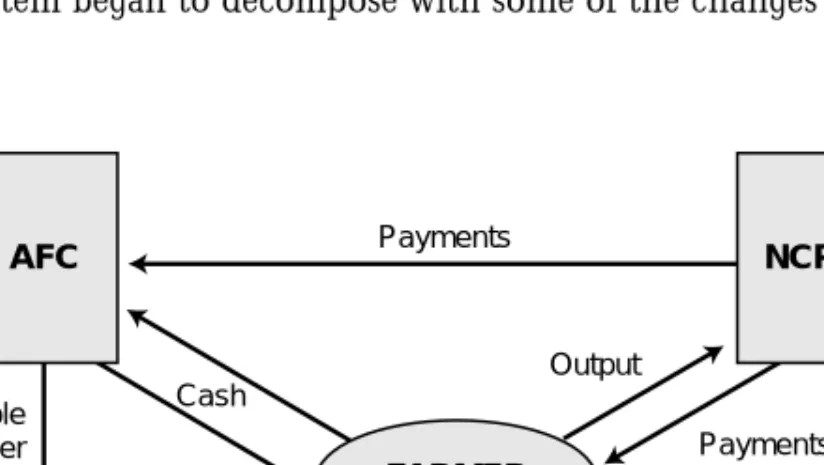
For example, the last century saw governmental schemes involving marketing boards, inputs and directed credit lines. The latter started in the 1930s with the creation of the National Advances Board which made available public funds for lending to farmers and for supervision of lending. These advances were made against land and the crop that was fi nanced as collateral. The Kenya case in Figure 2.2 shows the inter-relation of the governmental Agricultural Finance Corporation (AFC) providing inputs through the Kenya Farmers As- sociation (KFA) and cash to farmers who in turn sold their production output to the governmental National Cereals Produce Board (NCPB).
The NCPB discounted loan payments owed to the AFC and the remaining funds were repaid back to the farmers. During this time in Kenya, the AFC was in effect the only government organization that provided fi nance in agri- culture. The AFC was fi nanced by the government and grants and loans from international donors. Although costly, the government offered both credit and complimentary supportive services to farmers as shown in Table 2.1. The combined effect produced both stability and stimulus to growth in the agri- cultural sector. However, in the post reform period of agricultural fi nance, the integrated system began to decompose with some of the changes and effects noted below.
Figure 2.2 Interlinked cereal lending Source: Nyoro (2007)
Payments
Payments Output
Cash
Inputs Irrevocable
order
KFA
AFC NCPB
FARMER
Notwithstanding the many valid reasons for the discontinuation of the former governmental approach to integrated chains in agriculture used in Kenya, there are two important features to note. First, the ‘full-service’ ap- proach and the stability of prices promoted growth in income and use of technology, albeit at high cost. It also provided security for lending and for marketing procurement. When these were no longer available with the dis- continuation of the interlinked programme, the result was an increase in lending default and breach of sales contracts (side-selling).
A similar situation resulted with the breakdown of the Soviet Union. When the state-controlled integrated value chains, often extending between coun- tries, were severed, markets became unreliable and fi nancing became unavail- able. Only when value chain integration began to be developed by the private sector, did fi nancing begin to fl ow again, often using value chain fi nance approaches and instruments as a way to access fi nancial resources.
It is also important to note that value chain fi nance is not a replacement for mainstream fi nancial service providers such as banks and credit unions. These remain very important for providing fi nance and other fi nancial services to the chain actors. The approach and tools used in value chain fi nance build on and enhance informal credit and conventional, collateral-based fi nancing through banks and other fi nancial institutions to offer a full complement of fi nancing products. For example, traders commonly provide fi nance to farm- ers for harvest, inputs or other needs both related to the agricultural chain or household during the production cycles such as advances to cover emergen- cies. Many of these traders in turn receive fi nance from millers and processors who in turn may be fi nanced by banks and/or wholesalers or exporters who are farther along the supply or value chain. Although they often use con- ventional fi nancing institutions, rural producers, processors and retailers are Table 2.1 Kenyan Government Interlinked Cereal programme
Interlinked Cereal programme lending and services Effects
• Governmental fi nancing in agriculture for: • High economic and agricultural growth o capital purchases, including land; rates of 6 per cent per annum;
o farm machinery; • Comparatively the highest adoption rates o seasonal credit. for hybrid seeds and fertilizers;
• Subsidized inputs; • Local income growth;
• Market access and price controls; • High cost to national budget to maintain
• Extension services; AFC.
• Infrastructural development.
Kenyan post reform agricultural fi nance
Changes Effects
• Elimination of price controls for commodities; • Producers exposed to price risks;
• Discontinuation of integrated credit • High default rates on lending by AFC;
programmes; • Side-selling of agricultural commodities;
• Break-down of interlinked credit; • Withdrawal of commercial banks from
• Political interference on lending and recovery. rural areas.
receiving increasingly large injections of resources from other entities with which they maintain trade ties.
The amount of funding that fl ows upward in the value chain should not be underestimated since it is signifi cant. Agro-input suppliers providing seeds and inputs on credit, farmers who deliver products to warehouses or proces- sors with delayed payments and wholesalers who sell to supermarkets on con- signment or with delayed payments are among the most common examples.
Agricultural value chain fi nance as an approach
Value chain fi nance can be viewed as a series of tools and mechanisms, yet, most importantly it is an approach that takes a systemic viewpoint, looking at the collective set of actors, processes and markets of the chain as opposed to an individual lender-borrower within the system. Decisions about fi nancing are based on the health of the entire system, including market demand, and not just on the individual borrower. This means that in order to offer value chain-based fi nance, knowledge of the agricultural system is required.
In other forms of fi nance, whether internal fi nancing within the chain, such as traditional trader credit, or fi nancing originating externally, such as conventional banking fi nance, the view is less comprehensive, and therefore incorporates signifi cant risk. The additional risk is due in large part to ‘un- certainty’; not being able to fully understand the risks and consequently not being able to assess and mitigate against those risks. Uncertainty also leads to a higher perception of risk causing conventional lending to the sector to be reduced.
Shwedel states, ‘Chain-based fi nancing requires the banker to see and under- stand the business in its entirety. It demands adjustment to new market condi- tions, more accurate pricing, a better understanding of risk, and consequently, a greater willingness to take risk’ (2007: 22). In his work as value chain fi nance specialist for Rabobank Mexico, he has learned that with a holistic understand- ing of the chain, there is potential to reduce risk and open up the doors to fi nance based on systemic knowledge.
Box 2.2 Flower chain fi nancing, Mexico
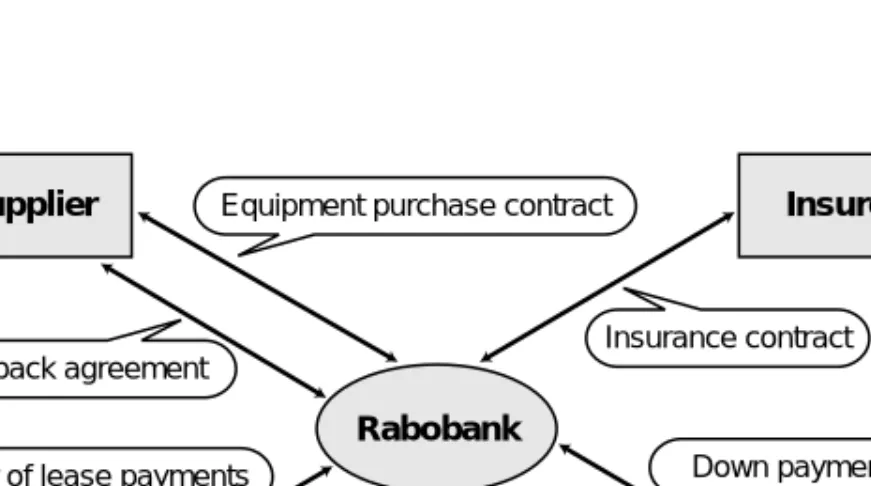
In the case of fl ower producers in Mexico, Rabobank fi nances their needs for working capital, equipment and technology. Closely aligned with this, Rabobank also fi nances the equipment distributor who provides needed technology to the farmers. The bank fi nances the farmers because the bank knows them and understands their marketing system. In fact, the farmers send their products to an auction market in Holland, and Rabobank fi nances the auction market and many of the buyers in the market. In this way, the bank has locked up the fi nancing of the whole chain and has intimate knowledge of the chain – production factors, equipment suppliers, and buyers. The bank also knows that the farm- ers receive their money as it is deposited in a Rabobank account, so that the bank can directly debit their accounts for loan payments.
Source: Shwedel (2007)
An example of the Rabobank approach is highlighted in Box 2.2 that de- scribes the fi nancing of fl owers which are considered a specialized, high-risk sector in Mexico.
As in the Rabobank case, a lender is more likely to give a loan to a farmer when that farmer is connected to a viable buyer, and when the buyer in turn has solid market access. Most businesses and fi nancial institutions do not have the global reach of Rabobank, but through strong linkages among partners and follow-up of fl ows of product and funds, they can achieve the necessary understanding and control needed to minimize risks and have competitive ef- fi ciency in their value chain fi nancing. In the past, without such value chain knowledge and interconnectivity, the farmers or small processors and traders may have been more readily refused a loan and therefore unable to fi nance their operations to take advantage of a market opportunity. The familiarity of the players in a specifi c chain with each other supports the promotion and de- velopment of effective arrangements that facilitate fi nancing. The main pur- pose is sharing risks among various actors, transferring defi ned risks to those parties that are best equipped to manage them, and as far as possible, reducing costs through direct linkages and payments.
Since value chain fi nance is built not only upon physical linkages but also through knowledge integration, a key to success for fi nancial institution is to
‘know the business’. Those who know the business the best are those persons and companies directly involved in the value chain. Having and using spe- cialized knowledge of the chain, fi nanciers and investors can understand the risks and work to mitigate them more easily than a conventional banker who works with all types of businesses and clients. This ability and commitment to analysing and using the value chain, enables fi nancial institutions to tailor appropriate fi nancial products and services to the participants in the value chain. Success in this fi eld depends upon making use of this collective body of knowledge followed by subsequent tailoring or structuring of traditional and non-traditional fi nancial mechanisms and tools to fi t the value chain. The main purpose is sharing risks among various actors and transferring defi ned risks to those parties that are best equipped to manage them. Hence, the value chain fi nance approach is a process of building and using knowledge to deter- mine fi nancial services and interventions. The actual fi nancing can be either direct from one chain partner to another, indirect by a third party fi nancial institution or ‘cascading’, meaning fi nancing enters the chain to partners at multiple levels according to the activities in the chain.
Whereas, conventional fi nancing relies heavily on the creditworthiness of the client and business, value chain fi nancing focuses more on the payments to be received from activities, such as production and value-added transac- tions. This allows for increased access to fi nance for those without suffi cient collateral but with predictable fl ows of goods, and strong partners in the chain. Moreover, in many cases, the transactions can be structured such that the repayment of a loan is automatically made via the transaction proceeds.
This direct form of loan repayment, reduces both repayment risk as well as
transaction costs of loan repayment. Each participant in a value chain has a different capacity to obtain fi nancing and the conditions vary accordingly.
Their common interest is in obtaining fi nance easily under favourable condi- tions; whether it comes from a bank, supplier or trader is not important. If, for example, a major buyer can obtain fi nancing and advance funds to others in the chain at less overall cost, everyone benefi ts.
Following a value chain fi nance approach, the loan analysis for a spe- cifi c borrower comprehensively considers the many aspects and processes of the value chain, including who within the chain is best placed to be the borrower(s), and what are the fl ows of funds and from whom. Kariuki states that the key issues for consideration in value chain fi nance in the Cooperative Bank of Agriculture are: 1) the strength of the value chain and its opportuni- ties and challenges; 2) the risks; 3) the technical, business and fi nancial ser- vices and support, and 4) the business model for value chain fi nance (Mwangi, 2007). In essence, the process involves a combination of value chain assess- ment, fi nancial assessment and securing agreements. A few key steps that can be employed by such an institution are:
1. Understand the value chain:
o Enabling environment – international, regional and domestic en- abling environment, regulatory constraints and opportunities for support;
o Vertical and horizontal relationships – linkages between levels of the chain and competitors and with those on the same level, their interests and commitment;
o Support markets and services – fi nancial and non-fi nancial services, and input supply markets;
o End market – market potential, consumer demands and chain risks (adaption from Coop, 2008).
2. Identify the value chain model that currently exists – lead actors, busi- ness model and sustainability strategy;
3. Identify the transaction processes – value added in the various stages of the product up the value chain;
4. Determine actual and critical points of fi nance – the current fl ows of funds and their sources of fi nancing, what is needed and in what point in time;
5. Analyse and compare fi nancing options – their relative strengths, risks and costs of fi nancing for each level of participant in the chain;
6. Design fi nancing according to the best option(s) to fi t the chain – draw up agreements for fi nancing between parties.
While much of the emphasis in a value chain fi nance approach is on the health of the chain and its value-adding transactions and linkages, a well- rounded assessment of all borrowers is still critical. This borrower assessment can be undertaken by looking at key areas commonly called the 5 C’s of loan assessment. These refer to: 1) character; 2) capacity; 3) capital; 4) collateral;
and 5) conditions (Miller, 2008a). Banks have typically given highest priority to collateral and in microfi nance the focus of priority is to character and ca- pacity. These remain important in loan assessment but, as shown in Box 2.3, their relative level of importance changes as does the breadth of the assess- ment to go beyond that of the immediate borrower.
In value chain fi nance, increased importance is given to the conditions of both the market outlook and the fi t of the fi nancial requirements to the needs and fl ows of the chain. The ‘fi t’ of the fi nancial conditions and cash fl ows to those clients within the chain is critical and assessment of the risks of break- downs in the chain form part of the analysis. The cash fl ow of the value chain must be suffi cient and in total synch with that of the loan conditions. The capacity of the partners as well as the borrower is also importance. Hence, a risk assessment moves well beyond client credit risk and requires assessment of the risks of market, price and production.
Does this mean that the bank or fi nancier must assess and fully understand everything in the value chain? No, most do not have such capacity except in the chains with which they are dealing closely, but rather they can often rely in part on the strength and reputation of the strongest actors in the chain.
Most often these are larger businesses farther up the chain with strong credit histories who are experts in the chains in which they operate.
Enabling environment
The collection of institutions, policies, attitudes and support services that defi ne the setting where enterprises operate is known as the enabling environment, or
Box 2.3 Five C’s of lending applied to value chain fi nancing
1. Character • Suppliers, producers, purchasers and others in a value chain who inter- act regularly can assess the character and management savvy of each other better than a banker, with whom they have infrequent interaction.
2. Capacity • Assessment is broadened from the borrower’s individual capacity toward a focus on the health and growth potential of the value chain and the competitiveness of those involved in it; also an individual’s borrowing capacity can be strengthened because they are integrated into a strong value chain.
3. Capital • The capital of the borrower alone is less emphasized in value chain fi nance, as increased attention is given to the capitalization within the whole chain.
4. Collateral • Cash and commodity fl ows which can be predicted from past relations or contracts can replace or enhance traditional collateral; also in tightly integrated chains the collateral of the strongest partners can be used for attracting fi nance, which can also be a benefi t to others in the chain.
5. Conditions • Conditions for fi nancing are more adapted to the chain; tailoring fi nance to fi t the specifi c needs becomes paramount to its success and can improve ‘bankability’ of the clients.
Source: Miller (2008a)
business climate. The constituting elements of an enabling environment in any given economy are multi-faceted, covering themes such as the rule of law, pub- lic sector governance, overall macro-economic conditions, infrastructure and regulations affecting business, and socio-cultural context among others. Gov- ernments and international organizations are now paying increased attention to the assessment and promotion of reforms of enabling environments, having acknowledged that a conducive business climate is an essential pre-requisite for investments in new enterprises and for the sustained growth and competitive- ness of the existing ones. The World Bank ‘Doing Business’ survey (World Bank, 2009) has been established as an authoritative benchmark in this area of con- cern, generating country rankings that have been instrumental in engendering business climate reforms worldwide.
The application of value chain fi nance depends upon the environment in which it operates. As with all fi nance, the starting point is to have the conditions for profi table business activity with some level of stability. Within fi nance, some fi nancial instruments can only be applied if certain regulations or compliance is in place. Macro-economic instability or erratic policies ad- versely affect risk perceptions and undermine the potential of value chain fi nancing instruments. Yet, at other times, value ch