The Language of Evaluation
Appraisal in English
J.R. Martin and P.R.R. White
This page intentionally left blank
The Language of Evaluation
Appraisal in English
J. R. Martin
and
P. R. R. White
© J. R. Martin and P. R. R. White 2005
All rights reserved. No reproduction, copy or transmission of this publication may be made without written permission.
No paragraph of this publication may be reproduced, copied or transmitted save with written permission or in accordance with the provisions of the Copyright, Designs and Patents Act 1988, or under the terms of any licence permitting limited copying issued by the Copyright Licensing Agency, 90 Tottenham Court Road, London W1T 4LP.
Any person who does any unauthorised act in relation to this publication may be liable to criminal prosecution and civil claims for damages.
The authors have asserted their rights to be identified as the authors of this work in accordance with the Copyright, Designs and Patents Act 1988.
First published in 2005 by PALGRAVE MACMILLAN
Houndmills, Basingstoke, Hampshire RG21 6XS and 175 Fifth Avenue, New York, N.Y. 10010
Companies and representatives throughout the world.
PALGRAVE MACMILLAN is the global academic imprint of the Palgrave Macmillan division of St. Martin’s Press, LLC and of Palgrave Macmillan Ltd.
Macmillan® is a registered trademark in the United States, United Kingdom and other countries. Palgrave is a registered trademark in the European Union and other countries.
ISBN-13: 978–1–4039–0409–6 ISBN-10: 1–4039–0409–X
This book is printed on paper suitable for recycling and made from fully managed and sustained forest sources.
A catalogue record for this book is available from the British Library.
Library of Congress Cataloging-in-Publication Data Martin, J. R.
The language of evaluation : appraisal in English / J.R. Martin and P.R.R. White.
p. cm.
Includes bibliographical references (p. ) and index.
ISBN 1–4039–0409–X (cloth)
1. English language – Semantics. 2. English language – Usage.
3. Evaluation – Terminology. I. White, P.R.R. (Peter Robert Rupert), 1956– II. Title.
PE1585.M29 2005
420.1⬘43—dc22 2005043360
10 9 8 7 6 5 4 3 2 1
14 13 12 11 10 09 08 07 06 05 Printed and bound in Great Britain by Antony Rowe Ltd, Chippenham and Eastbourne
Contents
List of Figures vii
List of Tables ix
Acknowledgements x
Preface xi
1 Introduction 1
1.1 Modelling appraisal resources 1
1.2 Appraisal in a functional model of language 7
1.3 Situating appraisal in SFL 33
1.4 Appraisal – an overview 34
1.5 Appraisal and other traditions of evaluative
language analysis 38
1.6 Outline of this book 40
2 Attitude: Ways of Feeling 42
2.1 Kinds of feeling 42
2.2 Affect 45
2.3 Judgement 52
2.4 Appreciation 56
2.5 Borders 58
2.6 Indirect realisations 61
2.7 Beyond attitude 68
2.8 Analysing attitude 69
3 Engagement and Graduation: Alignment, Solidarity
and the Construed Reader 92
3.1 Introduction: a dialogic perspective 92 3.2 Value position, alignment and the putative reader 95 3.3 The resources of intersubjective stance: an overview
of engagement 97
3.4 Engagement and the dialogistic status of bare
assertions 98
3.5 Heteroglossia: dialogic contraction and expansion 102 3.6 Entertain: the dialogistic expansiveness of modality
and evidentiality 104
v
3.7 Dialogistic expansion through the externalised
proposition – attribution 111
3.8 The resources of dialogic contraction – overview:
disclaim and proclaim 117
3.9 Disclaim: deny (negation) 118
3.10 Disclaim: counter 120
3.11 Proclaim: concur, pronounce and endorse 121
3.12 Proclaim: concur 122
3.13 Proclaim: endorsement 126
3.14 Proclaim: pronounce 127
3.15 Engagement, intertextuality and the grammar of
reported speech 133
3.16 Graduation: an overview 135
3.17 Graduation: focus 137
3.18 Graduation: force – intensification and quantification 140
3.19 Force: intensification 141
3.20 Force: quantification 148
3.21 Force (intensification and quantification),
attitude and writer–reader relationships 152 3.22 Analysing intersubjective positioning 153 4 Evaluative Key: Taking a Stance 161
4.1 Introduction 161
4.2 Evaluative key in journalistic discourse –
the ‘voices’ of news, analysis and commentary 164 4.3 Evaluative key and the discourses of
secondary-school history 184
4.4 Stance 186
4.5 Signature 203
4.6 Evaluation and reaction 206
4.7 Coda … 207
5 Enacting Appraisal: Text Analysis 210
5.1 Appraising discourse 210
5.2 War or Peace: a rhetoric of grief and hatred 212 5.3 Mourning: an unfortunate case of keystone cops 234
5.4 Envoi 260
References 262
Index 274
vi Contents
List of Figures
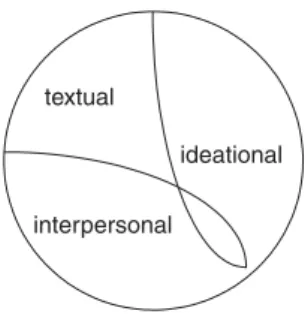
1.1 Ideational, interpersonal and textual
metafunctions 8
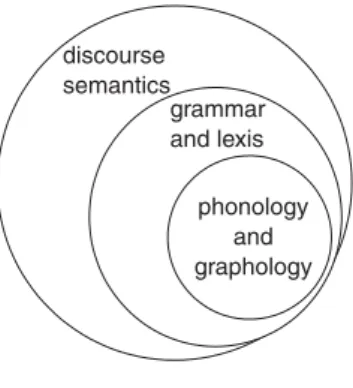
1.2 Language strata 9
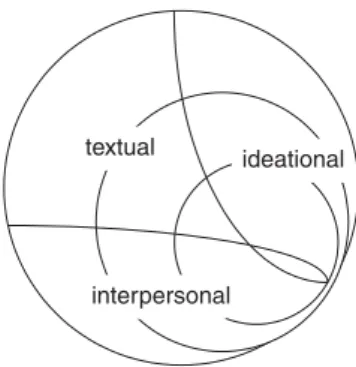
1.3 The intersection of strata and metafunctions 12
1.4 Network displaying dependent systems 14
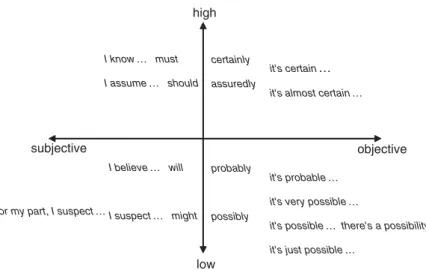
1.5 Network displaying two simultaneous systems 15 1.6 Network displaying three simultaneous systems 15 1.7 Halliday’s grammatical reading of modality 16 1.8 Representations of scaled systems (modality value) 16 1.9 A topological perspective on value and orientation 17 1.10 Kinds of meaning in relation to kinds of structure 18
1.11 Prosodic domain in Tagalog 23
1.12 Prosodic domain in English 23
1.13 Types of prosody 24
1.14 Cline of instantiation 25
1.15 Metafunctions in relation to field, mode and tenor 27
1.16 Register recontextualised by genre 32
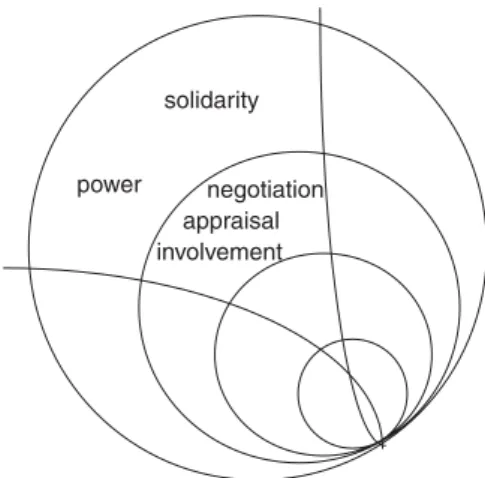
1.17 Interpersonal semantic systems and tenor
variables 34
1.18 An overview of appraisal resources 38
2.1 Judgement and appreciation as institutionalised
affect 45
2.2 Modality and types of judgement
(following Iedema et al. 1994) 54
2.3 Strategies for inscribing and invoking attitude 67
3.1 Engagement: contract and expand 104
3.2 Engagement – dialogic expansion 117
3.3 Engagement – contract: disclaim 122
3.4 The engagement system 133
3.5 A preliminary outline of graduation 138
3.6 Force: intensification – quality and process 141
3.7 Force: quantification 151
3.8 System network for graduation: force and focus 154 4.1 Reporter and writer voices: patterns of inscribed
authorial judgement 169
vii
4.2 Elaborated system of journalistic key 173 4.3 Journalistic keys – attitudinal profile 178 4.4 Journalistic voices and authorial sanction 182
4.5 The keys of history – network again 185
5.1 Bonding – the infusion of value in activity 212 viii List of Figures
List of Tables
1.1 Probability – value by orientation 13
1.2 Probability – subclassifying subjective realisations 14
1.3 Time frames for semiotic change 26
1.4 Interpersonal semantics in relation to
lexicogrammar and phonology 35
1.5 Approaches to evaluation 39
2.1 Irrealis affect 48
2.2 Affect – un/happiness 49
2.3 Affect – in/security 50
2.4 Affect – dis/satisfaction 51
2.5 Affect – kinds of unhappiness 51
2.6 Judgement – social esteem 53
2.7 Judgement – social sanction 53
2.8 Types of appreciation 56
2.9 Sub-types of appreciation 57
2.10 Interactions between attitudinal invocation and
attitudinal inscription 68
2.11 Example attitude analysis 71
2.12 Appraisal analysis conventions 73
2.13 Inscribed attitude in Proulx 74
2.14 Inscribed and invoked attitude in Proulx 75
2.15 Invoked attitude in Proulx 76
2.16 Inscribed attitude in ‘Baby, please don’t cry’ 80 2.17 Inscribed attitude for Dad in ‘Baby, please don’t cry’ 81 2.18 Inscribed attitude for Baby in ‘Baby, please don’t cry’ 81
3.1 The monoglossic and the heteroglossic 100
3.2 Realisation options for pronouncement 131
3.3 A taxonomy of pronouncement realisations 132 3.4 The gradability of attitudinal meanings 136
3.5 The gradability of engagement values 136
3.6 Feature combinations for quality intensifications 149 3.7 Feature combinations for process intensifications 149 3.8 Feature combinations for quantification 152
3.9 Engagement analysis of Heffer text 158
4.1 Cline of instantiation – from system to reading 163
4.2 Cline of instantiation – evaluation 164
5.1 Overview of meta-relations 232
ix
Acknowledgements
Copyright permissions and acknowledgements
‘The Dad Department’, by George Blair-West, from Mother & Baby magazine, June/July 1994, A. Bounty Publication, Sydney.
‘What We Think of America’, by Harold Pinter, Granta 77, March 14, 2002: 66–9.
‘What We Think of America’, by Doris Lessing, Granta 77, March 14, 2002: 52–4.
‘Mourning’,HK Magazine, September 21, 2001.
‘Damn the Peaceniks for the faint hearts’, by Carol Sarler, Daily Express, features pages, October 10, 2001.
‘A few questions as we go to war’, by William Raspberry. Guardian Weekly. Jan 2–8.
Other acknowledgements
Empire magazine, Emap Consumer Media, London for two extracts from the letters-to-the-editor page, November 2003 edition.
Extract from The Shipping News, Annie Proulx, London: Fourth Estate, 1993.
Extract from ‘The Valley of Fear.’ Part 1 ‘The Tragedy of Birlstone.’
Chapter 1 ‘The Warning.’, Arthur Conan Doyle, The Penguin Complete Sherlock Holmes. Harmondsworth: Penguin. 1981.
Extract from On the Case with Lord Peter Wimseyfrom, Three complete novels: Strong Poison, Have his Carcase, Unnatural Death, Dorothy L. Sayers, New York: Wings Books, 1991.
x
Preface
The impetus for this book grew out of work on narrative genres, principally undertaken by Guenter Plum and Joan Rothery at the University of Sydney through the 1980s. Their point was that interper- sonal meaning was critical both to the point of these genres (as empha- sised by Labov) and also to how we classified them. This encouraged us to extend the model of interpersonal meaning that we had available at the time (based largely on work by Cate Poynton on language and gender), especially in the direction of one that could handle affect alongside modality and mood.
The appraisal framework we’re presenting here was developed in response to this need as part of the Disadvantaged Schools Program’s Write it Right literacy project, which looked intensively at writing in the workplace and secondary school (from about 1990 to 1995). Jim was academic adviser to this project, in which Joan Rothery focussed on sec- ondary school English and Creative Arts (working closely with Mary Macken-Horarik and Maree Stenglin). Peter joined the team, and drew on his background as a journalist to focus on media discourse (working closely with Rick Iedema and Susan Feez). Appraisal theory developed as we moved from one register to another, and shuttled among theory, description and applications to school-based literacy initiatives. Caroline Coffin focused on secondary school history in this project, and adapted appraisal analysis to this subject area. The main innovation in this period involved moving beyond affect to consider lexical resources for judging behaviour and appreciating the value of things, and the recog- nition of syndromes of appraisal associated with different voices in the media and discourses of history.
During the 1990s Jim was also supervising influential PhD work by Gillian Fuller, Mary Macken-Horarik and Henrike Körner. Fuller’s heteroglossic perspective on evaluation in popular science, drawing on Bakhtin, was a major influence on the development of engagement as a resource for managing the play of voices in discourse. Körner specialised in legal discourse, and her work on graduation, especially the distinction between force and focus, was also foundational. Macken-Horarik’s study of appraisal in secondary school narrative drew attention to the need for a more dynamic perspective on evaluation as it unfolded prosodically in discourse. More recently Sue Hood’s application of appraisal theory to
xi
academic discourse led to further developments with respect to graduation, some of which we have incorporated here.
We are of course greatly indebted to these colleagues, and to all the functional linguists and educational linguists of the so called ‘Sydney School’ who gave value to our work. In 1998 Peter established his appraisal website and e-mail list, which has also proved a supportive context for the development of these ideas (www.grammatics.com/
appraisal/). Our collective thanks to all of those, too numerous to mention, who have contributed to the ongoing discussions there.
Thanks also to our SFL colleagues around the world who have engaged so helpfully with our ideas at meetings and over the net.
Of course none of this work would have been possible without the systemic functional linguistic theory that guides our endeavour. So a note of thanks as well to Michael Halliday, for his close attention to interpersonal meaning in language and for his design of the roomy theory that inspired this research.
Adelaide and Sydney, May 2005 xii Preface
1
Introduction
1.1 Modelling appraisal resources
This book is concerned with the interpersonal in language, with the subjective presence of writers/speakers in texts as they adopt stances towards both the material they present and those with whom they com- municate. It is concerned with how writers/speakers approve and disap- prove, enthuse and abhor, applaud and criticise, and with how they position their readers/listeners to do likewise. It is concerned with the construction by texts of communities of shared feelings and values, and with the linguistic mechanisms for the sharing of emotions, tastes and normative assessments. It is concerned with how writers/speakers con- strue for themselves particular authorial identities or personae, with how they align or disalign themselves with actual or potential respondents, and with how they construct for their texts an intended or ideal audience.
While such issues have been seen as beyond the purview of linguistic enquiry by some influential branches of twentieth-century linguistics, they have, of course, been of longstanding interest for functionally and semiotically oriented approaches and for those whose concern is with discourse, rhetoric and communicative effect. We offer here a new approach to these issues, developed over the last decade or so by researchers working within the Systemic Functional Linguistic (hereafter SFL) paradigm of M.A.K. Halliday and his colleagues. (See, for example, Halliday 2004/1994, Martin 1992b or Matthiessen 1995.) SFL identifies three modes of meaning which operate simultaneously in all utterances – the textual, the ideational and the interpersonal. Our purpose in the book is to develop and extend the SFL account of the interpersonal by attend- ing to three axes along which the speaker’s/writer’s intersubjective stance may vary.
1
We attend to what has traditionally been dealt with under the heading of ‘affect’ – the means by which writers/speakers positively or negatively evaluate the entities, happenings and states-of-affairs with which their texts are concerned. Our approach takes us beyond many traditional accounts of ‘affect’ in that it addresses not only the means by which speakers/writers overtly encode what they present as their own attitudes but also those means by which they more indirectly activate evaluative stances and position readers/listeners to supply their own assessments. These attitudinal evaluations are of interest not only because they reveal the speaker’s/writer’s feelings and values but also because their expression can be related to the speaker’s/writer’s status or author- ity as construed by the text, and because they operate rhetorically to construct relations of alignment and rapport between the writer/
speaker and actual or potential respondents.
Our concern is also with what has traditionally been dealt with under the heading of ‘modality’ and particularly under the headings of ‘epis- temic modality’ and ‘evidentiality’. We extend traditional accounts by attending not only to issues of speaker/writer certainty, commitment and knowledge but also to questions of how the textual voice positions itself with respect to other voices and other positions. In our account, these meanings are seen to provide speakers and writers with the means to present themselves as recognising, answering, ignoring, challenging, rejecting, fending off, anticipating or accommodating actual or poten- tial interlocutors and the value positions they represent.
We also attend to what has been dealt with under headings such as
‘intensification’ and ‘vague language’, providing a framework for describ- ing how speakers/writers increase and decrease the force of their asser- tions and how they sharpen or blur the semantic categorisations with which they operate.
By way of introduction to some of our principal analytical concerns and the approach we adopt, consider the following two text extracts.
They are both taken from the letters-to-editor pages of the UK movie magazine,Empire(November 2003).
Letter 1
Mood-Altering Substance
I had to write and say what a brilliant magazine Empireis. I was sitting on my bed on the morning of September 1, the first day I had to go back to school, and I was naturally very depressed. I heard the letter box open and the latest edition of Empirewas lying on the carpet. Even better was the discovery that 2 The Language of Evaluation
once hastily torn open, I saw there was an article on the Lord of the Rings: The Return of the King. My bad mood immediately lifted and I was no longer dread- ing the return to school. Keep up the good work.
[name of letter-writer], via email
Letter 2
An Indefensible Position
Just a line to say how severely saddened I’ve been at all the negative reviews of Tomb Raider 2. I feel the whole venture has been a very affectionate homage to the action genre pre-1980, and tonally perfect, paying attention to pacing while also keeping ironic humour at bay. Why, it even ended in a genuinely affecting manner. Oh – and Angelina Jolie is one of the few real movie starts we have, in the old-fashioned sense of the word. You just couldn’t take your eyes off her – totally charming.
[name of letter-writer], via email
For more crazy, way-out opinions, turn to page 112.
Letter 1 is an example of a text type which occurs with some regular- ity in leisure, life-style and special interest publications of this type – glowing endorsements of the magazine in question by an apparently extremely satisfied subscriber. While such a text may at first glance appear inconsequential, a closer analysis reveals points of significant interest for studies of evaluation and stance.
For a start, the writer’s motivation for making such a public display of his approval and enthusiasm seems somewhat obscure. We can not help being slightly suspicious that such paeans of praise may have been concocted by the magazine’s own staff (or their friends or family) and published in order to promote the magazine.1This very suspicion is of itself revealing. It points to a particular conception of what is nor- mal or reasonable in the use of evaluative language in public commu- nication, a conception which leads us to see such effusiveness as in some way aberrant or at least curious. The issue for us can not be sim- ply a matter of the correspondent’s positivity. We find unexceptional all manner of publicly-presented positive evaluations – for example, favourable arts reviews, positively-disposed journalistic commen- taries, obituaries, and ‘this-is-your-life’ style television programmes.
Rather, it would seem to be a matter of the manner and the targeting of the evaluation. We notice, for example, that the writer offers virtu- ally nothing by way of actual assessment of the magazine’s properties, no indication of where the magazine’s supposed virtues lie, apart from
the fact that it contained some material on The Lord of the Rings.
Instead, the correspondent offers the mini narrative of his journey from despair to equanimity. His praise of the magazine is construed as a matter of the effect its arrival in his letter box has on his emotions and state of mind. Thus the text operates with an assumption that this individual, very personal response is in some way more broadly signif- icant, that it carries evaluative significance for the magazine’s reader- ship generally.
As well, our attention is drawn to the social positionings and align- ments which are in play here. By grounding his approval in this way in emotion rather than in assessment, the correspondent constructs himself as enthusiast or ‘fan’ rather than as expert. The construed rela- tionship between correspondent and the addressed magazine staff is thus one of inequality. To praise another is, of course, to make a bid to bond with them in some way. In this case, the writer makes a public dis- play of seeking to bond with the magazine’s journalistic staff. In the absence, however, of any specific account of what it is the writer finds so worthy of merit in the magazine, other readers are largely excluded from this process of affiliation. Unless they also are ‘fans’ of the magazine, they lack the material necessary to decide whether they too would want to include themselves in this particular community of shared feeling and taste. We suspect that it is on the basis of this exclusion that we, as non-fans, find something gratuitous and inauthentic about this type of text.
This text, then, even though extremely short and perhaps ‘inconse- quential’ in its subject matter, still demonstrates something of the sub- tlety and complexity of the intersubjective relationships and affiliations which are observable once we attend to the interpersonal and the eval- uative in language. The extract is of even more obvious significance, per- haps, when we recognise that it exemplifies what would appear to be an increasingly conventionalised discursive persona – that of the popular cultural ‘fan’. In Working with Discourse, Martin and Rose (2003) observe how devotees of Blues music (and in particular the Blues music of Stevie Ray Vaughan) have exploited the reader/buyer feedback and review pages of the online retailer Amazon.com to very publicly express their
‘fandom’ and thereby to construct a global community of shared feeling. Even though these web pages obviously serve the global capital- ist purposes of Amazon.com (the fans’ enthusiasm promotes the prod- ucts on sale), as Jay Lemke has observed in personal communication, they also afford fans the possibility of some degree of resistance – the 4 The Language of Evaluation
opportunity for some anti-global guerrilla tactics of a semiotic kind. The fans use the pages as a resource for articulating the particular terms of their community of shared feeling, for constructing a discursive frame- work of alignment and rapport by which enthusiasts from around the world can be brought together. In our letter we see clearly articulated the dialogistic terms by which such affiliations are constructed. Though, on the face of it, an entirely ‘monologic’ text, the letter obviously con- structs a particular set of dialogic relationships. Most notably, it constructs an affiliation not only with the putative addressee (the magazine’s jour- nalistic staff ) but also, through its highly personalised use of affect, with all those other readers who share the writer’s enthusiasm (all the other
‘fans’). The point of the letter, then, is one of assuming the existence of this particular community of shared feeling among the magazine’s regular readership and of celebrating it.
The writer’s identity as ‘fan’ is conveyed by several other objective lexico-grammatical markers of enthusiasm. Through the use of I had to write and sayhe construes his enthusiasm for the magazine as some form of external compulsion dictating his actions. Somewhat similar in effect are the text’s use of exclamative fronting structures in which the Complement of a relational clause is moved into a textually marked position ahead of the Subject. This fronting occurs twice – in what a bril- liant magazine Empire is(versusEmpire is a brilliant magazine) and Even better was the discovery that …(versusthe discovery that … was even better).
Thus the fan’s eagerness and enthusiasm find their expression in the choice of a marked grammatical structuring which fronts and hence foregrounds the evaluative terms brilliantandeven better.
Note as well the use of naturallyin,
I was sitting on my bed on the morning of September 1, the first day I had to go back to school, and I was naturallyvery depressed.
Such terms are obviously interactive or dialogic in that the construed reader is thereby represented as sharing a particular set of values or attitudes with the writer – in this case a psychology in which it is the norm for school attendance to trigger distress and despair. The writer thus constructs a consensus with his intended readership based on
‘commonsense’.
The letter, then, though only a few sentences long, demonstrates a range of issues relating to the often complex functionality of evaluative language. It has demonstrated the effects of the writer favouring one
type of attitude (emotion) over other options – the choice gives rise to a particular discursive persona. And the fundamentally dialogic nature of evaluation has also been demonstrated, with this choice of attitudinal orientation, in conjunction with other intersubjective resources, con- struing relationships of alignment and rapport between the writer, the magazine and its regular readership.
Text 2 provides a contrast in that, rather than construing consensus, the writer set himself against what is apparently a very widely held view among film reviewers generally and the magazine’s own writers more specifically, namely that Tomb Raider 2was a bad movie. We notice that this difference is reflected in the way the two writers frame their texts.
As just noted, the first writer employs I had to write and saywhile the sec- ond writer begins with Just a line to say … . Tellingly the writer of the adversarial second text adopts a locution which, to some degree, dimin- ishes or downplays the significance or weight of what he is about to con- tribute to the debate. He certainly does not present himself as under some external compulsion. As well, his contrary positive assessment of the film (that it was a very affectionate homage …) is explicitly cast as his opinion by means of the framer, I feel, thereby overtly allowing for the possibility that others may ‘feel’ differently.
Text 2, however, does share at least one significant feature with text 1.
Its writer also grounds his attitudinal position in emotions – he begins by describing his sadness at the negativity of the Tomb Raiderreviews.
Reports of one’s own emotional reactions are highly personalising. They invite the addressee to respond on a personal level, to empathise, sym- pathise or at least to see the emotion as warranted or understandable. In this, the two letter writers employ a similar intersubjective strategy.
The similarity, however, is a relatively fleeting one. The second corre- spondent differs from the first in that, while starting with emotion, he then goes on to provide a number of specific, sometimes technical assessments in support of his viewpoint. Unlike the first writer, he con- structs his role as being, not that of the fan, but that of the expert who would set himself up as the equal of the magazine’s writers and other reviewers.
This discussion has served, then, as an introduction to the types of questions with which we will be concerned in the remainder of the book. We turn now to briefly describing the historical development of appraisal theory and to providing a brief sketch of its relationship to SFL, within which it has been developed and which it seeks to extend, and to other theories of the interpersonal and the evaluative.
6 The Language of Evaluation
1.2 Appraisal in a functional model of language
As indicated, our model of evaluation evolved within the general theoretical framework of SFL. Eggins 2004/1994 provides an accessible introduction to the ‘Sydney’ register of SFL which informed our work.
For grammar, we relied on Halliday 2004/1994 and Matthiessen 1995 and for discourse analyses we used Martin 1992b (later recontextualised as Martin & Rose 2003). The most relevant reservoir of theoretical concepts is Halliday & Matthiessen 1999 (for thumbnail sketches of SFL theory see the introductory chapters in Halliday & Martin 1993 and Christie & Martin 1997). We’ll now outline some of the basic parameters of SFL, by way of situating appraisal within a holistic model of language and social context.
1.2.1 Metafunction
At heart SFL is a multi-perspectival model, designed to provide analysts with complementary lenses for interpreting language in use. One of the most basic of these complementarities is the notion of kinds of meaning – the idea that language is a resource for mapping ideational, interpersonal and textual meaning onto one another in virtually every act of communi- cation. Ideational resources are concerned with construing experience:
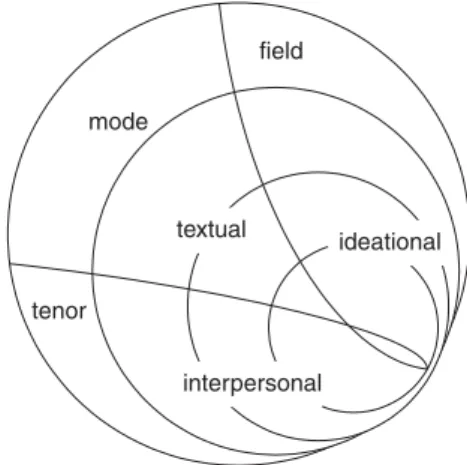
what’s going on, including who’s doing what to whom, where, when, why and how and the logical relation of one going-on to another. Interpersonal resources are concerned with negotiating social relations: how people are interacting, including the feelings they try to share. Textual resources are concerned with information flow: the ways in which ideational and interpersonal meanings are distributed in waves of semiosis, including interconnections among waves and between language and attendant modalities (action, image, music etc.). These highly generalised kinds of meaning are referred to as metafunctions, as outlined in Figure 1.1.
In this book we are focussing on interpersonal meaning. Martin & Rose 2003 provide a sympathetic framework for dealing with interpersonal meaning in relation to meaning of other kinds. In addition, for ease of exposition, we are concentrating here on interpersonal meaning in writ- ten discourse. In this respect our presentation complements Eggins &
Slade 1997, which deals with spoken language. Their participation in the development of appraisal analysis confirms our expectation that the tools developed here can be usefully applied to both spoken and written texts.
Up to about 1990, work on interpersonal meaning in SFL was more strongly oriented to interaction than feeling. This was the result of
Halliday’s seminal work on the grammar of mood and modality (Halliday 1994) and its extension into the analysis of turn-taking in dialogue (speech function and exchange structure as introduced in Halliday 1984, Martin 1992b, Eggins & Slade 1997). Working with col- leagues in the early 1990s we began to develop a more lexically-based perspective, triggered in the first instance by the need for a richer under- standing of interpersonal meaning in monologic texts. Initially we were concerned with affect in narrative, and moved on to consider evaluation in literary criticism, the print media, art criticism, administrative dis- course and history discourse as part of an action research project con- cerned with literacy in the workplace and secondary school (Iedema, Feez & White 1994, Iedema 1995, Martin 2000a, Martin 2001b). Since then the research has moved across many fields and the framework has stabilised somewhat around the categories outlined in Chapters 2 and 3 below. Readers interested in the ongoing development of appraisal are invited to join the discussions at www.grammatics.com/appraisal.
1.2.2 Realisation
The second lens we need to consider is realisation – the idea that language is a stratified semiotic system involving three cycles of coding at different levels of abstraction (see Figure 1.2). For spoken language the most concrete of these is phonology, which deals with organisation of phonemes into syllables, and their deployment in units of rhythm and intonation. For writing, of course, this level is concerned with graphol- ogy, and has to deal with the organization of letters into sentences (via intermediate units), alongside punctuation, layout and formatting.
For the language of the deaf, this level is concerned with signing.
In SFL the next level of abstraction is referred to as lexicogrammar. It is concerned with the recoding of phonological and graphological patterns 8 The Language of Evaluation
ideational textual
interpersonal
Figure 1.1 Ideational, interpersonal and textual metafunctions
as words and structures. The notion of recoding is critical here.
Lexicogrammar is not made up of phonological or graphological patterns;
rather it is realised through them. It is a more abstract level of organisa- tion, not just a bigger one. One way to appreciate this is to note that both phonology2 and grammar have their own compositional hierar- chies. In English phonology we can recognise tone groups consisting of one or more feet, feet consisting of one or more syllables and syllables consisting of one or more phonemes; and for English grammar we have clauses consisting of one or more groups,3groups consisting of one or more words and words consisting of one or more morphemes. And the two hierarchies don’t necessarily match up – we find clauses realised over two tone groups and one tone group realising two clauses, just as there are morphemes realised by one or more syllables (dog, parrot, elephant, etc.), and syllables realising one or two morphemes (hat, hats;
she, she’s). So it can’t be the case that lexicogrammar consists of phonol- ogy. Lexicogrammar is a pattern of phonological patterns; that is to say, it is a more abstract level realised by a more concrete one.
The third level of abstraction will be referred to here as discourse semantics, to emphasise the fact that it is concerned with meaning beyond the clause (with texts in other words). This level is concerned with various aspects of discourse organisation, including the question of how people, places and things are introduced in text and kept track of once there (identification); how events and states of affairs are linked to one another in terms of time, cause, contrast and similarity (con- junction); how participants are related as part to whole and sub-class to class (ideation); how turns are organised into exchanges of goods, services and information (negotiation); and how evaluation is estab- lished, amplified, targeted and sourced (appraisal).
discourse semantics
grammar and lexis
phonology and graphology
Figure 1.2 Language strata
Appraisal is placed in discourse semantics for three reasons. First of all the realisation of an attitude tends to splash across a phase of discourse, irrespective of grammatical boundaries – especially where amplified.
The following rave by a Stevie Ray Vaughan fan (from the Amazon website) accumulates a positive evaluation that is more than the sum of its clause-based parts:
awesome! awesome! awesome! awesome! it’s very worth buying.
oh did i say that it’s awesome! thank you. stevie ray!
Secondly, a given attitude can be realised across a range of grammatical categories, as in the following examples:
an interesting contrast in styles adjective (Epithet) the contrast in styles interested me verb (Process)
interestingly, there’s a contrast in styles adverb (Comment Adjunct) We need to move out of lexicogrammar to generalise the evaluative meaning common to this kind of scatter.
Finally, there is the question of grammatical metaphor (Halliday 1994, Halliday & Matthiessen 1999). This is the process whereby meaning is cooked twice as it were, introducing a degree of tension between word- ing and meaning. It’s possible, for example, to nominalise the attitude just reviewed so that it comes out grammatically as a thing.
the contrast in styles is of considerable interest
Phrased in this way a semantic process whereby something attracts our attention is rendered as a grammatical entity nominating a type of attraction. We could indeed have treated an interesting contrast in stylesabove along similar lines, since contrastis itself a nominalisation which was in fact unpacked (as different) in a review entitled ‘An interesting contrast’ as follows:
His overall appearance, his stage presence, even his playing style are quite different in the two shows.
Grammatical metaphor also comes into play as far as attribut- ing and grading opinions is concerned. Grammatically speaking this would involve modality, which we can realise through modal adverbs 10 The Language of Evaluation
and/or modal verbs:
Perhaps his playing style might be different.
Probably his playing style would be different.
Certainly his playing style must be different.
Alternatively we can draw on first person, present tense mental processes of cognition to establish degrees of certainty:
I suspect his playing style is different.
I believe his playing style is different.
I know his playing style is different.
And where we do use this explicitly subjective form (Halliday 1994) the appropriate tag is to Stevie’s playing style, not the speaker – because what we’re negotiating is how he plays, not whether the speaker thinks:
I suspect his playing style is different, isn’t it?
*I suspect his playing style is different, don’t I?4
In these examples a semantic assessment of probability is reworked as a grammatical process of cognition. The tension between the levels gives rise to verbal play such as the following:
‘I’m inclined to think—’ said I. ‘I should do so’, Sherlock Holmes remarked impatiently. I believe that I am one of the most long- suffering of mortals; but I’ll admit that I was annoyed at the sardonic interruption. ‘Really, Holmes’, said I severely, ‘you are a little trying at times’. (Doyle 1981: 769)
In summary, our point here is that the degree of play between discourse semantics and lexicogrammar which Halliday’s concept of grammatical metaphor affords is an important aspect of appraisal the- ory. And we can’t draw on these insights unless we develop appraisal as a discourse semantic resource for meaning.
The complementarity of the metafunctional and realisational comple- mentarities just reviewed is outlined in Figure 1.3.
Before turning to other relevant dimensions of SFL we should perhaps stress the Firthian perspective we take on realisation, namely that all levels make meaning. As far as interpersonal meaning is concerned
phonology contributes through intonation, phonaesthesia (eg sl-, gr-, -ump style series) and various features of voice quality which have tended to be marginalised as paralinguistic but appear far more central once appraisal systems are given their due. We do not accept, in other words, that a line of arbitrariness needs to be drawn between content and expression form as far as interpersonal meaning is concerned and would suggest that the commonplace mapping of Saussure’s signifié-to-signifiant opposition onto content and expression is unhelpful when interpreting realisation in a functional model of language.
Similarly, we take lexicogrammar as a meaning making resource rather than a set of forms, following Halliday 1994 and Matthiessen 1995.
It seems clear to us that Halliday’s main contribution to grammatical theory has been to design a theory in which meaning can be modelled grammatically. We’ve relied on his ‘meaning importing’ perspective on the grammar of English in our work. In Hjelmslev’s terms this means that we operate with a stratified content plane, in which both lexi- cogrammar and discourse semantics contribute layers of meaning to a text. The main complementarity between these strata has to do with the scope of our gaze – on meaning within the clause (lexicogrammar) as opposed to meaning beyond the clause (discourse semantics). Note in passing that interpreting grammatical metaphor as stratal tension with layers of meaning standing in a figure to ground relationship depends on a stratified content plane of just this kind.
1.2.3 Axis
Another critical dimension of analysis in SFL is axis – the yin/yang complementarity of system and structure. Although inherited directly 12 The Language of Evaluation
ideational
interpersonal textual
Figure 1.3 The intersection of strata and metafunctions
from Firth, this opposition goes back to Saussure’s consideration of paradigmatic and syntagmatic relations (the axes of choice and chain in language). For Firth, elements of structure in syntagmatic chains functioned as points of departure for systems. In phonology, for example, the CVC structure of a syllable would be explored paradigmatically in terms of the system of consonants that can operate initially as opposed to finally, and the system of vowels in between.
Halliday’s main innovation of this work was to treat units of structure as a whole as points of departure for systems, and deriving their structure from choices made with respect to the unit as a whole. In phonology this would mean systems of syllables (Halliday 1992) and other higher units as required. In grammar it led to the development of elaborate par- adigms of group and clause choices (Halliday 1976a) responsible for organising the structure of groups and clauses. This led in turn to the recognition of the metafunctional complementarities introduced above, and was critical to the development of grammars of meaning for English and Chinese (and many other languages over time; see Caffarel, Martin
& Matthiessen 2004).
1.2.4 System
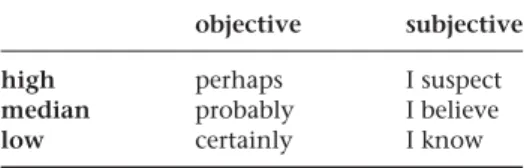
Traditionally paradigmatic relations are displayed in paradigms – tables plotting one dimension against another. In our discussion of grammati- cal metaphor above we looked at different kinds of probability (following Halliday 1994), including its value (high, median, low) and orientation (objective, subjective). These oppositions are presented as a matrix in Table 1.1.
As long as we are dealing with two dimensions this kind of display of paradigmatic relations works fairly well. Once we introduce subclassifi- cation however, for example the difference between explicitly subjective and implicitly subjective realisations, the picture becomes more compli- cated. We have to be more careful about labelling, and the formatting of borders (as in Table 1.2).
Table 1.1 Probability – value by orientation objective subjective
high perhaps I suspect
median probably I believe
low certainly I know
Each of the two systems in Figure 1.4 is a binary system, but systems can contain any number of features. In general they contain two or three, since it is usually possible to find reasons for grouping features into smaller systems if a system with three or more features is proposed (see the discussion of Halliday’s interpretation of value in relation to negativity, below).
Multidimensionality is handled by an angled bracket with the mean- ing of logical ‘and’. This can be used to handle the cross-classification in Table 1.1 as outlined in Figure 1.5. This network says that modality can be either objective or subjective and either high, median or low. It maps value against orientation in other words.
14 The Language of Evaluation
If we try and introduce a third dimension (say usuality or obligation), things become more complicated still. Visually speaking we end up with a three dimensional cube, which can be drawn, but ends up hard to read and is not much used. In Chapter 2 below we present a number of appraisal systems as tables, limiting as far as possible the number of dimensions and the amount of subclassification involved.
Table 1.2 Probability – subclassifying subjective realisations objective subjective: subjective:
explicit implicit
high perhaps I suspect might
median probably I believe would
low certainly I know must
objective
subjective
implicit
explicit
Figure 1.4 Network displaying dependent systems
In order to cope with this additional complexity, Halliday designed images referred to as system networks to display paradigmatic relations.
The names of rows and columns in paradigms are treated as features in systems of choice, and any feature can be an entry condition to another system. In Figure 1.4 the square bracket with the arrow leading into it represents a logical ‘or’; the network says that subjective modality can be either explicit or implicit.
With this kind of imaging there is no limit to the number of dimen- sions that can be displayed. Since the implicit/explicit opposition holds for objective (perhaps/it’s possible, etc.) as well as subjective modality we can in fact include this system as a third dimension, as in Figure 1.6.
We’ll use systems networks of this kind to display appraisal systems when we need to focus attention on subclassification of one system by another, or on multiple dimensions.
In grammar, system networks are used to represent categorical oppo- sitions. Systems classify grammatical items as one kind of thing or another (not both and not something in between). So although the high/median/low value system presented above looks like a scale, the system network notation does not formalise it as such. In other words, the arrangement of features top-to-bottom in a system has no meaning.
Halliday (1976a, 1994) in fact argues that grammatically speaking this system is not a scale, because median modalities interact differently with negation than high and low ones. With median probability, for example, we can freely transfer negativity between the modality and the proposition:
it’s probable his playing styles aren’t different it’s not probable his playing styles are different
Both of these are in some sense equivalent to His playing styles won’t be different. With the high and low values however, if the negativity
objective subjective
median low high
Figure 1.5 Network displaying two simultaneous systems
objective subjective
low explicit
implicit
median high
Figure 1.6 Network displaying three simultaneous systems
transfers, the value switches (from low to high or from high to low).
Thusit’s possible that … notpairs with It’s not certain that … it’s possible his playing styles aren’t different
it’s not certain his playing styles are different
Andit’s certain that … notpairs with it’s not possible that … it’s certain his playing styles aren’t different
it’s not possible his playing styles are different
Grammatically then, there is a motivated opposition between median modality and outer modality, which can then be divided into high and low. This interpretation is outlined in Figure 1.7.
As far as appraisal semantics is concerned, however, we have found it useful to interpret some systems as scaled and suspect that this may in fact be a distinctive feature of interpersonal semantic systems in general.
For such meanings it is useful to employ the notion of values being located along a continuous scale extending from ‘low’ to ‘high’, with var- ious intermediate points possible between these two extremes. Thus the sequence, contented ^ happy ^ joyous ^ ecstatic, can be analysed as repre- senting a cline from the low intensity value of contentedto the maximally high value of ecstatic. The modal values possibly[low] ^ probably[median]
^certainly[high] can be similarly analysed. Sue Hood (personal commu- nication) has suggested representing scalar systems as in Figure 1.8.
The introduction of scaled systems shifts our perspective from categorical to graded analysis. Technically speaking this is a shift from typology to topology. From a topological perspective we are interested in regions of meaning and the proximity of one meaning to another along a cline. For display purposes, we can plot one dimension against 16 The Language of Evaluation
high
low median
outer
high median
low
Figure 1.8 Representation of scaled systems (modality value)
Figure 1.7 Halliday’s grammatical reading of modality
another5 and arrange realisations in the image as closer to or farther away from one another. With modality, for example, we can treat both value and orientation as clines (from high to low and from subjective to objective) and consider degrees of subjectivity or objectivity, and a range of graded values. In Figure 1.9, we’ve included an extra-subjective and an extra-objective option (for my part, I suspectandthere’s a possibility), and values for hyper- and hypo-possibility (very possibleandjust possible).
There are of course many other gradings to explore.
1.2.5 Structure
As noted above, in SFL system and structure are complementary faces of meaning potential. The system perspective foregrounds the notion of choice – language as a resource. The structure perspective fore- grounds the inherent temporality of semiotic processes – they unfold through time, and phases of this process enter into interdependent relations with one another by way of signalling the meanings that are being made. Pike was the first linguist to acknowledge different kinds of incommensurable structuring principles, drawing on his reading in physics:
Within tagmemic theory there is an assertion that at least three perspectives are utilized by Homo sapiens. On the one hand, he
subjective objective
high
low certainly assuredly
probably
possibly
it's certain… it's almost certain …
it's probable … it's very possible …
it's possible … there's a possibility … it's just possible …
I know … must I assume … should
I believe … will
I suspect … might for my part, I suspect …
Figure 1.9 A topological perspective on value and orientation
often acts as if he were cutting up sequences into chunks – into segments or particles… On the other hand, he often senses things as somehow flowing together as ripples on the tide, merging into one another in the form of a hierarchy of little waves of experiences on still bigger waves. These two perspectives, in turn, are supple- mented by a third – the concept of field in which intersecting properties of experience cluster into bundles of simultaneous charac- teristics which together make up the patterns of his experience.
[Pike 1982: 12–13]
Halliday (1979) takes the further step of associating kinds of structure with kinds of meaning. In Martin’s terms (1995a, 1996), ideational meaning is associated with particulate structure, interpersonal meaning with prosodic structure and textual meaning with periodic structure (see Figure 1.10). Particulate structure is segmental, and we may find segments organised into mono-nuclear (orbital) or into multi-nuclear (serial) patterns. This kind of structure configures ideational meanings – for example the mono-nuclear nucleus/satellite relations of the Process and Medium to other participants and circumstances in a clause (with the Process/Medium as central, participants in orbit close to this centre, and circumstances in outer orbits); or of Classifier and Thing to pre- and post-modification in nominal groups (with the Classifier/Thing com- plex as central, and additional modification more and less gravita- tionally bound). The complementary serial patterns of realisation don’t 18 The Language of Evaluation
Figure 1.10 Kinds of meaning in relation to kinds of structure
Type of structure Type of meaning
ideational meaning – experiential
– logical
interpersonal meaning textual meaning periodic
particulate
prosodic – serial [multi-nuclear]
– orbital [mono-nuclear]
have any one gravitational centre; rather the structure unfolds through segmental interdependencies such as those we find for projecting clauses (I think he knows she feels…) or tense selections in the English verbal group (had been feeling– present in past in past). Periodic structure organises meaning into waves of information, with different wave lengths piled up one upon another. We are perhaps most familiar with this kind of pattern in phonology, where we can interpret a syllable as a wave of sonority, a foot as a wave of stressed and unstressed syllables, and a tone group as a wave of pre-tonic and tonic feet.6But information is organised into hierarchies of periodicity on all strata.
Halliday’s comments on the prosodic nature of interpersonal structure are of particular relevance to appraisal analysis:
The interpersonal component of meaning is the speaker’s ongoing intrusion into the speech situation. It is his perspective on the exchange, his assigning and acting out of speech roles. Interpersonal meanings cannot easily be expressed as configurations of discrete elements … The essence of the meaning potential of this part of the semantic system is that most of the options are associated with the act of meaning as a whole … this interpersonal meaning … is strung throughout the clause as a continuous motif or colouring … the effect is cumulative … we shall refer to this type of realisation as
‘prosodic’, since the meaning is distributed like a prosody throughout a continuous stretch of discourse. [Halliday 1979: 66–7]
Halliday of course is drawing here on Firth’s phonological analysis, which emphasised non-segmental forms of realisation – including artic- ulatory prosodies mapped across consonants clusters and syllables, vowel harmony, rhythm and intonation. Once we turn to lexicogram- mar and discourse semantics, prosodic structure is arguably more diffi- cult to model and understand, probably because it is the kind of structure that is most obscured by the evolution of alphabetic writing systems. We’ll introduce three types of prosodic realisation here, which we have found useful for interpreting the ways in which appraisal oper- ates as an ongoing cumulative motif.
saturation – this type of prosodic realisation is opportunistic; the prosody manifests where it can. A modality of possibility for example might be strung through the clause as a first person present tense mental process, a modal verb and a modal adjunct and picked up again in
the tag. This kind of opportunistic realisation is similar to vowel harmony in phonology.
I suppose he might possibly have mightn’t he
projecting modal modal modal verb
mental process verb adjunct (⫹neg)
intensification – this type of realisation involves amplification; the volume is turned up so that the prosody makes a bigger splash which reverberates through the surrounding discourse. Intensification involves repetitions of various kinds, and is similar to the use of loudness and pitch movement for highlighting in phonology7(as noted by Poynton 1984, 1985, 1996):
‘That,’ said her spouse, ‘is a lie.’ ‘It’s the truth,’ said she. ‘It’s a dirty rotten stinking lousy bloody low filthy two-faced lie,’ he ampli- fied. He’s just a lovely lovely lovelyguy;Truly, TRULYoutstanding.
Gregsypookins – five steps of ‘diminutive’ endearment (Greg-s-y- poo-kin-s).
A prosody can also increase in mass through submodification, exclamative structure or superlative morphology:
You will find yourself laughing in awe of how trulygreat a SRV show could be.
What anamazing album. ‘Love Struck Baby’ starts it off and is one of theirmostfamous songs. ‘Testify’ is one of the greatestsongs Stevie ever did.
domination– in this kind of realisation the prosody associates itself with meanings that have other meanings under their scope. In English gram- mar, Halliday’s Mood function works in this way by construing the arguability of a clause – the ‘nub’ of the argument. This function has been foregrounded in popular culture through the idiolect of Yoda in the Star Wars epics. Where standard English places the Mood function first in the clause, Yoda places it last.
[standard: Mood ^ Residue sequencing]
I can – sense a disturbance in the force.
He was – full of anger.
20 The Language of Evaluation
[Yoda: Residue ^ Mood sequencing]
Sense a disturbance in the force – I can.
Full of anger – he was.
For an earlier generation, Monty Python attracted attention to the arguability function of this interpersonal nub:
It’s just contradiction!
– No it isn’t.
– It is!
– It is not.
Well an argument isn’t just contradiction.
– It can be.
– No it can’t. [from Monty Python’s Flying Circus]
As illustrated, the Mood function sets up the mood of the clause (declarative, interrogative, imperative, etc.), alongside its modality and polarity. The rest of the clause, called Residue by Halliday, functions as the domain of these meanings. This is reflected in standard and non- standard English through the interaction of negative polarity in Mood and indefinite deixis in Residue. In the words of Australian boxing champion Jeff Fenech:
‘If you don’t get no publicity, you don’t get no people at the fight,’ … ‘If you don’t get no bums on seats you don’t get paid … Anyway I enjoy it.’
(cf. standard: If you don’t get any publicity for any fights in any papers from anyone … )
With this kind of prosodic realisation then, although the relevant inter- personal meanings may be realised locally (in the Mood function) they colour a longer stretch of discourse by dominating meanings in their domain (cf. McGregor 1997 on scopal meaning).
A comparable effect is achieved by associating interpersonal meaning with the crest of an informational wave. Interpersonal Themes in English (Halliday 2004/1994) construe an attitude towards the mean- ings of the clause which follow in the Rheme. Exclamatives, clause
initial comment adjuncts (including swearing) and intensified wh inter- rogatives all function in this way. We might interpret this as a co-option of periodic structure by a prosody.
All of the hits are here from the albums ‘Couldn’t Stand the Weather’
and ‘Texas Flood,’ plus so much more. Along with the band that night (Thursday, Oct. 4 1984) was The Roomful of Blues, a group of musicians who play the brass section. What agreat job they did!
Unfortunately for usSRV appeared in the production-poor 80’s;
fortunately for us, we have excellent live recordings to if not replace then bring into perspective his real greatness.
Our leaders are too holy and innocent. And faceless. I can understand if Mr (F.W.) de Klerk says he didn’t know, but dammit, there must be a clique, there must have been someone out there who is still alive and who can give a face to ‘the orders from above’ for all the operations.
Why, oh why, did he have to leave us so young?
Similarly languages might choose to associate interpersonal meaning with the head of a unit, on which the rest of the unit is hypotactically dependent. Tagalog uses its hypotaxis linker na/ng in this way to establish the prosodic domain of modality (and other interpersonal functions).
sigurado -ng u-uwi ka ng bahay ngayon hapon certain LK go home you-sg house today afternoon
‘You’ll certainly go home to your house this afternoon.’
Using Halliday’s ␣ notation for hypotaxis, we can show the prosodic effect of this association in Figure 1.11.
The explicitly subjective modality metaphors introduced above for English work in the same way by setting up modality as the head clause on which the propositions which is being modalised depends (see Figure 1.12).
␣ I cannot believe
 that his death and the murder of so many others in the last terrible weeks has not prompted an immediate response from the government!
22 The Language of Evaluation
We’ve used examples from grammar to illustrate saturation, intensifi- cation and domination as prosodic realisation principles here. By way of summary these strategies are outlined diagrammatically in Figure 1.13.
The same strategies work at the level of discourse semantics, and will be explored at that level as required later in the book.
1.2.6 Instantiation
A further complementarity we need to consider is that of instantiation in relation to realisation. Whereas realisation is a scale of abstraction, involving the recoding of one pattern of meanings as another (as intro- duced above), instantiation is a scale of generalisation, involving our perspective on inertia and change – are we trying to stand back and get an overall picture of what is going on or are we standing right up close, microscopically subsumed in the deconstruction of an instance, or are we somewhere in between? Halliday’s analogy here is weather and cli- mate (Halliday & Matthiessen 1999), weather being the capricious flux we experience day to day, and climate the relatively comforting inertia we try to use to plan. Critically, weather and climate are the same thing, looked at in different ways; climate is a generalisation of weather pat- terns, and weather is an instance of climatic trends. In SFL the concept of instantiation is used to explore the metastablity of systems – how they change globally in ways that matter (eg global warming) and how
Figure 1.11 Prosodic domain in Tagalog certainty
sigurado –ng α
β
uuwi ka nag bahay ngayon hapon
obligation I cannot believe that
α
his death and the murder of so many others in the past terrible weeks has not prompted an immediate response from the government
β
Figure 1.12 Prosodic domain in English
they vary locally in ways that apparently don’t (eg daily temperature variations). Theoretically speaking local variation is always nudging the system as a whole in one direction or another, just as every shot a batsman plays changes his strike rate (and every run her average). But for the most part, the changes are too small to take notice of. And we don’t hear a contradiction when the weatherwoman says that today’s temperature is 26⬚, 2⬚above average (when today’s temperature has in fact changed that average).
Although instantiation is a cline, linguists have tended to fix their gaze, implicitly or explicitly, at certain levels of generalisation. At one end of the scale we have the notion of system – in SFL the meaning potential that functions as a general resource for the community of speakers under consideration. Towards the other end we have the notion of text – the spoken or written instance of the system under investigation. Register and genre theory deals with sub-systems (with functional variation according to language use). Between this level of generality and instances, Halliday & Matthiessen propose the notion of text type for collections of instances which are too small to generalise as registerial or generic sub-systems. To this scale we can usefully add the 24 The Language of Evaluation
saturating prosody
It's a dirty rotten stinking lousy bloody low filthy two-faced lie intensifying prosody
dominating prosody Are you absolutely sure
that Miss Foley couldn't have replaced the keys in the box without your seeing her?
Fucken Hell man, who the hell told you I liked doing this kind of shit.
Figure 1.13 Types of prosody
Figure 1.14 Cline of instantiation
system (generalised meaning potential)
register (semantic sub-potential)
text type (generalised actual)
text (affording instance)
reading (subjectified meaning)
notion of reading, since texts themselves have more than enough mean- ing potential to be read in different ways, depending on the social subjectivity of readers (see Figure 1.14). The ultimate instance is thus the reading which a text affords, not the text itself; and as discourse analysts we need to continually remind ourselves that our analyses are always socially positioned readings and that we need to declare our ‘interests’ as best we can.
By way of declaration here, in this book we are proposing appraisal as a discourse semantic system. In Chapter 4 we will consider sub-systems of appraisal which we refer to as keys and signatures. More so than other semantic systems we have explored, appraisal analyses focuses attention on the meanings a text affords and the reading positions which focus on this potential in different ways. We explore some of the reasons for this in Chapter 2. Throughout the book we have tried as far as possible to draw attention to the reading which is ‘naturalised’ by the overall tra- jectory of the meanings in a text.
Instantiation makes room for both modernist and post-modernist perspectives as far as metastability is concerned. In modernity, linguis- tics was very much concerned with uncovering the system underlying the use of language, with some theorists8going so far as to suggest that instances of language use were not suitable data for an investigation of this kind. Radical post-structuralism has mounted a serious challenge to this idealism, rejecting the notion of grand systems and championing subjectified readings as the meaning of a text. Polarisation of this kind is not conducive to an explanation of language change, which has to address the relation of systems to instances since it’s through instances that systems negotiate both stability and change.
1.2.7 Genesis
Where instantiation focuses on the synergy of specific instances in relation to general systems, genesis is concerned with how far we look
26 The Language of Evaluation
Table 1.3 Time frames for semiotic change
logogenesis ‘instantiation of the text’ unfolding ontogenesis ‘development of the individual’ growth phylogenesis ‘expansion of the culture’ evolution
through time when we consider semiotic change. Halliday & Matthiessen 1999 develop an outline of time-frames involving the terms logogenesis, ontogenesis and phylogenesis, as outlined in Table 1.3. Logogenesis is concerned with the relatively short time-frame associated with the unfolding of a text; ontogenesis considers the development of semiotic repertoires in the individual; and phylogenesis deals with the evolution of the reservoir of meanings which give identity to a culture.
In a model of this kind, phylogenesis provides the environment for ontogenesis which in turn provides the environment for logogenesis. In other words, where a culture has arrived in its evolution provides the social context for the linguistic development of the individual, and the point an individual is at in their development provides resources for the instan- tiation of unfolding texts. Conversely, logogenesis provides the material (ie semiotic goods) for ontogenesis, which in turn provides the material for phylogenesis; in other words, texts provide the means through which indi- viduals interact to learn the system. And it is through the heteroglossic aggregation of individual systems (that are always already social systems), through the changing voices of us all in other words, that the semiotic tra- jectory of a culture evolves. Language change in this model is read in terms of an expanding meaning potential, a key feature of semiotic systems as they adapt to new discursive and material environments.
In this book we focus on the shortest of these time frames, consider- ing appraisal as it unfolds in texts – through prosodies, shifts in key and the phases and staging of various genres. For work on the ontogenesis of appraisal see Painter 2003. There is almost no work on phylogenesis using this framework as far as we are aware; Martin 2002a includes some fan- ciful speculations in relation to the evolution of evaluation in discourses of reconciliation.
1.2.8 Context
Unlike other functional theories, SFL has developed as both an intrinsic and extrinsic theory of language function. SFL’s internal model of lan- guage function was introduced in 1.2.1 above which dealt with meta- functions. By the 1970s this trinocular functionality had been projected
onto social context as a resonating external model of language use, involving the categories field, mode and tenor. During the 1980s in Sydney this model was further developed in relation to the concept of genre (Martin 1999a). We’ll assume this stratified register and genre model of context here and explore it in general terms in relation to appraisal analysis.
1.2.9 Register
Martin 1992b refers to the level of analysis comprised of the social context categories field, mode and tenor as register. Register is a more abstract level of analysis than discourses semantics, since it is concerned with pat- terns of discourse patterns. Hjelmslev makes a useful distinction between connotative and denotative semiotics, defining connotative semiotics as semiotic systems which have another semiotic system as their expression plane. In his framework, denotative semiotics have their own expression plane (for example language is realised through its own expression form – phonology, graphology or signing). In these terms, register is a connotative semiotic realised through language. The SFL model of register categories correlating with metafunctions (in the proportions ideational is to field as textual is to mode as interpersonal is to tenor) is outlined in Figure 1.15.
Field is concerned with the discourse patterns that realise the domestic or institutionalised activity that is going on. Technically speaking a field is a set of activity sequences that are oriented to some global institu- tional purpose. These activity sequences of course involve participants,
Figure 1.15 Metafunctions in relation to field, mode and tenor ideational
interpersonal textual
field mode
tenor