CORE BORROWING AND ITS POTENTIAL IMPACT ON INDONESIAN LANGUAGE DEVELOPMENT
Ida Bagus Putra Yadnya I Ketut Wandia
Universitas Udayana
multicultural
multilingual
Indonesian society is multicultural consisting of various ethnic groups with different cultures interacting intensively
Indonesian language is bound to grow
under the influence of the plurality of local and foreign languages.
Language interaction .
Lexical borrowing
polyglot
Language conflict
A phenomenon that often occurs in case of language interaction is the lexical borrowing, which will enrich the vocabulary of the receiving language. This paper tries to present core borrowing from English and its potential impact on the Indonesian language
THEORETICAL UNDERPINNING
Borrowing may be viewed from two perspectives. It could be considered as a method or a way to enrich Indonesian
vocabulary and as a strategy in translation to find equivalence of a source language text into target language. In the context of
vocabulary building, loanword (or lexical borrowing) is defined as a word that at some point in the history of a language entered its lexicon as a result of borrowing (or transfer, or copying).
Borrowing is dichotomically divided into cultural borrowings, which designate a new concept coming from outside, and core
METHODS
This is a descriptive qualitative translation study focusing on the objective aspects of translation. The data corpus in this study is in the form of a unidirectional parallel bilingual corpora consisting of source text (in English) and its translation in the target text (in Indonesian).
The translation was conducted by students of the English Department and Masters of Linguistics, Faculty of Arts, Udayana University
Data analysis was carried out using descriptive qualitative methods based on a plural and eclectic theoretical framework (text-based theory and translator-based theory on the one hand and on the other hand form-based translation and meaning-based translation)
RESULTS AND DISCUSSION
Linguistically, the lexical borrowings are identified in various categories including Noun, Verb, Adjective, and Adverb.
However, most of the data indicate that the words adopted into the repertoire of Indonesian are classified as noun.
As far as the data available a conclusion could be made in relation to the profile of lexical borrowings from English into Indonesian including (1) pure borrowing or direct borrowing (such as: snack, coffee break, proposal, and complicated) in daily communication; (2) borrowing with the adaptation of spelling and pronunciation (such as camera/ˈkæmərə/ → kamera /kamera/); (3) the adaptation of spelling without adaptation of pronunciation (design/dɪˈzaɪn/ → desain /desain/); and (4) the adaptation of pronunciation without adaptation of spelling (bias /baɪəs/ → bias/bias/)
Nativization process
Stages
word italicized/quoted/glossed
word in wider use but still felt to be foreign
word completely integrated (and used
metaphorically, i.e. kamikaze)
Borrowed Indonesian Vocabulary
(
Nomina, Verba, Adjektiva, dan Adverbia).
1. …workshop ini diikuti sebanyak 25 Politeknik Negeri di Indonesia (Bali Post, 31 Oktober 2016: 5)
2. Dia mengakui konsolidasi di tingkat public berjalan dinamis (Bali Post Magazine , No. 159, 31 Oktober—6 November 2016:36)
3. Tiket pesawat dan boarding pass (Bali Post, 27 Oktober 2016: 2)
1. …Investor masih menunggu dan hanya berani investasi di bawah 10 juta US dolar (Bali Post, 29 Oktober 2016: 1)
2. Petani menjerit jangan impor cabai (Bali Post, 28 Oktober 2016: 18)
1. Menghadapi tantangan global dan regional (Bali Post, 27 Oktober 2016: 1)
2. Besarnya biaya operasional…. (Bali Post, 29 Oktober 2016: 6)
3. …karena tanpa kemampuan persuasif yang baik, akan sulit menjalin networking (Tokoh, No. 925 Tahun XVII, 31 Oktober—6November 2016:2)
1. Pihaknya berencana membuka booth penjualan tiket on the spot (Bali Post, 31 Oktober 2016: 5)
From the field or domain perspective, the data showed that the lexical borrowing from English language can be grouped into various areas including (1) the domain of property, (2) tourism sector, (3) communication and transportation (4) sports, (5) politics, (6) law, (7) economics, (8) education, (9) environment, (10) health / medicine, (11) social community, (12) arts and entertainment.
RESULTS AND DISCUSSION
Field/Domain Borrowed Indonesian
Vocabulary Derived From
property
apartemen apartment
kondominium condominium,
renovasi renovation,
desain design
tourism sector
akomodasi accommodation
vila villa
hotel hotel
turis tourist
transportation
infrastruktur infrastructure
kokpit cockpit
kontainer container
transportasi transportation
28/01/2020 13
politics
konvensi convention
legislatif legislative
republik republic
demokrasi democracy
law
subsider Subsidiary
konvensi convention
konversi conversion
naturalisasi naturalization
eksekusi execution
economics
investasi investment
kredit credit
korporasi corporation
manajemen management
ekspor export
suplai supply
aset asset
education
edukasi education
kampus campus
kursus course
departemen department
disertasi dissertation
evaluasi evaluation
environment
reklamasi reclamation
konservasi conservation
ekologi ecology
ekosistem ecosystem
polusi pollution
health / medicine
kanker cancer
diagnosa diagnose
kapsul capsul
kolesterol cholesterol
internis internist
social community
aliansi alliance
komunitas community
kelas sosial social class
grup group
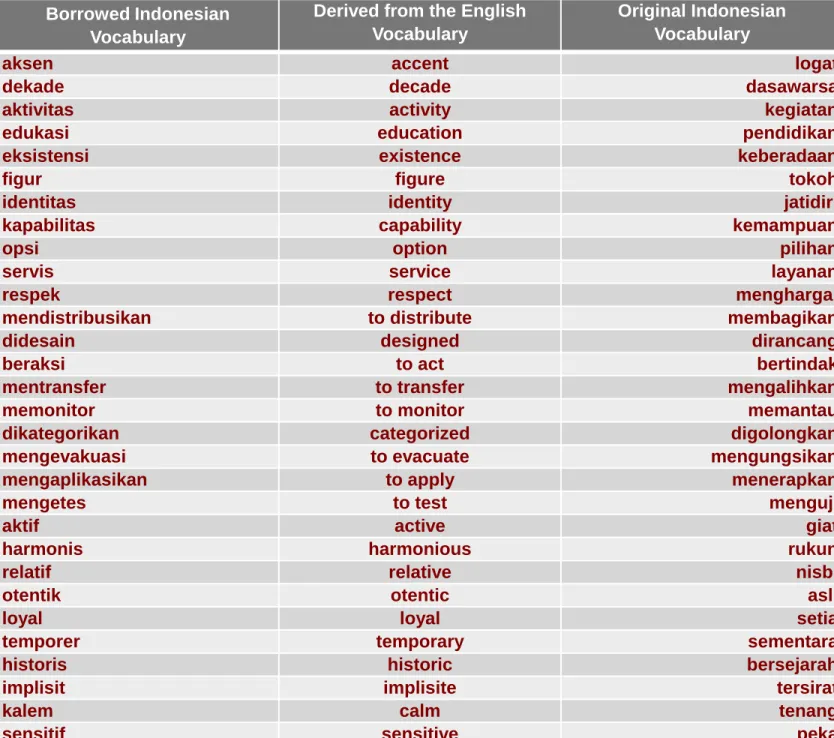
POTENTIAL IMPACT OF CORE BORROWING Lexical borrowing or translating words or foreign terms has several advantages. It has made Indonesian possible to evolve towards a modern language capable of bearing the vehicular load to express all aspects of life
Otherwise, core borrowings can be unnecessary or
excessive and lead to the occurrence of competing words
in its use. There are a lot of words permeated into the
repertoire of Indonesian that have actually existed
originally in Indonesian as seen in the following data:
Lexical Category Borrowed Indonesian Vocabulary
Derived from the English Vocabulary
Original Indonesian Vocabulary
Noun
aksen accent logat
dekade decade dasawarsa
aktivitas activity kegiatan
edukasi education pendidikan
eksistensi existence keberadaan
figur figure tokoh
identitas identity jatidiri
kapabilitas capability kemampuan
opsi option pilihan
servis service layanan
Verb
respek respect menghargai
mendistribusikan to distribute membagikan
didesain designed dirancang
beraksi to act bertindak
mentransfer to transfer mengalihkan
memonitor to monitor memantau
dikategorikan categorized digolongkan
mengevakuasi to evacuate mengungsikan
mengaplikasikan to apply menerapkan
mengetes to test menguji
aktif active giat
Competing words resulting from core borrowing
Conclusion
The effect of English has become a real dilemma because, on the one hand, it has made Indonesian possible to evolve towards a modern language capable of bearing the vehicular load to express all aspects of life.
The result shows that there has been core borrowing from English as the translation equivalent resulting in a lot of loan words that seem to be excessive and unnecessary since Indonesian has
certain lexical items to express the same meaning.
Motivations for core borrowing usually lumped as individual or collective prestige and needs including objective need to express new ideas as well as scientific and technological discoveries
RECOMMENDATION
Translation as an alternative measure to restrain excessive borrowing:
Direct Translation
Direct translation appears formally and semantically in the form literal equivalent such as the English word menu is also the same in the Indonesian language menu.
Baker (1991: 36) calls it a loan word that is applied to lexical item having culture-specific meaning and modern concepts.
The transfer of direct source text into equivalent target text grammatically and idiomatically (See Vinay and Darbelnet in Venuti (2000: 86 88), such as cottage