Despite the health benefits associated with breastfeeding and the economic disadvantages associated with the use of infant formula, social influences have caused a shift in neonatal health in the United States from wet breastfeeding to breast milk feeding now. I focused mainly on the United States, since that's where I'm best known and because we seem to be one of the most problematic countries when it comes to breastfeeding. The final chapter is titled, "The Growth of the Formula Industry and the Costs Associated with Formula Feeding," and examines the infant formula industry to see the role it played in promoting the bottle over the breast.
Social pressure needs to become less widespread and central in today's society, and people need to be made aware of its benefits.
CHAPTER I: MAMMALS, BREASTFEEDING, AND NUTRITION
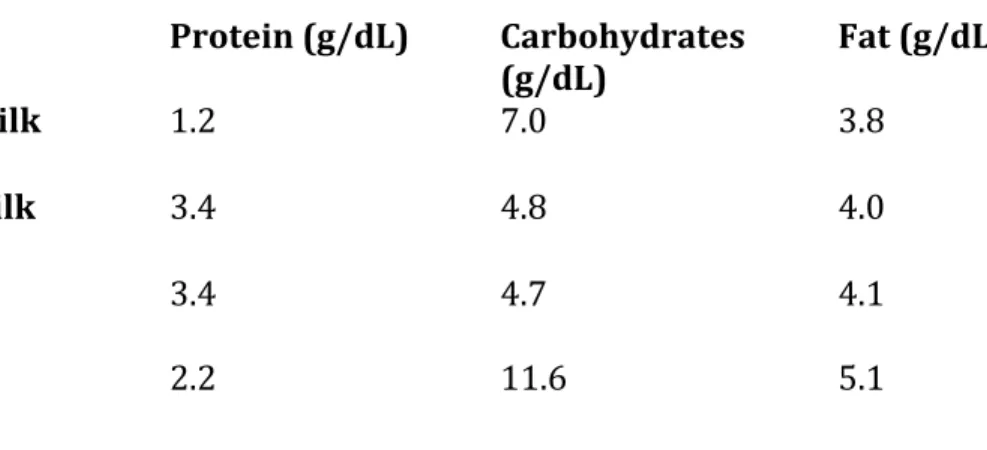
Breastfeeding has been found to “stimulate a universally orchestrated change in milk fat and cell content over time (3 hours) in lactation,” with the breast stimulated by suckling, “suggesting that this pattern is relatively conserved” (Hassiotou 5). Lipids self-organize into “milk fat globules triglycerides” allowing breast milk to facilitate “digestion and absorption of lipids” (Schanler). The next component of milk, which makes up about 40 percent of the calories in breast milk, is carbohydrates, mainly lactose and oligosaccharides.
One of the biggest factors when comparing cow's and human milk is the difference in protein.
CHAPTER II: PHYSIOLOGY AND BIOMECHANICS OF LACTATION Lactation, the production of milk, occurs from the mammary glands, which
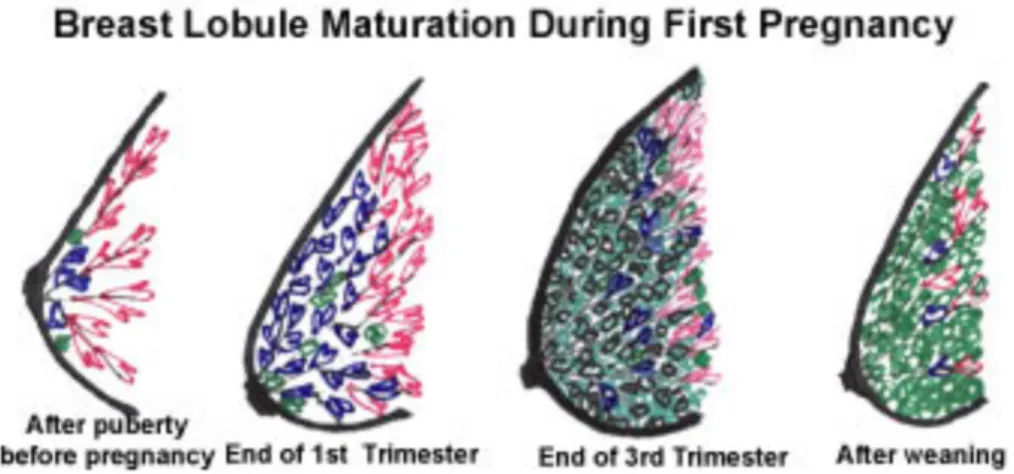
The simplest components of the secretory system are sac-like aveoli that, together with epithelial cells and other smaller parts, form the lobes of the breast. The anatomy of male breasts is virtually identical to that of women, with the exception of the specialized lobes. This process involves the development of the breasts from birth through the third trimester of pregnancy and involves the preparation of the breast through growth for milk production.
The body promotes prolactin secretion for the second time with the stimulation of the nipple by sucking. If milk is not removed on a regular basis during galactopoiesis, milk builds up in the lumen of the lobules, leading to the expansion of the alveoli and an increase in intramammary pressure. This protein is synthesized by the epithelial cells in the mammary glands as a result of the increase in intramammary pressure and is secreted into the lumen of the lobules.

CHAPTER III: HEALTH CONSEQUENCES OF BREASTFEEDING
Breastfed infants experience higher levels of gastric lipase due to the bile salt-dependent lipase found in breast milk. A study of four infants found that breastfed infants had a lower incidence of respiratory disease when breastfed for the first four months of life. The same study also found that in the first six months, breastfed babies had reduced morbidity.
Looking at the first two years of babies' lives, one study showed that the average duration of otitis media, inflammation of the middle ear, was greatly reduced in breast-fed babies compared to formula-fed babies. The study found that the incidence of diarrhea is 50% lower in breastfed babies during the first year of life, and also found that breastfed babies had 19% fewer episodes of otitis media and 80% fewer episodes of prolonged otitis media during the first year. compared to formula-fed infants (Dewey, Differences in Morbidity). Because of the antimicrobial and anti-inflammatory activity present in human milk, breastfed babies experience less severe infections.
These hormones are part of the stress axis and have a positive effect on social behavior; however, another possible explanation for this effect could be due to the increased cortisol levels in breastfed infants compared to bottle-fed infants (Schanler). The study looked at mothers one month after giving birth and found that breastfeeding mothers had lower systolic blood pressure than mothers who used other feeding methods. The study measured lower heart rates in exclusively breastfeeding mothers compared to nonexclusively breastfeeding mothers and in non-postpartum controls by measuring the parasympathetic heart.
A case study suggests that an inverse relationship exists between breastfeeding and breast cancer risk; however, this relationship appears more consistent among premenopausal women, mothers who breastfed more than 3 children, or who breastfed their first child for a longer period of time (Zheng). Mothers who often have to bottle-feed their babies also often have to work, which can reinforce these car characteristics due to stress.
CHAPTER IV: SHIFT OF NURTURANCE FROM WET NURSING TO FORMULA AND THE SOCIAL PRACTICES THAT HAVE INLUENCED THIS SHIFT
Wet nursing was very popular in the twelfth century and continued up to the eighteenth century. Physicians began to address infant health directly to mothers, and nineteenth-century American culture saw women begin to gain decision-making power when it came to family and the domestic arena. During the nineteenth century, “economic transformations resulted in new conceptualizations of home and work” (Golden 40).
It was during the mid-nineteenth century that the home was seen as the workplace for a mother. Because of this belief in the rarity of ideal breast milk, the nineteenth century created the. Nineteenth century physicians began to promote artificial feeding as the best alternative to breast feeding and in some cases as superior to.
Another explanation for the rise of artificial infant formula was that the increase in wealth of the rising middle class and ruling class strengthened women's role as consumers (Palmer 214). The wealthy women of the late nineteenth century were convinced by doctors and relatives that they were fragile beings too fragile to breastfeed their children (Palmer 215). The belief of the time was that women could not be trusted with the care and feeding of their children due to their delicate nature.
In the past 60 years, especially after World War II and with the formation of the large-scale infant formula industry. Their job was to take care of the home, especially in the wealthy families and the middle class.
In this culture, the female breast is considered an erotic genital organ that people find pervasive to the extent that some people even deny the actual glandular function of the breast to raise children (Stuart-Macadam 169). Certain aspects of today's society have led to the definition of "attractive" to a figure that can only be achieved through mutilation of the body. The episode portrayed breastfeeding as the enemy and not the lack of information that was really the cause of the baby's death (Bentley 306).
The condition of the area where a mother lives also influences whether she breastfeeds or not. In their study, "Major Factors Influencing Breastfeeding Rates: Mother's Perception of Father's Attitude and Milk Supply," Samir Arora, Cheryl McJunkin, Julie Wehrer, and Phyllis Kuhn found that "the major factors reported by bottle-fed mothers who would have encouraged them to breastfeed included more information. The "primary reasons for initiating bottle feeding over breastfeeding included the mother's perception of the father's preference and the mother's uncertainty about the amount of milk the infant would receive" (Arora 2).
Breasts are only permissible when trying to attract a man, not when trying to feed an infant, regardless of the fact that the intrinsic functional use of the breast is to feed infants. Jane Ussher has stated, "Ironically, breast-feeding is still widely rejected in public, denying the natural function of the breast while objectifying it for male sexual gratification" (22). Robledo, Wares, Fricker, and Pasek found that most participants “(80%) intended to breastfeed within the first few months of the infant;” but because they also stated that they “intended to introduce formula early,” participants were likely “not to persist when breastfeeding the recommended 6 months” (435).
Viewing breastfeeding through the lens of objectification theory, women "to varying degrees internalize this external view and begin to self-objectify themselves by treating themselves as an object to be viewed and evaluated based on their appearance." (Szymanski 8). Breastfeeding perception is one of the fundamental problems of breastfeeding in North America, and this problem can only be addressed through interpersonal communication.
CHAPTER VI: THE RISE OF THE FORMULA INDUSTRY AND COSTS ASSOCIATED WITH ARTIFICIAL FEEDING
The formula industry began to be advertised in the mass media, and in developed countries, bottle feeding became associated with the elite and breastfeeding became a symbol of the peasantry (Baumslag 148). These companies used new media that had become available to spread their message to most of the population in the United States and other developed countries. Many new mothers' first attempt to feed their child came while they were in the hospital, and while new mothers were nervous about their ability to nurse, according to hospital staff.
The results of this study showed that “the mother's attitude toward breastfeeding had a significant impact on her ability to breastfeed” (Apple 160). The formula industry began to flourish in the late nineteenth and early twentieth centuries as a result of several factors. During this time, conditions in the United States were ideal for a relationship between the formula industry and the healthcare market to flourish (Palmer 212).
These three factors contributed to the increased use of formula feeding throughout the twentieth century. These three factors contributed to an increase in the use of formula feeding throughout the twentieth century (Apple 169). As bottle feeding in urban areas with working mothers became popular, stay-at-home mothers also began to artificially feed their babies (Palmer 213).
The percentage of women who breastfeed for 12 months in the United States is approximately 17% to 20%, which is much lower than the global average. Association also found that “non-breastfeeding families spend nearly $700 on standard formulas in the first year” and “the USDA estimates that at least $3.6 billion in health care costs could be saved if breastfeeding rates were increased from current levels to the current level.” recommended by the United States Surgeon General” (813).
Chapter I
Chapter II
Chapter III
34;Differences in morbidity between breastfed and formula-fed infants." Journal of Pediatrics 1st ser. Analysis of longitudinal data from the Centers for Disease Control and Prevention Pediatric Nutrition Surveillance System." Pediatrics e81-‐e86.
Chapter IV
34;Breast Isn't Best: Readers Tell US Parenting Magazine." Breast Isn't Best: Readers Tell US Parenting Magazine.
Chapter V
34;Alyssa Milano Wonders Why Breastfeeding Photos Are More Shocking Than Kim K Naked." The Huffington Post.
Chapter VI