2
Building Strong Project Backbones
If one link is broken, the entire chain is broken.
— Yiddish Proverb
A
s a consultant, my primary job is to empower my clients with powerful concepts and coach them to reach great solutions. All great solutions begin by asking the right questions. My major contri- bution to the fi eld of Strategic Project Management is these Four Critical Strategic Questions , which I developed to make the Logical Framework Approach, (as you ’ ll see in Chapter 3 ) easier to understand.These seem like simple questions — that ’ s exactly the point.
They are indeed simple, but not simplistic. It took multiple refi ne- ments over several years in order to progressively simplify them while preserving their power to integrate multiple points of view. Albert Einstein famously said that if you can ’ t say something simply, you don ’ t understand it. I agree with Al.
The four following carefully crafted questions work wonders in virtually any situation. The fi rst three are usually glossed over in the rush to answer the fourth.
19
c02.indd 19
c02.indd 19 12/11/08 5:54:24 PM12/11/08 5:54:24 PM
Asking the Four Critical Strategic Questions
The call came from Keith, an Information Technology (IT) manager who had attended one of my strategy workshops at UCLA. He worked in a well - known company that needed to launch a critical ini- tiative, but their task force had made little progress after several frus- trating meetings. Keith invited me to facilitate their next discussion, which would be attended by a cross - section of company personnel with heavy representation from the IT Department.
There were a dozen key players in the conference room, each of whom looked frustrated when I entered. I listened to a lively techni- cal discussion on the merits of Linux versus Windows, C++ versus Ajax/Java evaluations, and other technical issues. They were well into the how of the project, without being clear on the what or the why . Then a bald, geeky executive glared at me and asked, “ Okay, you ’ re the consultant. We ’ re stuck. What should we do? ”
I responded to the executive by tossing out this fi rst question.
What Are We Trying to Accomplish and Why?
He and his team looked at each other as if to say, “ We brought this guy in to get good answers, not to ask such simple questions. ” Yet, while hardly profound, this fundamental question is the perfect place to start — whatever your issue.
Surprisingly, the motivating Objectives behind projects are not always clear, or are badly communicated in a corporate memo or vague strategic plan. Sometimes my fi rst question gets answered superfi cially by a catch phrase early in the game, but is seldom revis- ited, reconsidered, and revalidated.
The question of what the project should accomplish—and more importantly— why it needs to be done, deserves fi ne - tuned attention because those answers drive everything else. In the rush to decide on the how , who , and when of a project, people often gloss over the why .
This question posed to Keith ’ s team cut through clouds of con- fusion. Numerous answers tumbled out, which I captured on the whiteboard. The discussion rapidly shifted from technical solutions to customer needs and expectations as well as to the operational ben- efi ts expected. Later, the team would organize these Objectives into a logical sequence.
c02.indd 20
c02.indd 20 12/11/08 5:54:25 PM12/11/08 5:54:25 PM
Professionals today are often told what needs to be done, but are not really clear on why it is needed. Thus, they can easily become lost in the technical jungle of how. People fi rst need to answer the whole “ Wha t are we trying to accomplish and why ? ” question before concentrating their best brain power on the how .
When Keith ’ s team reached consensus on several major Objectives, I offered this next question.
How Will We Measure Success?
Their facial expressions suggested that I had revealed the magic for- mula that unlocks the universe. This question is signifi cant because Measures fl esh out and anchor what the Objectives really mean.
This question seldom gets the attention it deserves, due in part to the false belief that the answer must be obvious or else senior man- agement wouldn ’ t have mandated the project. One of Keith ’ s team members provided a perfect example when he replied, “ They said that our Goal is to deliver customer value; so, isn ’ t it clear what con- stitutes success? ”
Since it ’ s easy to presume that senior management or “ some other department ” will decide whether or not the project is success- ful, tackling the question may seem to be irrelevant or a waste of time. However, until you defi ne how success will be measured, even the most sincere visions are no more than highfalutin ’ fl uff. As we sketched out specifi c Success Measures for each Objective, the mood in the room changed. The team felt a sense of progress that had been missing from earlier sessions. Now they were rolling along the right path, and the worry lines on Keith ’ s furrowed brow began to soften.
What Other Conditions Must Exist?
When I posed this question, the geeky executive who had glared at me earlier began to smile. This third question puts your project, issue, or initiative into a larger strategic context. Asking this expands the analysis to include some of the outside factors which may disrupt your carefully crafted plans. All too often, capable, responsible professionals focus only on areas they can affect or control because it ’ s seemingly irresponsible or inappropriate to worry about things they can ’ t control. Asking this question forces us to think outside the artifi cial boundaries of the proj- ect scope and consider the project in its larger, often murky context.
c02.indd 21
c02.indd 21 12/11/08 5:54:25 PM12/11/08 5:54:25 PM
They began sharing their concerns about other factors which would infl uence or affect the team ’ s efforts: (1) How to provide nec- essary training; (2) how this system would mesh with processes already in place; (3) how to ensure suffi cient resources; plus other critical issues that could easily have been missed. Later we turned these issues into Assumptions, and tested their validity in order to uncover potential problems early. With Assumptions captured, the last question could be answered with greater confi dence.
How Do We Get There?
Now — but not before — was the time for the IT team to address the nitty - gritty details. The majority of project teams I have worked with tend to delve deep into the details much too soon, or get sidelined by premature technical arguments. They gloss over the fi rst three ques- tions in a rush to get moving. By ignoring or short - changing earlier questions, their neatly printed project plans are like the proverbial make up on a frog — lovely at fi rst glance, but masking the ugly warts underneath. The value of the fourth question comes from con- sciously placing it in its only, truly functional place in the planning sequence: Last.
These Four Critical Strategic Questions form the heart of Strategic Project Management. Each needs to be asked and answered, in exactly this order . Of course, they are iterative and interconnected. It ’ s smart to give fi rst - cut answers and then cycle through them again and again, each time improving your project design. In Chapter 3 , you ’ ll learn about The Logical Framework, a simple strategic thinking tool which elegantly organizes your answers to these four questions.
Concepts from the Cornfi eld
In the movie Field of Dreams , Kevin Costner ’ s character contemplates building a baseball park in the middle of an Iowa cornfi eld. He says to himself:
“ If we build it, then they will come. ”
These words capture a strategic principle that is both simple and profound: If - Then thinking. Understanding and applying this power- ful principle will leverage your ability to produce project payoffs.
c02.indd 22
c02.indd 22 12/11/08 5:54:26 PM12/11/08 5:54:26 PM
Planning is nothing more than imagining some future desired conditions, and then thinking backwards about the cause and effect steps needed to get there.
If - Then thinking (also called “ cause - effect ” or “ means - ends ” thinking) offers management language that lets you think top - down and backwards from future Goals to the present. In addition, you can think bottom - up and forward to the future, thus creating solid bridges between desired dreams and current reality. This phrase also illustrates the power of human vision and commitment — two ever - necessary competencies not to be set aside lightly.
Linking two Objectives into a logical If - Then relationship forms a hypothesis — a predictive statement of cause and effect that involves uncertainty. In plain language, a hypothesis is an educated guess that refl ects our life experience, mental models and best judgment of how the world (or at least the project at hand) works.
Stringing multiple If -T hen linkages together forms multi - level strategic hypotheses , a logic stream based on the generic formula “ If A then B, if B then C, if C then D. ” Every project builds around pre- sumed strategic hypotheses, whether or not they are consciously defi ned. When these hypotheses are fuzzy — meaning when causal linkages are unclear, undefi ned or illogical — your plan is a crap shoot.
The learnable discipline of If - Then thinking will dramatically boost your odds of success because it forces rigorous systematic thought.
As this book unfolds, you ’ ll appreciate how If - Then thinking is the key to integrating strategic intent into your project plans.
Reserve Your Reading Direction
As youngsters we were taught to read from the top of a page to the bottom, but in the diagrams that follow, it works best to read from bottom to top. That seems counter - intuitive at fi rst, but you ’ ll soon get comfortable with reading If - Then hypotheses from the bottom up.
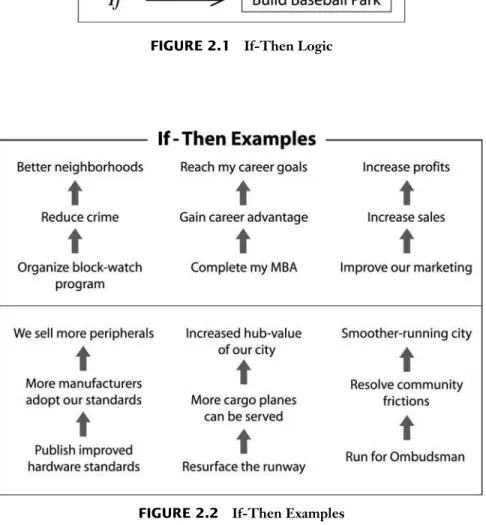
You can diagram this basic “ If we build it, then they will come ” linkage as shown in Figure 2.1 . (It works best to start at the bottom and read up.)
Figure 2.2 gives several examples of If -T hen logic, visually dis- played as linked hypotheses. Remember, start at the bottom and work up, connecting the phrases together with If - Then logic. Let ’ s walk through the logic of the fi rst example.
“ If we organize a block watch program, then we can reduce crime; If we reduce crime, then we will have better neighborhoods. ”
c02.indd 23
c02.indd 23 12/11/08 5:54:26 PM12/11/08 5:54:26 PM
As you read Objectives chains from the bottom - up, grasp the thinking behind the linking. Observe how the higher Objectives tend to be global, general, and infl uenced by many factors other than the present project. It ’ s best practice to design projects beginning with
FIGURE 2.2 If-Then Examples FIGURE 2.1 If-Then Logic
c02.indd 24
c02.indd 24 12/11/08 5:54:26 PM12/11/08 5:54:26 PM
Objectives at the top and working down, and to mentally test the soundness of our plan — and implement — by working bottom - up.
Making Strategy Simple
The essence of strategy — how to get to where you want to be — is embedded directly into If - Then statements, much like the chocolaty goodness baked into mom ’ s hot - from - the - oven cookies. The approach to executing any corporate or project strategy can be expressed using If - Then logic. If - Then is a neutral language that crosses disciplinary boundaries, enabling front - line employees, accountants, and CEOs to share the same view of the world. Project players with different backgrounds and thinking styles can use If -T hen to compare and integrate their mental models, and thus develop an informed and superior approach.
If -T hen thinking is the basic formula for successful design and implementation of strategies, projects, and action initiatives of all types. Consider, for a moment, your project to be a carefully struc- tured experiment. You design your project experiment by specifying a set of linked hypotheses or “ educated guesses ” believed to be true.
During implementation, you ’ ll determine the real - world validity of those hypotheses according to the results you get. You don ’ t have to be a scientist to manage in a way that ’ s strategic and scientifi c as well as street - smart. You may not win the Nobel Prize, but the quality of your results will be worthy of gold medals.
Why do I emphasize the importance of If - Then thinking?
Because most project teams miss this crucial concept entirely. Project plans may turn into dozens of pages of tasks, but if you can ’ t describe (with simple If - Then language) how your hard work ripples up to impact important organizational Goals, it probably won ’ t make an impact. In short, it ’ s hard to achieve what you can ’ t explain .
Keep This Distinction in Mind
If - Then causal logic may seem obvious, but there is a subtle twist:
Causal logic is different from the sequential If - Then logic commonly
c02.indd 25
c02.indd 25 12/11/08 5:54:27 PM12/11/08 5:54:27 PM
used in network diagrams, fl ow charts, Gannt charts, and computer programming. Here ’ s the critical distinction: In sequential logic, A precedes B in time. A must happen before B, although it does not cause B. But with causal logic, A not only precedes B, A causes B to happen .
When building a baseball diamond in Iowa, sequential logic can identify the logical order of action steps: (1) Harvest the corn;
(2) plow the fi eld; (3) plant grass, and so on. It ’ s true that “ If we cut the corn, then we can level the surface, ” but such a statement expresses a time - based sequential relationship —you must do this before you can do that. Cutting the corn does not cause the surface to level itself; rather it simply precedes it in time. Gantt charts and net- work diagrams do a good job of showing sequential task logic and dependencies, but they seldom express causal logic.
Sequential logic, however, is rarely strategic. Hunkering down and completing all the tasks on a Gantt chart doesn ’ t necessarily get you to the Goal. Many great ballparks, fl ashy products, and new sys- tems have been built that remain largely unneeded, unwanted, and unused.
Being more precise, we have to admit that building a ballpark, stadium, or golf course does not, in itself, cause people to come.
Having a winning team, creating successful promotions, and provid- ing easy access are all factors that directly impact the strategic hypothesis. At the same time, it ’ s true that “ they can ’ t come ” unless and until “ it ’ s built. ” So, building the ballpark is a necessary prerequi- site to people coming, but it is not suffi cient, in and of itself, to cause them to come.
Observe, too, that the statement “ they will come ” is still a hypothesis, a deeply - desired view of how the world will respond to the project. Wrapped in that hope is the conviction, the desire, that If we build it, then they will come. This hope makes the heart of Kevin Costner ’ s movie beat, but if you allow conviction to substitute for rigorous cause - effect reasoning, you ’ re in trouble.
Why does Costner ’ s character want them to come? What ’ s the top - level Objective that drives his project? Costner ’ s character was far behind on mortgage payments and slipping into foreclosure. So we can infer that “ save the farm ” was an even more important Objective. Let ’ s extend the If - Then linkages up a level to capture the ultimate Objective, as well as down a level, to identify the steps nec- essary to build the ballpark.
c02.indd 26
c02.indd 26 12/11/08 5:54:27 PM12/11/08 5:54:27 PM
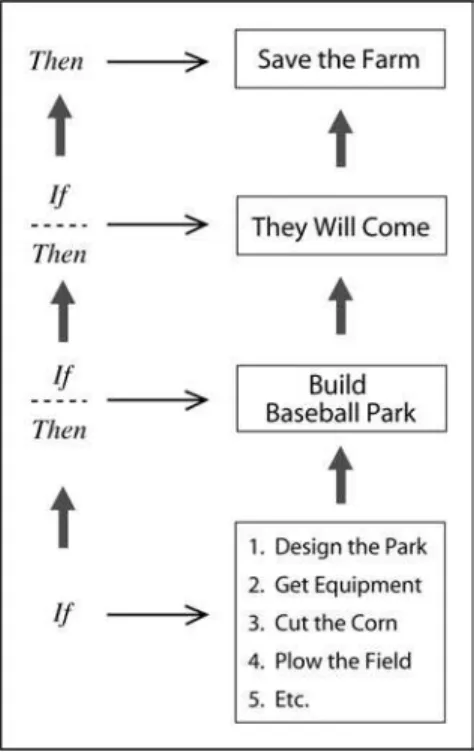
In Figure 2.3 , our logic chain now goes like this as you read up from the bottom:
• If we design the park, get equipment, and so on, Then we can build a baseball park;
• If we build a baseball park, Then they will come;
• If they come (and pay), Then we can save the farm.
We ’ ve now constructed a four - level strategic hypothesis — the logical backbone of any project. Note how the linkages start with do - able tasks at the bottom and progress up to high - level Goals. These linkages — based on answers to the fi rst question — provide a solid
FIGURE 2.3 If-Then Strategic Logic
c02.indd 27
c02.indd 27 12/11/08 5:54:27 PM12/11/08 5:54:27 PM
foundation for project design. (The complete LogFrame for the Field of Dreams example can be found at www.ManagementPro.com. )
Test Your Strategic If - Then IQ
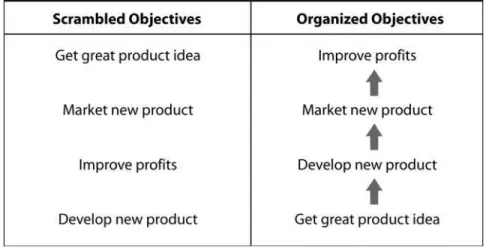
Brainstorming to generate multiple answers to the fi rst strategic question — What are we trying to accomplish and why? — produces a list of possible Objectives, but they are not in any particular order.
Your team then needs to convert these scrambled objectives into a logically organized Objectives list, as shown by the two examples in Figure 2.4.
Get the idea?
To deepen your understanding of If - Then logic, I am going to give you several sets of scrambled Objectives, which you can unscramble and rearrange into a logical order. Stack the Objectives logically, top to bottom and bottom to top. You can start by fi nding the “ highest ” Objective and putting it at the top and work down, or start from the bottom and work up, or go both ways. It ’ s best to actu- ally sketch them out as shown in the previous examples, with arrows and spaces between each item, or reason them out verbally by stating the linking If - Then phrases.
FIGURE 2.4 Converting Scrambled Objectives into a Logically Ordered List
c02.indd 28
c02.indd 28 12/11/08 5:54:28 PM12/11/08 5:54:28 PM
Take a few minutes to solve these examples, starting with a couple of light - hearted ones and then moving on to the more serious.
You can check your answers at the end of this chapter.
Example #1: Example #5:
• Get rich and move to Fiji • Get promoted faster • Find a mate for Orville the hamster • Get an MBA degree • Breed prize hamsters • Become a CEO by age 40 • Become “ the hamster giant ” • Take part - time classes
Example #2: Example #6:
• Meet lots of prospects • Write and publish articles • Join an online dating service • Become a sought - after
• Find a soul mate industry expert • Live happily ever after • Increase my professional
reputation
• Identify needs in my fi eld
Example #3: Example #7:
• Design a new expense • Increase corporate profi t reporting system • Develop a new product • Reimburse employees faster • Increase corporate sales • Have happier employees • Market product
• Implement a new expense successfully reporting system
Example #4: Example #8:
• Identify ineffective practices • Develop portable • Have staff use standard procedures land - mine detector • Develop and publish best - practice • Save lives and reclaim land
procedures • Get research funding
• Improve corporate productivity • Deploy device in
war - torn countries
c02.indd 29
c02.indd 29 12/11/08 5:54:28 PM12/11/08 5:54:28 PM
Here ’ s a fi nal unscrambled example which shows an illogical strategic hypothesis — one with little probability of reaching the top of the If - Then chain.
Live a life of luxury Win the lottery Buy a lottery ticket Drive to the 7 - 11
Note the virtual certainty of the lower - level If - Then link. You can indeed drive to a 7 - 11 to buy a ticket. That much is guaranteed.
But “ If buy ticket, then win lottery ” is a huge leap with millions - to - one odds against you. As most lottery ticket buyers know, this If - Then hypothesis depends entirely on which numbered ping - pong balls pop into the chute at the lottery headquarters, a random circumstance outside of your control and totally unimpressed by your fervent desire to win a pot of cash.
Sorting Out Your Objectives
Let ’ s dig deeper to explore fi ner points about Objectives. The moti- vation driving all projects is simple: To achieve desired Objectives.
Some typical Objectives could be:
Develop a new management system Reduce time to market
Produce new knowledge Invent the perfect gizmo Increase data security Generate increased profi t Reengineer core processes
Crafting meaningful Objectives begins with the careful use of language, using well - chosen verbs and descriptive phrases. (More expla- nation is in Chapter 4 .)
Yet, defi ning Objectives is seldom straightforward because peo- ple interpret Objectives in unique ways based on their own technical background, thinking style, and vested interests.
•
•
•
•
•
•
•
•
•
•
•
c02.indd 30
c02.indd 30 12/11/08 5:54:29 PM12/11/08 5:54:29 PM
To playfully make the point that words trigger different images in our minds, I ask my seminar participants, “ Please bring me a great dog.
Tell me what kind of dog you will bring me? ” The answers ring out:
“ Poodle. ” “ Doberman. ” “ Pekingese. ” “ Yellow Lab. ” “ Mutt. ” “ A dog just like Lassie. ” “ My own dog Bingo. ” “ Great Dane. ” “ Chihuahua. ” On occasion, someone thinks to ask what kind of dog I consider to be great, which is the essence of Question #2.
Then in mock disappointment, I ’ ll say, “ Can ’ t anyone get me a foot - long Coney Island hot dog in a warm bun lathered with mustard and relish? ” They chuckle and the point is well made: Words are ambiguous, even when describing something tangible and real like a dog. The confusion escalates when dealing with the abstract and con- ceptual terms used in management.
Since no standard management vocabulary exists, a rainbow of terms is used to express what we will simply call “ Objectives ” . Words like Goal, Purpose, aim, output, intention, Outcome, result, expecta- tion, and vision are common examples. These terms may be perfectly clear to the person using them, but his or her colleagues may have very different defi nitions. Even worse, they may just be interchange- able buzzwords thrown around without making any meaningful distinction.
The concept in your mind ’ s eye when you use terms like Goal or Outcome is not likely to match mine. But how often do teams take a moment to calibrate their terminology to ensure that meanings mesh?
Complicating the picture, all projects have multiple Objectives, ranging from those that are short - term, specifi c and easily achievable to those that are long - term and general and tougher to reach.
Without a mechanism to clarify and logically organize Objectives, the situation is like our six blind men feeling an elephant. Each per- ceives just one part and misses the logical whole. No wonder the failure rate is so high.
Let ’ s make a deal. From now on, we ’ ll agree to use the word Objective as a generic term to describe any and all project intentions.
In the next paragraphs, we ’ ll get more precise and distinguish different types and levels of Objectives.
Link How You Think and Think How You Link
Project teams seldom defi ne and examine the mental logic underpin- ning their efforts. That dangerous oversight leads to projects that
c02.indd 31
c02.indd 31 12/11/08 5:54:29 PM12/11/08 5:54:29 PM
deliver end products but fail to achieve business Goals. Examples abound of newly developed products that the market doesn ’ t need;
systems created that people don ’ t use; and other well - intended efforts that fail to leave a mark. You can avoid this disconnect by recognizing four levels of Objectives, which are defi ned as follows:
Goal The high level, big - picture strategic or program Objective to which the project contributes.
Purpose The impact we anticipate by doing the project, the change expected from producing Outcomes.
Outcomes The specifi c results that the project team must deliver by managing Inputs.
Inputs The activities and the resources necessary to produce Outcomes.
Put into words, the logic is:
“ If we manage Inputs, then we can produce or deliver Outcomes;
If we produce or deliver Outcomes, then we will achieve a Purpose;
If we achieve a Purpose, then we contribute to an important Goal. ”
Or, expressed more succinctly:
“ If Inputs, then Outcomes;
If Outcomes, then Purpose;
I f Purpose, then Goal. ”
The logic between levels is not random or accidental; each level forms a link in the strategic hypothesis. Admittedly, the choice of words used to defi ne each level in the project ’ s hierarchy (Goal, Purpose, Outcomes, and Inputs) may seem arbitrary, but the concept each term expresses defi nitely is not. Each Objective has a particular and precise meaning. While the specifi c word is not important, the
•
•
•
•
•
•
c02.indd 32
c02.indd 32 12/11/08 5:54:29 PM12/11/08 5:54:29 PM
meaning attached to that word is crucial. If you wish, substitute your own terms — but be certain everyone on the team uses those terms in the same way.
Think of these various Objectives as rungs on a ladder. The logic that links each rung permits a disciplined approach to project design. By getting the implicit strategic logic out of people ’ s heads and onto paper, you can test the soundness of any approach and fi ll in the missing gaps early in the game.
In general, project teams manage Inputs, which produce Outcomes to achieve a Purpose, which contributes to a Goal. Inputs and Outcomes are generally within the control of the project team, while Purpose and Goal are beyond their direct control.
Figure 2.5 gives several examples of bottom - up strategic hypotheses in various businesses.
In these examples, observe how the Goals tend to be global, gen- eral, and affected by many factors other than the project. Recognize the important distinction between Outcomes and Purpose. Outcomes are deliverables that the project team can control, make happen, and be held accountable for. Purpose is the expected impact from the deliv- erables, the aiming point which is beyond the team ’ s direct control.
FIGURE 2.5 Strategic Hypotheses—Business Examples
c02.indd 33
c02.indd 33 12/11/08 5:54:30 PM12/11/08 5:54:30 PM
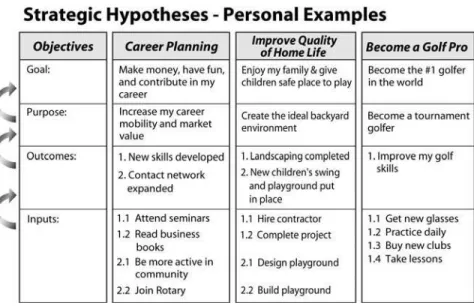
When your key players grasp these distinctions, they can con- centrate on delivering the right set of Outcomes, aimed at an impor- tant Purpose and Goal shared by senior management and critical stakeholders. Figure 2.6 applies the same logical progression to examples of personal projects.
Good project design requires that a project has a single Goal and a single Purpose, along with multiple Outcomes. Each Outcome can have several Inputs, which are the main tasks needed to get there.
In addition, reaching a Big Hairy Audacious Goal usually requires multiple project thrusts to get there. Each requires its own LogFrame that is tied to a common Goal.
Programs consist of multiple projects that contribute to one com- mon overarching Goal. Chapter 4 explores program management and how it benefi ts from the Objectives Tree tool that is presented in the next section.
Organizing Multiple Objectives Into Trees
Describing strategy using a single chain of linked If - Then Objectives is fi ne for getting a line of sight on stand - alone projects, but if the larger
FIGURE 2.6 Strategic Hypotheses—Personal Examples
c02.indd 34
c02.indd 34 12/11/08 5:54:30 PM12/11/08 5:54:30 PM
environment is more complex, multiple other Objectives and projects naturally come into play. How does our system incorporate these?
Before answering, we introduce Objectives Trees, which are visual tools that organize multiple and parallel Objectives using our now familiar If - Then logic. We ’ ll illustrate how If - Then thinking simplifi es complex problem situations by showing its use in combat- ing what was potentially the worst insect pest threat ever seen in the United States — the Asian Gypsy Moth invasion of the Pacifi c Northwest.
I fi rst learned about the Asian Gypsy Moth (AGM) invasion in an urgent phone call from a senior entomologist in the Washington State Department of Agriculture (WSDA). While I couldn ’ t imagine moths destroying more than a wool sweater, he soon convinced me otherwise.
“ This isn ’ t just any moth, ” James explained. “ Asian Gypsies are the King Kong of the moth world. These voracious little pests threaten to wipe out the forests of the Pacifi c Northwest because they eat everything in their path. ”
He explained how these pests slipped into North America as tiny batches of larvae aboard ships coming from Siberia. When the ships unloaded their cargo in the ports of Washington, Oregon, and Canada, the moths entered the mainland and laid their eggs.
James continued to describe the severity and urgency of the matter. “ The weather is getting warm. The moths, now in cocoons, will hatch and spread like wildfi re. In a few weeks, the U.S. Forest Service will put eight helicopters into the air and spray over 130,000 acres to kill them — but they won ’ t get them all. My team must then set out traps to fi nd and destroy any they miss. We face a huge task.
Our team needs to grow from just three people to almost 300 people in less than eight weeks. We must import, assemble and deploy 180,000 sticky - substance insect traps; hire and train trappers; then set up monitoring systems to fi nd and destroy any remaining moths. ”
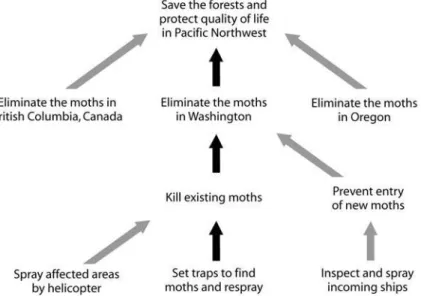
Whew! What a project! When they asked me to help them gear up fast, our fi rst step was to sketch an Objectives Tree, as shown in Figure 2.7 . This diagram offered a wide - angle perspective for planning how to fi nd and destroy those dangerous moths.
The center column of linked Objectives illustrates how setting traps would ripple up the cause-effect chain and lead to saving the forests and protecting the quality of life in the Pacifi c Northwest. Note how this If - Then logic handles parallel Objectives. These center Objectives were
c02.indd 35
c02.indd 35 12/11/08 5:54:31 PM12/11/08 5:54:31 PM
the responsibility of WSDA and became the focus of their LogFrame project plans.
This emergency effort would be coordinated with parallel efforts in Oregon and British Columbia, Canada. These other Objectives shown in the tree were outside the AGM teams ’ responsi- bility, but still vital to reach the Goal. From WSDA ’ s perspective, these were Assumptions. (Keep in mind that your Assumptions may be someone else ’ s full - fl edged project, and vice versa.)
In properly constructed Objectives Trees, for any Objective, look- ing up the tree should answer the question “ why , ” while looking down the tree answers the question “ how . ” If you look carefully at the Objectives Tree fi gure and select, for example, “ Eliminate the moths in Washington ” you may ask: Why are we doing it? The answer: To save the forests and protect quality of life. How are we doing it?
By killing existing moths and by preventing the entry of new moths.
FIGURE 2.7 Objectives Tree for Combating the Asian Gypsy Moth Invasion
c02.indd 36
c02.indd 36 12/11/08 5:54:31 PM12/11/08 5:54:31 PM
(A note of caution: Don ’ t confuse this why and how with those same elements in the LogFrame described later. In the LogFrame, those concepts are fi xed at certain levels, whereas with Objective Trees, the why/
how perspective fl oats freely as you climb move up and down the trees.) As you can see, the Objectives Tree arrows all point upward and show the key program elements necessary to reach the vision of sav- ing the forests by eliminating the moth.
Objectives Trees can clarify relationships, reveal missing ele- ments, and help identify projects that we plan in greater detail with LogFrames. More often than not, developing the Tree will surface the need for related tasks that might otherwise be missed.
But be cautious: Objectives Trees are an imperfect tool because no single Tree branches out to tell the whole story. Trees are a less precise planning tool than the LogFrame because there are few rig- orous defi nitions. In fact, it ’ s not wise to label Objectives in the Tree hierarchy at all. Let’s just call them all “ Objectives ” — our designated neutral term that covers all desires intentions, no matter how lofty or mundane. More precise labeling occurs when we create the LogFrame.
(You will fi nd a completed LogFrame for the Asian Gypsy Moth project at www.ManagementPro.com . A Special Report entitled “ Creating Objectives Trees ” is also available there. There ’ s no charge for these or other referenced resources.)
Key Points Review
1. All great solutions begin by asking the right questions. The Four Critical Strategic Questions keep your focus on solutions that are tied to the big picture.
2. The essence of smart project design is captured in two words:
If - Then. Use this cause - effect thinking to form strategic, hypotheses and design sound strategies, projects, and action ini- tiatives of all types.
3. Clearly identifying your underlying hypotheses forces rigorous, systematic thought and lets you design projects from a strategic, scientifi c, and management perspective.
4. Sharpening the strategic hypotheses of your project — the chain of If - Then connections — leads to common understanding and
c02.indd 37
c02.indd 37 12/11/08 5:54:31 PM12/11/08 5:54:31 PM
agreement on how the project deliverables ripple up to impact business Goals.
5. Use Objectives Trees in order to clarify relationships among multiple Objectives in more complex environments.
Answers to If - Then Exercises
Example #1: Example #5:
• Get rich and move to Fiji • Become a CEO by age 40 • Become “ the hamster giant ” • Get promoted faster • Breed prize hamsters • Get an MBA degree • Find a mate for Orville the hamster • Take part - time classes
Example #2: Example #6:
• Live happily ever after • Become a sought - after
industry expert
• Find a soul mate
• Increase my professional reputation
• Meet lots of prospects
• Write and publish articles
• Join an online dating service
• Identify needs in my fi eld
Example #3: Example #7:
• Have happier employees • Increase corporate profi t • Reimburse employees faster • Increase corporate sales • Implement a new expense • Market product
reporting system successfully
• Design a new expense • Develop a new product reporting system
c02.indd 38
c02.indd 38 12/11/08 5:54:31 PM12/11/08 5:54:31 PM
Example #4: Example #8:
• Improve corporate productivity • Save lives and reclaim
land
• Have staff use standard
• Deploy device in procedures
war - torn countries
• Develop and publish best - practice
• Develop portable procedures
land- mine detector
• Identify ineffective practices
• Get research funding
c02.indd 39
c02.indd 39 12/11/08 5:54:32 PM12/11/08 5:54:32 PM