BUILDING VOCATIONAL HIGH SCHOOL STUDENTS’
CREATIVE WRITING THROUGH INTERNET BASED VISUAL NARRATIVE WRITING TASKS
THESIS
By:
TSALJI MAGFIROTUS SHOLIHAH SRN T20186118
ENGLISH EDUCATION DEPARTMENT
FACULTY OF TARBIYAH AND TEACHER TRAINING
STATE ISLAMIC UNIVERSITY OF KIAI HAJI ACHMAD SIDDIQ JEMBER 2022
ii
THESIS
Submitted to Universitas Islam Negeri Kiai Haji Achmad Siddiq Jember in Partial Fulfillment of the requirements for Bachelor Degree of Education
(S.Pd.)
Faculty of Tarbiyah and Teacher Training English Education Department
By:
TSALJI MAGFIROTUS SHOLIHAH SRN T20186118
Approval by Advisor
Sandi Ferdiansyah, M.Pd.
NIP. 198503192019031004
iii
BUILDING VOCATIONAL HIGH SCHOOL STUDENTS’
CREATIVE WRITING THROUGH INTERNET BASED VISUAL NARRATIVE WRITING TASKS
THESIS
It has been examined and approved by the board of examiners in fulfillments of the requirements for the bachelor degree of education (S.Pd.)
Faculty of Tarbiyah and Teacher Training English Education Department
Day: Friday Date: June 18th, 2022 The Board of Examiners
Chairperson Secretary
Dr. Istifadah S.Pd., M.Pd.I. Aminulloh, M.Pd.
Members:
1. Dr. Suparwoto Sapto Wahono, M.Pd. ( )
2. Sandi Ferdiansyah, M.Pd. ( )
Approved by
Dean Faculty of Tarbiyah and Teacher Training of KH. Achmad Siddiq Jember
Prof. Dr. Hj. Mukni’ah, M.Pd.I.
NIP. 19640511 199903 2 001
iv
“Then Allah taught Adam the names of all things and presented them to the angels and said: “If you are right (that the appointment of a vicegerent will cause
mischief) then tell Me the names of these things.”
(Q.S. Al-Baqarah: 31)1
1 Abdul Haris Pito, “Media Pembelajaran Dalam Perspektif Alquran”, Andragogi Jurnal Diklat Teknis, Vol. 6, No. 2, Desember 2018, p. 107.
v
DEDICATION
With respect and pleasure, I dedicate this thesis to:
1. Mr. Saiful Bahri, S.Pd. and Mrs. Eko Hariyanti, my beloved parents who have worked hard to educate their last daughter, who have always been firm in teaching many things, and who have always sent prayers and blessings for me to get to this step. May Allah bless your struggle.
2. Mr. Fathur Rozaq, S.Si. and Mrs. Lubabah Putri Dhuha, S.Si., my beloved brother and sister who always motivate, support, teach, and encourage me to finish my thesis well. May Allah repay your kindness.
Syukran jazaakumullahu khairan katsiran…
vi
has given me the grace, blessing, health, and opportunity to complete my final project. Apart from that, the researcher realizes that this thesis would not finish without the help and guidance of other parties. Therefore, I would like to express my sincere gratitude to the followingg people:
1. Prof. Dr. H. Babun Soeharto, S.E.MM., the Rector of Universitas Islam Negeri Kiai Haji Achmad Siddiq Jember who has given occasion for me to study in this university.
2. Prof. Dr. Hj. Mukni„ah, M.Pd.I., the Dean of the faculty of tarbiyah and teacher training of Universitas Islam Negeri Kiai Haji Achmad Siddiq Jember who has facilitated my study in this faculty.
3. Dr. Rif'an Humaidi, M.Pd.I., the Head of Islamic Studies and Language Education Program who had supported and facilitated me in every matters.
4. As„ari, M.Pd., the Chief of English Education Department of who approved the title of this thesis.
5. Sandi Ferdiansyah, M.Pd., My supervisor who has advised, guided, and supported me during the writing of this thesis.
6. All lecturers of Universitas Islam Negeri Kiai Haji Achmad Siddiq Jember who have shared their sea of knowledge.
7. Participants in this study who are willing to be involved in a series of learning activities and in-depth interview session.
Hopefully, Allah will repay all the extraordinary kindness of these people who have helped me in perfecting this thesis.
Jember, November 8th 2022
Researcher
vii
ABSTRACT
Tsalji Magfirotus Sholihah, 2022: Building Vocational High School Students‟
Creative Writing through Internet Based Visual Narrative Writing Tasks Keywords: Creativity, Creative Writing, Narrative Writing, Visual Narrative.
Creative writing learning strategies mediated by visual-based technology can facilitate students in more exciting English as a foreign language (EFL) writing classes. The use of this strategy involves students being more active in writing activities and developing creativity through the use of visual-based technology. While many researches have investigated the use of visual media to facilitate language learning, little is known how digital visuals are employed to teach creative writing in the context of vocational schooling. Thus this case study aims to investigate how visual media can involve students in creative thinking to elicit ideas for writing and how visual narrative writing tasks can build students' creativity in creative writing.
The researcher took qualitative approach with case study as the research design. This research project was conducted in one of the vocational high schools in Jember. The participants involved were taken from 10th grade students in multimedia competency. The data collected was obtained from three techniques which included direct class observation which was strengthened by several critical incident captures, in-depth interviews which evidenced by audio recordings (presented in transcript form), and also document analysis which involved student artifacts. These data were processed and analyzed using an interactive model adopted from Miles, Huberman, and Saldaña.
Overall there are four findings from this study which include two main findings to answer the research focuses and two new findings that emerged as a development of the main findings. The findings include teacher scaffolding during discussion activities to build content knowledge which also has the potential to explore students‟ ideas, opinions and thoughts, next is the role of visual media which involves students creative thinking to generate ideas in writing, as well as develop creativity through writing visual narratives, and also post-writing activities as sites for students‟ reflective practice is reported to be able to strengthen and improve their understanding of the material and also the products they have created.
On all premises, it can be proven that the use of visual media in creative writing skills can build students' imagination and creativity. Not only for students, but this strategy also has positive impact for the teacher. The teacher scaffolding can lead students to the development of basic content knowledge. Hence, the researcher recommends the use of visual media as narrative writing learning strategy which can build students‟ creativity in creative writing skills.
viii
TABLE OF CONTENT
COVER ... i
ADVISOR APPROVAL SHEET ... ii
EXAMINER APPROVAL SHEET ... iii
MOTTO ... iv
DEDICATION ... v
ACKNOWLEDGEMENT ... vi
ABSTRACT ... vii
TABLE OF CONTENT ... viii
LIST OF TABLES ... x
LIST OF FIGURES ... xi
CHAPTER I: INTRODUCTION ... 1
A. Research Background ... 1
B. Research Questions ... 7
C. Research Objectives ... 7
D. Research Contributions ... 8
E. Definitions of Key Terms ... 9
CHAPTER II: LITERATURE REVIEW ... 11
A. Previous Research ... 11
B. Theoretical Framework ... 15
1. Creativity in education ... 15
2. Creative writing in language learning ... 16
3. Narrative writing in writing classroom ... 17
4. Visual narrative writing ... 18
5. Challenges of teaching visual narrative writing ... 20
6. Writing visual narrative to students‟ creativity ... 21
CHAPTER III: RESEARCH METHOD ... 24
A. Research Design ... 24
B. Research Setting & Participants ... 25
ix
C. Instructional Procedures ... 28
D. Data Collection ... 37
E. Data Analysis ... 40
F. Trustworthiness ... 43
CHAPTER IV: FINDINGS AND DISCUSSION ... 45
A. Research Findings ... 45
B. Discussion ... 58
CHAPTER V: CONCLUSION AND SUGGESTIONS ... 65
A. Conclusion ... 66
B. Suggestions ... 56
REFERENCES ... 68 APPENDICES
x
LIST OF TABLES
Table 2.1 List of related previous research ... 13
Table 3.1 Pre-writing activities ... 29
Table 3.2 Whilst-writing activities ... 34
Table 3.3 Post-writing activities ... 36
Table 3.4 Semi-structured interview questions ... 39
xi
LIST OF FIGURES
Figure 2.1 Example of TTCT: Figural ... 22
Figure 3.1 Components of qualitative data analysis: Interactive Model by Miles, Huberman, and Saldaña (2014) ... 40
Figure 3.2 Flows of the data condensation process ... 41
Figure 4.1 Group discussions ... 47
Figure 4.2 Discussion notes ... 47
Figure 4.3 The task of analyzing narrative text ... 48
Figure 4.4 Group collaboration ... 50
Figure 4.5 The task of visual writing ... 51
Figure 4.6 Welcome view of storybird website (storybird.com) ... 52
Figure 4.7 Group collaboration (Visual Analysis) ... 53
Figure 4.8 Students‟ visual narrative snippets ... 54
Figure 4.9 An answer sheet of follow-up questions ... 55
Figure 4.10 An answer sheet of self-reflection questions ... 57
1
This chapter reveals several things related to the research topic which includes the background of the research, research questions, research objectives, research contributions, and also the definition of key terms. The presentation of these matters is as follows.
A. Research Background
Creative writing has been adopted in language learning classrooms, either English as a second language (ESL) or English as a foreign language (EFL), to explore the world around learners based on the unique and different point of view through short story, poem, or visual essay writing tasks. Rather than simply giving information, it is a process of presenting thoughts through any forms of writing written with creative minds that aim to express the perspective of problems, experiences or even emotions.2 Creative writing can be incredibly fun because it gives students a break from formal essay writing assigned with certain criteria. Additionally, it gives them the freedom to write based on their interests without too much teacher‟s intervention such as guiding and controlling the implementation of specific subject.3 These demands cause students to have no personal motivation other than strong desire to get higher grades than their peers and make their teachers proud of
2 Ilona Olehlova and Inese Priedite, Creative Writing Cookbook (Tartu: Estonian UNESCO Youth Association in cooperation with Piepildīto Sapņu Istaba and Cooperativa Braccianti, 2016), p. 4.
3 Sybil Marshall, Language Guide: Creative Writing (London: MacMillan Education LTD, 1974).
2
them so this is where boredom arises caused by the monotony of learning. To support this, Alan Maley states the importance of creative writing for students as well as academics such as; feel proud when they can write something without limitations so they are more motivated to learn and write more, and also make English more 'alive' so it tends to be more interesting to learn.4 Drawing on these statements, teacher needs to be a pioneer to mediate students to build their creativity through creative writing in language classrooms.
In addition to building creativity, creative writing also can help students develop creative ideas for their own stories so they tend to be more enthusiastic about writing. Several studies have shown developments in creative writing learning with various strategies and media. For example, implementing photography mediated creative writing can improve students' verbal skills and creative writing. Fred R. Barnard stipulate that “one picture is worth a thousand words” thus, when students try to write words or even stories with a series of illustrations that make their story more coherent and make sense, so visual creativity will be very helpful.5 “There is a connection between visual media and language which is the key in the acquisition on the development of higher order thinking in children.”6 There is also a blended
4 Ruzbeh Babaee, “Interview with Alan Maley on Teaching and Learning Creative Writing”, International Journal of Comparative Literature & Translation Studies, Vol. 3, No. 3, July 2015, p. 77-78, http://dx.doi.org/10.7575/aiac.ijclts.v.3n.3p.77
5 Helen Lepp Friesen, “Photography and Writing: Alternative Ways of Learning for ESL Students”, Teaching English in The Two-Year College, Vol. 40, No. 1, September 2012, p. 39.
6 Ofra Walter, Ya'ara Gil-Glazer, and Billie Eilam, “„Photo-words‟: promoting language skills using photographs”, The Curriculum Journal, 2019, p. 1, https://doi.org/10.1080/09585176.2019.1568270
approach through reading and writing graphic novels which is not only focused on developing both of them, but also on building students' creativity through making a simple illustrated stories (i.e., hand-drawn creations) in each part.7 With this in mind, teachers can consider suitable visual media to be used to facilitate the development of students' creativity in their writing.
On the other hand, there are ample studies which doubted the effectiveness of using visual media in creative writing. For example, the use of graphic novels is still considered just a comic book and not a „real‟ book where it has too many pictures, but only a few words, so it does not fit to be called a literature.8 Not a few of the teachers consider that visual media, which is used to build students' creativity has been identified as very difficult or even impossible to be implemented in language learning because they are considered to have overlapping goals and contradict the curriculum. Those, who do not approve of learning to develop students' creative abilities, have a traditional belief that creativity is just a visual work that results from one's imaginative and intuitive abilities which is not structured in an ideal educational curriculum.9 The studies indicate that developing students‟
creativity through learning is challenging and needs to be integrated into educational curriculum. However, learning by developing creative abilities
7 Sally Brown, “A Blended Approach To Reading and Writing Graphic Stories”, The Reading Teacher, Vol. 67, No. 3, July 2015, p. 217-218, DOI:10.1002/TRTR.1211
8 Ruzbeh Babaee, “Realities of Graphic Novels: An Interview with Frederick Aldama”, International Journal of Comparative Literature & Translation Studies, Vol. 5, No. 3, July 2017, p. 1, http://dx.doi.org/10.7575/aiac.ijclts.v.5n.3p.1
9 Humaira Irfan Khan, “English Teachers‟ Perceptions about Creativity and Teaching Creative Writing in Pakistan”, American International Journal of Contemporary Research, Vol. 2, No. 3, March 2012, p. 57.
4
through various media (e.g., visual media) is feasible because they, if designed appropriately through meaningful learning tasks, can change the way of thinking, acting, and also expressing ideas which in turn will arouse students' interest in creative writing.
Along with the development of language learning styles and methods in this new era, technology has become a supporting facility during the learning process in the classroom. Currently, almost all educational curricula in various countries utilize audio and visual technology media which have a high chance of creating efficient and flexible learning tools to achieve basic communicative competence in the target language.10 For example, the use of technology which combines the real world (i.e., student experience) written in a story, with the digital world (e.g., audio or visual media) as a supporting element to strengthen their story.11 Thus, it will be easier for readers to analyze and make the story more 'alive and real'. As a result, students can stimulate the basic steps in developing creative thinking skills and free expression during classroom learning activities.
In this digital age, technology media has been widely used to support more effective creative writing classes. Considered as an example in expanding creative ideas and improving the quality of students' narrative writing, the use of digital photography based on visual technology can
10 Harold Hendriks, Juniusn L. Bennion, and Jerry Larson, “Technology and Language Learning at BYU”, CALICO Journal, Vol. 1, No. 3, 2013, p. 23, DOI: 10.1558/cj.v1i3.23-31
11 Carl Blyth, “Immersive Technologies and Language Learning”, Foreign Language Annals, 2018, p. 1, https://doi.org/10.1111/flan.12327
encourage their involvement in the writing process.12 Other examples on the use of technology as supporting media in creative writing learning activity such as when students make graphic stories, not a few of them find it difficult to illustrate in the picture. Therefore, there are many websites can be accessed easily, as well as supporting applications and digital tools to fix then develop the graphic illustration on the stories. In its use, after reading and writing graphic stories, students only use digital tools to rearrange the illustration adjustments13 such as giving color polish and highlighting certain graphics illustration which aim to describe 'feel' of the story in more detail.14 In sum, technology has an important role to help students in developing creative ideas in the writing process and also to complete the quality of their stories.
The use of visual media in ESL or EFL writing classes also yielded satisfactory results. A shining example of ESL writing class in Malaysia was reported that the use of picture series mediated writing can offer a more interesting way of learning to attract students' attention and participation so they are able to be more creative in writing.15 By utilizing multimedia resources as a pre-writing activity, the use of graphic organizers in India aims to create more 'smart' writing classes which can help improve the writing
12 Sandi Ferdiansyah, “Collaborative narrative writing: A digital photography task in an Indonesian Islamic secondary school”, Indonesian Journal of Applied Linguistics, Vol. 8, No. 2, September 2018, p. 312, doi: 10.17509/ijal.v8i2.13277
13 Janette Michelle Hughes et al., “Adolescents and „Autographics‟: Reading and Writing Coming-of-Age Graphic Novels”, Journal of Adolescent & Adult Literacy, Vol. 54, No. 8, May 2011, p. 611, doi:10.1598/JAAL.54.8.5
14 Tanya Manning-Lewis, “I hate writing: making a case for the creation of graphic novels in the Caribbean English classroom to develop students‟ creative writing skills”, Changing English, 2019, p. 11-12, https://doi.org/10.1080/1358684X.2019.1643228
15 Harwati Hashim et al., “Improving narrative writing in ESL Classroom Using Picture Series”, Religación. Revista De Ciencias Sociales Y Humanidades, Vol. 4, No. 21, November 2019, p. 122.
6
quality of ESL students and also motivate them to write more in the second language.16 In addition, the use of visual media in the EFL writing class also produces new learning methods which are very helpful for students‟ learning writing. A prominent example of writing classes was also documented in Indonesia. Students used 'Animaker' as a medium to scaffold students to build their creativity from the beginning of the process such as creating and arranging text, adjusting image animation, and displaying originality in their final product.17 Presently in Ecuador, research on the use of 'Pixton' as a learning aid in EFL writing classes has increased students' involvement in generating and organizing ideas, as well as motivating them to improve other aspects of writing, such as vocabulary, grammar, and coherence.18 To put it in a nutshell, the use of visual media as learning support in ESL or EFL writing classes can attract students' attention to develop creative ideas in their writing.
With this learning method, they will also be motivated to learn other aspects of writing besides creativity which aims to improve its quality.
These paragraphs rightly conclude that there are many ways to create more effective and flexible learning without limiting the creativity of students. One of those ways is the use of visual media or visual technology which can attract students' attention to be more enthusiastic in writing so that
16 Anam Shams, Asfia Khanam, and Shagufta Imtiaz, “The Impact of Audio-Visual Aids and Graphic Organizers on the Writing Skills of ESL Learners at AMU +2 Girls”, Global Journal of Interdisciplinary Social Sciences, Vol. 5, No. 5, 2016, p. 15.
17 Tiarma Marpaung and Erny S. N. Hambandima, “Exploring Animaker As a Medium of Writing a Descriptive Text: EFL Students‟ Challenges and Promoted Aspects of Digital Storytelling Literacy”, Academic Journal of Educational Sciences, Vol. 3, No. 2, 2019, p. 32.
18 Paola C. Solano, Paul G. Torres, and Cesar O. Cueva, “Using Pixton for Teaching EFL Writing in Higher Education during the Covid-19 Pandemic”, International Journal of Learning, Teaching and Educational Research, Vol. 20, No. 9, September 2021, p. 112, https://doi.org/10.26803/ijlter.20.9.7
it can promote the development of original creative ideas. With the freedom to express their ideas, they will feel more responsible for what they write so they will also pay attention to every smallest point to perfect their writing.
Although widely used in creative writing classes, visual media and technology are only used as tools to increase academic scores with certain criteria. To fill this gap, present study attempts to show the process of writing digital graphic stories through creative writing mediated visual technology.
Therefore, the foci of the present study are twofold (1) Exploring students‟
engagement to develop creative ideas in writing (2) Investigating students‟
creativity development in writing visual narrative-based task.
B. Research Questions
Dealing with the background described previously, this study will examine how writing a digital graphic story-based task is used to develop students' creativity. To guide the study, the research questions are formulated as follows:
1. How can visual media involve students to elicit creative ideas for writing?
2. How can visual narrative-based writing tasks increase student‟s creativity in creative writing skill?
C. Research Objectives
Based on the research questions above, the purposes of this research are:
8
1. To involve students in creative thinking so they are able to elicit creative ideas for writing through visual-based tasks
2. To investigate how visual narrative-based writing task can increase students' creativity in creative writing
D. Research Contributions
The findings of this study are expected to give contributions both theoretically and practically as follows:
1. Theoretical Contribution
With the results of this study, it is expected to be able to support and strengthen theories related to the use of digital graphic stories to develop creativity in creative writing learning. Thus, hopefully it can enrich knowledge about teaching strategies with learning method which is more effective, flexible, and fun ways.
2. Practical Contribution
a. Pre-service and In-service English Teachers
The present study also offers practical benefits for in-service and pre-service English teachers in finding new references related to creative writing learning methods that involve more students' roles through digital graphic stories-based tasks. It can also be used as an alternative to develop creative ideas and also promote student creativity in ESL/EFL writing classes.
b. Further Researchers
Not only for teachers, but the practical benefits can also be a reference for further researchers with the same research scope in building student creativity, especially in writing. In addition, the results of this study can also be used as a comparison in conducting similar research or as a further study of students' perceptions on the use of digital graphic stories in writing classes.
E. Definition of Key Terms 1. Creativity
Creativity is generally believed to be the release of imagination in order to express oneself in various ways which can generate ideas, and creative possibilities. This creative process can be seen from several factors such as who created it, how the process was, and also what the final product looks like (e.g. writing, visual works, etc.). In the present study, creativity refers to student who creates the story projects based on their own creative ideas with original visual illustrations.
2. Creative Writing
Creative writing is how we can create any form of writing with an original creative mind without certain criteria and limitations such as:
fiction, non-fiction, poetry, posters and many more. The goal is to express thoughts, personal experiences or even emotions. Not only to convey ideas or opinions, sometimes creative writing can also entertain,
10
educate and spread the value of awareness through the wisdom in its contents.
3. Narrative Writing
Narrative is basically a real or fictitious event in the form of story which can be delivered orally or in writing. Thus, narrative writing can be interpreted as an attempt to create a writing that has a story, character, conflict, and others.
4. Internet Based Visual Media
Internet-based visual media is a learning medium which involves stimulation of the sense of sight as stimulus for creative and critical thinking. With the sophistication of internet technology, visual media can be presented in a more interesting way for students to explore their imagination and creativity more broadly.
11
This chapter consists of two parts covering previous research and theoretical framework. The essence of the previous research represents some previous research related to this research. Meanwhile, the theoretical framework discusses in detail various theories to strengthen current research. The following two things are disclosed below.
A. Previous Research
This study explores relevant previous research in order to fill the gap in the research focus. So here, the researcher presents several summaries of previous research studies with the aim of being able to find flaws and fill in unresolved gaps.
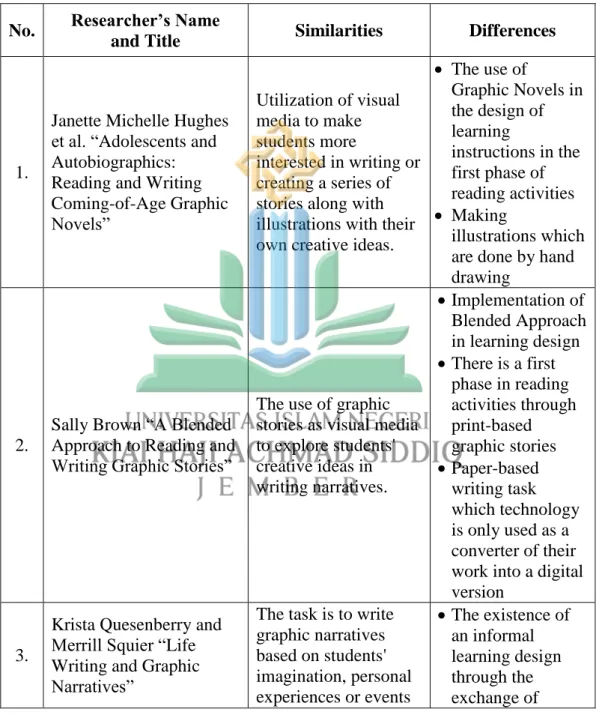
Here the researcher will start from a study with the title 'Adolescents and Autobiographics: Reading and Writing Coming-of-Age Graphic Novels' which examines how students can develop literacy skills through graphic novels.19 With the combination of images in the story text, students are more interested and enthusiastic when reading so they are also motivated to write or make a sequence of stories along with illustrations with their own creative ideas.
Still with the same scope regarding the development of reading and writing literacy, a research entitled 'A Blended Approach to Reading and
19 Hughes et al., “Adolescents and „Autobiographics‟: Reading and Writing Coming-of- Age Graphic Novels”, p. 611.
12
Writing Graphic Stories' which presents a combination of two approaches in a series of phases in their learning design.20 Thus, this study emphasizes that the combination of print-based literacy and digital communication has the potential to increase student engagement and understanding of complex texts.
Another research entitled 'Life Writing and Graphic Narratives' applies writing lessons based on daily life experiences in the form of illustrated narratives through email exchange.21 The purpose of this informal collaborative writing process is to develop the main principles in graphic narrative as a way of writing story texts based on personal experiences. So students can more freely explore their creativity through graphic stories.
Next is a research entitled 'Collaborative narrative writing: A digital photography task in an Indonesian Islamic secondary school' which mediates students in writing collaborative narratives by utilizing digital photography to help students develop ideas and improve the quality of their narrative writing.22 This research proves that collaborative narrative writing tasks based on visuals and technology can increase students' involvement in the writing process.
The last one is a study with the title 'I hate writing: making a case for the creation of graphic novels in the Caribbean English classroom to develop students‟ creative writing skills' which promote students‟ creative writing
20 Brown, “A Blended Approach To Reading and Writing Graphic Stories”, p. 218.
21 Krista Quesenberry and Susan Merrill Squier, “Life Writing and Graphic Narratives”, Life Writing, Vol. 13, No. 1, 2016, p. 63. DOI: 10.1080/14484528.2016.1130571.
22 Sandi Ferdiansyah, “Collaborative narrative writing: A digital photography task in an
Indonesian Islamic secondary school”, p. 303.
process through graphic novel writing task.23 Apart from the focus on sentence drills and grammatical structures, this research tends to make students become critical thinkers and expressive content creators.
Table 2.1 List of related previous research
The similarities and differences between previous studies and present study No. Researcher’s Name
and Title Similarities Differences
1.
Janette Michelle Hughes et al. “Adolescents and Autobiographics:
Reading and Writing Coming-of-Age Graphic Novels”
Utilization of visual media to make students more
interested in writing or creating a series of stories along with illustrations with their own creative ideas.
The use of
Graphic Novels in the design of learning
instructions in the first phase of reading activities
Making
illustrations which are done by hand drawing
2.
Sally Brown “A Blended Approach to Reading and Writing Graphic Stories”
The use of graphic stories as visual media to explore students' creative ideas in writing narratives.
Implementation of Blended Approach in learning design
There is a first phase in reading activities through print-based graphic stories
Paper-based writing task which technology is only used as a converter of their work into a digital version
3.
Krista Quesenberry and Merrill Squier “Life Writing and Graphic Narratives”
The task is to write graphic narratives based on students' imagination, personal experiences or events
The existence of an informal learning design through the exchange of
23 Lewis, “I hate writing: making a case for the creation of graphic novels in the Caribbean English classroom to develop students‟ creative writing skills”, p. 1.
14
in everyday life by expressing creative ideas.
picture stories conducted via email.
4.
Sandi Ferdiansyah
“Collaborative narrative writing: A digital photography task in an Indonesian Islamic secondary school”
Explore the potential in developing creative ideas and improve the quality of writing narratives through visual media so that students can be more involved in the writing process.
The learning design is made for collaborative tasks, from selecting story ideas to writing narratives.
The use of digital photography to help students develop ideas for writing stories.
5.
Tanya Manning-Lewis “I hate writing: making a case for the creation of graphic novels in the Caribbean English classroom to develop students‟ creative writing skills”
Students are not required to focus on sentence drills and grammatical
structures, but tend to focus on being critical thinkers and
expressive content creators with their own creative ideas.
Learning designs that direct
students to create graphic novels tend to have almost the same settings as comics.
Reflecting on the relevant previous research, it seems that almost all research was conducted in order to apply visual media as a creative writing learning strategy. However, the process of how vocational school students elicit creative ideas in writing narrative is worth further investigation. To fill this gap, this research will conduct a case study that focuses on exploring the process of how students elicit creative ideas for writing through visual narrative-based tasks. In addition, it will also investigate how the development of students‟ creativity in creative writing skill after the implementation of learning designs through visual narrative-based writing tasks.
B. Theoretical Framework 1. Creativity in education
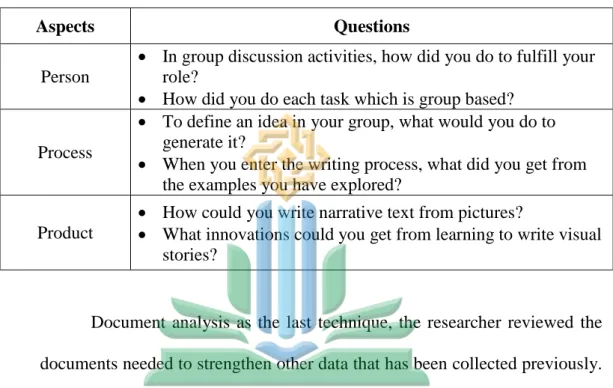
There are many opinions about how creativity can be defined from various perspectives, but there is one complete conclusion which is the basis for understanding what creativity itself is. Creativity can be called as an imaginative process which can be indicated through the 3 Ps: 'person' (who made it), 'process' (how the process is) and 'product' (the final result).24 In the context of education itself, creativity is also very helpful for students in building critical thinking. For example, when they try to find ways to solve problems with their imaginative thoughts and ideas from past experiences, it will make them build higher order thinking to create new connections.25 In other words, creativity is not only about art, but it is also an original idea and deep thought about something even everything related to the learning and teaching process.
Creativity has been a topic of interests for researchers in educational contexts for decades. In education, creativity will explore more deeply on how students can be more involved in teaching and learning activities to the assigned tasks. As educators, teachers need to implement learning activities by involving students not only in creative action-based work but also in creative thinking.26 A study proves that with the enactment of this learning design, the learning situation will stimulate
24 Robert Fisher and Mary Williams, Unlocking Creativity: Teaching Across The Curriculum (New York: David Fulton Publishers, 2004), p. 8.
25 Jack C. Richards, “Creativity in Language Teaching”, Iranian Journal of Language Teaching Research, Vol. 1, No. 3, October 2013, p. 21.
26 Anne Harris, Creativity and Education (Melbourne: Palgrave Macmillan, 2016), p. 1.
16
creative thinking through various creative designs to support student creativity.27 Generally speaking, creativity learning design can work in some contexts, but not necessarily in other contexts. Some are based on achieving assessment capacity, finding solutions to difficulties, or even investigating the thinking process. It all depends on the teachers who understand more about the characteristics and needs of their students.
2. Creative writing in language learning
„Is it only creative people who can write this?‟ this is what people assume when they hear the term of creative writing for the first time. In fact, it can be called as a process of presenting thoughts through various forms of writing with creative thinking which aims to express the perspective of problem, experience or even emotion based on the unique and different point of view.28 Thus, students can understand what steps they need to take to create a writing based on a problem created, past experiences, or even feelings in the form of fiction or non-fiction writings.
At this step, creative writing can help stimulate their critical thinking to influence their own views because it is achieved through exploration, experience, and expression rather than instruction.29
Frankly speaking, students who are learning additional languages, such as writing in English, will be limited by common writing instructions.
27 Danielle E. Kaplan, “Creativity in Education: Teaching for Creativity Development”, Scientific Research Publishing „Psychology‟, Vol. 10, February 2019, p. 145, DOI:
10.4236/psych.2019.102012
28 Olehlova and Priedite, Creative Writing Cookbook, p. 4.
29 Gillie Bolton, Write Yourself: Creative Writing and Personal Development (London:
Jessica Kingsley Publishers, 2011), p. 17.
Additionally, they are required to read a lot before being able to generate models, plots, and ideas to create their own work. In a different vein, creative writing offers a new strategy in language learning. It can be applied because “there is a combination of creativity and pedagogy which has relevance to educational practice”30 especially in today's language learning. Besides developing students' imagination and creative thinking, creative writing also enables students to write a piece of writing with their own creativity. Previous research reported that the impact of this innovative pedagogy was to provide students with opportunities to write by expressing their creative ideas so they could play an active role in internalizing language unconsciously.31 Here, students will tend to more easily remember the words they use in their writing. As a highlighted point, creative writing can enhance students' roles internally and externally in the writing process, especially in building identity as creative writers.
3. Narrative writing in writing classroom
Being one of the various texts, narrative is known as any form related to the delivery and presentation of stories orally or in writing. As one expert put it that, “a narrative is the semiotic representation of a series of events meaningfully connected in a temporal and causal way.”32 Therefore, narrative writing can be interpreted as writing a story in which
30 Steven Earnshaw, The Handbook of Creative Writing (Edinburgh: Edinburg University Press, 2007), p. 16.
31 Maria T. F. Guillén, “Creative Writing for Language, Content, and Literacy Teaching”, International Education Studies, Vol. 4, No. 5, December 2011, p. 43, http://dx.doi.org/10.5539/ies.v4n5p39
32 Susana Onega and Jose Angel Garcia Landa, Narratology: An Introduction (New York:
Routledge, 2014), p. 3.
18
the main character is involved in a problem, or an event based on true experience or just fiction.33 Students are free to write their stories based on their experiences or their imagination. With these, narrative writing can be an alternative to explore more broadly the students‟ perspectives and thinking styles in writing classroom.
In its enactment in the writing class, the teacher's role is very important in shaping an atmosphere of active and creative writing learning.
One study showed that students would be committed to creating expressive writing where students would pay attention to every detail to convey a 'feel' to what they wrote, while the teacher also provided more opportunities to explore their passions.34 To shorten the explanation above, in addition to writing narratives that can explore the originality of students' creative ideas, the role of the teacher is also needed to provide directions and opportunities for students so that they can write in their own 'style'. As the final result, they will be more involved in processing their creative ideas through writing a narrative based on experience or fiction.
4. Visual narrative writing
Visual narrative writing involves visual stimulation (i.e. eyes) through visual media (e.g. pictures, photos, paintings, hand drawings, etc.) as a tool to help writers describe a story they write, so it can becomes a special attraction for others to become the readers. As stated, visual
33 Introduction to Narrative Writing, Cayman Islands Department of Education Services, 2015, p. 1.
34 Ana M. C. Negrila and Andreea Lonel, “Features of Teaching Narrative Writing to EFL Learners”, Bulletin of “Carol I” National Defence University, No. 2, 2012, p. 5/179.
narrative will involve someone to be a sophisticated writer while at the same time being a skilled illustrator. Both of them are compatible vehicles to create story texts flavored with art.35 Although the presentation of the story seems relaxed, it will allow the readers to immerse themselves in the content of the story. Therefore, when applied in writing class, visual narratives are not only to reflect students‟ experiences, but also to shape their way of thinking, and even emphasize the core values they want to show.36
There are several studies using various visual media that are used to engage students actively and creatively in writing visual narratives. For example, a research was conducted on the use of digital photography which can increase student involvement in the writing process such as developing ideas so it also has an impact on their higher quality narrative writing.37 Another study was also enacted to promote students' creative writing through a graphic novel writing assignment which found improvements in students' engagement as critical thinkers as well as creators of expressive content.38 Drawing on these findings, writing visual narratives not only increase students' involvement in developing creative ideas on their narrative writing, but also their creativity in illustrating stories on a series of pictures.
35 Will Eisner, Graphic Storytelling and Visual Narrative: Principles and Practices from The Legendary Cartoonist (New York: W. W. Norton & Company, 2008).
36 Introduction to Visual Narrative, Genesis Inspiration Foundation, 2021, p. 2.
37 Ferdiansyah, “Collaborative narrative writing: A digital photography task in an Indonesian Islamic secondary school”, p. 303.
38 Lewis, “I hate writing: making a case for the creation of graphic novels in the Caribbean English classroom to develop students‟ creative writing skills”, p. 11-12.
20
5. Challenges of teaching visual narrative writing
Being considered to have overlapping goals with the curriculum, many educators think that visual narratives are not suitable for implementation in learning English, especially in writing subjects. In the literary environment, printed books or electronic books based on visual arts have received a lot of criticism because it is considered unable to deal with learning problems or achieve predetermined learning objectives.39 For example in the subject of writing visual narratives (e.g. comics, graphic novels, graphic stories, photo-voice, etc.), many teachers speculate that students will tend to focus on the visual element rather than the writing component. Therefore, they assume that writing visual narratives is difficult to implement because it crosses the boundaries of the writing discipline. In fact, they should make a movement not only turning inward but looking outward which aims to modify, improve, and also apply in learning activities that engage students more.40
In a complex and sometimes controversial concept, writing narratives and visual arts are two things considered difficult to combine to apply in writing classes. A study concluded that with this collaboration, it not only shows the differences and similarities between the two, but also to overcome obstacles during the writing process so students also can be
39 Eisner, Graphic Storytelling and Visual Narrative.
40 Dawn Mannay, Visual, Narrative, and Creative Research Methods: Application, Reflection, and Ethics (New York: Routledge, 2016), p. 131.
directed into a creative process.41 From this, it can be said that the challenge for researcher is not only about how to convey new information or offer new approach, but also to overcome people's biases and misunderstandings about visual narrative writing.
6. Writing visual narratives to students‟ creativity
Referring to the creative thinking process which is applied to non- verbal tests, writing visual narratives can be described as a writing task with creative ideas based on visual images or also a writing task that requires drawing or visualizing activities as creativity of the stories they write. As stated by Ellis Paul Torrence in Torrence Tests of Creative Thinking (TTCT), that creative thinking can also be assessed from a figural-based task mediated by visual pictures.42 From these pictures, students get space to generate creative ideas and then they can visualize it to their imaginative writing. In the TTCT figural activity, there are three standard tasks which is designed to take advantage of creative functions aspects such as picture construction, picture completion, as well as the repeated closed figures test (e.g. lines, circles, squares, triangles, etc.) (see Figure 2.1).43 Thus, drawing or illustrating activity is one of the creative thinking processes in addition to writing narratives with creative ideas, so
41 Anna Leahy, Lia Halloran and Claudine Jaenichen, “Text(ure), Modelling, Collage:
Creative Writing and The Visual Arts”, New Writing: International Journal for the Practice and Theory of Creative Writing, Vol. 11, No. 1, 2014, p. 118, http://dx.doi.org/10.1080/14790726.2013.871296.
42 Ellis Paul Torrance, Scientific Views of Creativity and Factors Affecting Its Growth (Cambridge: The MIT Press, 2013), p. 668.
43 Torrance, Scientific Views of Creativity and Factors Affecting Its Growth, p. 670-671.
22
students can produce a visual narrative as creativity in thinking and writing at the same time.
Figure 2.1 Example of TTCT: Figural
Several studies have investigated how the role of visual media can help students' creative thinking processes in reading or writing find satisfactory results. Such as research on the use of photography find that it can help students develop higher order thinking skills in writing more actively and independently.44 In this case, visual media offers students to imagine and think creatively about their perspective on photography which will be narrated based on their point of view. Next is the enactment of visual narrative writing which there is writing narrative activity with students' creative ideas (e.g. based on personal experience, or just fiction) and then they also have a role to draw or visualize the narratives into a series of related pictures (e.g. hand-drawings, paintings, etc.). A study on learning mediated by graphic novels found that it not only increased
44 Walter et al., “„Photo-words‟: promoting language skills using photographs”, p. 16.
Stimulus Basic Creativity
students' enthusiasm for reading, but students can also write amazing graphic narratives with their own creativity.45 The emphasis of the research above is that visual media can help students to generate creative ideas in writing narratives, or even promote their creativity through writing visual narratives.
If it can be detailed, there are several advantages of using internet technology-based visual media (i.e. website) in the EFL learning process, especially in writing classes. A study has shown that it has the power of being very efficient support tool for language teaching and learning which can be adapted to students‟ needs so it can also help students in learning languages better.46 Most of the students highly rated the potential of using this medium in enhancing their foreign language skills and study skills in general.47
Sketching on a series of conceptual theories and empirical evidence above, almost all studies have been conducted through classroom action research and there are only a few studies use case study designs. To fill this gap, the researcher is interested in using qualitative approach with a case study design which will be focused on how visual narrative-based writing tasks can involve students to elicit creative ideas for writing so they can also increase their creativity in creative writing.
45 Brown, “A Blended Approach To Reading and Writing Graphic Stories”, p. 217-218.
46 Erdogan Kartal and Levent Uzun, “The Internet, Language Learning, and International Dialogue: Constructing Online Foreign Language Learning Websites”, Turkish Online Journal of Distance Education, Vol. 11, No. 2, Article 4, April 2010.
47 Svetlana Kodrle and Anna Savchenko, “Digital educational media in foreign language teaching and learning”, EDP Sciences (E3S Web of Conf.), Vol. 273, No. 12018, June 2021, p. 10, https://doi.org/10.1051/e3sconf/202127312018.
24
CHAPTER III RESEARCH METHODS
This chapter discusses how the process of this research will be conducted.
This chapter consists of several sections covering research design, research setting and participants, learning procedures, data collection, and data analysis. The description of each section is presented as follows.
A. Research Design
The research questions refer to a detailed process analysis of students' activities in generating creative ideas through writing visual narratives so they are able to promote their creativity in creative writing. This focus can be strengthened on a theory which the research presentation is based on a qualitative methodology which is categorized as a case study design with in- depth exploration and related to the data collected in detail.48 It can be simulated that the case study design will explore more deeply the research questions that have been formulated and it will be strengthened by data evidence and detailed information that has been collected.
To add, “case studies are the preferred strategy when „how‟ or „why‟
questions are being posed, when the investigator has little control over events, and when the focus is on a contemporary phenomenon within some real-life context.”49 In this present case study, the researcher focuses on the
48 John W. Creswell, Research Design: Qualitative, Quantitative, and Mixed Methods Approaches (Thousand Oaks: SAGE Publications, 2009).
49 Robert K. Yin, Case Study Research: Design and Methods (3rd edn) (California: SAGE Publications, 2003).
involvement of students during the learning process through visual narrative writing-based tasks which is difficult for some teachers to apply this combination (i.e. visual media and narrative writing) in English language learning. Here the challenge is how the researcher can overcome some of the criticisms and traditional beliefs about 'unusual' things such as how the combination of visual media and creative writing can produce creativity which is not only about imaginative visual works, but also literary works with creative ideas and also visualizations.
B. Research Setting and Participants
This case study will be conducted in one of the vocational high schools in Jember, East Java. The reason that underlies the research is to pay attention to learning English for Specific Purposes (ESP) of the vocational pursued. In this case, I chose students majoring in Multimedia which in the design of my research activities would involve students in integrating their creative abilities through visual-based narrative writing. It is expected that students not only increase their creativity as story illustrators, but also improve their creative thinking skills as visual narrative writers. Therefore, the selection of the school was based on several considerations as follows: (1) the school provides supporting facilities that assist the learning activities during research such as LCD projectors, language laboratories, computer laboratories, etc.; (2) there are additional extracurricular activities outside of class hours, one of which is English Club which can be used to further explore a series of activities based on the planned procedures; (3) the school
26
supports fully this research which is expected to contribute to the school in the future. With these considerations in mind, the researcher not only examines a case in learning to write narratives, but also explores the potential of students' creative thinking skills in writing and integrating illustrations into creativity.
As the first step, I came to the school and was immediately met by the vice-principal of the curriculum section to inquiry my intention of coming to the school. I explained that I intend to ask for permission to do research for my final project as an undergraduate student. I also explained that my research focused on examining students‟ engagement in learning to write visual narratives to promote student creativity. In accordance with the procedures and ethics before the research, I also submitted a letter of permission or informed-consent obtained from the university authority. The first permission letter relates to initial observations at the school where I was also given the opportunity to talk directly with two English teachers at that school to provide further instructions regarding the research design and also the plan of activities during my future research. They were very enthusiastic to accompany and assist my research, they even asked me to immediately submit a research proposal when I had finished it along with the procedures for the activities. In this case, the school requested that a second permission letter for research be submitted with my research proposal.
In the discussion, the two English teachers explained that materials related to narrative text can be taught in the tenth grade where the tenth grade
also has more effective time than the eleventh grade which has practical work activities or the twelfth grade which focuses on many final exams. In addition, the two teachers also complained about the impact of Covid-19 some time ago which included reduced school hours which are usually full- day (i.e. until 03.00 p.m.) but now they have to end at 12.00 p.m., it causes decrease in student enthusiasm in learning even during school hours they still need emphasis to study or do assignments. Therefore, both of them were very enthusiastic when I tried to apply learning strategies in my research through visual media in narrative writing to build creativity and hoped that it can increase students‟ interest and involvement in learning activities.
From the meeting, they also recommended a class that might be suitable for my research because apart from being multimedia first year vocational students, most of them also participate in English Club extracurricular activities. There are 35 students in the class consisting of 7 boys and 28 girls whose ages range from 15 to 16 years old. Based on the research participant access procedure, this study involved adolescents under the age of 18 for which parental or guardian consent was required. To strengthen, “the concept of consent comes from the ethical issue of respect for participant‟s integrity as well as self-determination.”50 Anchored to the previous statement, in addition to providing flexibility for students to participate, I also provide a letter of consent for the parents of the students which aim to ask for permission to involve their children as participants in
50 Naresh Manandhar and Sunil Kumar Joshi, “Importance of Consent in The Research”, International Journal of Occupational Safety and Health, Vol. 10, No. 2, 2020, p. 90.
28
my research. Thus, it is certain that there are no elements or signs of personal abuse on the involvement of participants in this research.
C. Instructional Procedures
This present case study will focus on building students' creativity through writing visual narratives which are based on creative thinking skills in writing narratives with visualization of the story. Series of activities in this strategy involve students in offline and online-based learning which consist of pre-writing, whilst-writing, and post-writing activities. Here is the following design of the instructional procedures for learning activities adapted from several studies with adjustments to the researcher's design.
The pre-writing activities in this design were adopted as the first step in building students' basic understanding in a series of learning activities.
It has been adapted based on student needs which consist of two phases (see Table 3.1).
Table 3.1 Pre-writing activities
Stages Goals Activities Character
Building Deliberation
of visual narrative writing
To prepare students mentally and physically through brainstorming activities before they learn more about visual narrative writing
1. Students will be given examples of common narrative texts such as
folklore, fables, etc.
and then they will analyze the basic components of the story (see Appendix 1: Text).
2. Students will be shown examples of story illustration pictures which used as their visual stimuli in creative thinking (see Appendix 1:
Visual).
Critical thinking
Creative thinking
Formation of learning activity groups
To build
cooperation among students in peer groups as a solid team to achieve goals by
collaborating their skills and creative ideas.
To foster the responsibility of each student in doing their duties.
1. Students make groups consisting of three students in each group
2. Students determine their roles in group such as:
- Student 1 (Looking for information) - Student 2
(Explaining information) - Student 3
(Writing the results of the discussion).
(see Appendix 2)
Cooperation
Responsibility
30
Phase 1.1 Introduction to narrative text material
To give basic understanding of narrative material through group discussion.
1. Students begin to actively discuss narrative material they find from internet or textbook in group (see Appendix 2).
2. They analyze the story provided including its plot, settings, characters, and value of the story (see Appendix 2).
3. They present the result in their group
Socialization
Critical thinking
Collaboration
Responsibility
Phase 1.2 Determination of the story theme
To provide opportunities for students to think creatively in choosing the theme of the story they will make.
1. Students actively discuss, give their ideas and opinions in determining the theme of the story they will make.
Creative thinking
Socialization
Collaboration
Phase 2.1 Creativity stimulation through
Torrance Tests of Creative Thinking (TTCT) Figural
To provide initial stimulation of creative thinking through visual media (i.e.
pictures)
To train students in gaining creative ideas by analyzing what they have created before
1. Students are given visual creativity worksheets which they are asked to create an object from basic shapes to stimulate creative thinking through visual media.
2. Students are also asked to write down the results of the visual creativity analysis of the basic shapes they created.
Creative thinking
Collaboration
Creativity
Phase 2.2 Introduction to the use of supporting websites (i.e.
storybird.com)
To give initial direction to students about the use of features they will use on
supporting websites.
To help the process of students‟
writing visual narrative projects such as reading narratives are available for basic views and also how to write visual narratives as their final project
1. Students will be given a briefing by the teacher in using features of
Storybird.com especially reading and writing features.
2. Students will practice directly using a computer or cellphone after the briefing is complete.
Socialization
Cooperation
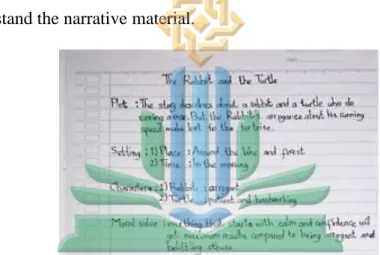
Learning activities will begin with brainstorming to stimulate students' mental and physical readiness through analysis of basic story components which include characters, plots, and moral values from examples of narrative texts such as folklore, fables, legends, romance, fairy tales, fantasy, and others. In addition to stimulating students' initial responses, this activity aims to attract their attention through several examples of illustrated images from stories that can engage them in creative thinking.
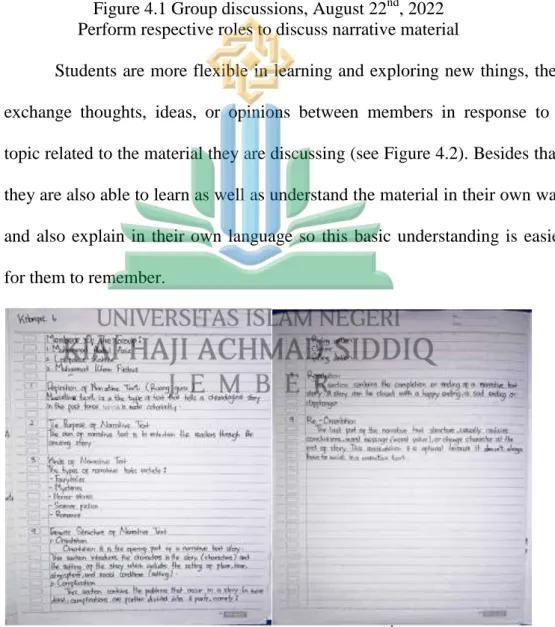
In the first phase, this instruction was adopted to direct students to basic activities in building understanding about narrative text which is done by group discussion.51 In this case, each group consists of three students with their respective tasks such as finding information, explaining information, and also writing the results of the discussion. Even though the tasks are
51 Ferdiansyah, “Collaborative narrative writing: A digital photography task in an Indonesian Islamic secondary school”, p. 306.
32
different, each student in the group continues to discuss together and explore more information about narrative text. At the end of the activity, the teacher will also provide further explanations to strengthen students' understanding of the related material. In this phase, students will be asked to discuss and collaborate in determining the theme of the story they will make. This first phase of pre-writing activities aims to build students' understanding of narrative texts with peer discussion which will stimulate collaboration skills in completing assignments.
For the second phase, the pre-writing activities aim to stimulat