Action research: a systematic review and guidance for assessment
H Waterman D Tillen
R Dickson K de Koning
HTA
Health Technology Assessment
NHS R&D HTA Programme
How to obtain copies of this and other HTA Programme reports.
An electronic version of this publication, in Adobe Acrobat format, is available for downloading free of charge for personal use from the HTA website (http://www.hta.ac.uk). A fully searchable CD-ROM is also available (see below).
Printed copies of HTA monographs cost £20 each (post and packing free in the UK) to both public and private sector purchasers from our Despatch Agents.
Non-UK purchasers will have to pay a small fee for post and packing. For European countries the cost is
£2 per monograph and for the rest of the world £3 per monograph.
You can order HTA monographs from our Despatch Agents:
– fax (with credit card or official purchase order)
– post (with credit card or official purchase order or cheque) – phone during office hours (credit cardonly).
Additionally the HTA website allows you either to pay securely by credit card or to print out your order and then post or fax it.
Contact details are as follows:
HTA Despatch Email: [email protected]
c/o Direct Mail Works Ltd Tel: 02392 492 000 4 Oakwood Business Centre Fax: 02392 478 555
Downley, HAVANT PO9 2NP, UK Fax from outside the UK: +44 2392 478 555 NHS libraries can subscribe free of charge. Public libraries can subscribe at a very reduced cost of
£100 for each volume (normally comprising 30–40 titles). The commercial subscription rate is £300 per volume. Please see our website for details. Subscriptions can only be purchased for the current or forthcoming volume.
Payment methods Paying by cheque
If you pay by cheque, the cheque must be in pounds sterling, made payable to Direct Mail Works Ltd and drawn on a bank with a UK address.
Paying by credit card
The following cards are accepted by phone, fax, post or via the website ordering pages: Delta, Eurocard, Mastercard, Solo, Switch and Visa. We advise against sending credit card details in a plain email.
Paying by official purchase order
You can post or fax these, but they must be from public bodies (i.e. NHS or universities) within the UK.
We cannot at present accept purchase orders from commercial companies or from outside the UK.
How do I get a copy of HTA on CD?
Please use the form on the HTA website (www.hta.ac.uk/htacd.htm). Or contact Direct Mail Works (see contact details above) by email, post, fax or phone. HTA on CDis currently free of charge worldwide.
The website also provides information about the HTA Programme and lists the membership of the various committees.
H Waterman
1 *D Tillen
1R Dickson
2K de Koning
31
School of Nursing, Midwifery and Health Visiting, University of Manchester, Manchester, UK
2
School of Health Sciences, University of Liverpool, Liverpool, UK
3
Royal Tropical Institute, Amsterdam,The Netherlands
* Corresponding author
Competing interests: none declared
Published July 2001
This report should be referenced as follows:
Waterman H,Tillen D, Dickson R, de Koning K. Action research: a systematic review and guidance for assessment. Health Technol Assess 2001;5(23).
Health Technology Assessment is indexed in Index Medicus/MEDLINE and Excerpta Medica/
EMBASE. Copies of the Executive Summaries are available from the NCCHTA website (see opposite).
technologies is produced in the most efficient way for those who use, manage and provide care in the NHS.
Initially, six HTA panels (pharmaceuticals, acute sector, primary and community care, diagnostics and imaging, population screening, methodology) helped to set the research priorities for the HTA Programme. However, during the past few years there have been a number of changes in and around NHS R&D, such as the establishment of the National Institute for Clinical Excellence (NICE) and the creation of three new research programmes: Service Delivery and Organisation (SDO); New and Emerging Applications of Technology (NEAT); and the Methodology Programme.
Although the National Coordinating Centre for Health Technology Assessment (NCCHTA) commissions research on behalf of the Methodology Programme, it is the Methodology Group that now considers and advises the Methodology Programme Director on the best research projects to pursue.
The research reported in this monograph was funded as project number 95/19/04.
The views expressed in this publication are those of the authors and not necessarily those of the Methodology Programme, HTA Programme or the Department of Health. The editors wish to emphasise that funding and publication of this research by the NHS should not be taken as implicit support for any recommendations made by the authors.
Criteria for inclusion in the HTA monograph series
Reports are published in the HTA monograph series if (1) they have resulted from work
commissioned for the HTA Programme, and (2) they are of a sufficiently high scientific quality as assessed by the referees and editors.
Reviews in Health Technology Assessment are termed ‘systematic’ when the account of the search, appraisal and synthesis methods (to minimise biases and random errors) would, in theory, permit the replication of the review by others.
Methodology Programme Director: Professor Richard Lilford HTA Programme Director: Professor Kent Woods
Series Editors: Professor Andrew Stevens, Dr Ken Stein, Professor John Gabbay and Dr Ruairidh Milne
Monograph Editorial Manager: Melanie Corris
The editors and publisher have tried to ensure the accuracy of this report but do not accept liability for damages or losses arising from material published in this report. They would like to thank the referees for their constructive comments on the draft document.
ISSN 1366-5278
© Queen’s Printer and Controller of HMSO 2001
This monograph may be freely reproduced for the purposes of private research and study and may be included in professional journals provided that suitable acknowledgement is made and the reproduction is not associated with any form of advertising.
Applications for commercial reproduction should be addressed to HMSO,The Copyright Unit, St Clements House, 2–16 Colegate, Norwich, NR3 1BQ.
Published by Core Research, Alton, on behalf of the NCCHTA.
Printed on acid-free paper in the UK by The Basingstoke Press, Basingstoke.
M
List of abbreviations ... i
Executive summary ... iii
1 The origins of action research in healthcare ... 1
Influential writers ... 1
Popular misconceptions and criticisms ... 2
Conclusions ... 3
2 The project... 5
Aims ... 5
Objectives ... 5
Methods ... 5
Validation of the project ... 10
Advisory panel ... 10
Time-frame... 10
Summary ... 10
3 Defining action research ... 11
A definition of action research... 11
Distinguishing features of action research .... 11
Philosophical perspectives ... 14
Judging action research ... 15
Summary ... 16
4 Action research in the UK... 17
Results of the preliminary search and systematic review ... 17
Characteristics of identified studies ... 17
Results of the direct consultative process .... 18
Summary ... 18
5 Detailed results of the systematic review and the consultative process... 19
Aims of action research... 19
Reasons for choosing action research ... 21
Issues addressed by action research ... 22
Outcomes and impacts of action research .... 23
Summary ... 28
6 Pivotal factors: the strengths and limitations of action research... 29
Participation... 29
Key persons ... 31
The action researcher–participant relationship ... 33
Real-world focus... 35
Resources ... 36
Research methods ... 37
Project process and management ... 38
Knowledge ... 40
Conclusion ... 41
7 Guidance for assessing action research proposals and projects... 43
The need for guidance ... 43
Notes on the guidance questions ... 44
Guidance: 20 questions for assessing action research proposals and projects ... 48
8 Discussion... 51
Project methods... 51
Definition ... 51
Action research in the UK ... 52
Analysis of the systematic review and consultative process... 52
9 Conclusions... 57
Implications for policy ... 59
Implications for practice... 59
Implications for future action research ... 60
Dissemination of the results of this review .... 60
Acknowledgements... 61
References ... 63
Appendix 1 Electronic search strategy and results ... 69
Appendix 2 Consultative process ... 71
Appendix 3 Data extraction sheet ... 75
Appendix 4 Interview schedule and topic guide ... 81
Appendix 5 Advisory panel... 83
Appendix 6 Data extraction tables... 85
Health Technology Assessment reports published to date... 159
Methodology Group ... 165
HTA Commissioning Board ... 166
Contents
i
List of abbreviations
A&E Accident & Emergency [Department]* CARN Collaborative Action Research Network CCU coronary care unit*
CDT community drugs team* CHD coronary heart disease
CPDA clinical practice development accreditation CRD [NHS] Centre for Reviews and Dissemination DGH district general hospital*
ENP emergency nurse practitioner* GP general practitioner
GRIP getting research into practice ITU intensive therapy unit* MAU Medical Admissions Unit* OAG oral assessment guide* PCA patient-controlled analgesia* R&D research and development RCN Royal College of Nursing RCT randomised controlled trial RSCN registered sick children’s nurse TNA training needs assessment*
* Used only in tables or appendices
iii
Background
Action research is employed in many healthcare settings in the UK but its scope and role in this context is not clear. It is practised under a variety of names and has been applied in many settings since Kurt Lewin coined the phrase in 1947. Its particular strength lies in the coupling of partici- pation and research to action and change.
Objectives
1. To provide a definition of action research.
2. To identify action research projects conducted in UK healthcare settings.
3. To analyse the identified action research in relation to:
• project aims
• reasons for choosing action research
• issues addressed by action research
• outcomes and impacts
• strengths and limitations.
4. To develop guidance for the assessment of action research proposals and reports.
Methods
There were four interlinked phases: a preliminary literature search, a systematic literature review combined with a consultative process, and data synthesis. This interpretative systematic review combined data from written reports of action research with primary data collected from focus group interviews.
Fourteen electronic databases were searched.
Relevant journals and conference proceedings were handsearched and the project was adver- tised at research conferences. Over 400 NHS research and development (R&D) managers and 300 action researchers were contacted.
Research reports were included if they:
• were carried out in a UK healthcare setting
• were published after 1974
• demonstrated or indicated an intention to follow a cyclic process in which problem
identification, reflection, research, an action intervention and evaluation were interlinked
• indicated that a partnership existed between the action researcher and the participants involved in the change process.
In anticipation of the limitations of the published material, five focus group interviews with partici- pants from included studies and two additional focus groups of action researchers attending an action research conference were carried out.
Data from the studies reviewed were entered into a statistical software package. For closed questions, frequencies were calculated to provide descriptive information; for open questions, content analysis was undertaken. Data from the focus groups were integrated with data from the systematic review.
A narrative overview for each of the objectives was produced. Data synthesis was substantively different in the achievement of the sub-objective on the strengths and limitations of action research.
Here the studies and focus group interviews were analysed, drawing on a process similar to meta- ethnography. Data were compared and contrasted, and organised into categories from which
themes emerged.
Results
The definition
Reflection on the literature and the primary research findings led to the following definition being used in this review.
Action research is a period of inquiry that
describes, interprets and explains social situations while executing a change intervention aimed at improvement and involvement. It is problem- focused, context-specific and future-oriented.
Action research is a group activity with an explicit critical value basis and is founded on a partnership between action researchers and participants, all of whom are involved in the change process. The participatory process is educative and empowering, involving a dynamic approach in which problem identification, planning, action and evaluation are interlinked. Knowledge may be advanced through reflection and research, and qualitative
Executive summary
iv
and quantitative research methods may be employed to collect data. Different types of know- ledge, including practical and prepositional, may be produced by action research. Theory may be generated and refined, and its general application explored through the cycles of the action
research process.
It is hoped that the definition will contribute to debate on the role of action research within the healthcare setting. It is expected that it will be refined as the understanding and process of action research evolve.
An overview of healthcare action research in the UK
The search yielded 285 possible studies, of which 59 met the inclusion criteria. Most were conducted between 1988 and 1996. The duration of projects ranged from 1 to 48 months (median 12 months).
Nurses formed the largest percentage of active participants (70%) and the majority of projects took place in hospitals (53%). There were 21 funded studies (36%). Interview, questionnaire and observation were the three most common methods of data collection. Qualitative research methods predominated.
Aims, reasons and issues addressed
The primary aims of the included studies were assessment of current situations, development of changes and evaluation of project outcomes. The reasons for choosing action research were partici- pation, facilitation of change and a cyclical process related to change. Issues addressed included pro- fessional education, assessment of clinical practice (areas where there was a conflict in clinical practice or a lack of evidence) and assessment of professional roles. The results suggest that action research is frequently selected to understand and resolve complex problems, and that the participatory nature and the process of action research enables the development of relevant and appropriate practices, services and organisational structures.
Outcomes and impacts of included studies
Outcomes and impacts varied and were dependent on where in the research process they were assessed (e.g. during the problem identification, planning or evaluation phase). Immediate outcomes from group action produced such things as clarification of issues and identification of need (problem identification phase), development of innovation and preparation for change (planning phase), and education, change and ownership (evaluation phase). Personal and professional developments
were noticeable outcomes throughout. For the purpose of this review, impacts were defined as ‘a lasting effect or influence’, as defined by the action researchers involved. A number of studies reported impacts such as continuation of newly established initiatives, adoption of projects into educational curricula and acceptance of new clinical practices.
Pivotal factors – strengths and limitations of included studies
Eight pivotal factors related to action research were identified: participation, key persons, action researcher–participant relationship, real-world focus, resources, research methods, project process and management, and knowledge.
Guidance for assessment of action research projects and proposals
These eight factors were used in combination with the definition to develop 20 questions that may be useful in the evaluation of action research proto- cols and project reports. These questions (and the accompanying explanatory notes) should be field- tested in order to assess their validity.
Conclusions
Action research is a complex research process that has been used in a wide variety of healthcare settings in the UK. A number of definitions of action research are currently being applied to the methodology. The definition provided here includes the major components of an action research methodology.
This definition emphasises the importance of
‘involvement’ in the action research process, which is consistent with the emphasis in NHS policy to increase the active participation of users of services in their care. However, few users were involved in the studies included in this review.
The review suggests that action research is being used and has the potential to play a role in achiev- ing the goals of the NHS. Specifically, the method- ology has the potential to be useful in areas such as developing innovation, improving healthcare, developing knowledge and understanding in practitioners, and involvement in users and staff.
The findings indicate that action research is suited to developing innovative practices and services over a wide range of healthcare situations.
The review demonstrates how the action research process can assist in the establishment of an
v environment that promotes the generation and
development of creative ideas and implementation of changes in practice.
Implications for policy
• Action research should be considered as complementary to other research approaches with the NHS.
• Action research has a potential role within the NHS R&D programme.
• A mechanism for evaluation of the quality of action research is required.
Implications for practice
A movement towards the acceptance within the NHS of the value of action research could be assisted by:
• the inclusion of action researchers on appropriate R&D bodies
• the provision of appropriate information on action research to those involved in policy development and funding decisions
• the dissemination of results of action research projects
• the adjustment of funding and reporting mech- anisms to allow for the action research process
• the development of collaborative
educational/healthcare institution action research education programmes
• field testing of the guidance for assessing action research.
Implications for future action research
Funding of action research would be appropriate in (but not limited to) the following areas:
• innovation, for example, in the development and evaluation of new services
• improvements in healthcare, for example, monitoring the effectiveness of untested policies or interventions
• development of knowledge and understanding in practitioners and other service providers, for example, promotion of informed decision making
• involvement of users and NHS staff, for example, investigation and improvement of situations in which there is poor uptake of preventative services.
1
T
he variety of definitions of action research has produced confusion in the implement- ation of the action research process.1–10In order to understand how these various definitions have arisen, the following brief review identifies writers who have influenced action research. Readers who desire a more comprehensive review of the origins of action research can refer to the work of Hart and Bond10or Greenwood and Levin.11Influential writers
Kurt Lewin
The roots of action research lie in the first half of the twentieth century. Kurt Lewin (1890–1947), a social psychologist, is often credited with coining the term ‘action research’.11Lewin was interested in a social science that could ‘help solve social conflict’.12He considered that research should help to address constructively the problems of exploitation and poverty in minority groups.
Adelman12noted that Lewin drew on theories of progressive education of the educational philosopher, John Dewey. Lewin was interested in how people could, through self-education, learn to enable themselves to improve their situation. His later work included ‘social experi- ments’ in factories aimed at increasing product- ivity. From this, he made a significant contribution to the concept of action research through his belief that, in order to solve practical problems, people are more likely to act upon decisions made democratically in a group than they are to act on decisions made without their involve- ment.12Lewin was also the first to promulgate the action research process as cyclical. He described several stages of action research including fact-finding, planning, action and reflection/evaluation, refining the problem.
A research component may be included in any or all of these stages.
Contemporary writers on action research have been critical of the sentiments of Lewin’s work.
Carr and Kemmis13suggested that democracy and group decision making were viewed as techniques to gain the cooperation of workers rather than a fundamental principle for social action and, according to Adelman,12Lewin did not develop
theoretical structures that would assist in the critique of oppressive power bases in poor manager–worker relationships.
Hart and Bond10suggested that Lewin’s work was highly influential in industrial and organisational action research (see, for example, Argysis, et al.14 and Whyte8). Typically, outside action researchers act as consultants to research (diagnose) the
‘problem’, work with the organisation to resolve it and then use research to evaluate any changes that have been made. The diagnostic, democratic, pragmatic and empirical nature of Lewin’s work is still apparent in contemporary healthcare action research.
Jacob Moreno
Gunz and Jacob15argued that Lewin was not the only forefather of action research but that Jacob Moreno (1892–1974), a social philosopher who, incidentally, shared students with Lewin, also helped to promote a social science that worked with people and did not reduce research subjects into passive roles. Gunz and Jacob reported that Moreno sought to integrate theory and practice by perceiving researchers as social investigators rather than as observers. In this model, experi- menters enter the field of study and participate with those being researched. This notion of bridging theory and practice through subjects acting as researchers and vice versa remains popular in action research today.
Lawrence Stenhouse and John Elliott
Educational action research, developed in the latter half of the last century, has also been influential in the development of action research in healthcare. Key proponents were Lawrence Stenhouse and John Elliott.16Stenhouse is acknowledged for reawakening interest in action research in the field of education through the Humanities Curriculum project in the 1970s.12 The aim of this project was, among other things, curriculum reform.16It initiated interest in the
‘teacher as researcher’ movement. It was at this time that, with rising dissatisfaction with social science based on traditional scientific/positivist philosophy, action research began to emerge as an alternative research methodology. University- based education research was considered by
Chapter 1
The origins of action research in healthcare
2
these writers to be elitist, and of little relevance to teachers. They argued that the strength of action research lay in the coupling of partici- patory research to action and change, thus making it relevant to the everyday problems of teachers.
John Elliott worked on the Humanities Curriculum project and went on to encourage an individual reflective approach to the under- standing of educational practice.17Drawing on Aristotle, Elliott placed particular emphasis on realising teacher constructions of knowledge and values. Noffke16considered that action research, as promoted by Stenhouse and Elliott, is part of the professionalisation process of teachers. She also identified the fact that not all educational action research has challenged dominant conceptualisations of curricula.
Wilfred Carr, Stephen Kemmis and Robert McTaggert
In contrast, educationalists based in Australia (Stephen Kemmis and Robert McTaggert) pro- moted, like Lewin, a collective form of action research, believing that groups have greater potential for effecting change than individuals.2 In addition, they clearly sought to work with teachers to understand and challenge repressive and oppressive educational ideologies. It is clear from reviewing reference lists that Carr and Kemmis’ book, Becoming critical: education, know- ledge and action research,13has been a reader for many healthcare action researchers.
Other authors
Other authors have also made important contributions to the debate. Gerald Susman and Roger Evered wrote a paper in 1978 in which action research was proposed as an alternative to positivist organisational science.18Richard Winter, an educationalist, promoted a reflexive action research that included theoretical perspectives of dialectics.19,20John Heron9and Peter Reason’s3 background was in psychology, and their work was influenced by phenomenology. Their interests were in communication and the resolution of conflict. They also emphasised participatory and holistic knowing, critical subjectivity and knowledge in action. Orlando Fals-Borda and Mohammad Anisur Rahman based their action research on the philosophy of José Ortega y Gasset. They recognised the need for a combi- nation of experience and commitment from those external to the situation (the researchers) and those intimately involved (the researched) to achieve shared goals.7This form of research has
been used extensively in developing countries in attempts to bring about social and political change in healthcare.
Interestingly, movements and pressures similar to those that occur in the promotion of educational action research exist in healthcare action research.
Greenwood1identified the lack of relevance of academic research to practitioners and promoted action research as a means of involving practi- tioners in research activities that were aimed at improving practice. Hart and Bond10argued that a substantial proportion of healthcare action research is carried out by nurses and is symbolic of their professionalisation, that is, of their in- creasing confidence and autonomy. Their work, although relatively recent, has also contributed to the understanding of the debates in health- care and social care action research. Healthcare action research, however, does have a different context to educational action research with, consequently, differing practical issues and concerns.21For example, in healthcare action research, the high rate of turnover of participants appears to be a feature that causes problems, whereas this is not generally the case in educational action research.
Popular misconceptions and criticisms
This brief overview of the key writings in the area of action research provides a background to the following discussion of the popular misconceptions and criticisms of action research.
In certain academic circles, action research has been criticised as being unscientific and not research. These criticisms focus on the role of the researcher, the project design and validity, the measurement of outcomes and whether action research is a research method. It has been argued that action research is anecdotal and subjective, and that it is inherently biased due to a lack of researcher independence or separation from the research process.11Questions raised about the objectivity claim of positivist research are suffi- ciently addressed elsewhere.18,22–24Objectivity is strongly associated with the claim of a single reality or truth put forward within a positivist paradigm.
Many social scientists have argued that this claim is inappropriate and hinders the understanding of the multiple realities that exist.
Researchers following in the positivist tradition attempt to disengage themselves from their study
3 subjects. Action research requires the researcher
and researched to be actively involved in all stages of the research process. The action researcher is therefore close to those being studied and the roles of the researcher and the researched are often blurred. However, action researchers view this intimacy as a means of promoting appropriate change and understanding of practice.
Closely related to the issues relating to objectivity is that of validity in action research. From the perspective of mainstream quantitative science, action research would appear invalid. However, it is argued that action research needs to be judged according to its own terms; that is, whether the work is participatory; whether it is aimed at change; and whether it involves movement be- tween reflection, action and evaluation.25Action research features both research and practice outcomes; for example, project data and action may give rise to theoretical insights as well as healthcare practice developments. Such practice developments may, in fact, be generalisable to other settings.
The process of action research is aimed at change (e.g. community organisation, improved practice), as well as the generation of knowledge. A crucial aspect of action research is the development of motivation and ownership of feasible interventions in complex real-life situations through the involve- ment of all who are affected by an issue. The flexibility necessary to develop action, which is owned by all stakeholders, is seen as a strength in action research. However, the identification and clarification of issues followed by a process of implementation, adaptation and evaluation is ongoing. Thus, distinguishing between the various cycles in the process is, at times, difficult. This means that the design of the research projects is evolutionary and, in the words of Fals-Borda and Rahman:7
“These socio-political tasks cannot be strictly planned, generalised or copied uncritically since they imply open social systems and conjunctural processes. There are no fixed deadlines in this work, but each project persists in time and proceeds according to its own cultural vision and political
expectations until the proposed goals are reached.
Or it may end forthwith through impatience and/or repression.”7
Considering the history of action research and its complexity, it is not surprising that differing definitions exist and that confusion exists regard- ing its application. Even when the process is well defined, it is difficult to predict or evaluate out- comes of action research projects. Preferred outcomes are often not known at the commence- ment of the process, or may change as priorities of participants are identified and developed during the research process. Hence, the setting of objective outcome measurements can be problematic.
For these reasons, action research is unlike mainstream scientific research and is frequently dismissed by those from the traditional scientific community. It is not seen as valid research and is often referred to as a management tool for the introduction of change, or as an educational method for continuing professional development.
Conclusions
Action research has been used in healthcare settings in the UK and, subjectively, interest in it appears to be increasing. Numerous writers have described the theory practice gap in healthcare and the evidence-based practice movement has served to highlight the lack of implementation and impact of research in the NHS. These have focused attention on alternate methodologies such as action research. However, the scope and role of this research process in the context of health technology are not clear. The complexity of the action research process has meant that researchers, managers and funders have experi- enced difficulties in assessing the value and outcomes of action research protocols and project reports. The aim of this project is to explore and understand these issues, and to consider how action research might be used appropriately within the context of a rapidly changing NHS.
5
Aims
• To examine the role of action research in UK healthcare settings and to provide guidance for funding agencies, policy makers, ethics committees, users and researchers for assessing action research proposals and reports.
Objectives
The objectives of the review were as follows.
1. To provide a definition of action research (see chapter 3).
2. To identify published and unpublished action research projects conducted in health- care settings in the UK (see chapter 4).
3. To analyse action research in the healthcare field (see chapters 5 and 6), by looking at:
• aims of action research
• reasons for choosing action research
• issues addressed by action research
• outcomes and impacts of action research
• pivotal factors – strengths and limitations (see chapter 6).
4. To develop guidance for the development and assessment of action research proposals and reports (see chapter 7).
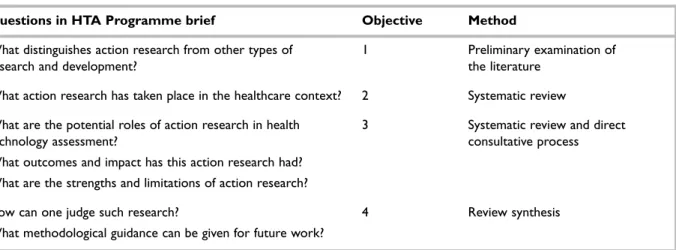
The relationship between the four objectives and the questions raised by the original HTA Programme brief and the activities of this study are outlined in Table 1.
Methods
The study consisted of three interlinked phases:
• preliminary literature review
• systematic review and direct consultative process
• data synthesis.
Preliminary literature review
Key methodological action research writings were identified. Definitions found in the texts were compared and contrasted, and a working definition of action research was developed. This definition informed and guided the systematic
review and consultative process. The aim of this preliminary review was to be inclusive: to encapsulate the nature and variety of action research in healthcare and to distinguish action research from other forms of research. Those characteristics identified as being key to action research were the cyclic process (problem identifi- cation, planning, action and change, evaluation) and the research partnership (the participatory nature of action research). Other aspects, such as theory generation, the nature of the knowledge to be produced and the nature of the collaborative process, were included as components of the framework. As discussed later, the working defin- ition was further refined in the light of the syste- matic review and the consultative process, and led to the achievement of objective 1.
Systematic review
There is a tendency in the area of health technology assessment to assume that systematic reviews are synonymous with systematic reviews of effectiveness. This assumption arises because such reviews have primarily been concerned with quantitative research, namely, randomised controlled trials (RCTs) that specifically address issues related to the effectiveness of a defined medical intervention.26These reviews draw heavily on quantitative methodology. Consequently, some research communities have questioned whether it is possible and even methodologically appropriate to undertake a systematic review of action research.
However, as Popay and Williams26argued, there are multiple research methods which address differing types of healthcare questions. They went on to argue that, in order to provide a comprehensive understanding of the challenges facing healthcare workers and to inform policy, there is a need to develop and undertake reviews of knowledge from other research traditions.
The systematic review that informed this project was designed to meet objectives 1–4 (Table 1 ) and, as such, does not address an effectiveness question.
In other words, it does not compare formally the effectiveness of action research with other methods of research and change management. It is better described as a systematic and interpretative review.
The review was conducted using a systematic approach to the searching, selection of studies
Chapter 2
The project
6
and extraction of data, using the recommendations for conducting reviews published by the NHS Centre for Reviews and Dissemination (CRD).27 Specifically, it included the development of a review protocol, a search strategy, a priori inclusion criteria and a method of data extraction. It will be seen that limited quantitative analysis of extracted data was undertaken in order to calculate frequencies.
These frequencies provide general information on the number, roles, outcomes and impacts of action research studies in healthcare settings in the UK (objectives 2 and 3). Beyond that, the review deviates from those described in the NHS CRD publication. In order to organise and make sense of the data on the strengths and limitations of the studies reviewed (objective 3), the approach used was similar to that of meta-ethnography, a qualitative method of qualitative data synthesis.28 Data sources
The search strategy included the following.
1. Searching electronic databases
(01/1975–07/1998): MEDLINE, CINAHL, EMBASE, BIDS (Social Science Citation Index, Science Citation Index), PsycInfo, ERIC, conference proceedings, Dissertation Abstracts, HMIC (Health Management Infor- mation Consortium), Aslib Index to Theses, Current Research in Britain, National Research Register, British Nursing Index, POPLINE, Institute of Education (see appendix 1).
2. Handsearching of reference lists and journals, including: Journal of Advanced Nursing, Journal of Clinical Nursing and Educational Action Research.
3. Searching the proceedings of two recent
qualitative research conferences held in the UK.
4. Advertising the systematic review at two major research conferences and through the Royal College of Nursing (RCN).
5. Requesting information and/or action research study reports, protocols and/or criteria for judging action research proposals and reports from:
• research & development (R&D) managers of 444 NHS trusts in the UK (appendix 2)
• action researchers identified from conference proceedings (appendix 2)
• approximately 200 action researchers known to the RCN, London
• known action research reviewers in the UK.
Electronic database searching was carried out in two phases, with the most recent search being carried out in July 1998. Two reviewers agreed the search strategy. Search terms are listed in appendix 1, together with a summary of the results of the search strategy.
Limitations of the search strategy
There was a need to balance the comprehensive- ness of the search against the value of identifying all available studies and the time available. The limitations of this search strategy included the following.
• Funding lists from funding bodies/researchers were not searched.
• The search of conference proceedings was limited (1992–98) and biased towards nursing conferences, with only one qualitative research conference and one mixed nursing/
collaborative action research network conference included.
• The CD–ROM version of the National Research Register has only been available from November 1998. Only the prototype was searched.
• ‘Action research’ did not exist as a delimiter in MEDLINE or the National Research Register.
TABLE 1 Relationship between project objectives and questions raised in HTA Programme brief
Questions in HTA Programme brief Objective Method
What distinguishes action research from other types of 1 Preliminary examination of
research and development? the literature
What action research has taken place in the healthcare context? 2 Systematic review
What are the potential roles of action research in health 3 Systematic review and direct
technology assessment? consultative process
What outcomes and impact has this action research had?
What are the strengths and limitations of action research?
How can one judge such research? 4 Review synthesis
What methodological guidance can be given for future work?
7
• Action research studies were referred to in journal publications but references were in- complete; hence, copies of papers could not be retrieved.
• It was not possible to target the key people at all NHS trusts who may have had knowledge of action research activities. Letters were addressed to ‘The Research and Development Manager’. Thus, action research carried out in the healthcare setting, of which a trust R&D manager was unaware, may have been missed.
• Projects that were not identifiable as being action research from their titles or abstracts were likely to have been overlooked by the search strategy.
Inclusion criteria
Identified studies were selected for inclusion in the review if:
• they were undertaken within the healthcare setting (primary, secondary or tertiary) in the UK
• they were dated after 1974 (studies prior to this time were unlikely to be relevant to the current NHS)
• they involved or had the stated intention of involving a cyclic process in which problem identification, reflection, research, and action intervention and evaluation were interlinked
• they were founded on a partnership between the action researcher and participants, all of whom were involved to some degree in the research and change processes.
Study selection, retrieval and inclusion The process of selection, retrieval and inclusion occurred in stages.
1. Two reviewers independently reviewed the abstracts of studies identified by electronic searching, in order to select studies for retrieval.
Any disagreements were discussed and consensus reached.
2. All retrieved publications and papers received from researchers and NHS trusts were pre- screened by one reviewer for inclusion in the review according to the predetermined inclusion criteria. A second reviewer independently assessed a random selection (114) of retrieved papers.
3. A second round of study selection occurred as studies were processed for data extraction. Some reports that had originally appeared to be action research did not, in fact, meet the inclusion criteria and were excluded following discussion between the two reviewers.
Data extraction
The development of the data extraction sheet, consisting of closed and open questions, was informed by a template designed by Meyer and Spilsbury (J Meyer and K Spilsbury, City University, St. Bartholomew’s School of Nursing, London:
personal communication, 2000). The form was developed, pilot-tested and amended (appendix 3).
One reviewer extracted data from all included studies and three additional reviewers cross- checked a selection of studies (ten studies each).
Discrepancies in interpret-ations were discussed and extracted data changed as appropriate.
Unlike RCTs and systematic reviews, there is no accepted or standard format for reporting action research.29,30This made data extraction a difficult and time-consuming process. Thus there was limited time available for contacting authors of included action research reports to clarify or expand specific aspects.
It is acknowledged that the reviewers’ interpret- ations during data extraction may be at variance with those of the authors. This is a potential problem in all systematic reviews. It is particularly important when examining reports of action research because of the sheer volume and complexity of information in included- studies projects.
Data entry
Data extracted from closed questions were entered into the statistical software package, SPSS. Responses to open questions were registered as present or absent in SPSS and, if present, the relevant statements were extracted and entered into the qualitative software package, NUD*IST.
The two datasets were crosschecked when appropriate to ensure that relevant data entries matched.
Assessment of the validity of included studies It is accepted protocol when conducting a syste- matic review of effectiveness to assess the quality of the included studies. At the time of this study, the reviewers identified an ‘unvalidated’ tool to assess the appropriateness of action research.25,31 However, it was not possible to identify a validated tool designed to assess the quality of studies re- porting action research in healthcare. An attempt was made to systematically appraise the quality of the included studies, using a modified version of the critical appraisal of qualitative research tool being developed by Professor Jennie Popay and her colleagues at the University of Salford (per- sonal communication, 2000). However, this tool
8
was neither designed nor has it been validated for use with action research, and the results of this assessment were uninterpretable – the main problem being that it did not consider all the key characteristics of action research. Hence, for the purpose of this review, no attempt has been made to report the quality of the included studies.
However, although a systematic appraisal of the quality of each included study was not carried out, each study was examined in detail in the context of the data extraction process. In this process a pre-established data extraction sheet was used that included aspects identified in the definition of action research. This enabled critical commen- taries to be made about each of these aspects within the included studies, in relation to the objectives of the review.
Reference is made to the action researchers’ own assessments of the success or failure of their study.
It is important to note that this refers to whether the action researchers were able to meet their objectives, and is not necessarily a reflection of the quality of the action research project.
Data analysis Closed questions
Frequencies were calculated to provide descriptive information about studies.
Open questions
Content analysis of identified statements (responses) to open questions for objectives 2 and the first two components of objective 3 resulted in emergent categories. As the data extraction proceeded, the number of emergent categories decreased and statements were allo- cated to existing categories. In order to ensure that categorisation was performed uniformly, data were reanalysed at intervals. The final categories were exported to SPSS to provide frequencies. These categories also provided detailed information on which to base the narrative components of this review.
A qualitative analysis was undertaken of the statements relating to open questions on the strengths and limitations of action research (the final component of objective 3.). The analysis or translation of data needed a qualitative approach, because this particular objective sought to describe and understand the issues involved.32For this, the method parallels that of Noblit and Hare,28in which six phases were identified. The first phase of the process is to identify an area of intellectual interest that is, in this case, the strengths and
limitations of action research. The second is to consider what studies are relevant and of interest.
It was decided to include all the studies because they provided an overview of perceived advantages and drawbacks that can be encountered in action research. The range of studies illustrates the various ways in which issues were played out and they added depth and richness. The third phase, according to Noblit and Hare,28is to read the reports of studies, although they acknowledged that this happens over and over again and is not a discrete phase. They suggested that texts be read for information on the topic under review. In our case, relevant information was extracted on to a computerised database. The sources of these extracts were kept, in order to refer back to the original paper if necessary. In phase four the findings from the studies are compared and contrasted. Phase five is the process of translating the information from different studies into a coherent interpretation. This has similarities to our endeavours to categorise the information.
In phase six, categories are collapsed into eight pivotal factors that served to describe and explain the strengths and limitations of action research in healthcare. The researchers are in agreement with Noblit and Hare28that the phases overlap and may run concurrently. Thus, although the general focus remains the same throughout, the resulting interpretation and supporting information develop simultaneously.
The direct consultative process
A direct consultative process was undertaken to add quality and depth to the information provided by the systematic review. It was designed to gain information unavailable through conventional published research reports.
Focus groups were considered to be the most appropriate method of obtaining the views of action researchers, participants and users on the themes that were emerging from the systematic review. Focus groups are particularly useful for gaining people’s opinions on common experi- ences, in this case the action research process.
Group interviews may trigger debates or critical discussions of issues that may not have occurred in single face-to-face interviews.33Sarantakos33 discussed how focus group interviews work, on the assumption that, in a group, people become motivated and stimulated to examine their experi- ences more critically. This has to be balanced against a major drawback of the method, which is its lack of ability to provide individual in-depth data. For the purposes of this review, group interviews were considered as providing an
9 opportunity to consult a wide range of people in
the time available. General advice, such as that given in Kruger,34was used in the preparation of the interviews. For each focus group interview, a moderator was identified whose role was to wel- come interviewees and to put them at ease. The moderator explained the purpose of the interview and how it would be conducted, and sought each participant’s consent. She also ensured that the topics covered were relevant.
Sampling for the consultative process Two focus group interviews were conducted in 1998 at an RCN/Collaborative Action Research Network (CARN) conference in Manchester. The conference was selected because it was billed as multidisciplinary and the delegate list included many healthcare action researchers. It provided an opportunity to explore the developing themes with both novice and experienced action researchers.
Participants were invited to take part in the focus group interviews prior to the conference. The moderators of these two focus groups were Korrie de Koning and Heather Waterman.
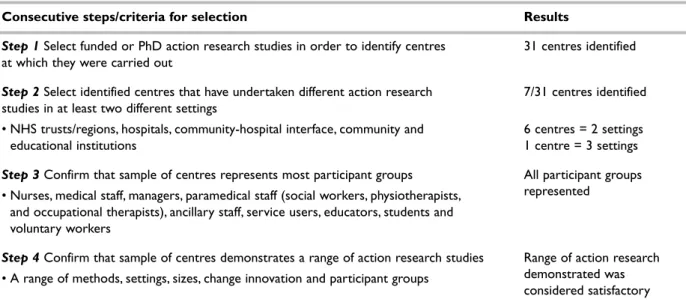
Healthcare settings in which action research had been conducted were identified and selected for further focus group interviews to be carried out by Dominique Tillen. Four study centres were identified from reviewed articles and selected for in-depth investigation. Criteria for selection were determined and applied in four consecutive steps (Table 2 ).
Seven of 31 centres met the criteria. It was possible to contact a key person at six of these, and one action research study per centre was selected
on the basis of relevance and the type and avail- ability of the study’s participants for interview. Two centres were unable to arrange focus group inter- views. The final site selection was agreed in con- sultation with two of the grant-holders who were knowledgeable in the field of action research.
Access was negotiated through the key person at each study centre who had invited the original study participants to take part in focus group or individual interviews and had organised the inter- view dates. It was stressed that, whenever possible, participants should represent the complete range of participant groups involved in the study. A drawback of pre-specifying the number of inter- views to take place is that it limits the flexibility and responsiveness of the project to explore further the issues raised by participants. In our case, however, it was considered that there was no need to sample more centres because data saturation was already being achieved, that is, by the last interview no new information was being generated.
Topic guide
A framework for the consultative process was produced and incorporated in an interview schedule and topic guide (appendix 4). This framework, the questions itemised in the HTA documentation, and the results of preliminary data analysis provided the basis for the topic guide.
Analysis of data from the direct consultative process
Analysis drew on qualitative techniques described by May.35Interviews were transcribed by a secretary and then checked for accuracy. The framework for
TABLE 2 Identification and selection of four study centres
Consecutive steps/criteria for selection Results
Step 1 Select funded or PhD action research studies in order to identify centres 31 centres identified at which they were carried out
Step 2 Select identified centres that have undertaken different action research 7/31 centres identified studies in at least two different settings
• NHS trusts/regions, hospitals, community-hospital interface, community and 6 centres = 2 settings
educational institutions 1 centre = 3 settings
Step 3 Confirm that sample of centres represents most participant groups All participant groups
• Nurses, medical staff, managers, paramedical staff (social workers, physiotherapists, represented and occupational therapists), ancillary staff, service users, educators, students and
voluntary workers
Step 4 Confirm that sample of centres demonstrates a range of action research studies Range of action research
• A range of methods, settings, sizes, change innovation and participant groups demonstrated was considered satisfactory
10
the initial analysis of the focus group and interview information was based on the issues identified in the topic guide (appendix 4). For the first two components of objective 3, qualitative data have been used both to illustrate and to add depth to the quantitative data. With regard to the final component of objective 3, the qualitative data were compared, combined with the data extracted from the reviewed studies, and contributed to the genesis and exploration of the pivotal factors.
Limitations of the direct consultative process
• The sample from which the selection was made does not include all action research centres in UK.
• Information used for making the selection may be missing and, thus, centres that would otherwise have been eligible for inclusion may have been passed over.
• The selection of interviewees by the key person at each location may have introduced selection bias in the sample.
Data synthesis
As discussed above, data from the systematic review and direct consultative process were integrated.
A narrative overview for each of the objectives with the presentation of tabulated information and frequencies, if appropriate, was produced.
The resulting data synthesis informed the guidance for the assessment of action research projects, presented later in chapter 7.
Validation of the project
Validation of the project’s process occurred through:
• involvement of an advisory panel of researchers with experience in action research
• regular communication between co-applicants
• use of a consultative process with key action researchers to elaborate on findings of the review
• presentation of preliminary results at two research conferences.
Advisory panel
An advisory panel consisting of researchers and members of interested parties advised the project team (appendix 5). The role of the panel included
providing guidance and feedback on the protocol and final report, identifying action research pro- jects, and providing information on published and unpublished studies. However, the resultant report should be considered as a reflection of the opinions of the reviewers, and not necessarily those of the advisory panel or its individual members.
Time-frame
The project was conducted over 17 months, from February 1998 until June 1999. The definition of action research was developed in the first 2 months.
Protocol development and the conducting of the systematic review extended over 12 months, from March 1998. The consultative process was carried out during the middle 6 months of the project. The preliminary results of the research were presented at two conferences in April and June of 1999, in order to obtain feedback on the conclusions reached by the reviewers.
Summary
The aims and objectives of this project were achieved through a mixed methodology that aimed to combine what might be considered
‘hard’ data from quantitative research with the depth and understanding of qualitative research.
In chapters 3–7, the results of the project are presented, as follows.
• Chapter 3 contains a definition of action research, and a definition and discussion of its distinguishing features (objective 1),
• An overview and summary of action research in the UK health setting is presented in chapter 4 (objective 2).
• The findings on the existing roles of action research and the outcomes and impacts of such studies follow in chapter 5 (objective 3).
• These lead on to the presentation of results on the strengths and limitations of action research, which are presented in chapter 6 in the form of eight pivotal factors identified during the review (objective 3).
• Finally, a synthesis of the key findings of the review is used to provide guidance in chapter 7;
this takes the form of 20 questions that could be used to begin an assessment of action research proposals and reports (objective 4).
11
A definition of action research
As previously indicated, there are a selection of descriptions and definitions of action research offered in the literature.1–6Holter and Schwartz- Barcott36pointed out that the core characteristics and differing approaches and uses of action research have not been systematically identified.
As a result, an embracing definition of action research remains elusive and existing definitions tend to focus on the description of characteristics.5
Hart and Bond10presented a typology of action research that identified seven distinguishing char- acteristics: it has an educative base; it deals with individuals as members in groups; it is problem focused; it involves a change intervention; it aims at improvement and involvement; it involves cyclic processes; it is founded on collaboration.
These characteristics were related to four action research types: experimental, organisational, professionalising, and empowering. Hart and Bond37also argued that the four types of action research are indicative of the evolving nature of action research. The strength of Hart and Bond’s typology is that it has been developed to be
“...able to retain a distinct identity (of action research) while spanning the spectrum of research approaches...” Thus, while not offering a definition of action research, the typology does make explicit the identified characteristics of action research, it attempts to clarify action research types, and avoids the problems associated with narrow definitions. An attempt was made to use these four action research types to categorise the reviewed studies but it was found that they did not accurately reflect the findings in the included studies. To be fair to Hart and Bond, they did argue that their types were ideal and not prescriptive of action research. The action research reviewed did not fall into distinct types.
There are many different ways of potentially classifying action research according to, for example, level of participation, research methods, and topic. Ultimately, a multidimensional matrix would be required to explain the variations but that would become unwieldy and too com- plicated. Finally, a definition was considered to be most helpful.
Extensive investigation and reflection on the literature2,4,5,9,10,36,38,39and lengthy discussions resulted in the definition of action research used in this review.
Action research is a period of inquiry, which describes, interprets and explains social situations while executing a change intervention aimed at improvement and involvement. It is problem- focused, context-specific and future-oriented.
Action research is a group activity with an explicit critical value basis and is founded on a partnership between action researchers and participants, all of whom are involved in the change process. The participatory process is educative and empowering, involving a dynamic approach in which problem identification, planning, action and evaluation are interlinked. Knowledge may be advanced through reflection and research, and qualitative and quantitative research methods may be employed to collect data. Different types of knowledge may be produced by action research, including practical and propositional. Theory may be gen- erated and refined, and its general application explored through the cycles of the action research process.
The definition does not specify a particular philosophical perspective. This is deliberate, in order to be able to encompass the variety of approaches in healthcare action research.
A general discussion follows of the distinguishing features of action research and the variations that exist within the definition. Consideration is also given to the philosophical frameworks that inform action research, and how they relate to the scope of the studies reviewed.
Distinguishing features of action research
Like Hart and Bond,37a number of other
authors3,5,10,13,18,36,40,41have identified key character- istics of action research. However, when these were scrutinised by the review team, it was noted that two criteria were fundamental to action research and these have been included in the definition.
These were:
Chapter 3
Defining action research
12
• the cyclic process of action research, which involves some kind of action intervention
• the research partnership, in which the degree of involvement or participation of the researched may range from cooperation, when the research participants work with outsiders to determine priorities but responsibility remains with the outsiders to direct the process, to collective action.42
These two criteria are inextricably linked; it would be impossible to have one without the other. As the definition indicates, there are other important aspects to action research, some of which overlap with other types of research, management and educational practices.
The cyclic process
In theory, action research is presented as a cycle of problem identification or situation analysis (including reflection), planning, action (imple- mentation of change and monitoring) and evalu- ation, which may lead to identification of new problems, planning, action and evaluation, and so on. In practice, action research may be made up of small-scale interventions, often as part of a larger project, that are reflected on, planned, implemented, reflected on and adapted, and not necessarily formally evaluated. An example of this is Lee’s work in training and developing registered nurses to become clinical supervisors.43 The depiction of the action research process as cyclical is necessary to aid understanding but, as with all models, this is the ideal and the ideal is not always attained. The manner of reporting of action research means that at times it is difficult to discern the cycles within a given action research report. The movement between the phases is, in reality, iterative and difficult to present clearly in written reports. For example, it is necessary to have some conception of the problem and possible action in order to reflect on and research it effectively. However, the study by Burrows and Baillie44is an example in which they claim completion of at least two cycles to investigate and bring about changes in the education of student nurses.
The research component may be the process of change and monitoring of outcomes; for example, Huby45employed qualitative research methods in the development and study of health service users’
experience of HIV/AIDS care in Lothian, Scot- land. Alternatively, research may feature as formal projects embedded in the process: for example, a controlled trial was part of the process of change
in the study by McKenna and colleagues.46,47 Other variations were in whether the focus was on practice issues, theory generation or evaluation of changes. For example, Gibson and colleagues48 considered the practice of oral care, whereas Waterman and colleagues49chose to theorise on barriers to changing nursing practice in an ophthalmic outpatient department, and Hanlon and colleagues50presented an evaluation of a radical reorganisation of acute medical care.
Not all projects have an intervention. For example, in a project in which action research is used to explore the acceptability and feasibility of an innovation, it might be decided that implement- ation is neither feasible nor acceptable. In our opinion, in the example just given, the work still constitutes action research even though the intervention is not accepted. This is because the participants will have learned something new in the process; intervention is used loosely to refer to any changes in understanding, beliefs, values and behaviour. Moreover, they will have moved through the cycle and, having evaluated the innovation, they may have found it unsatisfactory. Projects that appear to have no intention of taking any form of action do not fulfil the basic criteria of the link between action and research, and would not be considered action research according to our definition. Projects in which an attempt is made to take action but the action is thwarted for whatever reason, for instance, through lack of support as in the case of Jones,51would be considered to be action research because there are opportunities for evaluation of the processes that occurred. These issues are dealt with further in the discussion chapter of this report.
Action research provides a framework for the introduction and evolution of strategic action that recognises the effect of and uses local contextual factors in its advancement.52In professional settings, the process of action research may overcome the separation of theory and research from practice.53The movement between reflection, research, action and theory that may occur in each phase of action research has the potential to produce experientially and professionally relevant knowledge. Action research has a potential to provide a process in which understanding and development of practical knowledge can take place (some examples of the variations that exist are given in chapter 5). Action research can assist in putting knowledge/research into practice through reflection and the implementation of change, and can also lead to the development of innovative methods of managing the change pro-
13 cess (see chapter 5). Thus, it allows practitioners
to exercise their responsibilities towards the development of accountable practice.53 Changes in practice or services contribute to and are affected by the development of clinical knowledge. These changes and developments are captured and evaluated through reflection and/or qualitative and quantitative research, thus potentially leading to concrete or substantive theories. The cycles of action research also allow participants to explore practical and theoretical understandings from a variety of perspectives, for example, in different settings or with different people, that could serve to increase the general application of the outcomes of the process. How- ever, as will be reported later, in only a minority of action research projects included in the review was an attempt made to theorise beyond the local setting. Meyer,54for example, theorised to explain her experiences of developing lay participation in care. The presence or absence of generalisable theoretical abstractions may be due to the import- ance attached to this, compared with the import- ance of individual practitioner understandings.
In addition, some action researchers attempted to produce findings that could be generalised statistically: for example, Clarke