!"#"$%&'()"*"$(&+,-&.*/01&
!"#(-2&
&
&
345&6)"4",$&
789:&
&
;-((&<$4(-$(4&6)"4",$&
&
===>)"#"$%?()"*"$(>"$+,&
5 th Edition, 201 3
Diving Medicine for Scuba Divers 4th edition 2012 Published by Carl Edmonds
Ocean Royale, 11/69-74 North Steyne Manly, NSW, 2095 Australia
[email protected] First edition, October 1992 Second edition, April 1997 Third edition January 2010 Forth edition January 2012 Fifth edition January 2013
National Library of Australia Catalogue 1. Submarine Medicine
2. Scuba Diving Injuries
3. Diving – physiological aspects Copyright: Carl Edmonds
Title 1 of 1 - Diving Medicine for Scuba Divers ISBN: [978-0-646-52726-0]
To download a free copy of this text, go to www.divingmedicine.info
!
!
FOREWARD
!
!
!"#$%$&'! (&)! *+,(-+(.$/! 01)$/$&1"2! $&! $.3! .4$5)! (&)! 4$'467! 51381/.1)! 1)$.$9&2! 4(3!
859%$)1)! (! /95&153.9&1! 9:! ;&9<61)'1! :95! .41! )$%$&'! =1)$/(6! 859:133$9&(6>! ?9<2!
"#$%$&'! 01)$/$&1! @! :95! */+,(! #$%153"! $3! (! /9&)1&31)2! 3$=86$:$1)! (&)! 6$'4.15!
8+,6$/(.$9&! :95! .41! '1&15(6! )$%$&'! 898+6(.$9&>! A41! (+.4953! @! #53! B)=9&)32!
0/C1&D$1! (&)! A49=(32! 4(%1! )9&1! (&! 1E/1661&.! F9,! 9:! 859%$)$&'! (! /9=85141&3$%12!
+31:+6!(&)!+8!.9!)(.1!5139+5/1!,(31!:95!.41!)$%15!$&!.41!:$16)>!
!A41! 85131&.(.$9&! 9:! .41! =(.15$(6! 51:61/.3! .41! :(/.! .4(.! .41! (+.4953! (51! 1E815$1&/1)!
)$%153! (3! <166! (3! 381/$(6$3.3! $&! )$%$&'! =1)$/$&1>! A41$5! .4$&67! )$3'+$31)! 31&31! 9:!
4+=9+5! $3! 51:61/.1)! .459+'49+.! .41! .1E.! $&! 1=84(3$3$&'! $=895.(&.! $33+13! (&)!
9//(3$9&(667!F+3.!6$'4.1&$&'!.41!(/()1=$/!69()$&'!9&!.41!51()15>!A41$5!.51(.=1&.!9:!
(51(3! 9:! /9&.59%1537! 51:61/.3! .41$5! 1E815$1&/1! (&)! ,(/;'59+&)! $&! .51(.$&'! )$%$&'!
1=15'1&/$13>! *9=1! 51()153! <$66! :$&)! $&:95=(.$9&! <4$/4! =(7! ,1! $&/9&3$3.1&.! <$.4!
.41$5!.1(/4$&'3>!G.!$3!3.59&'67!3+''13.1)!.4(.!.41!51()15!8(7!(..1&.$9&!.9!.41!()%$/1!
.4(.! $3! 85131&.1)! ,7! .41! (+.4953>! A41$5! =(&7! 71(53! 9:! /+=+6(.$%1! 1E815$1&/1! $3!
51:61/.1)!$&!.41$5!()%$/1>!
!A4$3! .1E.! 5185131&.3! .41! ,59()13.! /9%15('1! 9:! )$%$&'! =1)$/(6! $33+13! .4(.! 4(3! ,11&!
:9/+331)!+89&!.41!'1&15(6!)$%$&'!8+,6$/>!G.!)913!(&!1E/1661&.!F9,!9:!,5$)'$&'!.41!'(8!
,1.<11&! .41! ")$%1! 513/+1"! .781! =(.15$(63! 8+.! 9+.! ,7! .41! %(5$9+3! ('1&/$132! (&)! .41!
9.415!1E/1661&.!=1)$/(6!.1E.3!<4$/4!:9/+3!85$=(5$67!9&!8473$/$(&!1)+/(.$9&>!A4$3!.1E.!
349+6)! 315%1! .41! 51()15! <166! 3$&/1! $.3! $&.1&.! $3! /61(567! )13$'&1)! .9! 3.$=+6(.1! .41!
)$%$&'! 898+6(.$9&! (.! 6(5'1! .9! ,1/9=1! ,1..15! $&:95=1)! 9&! /+551&.! )$%$&'! =1)$/(6!
$33+13>! H))$.$9&(6! 5139+5/1! =(.15$(63! (51! 85131&.1)! :95! .4931! <49! <$34! =951!
)1.($61)!$&:95=(.$9&>!
!I61&!J>!B'3.59=!K4>#>!
K59:13395!B=15$.+3!
#18(5.=1&.!9:!K473$969'$/(6!*/$1&/132!
L&$%153$.7!9:!M(6$:95&$(2!N93!H&'1613>!
!"##$%#&'O!
!A41!3+//133!9:!.4$3!.1E.2!.9'1.415!<$.4!$.3!P(8(&131!(&)!C951(&!1)$.$9&32!4(3!$&38$51)!
=1!.9!51%$31!(&)!+8)(.1!.41!=(.15$(62!1%1&!.49+'4!.41!81539&!G!95$'$&(667!)13$'&1)!$.!
:952!=7!79+&'!39&!0(5;2!$3!&9<!<166!$&.9!=$))61!('1>!
!A41! Q&)! 1)$.$9&! $3! <166! 9%15! (! )1/()1! 96)2! (&)! $.! 4()! 5+&! 9+.! 9:! 85$&.>! ! R$.4! .41!
(33$3.(&/1!9:!=7!13.11=1)!/9S<95;152!P94&!K1&&1:(.4152!(&)!6$:1!69&'!:5$1&)2!M6(55$1!
N(<6152!.41!T5)!(&)!:$&(6!1)$.$9&!$3!&9<!:$&$341)>!!
!07! $&.1&.! $3! .4(.! $.! ,1! =()1! (%($6(,61! :51167! U(.! 61(3.! 9&! G&.15&1.V! .9! (66! )$%1532!
/9&3/$1&.$9+3!)$%1!$&3.5+/.9532!8(5(=1)$/3!(&)!)9/.953!&1<!.9!.4$3!:(3/$&(.$&'!(&)!
51<(5)$&'!3+,F1/.>! ! M(56!B)=9&)32!QWXW!
!!
()*(!A4151! 4(3! ,11&! 9%15! TWWWW! )9<&69()3! 9:! .4$3! .1E.! 9%15! Q! 71(532! <$.4! (&!
+&;&9<&! &+=,15! 9:! /98$13! =()1! ,7! $&3.5+/.9532! )$%1! /6+,3! (&)! )9/.953>! A4(&;32!
ACKNOWLEDGMENTS
! For the 1
stand 2
ndeditions of this text
!A9!=7!)$%$&'!,+))7!(&)!<$:12!M$&)72!:95!415!$&%(6+(,61!/5$.$/$3=32!3+''13.$9&3!(&)!8599:S 51()$&'>!A9!=7!39&2!0(5;2!<49!$&38$51)!.41!851)1/13395!9:!.4$3!.1E.2!"H!#$%$&'!0(&+(6!:95!
0(5;"2!<4$/4!G!8518(51)!:95!4$=>!A41!=9.$%(.$9&!<(3!.9!1&3+51!.4(.!41!4()!=951!:(/.+(6!
$&:95=(.$9&! .4(&! .4(.! (%($6(,61! :59=! 4$3! 981&! <(.15! 3/+,(! )$%$&'! /9+531>! J1! $3! &9<! (!
/9=81.1&.!(&)!815/18.$%1!)$%152!8(5.67!:59=!4$3!+&)153.(&)$&'!9:!.4$3!.1E.>!A4(&;3!(639!.9!
K(.5(/$(!N(5;1!(&)!B&$)!K('1!:95!.41$5!31/51.(5$(6!315%$/13>!
M(56!B)=9&)3>!
!G! <9+6)! 6$;1! .9! .4(&;! =7! <$:12! H&&2! :95! .9615(.$&'! =7! 9&! (&)! 9::! (::($5! <$.4! (! <95)!
859/133952! (&)! (639! =7! )(+'4.15! #1,95(42! #13! N+&)2! A(==7! N712! *4$5617! R(5&152! (&)!
P9(&&1!R5$'4.!<49!41681)!=1!$&!.41!'13.(.$9&!9:!.4$3!,99;>!
Y(5.!0/C1&D$1!
A4$3! (+.495! <$3413! .9! '5(.1:+667! (/;&9<61)'1! .41! (33$3.(&/1! '$%1&! ,7! =7! )(+'4.152!!
?(.(6$(2!.9!859)+/$&'!39=1!9:!.41!)$('5(=3!+31)!<$.4$&!.41!,99;>!G!(639!<$34!.9!.4(&;!=7!
<$:12!#1&$312!:95!415!.$516133!3+8895.!(&)!8(.$1&/1!51'(5)$&'!=7!9:.1&!:5+3.5(.$&'!+31!9:!
.41!0(/$&.934!/9=8+.15!(&)!&9$37!85$&.15!$&!/9=861.$&'!.4$3!.1E.!@!39=1.4$&'!341!&1%15!
,16$1%1)!<9+6)!51(667!1%15!1%1&.+(.1Z!
Y9,!A49=(3!
+,-!./$!0-#!1%#!2%.$-%$.!$#3.3,%45!! !
John Pennefather, who assisted Carl Edmonds in reviewing and updating the text
Clarrie Lawler, who supplied many excellent diagrams Richard Chesher, for spectacular photographs
John Lippmann, CEO, DAN Asia-Pacific, for advice, corrections and preparation of both earlier and this edition
Richard Pyle for technical diving diagrams Cis-Lunar Development Laboratorie
DIVING MEDICINE FOR SCUBA DIVERS
BACKGROUND
1. History of Diving 2. Physics
3. Physiology
4. Breath-hold Diving 5. Equipment 6. Diving Environments
7. Stress Disorders — Panic and Fatigue 8. Female Divers
SPECIFIC DIVING DISEASES (PRESSURE RELATED DISEASES) 9. Ear Barotrauma
10. Sinus Barotrauma
11. Pulmonary Barotrauma 12. Other Barotraumas
13.Decompression Theory & Physiology 14. Decompression Procedures Tables 15. Decompression Sickness Clinical 16. Decompression Sickness Treatment 17. Dysbaric Osteonecrosis
18. Nitrogen Narcosis 19. HPNS
20. Hypoxia
21. Oxygen Toxicity
22. Carbon Dioxide Problems 23. Carbon Monoxide Toxicity 24. Breathing Gas Contamination
AQUATIC DISEASES 25. Drowning
26. Salt Water Aspiration Syndrome 27. Cold and Hypothermia
28. Infections
29. Dangerous Marine Animals
GEM of WISDOM, learnt the hard way.
If a diver suffers an illness/accident that you cannot understand or prevent, then it will happen again – but often with more serious consequences.
GENERAL DIVING RELATED MEDICAL PROBLEMS
30. Hearing Loss
31. Disorientation 32. Miscellaneous Disorders –
Contact Lenses Muscular Cramps Other Ear Problems Headache
Pulmonary Oedema (SDPE) Sunburn
Seasickness
Jaw Joint Arthritis Explosions
33. Unconsciousness in Divers 34. Why Divers Die
35. Sudden Death Syndrome 36. Psychological Disorders 37. Drugs and Diving
TREATMENT and PREVENTION 38. Medical Examinations for Divers 39. First Aid Kit
40. Oxygen Therapy Techniques 41. Training and Safety Checklist 42. Resuscitation Review
RECENT DEVELOPMENTS 43. Technical Diving
APPENDICES
A. Diving Medical Library B. Emergency Contact Numbers
C. In-water O2 Recompression Therapy D. Divers Alert Network
Chapter 1 — 1
Chapter 1
All chapters, full text, free download, available at http://www.divingmedicine.info
HISTORY of DIVING
Historians are unable to identify the first divers. Probably the techniques they used were similar to those of the native pearl and sponge divers. They may have used a stone weight to ensure rapid descent, but it is unlikely that they could dive deeper than 30 metres, or spend longer than 2 minutes underwater. Later, diving was employed for military purposes (such as destroying ships anchoring cables, boom defences, etc.) and for salvage work. Divers took part in great naval battles between 1800 BC and 400 BC. Alexander the Great was said to have descended in a diving bell (circa 330 BC) but the details are scarce and some of the stories of the descent are fanciful.
Commercial diving evolved through the 19th and 20th centuries and encompassed salvage and shell diving, extending into exploration, deep diving, off shore oil rigs, aquaculture, ecology and most importantly for you – recreational diving.
The history of diving evolved in two directions. The first is the development of diving equipment – described in this chapter. The second is the understanding of diving physiology and medicine – described in the rest of this text.
Fig. 1.1
A Roman historian, Pliny, recorded the earliest use of surface supplied breathing air by divers in AD77, when a breathing tube connected the diver to the surface. This possibly represents an
Chapter 1 — 2 early "schnorkel". Its use was limited to very shallow dives, since man's respiratory muscles cannot draw air very far down from the surface – maximum half a metre. It was also depth limited due to the excessive volume of the breathing tube.
Leonardo da Vinci sketched several designs for diving equipment and submarines. Many diagrams of divers' hoods can be found in other historical texts from 1500 AD onwards, but much of this equipment would not have worked at depths greater than a few feet. They did, however, attest to man's desire to remain below the surface for extended periods. In 1680 Borelli, an Italian, designed a diving set which purported to be a self- contained diving apparatus. Although it was impracticable, the idea was revolutionary at that time. Despite the fact that much diving equipment was primitive and rarely functioned adequately, diving bells were used with success from the 17th century onwards.
Fig. 1.2
Diving with a helmet (the equivalent of an upturned bucket which enclosed the diver's head) gradually became an accepted method. It contained air that was pumped down from the surface following the development of efficient air pumps around 1800 AD. Bellows were used to force air down to the divers. This allowed longer and deeper dives and brought to light the many physiological problems caused by the undersea environment.
In 1837 Augustus Siebe marketed the first effective standard diving dress. This incorporated an air-supply line connecting a pump or compressor on the surface to a diving helmet. The helmet was attached by an airtight seal to a flexible suit that enclosed the diver and was filled with air.
Fig. 1.3
Siebe's helmet.
Chapter 1 — 3
The development of self-contained air supplies was impeded by the lack of sufficiently powerful compressors and reservoirs. In 1863 the Frenchmen, Rouquayrol and Denayrouze, invented the first satisfactory demand regulator for self-contained underwater breathing apparatus (SCUBA), but due to lack of suitable high pressure air compressors and cylinders, it was limited to surface air supply lines.
In 1878 H. A. Fleuss made a workable self- contained (closed-circuit) oxygen breathing apparatus utilising caustic potash to remove exhaled carbon dioxide. "Closed" refers to the absence of an outlet for gas (i.e. no bubbles) and means that the exhaled gas is rebreathed. This was the forerunner of modern closed-circuit diving units.
Fig 1.4
Rouquayrol and Denayrouze, Diving suit 1863
Divers in the late 1800's were capable of reaching depths in excess of 50 metres, but the effects of decompression sickness (or bends) caused much concern and many injuries to divers. Paul Bert, a French scientist, was the first to explain that the disease was caused by the formation of nitrogen bubbles in the body and proposed the idea of a slow ascent to the surface. It was not until the early 20th century that Dr J. S. Haldane derived satisfactory mathematical decompression tables to overcome this physiological problem of deep diving. The first successful tables were based on the assumption that decompression sickness could be avoided by not exceeding a 2:1 pressure reduction between stops. It reflected a mathematical model of inert gas behaviour in a body and was to be the forerunner of current decompression tables.
Later observations showed this principle to be incorrect in many cases, but these early tables and the later modified versions, prevented many divers from developing the bends.
Diving research this century has lead to a great improvement in all forms of diving equipment and since 1940 the use of such equipment has increased greatly. The design by Cousteau and Gagnan in 1943, of a proper demand-regulated air supply from compressed air cylinders worn on the back has developed into modern day scuba.
The scuba equipment used today, with the high-pressure regulator on the cylinder and a single hose to a demand valve in the mouth, was invented in Australia and marketed by an engineer named Ted Eldred in the early 1950s, under the Porpoise trademark.
Closed-circuit rebreathing apparatus using, oxygen or oxygen/nitrogen mixtures, has also been improved considerably since the early units used by Italian Naval divers in their attacks on shipping in Gibraltar in 1941. With the advent of deeper diving, gas economy has become a major problem and for this reason closed-circuit systems have achieved even greater importance.
Diving to depths in excess of 100 metres required not only the development of specialised closed or semi-closed circuit rebreathing apparatus, but also the use of other inert gas mixtures mixed with oxygen. Nitrogen, because of its narcotic effect at depth, has been replaced largely by other gases such as helium and hydrogen. These are not used without complications – as all gases cause specific physiological problems and no ideal mixture yet exists.
Chapter 1 — 4 The advent of saturation diving has completely revolutionised the ability to dive and work at great depth, and for lengthy durations, and this is economically rewarding. The system is based on saturation at any depth of all the diver's tissues by the inert breathing gas. Once this is achieved the body is incapable of absorbing further amounts of gas, no matter what the duration of exposure at this depth. Hence, further exposure does not lengthen decompression times. This practice is now adopted for most diving with extended bottom times at depths in excess of 100 metres.
In an attempt to reduce the risks in deep diving, one-atmosphere diving suits (ADS) have been developed out of strong lightweight alloys. These suits are fitted with articulated joints and use mechanical levers or claws for "hands". Some even have mobility and propulsion, but all require backup 'rescue' facilities. They are equipped with a self contained rebreathing apparatus and are often used at depths of 200–300 metres. Although somewhat bulky and requiring hoisting gear at the surface, divers can achieve a reasonable degree of movement at depth with the latest models. These suits are also useful for inspection-type work, although much of this is now done by non-manned Remote Operated Vehicles (ROV's) with video surveillance.
Fig 1.6 The Royal Australian Navy Clearance Diving Team, 1955, with oxygen breathing equipmenrt and
wearing the famous “Clammy Death” suit.
Chapter 2 — 1
Chapter 2
All chapters, full text, free download, available at http://www.divingmedicine.info
PHYSICS
To understand the physical and physiological problems which can confront a diver, it is helpful to recall a few basic physical laws of nature. Only a brief and simplified review of the physics of diving is given in this text. For more detailed explanations, refer to the diving manuals.
PRESSURE
Some of the major physical hazards are related to the effects of pressure. Pressure is defined as force per unit area. i.e.
PRESSURE = FORCE
AREA
If a force is spread over twice the area, the pressure is halved.
This explains why, for example, wide tyres are preferable for driving on beaches. The weight of the vehicle (force) when spread over a large area causes less pressure on the sand. This vehicle is less likely to sink into the sand than one with narrow tyres.
The effect of stilleto heels on soft wooden boat decks
Chapter 2 — 2 Gases exert pressure because they are made up of lots of fast moving molecules. The greater the number and the faster they move, the greater the pressure.
Pressure on a Submerged Diver The pressure acting on a submerged diver has two components:
1. The atmosphere above the water, termed atmospheric pressure, 2. The weight of the water above the diver, termed hydrostatic pressure.
Divers’ depth gauges are calibrated only to read the hydrostatic pressure (the depth of water) and so they read zero at sea level. They do not read the 1 atmosphere (1 ATA) above them.
Thus the “gauge pressure” is always 1 atmosphere less than the true or “absolute” pressure.
We will now elaborate.
Atmospheric Pressure
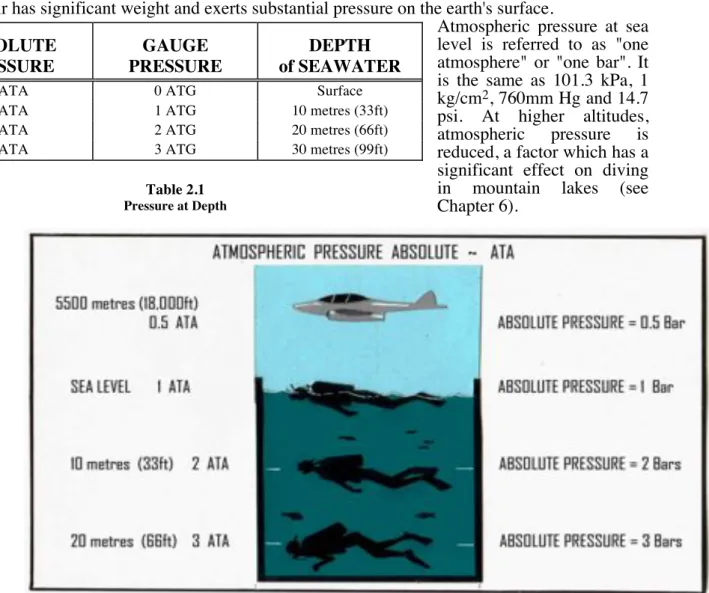
The atmosphere above the earth is some 150 km high. Although air is very light, this amount of air has significant weight and exerts substantial pressure on the earth's surface.
Atmospheric pressure at sea level is referred to as "one atmosphere" or "one bar". It is the same as 101.3 kPa, 1 kg/cm2, 760mm Hg and 14.7 psi. At higher altitudes, atmospheric pressure is reduced, a factor which has a significant effect on diving in mountain lakes (see Chapter 6).
Fig. 2.2 Atmospheric and Hydrostatic Pressures (depth) added and thus converted to Absolute Pressure
ABSOLUTE GAUGE DEPTH
PRESSURE PRESSURE of SEAWATER
1 ATA 0 ATG Surface
2 ATA 1 ATG 10 metres (33ft)
3 ATA 2 ATG 20 metres (66ft)
4 ATA 3 ATG 30 metres (99ft)
Table 2.1 Pressure at Depth
Chapter 2 — 3 Water is much denser than air and 10 metres (or 33 ft) of sea water exerts the same pressure (weight) as the whole 150 km of atmospheric air i.e. 1 ATA. For every additional 10 metres the diver descends, the water will exert a further pressure, equivalent to another atmosphere (1 ATA).
Common units of pressure (approximately):
1 ATMOSPHERE = 10 metres sea water = 33 feet sea water = 34 feet fresh water = 1 kg/cm2
= 14.7 lbs/in2, psi = 1 bar
= 101.3 kilopascals, kPa
= 760 millimetres mercury, mm Hg.
Absolute Pressure
The total pressure exerted on a diver at depth will be the pressure due to the atmosphere acting on the surface of the water (atmospheric pressure) plus the pressure due to the depth of the water itself (hydrostatic pressure).
The total pressure acting on the diver is termed the "absolute pressure". It is often expressed in terms of atmospheres and is called "atmospheres absolute" or "ATA".
To calculate the absolute pressure acting on a diver at a given depth in terms of atmospheres, divide the depth in metres by 10 (since every 10 m. sea water exerts 1 atmosphere pressure) and add 1 (the pressure of the atmosphere above the water).
e.g. the absolute pressure at 40 metres is [40 ÷ 10] + 1 = 5 ATA
(The depth in feet, divided by 33 + 1 also calculates absolute pressure, for those in the USA, e.g. the absolute pressure at 99 ft is 99/33 +1 = 4 ATA).
Chapter 2 — 4 Gauge Pressure
As described above, hydrostatic pressure in diving is generally measured by a pressure or depth gauge. Such a gauge is normally set to register a pressure of zero at sea level and so it ignores the pressure due to the atmosphere (1ATA).
The pressure registered by a gauge at 10 metres sea water depth would thus be one atmosphere gauge (1ATG) or equivalent units. Gauge pressure is converted to absolute pressure by adding 1 atmosphere pressure.
Partial Pressure
With a mixture of gases, the proportion of the total pressure contributed by each of the gases is termed its partial pressure (its part of the pressure). The partial pressure contributed by each gas is proportional to its percentage of the mixture. Each gas contributes the same proportion to the total pressure of the mixture, as is its proportion in the composition of the mixture.
e.g. air at 1 ATA contains 21% oxygen, hence the partial pressure of oxygen is 0.21 ATA and air at 1 ATA contains 78% nitrogen, hence the partial pressure of nitrogen is 0.78 ATA.
GAS LAWS
Gases behave in nature and in diving according to several laws. Knowledge of these laws is important to the diver because they influence the duration of the air supply and affect the gas containing spaces in the body such as the ears, sinuses and lungs. They also cause other diving illnesses.
Boyle's Law
This defines the relationship between pressure and volume. It states that the volume of a given mass of gas varies inversely with the absolute pressure (if the temperature remains constant).
Stated simply, for a given amount of gas, if the pressure is increased, the volume is proportionally decreased and vice versa. This means that if the pressure is doubled, the volume is halved and vice versa.
Stated mathematically: V varies as 1 (where V = volume and P = pressure) P
It follows that for a given amount of gas, the volume multiplied by the pressure always has a constant value.
i.e. P ! V is constant.
So if a sample of gas has an original volume of V1 and an original pressure of P1, and either the pressure or volume are changed, the new volume V2 and the new pressure P2 will multiply out to the same value.
i.e. P1 ! V1 = P2 ! V2
Chapter 2 — 5 This law can easily be demonstrated by a piston and cylinder such as a bicycle pump. If the piston is pushed into the cylinder half way, and the escape of gas prevented, the pressure in the cylinder will be found to have doubled. By this process, many litres of air can be crammed into a bicycle tyre but at the cost of an increase in pressure in the tyre (and hard work).
Compressors work in this way, squeezing 2000 or more litres of air into a scuba cylinder – but at a high pressure.
Since water pressure increases with depth, the consequent reduction in gas volume becomes very important to the diver because his body has numerous air spaces.
Descent Problems: The air in the diver's middle ear and sinuses will contract in volume as the diver descends. If these volume changes are not compensated for by adding more air ("equalisation"), then pressure damage (barotrauma) to the tissues will result. For example:
If a 6 litre bag is filled at the surface (1 ATA) and taken to 20 metres depth (3ATA), the volume will be reduced by a factor of 3, to 2 litres.
P1 ! V1 = P2 ! V2
" 1 ! 6 = 3 ! V2 i.e. V2 = 2 litres
Chapter 2 — 6 Fig. 2.5
In the same way, if a breath-hold diver takes a full breath at the surface and descends to 20 metres (3 ATA), the volume of air in his lungs may be reduced from 6 litres to 2 litres. The chest and lungs cope with compression better than distension. The limit for breath-hold diving is not known, but now has been shown to exceed 150 metres in certain individuals.
Ascent Problems. An average male diver's lungs may contain about 6 litres of gas. If a diver takes a full breath at 20 metres (3 ATA) from his scuba set and returns to the surface (1 ATA) without exhaling, the volume of gas in his lungs will increase from the 6 litre total lung capacity to 18 litres (6 ! 3 litres).
This can be easily calculated this way:
P1 ! V1 = P2 ! V2
P1 = 3 ATA, V1 = 6 litres, P2 = 1ATA , V2 = ? litres
V2 = P1 ! V1 P2
= 3 ! 6
1
= 18 litres
The lungs would have to expand to 18 litres to accommodate this volume – well beyond their rupturing point, causing burst lung (pulmonary barotrauma of ascent).
An important practical observation of Boyle’s Law is that the greatest volume changes take place near the surface. This means that the greatest danger from barotraumas is near the surface — and this applies with descent as well as ascent.
Chapter 2 — 7 For example, if diver has a maximum of 4 litres of air in his lungs at 40 metres depth (5 ATA) and ascends 10 metres without exhaling (to 4 ATA), the volume in the lungs will increase to 5 litres:
P1 ! V1 = P2 ! V2 5 ! 4 = 4 ! V2 " V2 = 5 litres
Some people could possibly accommodate this expansion without lung damage.
If the same diver started at 10 metres depth (2ATA), and then ascended 10 metres to the surface (the same ascent distance as before), without exhaling, the pressure would change from 2ATA to 1ATA. The air in the lungs would expand from 4 to 8 litres. This would rupture his lungs.
Although the dives involved the same ascent distances, the volume change, and hence the danger, in response to Boyle’s Law, is much greater near the surface.
Many divers are not aware of this and have a fallacious belief that if they confine their diving to shallow depths they will minimise the risk of barotrauma.
Buoyancy compensators are similarly affected by depth changes in response to Boyle's Law.
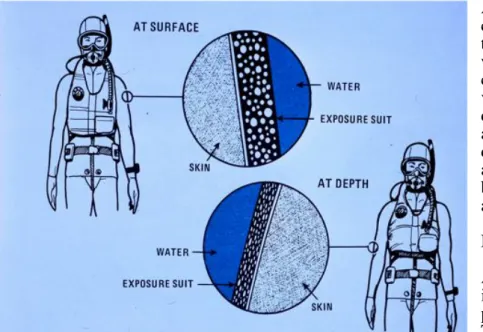
Wet suits are also affected and lose their buoyancy and insulating properties with depth.
Chapter 2 — 8 Charles' Law
Most divers will have noticed that bicycle pumps and air compressors become hot during use.
As the volume of gas is compressed, heat is produced. This is explained by Charles' Law.
This Law states that if the pressure remains constant, the volume of a given mass of gas varies directly with the absolute temperature (absolute temperature is obtained by adding 273 to the temperature in degrees Celsius).
In other words, at a fixed pressure, if gas is heated it expands, and if gas is cooled its volume contracts.
Fig 2.7
Charles' and Boyle’s laws can be combined into the General Gas Law : PV is constant T
For the non-mathematically minded this means that for a given amount of gas, the pressure multiplied by the volume, divided by the temperature, always comes to the same value – so if one of these factors is varied, it has an effect on the other two.
If a gas sample having P1V1 has one of these factors changed, T1
the new set of values P2V2 will multiply out to the same answer T2
i.e. P1V1 = P2V2 T1 T2
Chapter 2 — 9 Stated in another way; if a gas is compressed, its volume decreases and it gets hotter. If the gas is heated and the volume is prevented from expanding, the pressure rises.
The consequence of this law has lead to the demolition of several perfectly good automobiles (and divers!) following the storage of full scuba cylinders in the boot (trunk) in hot weather.
Similarly, inflatable dive boats are often pressurised to the maximum and are then left in the sun. As the temperature rises, the pressure of the contained air progressively increases and then suddenly reduces – when the volume increases and when the boat explodes.
If gas is allowed to expand rapidly, it cools. Cooling from the expansion of previously compressed air, as it is breathed from a scuba cylinder, can lead to the regulator freezing up during cold water diving.
Problem: If the temperature of a scuba cylinder is 37˚C after being disconnected from the compressor.
Its pressure gauge reads 199 ATG, what is the pressure after it has cooled to 17˚ C?
P1V1 = P2V2
T1 T2
now because V1 and V2 are the same (the cylinder volume is unchanged), the equation can be written:
P1 = P2 T1 T2
and this can be rearranged to:
P2 = P1T2
T1
Substituting the figures: (note that the cylinder pressure is in ATG and needs to have 1 atmosphere
added to get ATA, also that the temperatures have to be converted to degrees absolute by adding 273 degrees)
" P2 = (199+1) ! (273+17)
(273+37)
= 187 ATA
Chapter 2 — 10 Dalton's Law
With a mixture of gases, the total pressure exerted by the mixture, is the sum of the pressures that would be exerted by each of the gases if it alone occupied the total volume. That is, the total pressure is the sum of the partial pressures.
As the overall pressure increases (with descent underwater), so the partial pressure of each constituent gas increases.
e.g. if air contains approximately 21% oxygen (O2) and 78%
nitrogen (N2), then in a sample of air at a given pressure, O2 will contribute 21% of the total pressure and N2 will contribute 78%.
Fig. 2.9
At atmospheric pressure the partial pressure of O2 in air is 21
/
100 of 1 ATA. = 0.21 ATA while the partial pressure of N2 is 78/
100 of 1ATA = 0.78ATA.To calculate the partial pressure of a gas, multiply the percentage of gas by the absolute pressure.
This law is important when considering the toxic effect of gases at depth or the use of O2 for treatment purposes.
Problem: Since O2 can cause convulsions when breathed at greater than 1.8 ATA, would it be safe to breathe a mixture of 50% O2 and 50% N2 at 30 metres (4 ATA) ?
The partial pressure of O2 = 50% ! 4ATA = 2ATA
This oxygen / nitrogen mixture would be potentially toxic at this depth.
100% O2 may be breathed here, but may become toxic
AIR BREATHING
Chapter 2 — 11 Henry's Law
This law describes the dissolving of gas in a liquid and states that the quantity of gas which will dissolve in a liquid at a given temperature is proportional to the partial pressure of gas in contact with the liquid. This means that if the pressure of gas exposed to a liquid increases, then more gas will dissolve in the liquid.
Fig. 2.10
This diagram shows how more gas molecules are dissolved in a liquid as the pressure of the gas exposed to the liquid is increased from 1 to 2 ATA.
An example of this law can be seen whenever a fizzy soft drink bottle is opened. During the manufacture of these drinks, carbon dioxide is dissolved in the liquid under pressure and the lid on the bottle maintains the pressure. When the bottle is opened and the pressure released, the liquid will not allow as much gas to be dissolved and so the excess gas is released from solution in the form of bubbles.
At sea level (1ATA) the human body contains approximately 1 litre of N2 dissolved in the tissues. Whenever a diver breathes compressed air at depth, more N2 will dissolve in the body because the partial pressure of N2 in the air being breathed is increased. This is the cause of nitrogen narcosis.
Under certain circumstances, when the diver returns to the surface this N2 can come out of solution in the form of bubbles.
These bubbles cause tissue injury which is the basis of decompression sickness ("bends").
Fig. 2.11
Chapter 2 — 12 Diffusion of Gases
If a diver were to pass wind in a confined room, all the occupants of the room would soon be aware of the fact but, fortunately, not necessarily the source.
This process of distribution of gas is termed diffusion. It is caused by the rapid random movement of gas molecules to all parts of a contained space. Gas molecules, being only single or small groups of atoms, are able to easily diffuse through watertight membranes such as blood capillaries or cell walls. This process allows O2 and other gases to pass from the lungs to the blood and tissues, and then back.
GASES OF IMPORTANCE TO DIVERS
Air
Air consists of a mixture of O2 + N2 + a trace of carbon dioxide (CO2), and minute amounts of rare gases. Rare gases such as Neon (Ne), Argon (Ar) and Xenon (Xe), and Hydrogen (H2) exist in trace amounts only.
The approximate composition of air is:
Oxygen (O2) — 21% by volume Nitrogen (N2) — 78% by volume Carbon Dioxide (CO2) -- 0.04% by volume Others -- < 1 % by volume
Some less reputable suppliers of air fills for scuba tanks provide free additives to the compressed air, such as dust, oil, hydrocarbons, rust, water vapor and carbon monoxide (CO).
Oxygen – O2
This is a colourless, odourless, tasteless gas which is indistinguishable from air to breathe.
It is essential for metabolism and maintenance of life yet in quantities exceeding those in air it is toxic to man. Its proportion in air (21% or more specifically, a partial pressure of 0.21 ATA at sea level) is critical. A little more than this causes O2 toxicity, a little less will not support human life. For this reason most gas mixtures breathed by deep divers contain an inert gas – usually either N2 or helium (He), mixed with O2 to ensure that the O2 composition is maintained at a partial pressure close to 0.2 ATA (0.16 – 0.40 ATA).
Chapter 2 — 13 O2 supports combustion vigorously and can cause normally non-flammable substances (such as the occupants of a recompression chamber) to burn brilliantly if it is present at a sufficiently high partial pressure.
Divers should be aware of the potentially explosive and combustible properties of oxygen, as they may require to use it in first-aid, or be inadvisably enticed into diving with high oxygen mixtures.
Nitrogen – N2
This gas, which is the major constituent of air, is also colourless, odourless and tasteless. N2 dissolves well in body fluids and tissues, causing narcosis at depth and decompression sickness when it bubbles out of solution, after ascent.
It is termed an "inert gas" because it does not take part in human biochemical processes. The Creator appears to have included this gas in air to prevent us from developing O2 toxicity, and to reduce the fire hazard.
Divers vary this N2/O2 ratio (in Nitrox, oxygen enriched air or mixed gas diving) in an attempt to improve on nature, extend diving durations, and reduce narcosis.
Carbon Dioxide – CO2
This gas is also colourless, odourless and is said to be tasteless.
However if a diver inhales a mouthful of CO2 from a buoyancy vest inflated from a CO2 cartridge it will be found to taste very nasty, due to its formation of carbonic acid in water.
CO2 is a by-product of cellular metabolism and we exhale approximately 5% of CO2 in our breath.
If a diver rebreathes some of his exhaled gas by using faulty breathing equipment or an excessively long snorkel the CO2
will accumulate in the body leading to toxicity. These effects are discussed further in Chapter 22.
Carbon Monoxide – CO
This gas is colourless, odourless and tasteless. It cannot be detected by a diver and even in trace amounts can cause loss of consciousness or death.
It is usually produced as a product of incomplete combustion of carbon containing compounds and is a constituent of internal combustion engine exhausts and cigarette smoke.
Chapter 2 — 14 Air contaminated by carbon monoxide, if supplied in scuba cylinders or by surface supply to divers, may have lethal results (see Chapter 23).
Helium – He
This is a colourless, odourless, tasteless gas, which is very light and very expensive. It is obtained from underground natural gas sources found in North America and elsewhere.
It is used to dilute O2 in gas mixtures breathed at great depths because it has little tendency to produce narcosis (e.g. Heliox may be 90% He + 10% O2, or any other proportion).
Due to its very low density it readily escapes through small leaks in pipes and valves making it difficult to retain. It is also a very effective conductor of heat, causing serious problems with hypothermia.
The low density of He alters the normal process of speech production causing "Donald Duck"
like speech when a diver breathes this gas.
Hydrogen – H2
This is a very lightweight gas that can replace N2 to reduce narcosis at depth. Unfortunately it can combine explosively with O2 and the resultant water (H2O) is not sufficient to 'put out the diver'. It is sometimes used with very low O2 percentages, at great depths, by skilled professional divers. It shares many problems with He.
Inert Gases:
Neon – Ne, Argon – Ar, Radon – Rn, and Xenon – Xe
These are more biologically inert gases which are present only in trace amounts in the atmosphere. They are of no importance to recreational divers.
Oil Gases
Because of lubrication needs in the compressor, oil vapors and hydrocarbons can be produced which may then contaminate the air supply. See Chapter 24.
Chapter 2 — 15
BUOYANCY
It is important for divers to understand the factors affecting buoyancy. These are:
Density
Density is defined as mass per unit volume (density = mass ÷ volume).
For our purposes, mass can be considered to be the same as weight, so density is equivalent to weight per unit volume.
A substance is more dense than another if the same volume has more weight. Try lifting a bucket of water and then a bucket of lead, to illustrate this.
Specific Gravity
Specific gravity (S.G.) is the density of a substance compared to the density of fresh water which is given a value of one.
Lead has a specific gravity of 13.5 so it is 13.5 times as dense as water.
e.g.1 litre of water will weigh 1 kg., while the same volume of lead will weigh 13.5 kg.
The concept of specific gravity is important since the specific gravity of a substance determines whether it will float or sink in water.
A substance with a specific gravity greater than 1 (i.e.
denser than water) will sink. Lead, with a specific gravity of 13.5, does not float well, whereas oil, with a specific gravity of 0.8, floats easily — producing an oil slick.
The human body has a specific gravity of slightly greater than 1, depending on its content (fat has a specific gravity less than 1, and bones are greater than 1) but the air content of the lungs provides enough buoyancy to allow most people to float.
Chapter 2 — 16 Archimedes Principle
The ancient Greek, Archimedes (apparently while reclining in his bath), discovered that when an object is immersed in a fluid, it appears to be lighter, and that the apparent loss of weight (or buoyancy) is equal to the weight of water displaced by the object.
That is – the buoyant effect will be equivalent to the weight of fluid of equal volume to the immersed object.
Depending on whether the weight of fluid displaced is greater than, equal to or less than the weight of the object, an object immersed in the fluid will either float, remain suspended or sink. Even an object which sinks will still appear to be lighter than it would out of the fluid.
Sea water is denser than fresh water because of the salt content, so a greater weight of sea water will be displaced by an object.
Hence objects in sea water are more buoyant than in fresh water.
Air (in the abdomen, buoyancy compensator and wet suit) contributes to buoyancy.
Unfortunately air in these compartments varies in volume in response to the pressure changes with varying depth, making constant buoyancy adjustments necessary. This is usually accomplished by adding air to, or releasing it from, the diver's buoyancy compensator.
Divers go to considerable lengths to vary their buoyancy to help them submerge, to stay at a given depth, or to ascend or stay afloat in an emergency.
PHYSICAL EFFECTS OF THE ENVIRONMENT
Temperature
Body heat is a form of energy, the level of which can be estimated by measuring the body temperature.
Heat energy flows from areas of high temperature to areas of low temperature. The heat transfer which is important to the diver is thermal conduction (or transfer of heat by direct contact), and may cause hypothermia (low body temperature).
Since normal body temperature is 37°C and oceanic water temperature is commonly 12–20°C, the diver is almost always immersed in water at a lower temperature than his body. Usually
Chapter 2 — 17 the water temperature decreases with depth, but there may be layers of water at different temperatures (thermoclines) – especially in still water.
Cold water creates a strong temperature gradient along which heat flows from the body, resulting in a continuous heat loss into the water. This process is assisted by water having a high capacity to conduct and absorb heat.
Since the maintenance of normal body temperature is essential for physiological functioning, the diver needs to take steps to minimise heat loss. This may be achieved by inserting a layer of air (which is a poor conductor of heat) between the diver and the water. It is conveniently contained in minute cells in a wet suit or under a rubber skin in a dry suit.
Light and Colour
Substances that transmit light have a tendency to slightly alter the path of the light rays which pass through them. This process is termed refraction. The degree to which they do this is termed the refractive index. Each time light passes through an interface between substances with different refractive indices, its path is bent.
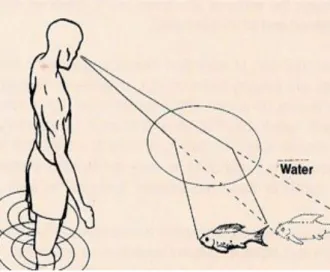
When a diver views objects underwater, light must pass through the water, the face mask glass, and the air in the mask before it reaches his eyes. The light rays are refracted at each of these interfaces and the distortion makes objects appear larger and closer by a factor of about 25%.
Until the diver adapts to this distortion, it may be difficult to judge size and distances.
This creates practical difficulties with simple tasks such as spear fishing.
Light rays are scattered by particles in the water making shadows less pronounced and reducing the ability to see clearly over large distances.
Fig 2.15 The fish appears closer, because the light rays are refracted at the air/water interface
Clear focusing of the eye depends heavily on the refraction of light rays passing between the air in front of the eye and the cornea (the clear surface at the front of the eye). If the eyes are opened underwater without a face mask, the absence of this air/cornea interface results in very blurred vision.
Water absorbs colours to differing degrees. In clean oceanic water, red is absorbed in the first metre, orange in the first five metres, yellow in the first ten, and green and blue at greater depths. This explains why most things, regardless of their colour on the surface, appear to be coloured shades of blue or green at depths beyond about ten metres.
Inshore waters often contain yellowish products of vegetable decay which absorbs most colours except green. As a result, clean oceanic water appears blue, while inshore and estuarine water appears green from the surface.
Because deep water is lit mainly by blue and green light, coloured corals and fish at these depths look less brilliant unless illuminated by a torch or camera flash.
Chapter 2 — 18
For safety reasons, it is advisable to wear conspicuously coloured diving equipment.
However, the absorption of light underwater needs to be considered when choosing these colours. Red, for instance, which is easily visible on the surface, appears black at depth because of the significant absorption of red light by the water.
Fluorescent orange or yellow paint or fabric affords better visibility because the fluorescent dye actively emits light of its own colour and also provides a good contrast against natural aquatic backgrounds.
Sound
Sound waves in air are usually reflected at the air–water interface, and therefore shouting instructions to submerged divers is not of much value. Underwater, the sound wave travels much faster than in air, and this makes localisation of the source much more difficult. An example of this is the concern experienced when divers hear outboard engines, but cannot identify the distance or direction of the boat.
Altitude
If exposed to altitude (less than 1 ATA) a variety of effects may endanger the diver. Some equipment may be affected e.g. pressure gauges, and the diving profile needs to be modified to prevent pulmonary barotrauma and decompression sickness (see Chapter 6).
Chapter 3 — 1
Chapter 3
All chapters, full text, free download, available at http://www.divingmedicine.info
PHYSIOLOGY*
A basic understanding of the bodies’ processes is needed to grasp the physiological effects of diving and the application of diving medicine. The cardiovascular and respiratory systems are described here while the physiology of some other organs, such as the ear, are considered in specific chapters.
METABOLISM
The Need for Energy
Energy is a fundamental requirement for all life processes. It is needed for growth, repair, movement and all the active functions of the body. The fuel for this energy comes from carbon compounds, which are incorporated in complex molecules in the food we eat. This is biochemically dismantled in the digestive tract into simple chemical compounds which are absorbed and carried by the blood stream to the cells. Here they undergo further biochemical processing until ultimately the carbon is combined with oxygen (O2), forming carbon dioxide (CO2) and releasing energy.
This is similar to the energy formation which takes place in an automobile engine or a fire, where carbon in fuel or wood is combined with O2 to produce energy. The body processes will only function under strict conditions of O2 availability, temperature and acidity.
The body needs a means of transferring food products to the cells, together with delivery of O2
and removal of CO2. This is performed by the blood, in the vascular system. It comprises arteries which take blood to the tissues, a vast network of microscopic capillaries that bring the blood into contact with all the cells of the body, and veins which return blood to the heart.
The blood is circulated through the blood vessels by a muscular pump – the heart, and the whole system is called the cardiovascular system. It brings O2 from the lungs to the cells and eliminates CO2 through the respiratory system.
* Reading this chapter can be delayed if time does not permit, and the reader is in a hurry to commence diving
Chapter 3 — 2
RESPIRATION
Anatomical Structure
The respiratory tract begins at the mouth and nose and ends in the microscopic air sacs called the alveoli, in the lungs.
The nose, apart from its decorative function, warms and humidifies the air that we breathe. It also filters large particles which might otherwise be inhaled. If the nose is bypassed by breathing through the mouth, a snorkel or scuba regulator, the lung then has to cope with drier, colder, unfiltered air.
After passing through the mouth or nose, the air then enters the throat where the larynx (or voice box) is situated. This is recognised as the "Adams Apple". The larynx produces the sounds of speech as well as helping to protect the lungs from inhalation of foreign material.
When sea-water from a flooded snorkel or scuba regulator enters the larynx, a trap-door like structure called the epiglottis closes over the opening and the vocal cords shut to prevent the foreign material from entering the lungs. If any material passes these structures, the cough reflex, activated by foreign material touching the inside of the air passages, may cause a coughing reaction which tends to expel whatever has been inhaled.
Chapter 3 — 3 Below the larynx the air passes through a tube called the trachea. This is about as thick as the average snorkel and branches inside the chest into two tubes, the bronchi, which lead to the lungs. Those air passages are lined with cells covered with microscopic hairs (cilia) which move a sheet of secreted mucous slowly upwards towards the larynx. Small pieces of foreign material such as dust eventually find their way to the larynx, along with this mucous sheet. It is then either coughed-up or swallowed. The cilia may be damaged by smoking or infection, causing retention of mucous and inhaled material which may eventually obstruct the air passages.
The bronchi divide repeatedly into progressively smaller passages rather like the branches of a tree. These passages have encircling muscles in their walls which, by contraction or relaxation, can vary the diameter of the air passage.
In asthma the muscles of the small bronchi become oversensitive and overactive, causing excessive narrowing and obstruction of these air passages. This can occur in response to exercise, allergy, cold, infection, anxiety, smoking or other inhalants such as sea water. At the same time, the cells lining these passages produce excessive and thickened mucous. The combination of these factors causes airway narrowing which has serious repercussions for a diver.
The smallest branches of the bronchi end in bunches of microscopic air sacs called alveoli. The vast number of alveoli are packed together into the two sponge like organs, the lungs. There are about 300 million alveoli in the lungs and the combined surface area of all the alveoli in the lungs is equal to about half a tennis court. The alveoli are lined by a thin layer of fluid containing a detergent-like substance called surfactant. This acts as a wetting agent to prevent the alveoli from collapsing from surface tension.
The surfactant lining of the alveoli can be damaged in disease or by inhalation of water, leading to collapse of the lungs and serious respiratory difficulty.
Each alveolus is surrounded by a network of blood capillaries. These bring the blood into close contact with the air in the alveolus, with only the microscopically thin walls of the alveolus and capillary separating the two.
Fig. 3.2
This diagram illustrates an alveolus with its surrounding meshwork of capillaries.
Chapter 3 — 4 If the wall of an alveolus is ruptured, as it may be in pulmonary barotrauma ("burst lung"), then air from the alveolus is able to enter the blood stream where it may cause blockage of distant vessels such as those in the brain. This is called an air embolism.
The lungs occupy a cavity about the size of a football on each side of the chest. The lung is covered by a thin membrane coating, called the pleura, and the inside of the chest wall is lined by a similar membrane. Between the two pleural layers is a narrow space which contains a small amount of lubricating fluid to minimise friction as the lungs expand and contract during breathing. If the outer surface of the lung tears, as it may in pulmonary barotrauma, then air can enter this pleural space causing the lung to collapse. This disorder is called pneumothorax.
The chest wall which encloses the lungs is made up of ribs with muscles between them - known as intercostal muscles. At the base of the chest cavity lies a large thin dome shaped muscle called the diaphragm. When the diaphragm contracts, it flattens and has a piston like effect, reducing the pressure in the chest cavity and increasing the volume of the lungs. The reduced pressure draws air into the lungs through the air passages.
Contraction of the diaphragm is the main method of inhalation in the resting state. It is assisted by contraction of the muscles between the ribs which rotate the rib cage upwards and outwards, enlarging the chest cavity and reducing the pressure in the chest. A group of neck muscles which are attached to the rib cage can also assist respiration when maximal breathing is required.
At the end of inhalation the elasticity of lungs and rib cage causes the lungs and chest wall to contract and exhalation takes place. With quiet breathing, this does nor require muscular effort.
With heavy breathing, exhalation can be assisted by the abdominal and chest muscles.
Respiratory Function
During quiet respiration in adult males, about 500 ml of air is moved in and out of the respiratory tract with each breath. The volume per breath is termed "tidal volume". During extremely heavy exercise, the tidal volume can increase 10 fold, up to about 5 litres.
The total amount of air that can be held in the lungs (total lung capacity or TLC) in adult males is approximately 6 litres. Only about 10% of the air in the chest is exchanged with each breath during quiet respiration. The vital capacity (VC) is the maximum volume that can be exhaled in one breath, and the forced expiratory volume (FEV1.0) is the maximum volume that can be exhaled in one second.
The flow of air through the respiratory passages varies at different stages of respiration. It reaches a peak about midway through inspiration — and during quiet breathing this peak flow rate is approximates 30 litres per minute. This value increases during exercise to 600–700 litres per minute.
Any breathing system (such as a snorkel or demand valve) which the diver is using, should be capable of handling these large air flows without significant resistance. If this does not occur, then the diver must exert extra effort during respiration in order to overcome this resistance. This problem is compounded when the diver is breathing compressed air at depth because the increased density of the gas will further increase the resistance to airflow in both the equipment and the lungs.
Chapter 3 — 5 Gas Uptake and Loss
Air, which contains approximately 21% oxygen (O2) and 78% nitrogen (N2), is inhaled into the alveoli where it is brought into contact with the blood in the capillaries. This blood contains a lower partial pressure of O2 than the air in the alveolus and a higher partial pressure of CO2, since it has just returned from the body, which has been using O2 and generating CO2. Consequently, there is a pressure gradient causing O2 to diffuse from the alveoli to the blood, and CO2 to diffuse from the blood to the alveoli, where it is then exhaled. There is no net movement of N2 since the N2 in the alveoli and in the blood is in equilibrium, except when diving, altitude exposure or breathing different gases.
If the diver breathes air (78% N2) or another inert gas such as helium, while descending or remaining underwater, this inert gas will pass from the alveoli to the blood because the partial pressure of the gas in the lungs is increasing as the diver goes deeper.
On ascent, the partial pressure of inert gas in the lungs will reduce, and this allows inert gas to move from the blood (returning from the tissues) to the alveoli, and be exhaled.
Respiratory Control
The partial pressures of CO2 and O2 in the blood are kept within very strict limits by a sensitive control system. There are sensors in the brain which detect small changes in the blood CO2. If this increases, then the sensor causes stimulation of the respiratory centre within the brain, leading to faster and deeper respiration to eliminate more CO2.
When a snorkel diver holds his breath, the CO2 level in his blood increases. This produces respiratory stimulation which compels the diver to take a breath — hopefully after he has had time to return to the surface.
The sensors for blood O2 pressure are in the carotid arteries which supply the brain. A reduction in the blood O2 level also leads to respiratory stimulation, but this effect is not as powerful as that caused by CO2 changes.
Smoking
The ingenious habit of rolling tobacco into a tube of paper, setting fire to it and inhaling the smoke, sabotages the complex respiratory and circulatory process at several points.
As well as predisposing to lung cancer and emphysema, noxious tars in the smoke precipitate out in the bronchi producing chronic irritation, narrowing of the bronchi and cause a persistent outpouring of mucous. This ultimately results in chronic bronchitis. The tar also poisons the cilia, which conduct the mucous up the airway to the larynx, resulting in retention of old mucous in the lungs (smell the breath!).
Various toxins in the smoke ultimately cause destruction of the alveolar walls producing cavities in the lungs and destruction of the lung architecture, resulting in the disease called emphysema.
This, combined with obstruction of the air passages, makes the smoking diver less physically fit and more liable to air trapping in the lungs and pulmonary barotrauma (see Chapter 11).
The carbon monoxide content of the smoke reduces the capacity of the blood to carry O2, thereby reducing oxygenation of the tissues.
Chapter 3 — 6 Some of the chemical constituents of the smoke are absorbed into the blood stream producing changes in the walls of the blood vessels supplying the heart, brain and limbs. Ultimately these become obstructed. In later life this can cause heart attacks, strokes and peripheral vascular disease (gangrene).
CARDIOVASCULAR SYSTEM
Blood
Arteries take blood from the heart. Veins return blood to the heart. Arterial blood (which has absorbed O2 as it passed through the lungs), is then pumped to the periphery by the heart and is brought close to all the cells in the body by the capillary system. Here the O2 diffuses into the cells and the CO2 diffuses out of the cells into the blood.
The blood transports O2 and CO2. The O2 is mainly carried by an iron containing compound called haemoglobin (Hb) contained in the red cells. 100 ml of blood will transport approximately 20 ml of O2. If the red blood cells are removed, blood plasma (the liquid part of blood) will transport only 0.3 ml of O2 per 100 ml blood. A drop of blood contains approximately 300 million red cells.
In arterial blood, the haemoglobin is almost 100% oxygenated when the blood leaves the heart to go to the tissues. It is bright red in colour. If for any reason the arterial blood is not adequately oxygenated, it causes the blue colour of the skin and tongue (cyanosis) seen in hypoxia (see Chapter 20).
Fig. 3.3
A diagram showing the relationship between the circulations produced by the right and left sides (ventricles) of the heart.
HEART LUNGS
BODY