Michael supported all the decisions that ultimately cost extra time and money, but resulted in a better book. The Citizen Kane art from which the reproductions were taken is in the Rare Books and Special Collections Library at the University of Illinois.
Visualization: The Process
Elements of The Continuity Style
The Workshop
The Moving Camera
I NTRODUCTION
In all cases, I have critiqued the cases in the first person, expressing my opinion rather than stating undisputed facts. For me, sequence design, like writing, is one of the greatest joys of narrative filmmaking.
A BOUT THE P HOTOGRAPHSAND
S TORYBOARDS U SED IN THIS
B OOK
Visualization
The Process
1 V ISUALIZATION
The Continuity Style
In the future, this will likely allow filmmakers to further expand the range of the continuity style. But what happens when he is presented with an empty frame representing the first shot of the same scene.
2 P RODUCTION D ESIGN
The next phase of development in the art department occurred in the 1920s with the rise of German cinema. The preeminence of art director continued throughout the sound period until a new title was invented for his expanded responsibilities.
Production Illustration
Menzies helped elevate the production designer to the inner circle of the production team, joining the director, cinematographer, editor and, in some cases, the writer as one of the principal shot and sequence designers in the film.
Concept and Final Design Illustrations
For the illustrations are the photographs of the sets as they appeared in the films. Since The Purple Rose of Cairo contained a film within a film, Wurtzel had to create both the real world of the mid-30s and.
Architectural Drawings
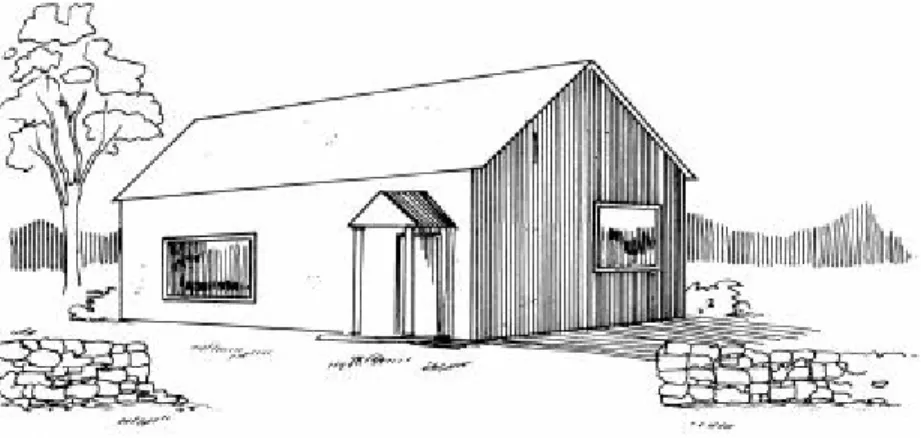
There are four basic types of architectural illustrations used in production design: plan, elevation, section, and projection.
Plans, Sections and Elevations
Projections
This means that parallel surfaces in the object are also drawn parallel in the drawing. Using Abbott's projection, the production designer, director and cameraman would know exactly what the camera set would look like for the lenses specified in the drawing.
Models
When a projection drawing is fully rendered like the Harlem Nights concept, it is one of the most powerful tools available to the art department and director. If you are interested in learning to design from plans and elevations or from photographs, Appendix I contains a complete explanation of the Michelson method.).
Continuity Sketches and Storyboards
The artistic director worked out the scenography and costumes and the continuity of the picture, assisted by the staff artists. The myth that films are made by directors on set often begins with the director and is perpetuated by critics, reviewers, film historians and the publicity departments of distribution companies.
3 STORYBOARDS
Storybooks are only a tool and do not necessarily reflect any style or content other than that which the individual filmmaker wishes to portray. It is true that the communicative value of storyboards grows with the complexity of the production, but storyboards are not limited to action scenes and big-budget productions.
The Director's Role in Storyboarding
Paul Power, one of the newer production illustrators with comic and film experience, enjoys working with a director who crafts each scene in long brainstorms. In fact, the primacy of the director was a consistent theme among all the production illustrators I spoke to.
Schedules
Even when the director has a clear plan in mind, he will encourage the storyboard artist to contribute ideas. Sometimes this involves reading the dialogue and acting out page after page of the script, with the director pausing only to make rough sketches.
Skills Required by Storyboard Artists
His involvement in the staging and dramatic concept of a film has led Power to describe the type of illustration he creates in the panels as 'acting with a pencil'. Power's defines the production illustrator's responsibility as helping the director find the means to express his vision. Because they are accustomed to refining a series through constant revisions, production illustrators recognize that there are many solutions to every problem.
In the studio days, when story artists were on staff, the average level of execution in production illustration was probably higher. While there are illustrators today who are capable of producing work equal to the best of the past, the general shift of money from below-the-line to above-the-line spending is starting to negatively impact illustration production and eventually.
Style
The basic action of the scene is quite close to the filmed version, but the camera angles and staging are very different. This is useful for both the designer and the cinematographer to communicate the technical requirements of the scene.
Materials
Pencil
Ink and Charcoal Dust
Markers
Illustrating Camera Techniques
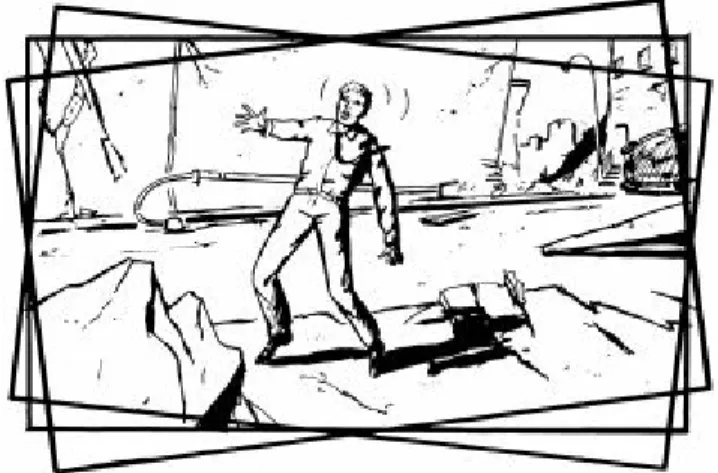
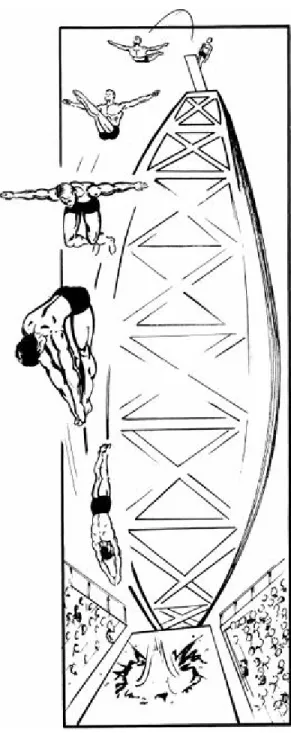
Optical effects such as blends and blurs are also beyond the illustrator's reach, as are most manipulations of depth of field and focus. Therefore, it is permissible (and often valuable) to allow the drawing to extend beyond the edges of the frame.
The Pan Shot and the Tracking Shot
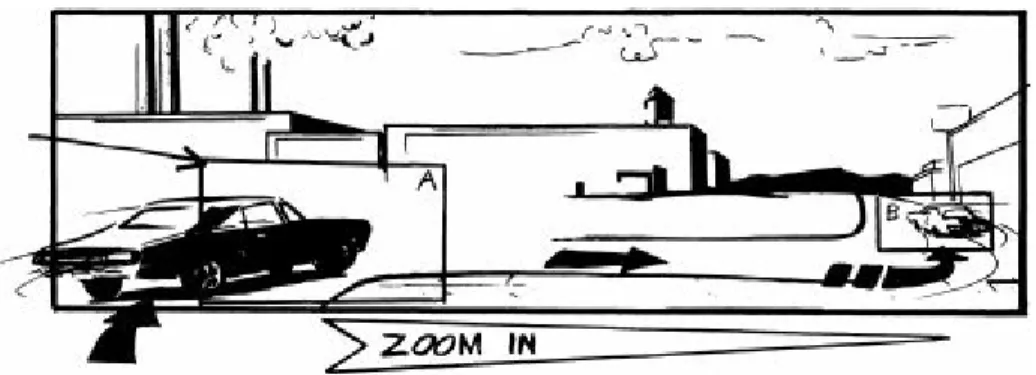
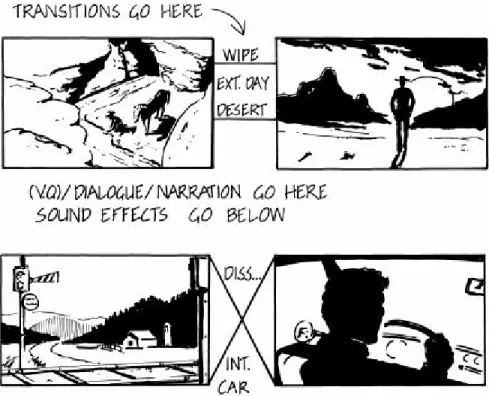
Because both camera and subject can move on film, the filmmaker will find that placing a frame of description within a larger drawing is a useful technique for illustrating the fluid compositional qualities of the medium. The arrow below the frame indicates that the camera zooms to the size of the smaller right-hand frame as the car moves right to left.
Dolly and Zoom Shots
With this type of illustration, it is difficult to determine whether the framing of the shot is a wide, medium, or close-up shot. If the lines connecting the inner frame to the corners of the outer frame were removed, it would mean that a change in shot size is achieved by taking a new shot.
Transitions Between Shots
The Crane Shot
The advantage of the notebook flippad presentation is that each panel is seen individually as a page is brought into view. He can vary the speed at which he turns the pages of the notebook to simulate editing rhythms.
Simplified Storyboard Illustration
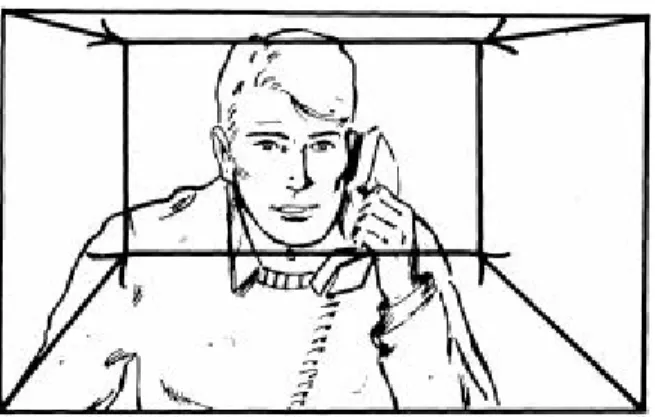
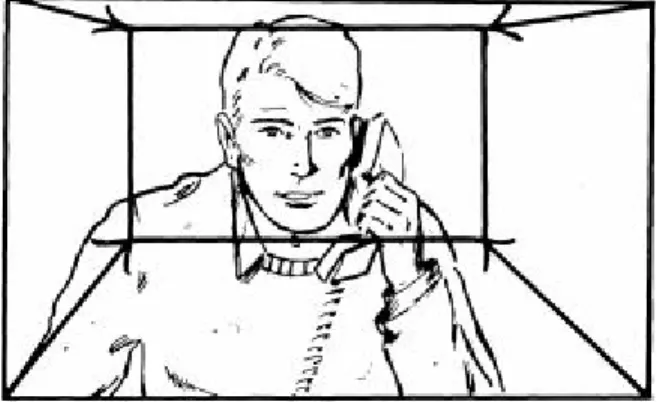
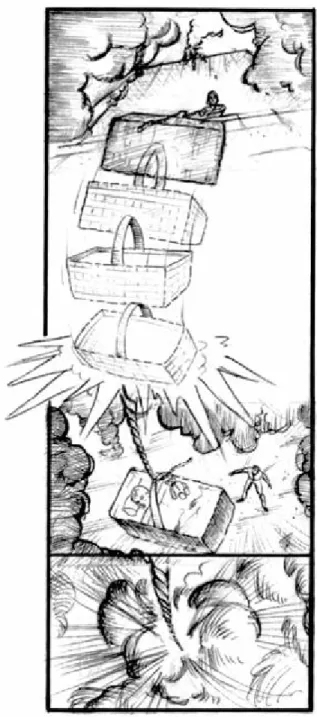
With a little extra work, arrows drawn in perspective can say a lot about the angle the director would like to see, as shown in Figure 3.12. For example, Figure 3.17 shows us how the director can try several variations until he is satisfied with the rendering of the car and the car.
Draftsmanship
Page 54 features many quick sketches drawn by Sherman Labby for Beverly Hills Cop II. Usually, drawings like those for Beverly Hills Cop II are used by the storyboard illustrator as notes for more finished versions, which are submitted later.
Mood
Character
Interpretation
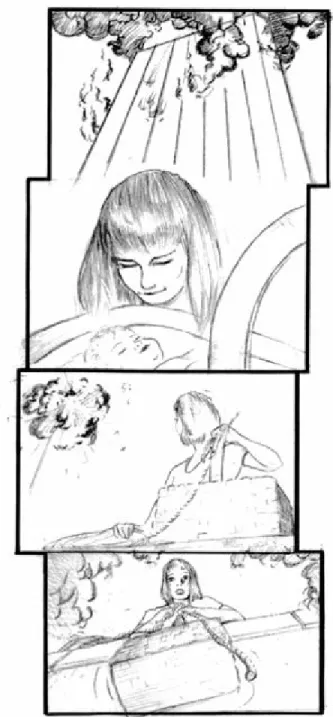
Even without knowledge of the story, the action of the boards is easy to read and the cutting rhythm is clearly established. Statement of line and compositional statement is never used as an end in itself, but is in complete harmony with the subject and narrative intent.
Adaptation
In theory, the storyboard artist merely depicts the ideas in the screenplay, but in practice the storyboard can come very close to a new version of the screenplay, if only to polish some ideas. Fortunately, we can compare different stages of the process: the novel; two drafts of the screenplay, the first draft dated January 7, 1986, by playwright Tom Stoppard and the revised third draft dated September 12, 1986, by Menno Meyjes; And,.
The Novel
The Screenplay
It turns out that the first and revised third versions of the screenplay are essentially identical. We can compare this with the storyboard, which is a fairly simple staging of the scenario.
The Sequence as Filmed
By omitting the inter-shots of Jim picking up the flashlight and going to the window, the scene is streamlined and the audience is surprised (but not confused) when Jim's signal light is above the Japanese signal in the wide shot of the river appear. Jim is reflected in two of the mirrors and his father is reflected in a third.
Seeking a Career in Production Illustration
Empire employed the talents of two production illustrators, David Jonas and Ed Verraux, who worked on the project for nearly a year. Jonas and the movie's other production illustrator, Ed Verraux, worked full-time on the project for nearly a year.
Instruction
Even if you are interested in production illustration for live action, you will probably have better luck finding instruction in the related areas of animation, as at least some art schools now offer courses in this field. Many art schools offer courses in advertising art, which include television commercial storyboarding in the curriculum.
Unions
There are also a few dedicated animation schools in the US that include design courses. Today, the craft unions in the film industry exert far less control than in the past, especially since there are so many independently produced, non-union pictures made outside of Los Angeles.
4 VISUALIZATION: TOOLS AND TECHNIQUES
Video
At one time, federal law required cable companies to provide an access channel with equipment and training for the public. Since deregulation, cable companies do not have to comply unless a separate contract has been worked out with the local municipality.
Desktop Video
If this is beyond your means, the public access channel on your local cable system probably has an editing system that is available free of charge for non-profit use. This is where the PC is carving out a very practical niche—as a description and projection system for movies and videos.
Storyboard/Animation Programs
Selected images can be compiled into a spreadsheet-like master list, edited and time-coded for playback. Storyboards can be printed out as a hard copy or displayed in motion on the computer screen.
CAD Programs
Of particular interest to the filmmaker is that the "angle of view of the lens" can be varied over a wide range (15mm and 500mm). When you return to perspective view, the room is rendered in new dimensions with the perspective adjusted correctly.
Production Management
This is a continuation of production illustrator David Jonas's several panels included in the final chapter. Visible in every panel is Jonas' ability to capture the precise moment in the action to convey the editing and dynamics of the shots.
5 THE PRODUCTION CYCLE
For their trouble, they gain a great deal of direct experience in all aspects of filmmaking craft and a degree of freedom that many star directors envy. Many of today's film school-educated filmmakers learned their craft this way and understand the filmmaking process from script to release.
PHASE ONE: SCRIPTWRITING
The film is not a conventional narrative (by Hollywood standards) and this is as much a result of the method of composition as the cause of it. On page 100, some of the storyboard panels are drawn by David Byrne, who helped shape the script.
Memory and Research
The images do not have to represent shots that the filmmaker expects to use in the film, but can be used to convey the spirit and tone of a scene to the production designer or cinematographer. Writers often develop backstories, or biographies, for their characters that describe their lives before the time frame presented in the story.
Connections
The images you find can be any type of picture that sets the tone and spirit of the scene. A similar technique uses images that represent the idea of a scene from your script, but not the specific look of the scene itself.
Sound and Music
Unsatisfied with her take on the role of missionary virgin Rosie, he suggested that Hepburn play the part as if she were Eleanor Roosevelt. For example, if your screenplay depicts two men in a midwestern bar in the 1950s, a photo of jukebox selections from that time and region will set the mood in a way that the screenplay could not.
A Visual Sketchbook
PHASE TWO
PRODUCTION DESIGN
Script Breakdown
Therefore, the director often finds himself shooting a scene from the middle and the end of a picture on the same day. Even if it only serves to inspire the director to create new shots on the set, the director will be able to see the total action of the story.
Pictorial Design
It has much in common with theater and architectural design and is usually the specific responsibility of the art director. This highly specialized craft is quite different from the successive art skills of the writer, continuity artist, director, cinematographer and editor.
Continuity Design
Patricia Von Brandenstein, production designer for many complex productions, including Amadeus and The Untouchables, is a strong advocate for the primacy of location, the physical reality of the space in front of the camera in the design process. Still others simply do not want responsibility for the visuals of the film and leave continuity decisions to the production designer, cinematographer and editor.
Location Scouting
Scrapbooks don't necessarily conflict with all of these goals, but if you don't like the tool, there's no reason to use it.
The Illustrated Script
When most of the locations are secured, I think it is very important for the creator to create an overview of the film. An "illustrated screenplay" is one way to help a filmmaker gain a sense of visual continuity throughout the film.
Overview Meetings
One way to do this is to put photos and/or concept sketches into the script that show the overall look of each scene. Because pre-production consists of an enormous amount of detail, directors tend to lose sight of the pacing, mood, and visual arc of the story that ties into the locations.
PHASE THREE
SCRIPT ANALYSIS
Creating a shot plan means describing the staging of the action, the size of the shot, the choice of lens and the camera angle. However, the director is ultimately interested in how the photographic qualities of a shot determine the narrative effect of the scene.
Shot Plan—First Draft
The following exercise is a good way to increase your awareness of the relationship between visual and dramatic elements by recasting traditional descriptions of photographs in dramatic terms. This exercise is free association and can include the director's feelings about the characters, how they are standing or what they are looking at or the look of the location.
Second Draft
- OTSLEE
- OTS GRANT
- CULEE
- CU GRANT
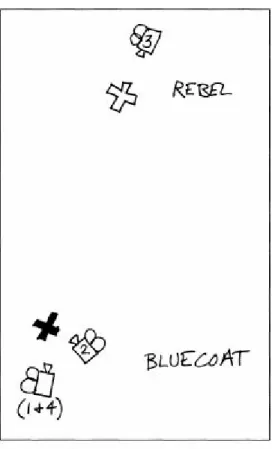
Since the director has decided to make this first shot's point of view that of the Union soldiers, the shot size/emotional distance refers to the soldiers' emotional separation from Robert E. In this way, the camera has a clear view of Lee while including many of the soldiers in the shot.
Preparing a Storyboard
When working with a dramatic scene, the director can record the dialogue in rehearsal and play it back while planning the scene. It may take several movies to greatly improve your visual memory by working with sequence art in this way, but your visualization skills will eventually sharpen.
Models and Miniatures
It also captures bird's-eye views of the miniatures, which will be helpful in later discussions with the production team. Once the director has wide-frame prints, he can draw on them with a felt-tip pen.
PHASE FOUR: CINEMATOGRAPHY
The interior walls of the actual location or set can be photographed, printed and glued onto foam core like miniature apartments. As with any visualization tool, its main function is to stimulate the imagination of the filmmaker.
PHASE FIVE: REHEARSAL
Often an evocative description is enough to give the director of photography the direction he needs. In the final weeks before shooting, the director must have an accurate understanding of the setting of his story, including sets, locations, key props, costumes and makeup.
Previewing Scenes
Evaluation of the lighting and photography can be done at this time by taking test shots of each of the design elements and making adjustments as necessary. The visualization continues, although the director has now viewed so many versions of the script that he can watch fluently.
Postproduction
Research Tools and Materials
Polaroid cameras are useful for location work, and amateur models are cheap and convenient. The advantage of older Polaroid cameras is that they allow manual control of shutter and exposure.
Scouting Kits
They specialize in rebuilding and modifying disused Polaroid cameras to accept the newer suit film. 4 Designs also builds additional features into the cameras, such as the ability for multiple exposure or connecting standard “PC” flash connectors to the shutter.
Elements of the Continuity Style
6 COMPOSING SHOTS: SPATIAL CONNECTIONS
Shot Size
Cut to a close-up of the man's hand turning the doorknob. The narrative logic and visual connection between shots work together to create a sense of continuous space.
The Close-up
In film, the use of off-center compositions becomes more common as the screen widens. Sharp off-center framing is possible in any aspect ratio, although the effect becomes more apparent the wider the screen is.
The Medium Shot
The Full Shot
One of the full shot's most attractive features is that it allows the actor to use body language. Compositionally, the long shot of a single figure offers many of the same opportunities for asymmetrical framing as the close-up.
The Line of Action
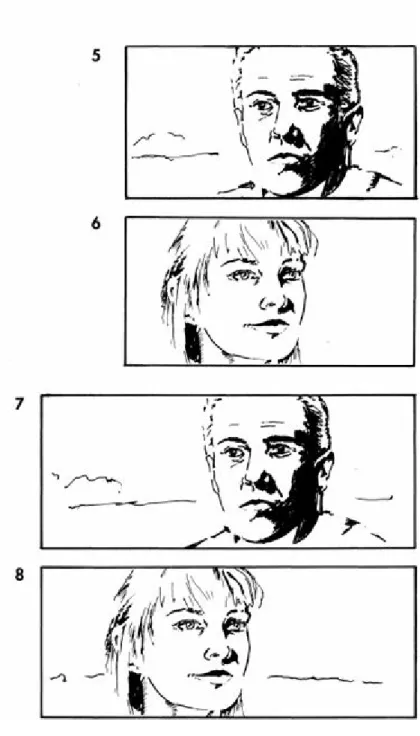
The result of this is that the screen orientation of all images obtained from one side of the line will be consistent with each other. This results in the man looking at the back of the woman's head.
The Triangle System
When the action line is in use, another convention, the camera placement triangle system, is a concise way of describing camera positions on one side of the line. Of course, the exact angle of the shot, composition and shot size are infinitely variable within the triangle as long as the line of action is not violated.
Establishing a New Line of Action With a New Sight Line
The shot plan has been adjusted so that all shots from a certain angle are consolidated even if the dialogue is shot out of order. On screen, the changing line of action may appear to follow a much more complex scheme than was actually the case.
Establishing a New Line When a Player Crosses the Line
The first part shows the line of action and the corresponding semicircular working space for the camera. The third part shows the 180 degree workspace if camera position A were used for the pan shot.
Moving the Camera Over the Line
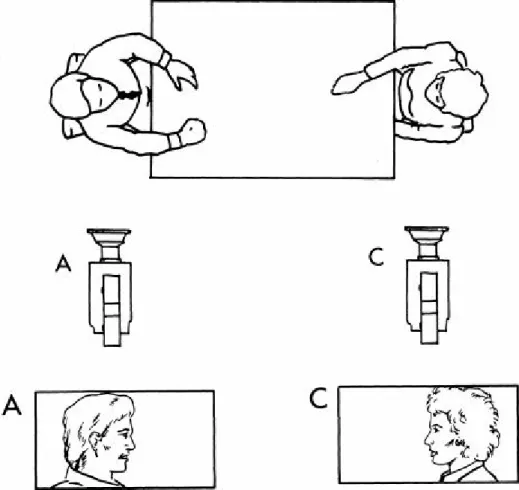
As a rule, the work area chosen for each new line of action keeps the camera in the center of the group when shooting dialogue situations at a table or in a confined space. In this situation, an eyeline does not need to be established and the camera can move from one side of the line of sight between two players to the other without confusion.
Cutaways and Bridge Shots
The Line of Action for Moving Subjects and Action
Note that more dynamic results can be obtained in some sequences if the line is crossed and the display direction is reversed. We'll take a closer look at other types of editing later, but for now, as we continue to explore the action line, keep in mind that there are alternative ways to organize your photos.
Action Sequences
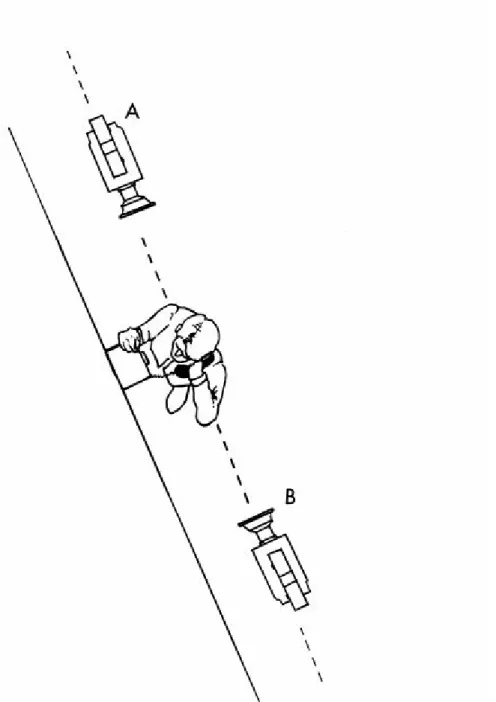
Images captured from both sides of the motion line (camera positions A, C and B, D) will result in a screen orientation change when cut together, as shown in the accompanying description panels. Implicit line of sight is a special case and only overrides the line of motion temporarily.
Crossing the Line in Action Sequences
Crossing the Line While on the Line
In Figure 6.20, camera positions A and B are on the line of action, so when they are edited together, there is a change of screen orientation. When the subject's line of sight is the same as the line of action, we get front and back shots, which help the viewer distinguish shots.
Conclusion
Each camera position shown above can be edited together without disorienting the viewer. Ten years ago, a defense of the action line would have been considered reactionary, dismissed by virtually any film movement outside of the main features.
7 EDITING: TEMPORAL CONNECTIONS
The Narrative Impulse
Spatial connections: We cut from a wide shot of the White House to a recognizable detail of the White House in a closer shot—for example, the portico and front door. Logical Connections: We cut from a wide shot of the White House to a shot of the.
Narrative Motion
President, then we make the logical connection that he is sitting in an office in the White House, even though there is no actual information presented to tell us that we are in the White House.
Q&A Patterns
We can probably think of them as background connections that establish the environment of a film, but they can also be used to shape the plot and the dramatic content. Although we don't talk about their storytelling in this way, much of what we value in the films of directors like Buñuel, Hitchcock, Godard, Welles and Truffaut are the ways in which they develop question and answer patterns that challenge the viewer.
Context
Using the Patterns
At this point in the story we haven't seen Tom and so we don't know what he looks like. However, at this point we haven't seen her in the story and don't know what she looks like.
More Q and A Variations
In this case, the look in the first shot will usually be answered by a shot from the gun. But frame 2 also raises the question of the significance of the pool of black ink on the floor.
The Limits of Clarity
This answers the question of the man's identity as we now know it is the man with the missing finger, but a new question is raised: Why was part of the letter carefully removed. However, if the introduction to the theater is composed of separate shots that raise questions, then the viewer is connecting these pieces to form a meaningful statement.
Camera Cutting vs. Coverage
He would probably shoot a medium and close-up of the father and the same schematics of the children. He would probably also shoot a three-shot OTS of the children and a reverse OTS of the father.
Composing Action for Editing
Although everyone on the creative team can agree that this is the way the scene should be photographed, it would be unwise to rely on this pose and not get reaction shots of the kids at the same time. However, rest assured that many of the photos will not be used in the edited version.
Cutting On Movement
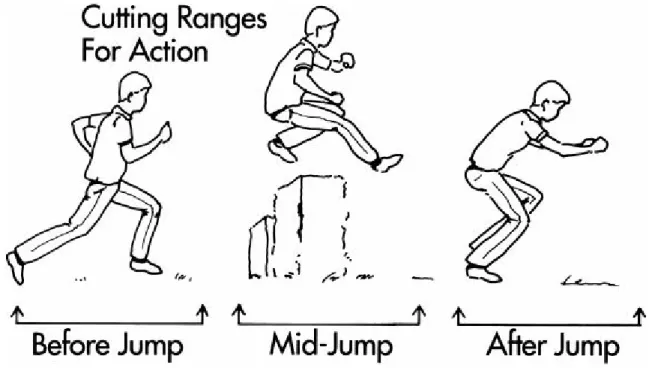
The exact cut point depends on the subject and the editor's sense of movement. The action cut is found in almost all types of sequences, whether the subject of the photograph is raising a drink to his or her lips or simply turning their head or moving their eyes.
Exits and Entrances
Clearing the Frame