Interactive Narratives and Transmedia Storytelling
Interactive Narratives and Transmedia Storytelling provides media students and industry professionals with strategies for creating innovative new media projects across a variety of platforms. Synthesizing ideas from a range of theorists and practitioners across visual, audio, and interactive media, Kelly McErlean offers a practical reference guide and toolkit to best practices, techniques, key historical and theoretical concepts, and terminology that media storytellers and creatives need to create compelling interactive and transmedia narratives. McErlean takes a broad lens, exploring traditional narrative, virtual reality and augmented reality, audience interpretation, sound design, montage, the business of transmedia storytelling, and much more.
Written for both experienced media practitioners and those looking for a reference to help bolster their creative toolkit or learn how to better craft multi-platform stories, Interactive Narratives and Transmedia Storytelling serves as a guide to navigating this evolving world. An accompanying online resource site, www.Storyfort.ie, will feature regularly updated articles and links to related content.
Kelly McErlean has developed graduate and postgraduate programs in film and new media for local and international delivery and successfully delivered eLearning and onsite contracts for international broadcast organisations on behalf of the European Broadcasting Union. Kelly lectures on new media, film and entrepreneurship in the Department of Creative Arts, Media, and Music at Dundalk Institute of Technology, Ireland. He has won several awards including a Golden Spider Award and a Digital Media Award for his film, new media, and photographic works. Kelly holds a PhD in visual culture from the National College of Art and Design, Dublin.
Interactive Narratives and Transmedia
Storytelling
Creating Immersive Stories Across New Media Platforms
Kelly McErlean
First published 2018 by Routledge
711 Third Avenue, New York, NY 10017 and by Routledge
2 Park Square, Milton Park, Abingdon, Oxon OX14 4RN
Routledge is an imprint of the Taylor & Francis Group, an informa business
© 2018 Taylor & Francis
The right of Kelly McErlean to be identified as the author of this work has been asserted by him in accordance with sections 77 and 78 of the Copyright, Designs and Patents Act 1988.
All rights reserved. No part of this book may be reprinted or reproduced or utilised in any form or by any electronic, mechanical, or other means, now known or hereafter invented, including photocopying and recording, or in any information storage or retrieval system, without permission in writing from the publishers.
Trademark notice: Product or corporate names may be trademarks or registered trademarks, and are used only for identification and explanation without intent to infringe.
Library of Congress Cataloging in Publication Data A catalog record for this book has been requested ISBN: 978-1-138-63881-5 (hbk)
ISBN: 978-1-138-63882-2 (pbk) ISBN: 978-1-315-63757-0 (ebk) Typeset in Warnock
by HWA Text and Data Management, London Visit the eResources: www.storyfort.ie
For Esther
vii
Contents
1 Introduction 1
2 Traditional Narrative Texts 14
3 Subjective Interpretation 45
4 Sound Design 63
5 Visual Montage 86
6 Codifying Story Elements 98
7 Interactive Narratives 120
8 The Business of Transmedia Storytelling 152
9 Conclusion 164
Appendix 1: Making The Little Extras 168 Appendix 2: Digital Data Compression 182
References 185
Index 193
1
1
Introduction
Forms move and are born, and we are forever making new discoveries.
Kasimir Malevich – Suprematist Manifesto (1916) This book explores contemporary and traditional storytelling concepts and ideas. It encourages theoretical research and experimentation in the development of interactive narratives and transmedia stories. It considers the work of a wide range of practitioners across a multitude of creative fields. These include writing, music, film, photography, theatre, art and new media. It identifies and examines key texts and includes interviews with industry practitioners and academic researchers. Throughout history artistic inspiration has often come from the most unlikely sources. An openness to new ideas always brings about original, exciting and challenging storytelling opportunities.
WHO IS THIS BOOK FOR?
The book is aimed at storytelling creatives who are looking to develop and deliver interactive narratives and transmedia titles using new technologies and distribution platforms. It is a synthesis of storytelling strategies and related theoretical concerns with regard to interactive content creation. It considers many of the current questions regarding interactive storytelling
2 Introduction
and is intended to guide and inform the reader’s knowledge and to promote ideas generation. A key concern of the text relates to story navigation: how will storytellers resolve the difficulties in creating interactive points within a plot to encourage a natural, rather than forced, story interaction? Who and where is the intended audience for interactive content and what issues are anticipated or currently experienced in targeting and then delivering to particular demographics? Does an interactive content audience need to have access to specific (perhaps the latest) technologies, do they need to have interactive story experience, a history of social media engagement, platform awareness or particular software application experience? What are the most appropriate skillsets and previous experience of an interactive story developer? Which elements of the traditional storytelling experience can be exploited within these new narrative paradigms? Sound design and music are considered within a broad storytelling context to look at their potential to fully realise narrative worlds and to promote audience immersion and engagement. The future of interactive storytelling is explored, and artistic and commercial projects, completed and in development, are considered.
Throughout the book I have avoided taking a technocentric approach. The emphasis is on the creation of engaging stories which (through trial and error) take advantage of the most innovative yet appropriate modes of delivery to effectively communicate story ideas across multiple platforms.
The book includes the most useful content that I have identified over many years teaching this subject in universities and colleges across Europe. You will note that there are many references to the works of traditional artists. I have made observations on their workflows when I considered them to be relevant to the development of interactive and transmedia stories. I have drawn on existing best practices from traditional media, to identify and give insight into creative works that are both experimental and engaging and to synthesise complex theories to make them accessible to a wide audience.
DEFINING INTERACTIVE NARRATIVES AND TRANSMEDIA STORIES
An interactive narrative offers a pre-specified level of story agency or choice to the audience, allowing them to exert an influence on the plot. The interactive experience is ‘highly context-dependent’ and involves some form of interface such as text input (entered at the command line), a hand-held controller or a gesture-sensing device (Laurel, 1991 p. 21). Each interaction results in various levels of impact on the story depending on the narrative design. Producer Hideo Kojima states that the challenge for interactive
Introduction 3
narrative developers is to offer increased agency without sacrificing the story emotion developed through ‘cut sequences’ (edited scenes rather than interactive gameplay) (Ashcraft, 2008). Brighton-based artists group Blast Theory released a very interesting interactive narrative titled Karen (2015).
Using a phone-based app to facilitate a series of ‘video calls’, the user takes the role of a client and interacts with a life-coach called Karen over several days. The multiple choice responses given to Karen’s often leading questions are used to construct a psychometric profile of each user which can be purchased at the end of the story. The story progresses along a satisfying narrative arc and includes a good level of story conflict, drama and humour.
User engagement is designed around well-constructed questions (delivered by Karen) and equally valid answer options for the user. The result is an interactive narrative that feels like you are a performer within a finely tuned theatrical experience.
Transmedia stories are delivered across multiple distribution platforms, in various formats that can include feature films, short films, episodic television, streaming content, social media, games, print media, music and audio clips.
Transmedia stories are defined as ‘many franchises developed around a core story and characters’ (Blumenthal & Xu, 2012 p. 190). Transmedia story elements exist within a single story world despite their perceived distance from each other. Blast Theory’s #FindTheGirl transmedia campaign to promote Thirteen (2016) delivered story content within the five-episode online drama itself, but also on social media platforms and across various websites (Puschmann, 2016).
THE AUTHOR
At 18 years old I took full advantage of the UK’s education grant system and left Ballymoney, Northern Ireland to study computer programming at Birmingham Polytechnic, UK. I graduated in 1989 and soon began my career as a computer programmer working for Marconi Command and Control Systems at a UK Ministry of Defence site in Leicester. I designed and coded software in Ada (the defence sector’s traditional language of choice) to perform phonetic searches on London Fire Brigade’s database of geographical locations. The system allowed emergency telephone call operators to enter street names as they heard them phonetically without the need to check spelling. However, I found working at the ‘command line’ lacked the creativity I sought so I returned to education to study photography at Bournville Art College under the inspirational guidance of my tutor John Hodgett. With
4 Introduction
a small child in tow, my then girlfriend Esther and I returned to Dublin in the mid-1990s where I was able to combine my software engineering, film and photography skills. I was hired by the influential sculptor and academic Aileen McKeogh to work in Arthouse, a trailblazing multimedia arts organisation in a newly refurbished, purpose-built premises in Temple Bar.
As Head of Training and Production I project-managed European-funded projects and designed and delivered new media education contracts on behalf of the Irish government. In 2000 I raised €250,000 private funding to set up a new media training college in Dublin city centre. I travelled extensively throughout Eastern Europe and North Africa helping international broadcast organisations to establish digital strategies and to develop new media training programmes for their personnel. In each country I would work on a photo- essay to pass the extended time between meetings. I almost got arrested in Pakistan on the road to Rawalpindi for photographing an enormous toll booth in the middle of nowhere. In Egypt, my now wife Esther and I interviewed prospective course participants and she was happy to receive numerous confidence-building proposals of marriage. On a visit to Media Production City, near Giza, a simple linguistic error left uncorrected led to me being mistakenly identified as the Director General of Radio Telefis Eireann (RTE).
In too deep, we spent the day being whisked around the impressive film studio complex introduced to movie stars and forcing a fully attended water park to wait for our arrival beifre starting a show.
During my travels I always noted the international language of storytelling and the potential of new technologies to create new narrative paradigms.
I continued to research the subject and was extremely fortunate to be supervised by Dr. Kevin Atherton and Dr. Paul O’Brien when successfully completing a PhD in visual culture at the National College of Art & Design, Dublin. By 2012 our award-winning college was fully accredited and delivering graduate and postgraduate programmes in film, theatre, games design, photography and animation, welcoming students from 22 countries.
We produced the animated logo for the Eurovision Song Contest, which aired before and after commercial breaks and was watched by over 120 million people each year. Our students won national and international awards and were highly sought after by audiovisual production companies.
In 2014 the Irish immigration service’s heavy-handed approach to international students forced the closure of dozens of private education facilities in Ireland, including ours. In the years since, I have worked in the public education sector and I am now researching and lecturing in the highly innovative Creative Arts, Media and Music Department, Dundalk Institute of Technology.
Introduction 5
I have always been interested in experimental narrative projects and generally prefer arthouse films to traditional commercial fare. I take inspiration from my children’s engagement and interaction with games and social- media platforms and I continue to develop my own projects – interactive stories, films and photo books. My most recent film work Singularitas was conceived as a multilingual short, with languages intermixed throughout and no subtitles. The intention was to create a concept piece, an audiovisual spectacle which would be currently incomprehensible, yet in a few years, be viewed via commonplace language translating devices. The translation would ‘free-up’ the text and remove the linguistic barriers of language, dialect, intonation and prosody, making it accessible to anyone, in any country, speaking any language. In short, the film was really for the future.
NEW MODES OF STORYTELLING
In this book I also consider how evolving technologies will impact storytelling media and modes of delivery. Narrative interpretation depends on our understanding of the technologies used to create and deliver stories (Wood, 2007 p. 42). Audiences are increasingly knowledgeable about production tools, workflows and distribution platforms. If the spectacle focuses our attention on technology itself, then it creates in the audience a desire to learn more about the process of production. Individual digital elements compete for audience attention while driving the narrative and helping to create an immersive environment (Wood, 2007 p. 45). The effect may work with real elements or act as a counterpoint, expanding and developing their meaning. There may be an over-emphasis on visual spectacle through attempts to recreate that which no longer exists or does not yet exist. In this sense new media technologies are no different than the special effects of early cinema. If the audience knows how an effect is produced then the impact is reduced and immersion in the story may be lost. The fluidity of perception leads to the creation of narrative perspective. The world is constantly changing and the author’s narrative is altered during its creation, and again when it is observed by the reader:
the shift of an object or area out of the center of vision even to the inner edge of the periphery transforms it … perceptual constancy is a phantom, and the world thus seen is no longer identical to itself.
(Crary, 2001 p. 298) The observer’s engagement with the technological invention manipulates the optical display. This is an alternative to the theatrical tradition of
6 Introduction
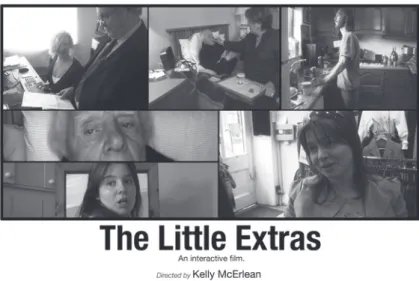
perception (Crary, 2001 p. 191). I will use as an example an interactive film I made called The Little Extras (see Appendix 1) which was created to extend the relationship between author and observer. In this film, viewer interaction alters their perspective of the story and creates a flexible or plastic narrative experience.
In interactive film the process of interaction may be considered a representational vehicle for the development and presentation of the characters. Navigation through the narrative leads to changes in our interpretation of the representation. The belief system that makes the representation possible is an acceptance of what is real both within the context of the story and the viewer’s world (Mitchell, 1995 p. 356). The representation of characters within the interactive narrative text is distanced from the reality of the actors who are playing the roles and the mode of interaction itself. We can consider representation as a process or mode of interaction as well as relating to a ‘particular kind of object’ (Mitchell, 1995 p. 420). The immersive nature of the story allows the distance to be traversed and a multiplicity of character perspectives to cohabitate the metanarrative.
The mode of interaction is blended to the narrative to function as a natural method of ‘reading’ the story, ‘all representations are conventional in the sense that they depend upon symbol systems that might, in principle, be replaced by some other system’ (Mitchell, 1995 p. 351). The mode of interaction in The Little Extras is rooted in simple hyperlinking. If the viewer has been properly encouraged and stimulated to ‘read’ the text and look for interactive opportunities, they will seize upon a symbol system that allows them to navigate more freely. The Little Extras creates a temporal reality within the interactive text. The temporal period is known to the audience in that it deals with historically familiar concepts including the emotions of jealousy and anger (Mitchell, 1995 p. 353).
Filmic representations of reality can be considered uncinematic (Carroll, 2008 p. 203). Narrative disclosure is unrealistic in that it does not replicate the reality we experience in everyday life where most issues remain unresolved and facts stay hidden. Theorists who favour the Italian Neorealist recording of experiences emphasise the value of photography in creating cinematic works where the camera simply photographs the reality in front of it. An alternative theoretical position is to emphasise the creation of narrative structure through editing. Pacing and juxtaposition of narrative elements create the relationships between shots and scenes for the audience and drive the narrative according to the author’s vision. Mitchell notes the difference
Introduction 7
in time between the writing of the story and its reading, ‘narrative seems to be a mode of knowing and showing which constructs a region of the unknown, a shadow text or image that accompanies our reading, moves in time with it’ (Mitchell, 1995 p. 190). The author of the non-linear story creates an organic text that lives and grows through interactivity. As the story develops, the relevance of its own past and future is in state of flux.
Dialogue in the text offers the characters a voice as an alternative to the absolutism of diegesis. This mimesis can be flexibly interpreted by the audience as they develop a greater understanding of the characters and their situations (Mitchell, 1995 p. 191). Most film-makers create work that their target audience will understand and cognise (Carroll, 2008 p. 212).
This includes incorporating known features specific to their genre such as high-key lighting in film noir thrillers and the lone gunman in westerns. A film that is ‘truly, ontologically incomparable with any other would be … an incomprehensible artifact. Faith in the consummately singular motion picture derives from a romantic-modernist fantasy of the genius’ (Carroll, 2008 p. 216).
Jerome Bruner explored the transference of knowledge and the assimilation of narrative. He points out that knowledge always represents someone’s perspective, so that the ‘normativeness of narrative, in a word, is not historically or culturally terminal. Its form changes with the preoccupations of the age and the circumstances surrounding its production’ (Bruner, 1991 p. 16). Bruner is stating that a perspective on a story is therefore influenced by one’s consideration of the author’s intent. It depends on what we know about both the author as a person and the subject under discussion. He refutes the concept of knowledge as a fixed entity. It is instead highly flexible and changing, mediated and remediated by successive readers, who have been influenced in turn by their background, friends, books, cultural experience and conventions. The reality created by a narrative is an interpretation of the facts presented to us.
Different cultures will adopt and exploit digital interactive media developments in different ways (Jenkins & Thorburn, 2003 p. 5). Political, cultural and economic forces will shape the interactions between the people and emerging technologies. The book includes an analysis of the communication and processing technologies that will be used to develop and distribute new media formats including interactive films. The relationship between author and observer is explored. Digital media allow the reader to alter original texts through interactivity including the use of
8 Introduction
inserts and links (Landow, 2006 p.126). The role of the author is changing.
The reader is empowered to actively construct meaning by adding layers of interpretation. However, readers have always ‘read’ texts from particular perspectives and in doing so altered their interpretation of meaning to suit themselves. In this way, the act of adding content to the published text is simply another step in the information reception process. This process leads to an interpretation and position taken by the reader in relation to the content.
A SUMMARY OF THE CHAPTERS
Chapter 2, ‘Traditional Narrative Texts’, explores the works of various creative artists including photographers, playwrights, authors, film- makers and academic theorists. It considers the extent to which non- linear narrative developers can exploit traditional storytelling structures, techniques and literary devices to produce a unique story experience. The chapter introduces relevant terminology and reflects on the prospective augmentation of linear narratives by the addition of interactive interfaces.
The chapter also examines classic film-making techniques including the incorporation of narrative conflict, promoting audience immersion and the use of sound. Subtitles in film are also considered with regard to the potential incorporation of hypertext within interactive film products.
Chapter 3, ‘Subjective Interpretation’, examines how an audience interprets meaning within narrative texts. The relative position of the author and reader is assessed. Burgess and Dovey are considered with regard to the linguistic construction of texts and the interactive storyteller’s relinquishment of authorial control. Bellantoni’s research into our emotional response to colour sequences is explored alongside Kandinsky’s theory on the psychology of colour and Mortenson’s description of our instinctual responses to geometric patterns.
Chapter 4, ‘Sound Design’, examines the explicit nature of music via the theoretical texts of Adorno and Eisler. The chapter also looks at Goodall’s research into the history of music development and Storr’s work on the emotional meaning of music. It considers the exploitation of musical devices and techniques including counterpoint, syncopation, allusionism, psychological time and instrumentation. It explores the use of music in cinematic works and examines the implementation of music in feature-film soundtracks.
Introduction 9
Chapter 5, ‘Visual Montage’, takes a detailed look at spatially presented audiovisual works and assesses the meaning and interpretation of both spatial montage and the juxtaposition of story elements. The chapter also considers the work of Hockney, Marker and Burroughs and examines how spatial presentation techniques used in traditional film and print media can be employed in an interactive narrative context.
Chapter 6, ‘Codifying Story Elements’, considers the classification of interactive narrative elements using a predetermined database schema.
Codification of content requires the identification of story components which can be stored in a database. Codified data can be accessed non-sequentially to present the audience with a non-linear narrative. The chapter also looks at the codification techniques proposed by Propp and Bal. It introduces narratology terminology and considers Barthes ‘message without a code’.
It further examines the metatagging of digital content, data visualisation, trend-identifying algorithms, data analytics and hypernarrative. The chapter also explores the historical archive and reflects on the work of Brecht, de Quincey and Perec.
Chapter 7, ‘Interactive Narratives’, looks at ergodic texts, interactive titles, interfaces, narrative immersion, story structures, latency, distribution platforms and related technologies. It considers both historical and contemporary interactive narrative works with particular emphasis on the theatrical tradition. Interaction methodologies and their impact on users is assessed, including gesture-controlled interfaces and the study of proprioception. Virtual reality (VR), virtual identities and augmented reality (AR) are also explored. VR creates a fully rendered computer graphics environment for the viewer whereas AR overlays computer generated text and graphics over our real world vision.
Chapter 8, ‘The Business of Transmedia Storytelling’, looks at the commercial implementation of interactive narratives and transmedia stories across international markets. It considers the work of several ground-breaking experimental storytelling companies such as Blast Theory (UK) and the content-creation department of Marriott International (US). The chapter explores a range of new storytelling platforms including social media, and examines some highly innovative and commercially successful attempts to monetise interactive content. It looks at the international news agencies’
development of data analytics tools to measure audience engagement, the development of augmented reality products and geo-located narratives.
10 Introduction
In Appendix 1, ‘Making The Little Extras’, I discuss the development of this interactive film. The film concept is compared and contrasted to the works of Brueghel, Manovich and Tarkovsky. Conceptually the film created a paradigm shift that fundamentally differs from traditional linear narrative. In Appendix 2 I have given a brief explanation of digital data compression. The exploration of new storytelling platforms, developing experimental narratives using digital workflows, is much improved by a good understanding of compression.
COMMERCIAL IMPERATIVE
During my research I spoke to media-industry professionals and academic theorists here in Ireland and abroad. While the former naturally seek to exploit the commercial potential of new storytelling platforms, the latter’s theoretical approach and openness to experimentation without a commercial imperative has resulted in the development of innovative products that could eventually be successfully monetised. Therefore, my approach has been to consider the potential success of all commercial opportunities within this highly experimental and inventive storytelling environment. The stories considered in this book have been delivered in a wide variety of formats from self-contained entertainment products to a media segment within a content creation department’s audience-building marketing strategy. Depending on your approach, you may believe the commercial imperative of content creation to be irrelevant. Generating income from interactive content is a challenge. However, it is worth noting that when one considers the income generation potential of the passive consumption of traditional media (selling commercial advertising space to clients based on projected audience figures and demographics), it seems likely that the commercial potential of individually identifiable interactive engagements with story elements is significantly greater.
THE COMMAND TO READ
To expand upon this practice of exploring traditional media I encourage the reader to continue to study a wide range of texts and to certainly move outside their comfort zone. Reading is not always easy, nor even pleasurable in some cases, as many worthwhile texts require significant effort to get through. As a film and photography lecturer I have always promoted the importance of critically analysing narrative texts. Keep reading until it becomes more than a thought, it becomes an opinion. With the rise of
Introduction 11
online broadcasting I have found it necessary to encourage ‘reading not watching’. Reading a text requires a greater level of engagement with the author’s text to fully consider their intention and line of argument. Reading creates a much more profound understanding of a concept. Watching an online documentary may be useful in some circumstances, but it tends to result in a simple regurgitation of facts – it lacks criticality. When reviewing student work, it is always obvious to me who has conducted their research by ‘reading’ and who has simply ‘watched’.
When considering relevant published materials as part of your research, go to a library with a good stock of visual reference books and simply browse through the texts one by one. Eventually, a narrative technique or visual style will appeal to you, it will make itself known and provide the starting point for future research and practice. Experimentation with techniques, styles and approaches often uncovers something original. The film-maker Alan Parker attributes his success in film-making to the large number of television commercials he made during his early career in advertising. It was here he says that he was able to make mistakes, experiment with new ideas and eventually hone his craft. It also allowed him to develop a unique storytelling style, a personal aesthetic. The repetition of the short storytelling process, conceiving ideas, shooting then completing the product allowed him to continually analyse his work and thus grow as an artist. In fact, in my experience as a teacher, it is the student who completes a large number of smaller projects, rather than getting part way through several larger and more ambitious ones, who is the most capable, confident and ready to work in a competitive industry.
LATERAL THINKING
A high level of critical analysis in turn results in a good degree of lateral thinking, considering an idea from various angles, thinking around the concept. In storytelling this allows the writer to produce unique, thought- provoking narratives. As the story creator engages with the development process while keeping an open mind, they will achieve a greater level of ownership of their work. This ownership, the act of critiquing your work and its intention as the narrative develops, encourages one to ‘say something’
with each story. This always results in a much more compelling narrative, one which has an opinion, is eloquently expressed and which promotes debate.
The increased engagement with the intention of the author also increases the potential for commercial success. It is important to have an opinion on
12 Introduction
something that you wish to engage with both creatively and intellectually.
The artistic artefact that you produce will create an intellectual discourse between you and your audience. In this regard, the most successful works
‘speak out’. Your opinion, the point of view you have adopted in relation to the subject being discussed, should come from an informed position, evidencing research, knowledge and synthesis.
PITCHING YOUR IDEA
It is beneficial to pitch your idea to an audience. The pitch forces you to consider who and where the market is for the product you intend to create.
An intellectual academic may experiment with concepts and storytelling paradigms having little interest in their commercial potential, yet most students are engaged in a programme of academic study in order to launch a successful career. Therefore, I consider it important to both identify the audience for a story idea that is being pitched and decide how the story will be delivered to them. This constraint, forcing the creative individual or team to tailor a product for a particular audience, is an opportunity to employ the techniques of lateral thinking to develop a fresh perspective and personal style.
DEVELOPING AN IDEAS BOOK/VISUAL DIARY
An ideas book or visual diary is an invaluable resource in ideas generation.
It should include all manner of visuals, texts, references, both obscure and well-known. Whatever takes your fancy. The important thing is to get it down on paper, scanned, copied or drawn. The best ideas books I have seen tended to be messy affairs, with bits of paper and assorted materials bulging out at the sides. In this personal volume, the individual is storing up a series of narrative elements, for future reference. The visual diary is an important tool for communicating ideas to both clients and other creatives. Note why you are including content; it is a common occurrence for visually exciting work to be included in an ideas book, only for the creative to forget what the (significant) point of its inclusion was.
* * *
This book has been written in order to be accessible, engaging, incisive and informative to the creative storyteller. The research that went into it was highly selective and concentrated on the simplification and clarification of
Introduction 13
complex, often abstract ideas. It highlights the vocabulary and knowledge most relevant to the development of new narrative structures. It identifies story products and creators, industry practitioners and academic researchers, and includes pertinent literary references to guide and inspire.
It’s all in there, it just needs to be ‘unpacked’.
14
2
Traditional Narrative Texts
This chapter looks at a range of traditional linear texts and considers various successful attempts to break away from narrative conventions. It explores the storytelling works of photographers, film-makers, playwrights; classical narrative structures, the differences between linear and non-linear narratives and the film-editing theories and techniques most relevant to interactive storytelling. A thorough knowledge of traditional story composition, story devices and narrative techniques allows for much greater experimentation with new delivery platforms. If storytellers are going to exploit new technologies effectively they will need to engage in a significant degree of trial and error to create new user experiences. Audiences must be encouraged to participate in the development of new narrative structures and interactive interfaces. Their engagement will be of fundamental importance to the organic development of new storytelling ideas. A storyteller with a significant grasp of traditional storytelling concepts and techniques will connect emotionally with their audience regardless of the delivery mechanism.
’TALKING PICTURES’: FINDING NARRATIVE IN PHOTOGRAPHY
The photographer Daniel Meadows started taking pictures as a student in Manchester in the 1970s. He was primarily interested in documenting
Traditional Narrative Texts 15
people’s lives. Early influences included the oral historian Studs Terkel and the photographer Bill Brandt who ‘used the camera as a passport to slip between the social classes’ (Meadows, interview 2016). Photography was a cheaper medium than video and Meadows preferred the significant level of engagement that stills photography offered. He would meet the subject, take their picture, process the film, then arrange to meet the subject again to give them the photograph and discuss the outcome. Meadows did not always have a tape recorder with him and it kept breaking down. He says he was recording audio just ‘to get good caption information’. At that time, the cost of editing was prohibitive, so he did not immediately combine the audio and visuals together. Years later, when he started working with digital editing technologies, he revisited this work and created his series of 40 Talking Pictures, short two-minute pieces, individual photographs with first- person voices. He describes these as a ‘window onto my archive’. Meadows’
documentary work considers the world from the bottom up, from the point of view of the common man. He wanted to work in a collaborative way, to produce work that was more ‘convivial, agreeable, democratic’. The result is a highly individual, unique work of social anthropology. He has captured a time and place, accents and behaviours that are long gone. The selected still image in each of the ‘Talking Pictures’ communicates its own narrative and is augmented by the edited audio. Meadows has created a sense of ‘presence’.
GEOMETRY IN PHOTO COMPOSITION
A contemporary of Meadows was the photographer Tony Ray-Jones. In New York, Ray-Jones studied under the influential European artist Alexey Brodovitch at the Design Laboratory. Brodovitch encouraged artists to interact ‘with aspects of modern life’ and his teaching ‘involved the posing of “moral and philosophical problems” in the pursuit of success, encouraging open debate and the search for a personal aesthetic’ (Russell, 2004 p. 11). Ray-Jones work was highly influenced by American street photography of the 1960s, particularly Garry Winogrand and his friend Joel Meyerowitz. The social-commentary format of his images found his photographic subjects ‘arranged like actors on a set with each character appearing to exist independently and collectively within the frame’ (Russell, 2004 p. 16). Ray-Jones wrote several diaries that included a number of ‘to- do lists’ for himself. These were intended to guide future photographic projects and editorial assignments. The list of entries included phrases like
‘get in closer’, ‘don’t take boring pictures’ and ‘not all eye level’. He sought to explore the medium of photography and develop an individual style
16 Traditional Narrative Texts
that communicated his particular vision of people and places. His images are geometrically balanced compositions. Each one constructs a complex narrative within a single frame. They exist both spatially and temporally, a dynamic representation of his unique perspective.
STORY SEQUENCES IN STILLS
The artist Duane Michals creates sequential-format photographic works to build an unfolding narrative across several images, exploring human emotions and reflecting on his philosophical musings.
[These] sequences stand in a similar relation to movies as poems do to novels: they act on the imagination not through the accumulated evidence of description and explanation, but through a compression of single images rich in metaphorical allusion.
(Livingstone, 1997 p. 8) Michals also adds handwritten text to the surface of his images, suggesting the photograph alone is unable to communicate the complex ideas of the artist. The addition of language and symbols to the photograph creates a high-concept interpretative work, layered with meaning.
Photobooks function as narrative devices and reveal the photographer’s
‘patterns of thought’ (Gibson, 1999 p. 705). The photo exhibition space allows for greater control on the part of the viewer to consider the work from various angles, distances, time and social context. A book constrains an audience in that it is normally held in one’s own hands at a fixed distance and its tactile nature influences the experience of reading it. However, the book retains a certain flexibility in that it can be viewed at any time, without the need for further curation, encouraging critical engagement with the author’s intention: ‘books turn into thought and then become memory’
(Gibson, 1999 p. 707).
Nicholas Nixon has photographed his wife and her three sisters every year since 1975 using a large format camera. His book The Brown Sisters: Thirty- Three Years (2007) features one representative image of the sisters for each year up to 2007 (Nixon, 2007). While they are positioned in the same order in every shot, the familial dynamic within each frame is different. We feel we can identify subtle changes in the sisters’ relations to each other and observe the impact of life experience, evidenced by their slowly aging faces.
Traditional Narrative Texts 17
PEDRO MEYER’S THE ILLUSION OF REAL SPACE
Pedro Meyer was an early adopter of digital-imaging technologies. He used them to reconstruct ‘the illusion of real space; no one will notice his alteration, performed with scalpel precision’ (Meyer, 1996 p. 13). His creative workflow included traditional image capture on negative film, followed by digital scanning and manipulation ‘to restore the picture to my memory of what actually happened’ (Meyer, 1996 p. 108). For Meyer, the image captured by the negative alone was not an accurate record of the reality he had experienced; it did not reflect his memory of being there. He felt he had to digitally retouch it to improve its authority. Meyer also exploited the potential of his visual archive by regularly revisiting it, searching for new narratives, story structures and meanings to be created through the digital manipulation and juxtaposition of historical images.
NAVIGATING NON-LINEAR TEXTS
While film texts are traditionally linear in structure, film-makers have experimented successfully with non-linear presentations of the fabula.1 This is a complex method of storytelling and requires both solid direction and an engaged viewer. The Summit , directed by Nick Ryan, is a film about the 2009 K2 mountain climbing tragedy. Ryan setup key story elements in advance, allowing the narrative to develop these points later in the film.
Presenting the story in a linear order would have been tedious, lacked narrative immersion and would have given away important plot details too early. So Ryan restructured the fabula to make it more engaging; he said ‘the whole point of editing is to navigate the story’ (Ryan, interview 2016).
VERISIMILITUDE
Susan Hayward notes that the dominant ideology of classical cinema was one of verisimilitude, the implementation of a contrived plot development.
Stories began with a disruption to the norm, followed by the blunt implementation of cause and effect to progress the narrative. The film ends with narrative closure and the sense that the world is right again. Here, the objective of social stability, as defined in the concept of Oedipal trajectory, involves the resolution of a crisis. However, this crisis offers opportunities for user interaction where the reader selects distinct navigational pathways, thereby creating an independent and autonomous route through the story (Hayward, 2006 p. 82).
18 Traditional Narrative Texts
BRECHTIAN REALISM
The Brechtian aesthetic brought science and practical action together, rejoining physical and mental activities. Brecht created ‘educational’ works for the enjoyment of audiences, for their immediate gratification. This realist approach promoted an active investigation of the text:
The ‘realistic’ work of art is one in which ‘realistic’ and experimental attitudes are tried out, not only between its characters and their fictive realities, but also between the audience and the work itself … the three- fold dimensions of such a practice of ‘realism’ clearly explode the purely representational categories of the traditional mimetic work.
(Adorno et al, 1986 p. 205) Here, the text is considered revolutionary; it can stimulate debate and change opinion. Content generated for mass-media distribution will achieve greater success by avoiding the elite modernist approach. This means creating an accessible product that is not a novelty. The modernist invention needs to be constantly renewed just to be modern, leaving too little time for critical evaluation and reflection. The product will not become streamlined and made more efficient if it undergoes rapid fundamental changes that leave the audience baffled. The author of the interactive work needs to consider the audience’s needs and expectations.
Brecht’s translation of Marlowe’s Edward II created ‘free but irregular rhythms’ which allowed the lines to ‘stumble’ (Willett, 1988 p. 95). Brecht later used the technique in his own plays to reject the flowing style of the iambic pentameter and to reflect the coarse, harsh characters and scenarios he sought to create. Brecht designed the text to be spoken in a theatrical context; characters had short, sharp lines, saying just what he wanted them to say and no more. This approach was intended to remove anything elegant from the sentence structures, which Brecht believed would obscure the true meaning of the text. The use of syncopation in verse, as in jazz music, serves to fragment the general rhythm of speech. The underlying attitude of each verse is conveyed with individual truth, rather than allowing an actor to apply a single emotion to long passages of text (Willett, 1988 p. 101). Brecht later employed further techniques to prevent the audience becoming immersed in the play including directing actors to leave the stage and join the audience at various points during the play. During rehearsals, actors would say their lines using indirect speech, as though they were an
Traditional Narrative Texts 19
eyewitness to their own character’s actions. This also informed the actor as to how the audience would view them. Preventing the audience from becoming immersed was meant to retain their critical frame of mind, to promote an intellectual engagement and consideration of the content of the play. Maintaining a critical frame of mind is important to interactive story texts. The dynamic process of interaction means the audience must be thinking at all times, to not become a passive, non-participating viewer.
Brecht ‘posited that catharsis is not complete until the audience members take what they have assimilated from the representation and put it to work in their lives’ (Laurel, 1991 p. 31).
ARISTOTLE’S POETICS
Aristotle had a healthy respect for human emotions and the effect of storytelling on them. He believed that emotions were a rational human response that should be interpreted and not dismissed as being too animalistic and non-spiritual. He considered emotions to be more than irrational impulses, and indicated that there is a time and a place for correct and satisfying emotional responses appropriate to the circumstances.
Malcolm Heath summarises Aristotle’s first argument for the primacy of the plot in narrative:
Tragedy aims to excite fear and pity; these emotions are responses to success and failure; success and failure depend on action; hence action is the most essential thing in tragedy; therefore plot is the most important element.
(Heath, 1996 p. xxi) Characters develop independently of the plot; in fact characters that exist within a predefined plot develop their own arc, their own voice.
They speak within their natural dimensions, so that text and plot are fully separate entities. The characters do not limit the plot. Writers of stories based on real events should not be constrained by actualities. If they were, the emphasis on the facts would be to the detriment of the plot. The events only need to be connected, within the context of the story. Aristotle defined the rules of creating plot-driven narratives. The best plot involved moving a virtuous person from a position of good fortune to bad. The second-best plot has a double line of development with good characters achieving good fortune in the end, while bad characters end in misfortune (Heath, 1996 p. xxxiv).
20 Traditional Narrative Texts
HOGARTH’S A RAKE’S PROGRESS
William Hogarth’s series of paintings A Rake’s Progress (1731–33) shows the decline and fall of Tom Rakewell, a wealthy merchant’s son who inherits a fortune and loses it all through gambling and high living. This series adhered to Aristotle’s ‘best plot’ structure in that the character’s fortunes decline as the story progresses. In the end all is lost and only his faithful friend Sarah Young (whom he earlier rejected despite his promise to marry her) loyally remains with him when he ends up in Bedlam asylum.
Aristotle argued against the use of one-dimensional characters that are overtly good or overtly bad, without complexity or facets. He believed that characters should be moral, or at least they should not be morally bad without good reason. They should be believable within the perspective of the narrative (Heath, 1996 p. xxi). Within the plot, they should seek to be virtuous, or as virtuous as the plot will allow them to be. Within the reality created by the plot, characters must behave according to the constraints of that reality, while also enhancing the plot. Events can happen to characters within the plot as long as they are necessary to move the plot forward, to convey the story the author wishes to tell.
BAUDELAIRE’S L’ART MNEMONIQUE
Sylviane Agacinski continues the analysis of Aristotle: ‘there is no time without movement or change, and it is in perceiving movement that we perceive time’ (Agacinski, 2003 p. 34). The tempo of change can be alternated to maintain interest in the text. Time does not have a ‘single measure’. This is important in creating an immersive environment in film to encourage audience ‘interaction’ with the text. The audiences of interactive narratives are working with the author to create the story.
‘Baudelaire attributes the formation of the interior image to a procedure by which the memory breaks with applied observation and achieves a perceptual synthesis … imagining the real at the very moment of perceiving it’ (Agacinski, 2003 p. 74). Baudelaire defined l’art mnemonique which ‘suggests that memory and imagination takes place in the execution of the work itself and not before’ (Agacinski, 2003 p. 74). The emphasis is on the processes of creation and interaction, rather than the definition of a completed work.
Traditional Narrative Texts 21
FILM EDITING: WALTER MURCH
Walter Murch described editing as ‘cutting – the sudden disruption of reality’ (Murch, 2001 p. 16). Although the human eye ‘cuts’ (blinks) when we look from one person to another or from one object to another, the edit can take the viewer ‘out’ of the story. A clumsy edit is generally considered clumsy because it is unnecessary and does not place the viewer where they want to be within the dramatic context. A smooth cut will seamlessly move the viewer from one shot to the next so that they think they have simply
‘blinked’ as they changed views. Various techniques are used to make the cuts smoother. These include cutting on movement (while a character moves to sit on a chair, the sudden change in shot perspective and potential continuity errors are hidden by the abruptness of the physical movement), cutting the audio before the visuals (the transition between shots appears ‘smoother’), and cross-fade edits, where one shot actually merges with another.
’THE RULE OF SIX’
During his extensive career as a film and sound editor Murch created ‘the rule of six’. This was a list of six criteria used to identify and to optimise each edit within a scene and the sequential placement of each individual cut. He also developed a method of use for this set of rules, ‘satisfying the criteria of items higher on the list tends to obscure problems with items lower on the list, but not vice-versa’ (Murch, 2001 p. 18). He classified their ratio of importance in percentages. At 51 per cent, ‘emotion’ was rated as the most important consideration by far. If the edit is true to the emotion of the moment then it is correct. This was followed by ‘story’
at 23 per cent – does the edit advance the story? ‘Rhythm’ is rated at 10 per cent – does the edit occur at the moment that is rhythmically interesting and ‘right’? ‘Eye-trace’ at 7 per cent – is the edit concerned with the location and movement of the audience’s focus of interest within the frame? Interestingly, the classic continuity considerations of ‘two- dimensional plane of screen’ and ‘three-dimensional space of action’ are rated low in terms of their relevance to the edit at just 5 per cent and 4 per cent (Murch, 2001, p. 18). According to Murch, the ideal cut will satisfy all criteria at once. But the decision to make a cut should be based on the priority of each rule in this weighting system. Therefore, finding the right emotion is most important and the relationship between characters (within the three-dimensional space) is least important. Finding the right emotion takes priority over story, story takes priority over rhythm etc.
22 Traditional Narrative Texts
By using this rating system to assess each edit, Murch moves the viewer through the story on various levels including emotion, narrative, rhythm and composition, allowing them to think critically about each edit and its impact on the story. The film audience will always assume that an edit is there for a reason and this system allows Murch to ensure that every edit serves the narrative and is fully justified.
While editing a film, Murch selects a ‘representative frame’ from every shot sequence, then blows it up into a photograph. He displays these photographs on a wall, in story order. Where a shot is visually complex he uses more than one photograph. Murch compares these images to Cartier-Bresson’s
‘decisive moment’: the theory that within every period of time there exists a
‘representative frame’ that communicates its very essence (Murch, 2001 p.
41). These photo boards allow him to view the story ‘all at once’, to consider alternative edits and potential scene structures. They are also useful as a reminder of the shot options available to him.
When organising test screenings, Murch recommends speaking to the audience several days after seeing the film. The film has had time to sink in. This avoids what he calls ‘referred pain’. With referred pain, the audience may indicate a scene they do not like and there is pressure on the editor to rework it. However the audience may be only be unhappy because the scene has not been properly set up, perhaps due to an issue with an earlier scene.
Murch likens this process to a doctor who suspects that a patient’s pain is the result of an as yet unidentified ailment. It is the ailment that needs to be fixed if the pain is going to go away.
Test audiences are often questioned about a film right after they have viewed it. This puts pressure on them to come up with immediate impressions, despite the fact that people often need several hours/days to decide on their long-term response to a film. The time immediately following a film is often spent ‘replaying’ parts of the story in one’s head. This replaying and conversations with other viewers gives us time to enjoy once more the significant scenes, or to realise that the story does not stand up to critical evaluation and we soon forget it. While production companies want to know straightaway what people thought of their product, they are ignoring the fact that the audience’s most important impressions are probably established some days after. In reality, audiences may recommend seeing a film only after this time of reflection is over. But they will continue to recommend a film for some time after.
Traditional Narrative Texts 23
Murch poses the question, why do we accept edits in film? They are visually unlike anything we experience in real life. He believes that we accept the cut because it resembles the way images are juxtaposed in our dreams. Murch also notes the similarity of the cut to a blink of an eye. When we move our heads to look at one object after another, we blink to avoid the ‘rush of detail’ as our head/eyes pass the intervening visuals. The cut also allows us to edit out unnecessary detail in a scene. We can move temporally, focusing on the moments that are most significant. Slow motion allows the viewer to go beyond ‘real-time’ and watch a ‘hyper-real’ version of a shot. This is used in action sequences, and often intercut with speeded up clips for emphasis.
Murch quotes John Huston:
[T]o me, the perfect film is as though it were unwinding behind your eyes, and your eyes were projecting it themselves, so that you were seeing what you wished to see. Film is like thought. It’s the closest to thought process of any art.
(Murch, 2001 p. 60) The opening sequence of Fellini’s 8½ (1963) moves seamlessly through edits so that they are hardly noticed. Instead, the viewer is caught up in the visual feast that Fellini presents and is immersed in the film’s reality.
In the 1990s Murch was a great exponent of digital-editing technologies and their inherent advantages over traditional linear systems. He believed their advantage lay in the greater options they offered editors as opposed to their speed. They allowed the editor to stay flexible with the edit, putting off commitment for as long as possible. Digital-editing systems allowed the editor to view multiple versions of an edited piece in quick succession.
This meant that more ideas could be experimented with, more concepts developed and negotiated. He noted that the flexibility of new technologies necessitates different disciplines than traditional equipment. Films can now be edited right up until a few days before release. The flexibility is such that the editor must work towards a specific narrative goal rather than continually making changes in the hope that something good will turn up. This flexibility also means that editors can throw ‘everything’ in there without worrying about stock damage or increasing costs. With traditional film editing, even testing a transition had significant processing and optical equipment costs associated with it. The editor had to pre-visualise the work and make informed decisions as to the potential success or failure of a cut.
24 Traditional Narrative Texts
Traditional processes also involved lengthy waits for the lab to process the edits forcing editors to think much more laterally about the whole film.
Sometimes too many stylistic elements are included in a single piece, just because it is possible to do so, not because it helps the film. This is why Murch’s ‘rule of six’ is so important. It regulates the edits being made and ensures that they are in keeping with the overall ‘style’ of the film.
Murch observes that people tend to blink their eyes when they are saying non-vocalised consonants – ‘s’, ‘f ’, ‘th’ but not ‘d’ (uh). Murch uses this blink of the eye to identify the frame to ‘cut’ shots. He edits when the actor blinks.
‘The same thing that makes a person blink … is also making the audience
‘blink’ – the audience is more receptive to a shift of attention at that moment’
(Ondaatje, 2004 p. 142). This is also true when we move our head to look from one object to another. As the head turns the eye will ‘pan’ to the next object. The pan will cause slight disorientation and dizziness so we ‘blink’
to miss it. As the head starts to turn, the eyes close and only reopen when the head has almost completed the movement. In this way, we are always performing natural edits in our heads. We are editing out the unimportant information that we do not want to receive, the information that sits between the two objects of interest. It is interesting to note this point as it explains why early cinema audiences accepted the traditional ‘edit’ so readily.
With regard to the timeline of films Murch says that it is acceptable to have an actor dressed in the same clothes over a long plot time because the audience subconsciously thinks, ‘I’ve only been here for two hours’. This is an interesting observation on how a film is ‘read’ by audiences. In real time the character would have changed clothes etc. but in the compressed time of the narrative this is not an issue. It is also interesting to note that most films show main characters eating and drinking. Without this type of refreshment it seems that the audience are reminded of their own reality and the fact that they are hungry or thirsty.
In the film The Conversation (1974) the main character ‘Harry’ is a recording expert played by Gene Hackman. The film was directed by Francis Coppola and edited by Murch. Murch notes that Harry would have been a peripheral character in a traditional film and part of the film’s objective was to view a story from the viewpoint of a peripheral character. Characters that are incidental and exist in the periphery of the narrative do not have any significant influence on plot development.
Traditional Narrative Texts 25
THE THIRD EFFECT
Murch reiterates Eisenstein’s theory of montage and considers how our right and left eyes view a scene from two slightly different perspectives.
These alternate fields of vision are very similar yet different. When the brain tries to see both at once, a ‘third concept’ is introduced which is ‘an arena in which both perspectives can exist’ (Ondaatje, 2004 p. 209). Thus, the brain is able to extrapolate depth information from the two 2D images created by the retinas. Murch is talking about the juxtaposition of visual elements that result in a meaning that is neither one nor the other, it is something completely new. As a photographer I have often explored the potential of this ‘third effect’ of seemingly separate visuals that come together to create a new meaning that is independent of the parts that created it. Each image is a diptych of two unconnected photographs. The interpretation of the two images together as one, is fundamentally distinct from the interpretation derived from the individual images. Eisenstein’s theory of montage is explored in more detail in the Visual Montage chapter.
EISENSTEIN’S DIAGRAMMATIC SCORE
Florian Brody (quoted in Lunenfield, 2000 p. 140) considers the diagrammatic
‘score’ which Eisenstein developed for Alexander Nevsky (1938). Each frame was constructed as an entity within a choreographed temporal flow, ‘the spatial and temporal composition of both the image and the development of the story, together with the sound, are evident’ (quoted in Lunenfeld, 2000 p. 140). Eisenstein proposed an ambitious exploitation of the audiovisual medium, by controlling all aspects of the content, including music, visuals, audio and geometry. His work left little room for open-ended interpretation, and cinema projectors already fixed the frame rate of audio and visuals and the ordering of scenes.
PRECIPITANT SOUNDS
Murch has worked as sound recordist on many films and has built up an extensive array of ‘meaningful’ sounds. He describes these as ‘precipitant sounds, something we associate with a specific environment but that is itself distinct, then the other sounds come along automatically’ ... ‘I spent a lot of time trying to discover those key sounds that bring universes along with them’ (Murch quoted in Ondaatje, 2004 p. 244). ‘I spent a lot of time trying to discover those key sounds that bring universes along with them’ (Ondaatje,
26 Traditional Narrative Texts
2004 p. 244). By employing the text of the sound or the universe that comes with it, Murch can inject many more layers of meaning into a scene. Murch has recorded and used sounds in films that ‘enhance’ the world the film- maker is trying to create. He gives various examples including the use of an almost imperceptible sound of a wrench being dropped in the distance to locate the audience spatially within the geographical limits of the film’s location. This piece of audio, subconsciously informed the audience that the scene was being played out near a dockyard location, seen earlier in the film, but which had no establishing shot in this scene.
Sound has colouration that may not match the visual colour. Murch suggests that film-makers should both visualise and auralise (listen to the space in which the sound is contained) to create a contiguous piece (Murch quoted in Ondaatje, 2004 p. 247). Mismatched colour and sound will appear disjointed and may even fragment the narrative.
Edits are created ‘purely with thought and emotion, with rhythm and musicality’ (Ondaatje, 2004 p. 269). In practice Murch edits on what he calls
‘flinch’ points. In this regard he aims to hit the same frame that he intends to cut on every time he watches a shot. He says there is something ‘organically true’ about the moment that indicates to him that this is the frame to cut on.
‘Made in America’, the concluding episode of The Sopranos (2007), is a striking example of a perfectly crafted edit. The final scene in the diner is deliberately disjointed. Tony Soprano has been at war with his enemies all season and could likely be killed at any moment. The rhythm of the scene is ‘off’ and the scene includes a disorientating ‘jump cut’. An incoherent visual sequence creates an uneasy atmosphere. Something’s not right, but what? While all appears well on the surface we believe Tony is sensing something, although probably too late. The edits take us inside and outside the diner, which continues to confuse and disconnect. The last shot is in keeping with some earlier contemplations on the death experience within the show. Tony symbolically looks up in expectation of his daughter Meadow walking through the diner door, a signifying bell rings (denoting the guardian angel Clarence Odbody in It’s a Wonderful Life [1946]) and his story collapses into a dark, black silence. Like Chantal Ackerman’s French short film J’ai faim, j’ai froid (1984) the scene may simply be a recollection of an event. This was Ackerman’s filmic representation of her adult self’s memory, the memory of her arrival in Paris as a runaway teenager. Perhaps the final scene in The Sopranos is Meadow’s account of that fateful night in the diner, retold many years later. Now, filled with profound, philosophical perceptions, the scene takes on a new resonance.
Traditional Narrative Texts 27
Murch is inspired by the work achieved by Guido d’Arezzo in music notation and he has examined the concept of creating a similar system of notation for the staging of a scene in film. But he believes that film-makers have not reached this stage and compares them to the medieval cathedral builders whose craft was ‘hands-on yet mystically intuitive’. They could create these incredible pieces of work that last for centuries, yet there was no system of notation to explain the rules for the buildings they created. According to Murch, an equivalent cinematic notation is possible but has yet to be developed.
Murch edited Cold Mountain (2003) using Apple’s Final Cut Pro. He gave a frank account to Charles Koppelman of this pioneering work editing a large-scale feature film using low budget technologies originally designed for amateur use. It was his first time using Final Cut Pro and he experienced many workflow issues while editing on location in Romania. He moved the technical set-up to London to complete the final edit with the director Anthony Minghella. The move itself caused many problems in terms of striking a set-up in one country and trying to rebuild it again in another.
Due to the experimental nature of the project (no feature film had ever been edited using Final Cut Pro), Murch did not get any official support from Apple. They were concerned that if the project failed their technology would be blamed. Despite the obvious advantage of having their consumer-model editing software being used for a major feature film, they were unwilling to offer official help. The cost of the equipment was significantly cheaper than Murch’s usual editing system, Avid. This meant that he was able to buy four Final Cut Pro systems for the same money and allowed him to hire technicians to work on elements of the edit under his supervision. Significantly, Murch’s team solved many problems by changing the ‘workflow’. Editing a film is a series of repetitive tasks including logging, editing, tweaking edits etc.
They were able to remove elements of the workflow to increase the overall speed of the edit. For Murch, finessing the workflow (incorporating several technologies) was more important than the technologies themselves.
The non-linear edit suite allowed Murch and Minghella to produce a complex narrative incorporating spatial and temporal shifts: ‘as the story progresses … it makes internal leaps forward in time. Minghella likes this structural motif. He tells non-linear stories and expects an audience to work a little harder to follow them’ (Koppelman, 2004 p. 211). Early scenes in the movie intercut two characters. Their time frame (pace) is different until they come to the same ‘time frame’. Then ‘the two main characters are intercut by location’ (Murch quoted in Koppelman, 2004 p. 213).